
River Street Reviews: Catherine Owen reviews nightstead by David Martin
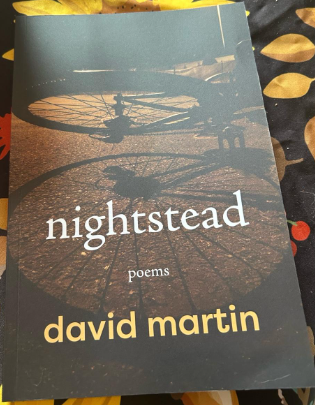
nightstead by David Martin, Palimpsest Press
In The English Elegy, Peter Sacks notes that the elegiac mode presents with a “dense matrix,” one composed of techniques such as “the use of repetition and refrain…reiterated questions” and tropes that evoke “the movement from grief to consolation.” David Martin’s nightstead is, both overtly and slantwise, a book-length elegy for his brother Ron, who died by suicide at 23. Martin, adept at formal and post-structural innovations in all his books, from the poly-vocalities of Tar Swan to the diction diminuendos of Limited Verse, draws further on his endless willingness to undertake the deep experiment, in this case, to chart the irrecoverable.
One of my favorite quotes about form in general comes from Richard Kenney who underscores that forms, “are not at root quaint cultural artifacts, they’re Darwinian solutions proposed by human neurology.” In grief, the poet can be given lingual passageways, forms as translations of loss, sigils of mourning. Martin, throughout Parts I and II, like a tickertape of pain on the base of the pages, runs a series of Joe Brainard-style “Do you remember” sentences (“do you remember listening to country music on the long drive home after the funeral?”… “do you remember standing next to me by a tree while waving a Canada flag?”) plumbing memories of his deceased brother, a highly effective emotional punctum that courses below and through the less emotive syntactical and rhyming pieces above. For the former, there are ee cummings-reminiscent wrenching apart of words as in “Mole”
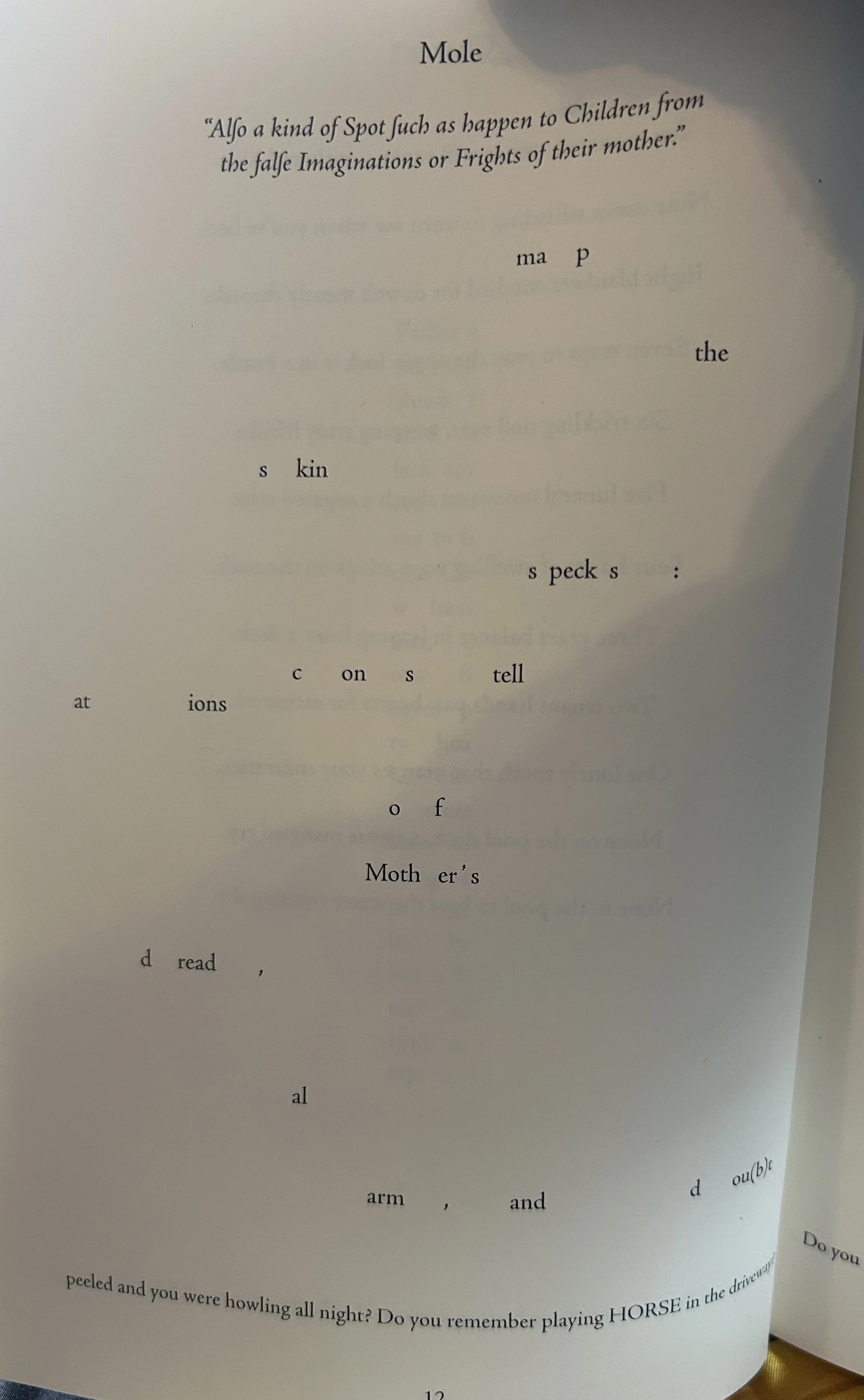
and for the latter, the archaic spell of a piece like “Charm” that unwinds a life numerically down to its repeated “none.”
Martin risks spaces, silences. The titular poem is only a raying-out of Anglo-Saxon compound words but the fusions, from “moonlawn” to “sleepwreck” amid a surfeit of blank page, allow all the absences to know attendance. He is also fiercely adept at traditional forms such as the triolet (All-Ages Show), the sonnet (Calgary Racing Pigeon Club for one), and other stanzaic structures (the period-less enjambments in the sestets of Case History, for instance). But even though more scattershot pieces like the visual river one (“flows south we sta/rt with rain at landing neopre/ne skin-layers and raft hefted o/ver the bar”) are less satisfying to read, they are essential in their contrapuntal context, echoing how grieving ruptures, then leaps to seeking excessive meaning, as in Martin’s concordance and definition pieces.
Part III, its core an 11-page accounting of the aftermath of Martin’s brother’s suicide, called “Here, after” is the centerpiece in nightstead. Martin states: “I had to wait a long time before I’d break/into the past,” this collection emerging many years post the loss, emphasizing the depth of processing that one often requires before raw grief can turn into the polished hauntings of art. “Here, after” contains sensorial imagery (the “cold wood” of the casket, the coffee and basket of muffins that seem “a miracle” following the hard early days of death’s tasks) but also the world’s quick indifferences, the “awkward space,” the “shame each year,” the tiny lies one tells in self-protectiveness. So moving and relatable.
Part IV feels like a bit of an anti-climax following this beautifully blunt tour-de-force of mourning but again, its pages of splintered homages to Simonides, the Greek elegist, who “fostered/arcana/of place” and Giordano Bruno, the Italian cosmologist whose heretical theories led to his execution, who “stitched a codex/of shadow” above random italicized objects (“bone trumpet found in the woods”) feel necessary as the mind must also detach itself from personal ghosts and enter the fragments of history.
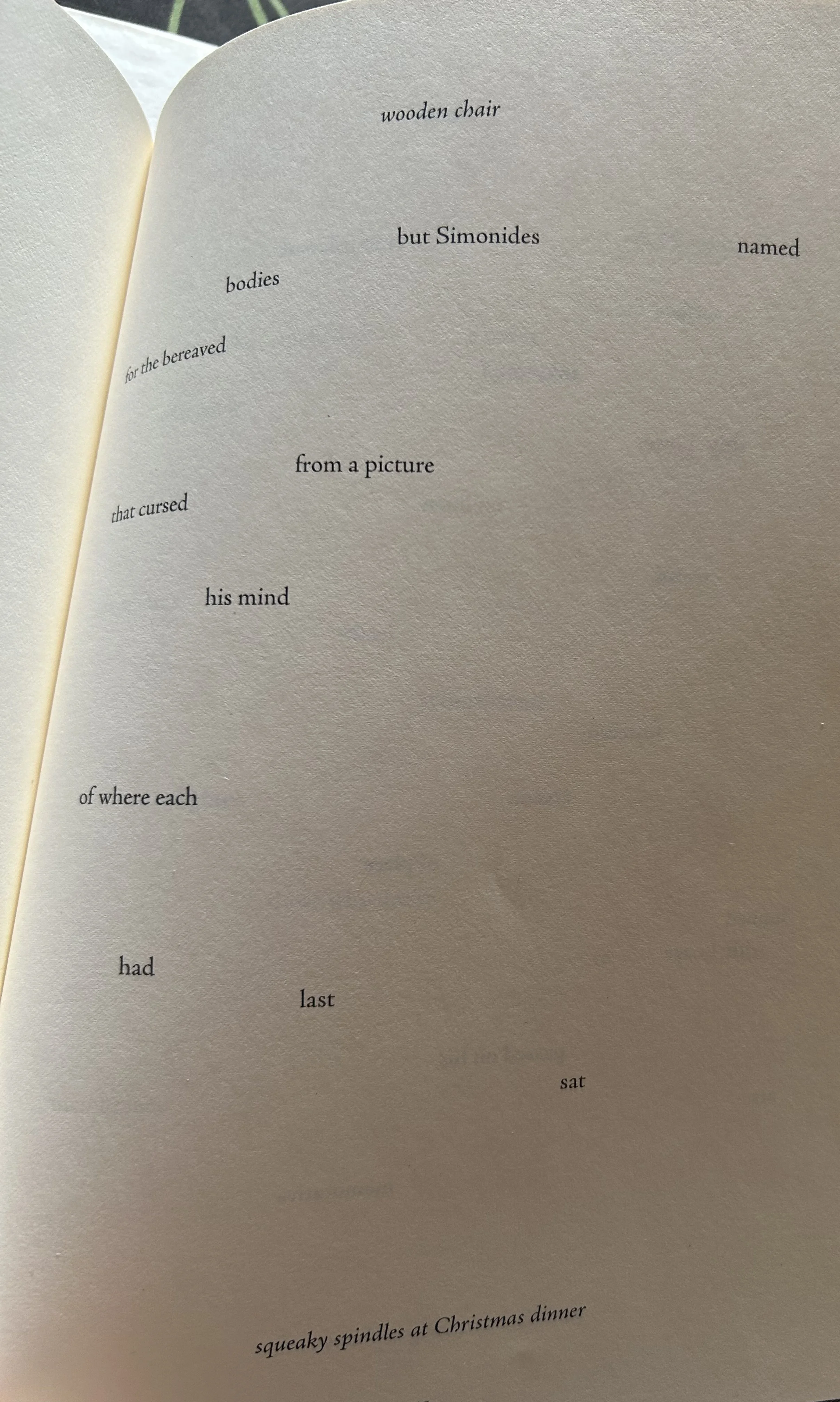
penultimate poem, a slim set of mostly couplets called “Mountain View” is close to an ideal closure as it contains a summation of grief’s rangings: visitations to memorials, realizations of transience, self solacings, as in the image of the geese who “dive heads/into pillows/of themselves.”
Annie Finch speaks of how a poet needs must find “the right form for the right occasion” but David Martin shows in nightstead that such lengthy mournings require as many ways of phrasing (and dismantling) the elegy as singing brings him.
About Catherine Owen:
In addition to being a thoughtful and incisive literary critic, Catherine Owen is a Vancouverite-Edmontonian and the author of seventeen collections of poetry and prose, the most recent Moving to Delilah (Freehand Books 2024), nominated for both the Al Purdy and Robert Kroetsch awards. She has been writing reviews for 15 years, hosted a poetry podcast for 2.5 years and has run performance series for over 25 years. Her next book is the hybrid-memoir 16 Homes due out from Wolsak & Wynn in Fall 2026.