
Viva
The bar is less interesting than she imagined it would be. Plain walls, adorned with only a few neon signs and mirrors, generic swag from breweries. No military stuff like her mother talked about. The only interesting feature is a sackcloth dummy standing heavily in the corner, its appearance brutalized as though knives have been used on it with alarming frequency.
She goes to sit at the stool closest to the register and kitchen, but Olsen motions her to the one adjacent. He looks perturbed but disappears before she can ask and reappears with a meal that smells like curried heaven. He makes her a Manhattan. Hard liquor isn’t her thing—booze in general isn’t her thing—but it’s remarkable how well its vermouth and whiskey pair with the curry.
— It’s an art, he says in response to her compliment.
After her meal, he puts a glass of water in front of her. Good instinct. The need to hydrate after the spirits, and to cool. Her
face flushes from the drink and the temperature in the bar, so she removes her hoodie and savours the air on her damp skin. She sips and looks around. There are two guys drinking in solitude at the far end of the bar and a couple enjoying a meal at the nearest table. Francis hasn’t reappeared. Avoidance? Or the normal rhythms of bar ownership? There are things to be said.
— I like your sleeve, Olsen says, pointing at the tattoo encasing her arm from wrist to shoulder.
— Thanks. Yours, too. Interesting pattern.
— Are yours unified or in pieces?
— Unified pieces, she says with a chuckle. Like a collage.
— Of?
— My adult life. What about yours?
— The same. Got a couple of decades on you.
He doesn’t elaborate further about his, a spindly mess of jagged lines climbing his thick forearms. She can’t place the pattern, but it’s an organized chaos. He places a few dirty glasses into the sink. He washes and dries them carefully, replacing each in its precise location, ranked on the glassware shelf behind him. His face is relaxed as he works.
— How long have you worked here? she asks.
— Forever. So what brings you to our lovely steeltown?
God, I hate small talk, she thinks.
— Some, uh, business I need to wrap up.
— I think you scared Francis away. Not surprised, though. I don’t think Fitz knows how lucky he is.
— I don’t understand.
— Your arms. They’re impressive. Strong. Lean. Not an ounce of wasted biology. And with your skin tone—
— What about it?
— Not light, not dark, like you could be from a thousand warm places.
— You sound like a racist trying not to sound racist.
— Just curious, is all, he says with a shrug. I’ve seen a few things. People are interesting.
— I think we need to stop this conversation.
— Why? I bet you talk about it.
— Jesus! You’re not shy, are you?
— Not even a little. You don’t have to answer.
— I know.
— I know you know.
Not an ounce of self-consciousness has entered his tone, even after calling him on the uncomfortable direction of the conversation. His eyes are calm, his features relaxed. His directness is easy to dislike and like. She wonders if that’s okay or not.
— Francis undersold how good your curry is. What’s your secret?
— Palm sugar and roasting the masala in ghee.
Francis finally appears from somewhere, slipping easily behind the bar. He scans the counter, the taps, the glasses. Satisfied.
— How’d you do that? he asks her.
— Do what?
— I’ve never heard Olsen share his ingredients with anyone.
— She told me about her ink, Olsen says. Didn’t hesitate. Least I could do.
— That so?
— Yep.
Olsen steps away and reappears a moment later with a meal for Francis. He lays it out on the bar: cutlery, curry, rice, cucumber salad, and even a white cloth napkin. He slides a wine glass from the rack and fills it with apple juice from the fridge, the glass immediately clouded with condensation. Interesting. She wants to ask about grown guys and juice but senses the wrongness of the moment. Nothing more gets said between the two men, Francis patiently waiting while Olsen gets the meal ready and giving a simple thumbs-up in thanks. He eats, closing his eyes at the first bite of curry and rice, and Olsen disappears into the kitchen bearing a low smile. She’s seen an entire history unfold in a few easy movements.
— So, he says, wiping his mouth with the napkin. Let’s talk about your mom.
— Right to it, eh?
— I hate small talk.
— Me, too. Mom’s dead.
The first time she’s said the actual words, but they come out easily. She watches his face. When you acknowledge a death, there’s an emotional expectation that shifts according to its proximity to the passing. Viva realized early that her way of dealing isn’t what people expect or depend on. Easy smiles at the few who made it to the visitation and the funeral, genuine gratitude to Mom’s friends for being there, a real sense of peace that there’s no more pain for her. Yet seeing their disappointment that she’s not visibly grieving, sadness not touching her tone or bearing, though it feels like a quarry has been blasted from her gut.
— So you said. How?
— Cancer, she replies. A couple weeks ago.
— Fuck. I’m sorry. Was it quick?
— No.
He winces and folds his arms, shakes his head. Still watching her, though.
— That’s it? she asks.
— What do you mean?
— I just told you that someone you know has died.
— Yeah. That sucks.
— That sucks?
More waiting. He shifts minutely.
— I’m sorry for your loss. Really, I am. And thanks for telling me. But I barely knew her.
— You were together.
— Once. It was fun, but—
— Haven’t you heard? Once is all it takes.
And there it is. Understanding creeps across his features so quickly it’s almost amusing. That connection between the strange woman showing up at your bar with the name of a one-time lover on her tongue and a specific history, one measured by missed milestones and birthdays. Perplexed by what to do with the knowledge she’s dropped into his hands, he frowns, loads his spoon, and chews, this time more slowly. A unique way of coping, one she finds distantly appealing. He swallows.
— Well, shit, he says. I did not wake up this morning expecting that.
— No one would.
— What kind of cancer was it?
— Does it matter?
— No. Yes. Medical details are my way of processing. Mother calls it my love language.
— It started in the liver then went all over.
— Cause?
She shakes her head. Francis falls silent again and takes a few more bites. Olsen comes out, sensing something heavy happening but too polite to ask. He busies himself by making a round of the customers to see if more drinks or food are needed. She sips her water. Olsen returns to fill it.
— Well, you can’t stay in your car, that’s for sure, Francis says. Let me help you unload.
— Hold on a moment. I’m not—
— Look, Viva, I have no fucking idea what to do with this, but I do know that if you are who you say you are, I can’t let you sleep in the parking lot.
— You’re not letting me do anything. I don’t need your help. That’s not why I came.
— Okay. Why did you come?
— I had to meet you.
— And . . .?
She pauses, nibbling her lower lip, the sensation comforting, as always. Sometimes to bleeding. Drove her mother crazy through Viva’s teen years. Viva’s ex-husband Aaron, too, fixated on the blood like he’d somehow get the blame. He lasted a few years then fucked off to Vancouver. No kids, thank God. And no divorce paperwork got filed, but the law’s clear about what atrophies after so much neglect.
— I don’t know, she admits with a sigh. Figured it would be clear when I found you.
— Not so much, then.
— No, not so much.
He stands and stretches, his face wincing from a different pain. Rubs his left ankle, mutters “Fucker!” like the joint deserves to be cursed. After a moment, he straightens and steps towards the door, obviously carrying through on his promise to unload the car. Not asking. There’s a brief instant while she waits, imagining the small pleasure of him finding the car with the door locked and her not there to let him help. But it passes quickly—you don’t punish someone whose instinct is to bring you in—and she follows him outside.
—Excerpt from The Peace Thieves (Thistledown Press, 2026) by Brent van Staalduinen. Copyright Brent van Staalduinen. Reprinted with permission.
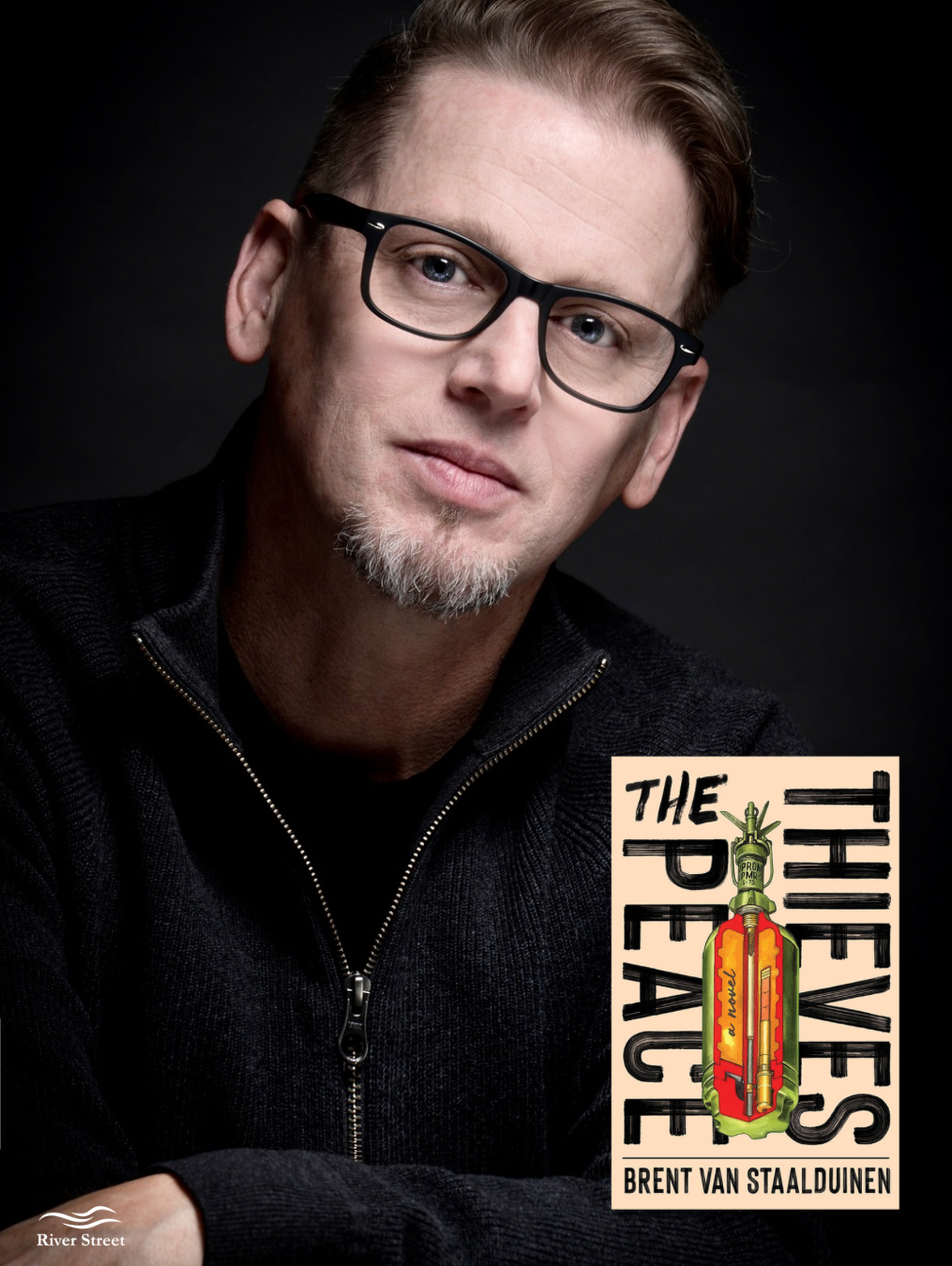
About The Peace Thieves (Thistledown Press, 2026):
This compelling and ambitious novel is about the search for peace during a civil war and through its long, complicated aftermath.
Thirty years after his tour as a peacekeeper in Croatia in 1993, Francis is getting by — though only just — but when Viva arrives in Hamilton searching for the father she never knew, Francis’ world tilts, upsetting the burden of his wartime memories. This powerful and compassionate novel alternates between the voices of Francis and Viva, delving into the secrets we hold, the hurts we try to hide, and the simple human connections that bind us.
In war-torn Croatia, Francis meets Lorina, a local woman whose father had just been killed in the conflict; he does his best to protect her in the face of overwhelming resistance and absurdity as he struggles to work alongside the impossibly difficult Master Corporal Mackey. Toward the end of his tour, Francis bears witness firsthand to the devastating aftermath of ethnic cleansing — and then, when a careless moment results in a life-altering injury, he is sent home.
Viva first encounters Francis serving breakfast to the homeless outside the bar he runs — where soldiers like him come to try to forget what they’ve seen and what they’ve done. The young woman is angry and resentful, spoiling for confrontation wherever she turns, but in time finds that Francis is not a villain, but someone she just might need to have in her life.
The Peace Thieves has the courage to ask tough questions about the true costs of war, not only to the citizens of the country where the conflict occurs, but to the people who attempt to help and protect them.
About the author:
Brent van Staalduinen is the award-winning and bestselling author of the novels Unthinkable, Nothing But Life, Boy, and Saints, Unexpected, and the story collection Cut Road. His stories have won numerous literary prizes and have appeared in journals and magazines on both sides of the Atlantic. A former army medic and recovering high school English teacher, he now lives in Hamilton, Ontario, Canada with his wife and two daughters, and when not writing or teaching writing to aspiring undergrads, he often finds himself looking for excuses to use his power tools or wandering city streets looking for stories. Find out more at www.brentvans.com.