
Power Q & A with Tom Halford
Q: How has The Trailer Park Boys influenced your writing?
A: I can remember the first time I saw an episode of The Trailer Park Boys. It's hard to explain how I felt. It was like the first time I drank coffee or went on a roller coaster. I was buzzing.
I was still pretty young, and I didn't think about anything other than how much the show made me laugh. Ricky, Julian, and Bubbles were saying and doing all of the things my friends and I were never allowed to say or do. They were swearing and drinking and committing crimes, and there weren’t any real consequences. Even when they were sent to jail, they seemed to enjoy the experience.
Today, when I rewatch certain episodes, there is a brilliance to the dialogue, the performances, and the plotting. Some of these episodes are as good as anything on television. However, when I first saw The Trailer Park Boys, I wasn’t fully aware of stereotypes about Atlantic Canada. Then I moved away from home, and I guess after that, I started to think about how the region is characterized by the rest of Canada. To put this unfair characterization into a short, painful list: the people are underemployed, uneducated, overly emotional, and prone to alcoholism. I started to worry about Ricky, Julian, and Bubbles. Maybe they presented the wrong image of the Atlantic provinces.
As I wrote Over the Lights and Over the Houses, I thought about The Trailer Park Boys constantly, and I wanted to focus on a character who was similar to Ricky in the sense that he’s always getting into trouble but with some key differences. My favourite aspect of The Trailer Park Boys when I was younger was how creatively some of the characters used swear words. To try to do something new, I put limitations on my own writing. Nick Kearney, the narrator of Over the Lights and Over the Houses is extremely uncomfortable with swearing, and he only drinks on special occasions. Although I wanted a character who would help me rework certain aspects of a show that is beloved by many, I still wanted Nick to be funny. I’m not writing to tell people how to think. I’m writing to make them laugh and—without sounding too grand—to encourage readers to feel curiosity and wonder about other human beings.
As I rewatch The Trailer Park Boys now, there is a central question that I think about. Does The Trailer Park Boys reinforce or satirize stereotypes? That is really to be answered by each viewer. For me, it’s an incredible satire. Nobody has to see things the way I do. The older I get I’m realizing that most people don’t. Whether Atlantic Canadians love the show or resent it, it’s hard to escape its influence. In writing Over the Lights and Over the Houses, I hope I captured aspects of the show that left me buzzing, but I also hope I put my own spin on it. Nick is employed at a power plant; although he’s not overly educated, his sister is; he’s often encouraged to be more emotional; and instead of the delightful sprinkling of curse words in The Trailer Park Boys, Nick is often dismayed by how frequently he hears the F-word. Here’s how Nick sees it:
At work, some of the guys swear way too much. They use it for every other word in their sentences. It’s all f this and f that. Some of them are like, “Hey f’er’s, how’s your f’ing day going? Holy F-word, this f’ing tomato and F-word sandwich is f’ing delicious.”
And I’m sitting there thinking, “Expand your freaking vocabulary already.”
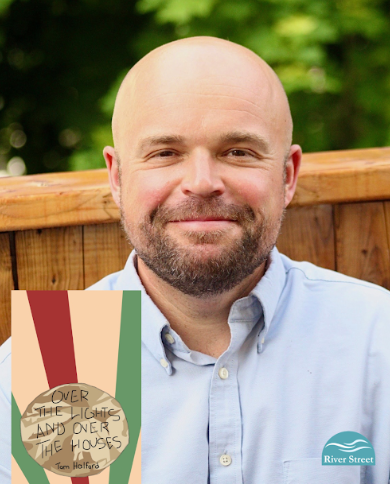
Tom Halford
At once experimental, dark, and playful, Tom Halford’s Over the Lights and Over the Houses will make you laugh until it hurts. Nick Kearney and his sister hardly ever speak. Before she moved away, they used to be inseparable. Trying to escape what feels like a prolonged rut, Nick decides to get on the road and surprise her with a visit. Traumatic figures from the past resurface, sending the siblings on a wild and antic adventure, ultimately leading them back to where everything started to go wrong. Readers are invited to indulge in down-home addictive wonders of Christmas magic while simultaneously entering a surreal literary landscape where anything is possible.
Tom Halford lives in Corner Brook, NL, with his wife, Melissa, and his kids, Violet and Douglas. He works as a scholar and teacher at Grenfell Campus, Memorial University of Newfoundland. In his spare time, he likes to coach and play soccer with his kids.