

BLOG

Power Q & A with Daniel Coleman
The 16th and 17th century encounters between Indigenous people in Turtle Island and merchant sailors coming from Europe constitutes the meeting of two very different ways of seeing and living in the world, two very different approaches to trade. The French, Dutch, and English who arrived at the mouths of rivers flowing into the Atlantic were the envoys of a new way of making wealth. These were not aristocrats who stood to inherit their fathers’ land and properties, they were sailors from Europe’s emerging merchant class who were looking for trade goods and resources—spices from Asia, minerals from “El Dorado,” manufactured items from China or India. They had recently developed the capacity to navigate across huge oceans, and they were learning that they could become independently wealthy by exploring the world’s coastlands and islands and bringing back objects they could sell at home.
Q: Your book, Grandfather of the Treaties: Finding our Future Through the Wampum Covenant (Wolsak & Wynn, 2025) is being hailed as an essential read for Canadians looking to understand our nation’s complicated history. What do the founding wampum agreements have to offer us today?
A: They can teach us a better understanding of trade at a time when trade wars are giving us lots of grief. The 16th and 17th century encounters between Indigenous people in Turtle Island and merchant sailors coming from Europe constitutes the meeting of two very different ways of seeing and living in the world, two very different approaches to trade. The French, Dutch, and English who arrived at the mouths of rivers flowing into the Atlantic were the envoys of a new way of making wealth. These were not aristocrats who stood to inherit their fathers’ land and properties, they were sailors from Europe’s emerging merchant class who were looking for trade goods and resources—spices from Asia, minerals from “El Dorado,” manufactured items from China or India. They had recently developed the capacity to navigate across huge oceans, and they were learning that they could become independently wealthy by exploring the world’s coastlands and islands and bringing back objects they could sell at home.
These new bourgeoisie met Haudenosaunee people on the Hudson River, who were also traders. But traders of a very different mindset. These inhabitants of Turtle Island understood “trade” as conducted between all the beings of the living world, not just between humans. So they were interested in the goods that the Dutch brought in their ships—copper kettles or iron knife blades—but they knew that the plants and animals and water systems all around them were influenced by trade, not just the people. Trade, to them, meant that whoever was involved, including non-humans, were part of the equation of exchange. Good trade meant exchanging what was necessary to the flourishing of the entire environment.
This is what makes the early wampum agreements that the Haudenosaunee made with the Dutch and then with the English so unique and so relevant for us today. When the Haudenosaunee diplomats explained that the Two Row Wampum (circa 1613) represented the Dutch trading ship and their own canoes as two vessels traveling down the river of life, they were emphasizing that the agreement made between the two vessels’ “culture, beliefs, and laws” must benefit not just the people in the vessels but also the river itself, which, after all is what kept everyone afloat (let alone hydrated). The Two Row Wampum which was renewed as the “Silver Covenant of Friendship” wampum agreement with the British (1674) is as much ecological philosophy as it is political philosophy. To make peaceful, healthy agreements between humans was not a separate undertaking from making agreements to secure the peace of the land, the earth, the watershed. “No one can claim Mother Earth,” the Haudenosaunee said when they were working out the Two Row agreement with the Dutch, “except the faces rising in the earth to be born.” Those “faces” were like seeds, the embryos of future plants, animals, or humans. The point is that the wampum agreements that shaped Dutch and then British relations with Indigenous North Americans understood that the eco (Gk: “home”) of “economy” is the same as the eco of “ecology.”
The Covenant Chain-Two Row Wampum agreements have been called the “Grandfather of the Treaties,” because the British learned these ground rules for treaty-and-trade-making from them, and they went on to make wampum covenants with First Nations all across northeastern Turtle Island. They then expanded from these to the written and numbered treaties, so these principles lie latent in our country’s constitutional DNA. We need to renew these understandings today. Our ancestors’ first agreements for how to live in this continent, how to share the river of life, were framed within these ground rules—because, in the end, ground rules.
So many of our legal arrangements have been twisted away from these early agreements. The extractive and exploitative understanding of trade, which disregards non-humans as participants in, let alone beneficiaries of, trade, has polluted and abused the river of life. The current battles over trade tariffs show how twisted our understanding has become. An obsessive focus on asserting sovereignty over dead objects (“resources”), distracts us from trade agreements aimed at benefitting the faces waiting in the ground to be born.

Grandfather of the Treaties: Finding our Future Through the Wampum Covenant by Daniel Coleman (Wolsak & Wynn, 2025)
More about Grandfather of the Treaties: Finding our Future Through the Wampum Covenant:
Grandfather of the Treaties shares Coleman’s extensive study of Haudenosaunee wampum agreements with European nations. It was written in close consultation with many Indigenous scholars and shows how we can chart a new future for everyone living in what we now call Canada—Indigenous, settler, more recent arrival—by tracing wampum’s long-employed, now-neglected past. The Covenant Chain-Two Row treaty tradition models how to develop good minds so that we can live peacefully together on the river of life that sustains us all. It is a philosophy, an ethical system, a way of learning to live as relatives with our human and more-than-human neighbours. This covenant has been called the “grandfather of the treaties,” and is also considered the grandmother of Canada’s Constitution.

Daniel Coleman
More about Daniel Coleman:
Daniel Coleman is a recently retired English professor who is grateful to live in the traditional territories of the Haudenosaunee and Anishinaabe in Hamilton, Ontario. He taught in the Department of English and Cultural Studies at McMaster University. He studies and writes about Canadian Literature, whiteness, the literatures of Indigeneity and diaspora, the cultural politics of reading, and wampum, the form of literacy-ceremony-communication-law that was invented in by the people who inhabited the Great Lakes-St. Lawrence-Hudson River Watershed before Europeans arrived on Turtle Island.
Daniel has long been fascinated by the poetic power of narrative arts to generate a sense of place and community, critical social engagement and mindfulness, and especially wonder. Although he has committed considerable effort to learning in and from the natural world, he is still a bookish person who loves the learning that is essential to writing. He has published numerous academic and creative non-fiction books as an author and as an editor. His books include Masculine Migrations (1998), The Scent of Eucalyptus (2003), White Civility (2006; winner of the Raymond Klibansky prize), In Bed With the Word (2009), and Yardwork: A Biography of an Urban Place (2017, shortlisted for the RBC Taylor Prize).

Power Q & A with Anthony Bidulka
We are beyond thrilled to be welcoming many time award-winning author, Anthony Bidulka to our blog to talk to us about his compulsively readable and utterly absorbing new mystery thriller, Home Fires Burn (Stonehouse Publishing, June 1, 2025). Anthony is a Canadian legend of the mystery thriller genre who writes from places and perspectives that you don’t often see represented on the page.
We are beyond thrilled to be welcoming many time award-winning author, Anthony Bidulka to our blog to talk to us about his compulsively readable and utterly absorbing new mystery thriller, Home Fires Burn (Stonehouse Publishing, June 1, 2025). Anthony is a Canadian legend of the mystery thriller genre who writes from places and perspectives that you don’t often see represented on the page.
Welcome Anthony to our Power Q & A to tell us about his new book!

Home Fires Burn by Anthony Bidulka, published by Stonehouse Publishing.
Q: When so many mystery novels are set in global metropolis, tell us about the importance to you as an author of setting your book in a smaller city in Saskatchewan.
A: Even as a young boy growing up on a small family farm in rural Saskatchewan I knew I wanted to write. And I had a lot of ideas. What I didn't have was an answer to the question: Why do I write? In my case it took decades to come up with the concise answer I have today. My WHY is this: I write to tell stories about underrepresented people and underrepresented places in a way that is accessible and entertaining.
Part of the reason for this is that growing up and even as a young adult, I rarely saw myself or my place or my community reflected in mainstream fiction. But when I did, it was mind-blowing, and felt important. Representation is important. As I came to define what was important to me as a writer this was top of mind.
From a purely practical side of things, finding a way to distinguish yourself in a very competitive industry is not a bad thing. With my first series I was able to factually claim that my protagonist, Russell Quant, was the first and only wine-swilling, wise-cracking, world-travelling, ex-cop, ex-farm boy, gay, rookie Canadian prairie private eye. With my current trilogy, I can describe my heroine Merry Bell as the first and only kick-butt, Canadian prairie, transgender P.I. To be able to do so sets me apart as a writer, is pretty cool, and serves my WHY perfectly.
ABOUT HOME FIRES BURN:
From the author of Crime Writers of Canada Best Crime Novel, Going to Beautiful, comes the final, standalone book of the Merry Bell trilogy. A celebrated philanthropist is found slumped against his car, frozen to death. Trans private investigator Merry Bell is hired by his son, country music star Evan Whatley, to find out the truth behind what really happened on that desolate stretch of road. As Merry’s investigation uncovers old wounds that never healed, her own are revealed as she confronts her pre-transition past and questions the boundaries of family and friendship.

About Anthony Bidulka:
Anthony Bidulka’s books have been shortlisted for Crime Writers of Canada Awards of Excellence, Saskatchewan Book Awards, a ReLit award, and Lambda Literary Awards. Flight of Aquavit was awarded the Lambda Literary Award for Best Men’s Mystery, making Bidulka the first Canadian to win in that category. In 2023, in addition to being shortlisted for a Saskatchewan Book Award and Alberta Book Publishing Award, Going to Beautiful won an Independent Publisher Book Award being named Gold Medalist as the 2023 Canada West Best Overall Fiction novel and was awarded the Crime Writers of Canada Award of Excellence as Canada’s Best Crime Novel for 2023.

Power Q & A with Caroline Topperman
Caroline Topperman’s memoir is not only highly anticipated but powerfully titled. Your Roots Cast a Shadow: One Family's Search Across History for Belonging (HCI, December 17, 2024), arises from Caroline’s 2013 move from Vancouver to her family’s homeland, Poland, and encourages readers to examine the ways in which family histories shape our understanding of ourselves and society.
Caroline Topperman’s memoir is not only highly anticipated but powerfully titled. Your Roots Cast a Shadow: One Family's Search Across History for Belonging (HCI, December 17, 2024), arises from Caroline’s 2013 move from Vancouver to her family’s homeland, Poland, and encourages readers to examine the ways in which family histories shape our understanding of ourselves and society.
We’re honoured to have Caroline join us today to speak to why she decided to share her family history with readers from around the world. Welcome, Caroline!

Your Roots Cast a Shadow: One Family's Search Across History for Belonging by Caroline Topperman (published by HCI).
Q: Sharing family stories can be fraught with tension and uncertainty. What made you decide to write this book—and share these stories—now?
A: In 2015 (when I started writing this book) Poland was very different than it is now, and frankly much of what I saw scared me. It was an eye-opening experience to participate in a Pride parade and have rows of police officers decked out in tactical gear on either side of our float. I was shocked each time I saw neo-Nazis and fascists and ultra-Nationalists marching through the streets. I participated in counter-marches; I signed petitions and it became more and more obvious that history is easily forgotten. I decided that I couldn’t stay silent.
More about Your Roots Cast a Shadow: One Family's Search Across History for Belonging:
Your Roots Cast a Shadow: One Family's Search Across History for Belonging is a gripping and powerful narrative of cultural translation, identity, and belonging. The thrill of a new place fades quickly for Caroline Topperman when she moves from Vancouver to Poland in 2013. As she delves into her family’s history, tracing their migration through pre-WWII Poland, Afghanistan, Soviet Russia and beyond, she discovers the layers of their complex experiences mirror some of what she felt as she adapted to life in a new country. How does one balance honouring both one’s origins and new surroundings?

Author Caroline Topperman.
More about Caroline Topperman:
Caroline Topperman is a European-Canadian writer, entrepreneur, and world traveller. Born in Sweden, raised in Canada with a recent stint of living in Poland, she holds a BFA in screenwriting. She is a co-founder of Mountain Ash Press and KW Writers Alliance, and currently runs Migrations Review, and Write, They Said. Her book, Tell Me What You See, serves as a toolkit for her writing workshops. She has written articles for Huffington Post Canada, Jane Friedman’s blog, was the Beauty Editor for British MODE Magazine, and served as managing editor for NonBinary Review. Her hybrid memoir, Your Roots Cast a Shadow, explores explosive intergenerational histories that link war zones and foreign shores with questions of identity and belonging. Her next book, The Road to Tang-e Gharu, integrates Afghan folktales and family memories with the story of one of the greatest roads ever built.

Power Q & A with Jeff Dupuis
It’s Power Q & A time, and we are delighted to welcome author Jeffery Dupuis to our series to talk about his thrilling Creature X series (published by Dundurn Press). This trilogy follows Laura Reagan and her team as they travel the world in search of mysterious creatures unknown to science and find murder and intrigue. After reading the first book in the series, we wanted to know more about how Jeff created this cryptozoological adventure, which (let’s face it), must have involved a fair number of weird discoveries.
It’s Power Q & A time, and we are delighted to welcome author Jeff Dupuis to our series to talk about his thrilling Creature X series (published by Dundurn Press). This trilogy follows Laura Reagan and her team as they travel the world in search of mysterious creatures unknown to science and find murder and intrigue. After reading the first book in the series, we wanted to know more about how Jeff created this cryptozoological adventure, which (let’s face it), must have involved a fair number of weird discoveries.
Welcome, Jeff!

Roanake Ridge, the first book in the Creature X series.
Q: What is the strangest thing you uncovered while researching your Creature X series?
A: In the world of tall, ape-like creatures, giant eels, and bioluminescent pterosaurs that feed on the unburied dead, it’s a real challenge to say what is the “strangest” thing I uncovered while researching the Creature X series. A stand-out is an incident known in cryptozoological circles as “The Battle of Ape Canyon.”
In the summer of 1924, Fred Beck and four other gold prospectors had been working their claim just east of Mount St. Helens. This was decades before any large footprints were found and the name “Bigfoot” was coined. While collecting water from a nearby spring, Beck and one of the other prospectors came across a 7-foot-tall ape-like creature and shot at it. They returned to their cabin, telling the other prospectors their story. They decided to pack up and leave the next morning.
That night, a group of these creatures attacked the cabin, pelting it with large rocks, banging on the door and climbing on the roof. The prospectors fired their rifles through gaps in the walls, through the door and the roof to drive the creatures away. Once the sun came up, the men took only what they could carry and fled the site, leaving their equipment. Beck claims to have shot one of these creatures as they were fleeing, watching its body drop into a nearby canyon. That area has since been known as “Ape Canyon,” which you can find on Google Maps.
Beck later claimed that these creatures were entities from another dimension, which is not an uncommon school of thought in the Bigfooter community. Some people believe that the creature is “extradimensional,” able to move between our world and another. There’s a substantial amount of overlap between those who think Bigfoot can travel across dimensions and those who think it can read minds and communicate telepathically. There really are as many variations of Bigfoot encounters as there have been encounters. No two are alike, but some are definitely stranger than others.

More about Jeff:
J.J. Dupuis is the author of the Creature X Mystery series. When not in front of a computer, he can be found haunting the river valleys of Toronto, where he lives and works.

Power Q & A with Margaret Nowaczyk
Today’s Power Q & A features best-selling Polish-Canadian author and pediatric clinical geneticist Dr. Margaret Nowaczyk. Dr. Nowaczyk’s most recent book, Marrow Memory: Essays of Discovery invites readers to examine her DNA under a microscope, sharing her vast life experiences in a series of invariably absorbing and beautifully-crafted personal essays. From growing up in Communist Poland, to immigrating to Canada as a teen, to working as a pediatric clinical geneticist and professor at McMaster University, Nowaczyk bares her soul while encouraging readers to explore the ways in which our experiences and identities are entangled with our ancestral history.
Today’s Power Q & A features best-selling Polish-Canadian author and pediatric clinical geneticist Dr. Margaret Nowaczyk. Dr. Nowaczyk’s most recent book, Marrow Memory: Essays of Discovery invites readers to examine her DNA under a microscope, sharing her vast life experiences in a series of invariably absorbing and beautifully-crafted personal essays. From growing up in Communist Poland, to immigrating to Canada as a teen, to working as a pediatric clinical geneticist and professor at McMaster University, Nowaczyk bares her soul while encouraging readers to explore the ways in which our experiences and identities are entangled with our ancestral history.
We’re honoured to have Dr. Nowaczyk join us for this short and sweet interview series.
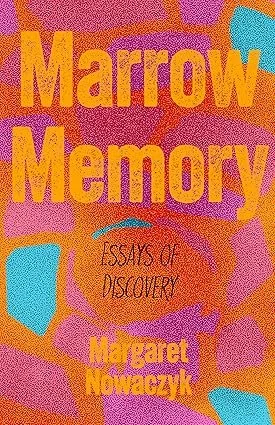
Bring home Marrow Memory: Essays of Discovery (Wolsak & Wynn, 2024).
Q: You’re an advocate of narrative medicine. Would you explain what that is and how—if at all—it shaped your writing of this collection of essays?
A: Narrative medicine trains physicians to be better listeners and diagnosticians. Narrative medicine is not a therapeutic modality; it is not narrative-based therapy with which it is sometimes confused. After training in narrative medicine, by paying close attention to the patient’s story, the text of the patient, so to speak, doctors are better able to determine the cause of illness and the optimal approach to therapy. In addition, narrative medicine has been shown to increase empathy and to prevent physician burnout.
How does that training happen? Narrative medicine recommends close reading of literary texts, writing about patient encounters in non-medical language, and reflective and creative writing. In the essay “Reading Dostoevsky in New York City” in “Marrow Memory”, my collection of essays, I describe the process of close reading; in my memoir “Chasing Zebras”, I wrote how attending a narrative medicine workshop opened my eyes to the power and potential of writing and sharing my stories. Both experiences were paradigm-shifting for me. I have always been an avid reader, but it is the attention paid during the process of close reading that trains one to notice nuances in patient’s behavior, the gaps in her story, the tell-tale signs of illness and distress. By paying attention to those subtle signs, a physician is better able to attend to the patient’s needs, both in terms of diagnosing her condition and of treating it. Writing about a patient encounter in non-medical language (done in what is called “parallel chart”), after the heat and stress of often too-brief a patient encounter, allows the physician to identify the many preconceptions and biases that medical language frequently hides. It is then that the writer has the luxury of time and reflection to do so. This practice fosters empathy. And creative writing, the final pillar of narrative medicine training? It allowed me to express my deepest fears, explore my darkest obsessions, and pay attention to my well-being in the safety of the ever so patient blank page.
Simply, without training in narrative medicine, I would not have become a writer. There would have been no stories, no essays, and no memoir.

MARGARET NOWACZYK (photo credit: Melanie Gordon)
More about Margaret Nowaczyk:
Margaret Nowaczyk was born in Poland in 1964 and emigrated to Canada with her family in 1981, having spent six months as a stateless person in Austria. She finished high school in Toronto in 1982. After receiving a B.Sc. in biochemistry in 1985, she graduated with honours from the University of Toronto Faculty of Medicine in 1990. For six years, she trained in pediatrics and genetics at the Hospital for Sick Children in Toronto, with elective training at Boston Children's Hospital in pediatric neurology and at Hôpital Enfants Malades in Paris, in inborn errors of metabolism. In 1997, she was offered a university faculty position as a clinical geneticist at McMaster Children’s Hospital. Since then, she has been caring for children with genetic disorders and providing prenatal diagnosis and genetic counselling for adults. She has authored 120 peer-reviewed papers in genetic journals, and rose to the rank of professor in 2014. She is a great advocate of the narrative approach to medical care. Her short stories and essays have appeared in Canadian, Polish and American literary magazines and anthologies. She lives in Hamilton, ON, with her husband and two sons.