

BLOG

Behind the Books with Noelle Allen
When I purchased the press and moved it to Hamilton, we continued going our own way, as the steel city was not seen at that time as a place for the arts. But we found a thriving literary and arts community here and we’ve grown much since then. I believe this ability to see potential where many companies might shy away is what sets us apart. Whether it’s a dedication to poets, seeing the beauty in a post-industrial city, encouraging our authors to blur literary genres and making space for new voices, we find books that change how people think about literature in Canada.
Behind the Books is a River Street interview series celebrating the hard-working visionaries creating the magic of small press CanLit. We are honoured to have Noelle Allen join us for our first installment!
Noelle is the publisher of Hamilton’s powerhouse small press, Wolsak & Wynn and the recent winner of the 2024 Arts Champion Award. She is the organizer for Sharp Words: Hamilton’s Winter Book Fair and works with Supercrawl to program the author talks. She is also the past chair of gritLIT and has long contributed to the literary community.
Welcome Noelle!

Wolsak & Wynn Publisher, Noelle Allen. Photo credit: Banko Creative.
1. Tell us about Wolsak & Wynn. What makes your press singular?
Wolsak and Wynn is a small literary press based in Hamilton that publishes a rich range of books. We’ve always gone a bit against the grain. When Marja Jacobs and Heather Cadsby started the press in 1982 it was dedicated to poetry and only published poetry for the first twenty years. As poets themselves Marja and Heather felt that authors they knew and admired were being overlooked by the current publishers. They decided that they would start a press and do something about that. When they had the press incorporated the lawyer also added stationary publishing to their papers, in case they decided they wanted to make money at some point. But they never wavered from poetry.
When I purchased the press and moved it to Hamilton, we continued going our own way, as the steel city was not seen at that time as a place for the arts. But we found a thriving literary and arts community here and we’ve grown much since then. I believe this ability to see potential where many companies might shy away is what sets us apart. Whether it’s a dedication to poets, seeing the beauty in a post-industrial city, encouraging our authors to blur literary genres and making space for new voices, we find books that change how people think about literature in Canada.

2. What’s one misconception people have about small press publishing?
That our books aren’t as good as something published by a multinational because they don’t sell as many copies. There are fabulous, innovative books being published by small presses across Canada, which I think are often better than much of what comes from those presses. What we lack is the heft of those enormous marketing departments. If I had as much money to spend on marketing as Penguin Random House does, our books would top every bestseller list.
3. Share a proud moment in your career as a small press publisher.
Why don’t I share two. The first was watching an author who has long been with the press, Richard Harrison, be awarded a Governor General’s Award for Poetry. I had attended a few of those ceremonies in other roles in the industry, and I had been struck by the power of seeing publishers I knew introduce their authors and then watching the authors be awarded those prizes. This was one of the earlier titles edited by our senior editor, Paul Vermeersch, after he had joined the press and it was lovely to be in Ottawa as this new version of Wolsak and Wynn, with a new publisher and new editor, was recognized in this way.
The second one is a bit more humorous. I was walking down my street in Hamilton one day, when one of my neighbours stopped me to tell me about this book she’d just read. She was sure I’d really enjoy it. She couldn’t quite remember the name, but it was by a local writer, something like Garden Work and it was put out by a publishing company in Westdale, just across the city. After a few questions I realized she was talking about Daniel Coleman’s Yardwork, which I had acquired and edited and which the press had released that spring. That’s when I knew our Hamilton books were really resonating with the community, even if the readers didn’t quite know where the books came from yet.

Yardwork: A Biography of an Urban Place by Daniel Coleman, published by Wolsak & Wynn, 2017.
More about Yardwork: A Biography of an Urban Place:
How can you truly belong to a place? What does being at home mean in a society that has always celebrated the search for greener pastures? And can a newcomer ever acquire the deep understanding of the land that comes from being part of a culture that has lived there for centuries?
When Daniel Coleman came to Hamilton to take a position at McMaster University, he began to ask himself these kinds of questions, and Yardwork: A Biography of an Urban Place is his answer. In this exploration of his garden – which Coleman deftly situates in the complicated history of Cootes Paradise, off of Hamilton Harbour – the author pays close attention to his small plot of land sheltered by the Niagara Escarpment. Coleman chronicles enchanting omnivorous deer, the secret life of water and the ongoing tension between human needs and the environment. These, along with his careful attention to the perspectives and history of the Six Nations, create a beguiling portrait of a beloved space.

Power Q & A with Margaret Nowaczyk
Today’s Power Q & A features best-selling Polish-Canadian author and pediatric clinical geneticist Dr. Margaret Nowaczyk. Dr. Nowaczyk’s most recent book, Marrow Memory: Essays of Discovery invites readers to examine her DNA under a microscope, sharing her vast life experiences in a series of invariably absorbing and beautifully-crafted personal essays. From growing up in Communist Poland, to immigrating to Canada as a teen, to working as a pediatric clinical geneticist and professor at McMaster University, Nowaczyk bares her soul while encouraging readers to explore the ways in which our experiences and identities are entangled with our ancestral history.
Today’s Power Q & A features best-selling Polish-Canadian author and pediatric clinical geneticist Dr. Margaret Nowaczyk. Dr. Nowaczyk’s most recent book, Marrow Memory: Essays of Discovery invites readers to examine her DNA under a microscope, sharing her vast life experiences in a series of invariably absorbing and beautifully-crafted personal essays. From growing up in Communist Poland, to immigrating to Canada as a teen, to working as a pediatric clinical geneticist and professor at McMaster University, Nowaczyk bares her soul while encouraging readers to explore the ways in which our experiences and identities are entangled with our ancestral history.
We’re honoured to have Dr. Nowaczyk join us for this short and sweet interview series.
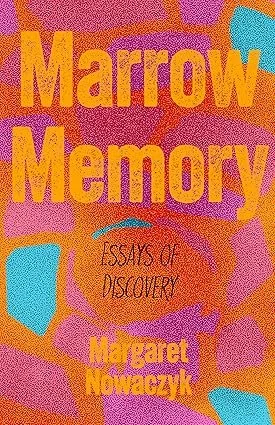
Bring home Marrow Memory: Essays of Discovery (Wolsak & Wynn, 2024).
Q: You’re an advocate of narrative medicine. Would you explain what that is and how—if at all—it shaped your writing of this collection of essays?
A: Narrative medicine trains physicians to be better listeners and diagnosticians. Narrative medicine is not a therapeutic modality; it is not narrative-based therapy with which it is sometimes confused. After training in narrative medicine, by paying close attention to the patient’s story, the text of the patient, so to speak, doctors are better able to determine the cause of illness and the optimal approach to therapy. In addition, narrative medicine has been shown to increase empathy and to prevent physician burnout.
How does that training happen? Narrative medicine recommends close reading of literary texts, writing about patient encounters in non-medical language, and reflective and creative writing. In the essay “Reading Dostoevsky in New York City” in “Marrow Memory”, my collection of essays, I describe the process of close reading; in my memoir “Chasing Zebras”, I wrote how attending a narrative medicine workshop opened my eyes to the power and potential of writing and sharing my stories. Both experiences were paradigm-shifting for me. I have always been an avid reader, but it is the attention paid during the process of close reading that trains one to notice nuances in patient’s behavior, the gaps in her story, the tell-tale signs of illness and distress. By paying attention to those subtle signs, a physician is better able to attend to the patient’s needs, both in terms of diagnosing her condition and of treating it. Writing about a patient encounter in non-medical language (done in what is called “parallel chart”), after the heat and stress of often too-brief a patient encounter, allows the physician to identify the many preconceptions and biases that medical language frequently hides. It is then that the writer has the luxury of time and reflection to do so. This practice fosters empathy. And creative writing, the final pillar of narrative medicine training? It allowed me to express my deepest fears, explore my darkest obsessions, and pay attention to my well-being in the safety of the ever so patient blank page.
Simply, without training in narrative medicine, I would not have become a writer. There would have been no stories, no essays, and no memoir.

MARGARET NOWACZYK (photo credit: Melanie Gordon)
More about Margaret Nowaczyk:
Margaret Nowaczyk was born in Poland in 1964 and emigrated to Canada with her family in 1981, having spent six months as a stateless person in Austria. She finished high school in Toronto in 1982. After receiving a B.Sc. in biochemistry in 1985, she graduated with honours from the University of Toronto Faculty of Medicine in 1990. For six years, she trained in pediatrics and genetics at the Hospital for Sick Children in Toronto, with elective training at Boston Children's Hospital in pediatric neurology and at Hôpital Enfants Malades in Paris, in inborn errors of metabolism. In 1997, she was offered a university faculty position as a clinical geneticist at McMaster Children’s Hospital. Since then, she has been caring for children with genetic disorders and providing prenatal diagnosis and genetic counselling for adults. She has authored 120 peer-reviewed papers in genetic journals, and rose to the rank of professor in 2014. She is a great advocate of the narrative approach to medical care. Her short stories and essays have appeared in Canadian, Polish and American literary magazines and anthologies. She lives in Hamilton, ON, with her husband and two sons.

Power Q & A with Maria Zuppardi
Maria Zuppardi, host of the Publisher’s Weekly recommended podcast, Get (Can)Lit, joins us today to talk about one of our favourite bookish topics ever: small press CanLit. Her answer to our question about reading books from small presses astounds and reminds us of why we started reading in the first place: to lose a bit of ourselves, and find a bit we never knew existed.
Maria Zuppardi, host of the Publisher’s Weekly recommended podcast, Get (Can)Lit, joins us today to talk about one of our favourite bookish topics ever: small press CanLit. Her answer to our question about reading books from small presses astounds and reminds us of why we started reading in the first place: to lose a bit of ourselves, and find a bit we never knew existed.
Welcome, Maria!

Get (Can)Lit—listen now!
Q: You’re obviously a voracious reader and one who vehemently supports small press CanLit. What would you tell someone who only reads—or reads predominantly—books by multinationals, to get them into reading more books by indie presses?
A: I have so many thoughts on this, what a topic to discuss! For those who read books that get all the social media hype, or the best placement in bookstores, congratulations, because you just fell for some great marketing plan that’s been in action for literally months. No shade though, because I’ll be honest, I totally fall for those blockbuster reads as well. I can’t deny reading a book I’ve seen a million times! But that’s what drives Big 5 publishing today - thousands of dollars (perhaps even hundreds of thousands?) being poured into printing ARCs, mailing costs, paid advertising geared towards librarians and booksellers, NetGalley costs and ads, conference fees, author travel….all to make sure that one of the books you read is THEIR book. By the time the book gets published, it’s all we see until the next big thing releases, and it’s up to us consumers to make up the financial hole this book is in, and help balance out those accounting reports for the publishers, or not.
It’s easy to walk into a bookstore or library and pick up the first thing we see because it’s on a table or other display, or on sale for that matter. But you know what? If you take your time and get lost in those bookshelves, you’re guaranteed to find a hidden gem, and it might not even be a book you’ve ever heard about! If you want to be a little more conscious of the types of books you read, here are my best tips:
Do a little bit of research. Simply googling “Toronto authors” or whatever province you live in will yield results, which will ultimately land you on an independent publishers list. We’re known for championing local authors before they’re snatched up by the Big 5!
Find out who your independent presses are. Again, a simple Google search that you can tailor to your needs. Canada has so many different types of publishers who specialize in unique books like travel, poetry, nonfiction, or again, specifically local authors.
Ask your local bookstore. Booksellers at indie bookstores are THE BEST. They know anything and everything about what you need even before you know you should read it. They have to be magical beings of some sort, I swear! Indie bookstores always keep indie presses in stock, and they are huge supporters for local indie authors. If you don’t have a local bookstore near you, you can always send them an email or see what types of books are on their social media, and find some new reads through there.
Scope out literary festivals. Even if you can’t attend, there’s always a great mix of Big 5 and indie press authors. See who’s on what panel, find out who published what and pick up that book that interests you. Just don’t regret not going to see the author talk about their book live when you had the chance!
At the end of the day, making slight behaviour changes to how you shop in bookstores or search for books online will go a long way. Authors from independent publishers face a unique set of challenges in the industry, and their books deserve to be read as much as anyone else. Especially for BIPOC authors. It’s so tough at the Big 5, let alone at an indie. But I promise you, #DiverseCanLit from Canadian publishers is literally superior to anything else that comes out internationally. Give it a try, agree with me, and keep buying those books from independent publishers! And when you find that little press you love, champion them on your own social media, share their books with others. You’ll have a very appreciative author, and press, behind you!

More about Maria:
Maria Zuppardi is an avid reader, book lover, and coffee drinker in Toronto. You can find her talking about all books at @readingmaria, and also talking about Canadian authors on the Get (Can)Lit Podcast available on your favourite platform.