

BLOG

Birdology II: Excerpt from Birdology by Carolyne Van Der Meer
On our way to run errands, we passed a parked car and heard
splashing. A look down revealed a host of house sparrows
bathing themselves in a convenient puddle—an unexpected
beginning to a warm fall morning.
Birdology II
On our way to run errands, we passed a parked car and heard
splashing. A look down revealed a host of house sparrows
bathing themselves in a convenient puddle—an unexpected
beginning to a warm fall morning.
Sometimes we don’t know what awaits us. How suddenly, on a
random day of puddle splashing, there is also a feeling of
bereftness that cannot be contained. A highway pile-up of grief.
When I woke up one morning to find the family dog—my dog—
had been given to a farmer, no goodbyes. The young man who
got electrocuted in our backyard after his hedge cutters hit the
arc of a high-voltage line. My father’s skeletal face as he moved
towards death, unconscious in a palliative ward. How my mother
-in-law lost her speech after dementia took its final hold. And
now, how my father-in-law is a prisoner in his hospital bed,
awaiting diagnosis as death’s beacon is bright. And as my
mother gives in and says a care home is the only next step—a
place of antiseptic loneliness, its dotted line the one I sign on.
I am overcome by the anchor of loss, rooted somewhere in my
pelvis, my body wracked with a melancholy for what I cannot
change, for what is normal, for what is the cycle of life. I am not
unique, this is not unique. As my father-in-law said today, we all
begin and end in the same way: it is the middle that makes a life.
And the wisdom of a faraway Dutch cousin: live slow, for we will
all get there eventually.
There was nothing weighing down the sparrows in their puddle,
no sadness that I could discern. They flapped their wings,
flicking the water off their little bodies. And dove in again.
Excerpt from Birdology published by Cactus Press, copyright © 2025 by Carolyne Van Der Meer.

Birdology (Cactus Press, May 2025) by Carolyne Van Der Meer is a tender collection of poems and essays moves through what she calls the “spell of grief,” accompanied by flocks of gulls, house sparrows and rock pigeons. I’d love for you to consider this chapbook for review.
Birdology is an exploration of loss of memory, of autonomy—and ultimately of the loved ones themselves. Against a backdrop of urban and natural environments filled with everyday birds, she considers how our relationships with our parents evolve as they age, need us more—and eventually leave us. Through a quintet of flash essays and a handful of poems, Van Der Meer gently dissects the layers of emotion in grief with the delicacy of a feather.

About Carolyne Van Der Meer:
Carolyne Van Der Meer is a Montreal journalist, public relations professional and university lecturer. Her articles, essays, short stories and poems have been published internationally. Her five published books are: Motherlode: A Mosaic of Dutch Wartime Experience (WLUP, 2014); Journeywoman (Inanna, 2017); Heart of Goodness: The Life of Marguerite Bourgeoys in 30 Poems | Du Coeur à l’âme : La vie de Marguerite Bourgeoys en 30 poèmes (Guernica Editions, 2020); Sensorial (Inanna, 2022) and All This As I Stand By (Ekstasis Editions, 2024). Chapbook publications include One Week’s Worth but a Lifetime More (Local Gems Press, 2022) and Broken Pieces: Hospital Experiences (2023); Birdology is forthcoming from Cactus Press in May 2025.

Excerpt from Iris and the Dead by Miranda Schreiber (Book*Hug Press, 2025)
I wrote a story for you in a journal and it vanished. Yes, van- ished. The journal itself disappeared. Where do such missing things go?
In the story I laid down all the things I wanted you to understand. I wanted to write it because, in the years since we lay in the yellow grass, I have come to some knowledge. I cannot recall the contents of the story in full. Because of its loss, I sobbed and felt like the victim of a cruel and unusual fate.
I wrote a story for you in a journal and it vanished. Yes, van- ished. The journal itself disappeared. Where do such missing things go?
In the story I laid down all the things I wanted you to understand. I wanted to write it because, in the years since we lay in the yellow grass, I have come to some knowledge. I cannot recall the contents of the story in full. Because of its loss, I sobbed and felt like the victim of a cruel and unusual fate.
Do you think you can write it again, said my mother when I told her.
In some ways, I said. I mean, only in part.
But the heart of the story is gone and I no longer own it.
Still, my need to speak with you seems to have no end. As I wanted to tell you, in every possible universe, when presented with what you offered me, I take it.
May I begin again?
Part I: Sickness
On My Rights as the Author
What do you remember of me? Is it difficult to make out? I know your mind, which doesn’t take much interest in the past, has possibly let me rot for years. Lacking attention, per- haps the sounds we heard together have shrunk and become difficult to name. The colours you associated with me, mixed together now, present a peculiar new hue. Maybe a bronze, made up of grey lake water and the sun.
Some of my memories of you have been darkened by the things I’ve heard and seen in the time since we knew one another. Seeing pictures of you online almost removes you more from me; an image of you in red light by the water seems to have nothing to do with you. It is only occasionally that something comes up in front of me—in that hard way vir- tual things do, so that the rest of the world recedes—and I’m flooded with feeling. For you, I know these memories might have died. For me, they keep. For you, have they simply been discarded? And if they have, to where? What I want to know is, where are the things that have vanished?
For me, very few things end. I can revisit funny memories and put a different name on them. The uncanny ones I’ve wanted to speak with you about. I am sick to death of being dazzled, of lacking the words. We did not have a love affair.
As I said, I have a story to tell you: a better one than I ever could have come up with at the time I knew you. In many ways, I am teeming with knowledge about what was hap- pening during the time we spent together, and beyond. But I should admit I’m not just trying to pass on the knowledge
I’ve come to. I also have questions to ask you. Even as I write with vital information I’m bewildered. But the answers I need may be in that place where the vanished objects go, because I am unsure that even you have them.
On the Beginning
When I was twelve I lost my mind.
The phrase doesn’t bother me. I think it’s correct. I lost my mind as accidentally as I lost pencils and five-dollar bills. Maybe my mind flew down the sky to a land of the dead. I don’t believe this, of course. But it’s better to think it was somewhere.
On the Study of Strange Things
A gift is frightening. It comes with moorings. I am indebted to you, which makes this whole thing stranger. You overflow, my love. You exceed. For years your gift and its consequences seemed uncontrollable.
Part of you helped me because you wanted to free me. That was the gift you gave. But another part of you wanted to keep me in a contractual relation. Because a gift creates a debtor; gratitude flows forever as all of the gift’s effects play out. And in another way you left me so little. I have letters, a T-shirt. There is some documentation of our time together. My unsent emails are a study in bewilderment. When I was twenty I thought about writing to you: Of course this isn’t to overlook the wonderful things you did for me, but I’ve been thinking about the cost… Still, however, the uninformed archivist would never be able to sort our data from noise. A colossus of evi- dence claims we were meaningless to one another. I myself, evaluating it, could make a strong case for barely knowing you. I could argue the following: there is only one photo of these women together. Neither has ever wished the other merry Christmas. The one card they exchanged said, “Thanks for everything thus far.” Therefore, these two women knew each other briefly and then forgot one another. These two women spent a few months together and didn’t think much about
it after.
But really, the card was written in panic. It implored. “Thus far” actually meant I must have more. “Thus far” was intended to mean I’m old enough now, although I wrote it when I was very young.
Excerpt from Iris and the Dead by Miranda Schreiber copyright © 2025 by Miranda Schreiber. Reprinted by permission of Book*hug Press.

Miranda Schreiber’s Iris and the Dead (Book*hug Press, June 10, 2025).
About Iris and the Dead:
Iris and the Dead unfurls the hidden power dynamics of abuse, offering a beguiling inquiry into intergenerational trauma, moral ambiguity, and queer identity. This haunting exploration of love and desire, disability and madness, and trauma and recovery, is a diaristic marvel for fans of Annie Erneaux.
Weaving personal memory with magic realism and folklore, Iris and the Dead asks: What if you could look back and tell someone exactly how they changed the course of your life?
For our narrator, that someone is Iris, the counsellor with whom she developed an unusual, almost violent bond. There are things she needs to tell Iris: some that she hid during the brief time they knew each other, and some that she has learned since. She was missing her mind the autumn they spent together and has since regained it.

Miranda Schreiber. Photo credit: Sarah Bodri.
MIRANDA SCHREIBER is a Toronto-based writer and researcher. Her work has appeared in places like the Toronto Star, the Walrus, the Globe and Mail, BBC, and the National Post. She has been nominated for a digital publishing award by the National Media Foundation and was the recipient of the Solidarity and Pride Champion Award from the Ontario Federation of Labour. Iris and the Dead is her debut book.

Excerpt from In Crisis, On Crisis: Essays in Troubled Times by James Cairns
The move itself was frigid. Men in boots tracking snow and salt through two houses. Half of our plants died in cold moving trucks. My big orange tabby shat in his cat carrier riding next to me in the car from Hamilton to Paris. An omen? Those first weeks in Paris, I saw omens everywhere. Worst was what I found in the attic. Kneeling and feeling for drafts by a small window, I saw bones lying on the floor next to me. They comprised a full skeleton. It was as though the skeleton had been picked clean and preserved for a science class. Not a bone missing or chipped. No rotting flesh or feathers attached. A bird? Squirrel? Baby raccoon? An offering to dark gods left by previous owners? I couldn’t tell.
Excerpt from “Crisis Moves”
[…]
The move itself was frigid. Men in boots tracking snow and salt through two houses. Half of our plants died in cold moving trucks. My big orange tabby shat in his cat carrier riding next to me in the car from Hamilton to Paris. An omen? Those first weeks in Paris [Ontario], I saw omens everywhere. Worst was what I found in the attic. Kneeling and feeling for drafts by a small window, I saw bones lying on the floor next to me. They comprised a full skeleton. It was as though the skeleton had been picked clean and preserved for a science class. Not a bone missing or chipped. No rotting flesh or feathers attached. A bird? Squirrel? Baby raccoon? An offering to dark gods left by previous owners? I couldn’t tell.
In Paul Auster’s Winter Journal he talks about finding a dead crow in the house he and Lydia Davis lived in in upstate New York during their short, doomed marriage. Auster doesn’t believe in ghosts, but feels that their house is haunted. In the crow, he saw “the classic omen of bad tidings”; and their marriage collapsed within a year of finding it. I didn’t have a bag or anything to put the bones in, and I didn’t want Jess or the kids to see them, so I left them lying where I’d found them for a few days. The skeleton lay on the floor of the attic, ten feet above our bed. Before falling asleep, I lay there thinking of it lying above me.
Our first months in Paris were isolating. It was the coldest, snowiest winter in memory. We couldn’t really go outside even if we’d wanted to because it was the peak of the omicron variant of COVID. Nearly everything about the move we’d been excited about – hikes, building community, exploring the town – felt unattainable. While the thing we dreaded most – feeling physically and socially isolated – was now our daily reality.
To make matters worse, there were all kinds of trouble with the house itself. Our first night in the home, the pipes connected to the bathtub leaked through the ceiling onto the basement stairs (talk about omens). The upstairs toilet moaned for fifteen seconds after every flush. We called it the “Paris-saurolophous” – because Gus loves dinosaurs, and the Parasaurolophus is the dino with the crest on its head that honks. You flush the toilet and wait. Then yell, “A Paris-saurolophus is running down the street!” while smiling at Gus and wondering what will break next.
The washing machine ran only hot water. Gus’ room was very cold, despite our covering the window in plastic. The door to the basement wouldn’t close. Neither would the bedroom door. Gus’ door didn’t have a handle. The gas fireplace stank. The whole main floor stank (of gas?). The bathroom sink faucet sprayed water on your clothes when running at normal pressure. Hammering a nail into the upstairs hall, I heard something large drop inside. Was this a normal level of move-in trouble, or had we bought a lemon? I imagined being interviewed for a TV show about people who unwittingly move into wrecks. Then the basement flooded.
Standing in the kitchen in morning darkness, bleary-eyed, waiting for coffee to brew, I heard unidentifiable splashing. With Gus in my arms, I ran down the basement stairs to see water gushing through the stone foundation. It had rained overnight for the first time since we moved. Snow melting in the yard poured into our utility room. In one spot, water was coming through the wall so rapidly, with such force, that it spurted into the room as if from a backyard garden feature. Weeping walls, a crumbling foundation – the contrived symbolism, the on-the-nose pathetic fallacy of an unimaginative poet. Was our house about to collapse? We were falling apart.
[…]
“Crisis Moves” is excerpted from In Crisis, On Crisis: Essays in Troubled Times by James Cairns copyright © 2025 by James Cairns. Reprinted by permission of Wolsak & Wynn.

In Crisis, On Crisis: Essays in Troubled Times by James Cairns
More about In Crisis, On Crisis: Essays in Troubled Times :
Drawing on social research, pop culture and literature, as well as on his experience as an activist, father and teacher, James Cairns explores the ecological crisis, Trump's return to power amid the so-called crisis of democracy, his own struggle with addiction and other moments of truth facing us today. In a series of insightful essays that move deftly between personal, theoretical and historical approaches he considers not only what makes something a crisis, but also how to navigate the effect of these destabilizing times on ourselves, on our families and on the world.

James Cairns
About James Cairns:
James Cairns lives with his family in Paris, Ontario, on territory that the Haldimand Treaty of 1784 recognizes as belonging to the Six Nations of the Grand River in perpetuity. He is a professor in the Department of Indigenous Studies, Law and Social Justice at Wilfrid Laurier University, where his courses and research focus on political theory and social movements. James is a staff writer at the Hamilton Review of Books, and the community relations director for the Paris-based Riverside Reading Series. James has published three books with the University of Toronto Press, most recently, The Myth of the Age of Entitlement: Millennials, Austerity, and Hope (2017), as well as numerous essays in periodicals such as Canadian Notes & Queries, the Montreal Review of Books, Briarpatch, TOPIA, Rethinking Marxism and the Journal of Canadian Studies. James’ essay “My Struggle and My Struggle,” originally published in CNQ, appeared in Biblioasis’s Best Canadian Essays, 2025 anthology.

Excerpt from The Unravelling: Incest and the Destruction of a Family by Donna Besel
Call me “Incested.”
I earned that name. I struggled long and hard to be able to say those words.
I cannot speak for husbands, children, sisters, brothers, cousins, wives, ancestors, friends,
or any of the hundreds involved; I speak only for myself. I tell this from my vantage point, my version of vision, my fractured reality.
PROLOGUE
Call me “Incested.”
I earned that name. I struggled long and hard to be able to say those words.
I cannot speak for husbands, children, sisters, brothers, cousins, wives, ancestors, friends, or any of the hundreds involved; I speak only for myself. I tell this from my vantage point, my version of vision, my fractured reality.
"She's lying. She's always been crazy and angry. What in hell is she trying to do?"
To that I say - this is my story. I earned it. I will call myself “Incested.”
CHAPTER ONE
August 15, 1992
This story begins, strangely enough, with a wedding.
As is often the case with incest, it had gone on for years, but the unraveling began when my family gathered for my younger sister's marriage. Even before the bride began to plan the nuptials, family members muttered, mumbled, and tried to think happier thoughts. We knew it needed to come out. I liked to call it the "constipated memory syndrome.”
Three months before the wedding, my brother David had decided to have his daughter christened. He suggested, since we might all be in the same city, we could gather to discuss incest. The time had come. Furtive and terrified, we freaked - we couldn't do this now- we had a wedding to plan, besides, what would the groom's mother think?
On the previous Christmas, the avalanche had already started. When my brother Robin dropped by for a visit, we had this strained conversation.
"Well, Shannon finally left home. He was still doing it to her. Did you know?"
"I'm not surprised. He did it to me for a long time."
"He did it to you? How come you never told me?"
"You never asked. I hoped he had stopped. We are so dumb."
"Who else?"
"Who knows?"
"What happens now? What can we do?"
"It's gonna be shitty, no matter what."
And then I felt a sinking feeling, like flunking a test, blowing an interview, only one hundred thousand times worse.
"Let's wait and see. Maybe it will work out. Maybe we won't have to do anything."
But we had come to a ledge, whether we wanted to or not.
And then ... we stepped off the cliff. Notice I say "We." I am mindful of pronouns, in writing and in speaking. Some of my siblings shared the same thoughts, fears, inklings of disaster. I wasn't on that precipice by myself.
First, some relevant numbers: my family of origin consisted of ten children, five sons and five daughters. I am sixth in birth order. We were raised in poverty, in a rural setting, in a small bush community called West Hawk Lake. My birth mother died of brain cancer at forty-eight, two years after her last child, Tom, was born. I was fourteen. My father remarried just as I turned eighteen, in my final year of high school. After a few years, my stepmother, Joan, adopted a daughter, Shannon, fours years old.
The arrivals of my brothers and sisters spanned about twenty-five years, in intervals of roughly every two years. Most managed to get educated, get married, and get children. Some managed all three, to greater or lesser success. At the time of the wedding, I was married, with two kids.
In the months prior to the wedding, my siblings silently transmitted the following message - the ceremony must be dealt with, before the incest bomb could be defused.
Not surprisingly, our family excelled at weddings. This would be our seventh. Wendy, the youngest daughter of our birth mother, deserved to have it done up right.
I gave the toast to the bride.
"Once upon a time, there was a girl with straight blonde hair, big blue eyes, and wrap-around grin. Her mother had so many children she didn't know what to do ...Whoops! Wrong story! Anyway, this girl seemed so old and so wise that everyone called her "Little Old Lady." When she was around six years old, her mother got sick and died, just before Christmas. The little girl became even older and wiser."
And so it went, on and on and on.
We raised our glasses, flung jackets on chairs, posed for photos, danced the polka - so boisterous and photogenic. For the moment, we could overlook the old man clutching and fondling the bridesmaids.
Wendy and her new husband Bill drove off into the darkness. Thankfully, they were far enough down the road and across the prairie, before the detonation. After the honeymoon ended, they returned to a changed family, smoldering, grieving, wounded; no semblance of the happy, bright wedding crowd remained.
CHAPTER TWO
While Wendy and Bill headed west, my second oldest sister, Belle, lingered in West Hawk Lake. She had arrived with lots of baggage, physical and other kinds. For four days, she asked questions, revealing glimpses of her own story. She pressed books about "survivors" into reluctant hands. Belle bothered people. She bothered our oldest sister, Jean, once too often.
Jean chose to enlighten Belle. But she did not talk about improprieties done to her, or any of our sisters. She told Belle about the sexual activity between Belle's adult daughter, Rena, and Belle's husband, Terry. He had been molesting her for years.
While Rena attended college, she worked as a seasonal employee for the local Parks Branch and lived in the big family home with our stepmother Joan and our father Jock. During those summers, she disclosed Terry’s sexual assaults to Joan and Jean. Both chose to keep quiet about these disclosures.
The day after the wedding, I returned home with my husband and children so I was not there when Jean told Belle about Terry abusing Rena. Belle called me later to tell me how she had lost control of every bodily function - screaming, puking, weeping, passing out, shaking, screaming some more.
Somehow, she managed to get to David's house in Winnipeg. David, one of the younger brothers, had hosted the christening in the spring. Belle spent three days with him and his wife, Sandra, vomiting and weeping, sedated at times.
In spite of her anguish, Belle phoned her husband.
— from The Unravelling: Incest and the Destruction of a Family by Donna Besel. Published by Univeristy of Regina Press. © 2021 by Donna Besel.

The Unravelling: Incest and the Destruction of a Family
By Donna Besel (Published by University of Regina Press)
About The Unravelling: Incest and the Destruction of a Family:
It’s the antithesis of why a wedding should be memorable. In 1992, at a sister’s nuptials, Donna Besel’s family members discovered that their father, Jock Tod, had molested their youngest sister. After this disclosure, the other five sisters admitted their father had assaulted them when they were younger and had been doing so for years. Despite there being enough evidence to charge their father, the lengthy prosecution rocked Besel's family and deeply divided their small rural community.
The Unravelling is a brave, riveting telling of the destruction caused by sexual assault, and the physical, psychological, emotional, financial, and legal tolls survivors often shoulder.
Donna Besel offers an honest portrayal of the years-long police process from disclosure to prosecution that offers readers greater insight into the challenges victims face and the remarkable strength and resilience required to obtain some measure of justice.

Author Donna Besel
About Donna Besel:
Donna Besel loves writing of all kinds, and does presentations for schools, libraries, universities, conferences, and retreats. Her work has gained recognition from CBC Literary Awards (three times), won national contests, and appeared in literary journals, magazines, and anthologies. Both of her books, a short story collection and a memoir, have been bestsellers.

Excerpt from Seeking Spirit: A Vietnamese (Non)Buddhist Memoir by Linda Trinh
After two thousand years, the historical truth of the two sisters, Trưng Trắc and Trưng Nhị, has evaporated into the winds of time, carried along by gusts of myth throughout the centuries. In the most traditional account of events, the one most widely reported by historians, the Trưng sisters were born into a noble family, their father part of the Lạc lords living in the Red River Delta valley, in Giao Chỉ province.
After two thousand years, the historical truth of the two sisters, Trưng Trắc and Trưng Nhị, has evaporated into the winds of time, carried along by gusts of myth throughout the centuries. In the most traditional account of events, the one most widely reported by historians, the Trưng sisters were born into a noble family, their father part of the Lạc lords living in the Red River Delta valley, in Giao Chỉ province. Presently, this is close to Hà Nội in northern Vietnam. The Lạc lords believed they were descendants of the Hùng kings as part of the origin story of the Vietnamese people. The mountain fairy Âu Cơ and the sea dragon Lạc Long Quân had one hundred children together. When they parted ways, fifty children went with their mother to the mountains where they became the highlanders. Fifty children went with their father to the seashore where they became the Hùng kings of the Lạc people.
Even after two hundred years of governance, the Lạc people had no love for their Chinese rulers of the Han Dynasty. In an act intended to secure obedience, the Chinese Administrator had Trưng Trắc’s husband, Thi Sách, executed for insurrection. This act had the opposite effect. Trưng Trắc set aside her mourning clothes and took up sword and shield in 40 C.E.
The sisters raised a rebellion army of women and men and drove out the Chinese through quick and decisive raids and battles. Trưng Trắc was crowned queen and she ruled for three years. Yet in 43 C.E., the Chinese came back, and defeated the Trưng sisters.
The historical accounts do not mention the sisters riding elephants into battle. There are different accounts of their deaths. The account closest to the hearts of the Vietnamese is that the sisters drowned themselves in the Hát River, preserving their honour for eternity. Yet others have written they were captured, executed, and their heads delivered back to the Han capital.
The Trưng sisters had fallen.
And the legend of Hai Bà Trưng, two sisters Trưng, was born.
The first time I saw the dance of Hai Bà Trưng performed, tears welled up in my eyes and goose pimples dotted along the back of my neck and down my bare arms. The Duckworth Centre at the University of Winnipeg where the Pavilion was held was well air-conditioned during muggy August. Yet I felt heat rise to my cheeks and out through the top of my head. I crossed my arms over my chest to hold myself together, my reaction was so immediate.
Mighty warrior women. Mighty Vietnamese women. I felt this story deep in my bones, resonating through my blood. This was my introduction to the two sisters, my first glimpse into my own history. The Trưng sisters were certainly not part of the curriculum at General Wolfe School in the West End.
Growing up in Canada, I knew about European explorers and I knew about ancient Egypt. Yet I knew very little about the history of the country of my birth. I was three when we emigrated, and I had visited Vietnam only once before entering junior high. The Vietnam War, phở noodle soup, and people on motorbikes came quickest to mind when I thought about where I was born.
I focussed on Jen standing stationary on her war elephant. What was going through her mind? She had just deployed her army to battle the greater force of the Chinese. Was she fearful? Was she determined to see this to the end? When did Trưng Trắc know she was going to be defeated? When did she decide to give up her mortal life? Trưng Trắc, channelled through my sister, reached out from the past. Trưng Trắc illuminated my path through the mists of the spirit realm, highlighting the Vietnamese pull to the otherworldly.
Ever since the summer of the Saigon Pavilion, Trưng Trắc has been nearby. She became my role model; I was a shy girl who loved to read and play games of imagination, but I did not see myself in my cherished Lucy Maud Montgomery books and blonde Barbie dolls. It was the first time I saw myself, a Vietnamese girl, represented anywhere.
Trưng Trắc was a whisper in the wind after I closed the front door. She was a flash of light after I turned off the lamp in my bedroom. She was a heroine from the land of my ancestors. Powerful and proud. A thread wove its way from Trưng Trắc through the generations to me. She was not far, she was close.
I followed the thread that linked me to Trưng Trắc. Through her, I discovered the threads that bound me to my family, that bound me to my dad, in the realm of the spirits.
Ba had passed on before I celebrated my eighth birthday. He went into the hospital and never came out. I only recall flashes—wavy black hair and brown sunglasses, a belly laugh that was contagious and hands tanned like leather, wrinkled yet warm. Everyone said I’d inherited my darker skin from Ba, while Jen took after Má. My memories of him as bone and flesh are faded and fragmented.
And yet, after his passing, I saw him everyday staring through his photo from his altar. We shared meals together of rice, bi soup, pan fried pork, after Má cúnged. I saw him when I cleaned his altar every month. When I envision Ba, I see him in black and white as a young man in his mid-twenties from his altar photo. Even though I never knew that man in real life, the man from the picture has been a presence in my life.
The veil between the living and the dead is thin. Family passes on and yet they remain. My family swirls around me, ghosts without form yet true to essence. A hand at my back, a caress on my cheek. Whispering to me, steadying my feet. They are never far from this world. Not peering down from heaven but walking alongside me. Slipping in between the veil of human breath and shadow existence.
A crack in the window, a doorway not quite shut, a lid slightly ajar.
Enough of an opening through which
light may pass,
air may flow,
water may seep,
and spirit may come.
— from Seeking Spirit: A Vietnamese (Non)Buddhist Memoir by Linda Trinh. Published by Guernica Editions. © 2025 by Linda Trinh

Seeking Spirit by Linda Trinh
About Seeking Spirit:
Linda Trinh says she had everything she thought an immigrant woman should want: motherhood, career, and security. Yet she felt empty. Growing up in Winnipeg, Linda helped her mom make offerings to their ancestors and cleaned her late dad's altar. These were her mother's beliefs, but was Buddhism Linda's belief? In her late-twenties, Linda sought answers in Egypt and China and prayed during corporate downsizing, seeking meaning in contemporary life. Via a collection of essays, she plays with form and structure to show the interconnection of life events, trauma, and spiritual practice, to move from being a passive believer to an active seeker.

Author Linda Trinh.
About Linda Trinh:
Linda Trinh is an award-winning Vietnamese Canadian author of fiction and nonfiction for children and adults. She is the author of The Nguyen Kids series. Her work has appeared in various anthologies and literary magazines, and has been nominated for numerous awards. The Secret of the Jade Bangle co-won the Manitoba Book Award for best first book. Linda immigrated to Canada with her family from Vietnam when she was three years old. She and her older sister were raised by a single mother, surrounded by extended family in the West End of Winnipeg, after her father passed away when she was seven. Growing up, she did not see herself represented in books and that absence influences her exploration of identity, cultural background, and spirituality. She lives with her husband and two kids in Winnipeg, on ancestral lands, Treaty 1 territory, traditional territory of the Anishinaabeg, Cree, Oji-Cree, Dakota, and Dene Peoples, and on the National Homeland of the Red River Métis.

Excerpt from On Beauty by rob mclennan
Upon the death of her widower father, there came the matter of dismantling his possessions. Emptying and cleaning the house for resale. It wasn’t as though either of the children were planning on returning to the homestead, both some twenty years removed, but it fell to them to pick apart the entirety of their parents’ lives from out of this multi-level wooden frame, a structure originally erected by their grandfather and great-grandfather immediately following the Great War.
On beauty
Upon the death of her widower father, there came the matter of dismantling his possessions. Emptying and cleaning the house for resale. It wasn’t as though either of the children were planning on returning to the homestead, both some twenty years removed, but it fell to them to pick apart the entirety of their parents’ lives from out of this multi-level wooden frame, a structure originally erected by their grandfather and great-grandfather immediately following the Great War. Theirs was the first house in the area, constructed on seventy-five acres of farmland, long since disappeared to development. Across the street, a smaller house of similar design and build, where the hired man and his family had lived. Where, originally, their widowed great-grandmother spent her final days, sixteen long years past the death of her husband.
The house was a local oddity, an obvious construction decades before the brown brick and stone-grey on either side, and contemporary infills. Where the neighbouring bungalow was once their back garden; another, where livestock spent fallow days. Where most likely a barn stood, then a shed, which now hold driveway and garage. Foundation maintenance that routinely uncovers the roots of an orchard. The difficulty of inground pools, and the puncture of linings.
Their father’s house: now that he was dead, it was though it had died as well. They had no choice but to bury it. Not a word. Silence. My wife and her sister, dismantling what would never exist again, and by dismantling, removing it from all but their memory. This, too, will fade.
—”On beauty” from On Beauty by rob mclennan. Published by University of Alberta Press. © 2024 by rob mclennan.

On Beauty (stories) by rob mclennan, published by University of Alberta Press.
About On Beauty:
The thirty-two stories in On Beauty exist as lyrically dense bursts of short prose that move across wide swaths of narrative in compact spaces, offering explorations of characters working through small or large moments. The stories include parenting, pregnancy, the death of a parent, complications between friends, spouses, etcetera. These stories, in their own ways, explore moments as potential sequence, and how each of those moments might impact each other. To ask where, when, how or who: the “why” is the story; all else are facts.

rob mclennan (Photo credit: Amanda Earl).
About rob mclennan:
Born in Ottawa (Canada’s glorious capital city) and raised on a farm near Maxville, Ontario, rob mclennan lives in Ottawa, where he is home full-time with the two wee girls he shares with Christine McNair. The author of more than thirty trade books of poetry, fiction and non-fiction, he won the John Newlove Poetry Award in 2010, the Council for the Arts in Ottawa Mid-Career Award in 2014, and was longlisted for the CBC Poetry Prize in 2012 and 2017. With recent titles including World’s End, (ARP Books, 2023), essays in the face of uncertainties (Mansfield Press, 2022) and the anthology groundworks: the best of the third decade of above/ground press 2013-2023 (Invisible Publishing, 2023), On Beauty: stories (University of Alberta Press, 2024) is his fourth work of fiction, after the novels white (The Mercury Press, 2007) and Missing Persons (The Mercury Press, 2009), and The Uncertainty Principle: stories, (Chaudiere Books, 2014). An editor and publisher, he runs above/ground press, periodicities: a journal of poetry and poetics and Touch the Donkey [a small poetry journal], and co-founded the ottawa small press book fair in fall 1994, which he’s run twice a year on his own since, The Artistic Director of VERSeFest: Ottawa’s International Poetry Festival, he spent the 2007-8 academic year in Edmonton as writer-in-residence at the University of Alberta, and regularly posts reviews, essays, interviews and other notices at robmclennan.blogspot.com

Excerpt from Your Roots Cast a Shadow by Caroline Topperman
I am standing in the middle of the street, crying. “I hate this coffee. Why does everything taste so weird? Why is surówka served with everything?” To this day I don’t get what’s to love about a type of coleslaw. Why did we come here? What was I thinking? My poor husband stands helpless, watching my meltdown. He later tells me he was concerned by my extreme reaction, and worried that I was going to unravel. He felt bad, he said. He had no idea how to help me. We haven’t found our support system. For now it is just the two of us trying to navigate our daily existence.
ASSIMILATION (OR NOT) BY WAY OF FOOD
I am standing in the middle of the street, crying. “I hate this coffee. Why does everything taste so weird? Why is surówka served with everything?” To this day I don’t get what’s to love about a type of coleslaw. Why did we come here? What was I thinking? My poor husband stands helpless, watching my meltdown. He later tells me he was concerned by my extreme reaction, and worried that I was going to unravel. He felt bad, he said. He had no idea how to help me. We haven’t found our support system. For now it is just the two of us trying to navigate our daily existence.
The honeymoon period in a new place lasts about a month. That’s when everything feels new and shiny—before your new reality takes you by surprise. I have to wonder: is this how my parents felt when they first lived in Baghdad or Paris, in Sweden or Toronto? No wonder they didn’t hang on to the foods they knew. Or to the traditions. How could they? They learned it was easier to adapt than to blindly cling to old conventions. My father grew up in postwar Poland when food was heavily rationed. For years my parents had to be financially creative to put healthy meals on our table. Food was the bridge to our life in Canada and all the places my parents called home.
Adjusting to our new life in Poland is demanding. Having breakfast at Vincent’s, a Parisian café in the heart of the city, helps, and in a couple of days we fall into a routine that leads us daily to this tiny piece of Paris, complete with flags, those iconic wicker chairs, and the best baguettes outside of France. Each morning we leave our flat for a small park with sweeping views of Powiśle, an indie neighborhood bordering the Vistula River and the escarpment where we live. There are always lots of people, all walking dogs off leash, so we pick our way through dog poop and garbage left by partygoers, local drunks, and students. Pristine the park is not, but we have a prime view of the church grounds—one of the many, many churches in Warsaw—and a view of the river and the rooftops. Walking down a steep hill where kids toboggan in the winter, we come to the Chopin University of Music, where we’re serenaded by students practicing the piano or violin or occasionally a flute, creating that alluring cacophony heard at the start of a classical concert, then make our way up to Nowy Świat, a part of the Royal Route.
This daily walk to Vincent’s makes us happy. The general societal mood is electric, despite a certain heaviness that lingers. Warsaw is a city that displays its memories, especially those that contrast starkly with the modern world. Memorials and statues stand out on prominent streets. Buildings show off shell holes from World War II assaults. Every few steps there is a plaque commemorating a death or a war event, like the beautiful old library around the corner from our home that saw its books burned during the Nazi regime. Even with history at every turn, the pink, blue, and yellow buildings perk up the gray wintry feel of Warsaw.
Pixie, with her laid-back West Coast disposition, putters along at our side as we pass restaurants and cafés that will soon be bustling. Pixie loves Vincent’s as much as we do. Why wouldn’t she? The owner hand-feeds her fresh croissants, sometimes with jam. Those croissants are the best part of our mornings. Breaking apart the buttery flakes, each bite a melting morsel, and washing them down with rich cappuccinos is the only sane way to start the day. Actually, there are three Parisian cafés to choose from on this street, each with its own flavor. Petit Appetit has vintage French music, and each baguette is named after a different city. A few meters away is Croque Madame, with whitewashed walls and bunches of lavender strategically displayed. Vincent’s is my favorite because it reminds me the most of Paris, but each café is filled with the aroma of fresh bread. From flaky pastries to cream-filled macarons to warm, melt-in-your-mouth pain au chocolat to delicate madeleines, every day brings some new indulgence. In the weeks to come, when we finally rejoin society, we will drop by Vincent’s on Saturday mornings to pick up a freshly baked baguette that is still warm to the touch, to pair with runny cheeses, fragrant meats, juicy red tomatoes, and crisp pickles. This is the meal that grounds us, that makes us feel we are home.
For now, walking to faux Paris every morning is our escape from the obvious. At some point, we will have to find work. At some point, we will have to eat healthier food. That means I will have to cope with grocery shopping.
When I finally try, some items really stump me. The tomato sauce tastes sweet, and the only milk I find is boxed up, on a shelf. Eggs aren’t in the fridge either, which makes for a confusing run around the market. It takes days of dipping into different stores before finally working up the nerve to ask a clerk about this strange new-to-me milk. Actually, I have no idea what to ask, which is why the conversation goes as follows. “Przepraszam? Prosze pana, jakie to mleko, czy można je pić normalnie?” This roughly translates as, “Excuse me, sir? What kind of milk is this? Can I just drink it normally?” Or at least that’s what I want to say. Whether it comes out like that, I can’t be sure. “O co pani chodzi?” he scoffs. This term I will come to know intimately over the next four years. It translates roughly as, “What are you talking about?” said harshly. Dismissively. To be fair, I probably sounded odd asking about milk I can drink “normally.” I went to Poland thinking I spoke Polish. Which I do. I speak Polish fluently, but I was used to speaking Polish with my family over dinner and throwing in the occasional English word or modifying a Polish word when I didn’t know how to conjugate. Conversation went like this, “Jak dzisiaj było w szkole?” (How was your day at school?) “Okay. Miałam, science test i myślę że, that I passed.” Do I even need to translate? But in Poland, it will take a year before I figure out that I should smile my biggest smile and say, “I’m sorry I haven’t learned that word yet,” so people will laugh and possibly go out of their way to help me.
— from Your Roots Cast a Shadow: One Family’s Search Across Histoy for Belonging by Caroline Topperman. Published by HCI. © 2024 by Caroline Topperman.

Your Roots Cast a Shadow: One Family’s Search Across Histoy for Belonging by Caroline Topperman. Published by HCI.
About Your Roots Cast a Shadow: One Family’s Search Across Histoy for Belonging :
A narrative of cultural translation, identity, and belonging.
The thrill of a new place fades quickly for Caroline Topperman when she moves from Vancouver to Poland in 2013. As she delves into her family’s history, tracing their migration through pre-WWII Poland, Afghanistan, Soviet Russia and beyond, she discovers the layers of their complex experiences mirror some of what she felt as she adapted to life in a new country. How does one balance honoring both one’s origins and new surroundings?
Your Roots Cast a Shadow explores where personal history intersects with global events to shape a family’s identity. From the bustling markets of Baghdad to the quiet streets of Stockholm, Topperman navigates the murky waters of history as she toggles between present and past, investigating the relationship between migration, politics, identity, and home. Her family stories bring history into the present as her paternal grandmother becomes the first woman allowed to buy groceries at her local Afghan market while her husband is tasked with building the road from Kabul to Jalalabad. Topperman’s Jewish grandfather, a rising star in the Communist Party, flees Poland at the start of WWII one step ahead of the Nazis, returning later only to be rejected by the Party for his Jewish faith. Topperman herself struggles with new cultural expectations and reconciling with estranged relatives.
A study in social acceptance, Topperman contends with what one can learn about an adopted culture while trying to retain the familiar, the challenges of learning new languages and traditions even as she examines the responsibilities of migrants to their new culture, as well as that society’s responsibility to them.

Author Caroline Topperman.
More about Caroline Topperman:
Born in Sweden and raised in Canada, in 2013 Caroline Topperman returned to her ancestral roots in Poland to live, and to explore her love of traveling and experiencing different cultures. From sampling authentic Neapolitan Pizzas in Naples, to photographing a piano, frozen in a river in Užupis, an independent artist’s republic in Lithuania, to pitching Poutine as a great comfort food to a local French baker in Poland. She speaks fluent English, Polish, and French. Caroline holds a BFA in screenwriting from York University (Toronto). Her book credits include Tell Me What You See: visual writing prompts for the wandering writer (One Idea Press) and a complementary guide to her blog, FitWise: straight talk about being fit & healthy. Caroline has written a column for Huffington Post Canada and was the Beauty Editor for British MODE.

Excerpt from I Don't Do Disabilities and Other Lies I've Told Myself by Adelle Purdham
I cradled Elyse in my arms. Playtime and storytime had ended. The sun descended in one fell swoop into the earth. The slack weight of Elyse’s being pressed against my breast. With one deft finger, I broke her latch; one tear of milk ran from the corner of her wet mouth. I transported her limp body to the soft cotton mattress of her crib, laid a blanket over her torso. Her hands were cupped by her face like half moons, wispy hair curled around the backs of her ears. I smoothed two fingers along the creases of her forehead. The motion soothed her. Then I bent over the crib railing to kiss her plump cheek, careful not to wake her.
From “The Golden Hour”
The sun is a flower that blooms for just one hour.
— Ray Bradbury, “All Summer in a Day”
IN ELEMENTARY SCHOOL, I watch the film version of Ray Bradbury’s short story “All Summer in a Day.” We are several classes gathered into the library, huddled around one of the shared television and VCR sets. We sit with our legs crossed, hands neatly in our laps, necks craned up toward the artificial blue light. Our faces take on an eerie glow from the lit screen.
In one of the scenes, a young girl is locked in a room. Her knees are pulled into her chest and she’s sobbing. This is the saddest thing I have ever seen. The sun was taken from her.
I nursed Elyse as an infant and into toddlerhood, sitting in the rocking chair in her nursery. A patch of sunlight filtered through the blinds and landed on my arm. The beams of light held dancing motes of dust suspended mid-air. Cradled in my arms, nestled against my flesh, Elyse often submitted to sleep. A tower of children’s board books stood beside us on the dark IKEA nightstand, as well as a circus-themed music box that operated with a crank, a gift from Elyse’s grandparents. The music box played the tune “Für Elise,” composed by Beethoven, who himself was disabled. For Elyse. Elyse’s song.
Bradbury’s story is set on Venus in a dystopian future where the sun emerges once every seven years, and for only one golden hour. We follow a group of school children who are forever trapped indoors, who spend time daily under sun lamps. The skies are perpetually grey and rainy. Most of the children have never seen the sun and of those who have, none of them remember what it’s like, with the exception of one new student, Margot. Margot arrived from Earth only five years earlier and the other children are jealous of her. Only Margot remembers the sensation of the sun. Collectively, the children count down the weeks, days, hours until the sun’s appearance, but it is Margot who is most excited. Moments before the sun’s arrival, the teacher steps out. A bully tricks Margot into believing the sun isn’t coming, and in that created confusion, he and the other children push Margot into a utility closet and lock the door. A moment later, the sky lightens, the teacher returns to summon her students, who run outside in ecstasy, and they forget Margot completely. Margot’s muffled screams and bangs on the locked door go unheard. She is abandoned, left behind.
Day after day, Elyse in my lap, I played her tune. I guided her fingers to the crank and helped her turn the dial, but her fingers would alight, splay outward, as though the handle were hot to the touch. Grasping was beyond her skill set. I wanted badly for her to use the music box the way it was meant to be used. Her chubby hands pushed the toy up into her face, and she brought the crank to her mouth. The only sound was the clang of the music box dropping to the floor. I wanted desperately to hear her song, the way it should be played.
I cradled Elyse in my arms. Playtime and storytime had ended. The sun descended in one fell swoop into the earth. The slack weight of Elyse’s being pressed against my breast. With one deft finger, I broke her latch; one tear of milk ran from the corner of her wet mouth. I transported her limp body to the soft cotton mattress of her crib, laid a blanket over her torso. Her hands were cupped by her face like half moons, wispy hair curled around the backs of her ears. I smoothed two fingers along the creases of her forehead. The motion soothed her. Then I bent over the crib railing to kiss her plump cheek, careful not to wake her.
She remained a baby much longer than most babies, which I both appreciated and loathed. The contradictory feelings were like nostalgia for a past that never was, hope for a future that would not be.
In the original short story “All Summer in a Day,” as readers we are with the narrator and the school children outside, witnessing their jubilation at the sun’s return, the rapid growth of the flowers, the planet awakening. We don’t experience Margot’s perspective. But in the film version, we see Margot sitting on the floor, scrunching her knees into her chest, sobbing, holding herself. A crack in the door filters in a shaft of light that eventually fades away, and we know, as Margot does, that she has missed the sun. The sun was taken from her.
I will never forget viewing this scene as a child, the shaft of sunlight withdrawing and the sense of injustice burning in my chest. I felt that child’s agony as viscerally as if it were my own. That scene represented two of the saddest things I could imagine: to be excluded and to miss out on the sun.
Waiting for Elyse to reach a developmental milestone is like seven years of waiting for the sun to emerge. When the moment comes, the effect is a ray of sunshine in an otherwise grey world. The golden hour is pure celebration, light. The experience isn’t the same with my other children, inhabitants of Earth. They are expected to reach milestones. I celebrate them too, of course I do, but it isn’t the same. As neurotypical children, they bask in summer light all season long, as every child should, while, societally, Elyse shivers in winter’s eternal darkness. With her, I must live all of summer in a day.
—from I Don’t Do Disability And Other Lies I’ve Told Myself by Adelle Purdham. Published by Dundurn Press. © 2024 by Adelle Purdham.

I Don’t Do Disability And Other Lies I’ve Told Myself by Adelle Purdham. Published by Dundurn Press.
More about I Don’t Do Disability and Other Lies I’ve Told Myself:
A raw and intimate portrait of family, love, life, relationships, and disability parenting through the eyes of a mother to a daughter with Down syndrome.
With the arrival of her daughter with Down syndrome, Adelle Purdham began unpacking a lifetime of her own ableism.
In a society where people with disabilities remain largely invisible, what does it mean to parent such a child? And simultaneously, what does it mean as a mother, a writer, and a woman to truly be seen?
The candid essays in I Don’t Do Disability and Other Lies I’ve Told Myself glimmer with humanity and passion, and explore ideas of motherhood, disability, and worth. Purdham delves into grief, rage, injustice, privilege, female friendship, marriage, and desire in a voice that is loudly empathetic, unapologetic, and true. While examining the dichotomies inside of herself, she leads us to consider the flaws in society, showing us the beauty, resilience, chaos, and wild within us all.
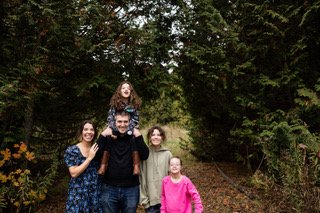
Adelle and family.
More about Adelle Purdham:
Adelle Purdham is a writer, educator, and parent disability advocate. She holds an MFA in Creative Nonfiction from the University of King’s College and teaches creative writing at Trent University. Adelle lives with her family in her hometown of Nogojiwanong (Peterborough), Ontario.

Excerpt from Johnny Delivers by Wayne Ng
In my bedroom, I did some shadowboxing while Bruce, in spandex shorts and boxing gloves, rope-a-doped and air punched rapidly.
I was doing a pretty good job, but Bruce refused to accept imperfection. “You are too rigid. Relax, bend, and shapeshift to respond to whatever comes at you mentally and physically.”
I told him to calm down.
“I do this by working hard,” he said.
In my bedroom, I did some shadowboxing while Bruce, in spandex shorts and boxing gloves, rope-a-doped and air punched rapidly.
I was doing a pretty good job, but Bruce refused to accept imperfection. “You are too rigid. Relax, bend, and shapeshift to respond to whatever comes at you mentally and physically.”
I told him to calm down.
“I do this by working hard,” he said.
Bruce trained and worked day and night. I wondered about his kids. I’ve seen the footage of his funeral in Hong Kong, where his kids looked so stunned. “Maybe you should have relaxed more. I’m sure Brandon would’ve loved more daddy time.”
“Don’t talk about my kids, okay?”
The happiest moments of my life were just hanging with Baba. “Trust me, every boy wants more of his father. That’s just a given. Even Shannon, I bet, wanted more daddy time.”
“I said, don’t talk about my kids.”
“Now look at who’s suddenly forgotten to bend and go with things,” I teased.
“Shut up.” Bruce pointed at me and scowled. “I’m warning you.”
“Okay, okay. It’s just that when my dad left, I was all busted up.” I knew Bruce’s father died when Bruce was just a bit older than me, and that his dad never got a chance to see Bruce at his pinnacle.
He stopped moving, and I froze, as the look on his face was so not him. I couldn’t tell if it was panic or desperation. You’d think Linda had just left him. You’ll never find Bruce sad or melancholy in the movies. Even when he didn’t win, he didn’t lose.
Whatever it was, we’re not supposed to go there.
My stomach kicked with hunger, and I hadn’t eaten since lunch, so I stepped into the restaurant through the back and into the kitchen. Once in a while, I want some Wonder Bread. No rice, ginger, soy, garlic, or green onions. Just plain white toast slathered with butter.
A couple of egg rolls were on the counter when I got downstairs. I hadn’t had one in a while, and though my mind was on toast, the rolls were still hot, almost like Mama knew I would be coming. I bit into one. It was hot! So hot I had to roll it around in my mouth. After a few bites, I peeled back the fried wrapper and looked inside. It really was good. It might even explain some of the extra sales.
I heard clanging and banging coming from the restaurant’s dining room. The warm glow of golden hour and a single overhead light shone on Mama who sat with her back to me. In front of her was a bowl of egg roll filling and wrappers. Beside that was the beat-up Tele-Tone portable record player Baba had dug out of someone’s garbage. She’d gotten it going, had cued the needle on the record player, and had put on one of her Chinese operas—all gongs, cymbals, and fiddle. It was pure torture—worse than the junior band tryouts.
Mama had tried to explain Chinese opera to me, but you might as well have made me eat cold, lumpy porridge. It wasn’t until she told me that Bruce’s father was a famous classically trained opera singer and that his training included weapons, acrobatics, and kung fu that I’d agreed to listen to her albums.
Mama told me when she was a girl, she fell in love with the Qingyi character and wanted to play her someday. But her mother laughed and said women were banned from performing. Looking closely at Qingyi at the next opera, Mama realized a man was playing her.
Mama has said the key to understanding who’s who is to recognize the patterns in the face masks. Each actor has unique techniques and interpretations, and each character has a set face type between which audiences can distinguish. They all just looked hideously over-made and exaggerated to me.
Her egg rolls had formed into a pile as she sang along.
“Gwo lai.” She called me over and said to bring the other hot egg roll.
She slid the plate of square wrappers and the filling bowl between us, then kicked a chair out for me.
The song soon ended and an awkward silence followed as I started filling and rolling.
“Too much filling,” she scolded.
“I know what I’m doing.” At least, I thought so—until I saw how she did three perfectly tight, chubby cigar rolls out of my two. Mine were perfect if you didn’t compare them with how even and aligned every fold of hers was. She lit a cigarette with her left hand and continued rolling with her right.
“When I was your age, I thought I knew what I was doing. I had a dream. I was going to be an opera star. Then I came to Canada, and things happened. It doesn’t matter. A long time ago.”
I just about fell out of my seat. That was as revealing as she ever got.
“These are magic egg rolls.” The corner of her mouth gripped her cigarette as she exhaled.
I nodded without looking up. “Ho sik wa.” They were delicious.
“Did you change the recipe?”
She listed the usual ingredients: the addition of tiny bits of homemade diced barbeque pork and oyster mushroom are flavour bombs no one else is doing.
She gave me a sharp look. “Same egg roll. Why is it so popular all of a sudden?”
She had this tone where I didn’t know whether it was a statement or an accusation, and I was left off-balance, unsure of what to say.
“And on days you work. Funny.”
I sped up, hoping to get through this batch. “I work most days, Mama.”
“And mustard. Funny. Very funny.” She switched to Toisanese, which I always struggled to keep up with. The needle on the record player skipped, repeating crackles and hisses. She ignored it. I overstuffed a roll and threw it upside down into the pile, hoping she wouldn’t notice.
“People phone and hang up all the time now. Sometimes, they come in for an egg roll, look around, and leave mad. They don’t even try the food. They are just mad. Not funny.”
I tore a wrapper accidentally and attempted to patch it up, but it looked awful. I know she noticed.
“Business is good, Johnny. But I worry—”
“Worry about what? Making money? Since when is that a problem?”
“I worry you are getting yourself into something. Am I wrong?”
My last two rolls were all uneven and sloppy. “I’m fine, the restaurant’s fine, school’s fine.”
The skipping on the record player was driving me crazy.
“This restaurant is not everything,” she said.
I stopped rolling. “It’s not? Because it’s not paying off your debt to Auntie?” That came out like a killer mahjong hand I’d revealed prematurely because I’d gotten impatient and foolish.
She stopped rolling. “That is none of your business. You do not understand. Do not—”
“What don’t I understand? What?”
“There are things we must do in a family.”
We finished wrapping the remaining egg rolls, sitting in our awkward silence. I slid my chair out and went to the kitchen to clean up. Before going upstairs, I glanced back at her. She was unwrapping some of my egg rolls, redoing my work. Making perfect the imperfections I’d created.
—from Johnny Delivers by Wayne Ng. Published by Guernica Editions. © 2024 by Wayne Ng.

Johnny Delivers by Wayne Ng.
More about Johnny Delivers:
Eighteen-year-old Johnny Wong’s dead-end life consists of delivering Chinese food and holding his chaotic family together in Toronto. When his sweet but treacherous Auntie, the mahjong queen, calls in their family debt, he fears the family will lose the Red Pagoda restaurant and break apart.
Invoking the spirit of Bruce Lee and in cahoots with his stoner friend Barry, Johnny tries to save his family by taking up a life of crime delivering weed with a side of egg rolls. He chases his first love, but his hands are already full with his emotionally distant mother, his dream-crushing father, and his reckless, sardonic little sister.
As he fights to stay ahead of his Auntie, sordid family secrets unfold. With lives on the line, the only way out is an epic mahjong battle. While Johnny is on a mission to figure out who he is and what he wants, he must learn that help can come from within and that our heroes are closer than we think.
Dripping with 1970s nostalgia, Johnny Delivers is a gritty and humorous standalone sequel to the much-loved and award-winning Letters From Johnny.

Wayne Ng.
More about Wayne Ng:
Wayne Ng was born in downtown Toronto to Chinese immigrants who fed him a steady diet of bitter melon and kung fu movies. Ng is a social worker who lives to write, travel, eat, and play, preferably all at the same time. He is an award-winning author and traveler who continues to push his boundaries from the Arctic to the Antarctic. He lives in Ottawa with his wife and goldfish.
Ng is the author of The Family Code, shortlisted for the Guernica Prize; Letters From Johnny, winner of the Crime Writers of Canada Award for Best Crime Novella and a finalist for the Ottawa Book Award; Johnny Delivers.

Excerpt from The Widow's Crayon Box by Molly Peacock
Have you received thoughts
And wondered why they’ve not
Occurred to you before?
They could be his


—”The Next World is One of Ideas” from The Widow’s Crayon Box by Molly Peacock. Published by W.W. Norton and Company. © 2024 by Molly Peacock.

The Widow’s Crayon Box by Molly Peacock.
About The Widow’s Crayon Box:
After her husband’s death, Molly Peacock realized she was not living the received idea of a widow’s mauve existence but instead was experiencing life with all 152 colours of the crayon box. The result is a collection of gorgeous poems, which are joyful, furious, mournful, bewildered, sexy, devastated, whimsical and above all, moving. They illuminate both the life as a caregiver and the crystalline emotions one can experience after the death of a cherished partner. With her characteristic virtuosity, her fearless willingness to confront even the most difficult emotions, and always with buoyancy and zest, Molly charts widowhood in the 21st century.

Molly and Mike. Photo credit: Alice Briesmaster.
About Molly Peacock:
Molly is the author of eight volumes of poetry, including The Widow’s Crayon Box, The Analyst: Poems and Cornucopia: New & Selected Poems, all from W.W. Norton, she recently wrote a book about a half-century friendship, A Friend Sails in on a Poem. As a poetry activist, Peacock was the co-founder of Poetry in Motion on New York’s subways and buses, the founder of The Best Canadian Poetry series, and the creator of The Secret Poetry Room at Binghamton University. https://www.mollypeacock.org/

Molly and Mike. Photo credit: Alice Briesmaster.

Excerpt from Secrets in the Water by Alice Fitzpatrick
With the formalities of the funeral behind her, Kate felt herself begin to relax.
A giddy shriek of female laughter drew her attention to a crowd of older women surrounding artist David Sutherland, Meredith Island's most famous native son, and according to Alex, the A-list of contemporary British artists. Kate reckoned he must have been going on seventy but looked younger with a full head of faded blonde hair. Unlike so many older people whose faces fatten to blur their original features, his face had managed to retain its high cheekbones, deep-set eyes, and a jawline softly rounded yet remarkably unbroken by jowls or creases around his mouth. As a young man, he must have been stunningly attractive.
from CHAPTER ONE
(CONTEXT: When Kate Galway was just three years old, the body of her beloved aunt Emma was discovered—an apparent suicide. Now Kate has returned to her childhood home, an island off the Welsh coast, to bury her grandmother, where she is confronted with the islanders’ suspicions that her aunt was murdered all those years ago. )
With the formalities of the funeral behind her, Kate felt herself begin to relax.
A giddy shriek of female laughter drew her attention to a crowd of older women surrounding artist David Sutherland, Meredith Island's most famous native son, and according to Alex, the A-list of contemporary British artists. Kate reckoned he must have been going on seventy but looked younger with a full head of faded blonde hair. Unlike so many older people whose faces fatten to blur their original features, his face had managed to retain its high cheekbones, deep-set eyes, and a jawline softly rounded yet remarkably unbroken by jowls or creases around his mouth. As a young man, he must have been stunningly attractive.
David looked over at Kate. She lowered her gaze, embarrassed that she’d been caught staring, and quickly scanned the room for her daughter. Alex was being plied with large pieces of Madeira cake by three elderly men known to the islanders as Feebles, Gooley, and Smee, which had always struck Kate as an excellent name for a Dickensian law firm.
Alex excused herself and came to stand beside Kate.
“You’ll be struggling to get into those power suits if you eat any more cake,” Kate teased.
Alex licked the stray crumbs from her lips and laughed. “Uncle Gooley says I need some meat on my bones, so he’s taken it upon himself to fatten me up.”
“I can’t say I disagree, but did you tell him you spend thousands of pounds a year to sweat at some posh gym to keep your bony figure?”
“I think he’d be shocked and quite probably disgusted. I'm sure I’d be if I were him.” Alex stared at the people in the pub. “God, I love this place.”
As a child, Alex had divided her summer holidays between the Galways and James’s mother in her Cheshire cul-de-sac whose residents spent their days deadheading roses and taking an inordinate delight in keeping each other informed about any curious goings-on. But it was on Meredith Island Alex had been free to be herself.
Alex smiled and wiped a tear from her cheek. “I seem to be getting sentimental.”
“It’s a day for being sentimental.” Kate gave her daughter a quick hug. “Right, I think I could do with another drink.”
In Alex's absence, Kate’s attention was once again drawn to where David Sutherland continued to hold court. Judging from the expressions on the faces of his female admirers, Kate wasn’t the only one who found him easy on the eye. Fiona Caldicott, who looked two sizes smaller than her mauve print dress, stroked David’s arm like a woman whose inhibitions had vanished with her last gin and tonic.
Alex returned and handed Kate her whiskey. “Is Fiona flirting with David Sutherland?”
“Oh, it’s moved way beyond flirting.”
Alex raised her glass in salute. “Well, good for her. I hope I can summon up that much enthusiasm for it when I’m her age.” Alex stared intently for a moment. “David’s looking good. Do you think he’s had work done?”
"Alex!"
"C’mon, Mum. He definitely does something with his hair. As for the rest, well, he can certainly afford it. I mean, you can’t buy a David Sutherland painting for less than £80,000.”
“That much?”
David disentangled himself from his ladies and started to walk towards Alex and Kate.
“Oh God, he saw us,” Kate whispered. “That’s twice he’s caught me staring.”
“Well, he must be used to it. You can't deny it’s a nice view.”
“Kate, Alex, my sincere condolences.” David kissed them both lightly on the cheek and took Kate’s hand in his. He looked closely at her, as if searching for something familiar in her face. At last he said, “Lilian was a wonderful woman. We’ll all miss her.”
Kate teared up again. The realization that her family were all gone pressed hard on her heart.
“You were friends with Emma, weren’t you?” Alex asked him.
Once Alex got something into her head, it was hard to stop her. Kate wished her daughter would leave it alone. There had been enough talk about Emma today.
David looked down to where his hand still held Kate’s. He gently released it. “I was.”
People within earshot of their conversation had become quiet.
“We both were.” Fiona approached, her voice uncharacteristically loud from the drink.
“Please, Fiona,” David pleaded, as if anticipating what was coming.
“You want to know about the suicide, don’t you, my dear?” she said to Alex. “She didn’t kill herself. I know that for a fact. I know how much she had to live for. And you know that too, David.”
Fiona was so tiny with her sloping shoulders and flat chest, yet her blue eyes were sharp with a ferocity that surprised Kate.
“Miss Caldicott, let’s get you home.” Reverend Imogen took Fiona’s arm. “The day’s obviously been too much for you.”
“We trusted the police with their science and fancy ways of getting to the truth, but they let us down. We should have spoken up, all of us, insisted they do more.” Fiona voice was shaking. “But we failed her. We failed Emma.”
As she manoeuvred Fiona toward the door, Imogen offered Kate an apologetic, embarrassed look. “I’m so sorry.”
Kate looked toward David who was staring into his empty glass. He seemed to be avoiding her gaze. “Mr. Sutherland, you said you were Emma’s friend.”
David’s eyes were watery as if he was remembering something bitterly sad. “And I want to believe she’d have come to me before taking her own life. The suicide note rules out an accident, and if it wasn’t suicide...”
Kate couldn’t help but finish his thought. Then it was murder.
She stared at the familiar faces in the room, the people she considered her family.
And if it was, the killer could be standing in this very room.
— from Secrets in the Water by Alice Fitzpatrick. Published by Stonehouse Publishing. © 2024 by Alice Fitzpatrick.

Secrets in the Water by Alice Fitzpatrick.
About Secrets in the Water:
Emma Galway's suicide has haunted the Meredith Island for fifty years.
Back on the island to lay her grandmother to rest, Kate can't avoid reflecting on the death of her aunt. Learning that her late mother had believed Emma was murdered and had conducted her own investigation, she decides to track down her aunt's killer. With the help of her neighbour, impetuous and hedonistic sculptor Siobhan Fitzgerald, Kate picks up where her mother had left off. When the two women become the subject of threatening notes and violent incidents, it's clear that one of their fellow islanders is warning them off. As they begin to look into Emma's connection to the Sutherlands, a prominent Meredith Island family, another islander dies under suspicious circumstances, forcing Kate and Siobhan to confront the likelihood that Emma's killer is still on the island.

Author Alice Fitzpatrick.
About Alice Fitzpatrick:
Alice Fitzpatrick has contributed short stories to literary magazines and anthologies and has recently retired from teaching in order to devote herself to writing full-time. She is a fearless champion of singing, cats, all things Welsh, and the Oxford comma. Her summers spent with her Welsh family in Pembrokeshire inspired the creation of Meredith Island. The traditional mystery appeals to her keen interest in psychology as she is intrigued by what makes seemingly ordinary people commit murder. Alice lives in Toronto but dreams of a cottage on the Welsh coast. To learn more about Alice and her writing, please visit her website at www.alicefitzpatrick.com.

Excerpt from A Necessary Distance: Confessions of a Scriptwriter's Daughter by Julie Salverson
My father was my first competition. He got the words down fast. Stories would spin from dad’s brain, dusting our dinner table with whimsy and adventure. The children of writers talk about the sanctity of the study, the private magical terrain of the parent’s imagination. I guess I experienced some of that, but it also felt ordinary. Writing was Dad’s occupation and he went to work like I supposed other parents did, except he was around. He found the job lonely, so when he carried his brown leather briefcase into the car and drove the hour to Toronto for rehearsals or meetings, those were good days.
A RADIO GUY
My father was my first competition. He got the words down fast. Stories would spin from dad’s brain, dusting our dinner table with whimsy and adventure. The children of writers talk about the sanctity of the study, the private magical terrain of the parent’s imagination. I guess I experienced some of that, but it also felt ordinary. Writing was Dad’s occupation and he went to work like I supposed other parents did, except he was around. He found the job lonely, so when he carried his brown leather briefcase into the car and drove the hour to Toronto for rehearsals or meetings, those were good days.
I interviewed my father when he was eighty. The old cassette tape surfaces in a box in the basement as I’m writing this book. His voice, after almost twenty years. He is talking about his mother Laura Goodman Salverson. She was the first woman to win the Governor General’s Award, and won it twice:
“My mother soaked into my head an instinct of what to do with words. She held salons to talk about ideas and writing and would sit up all night reading three books. I was six years old learning about curtain lines. Live radio was exciting. Stimulating. You couldn’t make a mistake. They drilled it into me that every word had to go on the air. For much of my life a producer would say, 'give me an idea and I'll give you a contract'”.
Dad often had to come up with ideas in a day or two. Once he walked into a producer’s office in Toronto, “I’d like a few days to develop this idea some more.” The man looked at him for a moment. “Oh, come on George. You know you just write it.”
Radio dramas in Canada by the CBC (Canadian Broadcasting Corporation) had a one-week incubation period in the 1940's and 50's. Every Tuesday, Dad drove to the studio and pitched his idea to the producer. Wednesday through Friday he wrote the script. Saturday, he drove back for rehearsals, a read through in the morning and rehearsal with full orchestra in the afternoon, conducted by Lucio Agostini or Morris Surdin. Sunday, they broadcast live. Monday was his 'day off’ when he puttered around the house musing story ideas, and Tuesday it began all over again. He would have been astonished at our astonishment at this level of achievement. To him it was a job. He said he was a journeyman not an artist, but I don’t think semantics mattered to him. He was dismissive of notions like ‘writer’s block’ or ‘finding the muse’. He had bills to pay and storytelling did the job. My father was the proverbial bum on the seat, words on the page kind of guy. I wish I had learned his talent for routine.
Early television was also live. Dad was one of the first to write for the medium. It was a new art form; nobody in the world was ahead of them. My father told of an ACTRA meeting (Alliance of Canadian Cinema, Television and Radio Artists) where five members sat around a table and a writer from Halifax asked, "Shouldn’t we wait until everyone is here?" The ACTRA rep replied, "You are.”
My neighbor has lived in Canada most of her adult life and teaches renaissance drama at Queen’s University. I send her a photo of my mother with actor Lorne Greene of the American western Bonanza fame; it's a publicity shot for Othello at CBC sometime in the forties. Greene is in ‘dark’ make-up. It is shocking now but was normal then. My neighbor writes: “I don’t know a thing about Canadian culture before the 70’s except what my mother remembered. She used to talk about Christopher Plummer because he acted in Ottawa and Lorne Greene - one of them had a Queen’s connection, right?”
I text back, “It was Greene who went to Queen’s. He was born a Russian Jew in Canada, and called Chaim at home in Ottawa.” I tell her the books piled on my desk are full of people who were at our dining room table. Lots of Scotch. Late nights after shows. “Mom…and the CBC Stages…did Shakespeare, Ibsen and adaptations of classics. In the 40’s my mom played leads, usually opposite John Drainie. She had too much success too fast. That and other things undid her, but she was famous for a while. In that world and on the air.”
In the 1920’s Canadian radio was virtually indistinguishable from everything American, and the drama relied primarily on scripts from traditional theatre. Audiences listened to touring American and British companies. It took an ardent group of visionaries – in particular Graham Spry and Alan Plaunt - to rally for the establishment of the Canadian Radio Broadcasting Corporation (1932) which four years later became the CBC. Immediately the corp, as people continue to call it, was caught between a philosophy of educating and uplifting. Lord Reith in Britain thought of audiences in terms of a church congregation, but others prefered fast-paced commercial entertainment, meaning American. In the 1996 book A Dream Betrayed, former CBC President Tony Manera writes: "For commercial broadcasting, audiences represent consumers to be delivered to advertisers; for public broadcasting, audiences are made up of citizens whose interests must be served."
The drama department was established in 1938 and for three decades enjoyed an international reputation, winning rave reviews in the New York Times from critic Jack Gould and at home from the likes of Nathan Cohen and Herb Whittaker. With the depression and then the outbreak of war in Europe, live theatres were closed or turned into movie houses, and radio became the main professional outlet for Canadian dramatists and actors. At one point CBC Stage was second in popularity only to Hockey Night in Canada.
My neighbor grew up in America but Canadians don’t know about this history either. Where would we learn it?
One day, CBC director Esse Ljungh was told by his girlfriend, actor Beth Lockerbie, "Guess what they’ve got over at CKRC. A playwright!" Ljungh commissioned Dad to write a show for New Year's Eve. Fletcher Markle from Vancouver was on his way to Toronto and stopped by to watch the live recording. He said to my father, "You’re the first writer to have his first play performed in evening dress!”
Esse called my father into his office one morning. "You can stay here, but you won't get anywhere. Go to Toronto, buy yourself a thousand dollars worth of furniture and wait for the phone to ring." In 1948, he took the plunge to try his hand in the big leagues of national radio. His first show for producer Andrew Allan was an adaptation of Dracula. "I was fresh from commercial drama," Dad says in an interview I found at the National Archives of Canada. "You learn not to upset anybody. I wrote a draft and Andrew said, "It's okay. But. Isn't it supposed to be a horror story, George?" "Well, yes." "Then let's make it horrible!"
— from A Necessary Distance: Confessions of a Script Writer's Daughter by Julie Salverson. Published by Wolsak & Wynn. © 2024 by Julie Salverson. Used with permission of Wolsak & Wynn.

A Necessary Distance: Confessions of a Script Writer's Daughter by Julie Salverson.
About A Necessary Distance: Confessions of a Script Writer's Daughter :
George Salverson had written over a thousand radio plays for the CBC before he became the first television drama editor for the corporation. He wrote scripts for such beloved series as The Beachcombers and The Littlest Hobo, but he kept very little of his writing, being decidedly unsentimental about his work. So when his daughter Julie found a series of notebooks from a round-the-world trip he’d taken in 1963 to work on a documentary about world hunger, she knew she’d found something important. But the writer of these notebooks is not the father she thought she knew. From there Julie Salverson traces a fascinating web of personal and political history, of storytelling, of culture and it’s shaping and of a man caught in a time of great change.

Author Julie Salverson
About Julie Salverson:
Julie Salverson is a nonfiction writer, playwright, editor, scholar and theatre animator. She is a fourth-generation Icelandic Canadian writer: her father George wrote early CBC radio and television drama and her grandmother Laura won two Governor General Awards (1937,1939). Julie's theatre, opera, books and essays embrace the relationship of imagination and foolish witness to risky stories and trauma. She works on atomic culture, community-engaged theatre and the place of the foolish witness in social, political and inter-personal generative relationships. Salverson offers resiliency and peer-support workshops to communities dealing with trauma and has many years of experience teaching and running workshops. Recent publications include the book When Words Sing: Seven Canadian Libretti (Playwrights Canada Press, 2021) and Lines of Flight: An Atomic Memoir (Wolsak & Wynn, 2016).

Excerpt from The Dark King Swallows the World by Robert Penner
Nora sat in the train compartment by herself, an open book on her lap, watching the fields drift past. The engine was chugging away somewhere behind her, pulling her along. She was falling backward through the landscape, into a forgotten space that lay beyond it. As she fell, she thought about the argument she had heard the day before, through the closed door of her grandparents’ bedroom.
“Why should we send her to live with that horrible woman?” her grandmother had demanded. “She’s perfectly happy here.”
“Hush,” replied her grandfather. “She’s only twelve. That woman is her mother, and she loves her. And there’s the brother.”
Nora had wondered if her grandfather meant she loved her mother or that her mother loved her.
“Brother! Half of a brother. Partial.”
Chapter 1
Nora sat in the train compartment by herself, an open book on her lap, watching the fields drift past. The engine was chugging away somewhere behind her, pulling her along. She was falling backward through the landscape, into a forgotten space that lay beyond it. As she fell, she thought about the argument she had heard the day before, through the closed door of her grandparents’ bedroom.
“Why should we send her to live with that horrible woman?” her grandmother had demanded. “She’s perfectly happy here.”
“Hush,” replied her grandfather. “She’s only twelve. That woman is her mother, and she loves her. And there’s the brother.”
Nora had wondered if her grandfather meant she loved her mother or that her mother loved her.
“Brother! Half of a brother. Partial.”
“But still a brother. And still a mother.”
“Why is that woman still here? Why can’t she go back to where she belongs? Back to America? Why can’t she leave the girl in peace?”
“Peace! Where is there peace?” Her grandfather began angrily, but then his voice softened, and Nora was sure he was thinking not just about the big war raging all around them but also about his son who died years before, when he went off to Spain to fight the Fascists. Nora’s father. A man whom she could barely remember and whom her grandparents could never forget. “There’s no such thing anymore. Not here. Not anywhere.”
She returned to her book.
An hour later, the book was beside her on the seat and she was looking down at the Tamar from an iron bridge that stood hundreds of feet above the river. She knew the bridge had been built ages ago by Isambard Kingdom Brunel. It was, she told herself, “a marvel of Victorian engineering.” The view was spectacular to the point of being disorientating. The little pleasure boats and fishing vessels were so far below her as to seem mere points of colour on a grey canvas, their smallness emphasized further by the great steel warship standing guard over the estuary mouth, guns pointed out at the endless wastes of the Atlantic.
Nora looked back up to the horizon to see the carefully ordered Devon landscape slipping away, and she knew that rushing up behind her, unseen, was Cornwall, unknown, a great adventure. She thrilled at the idea she was crossing the river to a different place, a place that all the books she’d read described as somehow older than the rest of England, a remnant of a different, almost lost world. She was infected by this nostalgia and let herself dream about ruined castles, stone rings, and witchy moors.
She woke as the train descended wind-swept hills into a forest of tall evergreens. The view seemed very rugged and un-English to her. Maybe German. Or Swiss. But even more surprising than the alpine landscape was the small man sitting across from her playing solitaire on the fold-out table beneath the window. He had on an old-fashioned, well-worn, but very neat, dark suit. His head was suspended in a halo of grey hair, heavy caterpillar eyebrows bunched together in concentration. A moustache drooped over his straggly goatee. His hands hovered over the cards. The fine hairs on the back of his fingers and hands grew thicker and blacker as they crept up his wrists and vanished into the mellow white of his shirt. Nora watched through half-lidded eyes as the little hands started to dart about and the cards snapped and cracked in a blur of intricate movement.
She watched in a reverie for quite some time. The sun flashed in and out of the tall trees along the track. The creak and moan of the carriage sounded like an old sailing ship, like they were cutting across the waves on a breezy day. Occasionally, the old man looked up at her slyly from beneath his beetled brow as his fingers danced about. When their eyes finally met, Nora smiled at him, and he gave her a small smile in return.
“Good sleep, yes?” he asked, and she could hear the burr of an accent, maybe something Teutonic, something that matched the scenery.
“It was lovely,” said Nora and stretched. She dug around in her bag and found the can of peppermints her grandmother had packed for her. She popped one in her mouth.
“Would you like one?” she proffered the can to the old man.
“Thank you,” he said, plucked one out, and began sucking on it noisily as he returned to his cards.
“What funny cards!” Nora said. “I thought you were playing patience, but the cards don’t seem quite right.”
“It is a piquet deck,” the old man said. “It has fewer cards than a bridge deck.”
He looked up at her, and this time his smile was so big that, for a second, his bright eyes vanished entirely.
“It is better for telling the future,” he said. “Fewer mistakes.”
“Can you read the future?” Nora asked.
“No,” said the old man. “But sometimes I can read the cards, and the cards can read the future.”
Nora giggled. “Can you read my cards?”
“Well,” he said, “I have been winning. And that always makes one a little more hopeful about such chancy endeavours as divination.”
He shuffled the cards into a tidy stack and had Nora cut them and shuffle them herself. Then he shuffled them again and laid out four, face up, in a cross: the jack of hearts, the jack of spades, the queen of diamonds, and a nine of hearts. He made Nora cut the deck again and lay the top card out in the middle of the cross. It was the king of spades. He frowned.
“I think that card is for me,” he said. “It usually is. Let us try again.”
They repeated the process, and while different cards appeared in the cross, the middle was once again occupied by the king of spades. And it happened in the same way the next time. And the next. Then again. And again.
“It’s all a muddle today,” he muttered as they stared at the card. “It has been since this morning.”
“But it doesn’t seem a muddle,” said Nora. “It seems quite the opposite. What does it mean?”
“It means we should play a different game,” the old man said.
“Oh please,” Nora said. “What does it mean? Is that my mother’s new beau? Is he another black-hearted beast?”
“Almost certainly if such has been her habit, but you don’t need cards to learn something like that,” said the old man, and then he changed the subject. “I’ll teach you piquet. It’s a very old game. Very old indeed. Older than this silly cartomancy. Rabelais played it, you know? Piquet. Think of that! Rabelais!”
“Who’s Rabelais?” asked Nora.
“He was an ass,” said the old man. “He was a marvellous ass, a marvellous dreaming ass.”
He began to shuffle the cards.
Penzance was the end of the line, and the old man scurried away with his cards before Nora could say a proper goodbye. She felt nervous as she gathered her things and did so slowly. It had been such a long time since she’d seen her mother, months and months really, and she paused to take a deep breath before she stepped out of the carriage and onto the almost deserted platform. And then her mother was there, waiting for Nora, holding the hand of a small boy of three. Nora had forgotten how tall and beautiful her mother was. Not forgotten, really. Misremembered. She preferred to think of her mother as pretty in a commonplace sort of a way, as she looked in the photographs Nora had tucked away in her notebooks and half-read novels. But in person, it was impossible to imagine her mother as anything other than beautiful. So beautiful that she never quite looked like she belonged in the scenes in which Nora found her. The scenes in which Nora accompanied her.
Nora once heard her grandfather telling her grandmother that their daughter-in-law was an actress who’d wandered from the stage to the street without noticing the transition. This seemed right, as if her mother had never stopped playing the role she’d chosen for herself when she first left her parents’ mansion in Paterson, going to Wellesley to become “an independent person,” which was how she always described herself to Nora when discussing this part of her life. Which was what, Nora wondered. What was an independent person, exactly? What was her mother’s role, precisely? Who did she pretend she was? Not independent, thought Nora. Not really. Certainly not financially. They were perpetually waiting for money to be wired to their hotels and apartments. So maybe it was something else. Her mother had seen some success as a singer. And she’d been married to Nora’s father for some time, with about the same degree of success. She also liked to organize parties. And meet new people. And travel. And chatter. But who did she think she was? Leda? Callisto? Demeter? She was certainly willowy and elegant, fay, like the drawings of the nymphs and dryads in Bulfinch’s Mythology, the type of creature that in the old stories always attracted the attention of the most brutal and violent gods.
“Nora!” her mother cried out, releasing the little boy’s hand. He had dark hair and eyes, and Nora returned his gaze as she was enveloped in their mother’s embrace. When her mother eventually straightened up and looked down at her, eyes bright with tears, Nora felt pleased at the sight of them.
“Sweetheart,” she said. “I’ve missed you so much.”
But Nora was still staring past her at the boy.
“Oh! Introductions! Nora this is Sam.” Her mother laughed happily. “He’s your brother.”
“Half brother,” said Nora. “Partial.”
— from The Dark King Swallows the World by Robert Penner. Published by Radiant Press. © 2024 by Robert Penner. Used with permission of Radiant Press.

The Dark King Swallows the World by Rober G. Penner
About The Dark King Swallows the World:
While isolated and friendless in World War II Cornwall, Nora, a precocious American adolescent, loses her younger half-brother in a car crash. Overwhelmed by grief, Nora’s mother becomes involved with Olaf Winter, the self-professed necromancer Nora believes is responsible for the accident. Desperate to win back her mother’s love from the nefarious Mr. Winter, Nora embarks on an epic journey and is plunged into a world of faeries, giants, and homunculi. Eventually she reaches the land of the dead where she confronts the dark king who rules that realm, attempts to retrieve her half-brother, and heal her mother’s broken heart.

About Robert G. Penner:
Robert G. Penner lives and works in Winnipeg, Manitoba. He is the author of Strange Labour, one of Publishers Weekly‘s Best Science Fiction Books of 2020. He has published numerous short stories in a wide range of speculative and literary journals under both his name and various pseudonyms. He was also the founding editor of the online science fiction zine Big Echo.

Excerpt of Lies I Told My Sister by Louise Ells
Rose didn’t know that eleven weeks after Quentin left Big Rock Lake to return to New York, I’d spent the night in this hospital. The abortion clinic.
I wanted children. But one day, not now. Having children was not something Quentin and I had discussed, but I could imagine his reaction if I told him I was pregnant, and it would not be positive. I wasn’t willing to risk losing him, so by myself I made the choice between him and our baby.
A meeting with a counsellor to discuss my options was a prerequisite for the surgery. I talked about being young, and unmarried, and having plans for graduate school. That was easier than admitting my real fear that my boyfriend of not quite four months would leave me.
Chapter Two
Big Rock Lake, 1990
Rose didn’t know that eleven weeks after Quentin left Big Rock Lake to return to New York, I’d spent the night in this hospital. The abortion clinic.
I wanted children. But one day, not now. Having children was not something Quentin and I had discussed, but I could imagine his reaction if I told him I was pregnant, and it would not be positive. I wasn’t willing to risk losing him, so by myself I made the choice between him and our baby.
A meeting with a counsellor to discuss my options was a prerequisite for the surgery. I talked about being young, and unmarried, and having plans for graduate school. That was easier than admitting my real fear that my boyfriend of not quite four months would leave me.
‘Have you spoken to anyone else?’ The woman was middle-aged, kind, and a mother herself I guessed. ‘Your parents, a close friend, your partner?’
‘Bobby–my father is dead, and I–I haven’t told anyone else, no.’ That was an odd thing for me to have said. Suggesting that if Bobby had been alive I might have told him? Never.
‘And that’s fine. It’s entirely your decision. Your body, your choice.’ She gave me a booklet and some leaflets. She told me exactly what to expect. She organized everything, including a ride home with a volunteer driver.
I thought I handled the situation well. I was deeply grateful that I lived in a time and a place of legal terminations. I had no last moment regrets, and felt only relief, no guilt at all, after it was over. The volunteer driver was an older woman in a chunky knit sweater who pulled the car to the side of the road when I started crying and gathered me in her arms in a tight hug. She said nothing. I don’t remember her face, her car—only her sweater and that hug. I spent the following two days in bed crying, but that was simply a reaction to physical pain.
As soon as my body had healed enough, I dealt with contraception. No more risks. No more unplanned pregnancies. I was an adult woman, making adult choices. The single after-effect I acknowledged was an increased sense of insecurity, which manifested as recklessness. I had chosen Quentin over a child; I had to prove to myself that had been the right choice; I had to make sure I didn’t lose Quentin. When we were together, he got all my attention. When we were apart, I barely thought about anything else. My marks, unsurprisingly, plummeted. I was let go from my waitressing job for missing too many shifts. I ignored the few provisional offers I received to graduate programs, knowing I wouldn’t meet the conditions. My roommates teased me at first, then grew concerned. Finally, Larissa and Sally staged an intervention and said Quentin was no longer welcome to stay—that even if I didn’t care about final exams, they did.
—from Lies I Told My Sister by Louise Ells. Published by Latitude 46. © 2024 by Louise Ells. Used with permission of Latitude 46 Publishing.

Lies I Told My Sister by Louise Ells (Latitude 46, 2024).
About Lies I Told My Sister:
After a nine-month estrangement, sisters Lily and Rose, are reunited in a hospital emergency room when the younger sister’s husband has been badly injured in a car crash. While waiting for updates, they reminisce about their childhood memories in an effort to unearth the family tragedy - the death of their older sister Tansy. Lily and Rose begin to unravel the lies of omission that pulled them even farther apart.
Lies I Told My Sister is an exploration of how our community of loved ones can both buoy us up or tear us down. How innocently kept secrets can cause profound chasms.

Author Louise Ells.
About Louise Ells:
Louise Ells was born and raised in northeastern Ontario. After years of travel, she moved to Cambridge and earned her PhD in Creative Writing. She was a Hawthornden Fellow in 2017, and published her short story collection, Notes Towards Recovery (Latitude 46) in 2019. Louise teaches at universities and colleges in England and Canada and currently lives just north of Toronto, where she can often be found in her library surrounded by books and snuggled up with her cats.

Excerpt of The Donoghue Girl by Kim Fahner
Chapter 2
The night pressed in so that the lamps had been turned on in the apartment upstairs. The store was closed and there was a dance being held that evening in the community hall, so the girls were getting themselves in order—brushing and curling hair, adding ribbons, and choosing the right evening dresses and shoes. Lizzie thought that it was one of the loveliest things about growing up in a family of mostly girls, that you could look around this large room and imagine they were all part of a Life magazine photo, like starlets from Hollywood.
There was a sharp knock at the door and in came Mama. She was dressed in one of her prettiest evening frocks.
Chapter 2
The night pressed in so that the lamps had been turned on in the apartment upstairs. The store was closed and there was a dance being held that evening in the community hall, so the girls were getting themselves in order—brushing and curling hair, adding ribbons, and choosing the right evening dresses and shoes. Lizzie thought that it was one of the loveliest things about growing up in a family of mostly girls, that you could look around this large room and imagine they were all part of a Life magazine photo, like starlets from Hollywood.
There was a sharp knock at the door and in came Mama. She was dressed in one of her prettiest evening frocks. It was periwinkle and she wore a matching hat to further cement herself as a leader in the community. Lizzie watched her as her eyes moved from girl to girl, assessing their dress and demeanour. The giggling and general mayhem slowed when she entered the room, with the girls knowing that their mother was not one to mince words. She stepped further into the room on her sharp shoes. They were from Toronto, Lizzie knew. One of the newest and most expensive styles. Father had ordered her a pair, included in the last shipment of men’s black Oxfords from down south, as a gift for his wife.
Maisie rushed into the new silence first, filling it with words. “Mama, do you mind if I just stay here tonight? My throat is sore and I can’t stop coughing.” Lizzie watched her as she gestured with a book, open to where she was reading it.
“Yes, that’s fine. Jack won’t be going tonight, anyway, so you two can stay here together. You can rinse and clean the raspberries for the pie tomorrow night.” Mrs. Donoghue said. She turned her attention to the other girls.
“Now. Let’s see you girls. Ann, let’s have a look. What a lovely green on you, my girl. The cut suits you. And now, Lizzie.” She sighed. Lizzie looked down at what she was wearing and wondered what was wrong with it. “Oh, Lizzie. Surely you could try to find something a bit more flattering? It looks like an outfit you would wear to tend the shop downstairs. Really. You’ll be the death of me.” The words came in a rush, like a sudden summer rain storm, the kind where a person might find herself caught in a downpour if she wasn’t properly prepared with an umbrella. With Mama, Lizzie knew you had to be at your best or else her words would pierce.
Lizzie stood her ground. “I’m quite presentable. I’m not trying to impress anyone. I don’t see a problem, to be honest.” “To be honest? Lizzie, Lord knows you are nothing if you aren’t honest. Perhaps we ought to try and cultivate a bit more dishonesty in you, hmmm? To be honest, my girl, I think you need to learn some manners. Now, you need to behave in a certain way. Your father is a leader in the Knights of Columbus, for goodness sake.” Lizzie knew that this would be the response, even before she’d begun to speak up for herself. “I know, Mama. I know exactly what is expected of us. I just don’t like it.”
“You represent your father, and this family, whenever you walk through the streets of this town. I’ll have you remember that, Elizabeth.” Impatience resonated in her voice, warning Lizzie. “Now. Reach into that wardrobe and pull out the navy blue dress— the one with the draping across the waist. It will suit you just fine. You can add the pearls that your father gave you for Christmas.” She was curt and dismissive.
As she walked towards the door of the girls’ room, Mrs. Donoghue turned one last time. “I’ll see you downstairs in five minutes. Be sure your hair looks presentable, Ann. Tuck that stray curl in somewhere, will you? Maisie, you help her.”
—from The Donoghue Girl by Kim Fahner. Published by Latitude 46. © 2024 by Kim Fahner. Used with permission of Latitude 46 Publishing.

The Donoghue Girl by Kim Fahner, published by Latitude 46.
About The Donoghue Girl:
Longing for a life bigger than the one she inhabits, Lizzie Donoghue thinks she’s found a simple escape route in Michael Power, but soon discovers that she might have been mistaken…
The Donoghue Girl is the story of Lizzie Donoghue, the spirited daughter of Irish immigrants who desperately wants to not only escape Creighton—the Northern Ontario mining town where her family runs a general store—but also the oppressive confines of twentieth-century patriarchy. She believes her escape can be found in Michael Power, the handsome young mine manager recently arrived in Creighton from the Ottawa Valley.
Caught up in a complex familial love triangle, Michael first courts Lizzie’s older sister, Ann, but then finds himself more and more drawn to Lizzie. Their lives twist and turn as they are all forced to face the harsh reality of the broken expectations of marriage and family just before the onset of WWII in Europe.
This is Lizzie’s story, from beginning to end, and readers will fall in love with her bright spirit as she comes to realize her true strength.

Author Kim Fahner.
About Kim Fahner:
Kim Fahner lives and writes in Sudbury, Ontario, Canada. She has published two chapbooks, You Must Imagine the Cold Here (Scrivener, 1997) and Fault Lines and Shatter Cones (Emergency Flash Mob Press, 2023), as well as five full books of poetry, including: braille on water (Penumbra Press, 2001), The Narcoleptic Madonna (Penumbra Press, 2012), Some Other Sky (Black Moss Press, 2017), These Wings (Pedlar Press, 2019), and Emptying the Ocean (Frontenac House, 2022). Kim is the First Vice-Chair of The Writers' Union of Canada (2023-25), a full member of the League of Canadian Poets, and a supporting member of the Playwrights Guild of Canada. She was Poet Laureate for the City of Greater Sudbury from 2016-18.

Excerpt from The Mona Lisa Sacrifice by Peter Derbyshire
In the beginning was an angel, a church and a knife.
I hunted down the angel, Remiel, in Barcelona. He was working as a living statue, one of those street performers whose job it is to separate tourists from their money before someone else does. His office was a wooden pedestal on La Rambla, the pedestrian boulevard by the harbour that every visitor has to hit before they start exploring the real city. He was tucked away among the kiosks that sold everything from postcards and magazines to live birds. A silver robot stood on a box to the left of him, while a clockwork man dressed in gears, wheels and pistons was on his right. Remiel was made up like a demon with golden skin, bat wings and two tails, holding a leather tome bound with three locks. He looked like just another out-of-work circus performer vying for tips. Apparently even angels have to make a living these days.
IN THE BEGINNING
In the beginning was an angel, a church and a knife.
I hunted down the angel, Remiel, in Barcelona. He was working as a living statue, one of those street performers whose job it is to separate tourists from their money before someone else does. His office was a wooden pedestal on La Rambla, the pedestrian boulevard by the harbour that every visitor has to hit before they start exploring the real city. He was tucked away among the kiosks that sold everything from postcards and magazines to live birds. A silver robot stood on a box to the left of him, while a clockwork man dressed in gears, wheels and pistons was on his right. Remiel was made up like a demon with golden skin, bat wings and two tails, holding a leather tome bound with three locks. He looked like just another out-of-work circus performer vying for tips. Apparently even angels have to make a living these days.
If you’ve been to Barcelona, or any other city with a tourist district, you know the scene: People with cameras and sunburns wandering around, the statues, jugglers and magicians competing with each other to earn a few of the local coins, while pickpockets go for the money the easy way.
And me.
You wouldn’t notice me. I’d be just another passing face, another man from somewhere else with a hat, sunglasses and backpack. I’m a pretty convincing nobody, thanks to centuries of experience.
But Remiel turned his head and scanned the crowd as soon as I caught sight of him. Angels have a sense for each other. He was looking for me. Trying to find me like I’d found him.
The problem for him was he was looking for the wrong thing. I’m not one of them. I can never be one of them. I’ll let you worry about whether that’s a curse or a gift.
— from The Mona Lisa Sacrifice by Peter Derbyshire. Published by Wolsak & Wynn. © 2024 by Peter Derbyshire. Used with permission of Wolsak & Wynn.

Bring home The Mona Lisa Sacrifice by Peter Derbyshire.
About the Mona Lisa Sacrifice:
This compulsively readable novel is the first in The Cross series and follows the reluctant hero Cross across time as he battles renegade angels trying to start a new holy war on Earth, hunts down a deadly ghost that is haunting Hamlet productions and assembles a crew of Atlanteans, pirates, vampires and the damned to stop Noah from ending the world. It’s a wild romp through history and literary culture, with a cast of characters that includes a band of very mischievous faerie, literary characters such as Alice from the Wonderland tales and a modern-day Frankenstein’s creature, an enigmatic Christopher Marlowe, gorgons, and much more.
The Mona Lisa Sacrifice will enchant readers who love the classics, and supernatural thrillers with a literary bent.

Author Peter Derbyshire.
About Peter Derbyshire:
Often referred to as Canada’s Neil Gaiman, Peter Darbyshire is the author of six books and more stories than he can remember. He lives near Vancouver, British Columbia, where he spends his time writing, raising children and playing D&D with other writers. It’s a good life.

Excerpt from RuFF by Rod Carley
The pendulum of literary fashion usually swung violently once it began.
The disillusioned young moderns of the new century turned their backs on their elders under the impression that they had made a completely new discovery about the world they lived in. For that great Renaissance characteristic – love of action – they substituted the conviction that the world was a pit of iniquity and the only thing worth doing was to sit down and point out its sins. For that other great Renaissance characteristic – love of beauty – they substituted a kind of horrified fear of sex coupled with a fascinated interest in its abnormalities. And for vigour they substituted cleverness: “I’m not insulting you; I’m describing you.”
Drunks, children, and Tommy Middleton always told the truth.
FOUR
The pendulum of literary fashion usually swung violently once it began.
The disillusioned young moderns of the new century turned their backs on their elders under the impression that they had made a completely new discovery about the world they lived in. For that great Renaissance characteristic – love of action – they substituted the conviction that the world was a pit of iniquity and the only thing worth doing was to sit down and point out its sins. For that other great Renaissance characteristic – love of beauty – they substituted a kind of horrified fear of sex coupled with a fascinated interest in its abnormalities. And for vigour they substituted cleverness: “I’m not insulting you; I’m describing you.”
Drunks, children, and Tommy Middleton always told the truth.
Tommy was a roaring boy, meaning he wore his satchel slung low, and his opinions even lower. He bought all his clothes second-hand at London pawnshops. His spiky black hair, black-and-white striped stockings, and black leather doublet signalled a new brand of writers – rebellious and aggressive young men who’d fallen from their upper-class stations.
While still a student at Oxford, Tommy published his first political pamphlet criticizing society’s treatment of the less fortunate. “Enjoying a long life in London requires a robust constitution, good luck, and a poor sense of smell,” he wrote. “We live in tough times. Life’s cheap. The average man’s dead by the time he’s twenty-five. There are few precincts NOT teeming with vermin and vice. I’m not referring to the four-legged variety – although there are plenty of those to go around. I’m talking about slumlords. If I were to drop a rat and a slumlord off London Bridge, do you know which one would hit the Thames sooner? Neither do I, but at least there’d be one less. Do you know what happens when you cross a slumlord with a rat? Absolutely no change whatsoever. Lie down with a rat and you wake up with fleas. Lie down with a slumlord and you wake up with a disease. I haven’t seen my landlord in eight months. All he does is raise my rent and take my money. Yesterday, I joined a group of tourists visiting St. Paul’s Cathedral. ‘This place,’ the guide told us, ‘is one-thousand years old. Not a stone in it has been touched, nothing altered, nothing replaced in all those years.’
‘Well,’ I said drily, ‘they must have the same slumlord I have.’
“And what is St. Paul’s doing to help? There are children so poor the only toy they have to play with is a dead rat, and they have to share it. Citizens so poor the pigeons throw bread at them. People so poor they can’t afford to pay attention to what’s killing them. I’m a university student. My stepfather stole my inheritance. I’m so broke that when I leave my one-room flat to walk to my morning class, I inhale the smell of the bacon cooking next door. THAT’S breakfast.
“And what does the Church have to say? ‘Pull yourself up by your bootstraps, people.’ These people can’t afford boots, much less a strap. Still the Church loves to give them a good strapping. Archbishop, instead of pretending someone else’s sin is worse than your own, confess yourself. That first step off your high horse is going to be a bitch. Tuck and roll, Archbishop.”
It was that last bit that got Tommy into trouble. The pamphlet fell into the hands of the Archbishop of Canterbury, who, incensed by Tommy’s slander, ordered all copies burnt as part of a massive public display. The university gave Tommy the boot and he and his notorious reputation were on their way.
For Tommy, taking a step backward after taking a step forward was not a disaster; it was more of a galliard. He was a sassy twenty-one-year-old, eager to put the boots to WILLIAM SHAKE-SHIT. His graffiti declared it on a wall on the south side of London Bridge.
—from RuFF by Rod Carley. Published by Latitude 46. © 2024 by Rod Carley. Used with permission of Latitude 46 Publishing.

Bring home RuFF by Rod Carley, published by Latitde 46.
More About RuFF:
Rod Carley is back with another theatrical odyssey packed with an unforgettable cast of Elizabethan eccentrics. It’s a madcap world more modern than tomorrow where gender is what a person makes of it (no matter the story beneath their petticoats or tights). Will Shakespeare is having a very bad year. Suffering from a mid-life crisis, a plague outbreak, and the death of the ancient Queen, Will’s mettle is put to the test when the new King puts his witch-burning hobby aside to announce a national play competition that will determine which theatre company will secure his favour and remain in business. As he struggles to write a Scottish supernatural thriller, Will faces one ruff and puffy obstacle after another including a young rival punk poet and his activist-wife fighting for equality and a woman’s right to tread the boards. Will and his band of misfits must ensure not only their own survival, but that of England as well. The stage is set for an outrageous and compelling tale of ghosts, ghostwriting, writer’s block, and the chopping block. Ruffly based on a true story.

Author Rod Carley. Photo credit Virigina MacDonald.
More About Rod Carley:
From Brockville, Rod is the award-winning author of three previous works of literary fiction: GRIN REAPING (long listed for the 2023 Leacock Medal for Humour, 2022 Bronze Winner for Humour from Foreword Review INDIES, a Finalist for the 2023 Next Generation Indie Book Award for Humor/Comedy, and long-listed for the ReLit Group Awards for Best Short Fiction of 2023); KINMOUNT (long listed for the 2021 Leacock Medal for Humour and Winner of the 2021 Silver Medal for Best Regional Fiction from the Independent Publishers Book Awards); A Matter of Will (Finalist for the 2018 Northern Lit Award for Fiction).
His short stories and creative non-fiction have appeared in a variety of Canadian literary magazines including Broadview (winner of the 2022 Award of Excellence for Best Seasonal Article from the Associated Church Press), Cloud Lake Literary, Blank Spaces, Exile, HighGrader, and the anthology 150 Years Up North and More. He was a finalist for the 2021 Carter V. Cooper Short Fiction Prize.
Rod was the 2009 winner of TVO’s Big Ideas/Best Lecturer Competition for his lecture entitled “Adapting Shakespeare within a Modern Canadian Context. He is a proud alumnus of the Humber School for Writers and is represented by Carolyn Forde, Senior Literary Agent with The Transatlantic Agency. www.rodcarley.ca.

Excerpt from I Think We've Been Here Before by Suzy Krause
Having your heart broken is like finding out you have bedbugs—not in an emotional sense, but practically. Both broken hearts and bedbugs require extreme treatment. You can’t just wash your sheets and think that’s enough. Not only is it not enough, you’ve likely made the problem worse by carting your dirty laundry all over the place.
You can get your house fumigated (this could be a metaphor for therapy), but even that won’t be enough, because the memories will be as bad as the bugs themselves. They’ll continue to plague you whether they’re there or not, crawling all over your legs and feet as you lie awake at night, unable to sleep. When you put on that T-shirt, you’ll feel them running up your neck into your hair. They’ll make their home in all the quiet, innocuous places in your life, burrowing into memories and holidays and songs and smells, and every time you think you’ve gotten rid of the last one, you’ll discover that you were an idiot to think there would ever be a last one.
That’s not how bedbugs work, and it’s not how broken hearts work.
OCTOBER
1
Having your heart broken is like finding out you have bedbugs—not in an emotional sense, but practically. Both broken hearts and bedbugs require extreme treatment. You can’t just wash your sheets and think that’s enough. Not only is it not enough, you’ve likely made the problem worse by carting your dirty laundry all over the place.
You can get your house fumigated (this could be a metaphor for therapy), but even that won’t be enough, because the memories will be as bad as the bugs themselves. They’ll continue to plague you whether they’re there or not, crawling all over your legs and feet as you lie awake at night, unable to sleep. When you put on that T-shirt, you’ll feel them running up your neck into your hair. They’ll make their home in all the quiet, innocuous places in your life, burrowing into memories and holidays and songs and smells, and every time you think you’ve gotten rid of the last one, you’ll discover that you were an idiot to think there would ever be a last one.
That’s not how bedbugs work, and it’s not how broken hearts work.
No, a broken heart requires more than a trip to the dumpster or a visit from a licensed exterminator. You have to get rid of the mattress, the rug, the other furniture, the pillows, the clothing in the closet. The closet.
The house.
Replace it all. New Everything.
Nora doesn’t know that starting over like this is a privilege reserved almost exclusively for the young. She doesn’t know that metaphorical fumigation is often the only option when you’re, say, forty, and you have a job and a mortgage and responsibilities and friends and New Everything is just a lot of work, a lot of money you don’t have. She doesn’t think about it because she doesn’t have to; she simply does what young people do, what young people are uniquely able to do: in the face of her first real broken heart, she gets on an airplane and finds New Everything.
She finds a fifth-floor apartment on Greifswalder Strasse and a view of reddish-brown rooftops out the slanted ceiling window. Thin daisy curtains and unframed band posters and fake chrysanthemums in a dollar store vase by the sink. Two roommates, one from the States and one from Germany.
She finds a new language and a new currency. Air that feels and smells new and people who interact with each other in a new way and new things to look at (mostly buildings, all of them ironically very old, with giant, brightly colored murals painted all over them).
She finds a new coffee shop, named Begonia, on a street with a long, hyphenated name she doesn’t know how to pronounce yet. It’s a modern place, lots of tile and wood, a neon-
pink sign behind the counter spelling out its name in sharp calligraphy. You can buy indie electronica albums with your freshly squeezed orange juice, and you can sit by the window and watch all the fascinating strangers walk by on the sidewalk outside.
Everything here feels like it is trying specifically, pointedly, to be the opposite of where she grew up—a rural Saskatchewan village full of quiet, blond Norwegian Canadians; no lights, neon or traffic; no indie electronica albums. No sidewalks, even.
She appreciates the effort Berlin has made to help her feel emphatically not at home. Maybe her brain can be persuaded that this is not just a new beginning, but that it is the beginning. Nora’s beginning. That nothing has ever happened to her before, that she came into existence in Berlin at nineteen years old, has never been in love, has never been hurt.
Maybe an alternative to what feels impossible—healing a broken heart—could be to convince it that it had never been broken to begin with, that it, the heart itself, is new.
—from I Think We’ve Been Here Before by Suzy Krause. Published by Radiant Press. © 2024 by Suzy Krause. Used with permission of Radiant Press.

Bring home I Think We’ve Been Here Before by Suzy Krause, published by Radiant Press, September 24, 2024.
About I Think We’ve Been Here Before:
Marlen and Hilda Jorgensen’s family has received two significant pieces of news: one, Marlen has been diagnosed with a terminal illness. Two, a cosmic blast is set to render humanity extinct within a matter of months. It seems the coming Christmas on their Saskatchewan farm will be their last. Preparing for the inevitable, they navigate the time they have left together. Marlen and Hilda have channeled their energy into improbably prophetic works of art. Hilda’s elderly father receives a longed-for visitor from his past, her sister refuses to believe the world is ending, and her teenaged nephew is missing. All the while, her daughter struggles to find her way home from Berlin with the help of an oddly familiar stranger. For everyone, there’s an unsettling feeling that this unprecedented reality is something they remember.
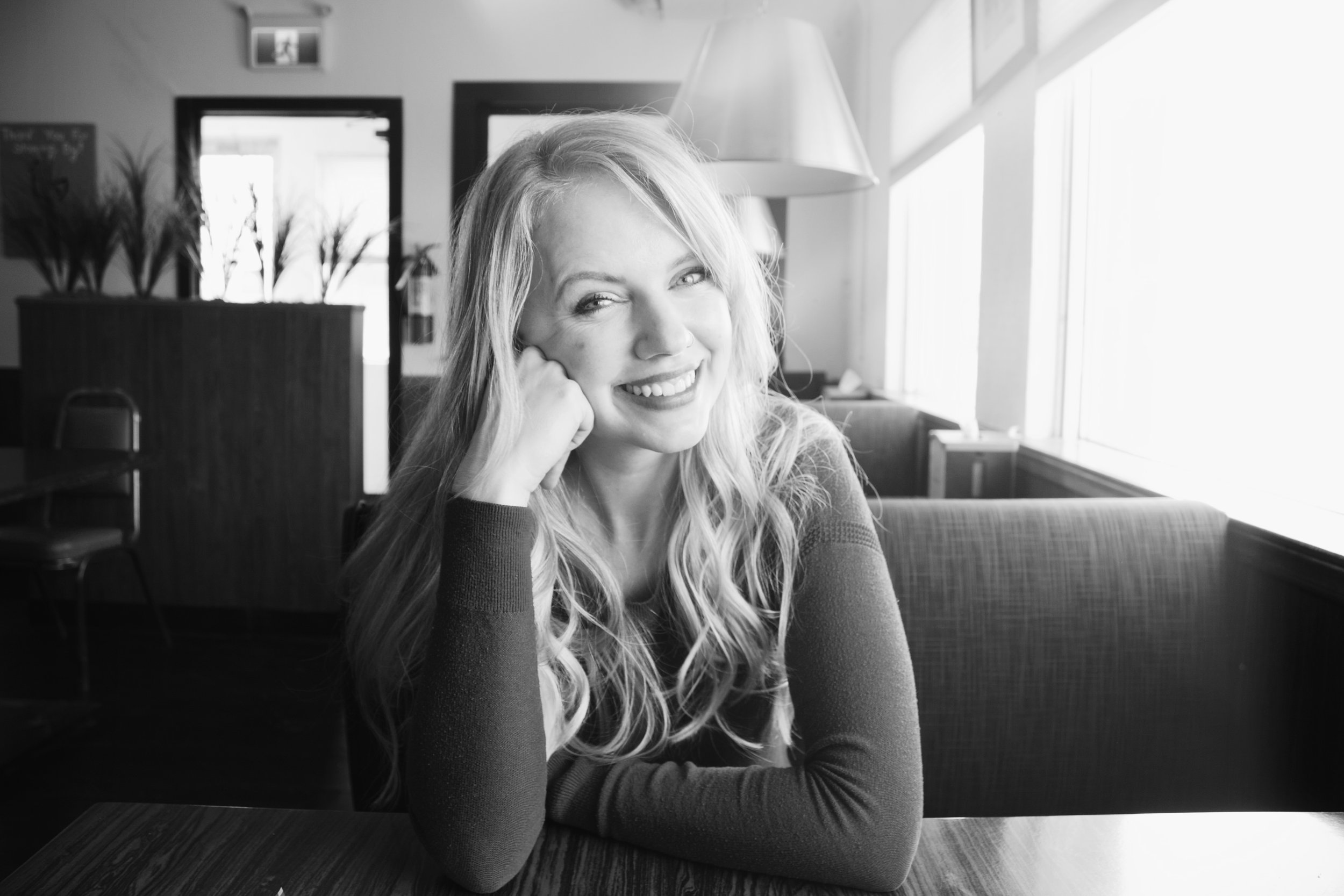
Author Suzy Krause.
About Suzy Krause:
Suzy Krause is the bestselling author of Sorry I Missed You and Valencia and Valentine. She grew up on a little farm in rural Saskatchewan and now lives in Regina, where she writes novels inspired by crappy jobs, creepy houses, personal metaphorical apocalypses, and favorite songs. Her work has been translated into Russian and Estonian.

Excerpt from Yellow Barks Spider by Harman Burns
it started with a little black box, past a door and down a hall, one with a light switch that didn’t seem to work. old corridor with a draft, a sound, voice; there might have been someone talking to you.
kid was shaping coloured plasticine between his finger and thumb, shaping it into a figure, a man, cowboy maybe — here’s a head, funny little legs, an arm, arms. the revolver. surrounded on the dining room table by clay sculptures, buildings and streets, a spacecraft, a whale. a world was unfolding in the structures spread out there, pushed and pressed into shapes and bodies and things, and someone might have been talking to him but kid didn’t mind it at all.
PART ONE
it started with a little black box, past a door and down a hall, one with a light switch that didn’t seem to work. old corridor with a draft, a sound, voice; there might have been someone talking to you.
kid was shaping coloured plasticine between his finger and thumb, shaping it into a figure, a man, cowboy maybe — here’s a head, funny little legs, an arm, arms. the revolver. surrounded on the dining room table by clay sculptures, buildings and streets, a spacecraft, a whale. a world was unfolding in the structures spread out there, pushed and pressed into shapes and bodies and things, and someone might have been talking to him but kid didn’t mind it at all.
as the figure took shape in his hands, kid’s thoughts wandered into memory: it might have been the night before, but kid was sure he had a dream at some point. he was almost sure of it.
he remembered telling his mom about the dream, and she listened to him and paused what she was doing to nod attentively as he told her. when kid finished, she said grandma understood what dreams meant, and she told kid to ask grandma what she thought of the dream.
his fingers were sticky with plasticine and the heel of his right hand was silvery gray from drawing with pencils and kid found grandma in the living room getting ready to play cards.
he climbed onto a chair across from her and she dealt him some cards and while he struggled to get them in order he chewed on his lip and asked her if she knew much about dreams.
i know about dreams, she said. tell me about yours.
she laid down a card, then another, and so did he. They played some cards, and kid told her. kid told her about the first time he dreamed about the shed. he told her about waking up
clawing at his pyjamas throwing off his covers trying to pull the spiders from his body. he told her about his dreams of spiders.
well, she said, dreaming about spiders means you’re growing up.
is that true.
yes. when you dream about spiders it means you’re changing. you’re growing up.
she laid down a card, then another, and so did he. While they played cards kid thought about that. kid thought about the little black box he’d built in his head where he kept the spiders.
the little black box at the end of the hall where the light switch didn’t work. kid thought about the things he promised himself he’d forget, the things he promised he’d bury forever in the deepest place a memory can go. he wondered if that’s what adults meant when they talked about growing up: learning to forget.
stepdad came downstairs and kid could hear the ice clink in his glass as he whispered something into mom’s ear and she gave him a playful push. stepdad came into the living room and stood beside the table and watched grandma beat kid at another hand.
careful, she’s ruthless, kid. she’ll go for the jugular at the first sign of weakness.
he came around behind kid’s chair and poked a finger into his ribs and when grandma beat kid at another hand stepdad said something like i told you so and everyone laughed. mom came in with a bowl of snacks and kid ate by the handful.
—from Yellow Barks Spider by Harman Burns. Published by Radiant Press. © 2024 by Harman Burns. Used with permission of Radiant Press.

Bring home Yellow Barks Spider, Radiant Press, October 22, 2024.
About Yellow Barks Spider:
Yellow Barks Spider (Radiant Press, 2024) akes place in the Canadian prairies, but it seeks to explore this landscape through the intimate lens of a ten-year-old trans kid. Set against the backdrop of the placid countryside, dusty summers and barren winters, it is both a queer coming-of-age novella as well as a deeply psychological character study, reflecting on the nature of memory, trauma, and self-discovery.
In the threadbare prairie town where Kid grew up, life moves slowly. For a troubled ten-year-old, the vast landscape of open skies and barren winters is a place of elemental magic and buried secrets. As the summers pass by, Kid explores a world of weed-choked yards, murky lakes, and a traveling carnival. But when Kid finds himself increasingly haunted by strange spider-infested visions of his next door neighbor’s shed, he falls deeper and deeper into his haunted inner world, eventually turning to mind-altering substances to combat his growing torment. Confronted by this psychic pressure, the book itself begins to crumble, splintering into disparate narrative voices as the workings of Kid’s imagination become animate, tactile—and language self-destructs.
Emerging from this crucible, Kid surfaces into adulthood as she moves through love, sex, and self-discovery as a trans woman. But when she returns to her hometown following the death of a family member, she is forced to reckon with all the fears she once left behind. Yellow Barks Spider is an unforgettable portrait of trauma, isolation, and self-compassion. At its heart, it is a deeply-felt exhumation of memory, love, and the human spirit.

Author Harman Burns
About Harman Burns:
Harman Burns is a Saskatchewan-born trans woman, filmmaker, sound artist and writer. Her practice is informed by folklore, nature, the occult and bodily transfiguration. Her writing has been published in Untethered Magazine and Metatron Press, and was shortlisted for The Malahat Review’s Far Horizons Award for Short Fiction. Burns currently resides on the unceded ancestral territories of the Musqueam, Squamish, and Tsleil-Waututh peoples (Vancouver).

Jewish Heritage Month Feature: Excerpt from Rubble Children by Aaron Kreuter
May is Jewish Heritage Month, and we are delighted to host an excerpt from Rubble Children (University of Alberta Press, July 2024)—new short fiction from Govenor General Award Finalist Aaron Kreuter.
Rubble Children is an absorbingly timely and necessarily explorative read, tackling Jewish belonging, settler colonialism, Zionism and anti-Zionism, love requited and unrequited, and cannabis culture, all drenched in suburban wonder and dread. Engaging, funny, dark, surprising, this collection is a scream of Jewish rage, a smoky exhalation of Jewish joy, a vivid dream of better worlds.
May is Jewish Heritage Month, and we are delighted to host an excerpt from Rubble Children (University of Alberta Press, July 2024)—new short fiction from Govenor General Award Finalist Aaron Kreuter.
Rubble Children is an absorbingly timely and necessarily explorative read, tackling Jewish belonging, settler colonialism, Zionism and anti-Zionism, love requited and unrequited, and cannabis culture, all drenched in suburban wonder and dread. Engaging, funny, dark, surprising, this collection is a scream of Jewish rage, a smoky exhalation of Jewish joy, a vivid dream of better worlds.
"What if the worldview you were raised in turns out to be monstrous? In the stories that form Rubble Children, Aaron Kreuter examines a Jewish community in flux, caught between its historical fealty to Israel and a growing awakening and resistance to it. Rubble Children is a book of great range: at once political, communitarian, empathetic, funny, revolutionary, touching, and hopeful. This is a work that is essential for our moment."
—Saeed Teebi, author of Her First Palestinian
The passage we are sharing below is from "Mourning Rituals," the first story in the collection, which takes place during the shiva for Joshua and Tamara's father.

Bring home Rubble Children by Aaron Kreuter.
From “MOURNING Rituals”, Rubble Children
That evening, the adults praying in the living room, facing east, worn blue prayer books brought from Kol B’Seder in their hands, bending and calling out, Joshua and Tamara sat with their cousins in the family room in half-tense silence. Simon in his Israeli Defense Forces uniform, Clarissa, her hair in a high bun, sweatpants tucked into woollies snug in Uggs, bent over her phone, thumbs dancing. Shelly, cuddling with Andre, her new boyfriend; he looked lost, out-of-place, the Hebrew rising and falling from the front of the house registering on his face as alien, off-putting cacophony.
Joshua was staring at the rug, the day’s bottomless allotment of grief having finally tipped his meager watercraft. Simon was looking around the house with detached, distant arrogance. His head was smooth, his skin tanned deep brown, his cheek shaven by naked blade. He’d made aliyah two years ago. Tamara was staring at him, her face souring with each passing minute.
She bent over to Joshua.
“It looks like Simon’s itching to pick a fight,” she said into his ear.
“Hmm...”
“He’s holding his babka like a semi-automatic.”
“He probably just misses his gun.”
“He’d rather be with his unit, riding a tank through the desert at dawn, trashing the house of a Palestinian family because the father looked at him funny.”
“Tamara, not now.”
“...I might just oblige him.”
Simon must have known they were talking about him.
“Sorry for your loss,” he said to them from across the room, the first thing he’d said to them since arriving. Tamara smiled sarcastically.
“How’s Panem?” she shot at him. “Get out to the districts much?”
Simon looked startled. “Pardon?” he said. He was affecting a slight Hebrew accent.
“Tamara!” Shelly shouted. Tamara looked at everyone in turn, the flourishes of prayer fluttering through the house. She was in her element.
“What?” she said, feigning innocence. “What? He chose to go over there and play-act as a colonialist, comes here to this house of mourning dressed in his uniform, and we’re supposed to sit here smiling like idiots?”
Now it was Joshua’s turn to put a hand on Tamara’s shoulder, to push pause on the coming confrontation. She shrugged it off but didn’t continue. It was too late, though: the flood gates were open.
Simon smiled. “What, you don’t approve of my joining the army or something? Shit, my dad’s right about you: you’re too far gone to the left to even see reality. I know your dad just died, and, like I said, I’m sorry about that, but do I really have to tell you that if we weren’t keeping the Arab hordes at bay your little North American hippie-dippie pacifist hacker existence would become ancient news?” Simon turned to Joshua now, who was trying not to look at anyone, trying to not get involved. “I hope you haven’t followed your sister to the dark side, Joshua. Especially you.”
He had no choice but to look at Simon. “What’s that supposed to mean?”
“You know what it means. Israel is the only country in the whole Middle East where you wouldn’t be stoned to death for your, for your…lifestyle.”
Joshua laughed, to himself, like he had had a private revelation. Tamara, though, Tamara’s mouth was agape. She was gathering her wits for a full-frontal assault, but Clarissa beat her to it, pivoting from her phone for the first time since she arrived.
“You know, Simon. I wasn’t going to say anything because I was raised better, but you’ve really become an asshole. And, I’m sorry, I’ve got to say it: why is joining the Israeli army, like, given a pass? You know how our parents would react if one of us joined the Canadian army? The Canadian army is for people from Saskatchewan! And the American army, oh, you’re a misguided, bloodthirsty imperialist! But the Israeli army! Ooooh, the Israeli army! Why, then, you’re fighting for the Jewish nation! You’re a hero! You’re rewriting the history of a blighted people! How does it not, like, ring terribly false? Hero! What total horseshit!”
Everybody was silent, stunned, in the wake of Clarissa’s outburst. Later, Joshua would tell Tamara how surprised he was that Clarissa had thoughts or feelings like that. “The last serious conversation we had was five years ago, when we debated which Backstreet Boy we’d rather went down on us.”
Somebody hiccupped and all eyes turned to Shelly. She was crying. Andre was stiff beside her, stuck between wanting to comfort his girlfriend and wanting to get out of this house of strange Jewish customs and head-on battles. Feeling the attention, Shelly looked up. “How could you say those things, Clarissa? And during my Aba’s shiva! Don’t act like you don’t remember how proud he was of Simon when he made aliyah! He is a hero, out there all alone protecting the homeland!” She jumped up and ran to her room, her feet stomping on the stairs echoing through the house.
Tamara and Joshua looked at each other. Andre looked like he had just found out that his father had died. Simon swept a triumphant scowl across the room, stood, smoothed his uniform, and went up the stairs after Shelly, not making a sound as he ascended. Clarissa shrugged, went back to her phone. The steady chatter that rose from the other room and permeated the house meant one thing: the prayers were finished. Soon the house would empty out, and, tomorrow, it would start all over again, the pattern repeating for four more days and then—just like that—ceasing, leaving the mourners alone with their grief, with nothing but time to do what it will.

More about Aaron Kreuter:
Aaron Kreuter's most recent poetry collection, Shifting Baseline Syndrome, was a finalist for the 2022 Governor General's Award, and was shortlisted for the 2022 Raymond Souster Award and the 2023 Vine Awards for Jewish Literature. His other books include the poetry collection Arguments for Lawn Chairs, the short story collection You and Me, Belonging, and, from spring 2023, the academic monograph Leaving Other People Alone: Diaspora, Zionism and Palestine in Contemporary Jewish Fiction. Aaron's first novel, Lake Burntshore, is forthcoming from ECW Press. He lives in Toronto, and is an assistant professor at Trent University.