

BLOG

Power Q & A with Allister Thompson
Like a lot of people, when I moved here, I was amazed at the sheer scope of a sparsely populated landscape, as well as its natural beauty, and it really captivated me. It still does. I wanted to share that feeling. Second, given that fact, I felt that while there is a great body of literature about northern Ontario, there can always be room for more!
Q: Why was it important to you to set your YA novel, Birch & Jay (Latitude 46 Publishing) in northern Ontario?
A: There were a few reasons for the setting being important. First, I live here. I know intimately the beauty of the northern wilderness and what it has to offer the imagination and the soul. Like a lot of people, when I moved here, I was amazed at the sheer scope of a sparsely populated landscape, as well as its natural beauty, and it really captivated me. It still does. I wanted to share that feeling. Second, given that fact, I felt that while there is a great body of literature about northern Ontario, there can always be room for more! And in this particular genre (speculative fiction/post-apocalyptic), I felt I could do something unique in this setting that no one has done before. Lastly, it was important to my process because my knowledge of this area, all the way down to Toronto, really enabled me to accurately describe and bring to life the settings in vivid ways.
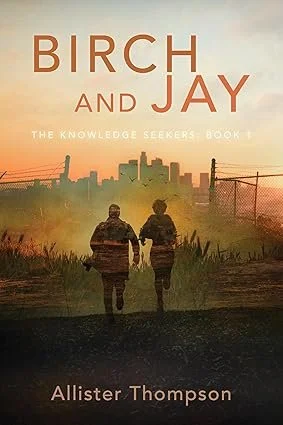
Birch & Jay by Allister Thompson, published by Latitude 46, spring 2025.
More about Birch & Jay:
Decades after the world was levelled by the effects of human-made climate change, the scattered remnants of humanity have begun to pull themselves together. Birch and Jay are a young couple living in a small, idyllic community away from the ruins of one of Canada’s great cities.
As a newly graduated Knowledge Seeker, Jay must leave Birch and their community to collect remnants of old wisdom from the dead world. Along the way, he comes across a mysterious elderly woman who offers to travel with him. He will receive more than a travel companion — she offers revelations about their town’s founding as well as knowledge of how to survive in a lawless world.
Birch, seeking adventure, pursues Jay but finds more danger than she ever imagined. Will they find each other in the chaos and brutality of the city and get safely back home to tell the tale?
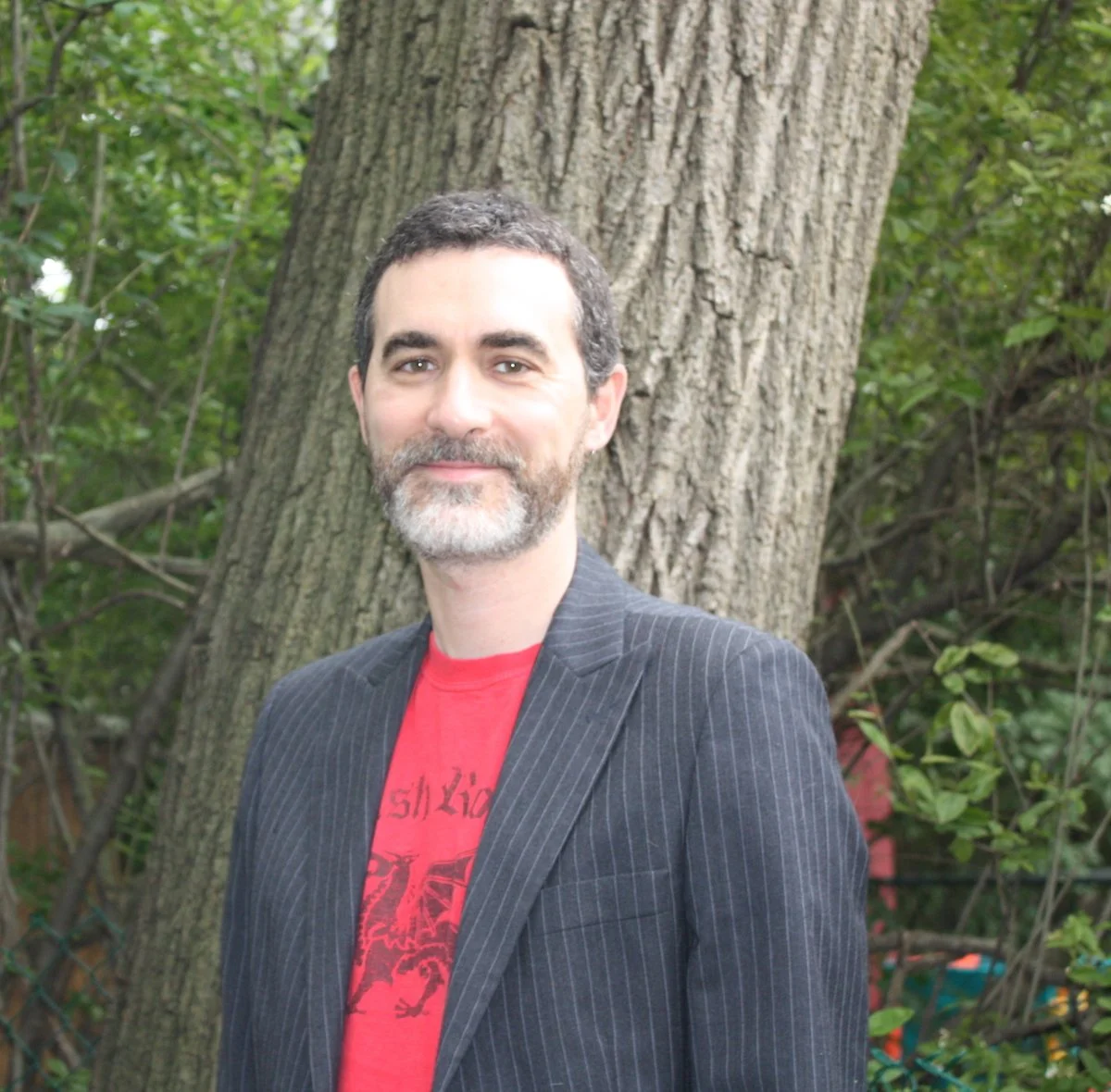
Author Allister Thompson
About Allister Thompson:
Allister Thompson was born in the UK and spent his childhood in Mississauga, Ontario, where he got his first part-time job in a small bookstore at the mall at age sixteen. He has spent the rest of his life working in the publishing and bookselling industries. He worked for small and mid-sized publishers in Toronto for fifteen years before striking out on his own as a freelance editor. This freedom eventually led him to North Bay, Ontario, where he has lived and worked with dozens of authors for the past ten years.

Power Q & A with Bruce Hunter
Frontenac House Press has published a gorgeous reissue of Bruce Hunter’s award-winning novel of love, disability, and wildness, In the Bear’s House(May 23, 2025.)
Set in 1960s Calgary and Alberta ‘s backcountry, this reissue of In the Bear’s House tells the story of a creative young mother, Clare Dunlop, raising her deaf son against the insurmountable odds of poverty, mental illness and hardship. In the Bear’s House is ultimately about listening to the wild and the wilderness, and what we lose when it’s gone.
We are honoured to have Bruce join us to answer a question about the rebirth of his much-loved story.
Frontenac House Press has published a gorgeous reissue of Bruce Hunter’s award-winning novel of love, disability, and wildness, In the Bear’s House (May 23, 2025.)
Set in 1960s Calgary and Alberta ‘s backcountry, this reissue of In the Bear’s House tells the story of a creative young mother, Clare Dunlop, raising her deaf son against the insurmountable odds of poverty, mental illness and hardship. In the Bear’s House is ultimately about listening to the wild and the wilderness, and what we lose when it’s gone.
We are honoured to have Bruce join us to answer a question about the rebirth of his much-loved story.
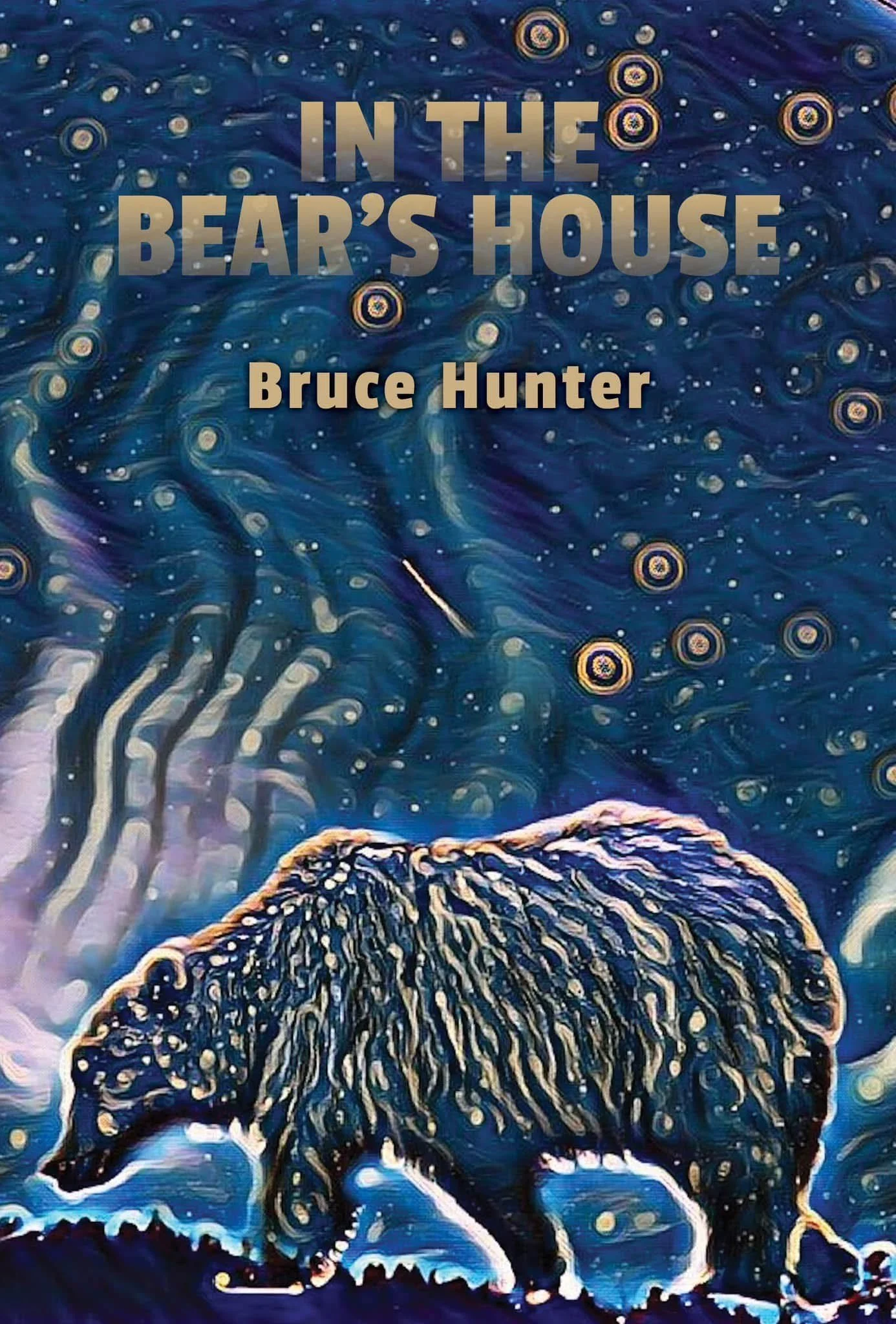
In the Bear’s House by Bruce Hunter
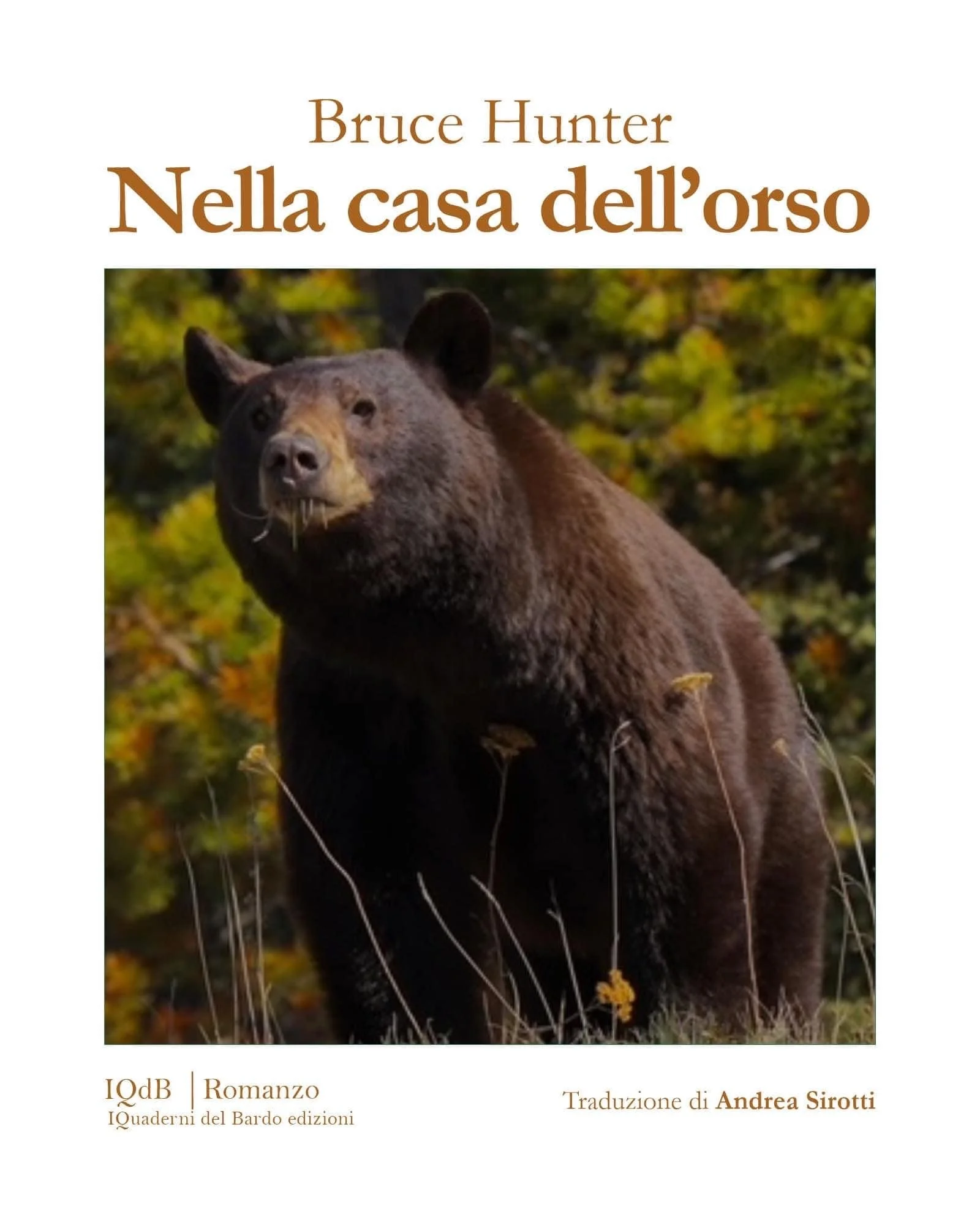
Nella casa dell’orso by Bruce Hunter, translated by Andrea Sirotti, published by iQdB eidizioni.
Q: What has it been like to reissue In the Bear’s House and have it translated?
A: As a mature writer on the eve of his 73rd birthday on May 21, I’m gobsmacked to have in my hands an Italian translation by iQdB eidizioni, and a sparkling new edition by Calgary’s Frontenac House. What a validation of my life’s work. Which I hope is an inspiration to all writers, young and old. To borrow a baseball metaphor, it’s all about staying in the game, whether you strike out or not, and keep getting up to bat.
Both publishers lavished such love on their books, inside and out. Both books radiate that level of professionalism and care.
I first published In the Bear’s House in 2009. It sold well and won an award at the Banff Mountain Film and Book Festival where it was deemed a mountain classic. But the publisher disappeared as did my edited galleys. I gave up all hope of ever seeing it in print again. Then my neighbor, the gifted poet and editor, Elana Wolff read It. It speaks to our times, she said. You must get it out there.
A cousin in IT scanned the hard copy and created a new submissible file. I showed it to the brilliant editor Micheline Maylor-Kovitz at Frontenac House in Calgary who took it to her bosses. There, Micheline, Terry Davies, and Neil Pretunia helped me take In the Bear’s House to a whole new level.
In the meantime, my Italian publisher brought out a translation as Nella casa dell’orso (literally, ln the House of the Bear). In April, I did a four-city tour to Lecce, Copertino, Florence, and Trieste, where the audiences’ enthusiastic response showed the story of a creative young mother and her deafened son in 1960s Alberta transcends time, language, and culture.
I look forward to the Calgary launch on May 23. What a birthday gift. From the bottom of my mended heart, gratitude to every one of you who got me here.
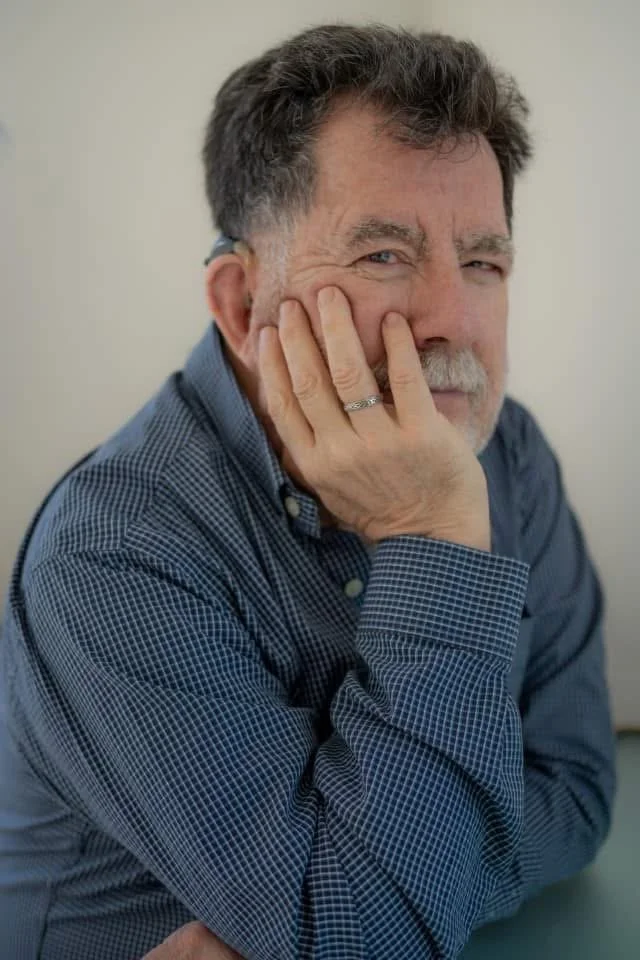
Bruce Hunter
About Bruce Hunter:
Bruce Hunter is a writer, editor, speaker, and mentor. In 2024, his novel, Nella casa dell’orso, was published in Italy by iQdB edizioni. In 2023, his poetry collection, Galestro, was published in Italy, following the release there in 2022 of A Life in Poetry, Poesie scelteda Two O’clock Creek, also by iQdB edizioni. 1n 2021, his memoir essay, “This is the Place I Come to in My Dreams” was shortlisted for the Alberta Magazine Publishers’ Awards. In 2024, his long poem “Dark Water” from Galestro won Gold for poetry for the Alberta Magazine Publishers’ Awards. And he is a proud new grandfather of Alice, Julian and Lucas.
Born in Calgary, Alberta, Bruce was deafened as an infant and afflicted with low vision much of his adult life. He grew up in the working-class neighbourhood of Ogden in the shadow of Esso’s Imperial Oil Refinery and now decommissioned Canadian Pacific Railway’s Ogden Shops. Calgary is located on Treaty Seven lands, in the traditional territories of the Blackfoot Confederacy (Siksika, Kainai, Piikani), the Tsuut’ina, the îethka Nakoda Nations (Chiniki, Bearspaw, Goodstoney), the Otipemisiwak Métis Government (Districts 5 and 6).
In his early teens Bruce discovered writing, for there he could hear everything – and be heard. After high school, he worked for ten years as a labourer, equipment operator, Zamboni driver, and completed his technical education and apprenticeship as a gardener and arborist. In his late twenties, his published poetry won him a scholarship to the Banff School of Fine Arts to study with novelist W.O. Mitchell and poet Irving Layton. From there he went onto York University to study film and literature and taught in the creative writing department before landing a position at Seneca College.
His poetry, fiction, reviews, interviews, and creative nonfiction have appeared in over 90 blogs, journals and anthologies internationally in Italy, Canada, China, India, Romania, the U.K. and the U.S.
Bruce has authored seven poetry books, as well as the best-selling CBC Radio-produced 1996 short story collection, Country Music Country (the third edition, the Reboot appeared in 2018).
In 2009, In the Bear’s House, won the Canadian Rockies Prize at the Banff Mountain Book and Film Festival. In 2010, his book Two O’clock Creek – poems new and selected, won the Acorn-Plantos Peoples’ Poetry Award for Canada.
Bruce was the 2017 Author in Residence for Calgary Public Library. His past residencies include the Banff Centre, Deaf and Hear Alberta, Richmond Hill Public Library, University of Toronto, Mount Royal University, and many others across Canada.
Bruce is an associate member of the Association of Italian Canadian Writers, a full member of the Canadian Authors Association, a life member of the Canadian Hard of Hearing Association (C.H.H.A.), and the Canadian National Institute for the Blind (C.N.I.B.), as well as long-time member of the League of Canadian Poets, the Writers’ Union of Canada, and the Writers’ Guild of Alberta. For more than three decades, Bruce has championed accessibility for those with vision and hearing loss.

Power Q & A with Caitlin Galway
The longer form definitely comes naturally to me, though it’s not something I set out to do, so much as a reflection of how I think. I’ve learned to see my own intuitive approaches more clearly, and how to amplify or deconstruct them, challenge or upend them. Something particular that I’ve realized is that as I write, everything is somewhat of a spiderweb; ideas emerge connected to several other ideas, which connect to one layer, then another, and so on. It’s part of what feeds me electricity as a writer: this instantaneous, sparking interaction between narrative, symbolism, philosophy, psychological and emotional interiority, history, and commentary, and I find that it means the story will probably need more breathing room.

Q: Your short fiction collection, A Song for Wildcats (Dundurn Press, 2025), is remarkable in many regards: it has lilting, poetic language, haunting and gorgeous imagery, and—what we want to ask you about today—an unusual structure. Your book is made up of five longer stories, as opposed to many shorter ones. Would you tell us about writing longer form short fiction?
A: The longer form definitely comes naturally to me, though it’s not something I set out to do, so much as a reflection of how I think. I’ve learned to see my own intuitive approaches more clearly, and how to amplify or deconstruct them, challenge or upend them. Something particular that I’ve realized is that as I write, everything is somewhat of a spiderweb; ideas emerge connected to several other ideas, which connect to one layer, then another, and so on. It’s part of what feeds me electricity as a writer: this instantaneous, sparking interaction between narrative, symbolism, philosophy, psychological and emotional interiority, history, and commentary, and I find that it means the story will probably need more breathing room.
“The Lyrebird’s Bell”, for example, on a narrative level is a story about two young girls and the absorbing, even disturbing bond they form in response to isolation and familial abuse. There’s a prominent layer exploring the complexities of human relationships, and another navigating grief, trauma, and the impulse to retain some shred of love. However, it’s also a story about essentialism, and how metaphysical reflection might manifest in the mind of a child desperate to make sense of the inexplicable. It’s also about imagination, both as joy and necessity, and why it’s so often steeped in myth.
Those layers need to engage with one another thoughtfully and meaningfully, and as a result, I usually feel a certain elasticity to a story. It keeps lengthening because it demands more space to explore itself, and for me, it’s a matter of being receptive and listening.
More about A Song for Wildcats:
Infatuation and violence grow between two girls in the enchanting wilderness of postwar Australia as they spin disturbing fantasies to escape their families. Two young men in the midst of the 1968 French student revolts navigate — and at times resist — the philosophical and emotional nature of love. An orphaned boy and his estranged aunt are thrown together on a quiet peninsula at the height of the Troubles in Ireland, where their deeply rooted fear attracts the attention of shape-shifting phantoms of war.
The five long-form stories in A Song for Wildcats are uncanny portraits of grief and resilience and are imbued with unique beauty, insight, and resonance from one of the country's most exciting authors.

About Caitlin Galway:
Caitlin Galway is the author of the novel Bonavere Howl and the forthcoming short story collection A Song for Wildcats. Her work has appeared in Best Canadian Stories 2025, EVENT, Gloria Vanderbilt's Carter V. Cooper Anthology, House of Anansi's The Broken Social Scene Story Project (selected by Feist), The Ex-Puritan as the 2020 Morton Prize winner (selected by Pasha Malla), Riddle Fence as the 2011 Short Fiction Contest winner, and on CBC Books as the Stranger than Fiction Prize winner (selected by Heather O'Neill).

Power Q & A (Part II) with Kathryn Kirkpatrick
Talk about wonder! Paula Meehan's work came to me in the mail as a request for a book review! Poet and editor R.T. Smith certainly kept channels open for synchronicities, and I'll always be grateful for that request. I think currently we're suffering from the Cartesian dualisms inherent in our capitalist version of modernity, and we've got some horrendous fixes floating around. Paula's beautiful work combines a compassionate, progressive politics (for lack of a better word) through a thoroughgoing critique of the class exploitations underwriting modernity as we know it.

Q: Your book, Enraptured Space: Gender, Class, and Ecology in the Work of Paula Meehan
(West Virginia University Press, 2025) opened our world to a poet we, admittedly, had never heard of before. Would you tell us why the work of Paula Meehan is particularly salient today and how you came to her writing?
A: Talk about wonder! Paula Meehan's work came to me in the mail as a request for a book review! Poet and editor R.T. Smith certainly kept channels open for synchronicities, and I'll always be grateful for that request. I think currently we're suffering from the Cartesian dualisms inherent in our capitalist version of modernity, and we've got some horrendous fixes floating around. Paula's beautiful work combines a compassionate, progressive politics (for lack of a better word) through a thoroughgoing critique of the class exploitations underwriting modernity as we know it. I think her work invites us to find a third way through the dualisms of culture/nature, man/woman, head/heart, reason/feeling. What does that world look like? How might we feel and think our way into it? Can we keep what we've learned through this human passage through capitalist modernity and come through it with the insight and lessons, while being open to what might come next? I think she's always on the border of this kind of seeing, and I want to be there with her, and to be there also in my own life and writing.
More about Enraptured Space: Gender, Class, and Ecology in the Work of Paula Meehan:
Drawing on her own lived experiences as a practicing poet, Kirkpatrick explores how scholarship is grounded in an imaginative exchange between words on the page and the material conditions of the scholar who works to inhabit them. With chapters of literary analysis swimming in a conversation between poets, this book breaches the boundaries between criticism and memoir, suggesting the ways that every scholar is transformed by the subjects they study.
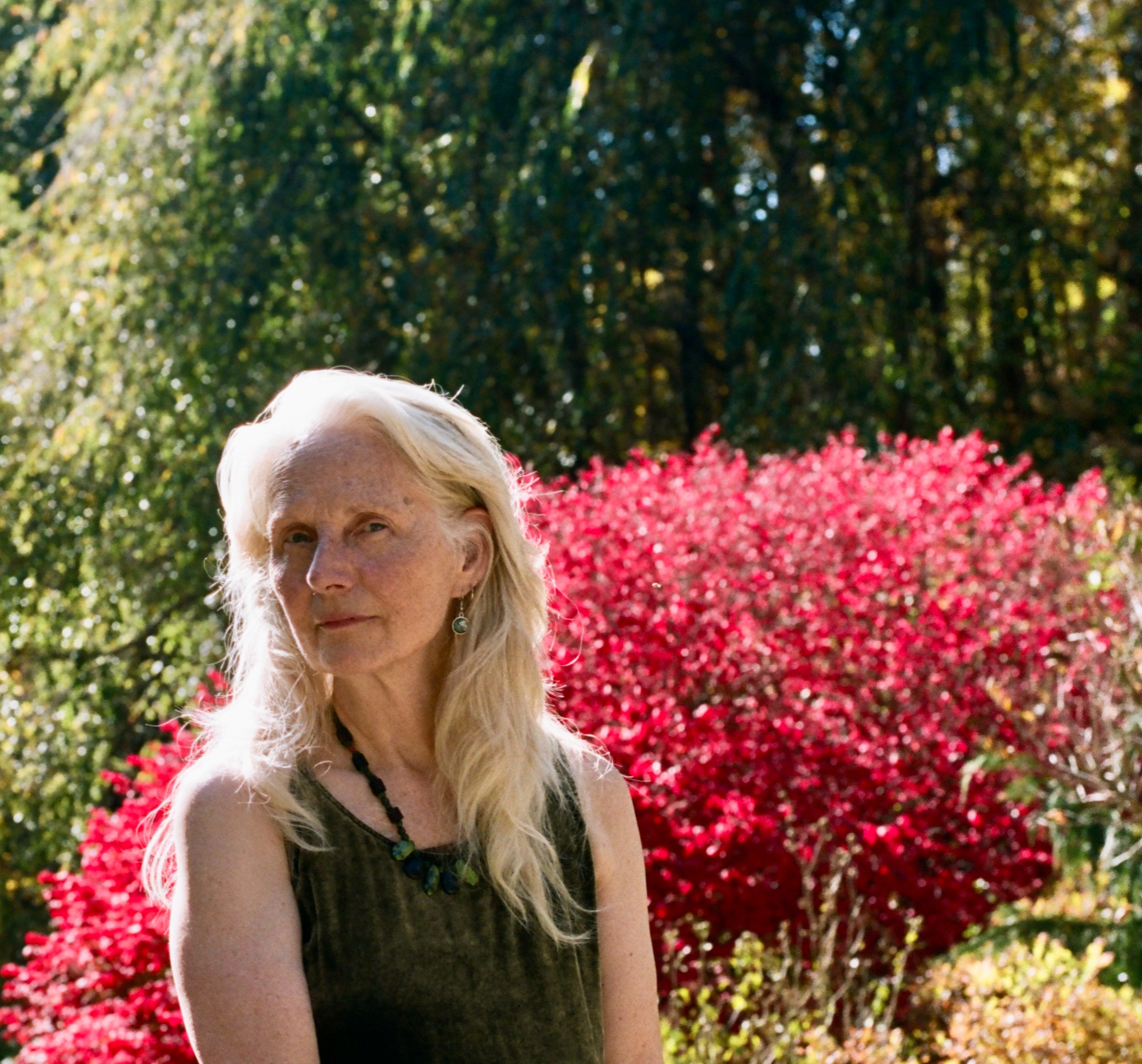
About Kathryn Kirkpatrick:
Kathryn Kirkpatrick is the author of seven collections of poetry, including three recipients of the NC Poetry Society’s Brockman-Campbell award. The Fisher Queen: New & Selected Poems (Salmon, 2019) received the NC Literary and Historical Society’s Roanoke-Chowan Poetry Prize. Although she grew up in the nomadic subculture of the U.S. Air Force and spent my childhood in the Philippines, Texas, and Germany, she has lived in the Blue Ridge Mountains for many years, where she teaches environmental literature, animal studies, Irish studies, and creative writing as Professor of English at Appalachian State University.

Power Q & A with Kathryn Kirkpatrick
These two words—insistence and wonder—speak to the paradox of making poems. There's got to be a willfulness involved in showing up to the blank page or the page with scattered lines and notes for a poem. I have to be insistent about that time and space. If I'm not, if I let the business of life's obligations take over, then there's an emotional and physical insistence that arises.

Q: We devoured your beautiful poetry collection, Creature (Jacar Press, 2025). Would you speak to how “insistence and wonder” I play a part in your poetic practice?
A: These two words—insistence and wonder—speak to the paradox of making poems. There's got to be a willfulness involved in showing up to the blank page or the page with scattered lines and notes for a poem. I have to be insistent about that time and space. If I'm not, if I let the business of life's obligations take over, then there's an emotional and physical insistence that arises. I feel heavy and a bit out of focus. Because I know that when I'm faithful to my practice, I have so much more access to a state of wonder, when what's offered by experience is so rich, I can't stay outside my practice for long. Or, if I do, I'm simply unhappy. The wonder for me is having access to other dimensions of life and reality--I start to recognize synchronistic events unfolding across the day, insights I wasn't making space and time for otherwise. Yet it takes courage to show up consistently, insistently (!) for that dynamic dimension of life. It both provides a grounding and a need for a grounding--wonder can sweep you away, take you outside time--and I still have to pay the bills. Perhaps that's why the monastic orders provide such ritualized structures to hold an intensely spiritual life and its wondrous dimensions. (I'm writing now as the new Pope is being chosen!)
About Creature: Poems:
What does it mean to be a person in relation to others, both human and animal? Rife with observations of the natural and manmade worlds, Creature by Kathryn Kirkpatrick is a garden of awareness and grief, insistence and wonder. In this full-length collection, Kirkpatrick blends a clarity of vision with a close attention to form, metaphor, and the nuances of language. These are poems rooted in landscape and memory, about mothers and daughters, love and mourning, and the harrowing context in which we now find ourselves living. Creature offers a poetry of paying attention and of being in the world, ultimately revealing that what is most human about us is what is most creaturely, and how we are all ultimately “tossed in the vastness.” Natalie Eleanor Patterson, Editor’s Choice Award.

About Kathryn Kirkpatrick:
Kathryn Kirkpatrick is Professor of English at Appalachian State University where she teaches environmental literature, animal studies, and Irish studies from an ecofeminist perspective and where she co-directs the animal studies minor, a multidisciplinary program she helped to found. Kirkpatrick has published essays on class trauma, eco-feminist poetics, and animal studies, focusing particularly on the work of Dublin poet Paula Meehan. Her monograph on Meehan’s work, Enraptured Space, is from West Virginia University Press (2025). She is co-editor of Animals in Irish Literature and Culture (2015), which includes her essay on the representation of foxes in Somerville and Ross’s Irish PM stories. As well as a scholar and editor, Kirkpatrick is the author of eight collections of poetry, including three recipients of the NC Poetry Society’s Brockman-Campbell award, The Body’s Horizon (1996), Our Held Animal Breath (2012), and Her Small Hands Were Not Beautiful (2014). The Fisher Queen: New & Selected Poems (Salmon, 2019) received the NC Literary and Historical Society’s Roanoke Chowan Poetry Prize. Creature was published by Jacar Press in 2025.

Power Q & A with Catherine Bush
Like many writers, I started out writing stories but very quickly discovered that a story I cared about deeply was trying to be a novel, so I plunged headlong into long-form fiction and never looked back. That unwieldy story became my first novel, Minus Time. I felt like the novel was my natural breath as a writer. A few years ago, I became intrigued by the wild and meaningful compression of flash fiction – the opposite of a novel. I started writing stories again more intently during the pandemic at a time when I felt exhausted and unable to start a new novel.

Q: How has writing this collection of short stories, Skin (Gooselane Editions, 2025) been different than writing a novel? And how has your publishing experience been different if it has?
A: Like many writers, I started out writing stories but very quickly discovered that a story I cared about deeply was trying to be a novel, so I plunged headlong into long-form fiction and never looked back. That unwieldy story became my first novel, Minus Time. I felt like the novel was my natural breath as a writer. A few years ago, I became intrigued by the wild and meaningful compression of flash fiction – the opposite of a novel. I started writing stories again more intently during the pandemic at a time when I felt exhausted and unable to start a new novel. Writing stories allowed me to enter other worlds on compressed timelines, to play, try out new things, seek pleasure at a time when pleasure was hard to find. I love the challenge of bringing a complex world to life in no more than a few pages. I love aiming for unpredictability in the story form, unusual intimacy, the swerve. The short arc rather than the long one. One of the perhaps unorthodox qualities of my collection is that it assembles stories of truly varied lengths, from flash to novella and those in between. A few of the stories, such as The International Headache Conference, about a woman who has an intense hook-up-type encounter with another migraine sufferer, or Voices Over Water, which draws on stories told to me by my father and grandfather, are older, re-edited for the collection. Benevolence, the long story that opens the collection, takes an idea that I began to explore years ago and totally re-imagines it. The title story, about a woman obsessed with foot washing, and Derecho, in which a man finds himself strangely attracted to extreme winds, are two of the newer stories. Because the stories were conceived over a long span of time I think of them as kind of a fictional autobiography (emphasis on fiction!).
My editor, André Alexis, was the person who said that he thought I should turn the stories into a collection and as I revised them, we both gave a lot of thought about how to order the stories to create a meaningful journey for the reader and, ultimately, a sense of a whole. Honestly, I think that the taxonomic distinction between novels and stories is a bit of a false one: novels come in all sorts of forms and lengths, as do stories. Whatever fiction you’re trying to create, it needs to find its necessary length – and breath!
More about Skin:
Now, for the first time, a blistering book of short fiction from one of Canada’s most loved novelists.
In Skin, Catherine Bush plunges into the vortex of all that shapes us. Summoning relationships between the human and more-than-human, she explores a world where touch and intimacy are both desirable and fraught.
Ranging from the realistic to the speculative, Bush’s stories tackle the condition of our restless, unruly world amidst the tumult of viruses, climate change, and ecological crises. Here, she brings to life unusual and perplexing intimacies: a man falls in love with the wind; a substitute teacher’s behaviour with a student brings unforeseen risks; a woman becomes fixated on offering foot washes to strangers.
Bold, vital, and unmistakably of the moment, Skin gives a charged and animating voice to the question of how we face the world and how, in the process, we discover tenderness and allow ourselves to be transformed.

About Catherine Bush:
Catherine Bush is the author of five novels. Her work has been critically acclaimed, published internationally, and shortlisted for numerous awards. Her most recent novel, Blaze Island, was a Globe and Mail and Writers’ Trust of Canada Best Book of the Year, and the Hamilton Reads 2021 Selection. Her other novels include the Canada Reads longlisted Accusation; the Trillium Award shortlisted Claire's Head; the national bestselling The Rules of Engagement, which was also named a New York Times Notable Book and a L.A. Times Best Book of the Year; and Minus Time, shortlisted for the City of Toronto Book Award. The recipient of numerous fellowships, Bush has been Writer-in-Residence/Landhaus Fellow at the Rachel Carson Centre for Environment and Society in Munich and a Fiction Meets Science Fellow at the HWK in Delmenhorst, Germany. An Associate Professor of Creative Writing at the University of Guelph, she lives in Toronto and in an old schoolhouse in Eastern Ontario.

Power Q & A with Anthony Bidulka
We are beyond thrilled to be welcoming many time award-winning author, Anthony Bidulka to our blog to talk to us about his compulsively readable and utterly absorbing new mystery thriller, Home Fires Burn (Stonehouse Publishing, June 1, 2025). Anthony is a Canadian legend of the mystery thriller genre who writes from places and perspectives that you don’t often see represented on the page.
We are beyond thrilled to be welcoming many time award-winning author, Anthony Bidulka to our blog to talk to us about his compulsively readable and utterly absorbing new mystery thriller, Home Fires Burn (Stonehouse Publishing, June 1, 2025). Anthony is a Canadian legend of the mystery thriller genre who writes from places and perspectives that you don’t often see represented on the page.
Welcome Anthony to our Power Q & A to tell us about his new book!

Home Fires Burn by Anthony Bidulka, published by Stonehouse Publishing.
Q: When so many mystery novels are set in global metropolis, tell us about the importance to you as an author of setting your book in a smaller city in Saskatchewan.
A: Even as a young boy growing up on a small family farm in rural Saskatchewan I knew I wanted to write. And I had a lot of ideas. What I didn't have was an answer to the question: Why do I write? In my case it took decades to come up with the concise answer I have today. My WHY is this: I write to tell stories about underrepresented people and underrepresented places in a way that is accessible and entertaining.
Part of the reason for this is that growing up and even as a young adult, I rarely saw myself or my place or my community reflected in mainstream fiction. But when I did, it was mind-blowing, and felt important. Representation is important. As I came to define what was important to me as a writer this was top of mind.
From a purely practical side of things, finding a way to distinguish yourself in a very competitive industry is not a bad thing. With my first series I was able to factually claim that my protagonist, Russell Quant, was the first and only wine-swilling, wise-cracking, world-travelling, ex-cop, ex-farm boy, gay, rookie Canadian prairie private eye. With my current trilogy, I can describe my heroine Merry Bell as the first and only kick-butt, Canadian prairie, transgender P.I. To be able to do so sets me apart as a writer, is pretty cool, and serves my WHY perfectly.
ABOUT HOME FIRES BURN:
From the author of Crime Writers of Canada Best Crime Novel, Going to Beautiful, comes the final, standalone book of the Merry Bell trilogy. A celebrated philanthropist is found slumped against his car, frozen to death. Trans private investigator Merry Bell is hired by his son, country music star Evan Whatley, to find out the truth behind what really happened on that desolate stretch of road. As Merry’s investigation uncovers old wounds that never healed, her own are revealed as she confronts her pre-transition past and questions the boundaries of family and friendship.

About Anthony Bidulka:
Anthony Bidulka’s books have been shortlisted for Crime Writers of Canada Awards of Excellence, Saskatchewan Book Awards, a ReLit award, and Lambda Literary Awards. Flight of Aquavit was awarded the Lambda Literary Award for Best Men’s Mystery, making Bidulka the first Canadian to win in that category. In 2023, in addition to being shortlisted for a Saskatchewan Book Award and Alberta Book Publishing Award, Going to Beautiful won an Independent Publisher Book Award being named Gold Medalist as the 2023 Canada West Best Overall Fiction novel and was awarded the Crime Writers of Canada Award of Excellence as Canada’s Best Crime Novel for 2023.

Power Q & A with Sharon Berg
May is National Short Story Month and we’re kicking it off with a brief and salient interview with award-winning multi-genre writer Sharon Berg, author of many books, including the short fiction collection, Naming the Shadows (Porcupine’s Quill 2019). Never one to shy away from tough conversations, we ask Sharon about writing difficult subjects as a necessary part of the responsibility we bear for one another.
May is National Short Story Month and we’re kicking it off with a brief and salient interview with award-winning multi-genre writer Sharon Berg, author of many books, including the short fiction collection, Naming the Shadows (Porcupine’s Quill 2019). Never one to shy away from tough conversations, we ask Sharon about writing difficult subjects as a necessary part of the responsibility we bear for one another.
Thank you to Sharon for joining us, and for your thoughtful response to our question. Keep reading.

Naming the Shadows by Sharon Berg (Porcupine’s Quill 2019).
Q: We are interested in your advice for writers who want to deal with difficult topics like violence against children, and how to do this with honesty while still being sensitive to readers. We are not readers who feel like we should be spared violence to save our own fragile sense of safety. We never think we should turn from the humanity of others.
A: Yes, I’m dealing with violence against children and young women in my stories and poetry all the time! If people hadn't turned away from the horrible things being done to me as a child or young woman, and if several agencies hadn’t failed me or my children, our lives would have turned out a whole lot differently. A big part of that is the laws protecting children need to be stronger, and the agencies claiming to safeguard them have to be more honest about what they will or cannot [read that as do not] do for them. Andrea Munro’s case against the husband of her mother points this out as she was failed by so many people and agencies in dealing with her trauma. Everyone is quick to point to Alice Munro’s failings but they don’t address the basic fact that neither her father or the several agencies involved truly addressed her pain.
There can be no denial that our laws need to change. When my daughter was sexually abused as a four-year-old by a neighbour in 1979, I was told by a policeman who said he 100% believed her, no child could testify against an adult. He suggested I try to catch him in the act next time. Absurd. I moved within two weeks. But I can tell you nothing is different in 2025 and that is beyond ridiculous. We have a duty as individuals living in a democracy such as Canada... to protect children and each other... or our house is built on a pile of lies.
I can’t be convinced people don’t have a responsibility to each other when we live in community. That’s the definition of community in my eyes. Refusing to review our legal response and neighbourly alert systems to the various trauma suffered by children says we deny our reality. I believe, as a writer, I have a duty. Fiction and poetry can and has addressed the unwilling observor and pulled them into action. Stories can speak to the heart, convincing us through artful writing, to address the trauma suffered by others. What I’m addressing in my stories is mainly the daily skirmishes being fought in our country and others around the world, the hidden casualties of an on-going war with paternalism and criminal mindset. That sort of war is just as important as any other. It gives criminals an arena to practice in. We need to stand on guard for all of those daily victims.
I truly believe I’m broadening people’s awareness through my writing or I wouldn’t bother. As Margaret Atwood has said, nothing I write about hasn’t happened, and I’d lay dollars to donuts the same is true for Alice Munro and Margaret Laurence. For my own female characters, I’d say nothing I write about hasn’t happened to me or a dearly loved one. Who can argue with the truth? I can’t speak for other authors, but I just add some literary devices and stir.
More about Naming the Shadows (Porcupine’s Quill 2019):
Sharon Berg’s quietly insightful collection focuses on relationships between generations, acknowledging the prevalence of the shadows that are everywhere—but also celebrating the light.
The stories in Naming the Shadows are touched with humour and outrage, mystery and shadow. Curious preteens receive an unexpected education at a mall-side carnival show. A lonely dairy farmer develops a special bond with his neighbours’ children, then suffers unexpected consequences. An ageing author manages to get one up on her adversarial interviewer, while another woman’s unsettling way of remembering past lovers confirms her emotional freedom.
In these stories of loss and learning, conflict and memory run through generations, innocence gives way to experience, and all must learn to redefine themselves and the way they see the world.

Author Sharon Berg. Photo credit: Cathi Carr.
More About Sharon Berg:
Sharon Berg’s work appears in Canada, USA, Mexico, England, Wales, Amsterdam, Germany, India, Singapore, and Australia. Her poetry includes To a Young Horse (Borealis 1979), The Body Labyrinth (Coach House 1984), three poetry chapbooks (2006, 2016, 2017), plus Stars in the Junkyard (Cyberwit 2020) was a 2022 International Book Award Finalist. Her short story collection is Naming the Shadows (Porcupine’s Quill 2019). The Name Unspoken: Wandering Spirit Survival School (BPR Press 2019) won a 2020 IPPY Award for Regional Nonfiction. She’s Resident Interviewer for The tEmz Review (London, ON, Canada) and operates Oceanview Writers Retreat out of Charlottetown, Newfoundland, Canada.

Power Q & A with Amanda Shankland
Speech Dries Here on the Tongue (edited by Hollay Ghadery, Rasiqra Revulva, and Amanda Shankland) is an anthology of poetry by Canadian authors, published by The Porcupine’s Quill, exploring the relationship between environmental collapse and mental health.
It’s been listed as a book to read by Quill & Quire and CBC Books, and we’re honoured to have one of the editors, Amanda Shankland, join us for this Power Q & A to talk about where this anthology started for her.
Speech Dries Here on the Tongue (edited by Hollay Ghadery, Rasiqra Revulva, and Amanda Shankland) is an anthology of poetry by Canadian authors, published by The Porcupine’s Quill, exploring the relationship between environmental collapse and mental health.
It’s been listed as a book to read by Quill & Quire and CBC Books, and we’re honoured to have one of the editors, Amanda Shankland, join us for this Power Q & A to talk about where this anthology started for her.

Speech Dries Here on the Tongue edited by Hollay Ghadery, Rasiqra Revulva, and Amanda Shankland, Porcupine’s Quill, 2025.
The idea for Speech Dries on the Tongue came to me during the long months of the pandemic. We all felt trapped in some way, in our homes, in our families, in our heads. Long walks were an escape from isolation, from uncertainty, and sometimes, from ourselves. Connecting with nature has always brought me peace. I thought about how others around the world might be connecting with nature at a time when we all stood face-to-face with an unclear future.
I started thinking a lot about how the pandemic wasn’t just a health crisis- it was also part of a larger story about disconnection, environmental loss, and how fragile our relationships with each other and the natural world can be.
In early 2021, I lost a dear friend to suicide. It was devastating and sad to know that despite the love of his family and friends, he did not get help in time. It reminded me of how important it is to find ways of connecting, especially in difficult times.
Poetry has always been a space for me to connect, share my inner struggles and remind myself that in spite of how difficult life can be, we are all experiencing similar emotions- grief, anger, love, frustration, and hope- are all part of the human experience.
That’s how this book started- as an idea to gather voices together. To create something honest about how we were living through this moment. About how we are part of the world around us and how who we are is fundamentally shaped by our environment.
Speech Dries on the Tongue is an anthology about isolation, connection, environmental grief, and the ways we care for each other in uncertain times.
More about Speech Dries on the Tongue :
Speech Dries Here on the Tongue is an anthology of poetry by Canadian authors exploring the relationship between environmental collapse and mental health. This threat of environmental collapse has brought with it a sense of impending annihilation and has contributed to the current mental health crisis, made crueller by a global pandemic that highlighted our fragile nature. These are poems by writers who have used their words to both articulate and navigate this crisis, unpacking the complex interplay between mental and environmental health in order to alert, inform, and inspire readers.
Edited by Hollay Ghadery, Rasiqra Revulva, and Amanda Shankland, the collection includes work by Brandon Wint, Jennifer Wenn, Canal Smiley, Amanda Shankland, Concetta Principe, Dominik Parisien, Khashayar Mohammadi, Kathryn Mockler, Tara McGowan-Ross, D.A. Lockhart, Grace Lau, Fiona Tinwei Lam, Aaron Kreuter, gregor Y kennedy, Maryam Gowralli, Elee Kraljii Gardiner, Sydney Hegele, Karen Houle, nina jane drystek, AJ Dolman, Conyer Clayton, Gary Barwin.

Amanda Shankland
About Amanda Shankland:
Amanda Shankland, Ph.D., is a writer, educator, and researcher whose work moves between creative storytelling and critical scholarship. She is the author of Cultivating Community: How Discourse Shapes the Philosophy, Practice and Policy of Water Management in the Murray–Darling Basin (Sydney University Press, 2024) and editor of the poetry collection Speech Dries on the Tongue (Porcupine’s Quill, 2025), which explores mental health, climate grief, and resistance. Her articles and reviews have appeared in Cuizine: The Journal of Canadian Food Cultures and Parvati Magazine, among others.
Shankland’s academic research focuses on water governance, agroecology, and food systems. She has recently published in the Journal of Agricultural and Environmental Ethics, Canadian Food Studies, and the Routledge Handbook of Sustainable Diets. She is also a contributing author to the Elgar Encyclopedia of Food and Society and an editor with Agroecology and Sustainable Food Systems. She holds a Ph.D. in Political Science from Carleton University and a Master’s in Public Policy from Toronto Metropolitan University. She teaches politics and food systems at Carleton University and the University of Ottawa and is currently a post-doctoral research fellow at the Global Center for Understanding Climate Change Impacts on Transboundary Waters.

Power Q & A with Saad Omar Khan
Saad Omar Khan’s gorgeous novel, Drinking the Ocean (Wolsak & Wynn, May 6, 2024) is a tender and absorbing story of love, family, and the complexities facing Muslims in the West. It has been named one of the 49th Shelf’s most anticipated fiction books of the year and is also one of the most anticipated books within our community.
Moving between Lahore, London, and Toronto, Drinking the Ocean is a story of connections lost and found and of the many kinds of love that shape a life, whether familial, romantic or spiritual.
Saad Omar Khan’s gorgeous novel, Drinking the Ocean (Wolsak & Wynn, May 6, 2025) is a tender and absorbing story of love, family, and the complexities facing Muslims in the West. It has been named one of the 49th Shelf’s most anticipated fiction books of the year and is also one of the most anticipated books within our community.
Moving between Lahore, London, and Toronto, Drinking the Ocean is a story of connections lost and found and of the many kinds of love that shape a life, whether familial, romantic or spiritual.
We are delighted to welcome Saad to our Power Q & A to answer a quick question about his book.
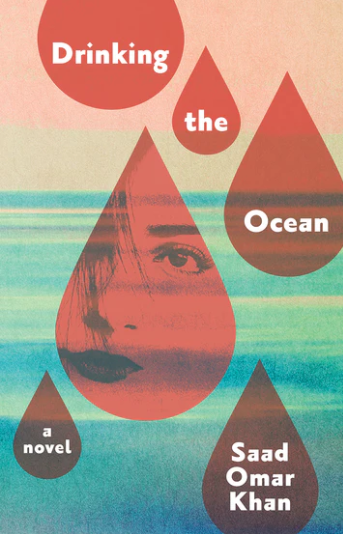
Drinking the Ocean by Saad Omar Khan
Q: Would you describe for readers how your book challenges Western perceptions of Muslim life?
A: One of the biggest challenges when representing the lives of Muslims living in the West is being forced to see Muslims only through the lens of geopolitics or the pathologies that non-Muslims assume is typical of Muslim communities.
Drinking the Ocean was, in a way, my rejoinder to this framework. In the course of writing this novel, it was often suggested to me that adding in a storyline on terrorism would make the book more marketable. This was well-intentioned advice, given in the context of a post 9/11 world where what is extreme and bloodthirsty had more appeal than a relatively quieter story where the inner lives of Muslim characters takes the centre stage.
Drinking the Ocean was never intended to be a specifically “political” book. It is an unfortunate reality, however, that Muslim identities have become inherently politicized. For years, we were a community seen as problematic, a source of chaos, a potential “fifth column” in the War on Terror, the antithesis of everything the secular, liberal, democratic, progressive West sees itself as.
Even in our current climate, where non-Muslims recognize the presence of Muslims in society more, and where Islamophobia as a form of bigotry is increasingly acknowledged, it still comes across to me that there is little room for representing the interaction of Muslims with their religious background in ways that are not simplistic, or where the Muslim character, in some fit of self-liberation, divorces themselves from the oppressiveness of Islam in favour of the warm, permissive embrace of a Western, non-religious value system.
I was, frankly, completely uninterested in this narrative template. Western literature has a long, rich tradition of characters from the Judeo-Christian tradition having to reconcile their sacred, spiritual identity and the realities of their profane, emotional existence. Their are many examples of this, but one that resonated strongly with me while I was writing Drinking the Ocean was Graham Greene’s The End of the Affair. In it, an atheist character has a passionate extramarital affair with a Catholic woman, who abandons the affair as part of a promise to God that she would leave her lover if it would spare his life during a V-2 rocket attack during the Second World War. At no point did Greene, a Catholic himself, condescend to the religious worldview of any of the characters. At the same time, Greene never hesitated to show his characters, believers or otherwise, as what they were: flawed, complex, nuanced, and all too human in the messiest sense of what being human means.
I use this example to illustrate one objective I had in writing this book. As I stated above, this book wasn’t intented to be specifically political, yet it has a political tone just underneath the surface that comes out subtly, and perhaps unintentionally, on my part. Writing about my characters and their emotional challenges--grief, mental illness, familial strife, and difficulties finding spiritual and worldly love--is a political act. It is my fight against the conventional framing of Muslims solely in terms of geopolitics or conflict. The challenge I hope to pose to the reader is to experience this inner world as the characters would. The only explosions to be witnessed are those that exist solely within the human heart. The ruptures my characters face are no less dramatic for it, and certainly no less compelling, as they speak to all of our desires, our need for connection, and our hope in experiencing life at its most transcendent.
More about Drinking the Ocean:
The day after his thirty-third birthday, Murad spots a familiar face at a crowded intersection in downtown Toronto. Shocked, he stands silently as Sofi, a woman he’d fallen in love with almost a decade ago, walks by holding the hand of a small child. Murad turns and descends the subway steps to return home to his wife as the past washes over him and he is taken back to the first time they met.
As Murad’s and Sofi’s lives touch and separate, we see them encounter challenges with relationships, family and God, and struggle with the complexities facing Muslims in the West. With compassion and elegance, Saad Omar Khan delicately illuminates the arcs of these two haunted lives, moved by fate and by love, as they absorb the impact of their personal spiritual journeys.

Saad Omar Khan
ABOUT THE SAAD OMAR KHAN:
Saad Omar Khan was born in the United Arab Emirates to Pakistani parents and lived in the Philippines, Hong Kong and South Korea before immigrating to Canada. He is a graduate of the University of Toronto and the London School of Economics and has completed a certificate in Creative Writing from the School of Continuing Studies (University of Toronto) where he was a finalist for the Random House Creative Writing Award (2010 and 2011) and for the Marina Nemat Award (2012). In 2019, he was longlisted for the Guernica Prize for Literary Fiction. His short fiction has appeared in Best Canadian Stories 2025 and other publications.

Power Q & A with Alex Gurtis
We became aware of American poet Alex Gurtis through his work as a literary critic and then further familiarized ourselves with his work in the literary community—specifically, his work uplifting Canadian authors. Then, we learned more about his poetry, and our interest was doubly piqued. We picked up his chapbook, When the Ocean Comes to Me (Bottlecap Press, 2024), and were blown away.
We became aware of American poet Alex Gurtis through his work as a literary critic and then further familiarized ourselves with his work in the literary community—specifically, his work uplifting Canadian authors. Then, we learned more about his poetry, and our interest was doubly piqued. We picked up his chapbook, When the Ocean Comes to Me (Bottlecap Press, 2024), and were blown away. His work is wild and rangy and polished and devotional. We had to talk to him, and are delighted he agreed.
Welcome, Alex, to our Power Q & A series.

When the Ocean Comes to Me (chapbook) by Alex Gurtis, Bottlecap Press, 2024.
Q: Your poetry seems to exist in the midst of perpetual motion: a ribboning out to times and places and people. Would you tell us about creating this energy in your writing which makes it feel alive and electric.
A: My creative process for this collection was grounded in answering how we project our emotions onto the landscapes around us and how those spaces come back to us. As someone living in an area that is a North American ground zero for climate change, I wanted to capture the interplay between, as you put it, “the ribboning out between time and place and people.” That last word, people, is the most important. My work is very anthropocentric, focused on real people living within changing spaces. There is an ecopoetic aspect too, but I wanted to focus on humanizing the climate crisis and parallel political crisis. In the same way a landscape painter pulls from their surroundings, my subject matter was the people around me. I like to think I applied an ekphrastic gaze in freezing the world around me like a still life in motion and then bringing it to life on the page.
In my opening poem, “Hurricane Party,” the anxiety of watching a storm barreling at you non-stop for 48 hours while you are being told the apocalypse is now, is mentally exhausting. It leaves you a little unhinged. It’s a space where you “walk backwards out of a store/with a bottle of wine” and “watch a man as cracked as the sidewalk/ juggling a baseball, football, and basketball” as entire communities are devastated. None of those experiences are made up. A lot of these poems started as collages of images around certain thematic events like Hurricane Ian. The other half of the collection is political by way of economics and really pulled from my time working in grocery, as a barista, running a bookstore, and working as an adjunct. So many people in my life have been close to or spent time houseless. Rent is high and pay is low in Orlando, Florida and the storms keep coming. My poem “Absence of a Diet Coke” began as a riff off a comment made by a peer in MFA who couldn’t buy a coke. Her credit card bounced because our TA pay got delayed a month.
Ultimately, the real currency we are lacking isn’t dollars but time. We are reacting too slow to stop the climate crisis. Florida is under Neo-Fascist control (as is America as a whole) and the life plan we were all sold, the “American Dream” is a bunch of bollocks. “Post Capitalist Americana” could be retitled “Life in Late-Stage Capitalist America” but wouldn’t have the same snap. Still, it raises a question about identity and how it relates to place. What is America after capitalism? Is there one? Similarly, what is the Floridian identity after “the sea began to rise”? Worst case is probably an archipelago thanks to the Lake Wales Ridge but that's a lot of displaced people when we are just struggling to survive. This isn’t a uniquely Florida problem either. So many people around the country are dealing with disasters like fires that are forcing us to rethink where we live.
Anxiety is a perpetual motion, a sort of flight response, I’m trying to capture though, to borrow a phrase from Carolyn Forché, “the poetry of witness” which I try to apply to communities and spaces that are being erased by extreme weather events incited by the political refusal to accept carbon’s role in changing our planet. Similarly, I want to create a space to help readers find anxious affirmations and grieve while also maintaining a space for readers to hold hope for the future, even if it looks vastly different than we imagined or want it to be. There is something powerful in recording the stories of the people now so people can look back and see that the world was scary, we were scared, but also, we lived.
More about When the Ocean Comes to Me:
When the Ocean Comes to Me is a collection dripping with the anxiety of the Anthropocene. Salt water rises along Florida’s coast as inhabitants watch a clock’s “hands chase each other/ along their predestined path.”
These poems meditate on how “education is a type of trauma” and ask how we can cope with the knowledge that our planet is changing before our eyes. Imagist studies of built environments come unraveled as late-stage capitalism erodes cities and natural landscapes alike.

Writer Alex Gurtis
More about Alex Gurtis:
Alex Gurtis is the author of the chapbook When the Ocean Comes to Me (Bottlecap Press, 2024). He is an assistant editor for Burrow Press and runs an occasional interview series at Barrelhouse.
A ruth weiss Foundation Maverick Poet Award Finalist and a winner of Saw Palm’s 2022 Florida Fauna and Flora contest, Alex received his MFA from the University of Central Florida. His work as a poet and critic has appeared in or is forthcoming in anthologies and publications such as Aquifer: The Florida Review Online, Barrelhouse, Bear Review, HAD, Heavy Feather Review Identity, Identity Theory, Rain Taxi, The Shore and West Trade Review, among others.
An avid believer in community and leaving the world a little better than he found it, Alex serves on the board of the Kerouac Project of Orlando and is often found at the intersection of writing and place making. You can follow him on Instagram @apbg_alex, Bluesky @alexgurtis.bsky.social and Substack,

Power Q & A with Andrew French
On this Power Q & A, we are tickled to be joined by poet and podcast host, Andrew French. Andrew is the host of the popular Page Fright poetry show, where they interview established and emerging authors about breaking through as writers and finding their literary style.
In this interview, we ask Andrew to share with us about why they started the podcast.
On this Power Q & A, we are tickled to be joined by poet and podcast host, Andrew French. Andrew is the host of the popular Page Fright poetry show, where they interview established and emerging authors about breaking through as writers and finding their literary style.
In this interview, we ask Andrew to share with us about why they started the podcast.
Welcome, Andrew!

Listen in to Page Fright.
Q: Would you tell us about your podcast and why you started it?
A: Page Fright is a poetry podcast with a simple concept: I talk to my favourite poets from across Canada about their latest collections and poetics more generally. Guests share poems from their recent publications, answer a question from my previous episode’s guest, and discuss the process of creating their collections and writing as a practice beyond their latest projects. The show has been running for nearly six years and has a catalogue of over a hundred episodes you can listen to wherever you get your podcasts.
I started the show out of a selfish desire to make some friends in the literary community. I moved back to Vancouver in 2018 after graduating from Huron University College in London, Ontario and didn’t have any writer pals (or community at all, really) out here. I attended a few readings alone and sheepishly chatted with authors afterwards as they signed my copy of their book, realizing they were surprisingly willing to answer my questions about their work. What started with a rented booth at the Vancouver Public Library, a brief chat with one of my many inspirations and fantastic poet Shazia Hafiz Ramji (thank you again and always, Shazia!) and some free audio software, has led to me gabbing my way across Canada video call by video call.
What keeps me returning to these conversations is the community that’s grown and continues to grow around the show. Podcasts are weird because you can’t see the audience, so it often feels as if you’re talking into a void. But the moments of interaction online or at the readings I’ve organized for the show make all those chats into the online abyss well worth the awkwardness. I was so scattered and nervous at the live reading/taping I held for the show’s 100th episode last fall because there it was: a room full of people who had heard everything I thought I was only admitting to the other voice in the Zoom room.
That community is such a powerful motivator as a poet, though; we’re not writing for money or even for readership at times! I write poems to try and create moments of connection between myself and the world around me, and anytime somebody else engages with that connection is truly the most beautiful bonus. I think people come on my show for that reason – I’m engaging with the connections they’ve created and relating to their perspective on some level.
On my end, Page Fright is the best project I’ve created, far beyond my own publications and writing. It’s certainly the most rewarding. It inspires me to keep working on my own poems, reading new collections, and engaging with the Canadian literary community. This isn’t the world’s biggest podcast, and I’m never going to be flooded with sponsorship deals for boxed mattresses and online therapy companies, but I am beyond grateful for the community that’s grown and continues to grow around it. It’s the reason I begin episodes with “Welcome back to Page Fright” instead of “Welcome” – whether it’s your first episode, your last, or somewhere in between, this space is and always has been yours to connect in as much as it is mine.

More about Andrew French:
Andrew French is a queer poet from North Vancouver, BC. Their third poetry chapbook, Buoyhood, is forthcoming from Alfred Gustav Press in July of 2025. Andrew’s writing has previously appeared in Event, PRISM International, long con, and a number of other literary journals across North America and the UK. In addition to their own writing, Andrew has chatted to their favourite poets as host of Page Fright: A Poetry Podcast since 2019.
More about Buoyhood:
In Buoyhood, Andrew French surfaces a queer identity that has been suppressed by a speaker swimming in masculinity. A brief selection of poetry spanning a range of forms, the collection explores what it means to be a man, to be family and, more simply, to be.

Power Q & A with Tim Welsh
We are delighted to have Tim Welsh join us today to speak about history in his extraordinary debut novel, Ley Lines (May 1, 2025, Guernica Editions).
Set in the waning days of the Klondike Gold Rush, Ley Lines begins in the mythical boom town of Sawdust City, Yukon Territory. Luckless prospector Steve Ladle has accepted an unusual job offer: accompany a local con artist to the unconquered top of a nearby mountain. There, the duo finds a seven-foot human ear, floating in a halo of light. This mysterious discovery briefly upends Sawdust City's fading fortunes, attracting a crowd of gawkers and acolytes, while inadvertently setting in motion a series of events that brings about the town's ruin.
We are delighted to have Tim Welsh join us today to speak about history in his extraordinary debut novel, Ley Lines (May 1, 2025, Guernica Editions).
Set in the waning days of the Klondike Gold Rush, Ley Lines begins in the mythical boom town of Sawdust City, Yukon Territory. Luckless prospector Steve Ladle has accepted an unusual job offer: accompany a local con artist to the unconquered top of a nearby mountain. There, the duo finds a seven-foot human ear, floating in a halo of light. This mysterious discovery briefly upends Sawdust City's fading fortunes, attracting a crowd of gawkers and acolytes, while inadvertently setting in motion a series of events that brings about the town's ruin.
Welcome, Tim!

Q: Would you tell us about writing this trippy story in a historical setting?
A: A benefit of writing fiction with a historical setting is that it gives you a larger palette of words to play with. One of the joys of writing Ley Lines was melding the language of 19th-century prospectors with my own style. The goal isn’t necessarily to be historically accurate (if it were, the book would be a failure on multiple levels, lol) but to create a distinctive experience for the reader.
To me, style is the thing that makes literary fiction unique as a form; it’s the difference between writing a novel and, say, relating the plot of an imaginary movie (which is how I would characterize a lot of bad fiction). To the extent that the book works, a large part of that is because the language itself—slightly absurd, slightly psychedelic—mirrors and complements the narrative as a whole. I wouldn’t write this way if I was writing, say, a tender, realistic, coming-of-age drama; conversely, Ley Lines wouldn’t be Ley Lines with any other style of writing. You’re either in for the ride or you’re not.

More about Tim Welsh:
Tim Welsh was born in Ithaca, New York in 1980. He was raised in Ottawa, Ontario, and attended Queen’s University and Carleton University, graduating with an MA in English Literature. Since then, he’s lived in New York City and Oaxaca, Mexico, played bass in a punk band, and managed a failing art gallery. Tim Welsh lives in Toronto with his wife and two children. Ley Lines is his first novel.

Power Q & A with Barbara Tran
Barbara Tran’s entrancing poetry collection, Precedented Parrotting (Palimpsest Press, 2024), was a finalist for the Governor General Literary Award for Poetry. This beautiful book stands as an expansive debut that plumbs personal archives and traverses the natural world.
We are honoured to have Barbara join us for our Power Q & A series to speak with us about the visual impact of her work, which uses the whole stage of the page.
Barbara Tran’s entrancing poetry collection, Precedented Parrotting (Palimpsest Press, 2024), was a finalist for the Governor General Literary Award for Poetry. This beautiful book stands as an expansive debut that plumbs personal archives and traverses the natural world.
We are honoured to have Barbara join us for our Power Q & A series to speak with us about the visual impact of her work, which uses the whole stage of the page.
Welcome, Barbara!

Precedented Parrotting by Barbara Tran (Palimpsest Press, 2024)
Q: Your poems are striking in so many ways, and we’d like to focus on the visual form of your work in this collection, that seems to flit and burst, mimicking bird flight. We wonder if you could speak to us about the form of these poems. Was the form intentional? Or a natural expression of the themes addressed in your collection? Maybe a bit of both?
A: Thank you so much for this question. I absolutely love talking about form. It’s at the crux of most of my writing. If I can’t figure out the form, I usually cannot move forward with the piece.
I read poetry — and write most everything — out loud, meaning I have to speak the words as I’m writing them down or reading them. It rules out working in a coffeeshop.
But, the upside of writing out loud is it tells me when a poem’s form is “off.” If I walk away from my writing and come back when I don’t really recall the words and their rhythm, and I can’t tell how to read the thing based on how it allows itself to take up space on the page, I know the form is not working to its full potential. The form should tell me where and how long the pauses are. And where the emphases. Is there a moment of contemplation?
I come from a background where there was not much stability, so, for me, a solid left margin often feels like a lie. It’s not where I come from.
On page 33 of my book, the text falls to the lower right half of the page. At the top could have been blank white space. But when we look at a page of mostly white space and a little bit of text, our eyes automatically go directly to the text. They tend not to linger on the white space for very long before being tempted off, and what I wanted for this time/space before the text at the bottom of the page was for the reader to contemplate, to spend a moment considering what was missing. What photos would they put here? What text? Who? What was here has been silenced. Why?
Myself, I’m so exhausted, thinking about what is missing, that I can no longer bring myself to rise to the top of the page. I’m leaving the text here at the bottom.
On the facing page, 32, the text refers to the speaker’s beginning. (The speaker in the poem is both me and not me.) The ground shifts before the text even gets to the speaker’s birth. Then, her existence is shrouded in secrecy. There is no solid ground here. The lines shift around on the page to convey that.
They move though, with intention. There is an Easter egg hidden here for my enjoyment. I don’t expect any readers to get it, but it puts a smile on my face every time I see it. This is an origin story, and it’s shaped like the country of Vietnam.
More about Precedented Parrotting:
Opening with an exit, the poems in Precedented Parroting accept no assumptions. With the determination and curiosity of a problem-solving crow, this expansive debut plumbs personal archives and traverses the natural world, endeavouring to shake the tight cage of stereotypes, Asian and avian. Praised as “lively and intelligent” and “lyrically delicious,” Barbara Tran’s poetry offers us both the keen eye and grace of a hawk, “red-tailed gliding / on time.”

Poet Barbara Tran.
About Barbara Tran:
Born in New York City, Barbara Tran is an immigrant. And a settler. She writes in multiple genres. Her debut poetry book, Precedented Parroting, was a Finalist for the 2024 Governor General’s Literary Award. Barbara’s short fiction and poetry have appeared in Conjunctions, The Malahat Review, The New Yorker, and The Paris Review. Her poetry chapbook, In the Mynah Bird’s Own Words, was selected by Robert Wrigley, as the winner of Tupelo Press’s inaugural chapbook award. Barbara's writing has been longlisted for the CBC Nonfiction Prize and nominated for two National Magazine Awards for short fiction. Barbara authored the titular character’s narration of Madame Pirate: Becoming a Legend, a short, virtual reality film, nominated for Best VR Story at the 2022 Cannes Film Festival. She is currently at work in collaboration with Jacqueline Hoàng Nguyễn on the screenplay for Nguyễn's debut feature film.
A contributing co-editor of Watermark: Vietnamese American Poetry and Prose, 25th Anniversary Edition, Barbara has been awarded a Pushcart Prize, MacDowell Freund Fellowship, and Bread Loaf Scholarship, as well as writing residencies at the Banff Centre for Arts and Creativity, Hedgebrook, Lannan Foundation, and Millay Arts, amongst others. Barbara is a member of the AfroMundo collective and has contributed to collaborative hybrid projects by She Who Has No Master(s). She shares her home in Dish with One Spoon Territory with her partner, the economist Bob Gazzale, and their two adopted canines, Sprocket and River.

Power Q & A with Andrew Whiteman
Close your eyes and open your ears, friends, ‘cause cultural icons, Anne Waldman (The Iovis Trilogy: Colors in the Mechanism of Concealment) and Andrew Whiteman (Broken Social Scene) have collaborated to create Your Devotee in Rags—a metamorphic sonic poetry LP being released with Siren Recordings.
Your Devotee in Rags is a missive to this age of patriarchal power, its songs and poems are designed to specifically confront that power and hold it to account. Taking such activist inspiration from musicians like Lido Pimienta and Tanya Tagaaq, musically YDIR blends acoustic and electronic genres, waltzes, laments, and Pauls Boutique-era Beastie Boys mash-ups all with the intent of creating a new artistic headspace: sonic poetry. The cultural direction is forward, the earbuds open up the stereo field, listening to YDIR is, in a word, empowering.
Close your eyes and open your ears, friends, ‘cause cultural icons, Anne Waldman (The Iovis Trilogy: Colors in the Mechanism of Concealment) and Andrew Whiteman (Broken Social Scene) have collaborated to create Your Devotee in Rags—a metamorphic sonic poetry LP being released with Siren Recordings.
Your Devotee in Rags is a missive to this age of patriarchal power, its songs and poems are designed to specifically confront that power and hold it to account. Taking such activist inspiration from musicians like Lido Pimienta and Tanya Tagaaq, musically Your Devotee in Rags blends acoustic and electronic genres, waltzes, laments, and Pauls Boutique-era Beastie Boys mash-ups all with the intent of creating a new artistic headspace: sonic poetry. The cultural direction is forward, the earbuds open up the stereo field, listening to Your Devotee in Rags is, in a word, empowering.
We are excited to have Andrew join us today to talk to us about poetry as resistance. Welcome, Andrew!
Q: How is the performance of poetry an act of resistance, and what kind of resistance can listeners of Your Devotee in Rags expect to experience?
A: In the global west, the reading of poetry is already culturally resistant: its values are contrary to those promulgated by the culture-at-large. It seeks sustained and total attention, it slows the world around you down to a movement of breath, it rejects merely instrumental language and instead offers soul-making as the ‘pay-off’. Poetry doesn’t explain, it makes; but what it makes isn’t valued by society. To decide to spend one’s time here is to resist everything else the culture throws at you. Anne Waldman’s long career of poetry and performance teaches us that the human body is an integral part of this pact. The sounding of poetry keeps us grounded to the physical dimensions of our psychic being, even as it splits off like a kite into the blue or a truffle pig snout to the dirt. Isn’t that an antidote to virtuality, as it is now envisioned? Sonic Poetry treats the earbuds as the entry point for an experience of physicalized thought—in this case, Anne’s Your Devotee in Rags. Here, Waldman launches mind form after mind form at the patriarchy’s cynicism and embedded cruelty, buoyed and urged onward by an acoustic/electric collage by turns terrifying and tender. Like life.

Andrew Whiteman
More about Your Devotee in Rags:
Your Devotee in Rags is a sonic poetry collaboration between Anne Waldman and Andrew Whiteman; an act of desire and metamorphosis expanding the performative vision of being at the horizon of new experience, stripped down, exploring the turf, through poetry and spiritual yearning.
Anne says: “Wizard Hal Willner would be proud of us companions in the vibrational matrix. Comrades in a studio of subtle suspense, and where were we headed? A magnificent voyage! Tender, rugged, true. I met Andrew Whiteman, genius player, composer, scholar, in one of Hal’s unpredictable alchemical laboratories. We instantly bonded as mavens of poetry and its attendant orality, dedicated to the passion of epic life that is the source of this album, the 1000 plus pages of the feminist canto: Iovis Trilogy: Colors in the Mechanism of Concealment; passages plucked to be re-imagined in ambient explosive word-sound. On the Yantzse, in a strip club, a maelstrom of memory honoring precursor male poets, dressed in the rags of Celtic hags, so much more as mendicant, witty siren, compassionate lover, exploding empires of patriarchy and war. A kind of mythic hospitality.”
Andrew says: “It was filmmaker Ron Mann and producer Hal Wilner who showed me the way. Hal was my guiding presence—whip smart, funny, gentle, empathic. This album is dedicated to him.”
More about Anne Waldman:
Anne Waldman is a living legend. Poet, performer, professor, editor, cultural activist, grandmother, and co-founder with Allen Ginsberg of the Jack Kerouac School of Disembodied Poetics. Former director of the Poetry Project. Tireless author of over 40 books, her trademark energy coils ever outward, always seeking to reveal the four-fold vision that we have largely lost.
More about Andrew Whiteman:
Andrew Whiteman is a musician and mythopoetics scholar from Montreal, Canada. He writes and performs in Broken Social Scene, Apostle of Hustle, AroarA, and Poets’ Workout Sound System. He is a co-founder of Siren Recordings.
Siren Recordings is a digital, multimodal platform that operates as boutique, studio, and archive. We seek to connect scholars, artists, and lovers of sonic poetry in an online community. Following Ed Sanders, we believe that perfection comes in the poetic triad: “the spoken text/the text as beauteously presented on the page/the text as performed.” We incorporate elements of sound and music into recordings of poetry performances to emphasize the affective, social experience of poetic work.
We value experimentation in form, both contemporary and modern. We renew older poetic works by treating the archive as a participant in the work we are making; archival play ensures that our releases blend contemporary technology with influential poetry. These values seek to serve one, ultimate goal: to contribute to the siren call that warns of the diminishing time we spend in the archaic situation of gathering to hear someone speak.
Media inquiry about Your Devotee in Rags? Drop us a line!

Power Q & A with Laine Halpern Zisman
Laine Halpern Zisman’s latest book Conceivable: A Guide to Making 2SLGBTQ+ Family (Fernwood, 2024) is the first book of its kind in Canada.
Laine Halpern Zisman is an adjunct professor at the School of Public Health and Social Policy at the University of Victoria. She is founder and project lead on Family Building Canada (familybuildingcanada.com) and a Certified Fertility Support Practitioner with Birth Mark in Toronto. Her research traverses the intersections of 2SLGBTQ+ equity, culture, and reproductive care.
Laine Halpern Zisman’s latest book Conceivable: A Guide to Making 2SLGBTQ+ Family (Fernwood, 2024) is the first book of its kind in Canada.
Laine Halpern Zisman is an adjunct professor at the School of Public Health and Social Policy at the University of Victoria. She is founder and project lead on Family Building Canada (familybuildingcanada.com) and a Certified Fertility Support Practitioner with Birth Mark in Toronto. Her research traverses the intersections of 2SLGBTQ+ equity, culture, and reproductive care.
We are honored to have Laine here with us today to talk about about her work.

Concievable by Laine Halpern Zisman (Fernwood, 2024)
Q: What is one thing you think people would be surprised to learn about the state of reproductive care in Canada?
A: Fertility care in Canada might not always be what you expect, which is why I always say to 'expect the unexpected.' There’s no national standardization of cost, wait times, and access, and that can lead to major gaps. Access, funding, and finding a clinic that fits your needs can vary drastically depending on your province or territory (and even your city). For example, some provinces have many clinics in city centres, while others have one clinic or none at all. Some provinces offer coverage for treatments like IVF, while others provide nothing at all, leaving patients to pay out of pocket (anywhere from $10,000-$100,000). On top of that, there’s no consistent system to help you navigate options, policies, or timelines. This lack of standardization is why advocacy is so critical—people need to know their rights, push for transparency, and demand equitable, accessible care no matter where they live.
About Conceivable:
Conceivable: A Guide to Making 2SLGBTQ+ Family moves beyond the birds and the bees to consider the politics, challenges, choices and opportunities for agency and joy involved in 2SLGBTQ+ fertility, conception and family building in Canada. With contributions from healthcare workers, mental health professionals and support people in the field of reproductive health and 2SLGBTQ+ sexual care, this book is an honest and thorough look at growing your family.
Conceivable is for birthing parents, non-gestational parents, families seeking a surrogate or donor, and those who do not yet know what they need. With illustrations, worksheets and activities to help you think about the intimate questions of communication, relationship building and community, this guide will prepare you with the knowledge you need to navigate advocacy, rights and regulations.

Laine Halpern Zisman
More about Laine Halpern Zisman:
In addition to Conceivable, Laine has published two collected volumes, Women and Popular Culture in Canada (2020) and the second edition of Queerly Canadian, co-edited with Professor Scott Rayter (2023), as well as multiple scholarly articles in academic journals and collected volumes.
Halpern Zisman received a SSHRC Partner Engage Grant (2023) and SSHRC Connection Grant (2022) to support activities related to HIV In My Day at the University of Victoria, as well as a Community One Foundation Grant (2023) to launch a new online platform for 2SLGBTQ+ Family Building (familybuildingcanada.com). She is the recipient of a CIHR Health Hub fellowship (2022); CATR O'Neill Book Prize (2022); a Graduate Mellon Fellowship (2017); and Course Instructor Teaching Excellence Award.

Power Q & A with Jean Marc Ah-sen
Kilworthy Tanner by Jean Marc Ah-sen (Vehicule Press, 2024) tells the story of Jonno—a ner’er-do-well and perpetually up-and-coming writer who becomes enthralled with the established, acclaimed, controversial, and already married but not monogamous author Kilworthy Tanner. What follows is a titillating metafiction that mirrors a literary world replete with “grasping, unprincipled” egos.
There’s much to love about this book, including Jonno’s narration, which teases and bites and soothes and is tender and playful. We are tickled to have Jean join us for this Power Q & A to talk about how he created his protagonist’s distinct voice.
Kilworthy Tanner by Jean Marc Ah-sen (Vehicule Press, 2024) tells the story of Jonno—a ner’er-do-well and perpetually up-and-coming writer who becomes enthralled with the established, acclaimed, controversial, and already married but not monogamous author Kilworthy Tanner. What follows is a titillating metafiction that mirrors a literary world replete with “grasping, unprincipled” egos.
There’s much to love about this book, including Jonno’s narration, which teases and bites and soothes and is tender and playful. We are tickled to have Jean join us for this Power Q & A to talk about how he created his protagonist’s distinct voice.

Kilworthy Tanner by Jean Marc Ah-sen.
Q: We have to know: what was the inspiration for Jonno’s language? It’s simultaneously highfaultin and grubby and, should anyone feel compelled to speak his words aloud, it’s also just plain delightful to wrap your tongue around.
A: I started to have the impression that my style was becoming too defined for my liking, and that it was starting to ossify. Something written with a more conversational patter, while still being intensely voice-driven, felt like a good way to break out of this pigeonhole.
Jonno's narrative voice was modelled after autobiographies and novels pulling back the curtain on cryptic scene-affiliations - what Dee Dee Ramones's Lobotomy did for the early days of punk, or what Jean-Patrick Manchette's Nada did for post-1968 revolutionary fervour, were inspirations on writing group dynamics. I'm not sure if I was successful on these fronts, but I think that it is better to fail spectacularly than to toe an unremarkable line, stylistically speaking.
More about Kilworthy Tanner:
A madcap, witty account of an aspiring author’s relationship with an infamous and provocative mentor.
Fresh-faced Jonno is looking to make a splash in the literary scene when he encounters celebrated novelist Kilworthy Tanner at a party. Having sold first editions of her works to Toronto’s book dealers, he’s immediately star-struck and more than a little surprised when she takes an interest in him. Could this be the break he’s after? It’s not long before the controlling and aloof Kilworthy is casually letting young Jonno move in with her, and they begin co-authoring sensational and unruly fictions together. But who’ll get the credit for these collaborations, and why does he constantly feel like he must fend off rival authors? Fuelled by outrageousness and hell-bent on literary self-annihilation, Kilworthy Tanner is Jonno’s tell-all ‘pseudobiography’ of their entanglement, and he doesn’t withhold any details of the sexual degeneracy, prodigious drug use, and vendettas of the era.
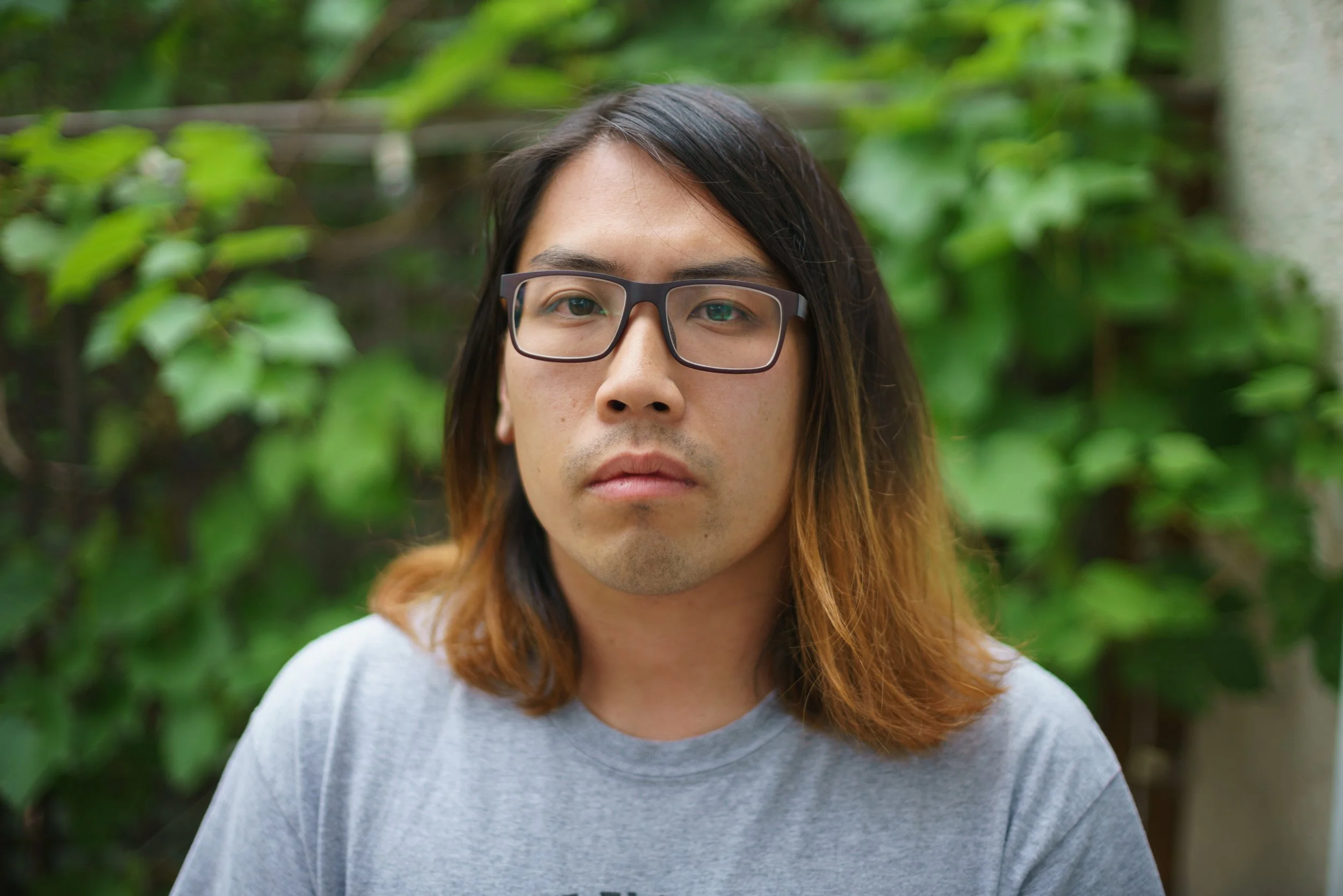
Jean Marc Ah-sen. (Photo credit Justin Legace.)
More about Jean Marc Ah-sen:
Jean Marc Ah-Sen is the author of Grand Menteur, In the Beggarly Style of Imitation, and Kilworthy Tanner. His work has appeared in Literary Hub, The Walrus, The Globe and Mail, and elsewhere. The National Post has hailed his writing as an “inventive escape from the conventional.”

Power Q & A with Caroline Topperman
Caroline Topperman’s memoir is not only highly anticipated but powerfully titled. Your Roots Cast a Shadow: One Family's Search Across History for Belonging (HCI, December 17, 2024), arises from Caroline’s 2013 move from Vancouver to her family’s homeland, Poland, and encourages readers to examine the ways in which family histories shape our understanding of ourselves and society.
Caroline Topperman’s memoir is not only highly anticipated but powerfully titled. Your Roots Cast a Shadow: One Family's Search Across History for Belonging (HCI, December 17, 2024), arises from Caroline’s 2013 move from Vancouver to her family’s homeland, Poland, and encourages readers to examine the ways in which family histories shape our understanding of ourselves and society.
We’re honoured to have Caroline join us today to speak to why she decided to share her family history with readers from around the world. Welcome, Caroline!

Your Roots Cast a Shadow: One Family's Search Across History for Belonging by Caroline Topperman (published by HCI).
Q: Sharing family stories can be fraught with tension and uncertainty. What made you decide to write this book—and share these stories—now?
A: In 2015 (when I started writing this book) Poland was very different than it is now, and frankly much of what I saw scared me. It was an eye-opening experience to participate in a Pride parade and have rows of police officers decked out in tactical gear on either side of our float. I was shocked each time I saw neo-Nazis and fascists and ultra-Nationalists marching through the streets. I participated in counter-marches; I signed petitions and it became more and more obvious that history is easily forgotten. I decided that I couldn’t stay silent.
More about Your Roots Cast a Shadow: One Family's Search Across History for Belonging:
Your Roots Cast a Shadow: One Family's Search Across History for Belonging is a gripping and powerful narrative of cultural translation, identity, and belonging. The thrill of a new place fades quickly for Caroline Topperman when she moves from Vancouver to Poland in 2013. As she delves into her family’s history, tracing their migration through pre-WWII Poland, Afghanistan, Soviet Russia and beyond, she discovers the layers of their complex experiences mirror some of what she felt as she adapted to life in a new country. How does one balance honouring both one’s origins and new surroundings?

Author Caroline Topperman.
More about Caroline Topperman:
Caroline Topperman is a European-Canadian writer, entrepreneur, and world traveller. Born in Sweden, raised in Canada with a recent stint of living in Poland, she holds a BFA in screenwriting. She is a co-founder of Mountain Ash Press and KW Writers Alliance, and currently runs Migrations Review, and Write, They Said. Her book, Tell Me What You See, serves as a toolkit for her writing workshops. She has written articles for Huffington Post Canada, Jane Friedman’s blog, was the Beauty Editor for British MODE Magazine, and served as managing editor for NonBinary Review. Her hybrid memoir, Your Roots Cast a Shadow, explores explosive intergenerational histories that link war zones and foreign shores with questions of identity and belonging. Her next book, The Road to Tang-e Gharu, integrates Afghan folktales and family memories with the story of one of the greatest roads ever built.

Power Q & A with Paola Ferrante
It’s easy to lose yourself in the dark and dreamy world of Paola Ferrante’s Her Body Among Animals (Book*hug Press). This collection of short fiction absorbs and unsettles. It explores the pressure of the patriarchy with playful and twisted stories that have dazzled readers since the book’s release in 2023. Paola’s book has been a finalist for the 2024 Governor General’s Literary Award for Fiction, a runner-up for the 2023 Danuta Gleed Literary Award, the Silver Winner of the 2023 Foreword INDIES Book of the Year Award for Short Stories, and a finalist for the 2023 Shirley Jackson Awards.
We are delighted to have Paola here with us today to talk about how her stories pitch darkness into light.
It’s easy to lose yourself in the dark and dreamy world of Paola Ferrante’s Her Body Among Animals (Book*hug Press). This collection of short fiction absorbs and unsettles. It explores the pressure of the patriarchy with playful and twisted stories that have dazzled readers since the book’s release in 2023. Paola’s book has been a finalist for the 2024 Governor General’s Literary Award for Fiction, a runner-up for the 2023 Danuta Gleed Literary Award, the Silver Winner of the 2023 Foreword INDIES Book of the Year Award for Short Stories, and a finalist for the 2023 Shirley Jackson Awards.
We are delighted to have Paola here with us today to talk about how her stories pitch darkness into light. Welcome, Paola!

Paola Ferrante’s Her Body Among Animals, published by Book*hug Press.
Q: You've fashioned darkness in your stories into a force of light and release for some of your characters. Was this something you consciously did, or an unconscious reaction to the stories you are telling?
A: I’m a horror fan, which is probably no a secret to anyone who’s read Her Body Among Animals, considering how many times I talk about Michael Myers or the Enfield poltergeist. And one of my favourite horror movies, The Babadook, is favourite precisely because it has a completely non-traditional ending for a horror film. Hopefully I’m not spoiling this for anyone, but there’s something so satisfying in seeing the monster chained up in the basement, and the victims, the mother and her son, now completely unafraid of him and able to go about their lives. That to me was always the type of ending I wished to achieve in my own fiction. So aiming for the light, while diving deep into the dark, was my aspiration from the beginning.
Because I knew, going into it, that the stories in Her Body Among Animals were going to deal with some pretty dark subject matter. These are stories about postpartum anxiety, climate grief, domestic abuse, untreated and stigmatized depression, and general misogyny. The reason I told these stories using the conventions of dark fantasy, science fiction and horror, letting sentient sex robots and ghosts and urban legends about lizard men do a lot of the heavy lifting for me, was because I wanted my reader to actually “enjoy” the experience of engaging with difficult material. And there’s a difference between writing horror and being bleak, one I learned from reading Timothy Findley’s memoirs (who, as an aside, is probably my favourite Canadian writer of that generation). I will always remember reading Findley’s memoir when I was a baby writer in a university creative writing program. During one section, he spoke about burning an entire manuscript because he felt, when it was done, that it had nothing redeeming for the reader. So I was very conscious that, in a book about women’s resilience, about looking at the mistakes of the past, and about trauma, there had to be a light at the end of tunnel. There had to be something for the reader to grab onto.
I believe, as a writer of this kind of fiction, it’s my responsibility to offer an idea how things could be different, whether it’s a young woman deciding not to put her self on hold to go to Mars with her boyfriend, a teen boy acknowledging his culpability in bullying another boy, thereby contributing to the kind of toxic masculinity in his friend group that enabled his brother to commit a sexual assault, a woman breaking out of the expectations of childbearing in her marriage by electing to stay a spider, or a sex robot enacting some fiery revenge. I always think the reader needs to see a way out. Because I think one of the greatest things fiction gives us is the ability to play with ideas, to imagine alternate futures of better possibilities.
More about Her Body Among Animals:
In this genre-bending debut collection merging horror, fairy tales, pop culture, and sci-fi, women challenge the boundaries placed on their bodies while living in a world “among animals,” where violence is intertwined with bizarre ecological disruptions.
A sentient sex robot goes against her programming; a grad student living with depression is weighed down by an ever-present albatross; an unhappy wife turns into a spider; a boy with a dark secret is haunted by dolls; a couple bound for a colony on Mars take a road trip through Texas; a girl fights to save her sister from growing a mermaid tail like their absent mother.
Magical yet human, haunted and haunting, these stories act as a surreal documentation of the mistakes in systems of the past that remain very much in the present. Ferrante investigates toxic masculinity and the devastation it enacts upon women and our planet, delving into the universal undercurrent of ecological anxiety in the face of such toxicity, and the personal experience of being a new mother concerned about the future her child will face.
Through these confrontations of the complexity of living in a woman’s body, Her Body Among Animals moves us from hopelessness to a future of resilience and possibility.

Paola Ferrante is a writer living with depression. Her debut fiction collection, Her Body Among
Animals (Book*hug Press, 2023), was nominated for the Governor General’s Award for Fiction and the Shirley Jackson Award, was a runner-up for the Danuta Gleed Award, a Silver Medal Winner in Foreword INDIES Book of the Year Awards, and was published in the UK by Influx Press in August 2024. Her fiction has been longlisted for the Journey Prize, and her debut poetry collection, What To Wear When Surviving a Lion Attack (Mansfield Press, 2019), was shortlisted for the Gerald Lampert Memorial Award. She was born, and still resides in, Toronto, with her partner Mat and their son.

Power Q & A with Sheila Stewart
Sheila Stewart’s stunning poetry collection, If I Write About My Father, (Ekstasis Editions, 2024) dismantles the patriarchal religious ideologies of Sheila’s upbringing by a protestant minister, while sustaining the emotional intimacy experienced in familial relationships.
Sheila explores the daughter-father relationship, uncovering the complexities of growing up as the minister’s only daughter in a family shaped by church and manse in small-town southern Ontario. She braids narrative and lyric, the textures of liturgy and memory. While critiquing patriarchal weight and constraint, the work explores how a particular religious upbringing shapes thinking, the rhythms of language, and the fabric of consciousness.
Sheila Stewart’s stunning poetry collection, If I Write About My Father, (Ekstasis Editions, 2024) dismantles the patriarchal religious ideologies of Sheila’s upbringing by a protestant minister, while sustaining the emotional intimacy experienced in familial relationships.
Sheila explores the daughter-father relationship, uncovering the complexities of growing up as the minister’s only daughter in a family shaped by church and manse in small-town southern Ontario. She braids narrative and lyric, the textures of liturgy and memory. While critiquing patriarchal weight and constraint, the work explores how a particular religious upbringing shapes thinking, the rhythms of language, and the fabric of consciousness.
Sheila joins us for this Power Q & A to talk about why she decided to tackle the church and her relationship with her father with these powerful poems.
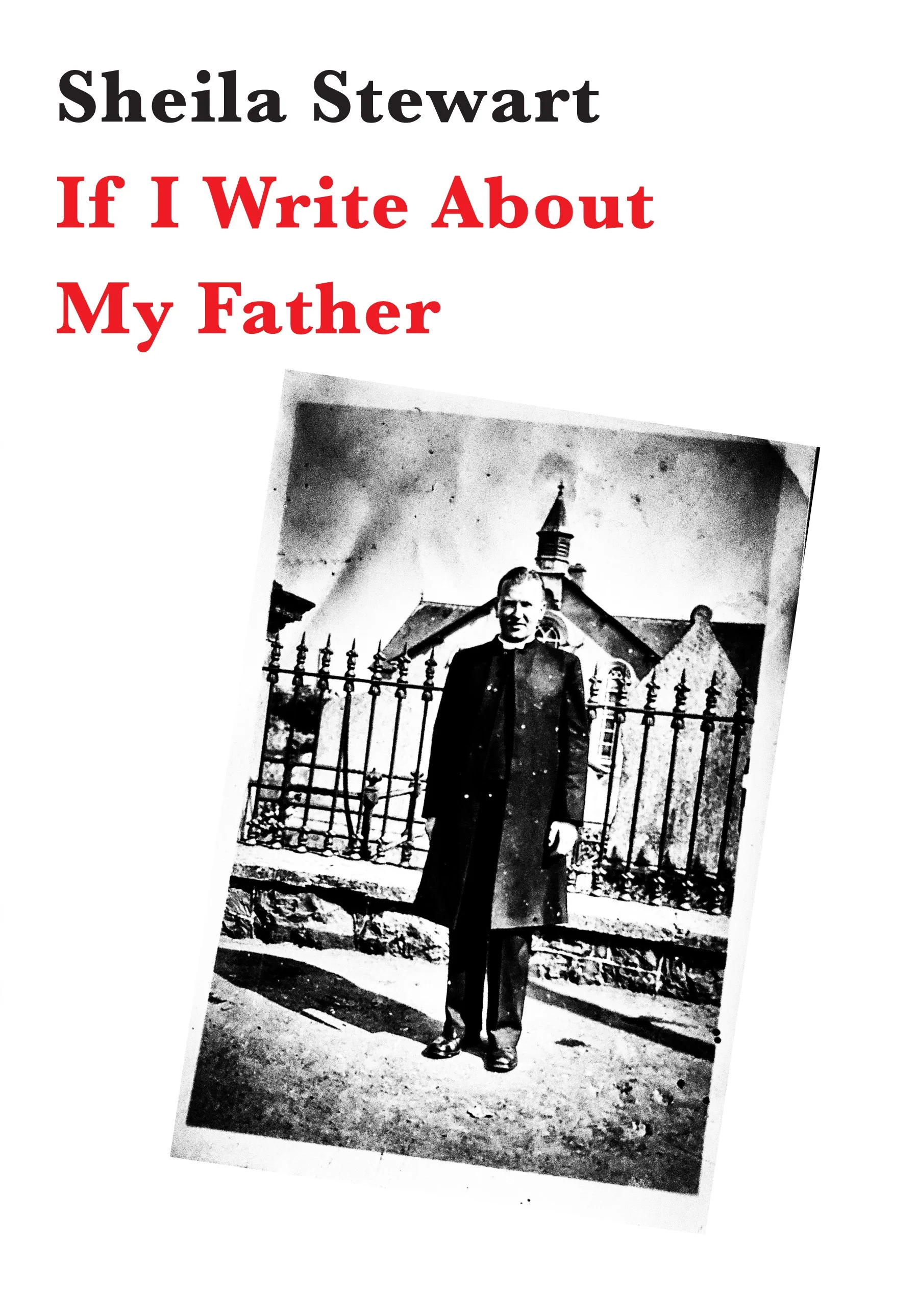
Q: Why did you focus this collection on your relationship with your father and the church?
A: It wasn’t so much a deliberate choice to write about my father and the church, as something I was compelled to do. I was writing a dissertation at the Ontario Institute for Studies of Education/University of Toronto (OISE/UT) and wrestling with my own authority as a writer. While I’ve always been drawn to ideas and learning, tackling a PhD at age 48, was intimidating. I was aware of the hierarchies and power structures of the University having worked at OISE/UT for years as a research coordinator on adult literacy issues.
Growing up in small town Southwestern Ontario as the minister’s only daughter, I was conscious of the power dynamics within our traditional Irish Canadian home and the congregations where my dad served. I’m very interested in the way religions provide stories and meaning for people to live their lives. I’m not Christian, but I was surrounded by the language and poetry of the Bible as a child. The book begins with a poem called “Altar”. I am exploring spirit and, in a sense, find it in the natural world, Lake Ontario, High Park. My earliest years were mainly indoors, in the manse and at church surrounded by parishioners, and then at school where I was known as the minister’s daughter. I needed to work through the restraint and strictures of my church upbringing to inhabit a more embodied sense of self.
My first collection, A Hat to Stop a Train (Wolsak and Wynn), is about my relationship with my mother and her life as a minister’s wife. I’m fascinated by how family members shape each other. If I Write About My Father (Ekstasis Editions) is kind of companion piece to my first book. While the book is about aspects of my relationship with my father, it is also about authority and power of different kinds: institutional and that found as a writer, often through a long wrestle with words.
More about If I Write About Father:
What effect do fathers and faith have on a child? In If I Write About My Father, Sheila Stewart explores the daughter-father relationship drawing on reflections about her father, a Northern Irish Presbyterian minister who immigrated to Canada and joined the United Church. Her poetry uncovers the complexities of growing up as the minister’s only daughter in a family shaped by church and manse in small-town southern Ontario. Stewart braids narrative and lyric, the textures of liturgy and memory. While critiquing patriarchal weight and constraint, the work explores how a particular religious upbringing shapes thinking, the rhythms of language, and the fabric of consciousness. In this quest, the poet draws from the sensory world by walking the woods and Lake Ontario shores.
Sheila Stewart
More about Sheila Stewart:
Sheila Stewart’s publications include two poetry collections, A Hat to Stop a Train and The Shape of a Throat, and a co-edited anthology of poetry and essays entitled The Art of Poetic Inquiry. Awards include the gritLIT Contest, the Scarborough Arts Council Windows on Words, and the Pottersfield Portfolio Short Poem Contest. Her poetry has been widely published in Canadian and international journals. She recently left teaching at the University of Toronto to devote herself to writing.