
Looking Under the Hood: A Conversation on the Writing Life with Michelle Berry and Peter Darbyshire
Michelle Berry and Peter Darbyshire are Canadian writers who are widely regarded as masters of their genres. Berry is known for her exhilarating and provocative literary thrillers. Her most recent novel, Satellite Image (Wolsak & Wynn, 2024), has been hailed as “a super-creepy, anxiety-filled tale that will dash any urbanite's fantasy of escaping to the tranquil countryside.” (Elyse Friedman, author of The Opportunist and The Answer to Everything.) Peter Darbyshire is renowned for wild and immersive speculative fiction that “mashes pop-culture genres together, exposing profound truths beneath classic tropes in ways at once hilarious, weird, and heart-breaking.” (Publishers Weekly.) Staring with The Mona Lisa Sacrifice, Darbyshire’s Cross Series, (which was originally published by the now defunct ChiZin)e, is enjoying a second reincarnation this year thanks to Hamilton, Ontario’s beloved publisher Wolsak & Wynn.
In this refreshingly real conversation, Berry and Darbyshire on their writing process and the writing life to reveal the mechanisms behind the so-called “magic.”
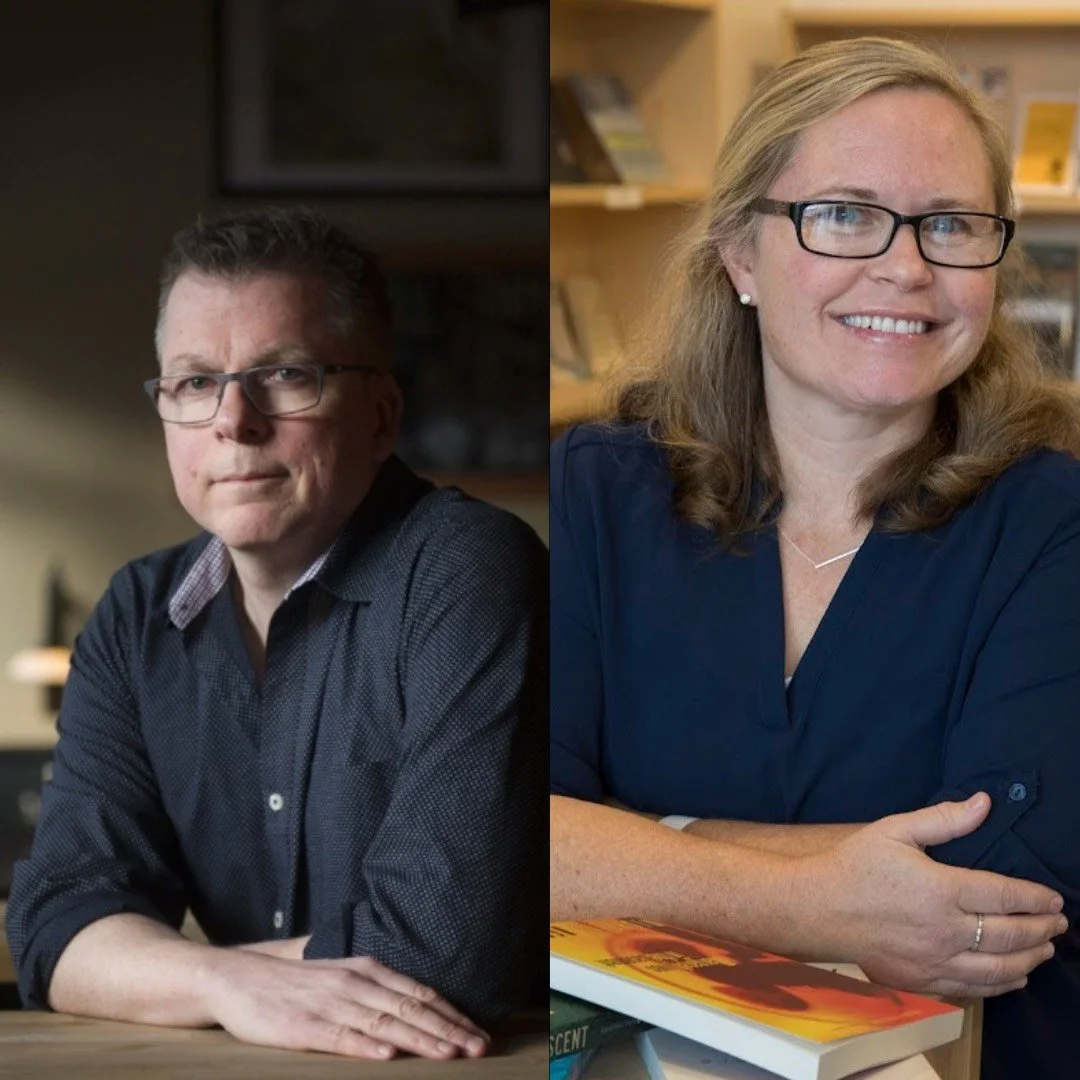
Peter Darbyshire: You published a dozen books before Satellite Image, a genuinely creepy novel that turns every urbanite’s dream of escaping to idyllic small town life into a nightmare. (Thanks for ruining that fantasy for me!) The steady pace at which you’ve been able to publish books tells me you’ve figured out some sort of writing system that’s working for you. What’s your secret?
Michelle Berry: Great question (and I'm sorry for ruining your dream of small town living). I look at my steady pace and look at what was happening in my life throughout and wonder the same thing. How did I continue to write while raising two children and three pets and a husband, while moving houses and cottages and cities, while teaching, while traveling and owning and working full time at my bookstore, during covid and suffering ongoing health issues? Maybe because writing can take me from the everyday and emotional and chronic conditions I live in to a world I can manipulate, a world that seems controllable. I've also been lucky to think that writing is my career and that there is nothing else. Even when I owned my bookstore I was thinking, I'm just doing this to procrastinate, soon I'll get back to my real work.
My system is that when I have a novel on the go I sit at my desk every day and try to work for a couple hours. No matter what is going on I've conditioned myself to check in with my characters every day. If I don't have something to work on I read and I read like a writer -- what is working in this book I'm reading? Why is it working? How does the author do this? I pick apart everything. Funny thing is that, because I read like this, I never remember what happened in a book about two weeks after I finished it. And I never remember the endings. I only have a sense of whether I liked it or not and some images of scenes float around my brain. But, really, my system is that my whole world revolves around books. If my fingers aren't on the keyboard moving then I'm lost. Weekends are long in my world because I don't have the routine of sitting at my desk, so I often feel lost.
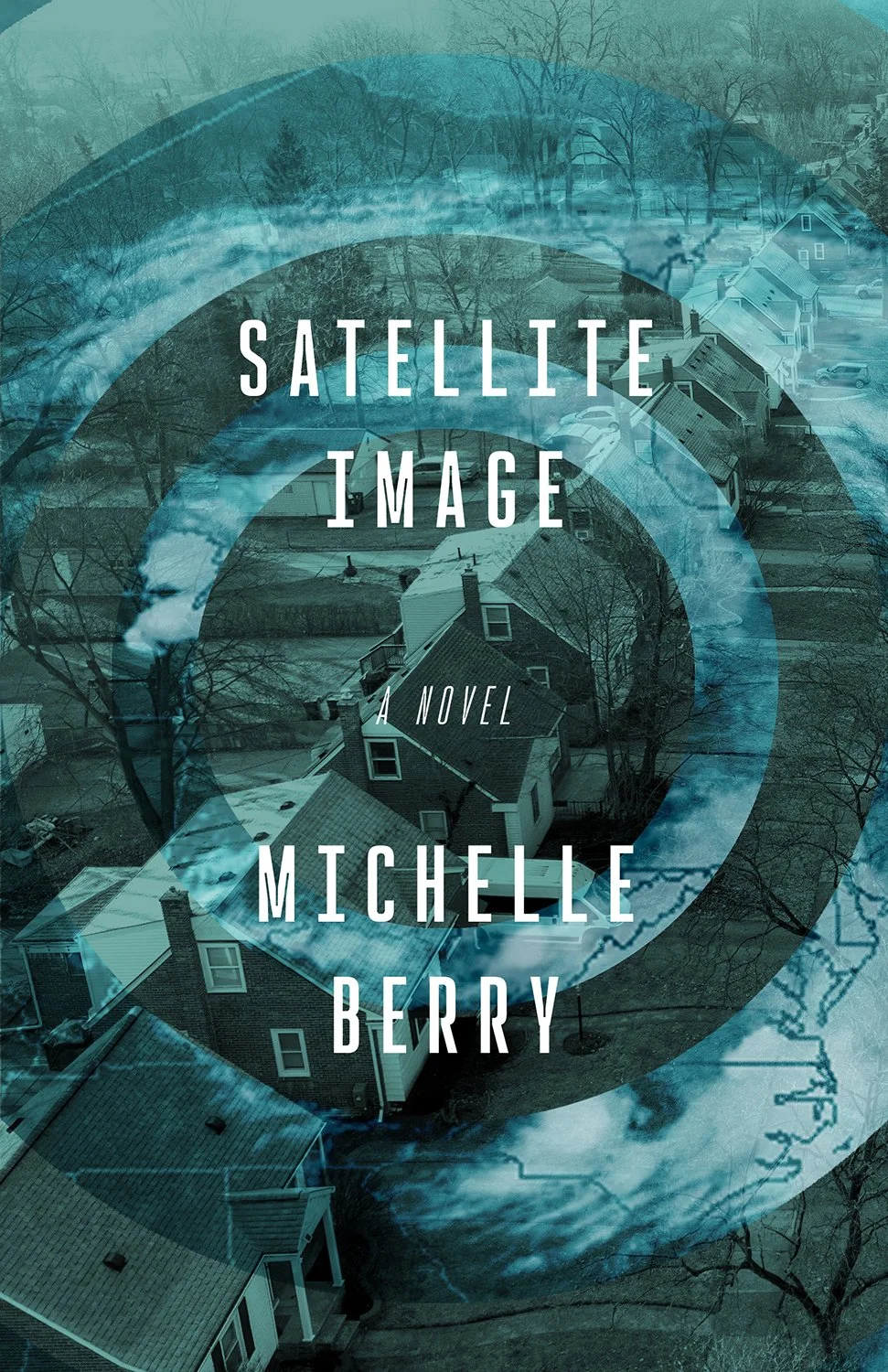
Satellite Image by Michelle Berry, published by Wolsak & Wynn.
PD: Oh, I love the idea that the act of writing can give you a sense of control in a world where we far too often have no control at all — of anything in our lives, really. I suppose the same could be said for reading. It’s a bit of escapism, but even more it helps us to make sense of a world that increasingly makes no sense.
So your writing secret is the old “butt in chair” approach? It does tend to be effective if you can turn off all the distractions on your computer and use that time in the chair to actually write. For those times when you’re not writing and you read instead, do you read at the same desk for the sake of consistency?
I find it interesting that you read to “pick apart” what other writers have done — reverse engineering! When I was younger I used to take short stories by other authors I really liked and copy them out by hand. I found that act of rewriting the stories word by word somehow gave me better insights into how they were structured and where everything was connected under the surface. It’s like taking an X-ray of the story.
What do you do when you are working on a project but your characters aren’t cooperating and the writing isn’t happening? I’ve struggled with that a few times, but I had a breakthrough with my second book, The Warhol Gang, where I realized I don’t actually have to write a book in a linear fashion. I can jump past the scene that is blocking me and work on the scenes that I know are going to happen later. I’ve found that writing the later scene often helps me figure out what is missing from the earlier scene. Sometimes writing feels more like assembling a jigsaw puzzle than building something from start to finish.
MB:You've given me so much to unpack here. I never get to talk about my writing in my daily life so this is wonderful. Don't you find that people who don't write tend to think of writing as magical, that it just happens? But writers work at what they do. Your first question here, about physicality, about sitting in the same spot to read—no, I don't do that. I read all over the house and porches and yard and I don't really associate my reading with my writing while I'm doing it, weirdly. Even though I'm picking apart someone else's work, with the book in my hand I'm not really fully aware that this will benefit my own writing. That comes later. I'm usually just in awe about someone else's talent. Your "butt in chair" meaning "butt in the exact same chair" might be something that could definitely help me (if not lead to slumped shoulders and more carpal tunnel). I think I'll try it and report back to you someday.
In fact, I do have to tell you my biggest trick to writing -- moving furniture. I tend to move my office around or into another room the days before I start writing something new. There's something about a new setting that leaks into my work, as if I've suddenly moved my brain slightly to focus on a new idea. I've put the old to rest and manipulated the new. Try it. Turn your desk around, move your bookshelf, see what happens. Your copying of a writer's work has the same effect, I think, and is a great idea. Instead of moving furniture to manipulate your world, you are jumping into someone else's brain and seeing how they manipulated a world. In the same way, I used to edit by retyping my own novels, it made it easier somehow to add and subtract to something already written, but I stopped somewhere along the way. You've reminded me that this process worked.
Your question about what I do when my characters aren't cooperating and about how you see your writing now as a jigsaw puzzle that you are building is fascinating. I think we are about the same age, Peter, and I've suddenly discovered that I don't like writing as much as I like editing -- and that is because creating is hard work but editing, to me, is like putting together a jigsaw puzzle (I've actually been using this analogy a lot lately). Moving characters, settings, plot around and fitting everything together smoothly is way more fun than creating these days. When I'm creating, and my characters aren't cooperating, I tend to go back through the whole piece I've written and play with the puzzle -- put that piece over here, discard the other piece, fit together pieces, until I see a pattern. Then I go back to that uncooperative character and suddenly she/he makes sense. I also read or go for a walk when I'm stuck.
Speaking of me trying to control everything (ahem), in your novel The Mona Lisa Sacrifice your character, Cross, goes with the flow, there is nothing he can control in his wild world so he (sort of) has to accept his crazy existence. In fact, he isn't in the real world, he moves from place to place and through history like he's on fire (which he is at some points, actually). Are you like Cross? Does your brain skip and race all over and throughout time? How do you keep up this frenetic pace in a novel? I felt like I was reading your book on adrenaline and had a hard time imagining you sitting peacefully at your desk. Tell me about how you keep Cross moving so rapidly and consistently over the years it must have taken you to write him? You must drink lots of coffee?
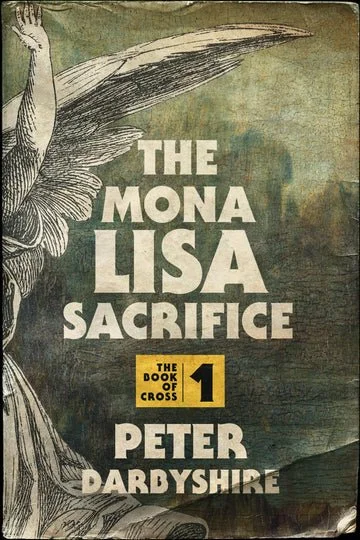
The Mona Lisa Sacrifice by Peter Darbyshire, published by Wolsak & Wynn, 2024.
PD: I think I did project a bit of myself onto Cross in The Mona Lisa Sacrifice, at least the times where I’m just exhausted with existence and this world. I figured that someone immortal like Cross would get pretty weary of the same stupid things that humans do over and over throughout the ages. But there’s also a strong element of stoicism to Cross, which helps him to accept that things are the way they are and he can only change the things he is actually capable of changing. (Which, granted, can be a lot when you have magic powers, hang out with faerie and gorgons, and get into fights with angels.) I was reading a lot about stoicism at the time I wrote the books to help me cope with anxiety issues and my tendency to catastrophize (all that coffee didn’t help!), so I think some of that definitely found its way into The Mona Lisa Sacrifice and perhaps more so its sequels, The Dead Hamlets and The Apocalypse Ark.
I don’t typically write myself into my own stories, although the episodes in Please, my first book, were largely inspired by things that had happened to me or my friends. But by the time I began writing The Warhol Gang I had moved on to being inspired by the unreality of the larger world — I was really trying to write tomorrow’s headlines with that novel. With the Cross books, I wanted to bring some magic into our world, maybe to counter all those bleak and absurd headlines. So I took the literary characters I had fallen in love with over the years, and the works of art that intrigued me, and I brought them to life in the books as Cross’s friends and enemies, or as plot elements and so on. The best way to fight absurdity is with creative absurdity!
The interesting thing about working with other creators’ characters as I did, such as Alice from the Wonderland tales or Captain Nemo from Jules Verne’s works, is that they tend to have a kind of literary resonance about them. They invoke other stories and even other worlds just by their presence — not only for the reader but also for me. I think it’s what leads to that frenetic pace you mention. I keep getting ideas for new twists or directions from those other characters, so Cross keeps bouncing from one story to another within a book, and somehow they come together to form the larger tale. Often it’s not the tale I set out to write, but writing should be a process of discovery not transcription.
I found the Cross books actually changed my writing style in some substantial ways. I now often hint at storylines that I have no intention of following up on. I want to plant the story seed in the mind of readers, but I want them to imagine those other storylines and what happens off the page for themselves. It’s a little more participatory for the reader, and it creates this sense of each book being a sort of endless library of tales, which fits the mood of the overall Cross series.
How do you feel your writing style has changed over the course of your career?
MB: Things that worked before don't often work the next time. I think my writing style has changed because I'm more forgiving when things aren't working than I used to be. I used to ceaselessly fret, now I just give myself a break and try to do something else for a bit if I can. Now I know that moving furniture helps my process. Now I don't retype my work in progress anymore (and in the process have saved my fingers). So I would say my style has changed in that I'm accepting and forgiving of myself now. All I want is to enjoy the process and have others enjoy the results. I look back at the writing of Satellite Image and remember all the old characters, all the other subplots I had and the other endings -- this wasn't the book I started with -- and I'm happy with the fact that I made all those changes without worrying about how different the book had become. And that's how my style has changed -- I'm more laid back about the whole process now. I've finally grown up.
I'm hoping and assuming that you are going to write more Cross books? Has your writing style changed over these last three novels more than it did, say, between Please and The Warhol Gang? I'm assuming that because you are following the same character, Cross, all through that you have to be incredibly consistent here. Micro-consistent. Does that bother you? Does a sequel take away from the excitement of creation? Or do you feel like you are jumping into a familiar skin and living the best (and strangest) life each time?
PD: That’s a really interesting question because I recently finished a new Cross novel, as well as a collection of short stories about Cross’s misadventures over the ages. At the same time, I’ve been editing the first three books for new editions due out in October 2024 with Wolsak and Wynn. Republishing the books has given me an opportunity to make some changes and rewrite parts of them. Most writers don’t have a chance to change a book once it’s been published, so it’s been a wonderful opportunity for me.
My writing style has changed somewhat over the past few years, in that I think about structure in different ways. This came out of being in a workshop group with some local writers — Sebastien de Castell, Wil Arndt, Kim Tough and Brad Dehnert — where we spent a lot of time talking and reading about structure, looking at the “rules” of structure in different mediums, that sort of thing. So when it came time to edit the new editions, I did some work on restructuring the series to make the books connect together better — more foreshadowing and echoes, etc. — and also to generate more inner conflict and mysteries for certain characters. I’m completely incapable of just leaving things alone in an edit — I also want to change things because I’m always thinking of new angles that interest me, and I find the act of writing a bit like solving a mystery. Once it’s done, I kind of lose interest in the project. So when I’m editing I have to introduce some new mysteries for me to solve to maintain my interest, even if they are simply technical mysteries.
I was really eager to step back into Cross’s world for the fourth book, but I did wonder if it would be a challenge given I hadn’t written anything in the series for a few years. So yes, I was worried about that consistency issue, to make sure it was like the other books. But I also wanted to take the series in a new direction because you should start seeing some changes four books in to a series, if you know what I mean. The nice thing about working in an established world is that you can slip back into it quite easily — jumping into the familiar skin, as you say. You already have the characters and their relationships and the world established, so the focus for you as a writer is really the plot. That’s quite different from a stand-alone book, where you have to figure out all those things. But you also have to watch out that you don’t slip into some unconscious pattern where you’re just repeating the same thing as previous books. So with the fourth book I spent a lot of time thinking about how to change Cross’s world and what those changes would mean for him. I was going through some significant personal changes while writing the book, so I tried to let some of the spirit of that enter the book, in the same way my reading about stoicism influenced the character of Cross.
One of the unexpected challenges of writing a series if you haven’t done so before is finding a system to keep track of all the characters, settings, plot threads, etc. There were times when I was writing the fourth book where I honestly couldn’t remember if I’d killed a character in one of the earlier books and so couldn’t use them again, that sort of thing. Plus I needed a better way of keeping notes than writing them down on scraps of paper I inevitably lose. I realized I needed a database system and wound up using Notion, which has really helped me keep track of things. I know other people use Scrivener or Evernote, so it’s whatever works for an individual writer. But at a certain point I think every writer needs a system to keep track of things.
I want to return to the idea of writing groups and peer support for a moment, because the idea of community has become very important for me when it comes to writing. I don’t think I would have ever become a published author without that community, and I doubt I would still be writing if not for my writer friends. That was actually one of the reasons I wanted to have this conversation with you, because you had sort of mentored me with Please when I was taking my first steps to being a writer. How important has mentorship and the writing community been to you as a writer?
MB: That’s so kind of you to say about me mentoring you for Please. I never feel as if I help anyone in any way and so hearing that memory is wonderful. I’m actually in a deep hole these days with my life. I ran my store for 5 years and was so focused on paying the rent, ordering books, hiring staff, etc. that I didn’t have time to concentrate on my writing. I was only able to edit during that time, really, and so I dredged up an old book of mine that I had filed away, Everything Turns Away, and spent months editing at the store and put that out instead of writing something new. I have also, for eight years, had major chronic health issues that are messing with my ability to see anyone (except doctors) so the only thing I do these days is get lost in my own work. I haven’t been able to reach out as much to other writers anymore in person and no one wants to chat on the computer because that seems like work to them now. I do mentor and teach online at U of T in the continuing education department, and I find that exciting and important and affirming. I know that discussing someone else’s work makes me look at my own work in a different way, plus it keeps me informed about the writing industry. Community is incredibly beneficial. But I feel I’ve lost a lot of that over the years.
I think about the past and how we were all together, fighting the good fight. Ha ha. We saw each other weekly at parties, readings, book events. We talked about writing on the run. But now we’re all spread out and have no time or energy (or health) anymore. But when I do get talking (like this!) with one of my colleagues I feel part of something again. Only another writer (or editor) can tell you what you need to hear to make a piece of work better. Maybe I just need to do more teaching and mentoring. I helped Trent University start a great continuing education certificate in creative writing many years ago (which has since been shut down) and I loved how involved I was with that. I do have some friends who used to be consistent readers for me. Charlie Foran was a big one over the years, as was Jonathan Bennett, a good friend to both of us. Another friend of ours, Paul Vermeersch, has been a constant supporter. My dad, a retired English professor, reads and comments on everything I write. My husband, of course, is saddled continuously with hearing about and reading my books in progress. My editors, my agents all help. I’m starting to realize, Peter, that, during this interview, you have been reminding me of all the things that used to work for me, all the things that I have to go back to doing.
My last question to you is: (because you’ve reminded me of my past so much in this interview)
If you could go back in time (like Cross) and tell your young writer-self what to do, how to make things better, how to avoid the bad things, take advantage of the good things, how to be the best writer you can be, what would you say and do? And conversely, if you think you’ve done everything you can at this point, what is your best writer-advice to the new up-and-coming writers? Be the crotchety old man in the rocking chair, Peter, the one who says, “when I was young,” and give those writers some hints and instructions and recommendations.
PD: I’m sorry to hear of your health issues and how that’s affected your sense of community. Maybe we need to start an online writing group to keep everyone in touch! You’re right that connecting with other writers or editors does make you feel part of something again. I always feel a renewed interest in writing after meeting with other writers. Sometimes we don’t even meet for writing — the group I mentioned earlier is also my D&D gang and we have wonderful times getting up to crazy misadventures together.
As for lessons to my younger self, that’s a tough one. It feels like so much of my writing career has been defined by luck, both good and bad (although I suspect we all feel that way). Obviously, I would say find that community and stay involved in it, as we’ve just been discussing. Or maybe communities — both physical and online. The other thing I would say is focus less on goals and find a system that really works for you. (Here I go about systems again….) It’s good to have a goal, such as getting your first book published or writing a book a year or whatever it is. But even if you achieve your goals — and that’s a big if when so much is out of your control — whatever satisfaction you get from that will be fleeting at best. Instead, if you work on developing a system that makes you happy or at least gives you satisfaction, you’ll likely be more inclined to sit down and write more often. And if you’re doing that, the goals tend to take care of themselves.
That system can be whatever you like — it could be writing in a certain environment or using a specific app or listening to soothing music or whatever. For me, it was trying to make my writing space more pleasant, which maybe gets back to your earlier point about moving desks and so on. I had a time when I just didn’t want to sit down at my desk and write because it felt like grinding work for not much return. So I set about trying to make my office more fun and a pleasant space where I wanted to spend time. I framed some D&D postcards and put them on my desk to keep my environment fun and creative, bought a Tintin rocket to sit beside my computer because I’d always wanted a Tintin rocket since I was a little boy, kept my stoicism coins from The Daily Stoic close at hand so I’d have something to fidget with that would help my peace of mind, changed my desktop pictures to photos of my kids, and so on. In short, I made it an environment I wanted to be in, not one that I felt obligated to visit to get some work done. As soon as I made those relatively simple changes, I began to write more. So figure out what makes you happy, then find a way to incorporate it into your writing routine.
Finally, I recommend that you write what you want to write. I think we all stress about writing to the market o the latest trends, what will sell and what won’t, and all that. That’s fine to a point — and perhaps unavoidable in today’s publishing market. But make sure that you are writing something that you actually want to write, that engages you and is your story and yours alone. Always remember that your creative vision and voice are valid and that there are readers out there who are waiting for exactly what you are writing. Maybe they number in the millions, maybe in the dozens, but they are out there and your writing will make a difference in their lives. Always remember the world needs you. So get writing.
Michelle Berry is the author of more than eleven books. Her latest novel, Satellite Image, was released by Wolsak and Wynn in October 2024.
Peter Darbyshire is the author of six books, including the Cross series of supernatural thrillers. The first three Cross books — The Mona Lisa Sacrifice, The Dead Hamlets and The Apocalypse Ark — was released by Wolsak & Wynn in October 2024.