
Introduction
“To say it seems simplistic, but I will give it a try—there are all different kinds of books of poetry. That’s it, there are all different kinds of books of poetry. Not that there are all different kinds of poetry that end up in books, which I think of as the more common sense of it. But that unlike most other forms of writing, poetry shoves, nudges, and creates its own spaces. And the only way to really express this, and the only way I imagine to express that cosmos of formal possibility, would be to describe hundreds of books, hundreds and hundreds of books. Not their poems, exactly, but their forms and the forms they came to have because of their poetry.”
—Joshua Beckman, Three Talks (2018)
Without understanding that it was happening, I received an education in mid- and late-twentieth century book design during my childhood. My father, Rod Anstee, had what was likely the largest collection of Kerouac and Beat literature in Canada at the time. Ours was a house full of books and as people who live in such houses know, that meant an ongoing process of sorting, shelving, culling, re-sorting, and re-shelving to wrestle a perpetually precarious order. I can see now what a privilege it was to grow up in such an environment, one in which books—remarkable books—were simply a daily presence. The collection was of such scale and significance that I remember visits from people my father had become acquainted with through its assembly, among them Carolyn Cassidy, Jim Christy, and George Bowering. And so I shelved and re-shelved in service to that collection, and eventually I started reading once I realized what I had been handling, all the while absorbing what I can now see were formative influences for my own tastes in book design—Grove Press’ combination of abstract expressionist art with inspired typographic design; the evocative bursts of colour on the Viking first editions of Kerouac’s On the Road and The Dharma Bums; the distinctive black and white photographs blazoned on covers from New Directions; the spare, expressive typography of the City Lights Pocket Poets series; the strikingly diminutive scale of Hanuman Books; and the scores of weirder smaller books from weirder smaller presses that my father continues to be adept at finding.
The book in your hands documents, in part, how I learned to look at and handle books—and to a lesser degree, how to make them—in the decades that have elapsed since, something I began to do in a concerted way during my undergraduate studies. I worked as an editor at Collett Tracey’s In/Words Magazine and Press while completing my B.A. in English Literature at Carleton University in Ottawa in the mid-2000s, an experience which taught me the basics of making chapbooks while instilling my first understanding of how many people in this corner of the world were producing exceptionally interesting and well-made books. That is to say, it taught me how little I knew, how much better so many others seemed to be at the thing I wanted to do, and how to seek out ways to learn. I have a vivid memory of a lecture Collett gave about Contact Press during my second-year Canadian literature survey; I can see the room and where I was sitting, and I can hear her reading a letter that Louis Dudek wrote to Raymond Souster and Irving Layton in 1952 when they were weighing whether or not to found the press:
Yes, goddamit, let’s get ourselves out a book of our own, the three of us, and piss on the presses. The poet has to publish his own work henceforth, if he wants to print more than 12 pages in SIX YEARS … The whole system stinks, when 1000000000 advertisements get mass distribution and a few poems get 250 copies on toilet paper.
To this day that letter reverberates in my head when I think of the impact of the small press (even as I feel, more and more strongly each year, that 12 pages every six years in editions of 250 copies would suit me beautifully as a rate of production). It is the spirit of it that stays with me, the impulse to figure out how to publish with the tools at hand in a way that suits the work.
In classrooms, libraries, and bookstores, and at small press book fairs and poetry readings, I began to learn about the Canadian small press, past and present. In the stacks at the MacOdrum Library, I handled and admired books from Contact, Coach House, Weed/Flower, and other legendary presses of the 1960s and 1970s, books I mostly could not afford unless I lucked into finding beat-up copies at cheap prices. Like anyone who starts hanging around in small press communities, I then quickly encountered the long-serving and seemingly tireless Proper Tales Press, CURVD H&z, and above/ground press, each with a clear identity and distinctive design aesthetic, and each offering a different model for contributing and committing to the small press. Moreover, at the Ottawa Small Press Book Fair, I found chapbook makers who were more or less my age but were somehow already doing astonishing and imaginative work, among them The Emergency Response Unit, Ferno House, and Puddles of Sky. To my amazement and delight, I learned that I could afford (or trade for) their books! And all the while, in those formative years, my partner and I wandered in bookstores and art galleries, broadening my awareness of what was happening, what had happened, and what was possible.
Excerpt from Footnotes: Case Studies in Canadian Small Press Book Making by Cameron Anstee, published by Palimpsest Ptess, 2026. Copyright Cameron Antsee. Reprinted with permission.
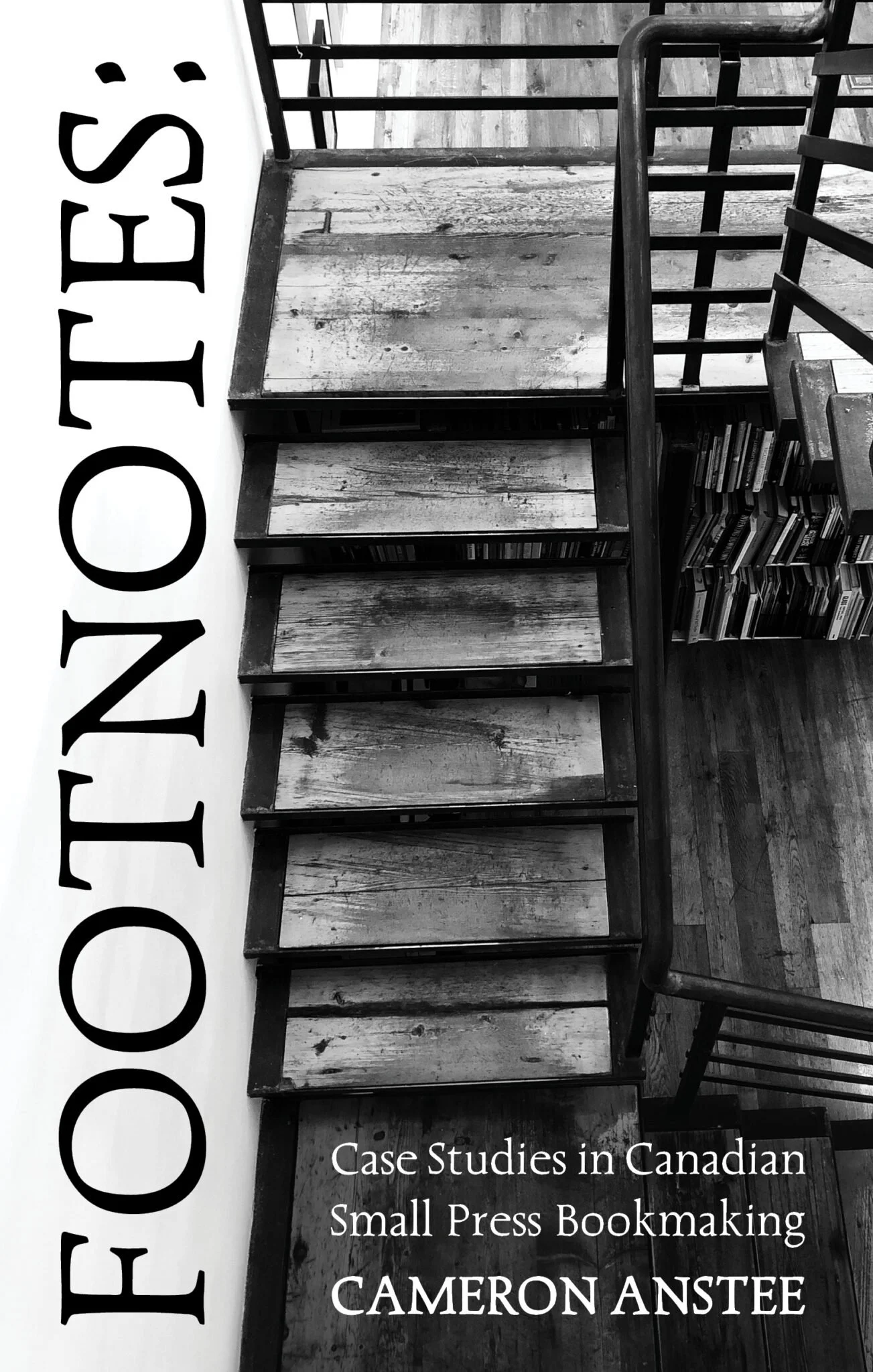
In Footnotes: Case Studies in Canadian Small Press Book Making, Cameron Anstee takes a deep dive to look at small press book makers in Canada from the 1960s onwards. His essays are a tribute to the people who have found ways to make books—and to persist in making books—celebrating work that is all too often un- or underacknowledged. Footnotes is an act of recovery, of bibliographic recuperation; it makes the case for looking at how small press books are constructed as objects and as ideas, and at how readers are asked to engage with these book objects in a constantly shifting cultural landscape.
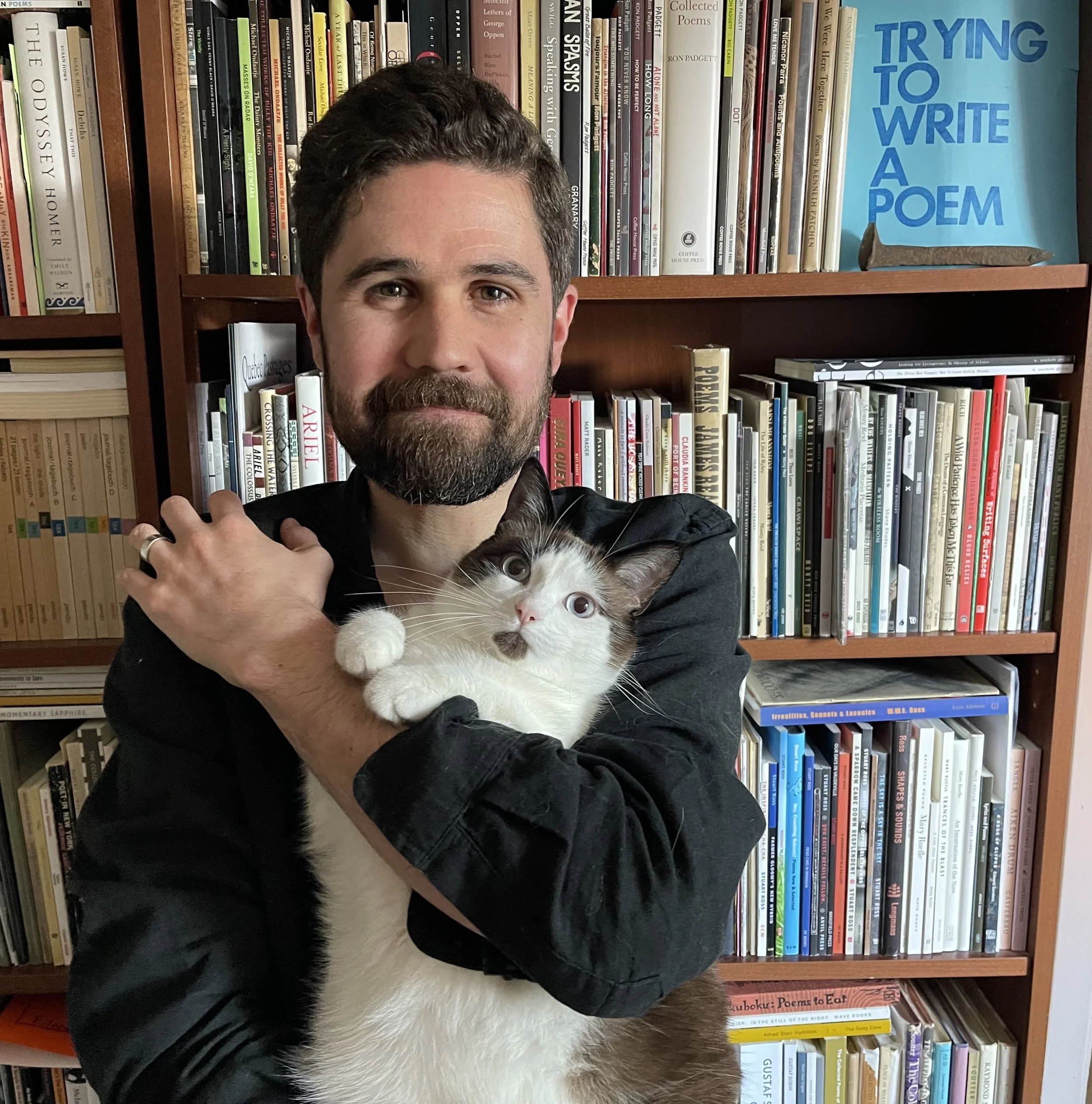
Cameron Anstee is the author of two books of poetry, Sheets: Typewriter Works (Invisible Publishing, 2022) and Book of Annotations (Invisible Publishing, 2018), and the editor of The Collected Poems of William Hawkins (Chaudiere Books, 2015). He posts photos of small press books in his collection on Instagram (@smallpress_bookshelf) and his third book of poetry is forthcoming from Knife Fork Book in 2027. He is the editor and publisher of Apt. 9 Press and holds a Ph.D. in English Literature from the University of Ottawa. Footnotes is his first book of essays.