
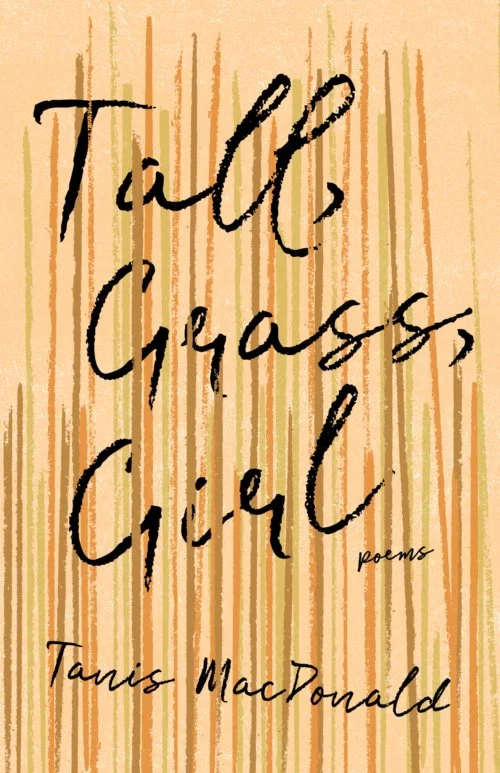
Tall, Grass, Girl
By Tanis MacDonald
Book*Hug Press
Review by Micheline Maylor
Tanis MacDonald opens Tall, Grass, Girl with an epigraph from Phil Hall, “I am with the adopted / who have been ruined by a story / we are starving for”. Tall, Grass, Girl, then launches into a generous buffet, cut wide in the cloth, of telling, redeeming, exploring, and refusal. This book has heft and energy. Frequently, rivers, birds, and fragments create a symbology to illustrate a feminine manifesto for feminist resistance.
The opening poem suggests a cleaning of the space and sets the reader up for a healing and purifying. “We open on / a porch party in the neighbourhood / by the Assiniboine (in Winnipeg there’s always / a river) with giant elms, the hosts smudge / on this stolen river lot land . . .” (15). Indeed, the whole becomes a perceptive reclamation of the title indicators: Tall, Grass, and Girl.
Macdonald’s loose style of punctuation frequently eschews full stops to narrate in a fragmentary stream of consciousness with links comprised of memory and symbolism. The effect is both accurate and fragmentary, as most recall is. Hinged wordings brachiate like pendulums to leave notes of seriousness and play lingering on the tongue with complex images tumbling over themselves. This, coupled with the lack of end stops, echoes of visceral recall. Have you, yourself, ever recalled anything but in impression, that lead to other impressions?
and you know you won’t remember
the name of the bird, only how she sang
just as you can’t remember the girl
in your grade 1 class who fell off a cliff until
someone says bandages on her face and then
you see her falling, earth gone to dust beneath her,
and how she sat at her desk with gauze
wrapped over her eye, and then a man tells you
her father shot someone on a hunting trip,
mistaking him for a deer (or not), and his son
painted the shooting after years of foster
homes and he points to the painting
on the wall and tell you he calls it
the gallery of memory, and you stare
at the painting and see (15)
The ordering of the book is conscious - tracers from previous poems form throughlines, “Lost, she knows / exactly who she is”(16). It’s clear that MacDonald uses language as a kind of forest to hike around in. Her neologisms “girltrace” “grassfeet” “stutter-self” and verb choices delight: “she larches”, “a train whanging by”, “the pond sedges her”. The result is sumptuous and sating.
The narrator’s past self is observed by her now self in a meta-observance. It is a who is observing who situationship. Occasionally, the pronouns get sloppier than I’d like and must retrace my steps to figure it all out especially in the longer, looser poems.
Thematically, definition and self-identity is at the heart of the book. Who defines who and how? Paradox is everywhere. Past-present; internal and external landscapes; young and old; innocent and unnatural hag. I frequently found myself recalling the Gwendolyn Brooks lines, “We are each other’s harvest; we are each other’s business; we are each other’s magnitude and bond.” Tall, Grass, Girl is an autobiography of belonging and unbelonging in space and time.
Early on, the narrator confesses to CPTSD, an entire section hinges on adoption and genetics, a guessing game of who are you? “I spent my whole life as that baby / they took in.” (47).
In “Feckless” naming is called to the stand to defend its legitimacy. Only birth lineage has the weight of authenticity “and it hurts to not / have a girl gang of aunties built into my DNA. I forgot the mother.” (56).
A younger self wants proof of identity, without that proof, identity is saturated with a kind of secrecy disguised as overt tension, and a little anxiety ringing underneath. Proof denied becomes eternal questioning. I often pay this game too, with my own complicated parentage. The game is called what if the other parent was your parent – what would your life be then, now, and in the future? As anyone with adaptive parents knows, this game is inescapable. “Mothers declare people to be / themselves.” (51). In “GNOS: An Adopted Grammar”, lineage is too complicated for the search engine algorithm, and staccato and disruptive enjambment emphasises the lack of flow. Complexity erupts:
subtract second set of parents
subtract Alternate Mother
subtract Alternate Father
subtract New Person
subtract as biological by default
Seeking evidence is too big to load on this page. The search for selfness only satiates when feet touch dirt and the earth. There a synesthesia happens, and melding of place and person removes the tensions of such concerns. “The difference between grass and girl is negligible. / Sing into the wind.” (40).
The section titled, “Bravado Waltz” embraces feminist rage. Identity becomes a defense against the negation and diminishment of everyday living:
The only Gorgon in the city
feeds her headsnakes live mice.
Bless me, Medusa, for I have chagrined.
It has been three weeks since my last
confessional poem. At the banquet I paid for
with my sins and my ability to catch lightning
in my bare but scorched hands,
the man beside me said
I read a woman’s book,
And I’m not even a woman!
Not since Laurie Anderson’s viral video “Women Listening” have I seen such an efficient commentary of patriarchal norms as unpleasant impositions. Nice girls sit, listen, endure, agree. Self-transference to gorgon, medusa, and hag, are necessary as defences against such ignorance. Like Anderson, MacDonald dismantles expectations and resists. The message is: never be unarmed or unprepared for such voluptuous stupidities. Reinventions of the self never cease, and development itself is discordant. Time is an infraction. Hence the references to Daphne, Nut, and other mythological figures who had to endure all sorts of deified masculine bullshit. Yet, she summarizes with, “We are girls, / we are gods: these are the clues.” (82).
Tall, Grass, Girl, is a redress and reclamation situated in healing. Somehow, MacDonald retains a hope against hope that playfulness, dirt, reading, and good tea counteract some of the wrongs of living, and that “Leaf and bole, we muster / all the fortunate / interference we can bear.” (148).
More about Tall, Grass, Girl:
A feminist crow at a history of violence, Tall, Grass, Girl is essential reading for those who are tired of healing narratives that ring hollow, but who also believe hope is curative.
In this searingly honest lyrical collection, Tanis MacDonald examines living in the space between belonging and non-belonging, between victimhood and bold survivorship. She makes no apologies and pulls no punches, taking us on a journey through adoption and assault, to subsequent escapes, and eventually, into full-feathered survivor joy.
This book contends that making one’s way to tenderness can take years, that a good life can come from harsh beginnings, that feeling crazy in an impossible world is more than normal—it’s necessary. Surviving the past can be hard work, and to grow tall, to push past expectations, is to become a person who can refuse and thrive. These poems are a moving testament to remembering oneself via harsh and beautiful terrain, to transmuting past violence, and to finding one’s way back to being a tall, grassy girl self.
TANIS MACDONALD is the author of seven works of nonfiction and poetry, including Mobile, which was longlisted for the City of Toronto Book Award. She is a two-time recipient of the Malahat Review’s Open Season Awards for Creative Nonfiction and has also won the Robert Kroetsch Award for Teaching Creative Writing. She is the co-editor of the anthology GUSH: Menstrual Manifestos for our Times (with Ariel Gordon and Rosanna Deerchild). Originally from Treaty 1 territory/Winnipeg, she now lives near O:se Kenhionhata:tie (Willow River) in the southwestern Ontario watershed region.
Dr. Micheline Maylor is a Poet Laureate Emerita of Calgary (2016-18). She was awarded the Queen’s Platinum Jubilee Award for literary contributions to Alberta in 2022. She is a Walrus talker, a TEDX talker, and she a past Calgary Public Library Author in Residence (2016). Her most recent book is The Bad Wife (U of A Press 2021) won the BPAA Robert Kroetsch Award for best book of Alberta poetry. She was short-listed for the Exile Robert Kroetsch award for experimental poetry. She won the Lois Hole Award for Editorial excellence for poetry in Alberta (2019). Her poems have recently been translated into Farsi, Chinese, and Italian.