
Say What?: On the Culture of Book Reviewing in Canada
We are delighted to announce our third and newest River Street Reviewer-in-Residence, Catherine Owen. In addition to being a thoughtful and incisive literary critic, Catherine is a Vancouverite-Edmontonian and the author of seventeen collections of poetry and prose, the most recent Moving to Delilah (Freehand Books 2024), nominated for both the Al Purdy and Robert Kroetsch awards. She has been writing reviews for 15 years, hosted a poetry podcast for 2.5 years and has run performance series for over 25 years. Her next book is the hybrid-memoir 16 Homes due out from Wolsak & Wynn in Fall 2026.
Catherine joins us today with a fascinating piece on the culture of literary criticism in Canada. Welcome, Catherine!
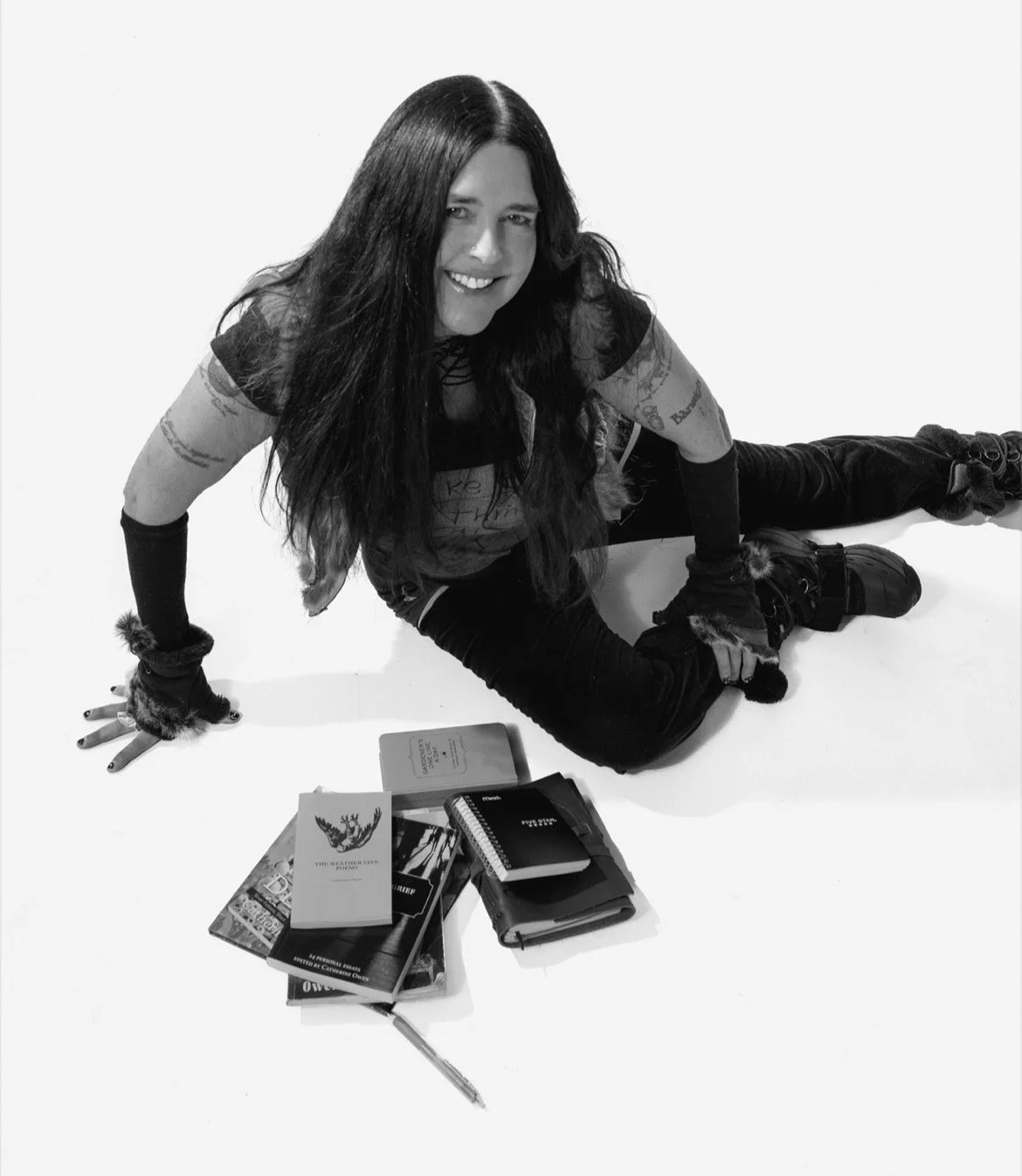
Photo of Catherine by Kaelyn Andrews.
Say What?: On the Culture of Book Reviewing in Canada
By Catherine Owen
According to Dreamers Creative Writing Magazine, a periodical currently soliciting online reviews of Canadian books: “it's not really worth your time to write a negative review. What’s the point? It’ll be more enjoyable for you and for us to write a kind and positive review and it may even facilitate a dialogue with the author you’re reviewing.”
Such rhetoric is prevalent in the reviewing realms and shall I say, brutally simplifies the reason why reviews are written, while indubitably patronizing authors who are deemed to be so ultra-sensitive that they cannot handle a real critique of their work, one balanced between grounded praise and articulate and respectful attention to what might need reassessment.
Many reviews published in Canada fall into what I call the “overview” category where the reviewer merely describes what is in the book without any critical acumen brought into play. If the tone slants in any direction, it will likely be in a “blurby” one, where the aim is to praise in order to “sell.”
These might serve promotional purposes but as criticism, they are “bad.”
Occasionally, and much less so now than in the past, the review will be a “slam” and this IS in fact a bad review too, as the tone is wholly designed to shred the text or worse, the author, to the point where the writer might condemn the reasons why the book was published at all. Having written a few of these types of book slags in the far past, I have stopped reviewing books I thoroughly dislike, not because I fear the author’s response, but because it’s a waste of my time. Generally, composing such reviews serve to put yourself in a bad light in terms of your intentions and the writer themselves will not learn from your critique. Also, you may hurt them and that should never be your aim.
Albertan poet Alice Major once told me that she doesn’t write reviews because “it will all come out in the wash in the end.” I respect Alice utterly but I have always disagreed with this opinion. It just seems overly passive to the critical bulldog I am ;)
But yes, I do think it’s a challenge to be a reviewer in Canada for a few reasons. First off, the pay is minuscule or nada so that motivation doesn’t really exist (except for inveterate ‘bits n piecers’ like me who regularly add up 25 plus 120 plus 50 to pay the bills). Secondly, it’s hard work to think about a book at some depth and attempt to encapsulate it in a balanced, engaging way in a short span of words and who has the time or energy?
Thirdly, and most damningly, there is still a stigma to writing reviews. Perhaps the stigma is worse now than when writers could review regularly, be paid a comparatively decent income (I have heard accounts of such a magical era), have these reviews more widely published in newspapers say, and it seem to matter on a national level. Now, with all the rampant book publishing going on in this country and the plaguey-spread of prizes of every kind meant to justify our existences, boost the reputations of the rich, and bump up the cashflow for precariously-funded periodicals, there is less reviewing than ever, fewer places to publish criticism, and the sense that if you stoop to such sordid acts then you are somehow damaging your “pure” writing career in the process.
Hooey!
Every writer, as I underlined in my book The Other 23 and a Half Hours or Everything You Wanted to Know that your MFA didn’t Teach You (Wolsak & Wynn 2015), should compose at least one and better yet, many reviews in their lifetime (also maybe run at minimum one performance series or podcast or radio show) so that not only are you developing these critical skills but you are learning more about what you like and don’t and, in the process, contributing significantly to the literary scene. Those who seek to publish and yet hardly even buy books, not to mention connecting to their communities beyond their academic positions irk me. It seems self-centered in a way insulting to the art world they apparently want everything from while giving little back.
And reviews aren’t just for the writer, to help in publicity matters (I have been banned on several occasions from writing critical reviews because they weren’t deemed sufficiently ‘sales persony’ in tone. Say what?! Nay, I work for poetry and literature in general as honoured art forms, not for a bump-up-the-profits business mentality), or even to let them know what works and doesn’t in their collection. The presence of balanced reviews in newspapers, blogs, periodicals and other media encourages readers to take our nation’s literature seriously, while giving them an expanded vocabulary of critical concepts, ones nurtured by the reviewer’s own cache of references, so they can read at greater depth and comprehension.
I find it disturbing and absurd that a medium that is designed to be about thinking, feeling, learning, imagining and other slow processes has become more about speed of release, spew of publicity, the garnering of prizes and then the quick dismissal into the bargain bin of wasted resources of all kinds.
As a child who was raised in what Sven Birkerts in his amazing 2006 book, The Gutenberg Elegies: The Fate of Reading in an Electronic Age calls “deep time,” I know that we cannot develop the ability to think and imagine and create unless we give ourselves space to delve into books, to emerge with ideas and visions that didn’t come quickly or easily. In this age where we are not only seeing our Canadian identities eroded, but worse, our very capacity to think dismissed by artificial forms of thievery and dismantlement, the ability to write respectful, critical reviews of books that impact us is even more essential.
Natalie Bakopoulos in an essay called “Particular Ways of Being Wrong” (The Millions.com, 2013) underscores that, “When we read we are creating a map in our minds of the book, and as reviewers we are to act as cartographers of this imagined space. A review is really a mapping of one’s intimate conversation with a book.” Criticism (not bad/good, negative/positive but balanced and considered) is that necessary talking about a text that makes it matter more fully in the world.
Photo by Kaelyn Andrews