
Catherine Owen reviews Theresa Kishkan’s The Art of Looking Back: A painter, an obsession and reclaiming the gaze
Review of Theresa Kishkan’s The Art of Looking Back: A painter, an obsession and reclaiming the gaze (Thornapple Press, 2026), by Catherine Owen.
Being the subject/object of unwanted gazes, overt attention and other creepy male incursions, is so ubiquitous in most women’s lives that few even seem to address its rupturing dominance. Even when we consider ourselves to be outspoken feminists, writing about this pervasive reality isn’t simple. And perhaps it’s even more complex when the obsessive is an artist, or wealthy, someone we should supposedly feel honoured to have snagged the eye of so that, even if we don’t yield to their advances, we should at least shut up regarding our own resistance (despite the powerful examples of the #metoo movement).
I had this kind of experience in my 20s with the poet/doctor/promotor Goh Poh Seng, my landlord on Vancouver’s Victoria Drive. He stared out of an upstairs window as I took my daily walks, popped by unannounced with wine and poems, stooped to kiss me with Parkinsonian lips, and eventually begged me to be his secret mistress (his wife, and mother to his four sons, lived in the same house). I recoiled yet only gently refused him, feeling I didn’t want to cause hurt (and also, jeopardize my tenancy!), but eventually moved out. His pushy amorousness was one of the reasons. And even now, over 20 years later, and long after his death, there remains a thread of guilt in me at exposing his transgressions in writing. How our conditioning always does battle with our sense of justice!
All this to say how grateful I am to writers like Theresa Kishkan who, in her lyrical memoir, The Art of Looking Back, has assumed the difficult task of telling her tale of a man’s (a well-known painter, Jack Wilkinson’s) obsession with her in her early 20s and beyond (and even more disturbingly, his passion for his own daughter, whose image is often the doppelganger for Kishkan’s). In this narrative, she risks her own obsessiveness too, as she quests, in a plethora of short, titled segments, for the reasons behind this discomforting pursuit, returning to the wound of it to examine pain’s parameters, what once lay beyond the frame of her younger incomprehension.
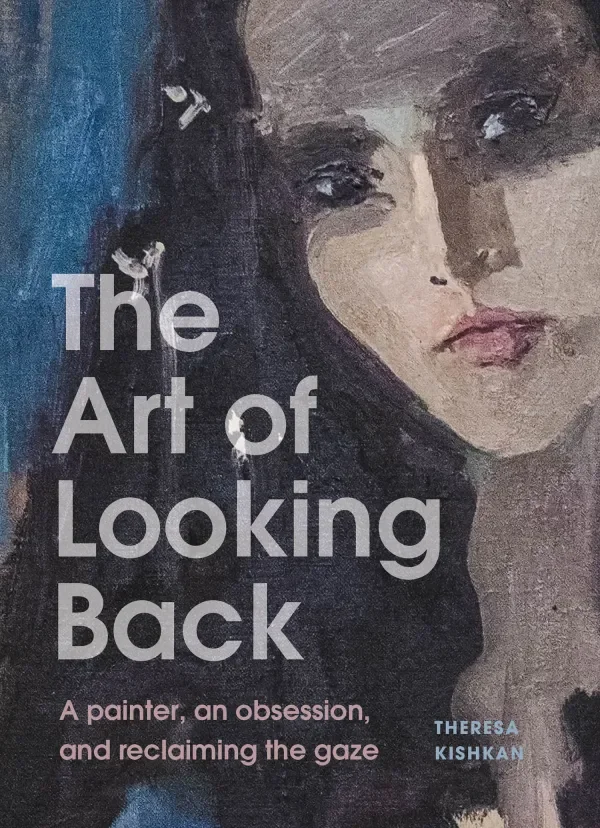
Kishkan is a movingly precise raconteur and the reader is held by her careful details: the “dark hair strewn with flowers” of one of Wilkinson’s early paintings of her; the empathic picnic they once shared of a “baguette and soft cheese, slices of apple…wine out of small tumblers”; the Grecian path in Iraklion fringed by “wild oats, henbane, the desiccated leaves of coreopsis”; or Ireland where she fled his incessance to a place of “dark bricks of turf cut from the bogs” to a “weather-beaten whitewashed cottage surrounded by grey-green leaves.” Woven within, allusions to Homer, Berger, Freud, Kristeva, as Kishkan interrogates the confusing past from an array of angles: her own shame or maybe her innocence, the painter’s wife, her possible perceptions in the wake of their divorce, the judgement of outsiders, and her own husband’s acceptance even as Jack’s erotically-tinged sketches persist despite her marriage and children.
Fragments of Jack’s letters splatter across the sections, some just descriptions of painting techniques or personal yearnings, but others, revisited to re-examine intent, are more disruptive, as in his note of May 7th, 1978 when he claims he plans to distribute a folio of nudes of her around Victoria, BC and warns, “if you ever do return, you will probably be quite well known, every inch of you.” The patriarchal gaze implies codified dominion, entrenched control, easy ownership. Until we are older when we become “invisible, no painterly gaze lingering,” we are beholden, most of us, to yielding to, rebuffing, questioning this socially-coded possessiveness.
And even when utterly acknowledged, we are still taught that we must be complicit in some way. Kishkan eventually concludes that she also caused “pain” for Jack and his family along with the “anxiety…hurt…shame” he instilled in her. Is this a fair assessment? That’s up to each reader to consider in relation to their own histories. But whether memory offers up accuracies or eludes them, The Art of Looking Back honours the turmoil behind such unwanted bonds, ones that, in this case, also resulted in so many beautiful traces.
About The Art of Looking Back:
At 23, Theresa Kishkan met an artist who became obsessed with her. She was young, she was flattered, and the situation quickly overwhelmed her. He drew and painted her for a few months, after which she went away for a year. When she returned, she was determined not to resume the relationship.
But the artist made contact with her after the birth of her first child and became a family friend, bringing gifts of paintings. Those images hung in Theresa’s home, and one in particular reminded her almost daily of her younger self, in ways both positive and not so much. She avoided looking too closely at his images of her and at his long, passionate and often troubling letters.
Decades later, while sorting old correspondence, she was taken back to those early days and began, at last, to write about her relationship with the now-deceased artist. The Art of Looking Back is a meditation on the male gaze, on reclaiming one’s younger self, and on agency: how we lose it, how we find it again. This poetic memoir asks questions about older men and younger women and girls, and the persistence of that dynamic in art.
Learn more about Catherine Owen, our Rewiewer-in-Residence.