
Power Q & A with Ken Wilson
Q: Walking the Bypass: Notes on Place from the Side of the Road, your first book, and Walking Well: Trails, Paths, Pilgrimages, your second, are both about moving through the world on foot. What draws you to that topic?
A: I’ve always been a walker. I’m old enough that I walked to elementary school, for instance, instead of being driven there. My family sometimes went on short hikes; I write about one of those in Walking Well. When I was a university student in Ottawa, I would usually walk to the campus instead of waiting for a bus. I felt a lot colder waiting at the bus stop than I did when I walked. I got away from walking after moving to Regina, but in 2013, when I decided to walk the Camino de Santiago, the pilgrimage path in northern Spain, I rediscovered what travelling on foot meant to me. These days I walk to work and back. I’m incredibly lucky, because my route takes me through the biggest urban park in North America, Wascana Centre in Regina, Saskatchewan. I don’t know what I’d do if I couldn’t start my day that way.
Scientists have looked into the physical and emotional benefits of walking. They’ve discovered that it reduces our risk of diseases like diabetes, cancer, and dementia. It also helps us think creatively and can be as effective as antidepressants in treating mood disorders. I think my daily walking practice is partly responsible for the fact that I no longer have to take medication for depression. I never imagined that I would be free of that bleak, numb sadness, that awful self-loathing, which I’d carried with me since childhood. Walking has helped me experience joy and connection instead. I feel so grateful for that. Of course, everyone is different, and what worked for me might not work for others. But we seem to be experiencing an epidemic of anxiety and depression, and moderate exercise, especially outdoors, is worth trying if you experience those conditions. There isn’t much of a risk of side effects, except blisters, maybe, if you try to walk too far.
I think walking helps with emotional regulation because it provides an opportunity to connect with the world, to pay attention to the other creatures we live alongside. Those connections don’t have to be deep to be meaningful. Recognizing a favourite tree, the way it changes during different seasons, is a form of connection. So is smiling at someone who’s walking their dog—and at their dog, too. I say hello to the ducks and geese I see resting on the shore of Wascana Lake, in English and in Plains Cree, a language I studied when I was working on my PhD. tânisi, niskak, I say. tânisi, sîsîpak. Hello geese, hello ducks. That brief moment of connection helps to pull me out of myself, to interrupt any ruminations cycling through my mind.
It’s particularly important to make those connections these days, when so many of us are consumed by social media feeds which promise relationship but deliver disconnection. You know how the kids tell each other to “touch grass”? Walking is a form of touching grass, even if we’re stepping on a paved footpath. It makes us slow down. It gives us a chance to put aside the hurry, the busyness, that can define our days. I know that might feel like a luxury, since many of us are legitimately overwhelmed by work or other responsibilities. But even five or ten minutes might make a difference. Again, it’s worth trying, just to see if it helps you.
If we walk with other people, we might find ourselves developing deeper connections with them. That’s been my experience. Walking becomes an opportunity to have a conversation, to share space, to notice things in the world together. Sometimes walking side-by-side feels more comfortable than having a face-to-face talk. As we move together, we might begin to understand the web of obligations that link us, the experiences we share with each other. The longer the walk, the greater the possibility of making those connections. I don’t mean to suggest that long walks are the only ones that matter, though. One of the journeys I write about in Walking Well is from the front door of our house to a chair in the side yard.
Walking can also help us understand our history. When I trekked through the Haldimand Tract in southwestern Ontario, for instance, an experience I write about in Walking Well, I was trying to grasp the history of colonialism there, the way that settlers have stolen back almost all the land the Haudenosaunee were deeded in 1784 after losing their homeland in what’s now New York State during the American Revolution. Before I made that walk, I knew that the Haldimand Tract, which covers the entire Grand River valley, is about 300 kilometres long. I wanted to understand much land that was—with my body, not just my mind. After I took off my boots and waded into Lake Erie on the final day of that journey, I knew what 300 kilometres feels like, and I understood the gravity of the theft of Haudenosaunee land.
Walking has become a big part of my life. Walking Well explores the way it helps me to connect with places and other people—and myself. That’s why I write about it. And if Walking Well encourages somebody to lace up their shoes and go for a stroll? All the better.
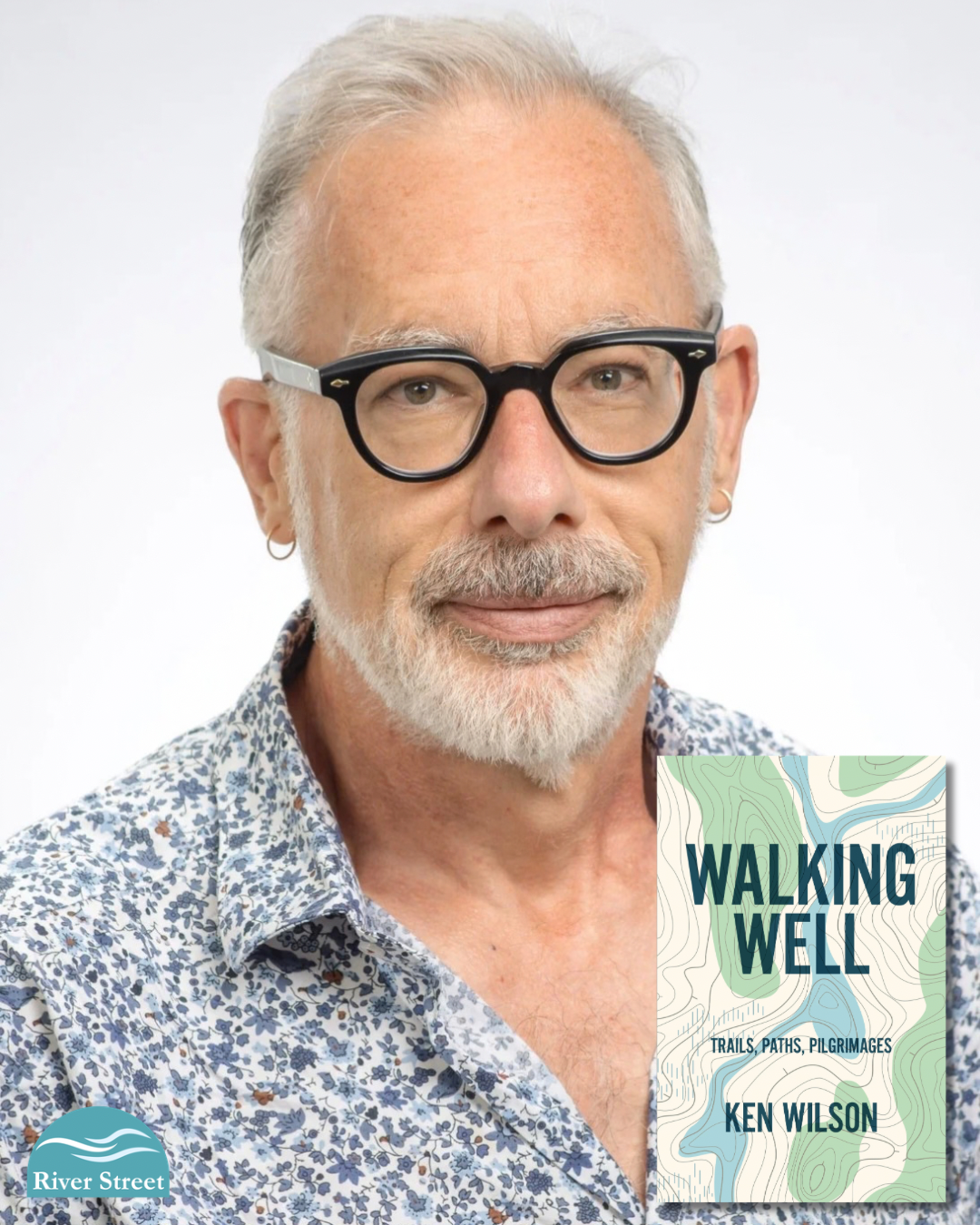
Ken Wilson
About Walking Well: Trails, Paths, Pilgrimages (Wolsak & Wynn):
What a world this is that contains such loveliness. I want to be part of it for as long as I can.”
The year Ken Wilson turned fifty he felt “called” to walk the Camino de Santiago, though he’d never engaged in this kind of pilgrimage before. Over the course of the Camino, Wilson uncovered both the joy and healing power of movement and began the walking practice that has become a cornerstone in his long struggle with depression. In these elegantly written essays, the author delves into the mental, emotional and physical impact of walking, whether it’s during that first journey on the Camino de Santiago or on a simple walk across his local park, alongside Wascana Creek in Regina, Saskatchewan. In each piece Wilson shares the experience of the walk as well as the considerations that shape the walk, such as joining the Walking with Our Angels procession in Saskatchewan to draw attention to the high suicide levels in northern communities. From the Haldimand Tract in Ontario to Pacific Rim National Park in British Columbia, Wilson captures the way walking brings people into wholeness and understanding, with themselves, with their communities and with the natural world that surrounds them.
Ken Wilson is a settler-descendant who grew up in the Haldimand Tract in southwestern Ontario, Canada. He lives on Treaty 4 territory in oskana kâ-asastêki (Regina, Saskatchewan, Canada), where he is an assistant professor of English and Creative Writing at the University of Regina. His poetry and creative nonfiction essays have been published in The Goose and Queen’s Quarterly. Walking the Bypass: Notes on Place from the Side of the Road is his first book; its manuscript won the 2022 City of Regina Writing Award. He blogs about books he’s reading and walks he’s making at readingandwalking.ca.