
Excerpt from Sixteen Homes by Catherine Owen
The Maywood Home for Unwed Mothers, Oak Street, Burnaby, BC, 1988
We used to pass the home on the way to school. We knew what it was and had a morbid curiosity about the girls who were inside. But we never saw anyone. – Barbara from Vancouver, Anne Petrie, Gone to an Aunt’s: Remembering Canada’s Homes for Unwed Mothers
January 11, 1988
Well, I’m four months pregnant and this will be my last entry in this diary. It’s a fresh chapter in my life. No more smoking, drinking or sex with other boys for me. M will be a good dad. I’m moving to Maywood Home until the baby is born so I can work on high school classes. Also, my parents don’t really want me here. My mother said, “Do you think I should shout it from the rooftop?”
Home is a misnomer when the governing principle is duty and not love. I was sixteen and about five months pregnant when I was sent here to live during the week: an old brick edifice in Marpole, set back from the street and surrounded by laurel bushes and a high fence. Run by the captains of the Salvation Army, Maywood had been assisting adolescent girls to mostly relinquish their infants since 1940. Once part of a chain of such hideouts across Canada, this home closed in 1989, a mere year after my several months’ stay, a decision made so I would continue my schooling via distance education, but also from shame. No one wanted a knocked-up teen around. The option had just been to say no, a response hard enough for my hormones and nearly impossible in the absence of information about sex, my body or my potential future as a young woman.
The father was someone four years older than me. I had met him, the manager, while slinging burgers at McDonald’s and had known him for six weeks when the two lines darkened their one-way street on the pregnancy test at the Crisis Centre. They called it a crisis but no actual crisis was allowed. I was raised Catholic and had no option but to keep the fetus.
At the time, fourteen girls between the ages of thirteen and eighteen lived in this home, a number that would quickly be reduced to only six by the day I left, the final full intake before schools added pregnancy portables on their grounds to accommodate the graduation of young mothers. Then too, abortion was both legalized and funded by the early ’90s, along with more readily available birth control.
The Victorian-style architecture of Maywood Home was gracious, a hearkening back, but once you passed into the foyer, a bland institutionality of beige walls and brown linoleum floors took over. I remember the schoolroom best, simply rows of desks and chairs and a table in front where Captain Maria sat to assist us with our mailed-out courses in their manila envelopes, handwritten into booklets and shipped to the Ministry of Education for grading in inked boxes below our names. First names only. This was the most important rule – no one must later be traceable. So you relinquished the full name valid in your prior home and assumed a partial identity in this one: Catherine, teen mother. We not only studied English, Science and Consumer Education but took classes in nutrition, cooking and sewing, as well as instruction in how to clean and stay organized. Fortunately, by this time the home was government-run so religious studies were no longer required.
When I first moved in, Captain Buck of the protuberant teeth toured me around the gargantuan kitchen with its phalanx of toasters and giant bottles of vitamins, a lounge where we could drape our burgeoning bodies over the well-eroded couch and watch a film on the small TV, the laundry room, a nurse’s cubicle, where we were weighed once a week, and thence up the broad oak stairs, carpeted in drab underlay, to our bedrooms and bathrooms. I was fortunate, she told me. I wouldn’t have a roommate in the double-bedded square, complete with two stolid dressers and a view out the mullioned windows to the unused lawn and a smattering of cypress trees. However, all toilets and showers were shared and sat between the bedrooms, accessible via adjoining doors. They smelled always of old toasted cheese and floor wax. They were also one of the hormonal war zones for a dozen adolescent girls in various stages of unacknowledged trauma.
*
I’m starting with this home because it was when I understood the word as signifying somewhere different than the place I was initially raised. Here there was no permanence, affection, happy gatherings, personal history or solid identity. So how could both these places be called homes? I didn’t yet comprehend how insufficient the English language is, particularly in the ways it resists specificity, and most often in relation to emotional states. Home, we are told, is a feeling, a tradition, a brand, a heritage, an absence. Does anyone living not hold a concept of what home is close to them, even if solely as loss or what might have been?
—Excerpt from Sixteen Homes by Catherine Owen, published by Wolsak & Wynn, 2026. Copyright Catherine Owen. Reprinted with permission.
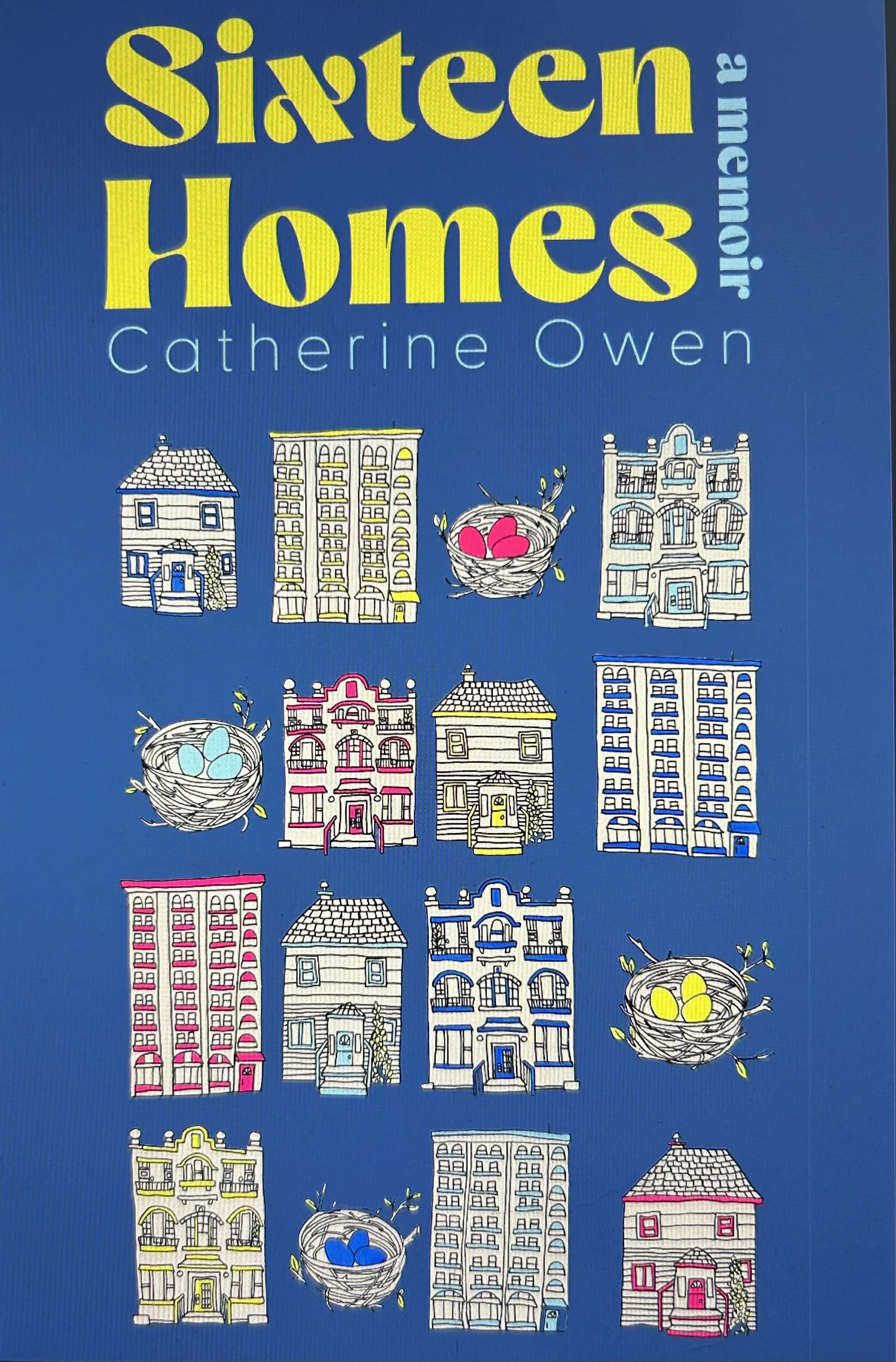
Sixteen Homes by Catherine Owen, published by Wolsak & Wynn, 2026.
You say house and wood falls over you like a cloak, your passion becomes windows. You say home and all memories gather.
In Sixteen Homes award-winning author Catherine Owen set out not to write a memoir but to reflect on a society that has priced many out of their home cities and to ask what that costs us all. Moving between diary entries, essays, poetry and photographs, Owen shares her path from her struggles with housing as a young mother to the security she now feels. From her parents’ purpose-built home in Vancouver – co-owned with another family – to Delilah – the century-old house she now owns in Edmonton – Sixteen Homes moves through the many places Owen has lived, as well as the homes she has visited. All along she invites the reader to consider what it is that turns a house into a home and who it is that gets to have one.
Catherine Owen, a born and raised Vancouverite, is the author of seventeen collections of poetry and prose. Her award-winning work has toured Canada, been turned into one-woman plays, translated into Italian, sung with a metal band and performed to children. She edits, teaches Poetic Forms and gardens from her 1905 home in Edmonton, Alberta.