
This excerpt is from the point of view of Cliff, an ex-drug dealer turned real estate shark who has left behind one hustle for another:
Every man, unless he is born decided, has his own conversion story. All men convert, because all men worship, whether they know it or not. To be blessed is to know what you worship, and to understand why. To know what holds you, and to what extent you hold it back. The salesman knows himself to be a lucky man.
There is a magnetic, vacuous flow in the city, pushing glacially through alleys, moving unchecked between telephone wires overhead, dripping through subway grates and pooling in the uneven soggy park ground, an inertia that sucks people in and doesn’t let them back out. A viscous river with no visible banks from which they are unable, with lazy kicks and half-hearted flails, to free themselves. From which they cannot free themselves because they are too drunk on the thing itself, lungs and nostrils and mouths stuffed full of amnesic cloying matter that is tasteless and leaves no trace.
You don’t realize it’s happening until you’re in it, far in, coming into the eye of the massive glacial vortex turning ever so slowly, ever so seductively across the concrete landscape, through doorways of rental houses into crooked rooms, dingy convenience stores, late-night bars, pricey coffee shops. Places frequented by those with nowhere to be. It was when he got tired of partying that he first saw it, the receding shore and how far out he’d allowed himself to be pulled by this current he’d failed to perceive.
The first few times you see the sun coming up after a night out it’s new, exciting, invigorating, transgressive in some fundamental way having to do with defying the sanctioned hours of sleep. How quickly it then gets old because you’ve been partying since you were seventeen and now that you’re twenty-nine it’s just horrifying, the nightly threat you work around and avoid in a permanent interior cringe, withering at the thought of the coming dawn. And already at seven in the evening you’re thinking it, laying down lines and pouring out shots, getting stoked for the night ahead but knowing already, having known already since that morning and before even planning to go out how bad it was going to be. And hating yourself, passionately, in advance.
And bad, it was going to be very bad. Like the first time you notice that six a.m. is primetime for the most balanced people on earth to leave their homes: joggers in precise new spandex and bright-eyed dog walkers and mothers pushing sleep-resistant toddlers in strollers through the park and businesspeople in their crisp-suited best running for the streetcar with coffee in hand while you drag your drug-flooded body and massive pupils and running gnashing coke mouth down the street in last night’s clothes and pretend like they’re the stiff ones and you just don’t care. Realizing that it’s not normal and that maybe you’re a wastoid, that sometime in the years sandwiching your awareness and ironic use of this term you have actually become what you mock, and that you can’t say how or when this change occurred. That you are suddenly embarrassed to be seen this way. That the prospect of the comedown leaves you drenched in real physical dread.
You begin to grow pale because you stick to the evenings, going out at night or not at all. Crawling from place to place while holding in your ever-restless insides, less like a human being and more like a worm. You count lines before they begin to run out, keep an eye on rapidly depleting piles of white powder that are supposed to bring you such perfect pleasure and bring you only the anticipation of their end. There is never enough coke. You may be the dealer, but there is never, ever enough.
He started noticing, all at once, that a lot of his friends had been doing the same thing for years, now—for nearly a full decade—working serving jobs and playing the same gigs at the same places and drinking the same things, but in greater quantities, and doing the same drugs, but now in bulk. Drifting within this space that has no internal rules of motion but its own inertia while people much younger and much cleaner drifted in and out, passing through. All his friends wearing their tired shapes into the places they whittled their hours away in each night, leaving some trace, but nothing too substantial.
And seeing his mother’s obvious disappointment, his grandmother’s strained cheerful face. And being bothered by desperate inebriated people on his phone at four in the morning when the bags had run out and been licked and other avenues exhausted, and dealing with major sketchballs, and worrying about police. Changing his number and picking up stock and sweating buckets until he could get inside and set it all down, stash it safely beneath the kitchen sink in carefully portioned bags. Depositing enormous, weirdly denominated amounts of cash the tellers never stopped asking about.
Seeing people like Lee with his unfinished BA degree in Spanish raking in minimum wage at the movie theatre, or Kels waiting the same tables at the same two places on the same days each week, and sometimes every night of the week because it was winter and the tips weren’t so great. No fucking way is that going to be me, he thought. Not a fucking chance in hell.
And started thinking about what he might do.
And then, one day, as he was walking back home from whatever hole he’d crawled out of, head down and pulsing against the sickening morning sun, he tripped right into a newspaper box holding a brand-new, freshly replaced stack of the day’s Metro. Feeling wasted and faint and generally ready to keel over and die from shame or nausea or a healthy mix of both, he bent over himself and studied the front page of the issue sandwiched between panes of scratched graffitied display plastic, the content of which it took him about ninety seconds to realize was not the headline, but an advertisement for the Toronto Real Estate Association:
WHAT ARE YOU SELLING?
The glare brightened and his head ached more keenly and his insides clenched up, because he immediately understood that it meant something, though he couldn’t have said what. It had been left there for him specifically and him alone.
What are you selling?
It was not a question he’d ever considered before.
Excerpt from Middlemen by Maria Cichosz (NoN Publishing, 2026). Reprinted with permission. Copyright Maria Cichosz.
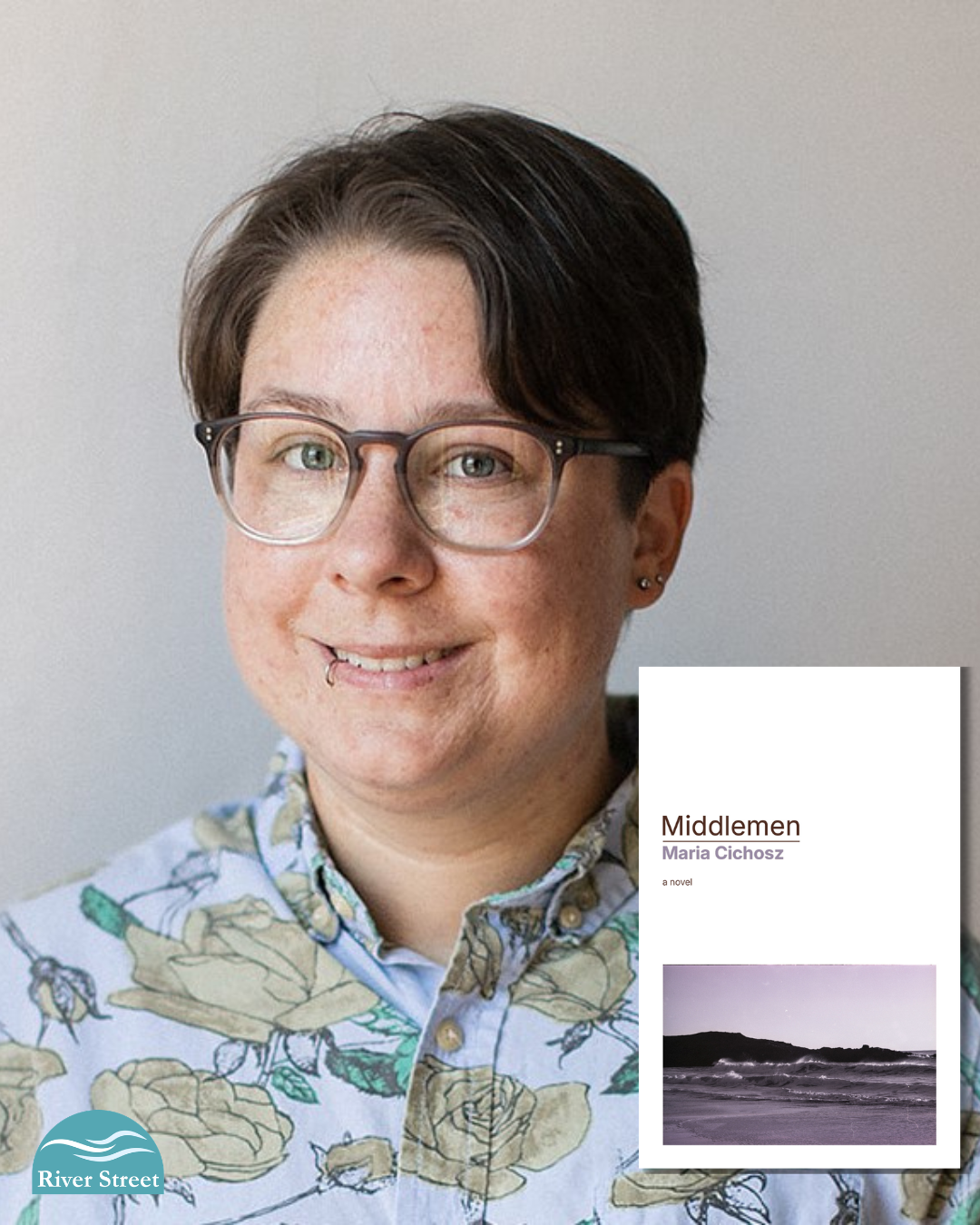
Middlemen by Maria Cichosz (NoN Publishing, 2026)
About Middlemen:
Toronto in the mid-2010s: the economy is shit, the opioid epidemic is about to make major headlines, and Beau Larky has been bumming around town doing too many drugs, photographing lavish weddings to support his habit. When he learns his old roommate and once-lover, Cam, now a celebrity academic living on the west coast, has had a mental break, Beau is overcome with desire to see his estranged friend for the first time in years. His sudden decision to visit Cam in California sparks the ire of Stacey, the professor’s soon-to-be wife, convinced the photographer sees Cam as a convenient exit ticket from his addiction and financial woes, and Cliff, their old drug dealer turned realtor, too busy enjoying the lucrative housing boom to care about anything but the market.
To middle is to sell drugs to support one’s own habit, but also to stay in a pattern or refuse to decide. The middle ground is both safe and stagnant, neither black nor white, but grey, empty, and contentless: a placeholder for action not taken. Centered on a close friend group compromised by the attempted suicide of its most beloved member, Middlemen is a gritty, dark story about class, distance, addiction, confusion between human and financial relationships, and the generational disappointment of an aging cohort hardest hit by economic crisis. Above all, it is a break-up letter to the city of Toronto, the novel’s meanest character. Punctuated by original photographs shot on expired film, the novel poses these questions as a dialogue between terse, tortured words and opaque, haunting images.
Maria Cichosz is a writer and scholar of post-1945 literature, art, and theory, with a particular interest in drug histories and cultures. Her work has appeared in places like Critique, The Los Angeles Review of Books, The Puritan, The Literary Review of Canada, and on the CBC Literary Awards shortlist, and received support from the Social Sciences and Humanities Research Council and the Canada Council for the Arts. She is the author of two novels, Cam & Beau (Now or Never, 2020) and Middlemen, which will be published in Fall 2026. She's currently writing On Drugs, a forthcoming entry in Biblioasis's Field Notes series.