

BLOG
10 Amazing Books to Add to Your 2026 Reading Challenge
2026 is well underway with spring fast approaching, and there have already been lots of great books by small presses released to start off the year. But there are plenty more coming out soon and it’s never too late to add to your reading challenge, whether you’ve set an official one on Goodreads, joining many other avid readers, or something more casual, such as a list of titles you’ve been meaning to get to before the year is out. However you like to enjoy your reading, without further ado, here are 10 books published by Canadian small presses that you should consider adding to your 2026 reading challenge, and why they deserve to be there.
By Michael Schmidt
2026 is well underway with spring fast approaching, and there have already been lots of great books by small presses released to start off the year. But there are plenty more coming out soon and it’s never too late to add to your reading challenge, whether you’ve set an official one on Goodreads, joining many other avid readers, or something more casual, such as a list of titles you’ve been meaning to get to before the year is out. However you like to enjoy your reading, without further ado, here are 10 books published by Canadian small presses that you should consider adding to your 2026 reading challenge, and why they deserve to be there.
Stan on Guard by K.R. Wilson, published March 1, 2026 with Guernica Editions
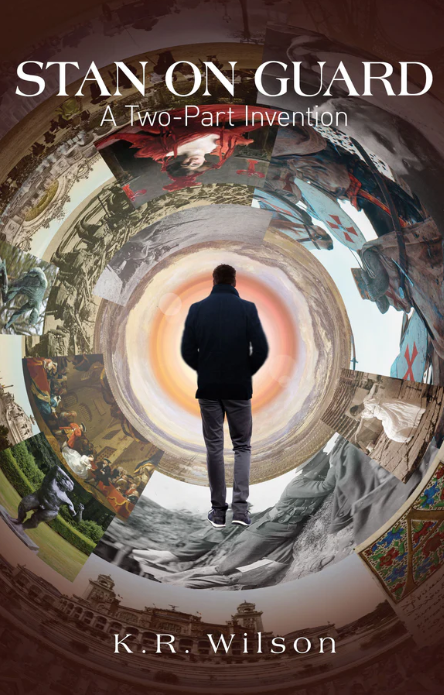
the follow-up to Wilson’s novel Call Me Stan: A Tragedy in Three Millennia, which was long-listed for the 2022 Leacock Medal for Humour
a gripping story that spans genres-- tragedy, comedy, historical fiction-- and multiple eras of history, from a retelling of the Odysseus story, through the Great War and its horrors, to present day Toronto
lead characters are immortals, including the protagonist Stan, a Hittite who has seen and experienced many things over the centuries, and his adversary, an immortal Trojan princess named Tróán
Yield by Jamie Forsythe, forthcoming with Wolsak & Wynn, April 2026
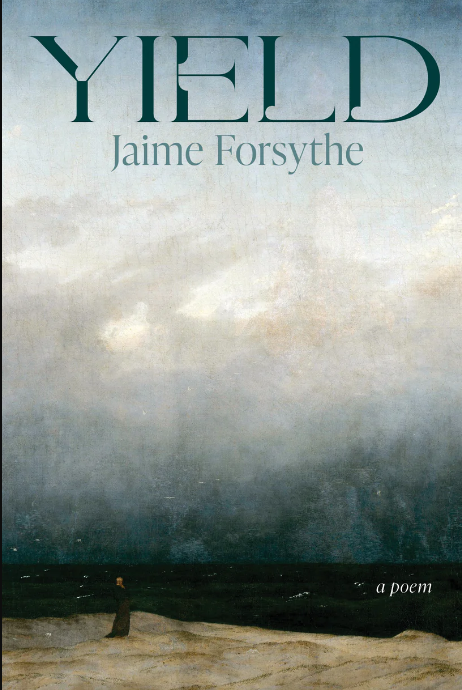
the third poetry collection from Nova Scotian writer Forsythe, Yield is a book-length poem you won’t be able to forget once you pick it up
set against the alluring backdrop of the Maritime coastline where the land converges with the sea and follows a mother navigating a postpartum world
features a unique, dreamlike writing style that involves repeated waves of couplets, bringing to life memorable images that will stick with you and showcasing Forsythe’s impressive command of language
The Fall-Down Effect by Liz Johnston, published by Book*hug Press, April 21, 2026
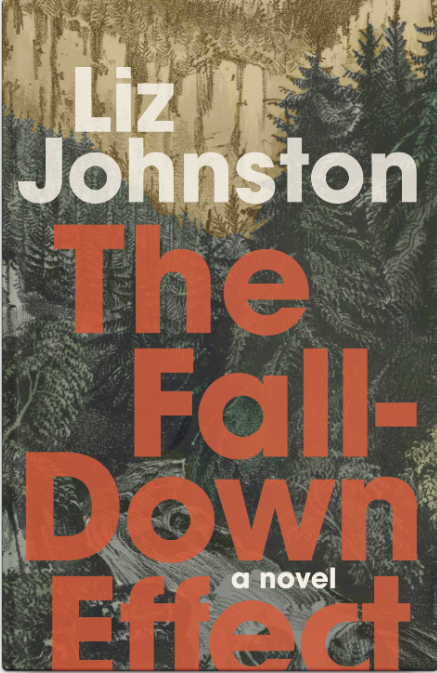
an exciting debut novel featured in several anticipated book previews, such as The Grind, MER Journal and Quill & Quire
centred on the themes of climate change and environmental protest-- if you’re someone with a keen eye for this important contemporary topic, The Fall-Down Effect is a title you won’t want to miss
a second major theme, and no less enthralling, is that of fractured family relationships and the drama that can arise from the dynamics between loved ones, crafted in compelling fashion that will hook you right from the first page
Wound Archive by Anna Veprinska forthcoming with Gordon Hill / The Porcupines Quill, April 2026
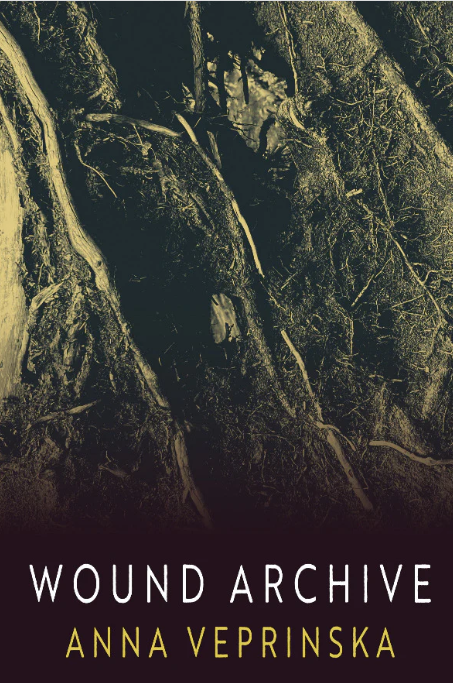
a collection of poems that explore a poignant and captivating subject as its central theme: the end of a relationship and the beginning of an invisible illness, both happening at the same time
for poetry lovers, but also for anyone wanting to experiment with their reading preferences, as the collection has a minimalist poetry style
the poems explore how language can be turned upside down, both figuratively and formally, and demonstrate how brevity is able to hold the expansiveness of ache and deep-seated wounds
Seldom Seen Road, by John Degen, forthcoming with Latitude 46 Publishing, May 7, 2026
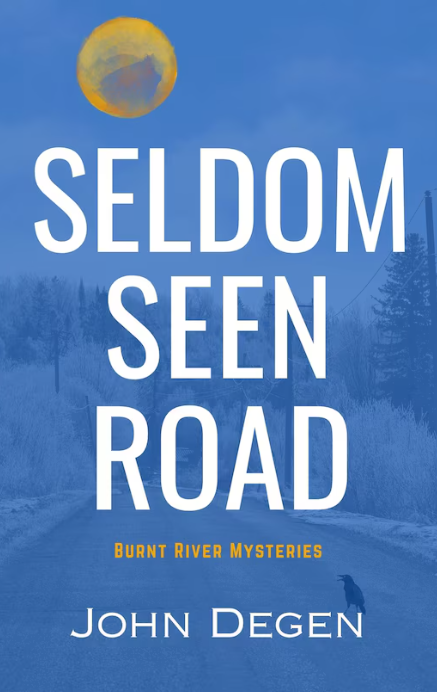
a thrilling murder mystery set in a small, northern Canadian town brimming with secrets waiting to be uncovered, and the first novel in a new murder-mystery series
follow along with protagonist and amateur sleuth Mark Roth as he attempts to solve the murder despite lacking any official detective experience, often putting himself in the eye of danger in his pursuit of the truth
unique to the genre, Mark works alongside two family members, his cousin a constable and his daughter a criminologist, who each bring their dynamics and skillsets to the task
The Instrument Must Not Matter by Christine Fischer Guy, forthcoming with Wolsak & Wynn, May 12, 2026
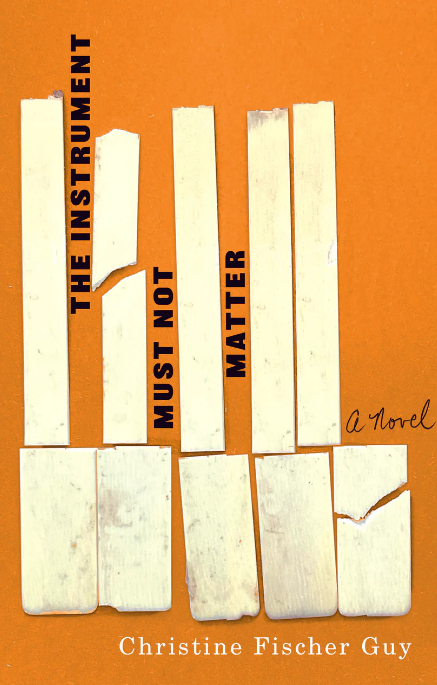
an enchanting, coming-of-age story about a gifted young pianist named Lila Rys as she strives to accomplish her dream of becoming a brilliant performer and bring music back to her family, which was stifled by the Soviet Regime
follow Lila’s journey as she moves from Prague to New York City and navigates a new world and studies under a famous teacher, all the while struggling to live up to high expectations
a romantic encounter with a renegade female pianist, and the discovery of powerful family secrets that the protagonist and her family will be forced to reckon with
Here’s to Letting Go by Blaine Thornton, forthcoming with Latitude 46 Publishing, May 21, 2026
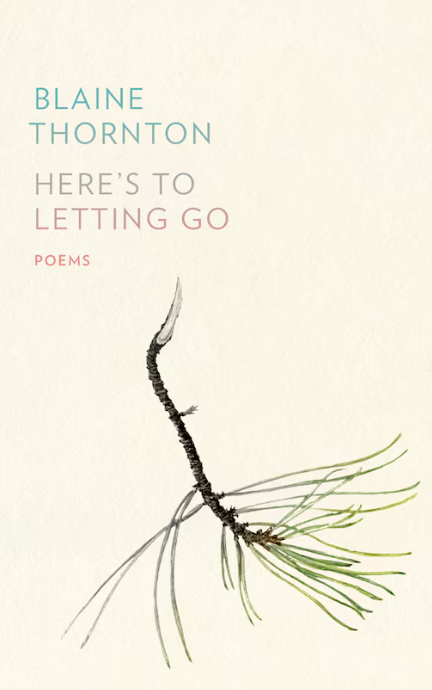
a touching, thought-provoking poetry collection that blends poetry and prose to explore the intersectional experiences of queerness, homelessness, and mental illness-- shining a light on stories that often go untold
told from the perspective of a young trans, non-binary person, weaving their memories of escaping home and having to survive in the loneliest of places into a narrative sure to compel and widen your worldview
Thornton reveals what it takes to come back, to survive hardships, and find a path towards healing and acceptance
Not All Dragons by David Ly, forthcoming with Wolsak & Wynn, May 2026
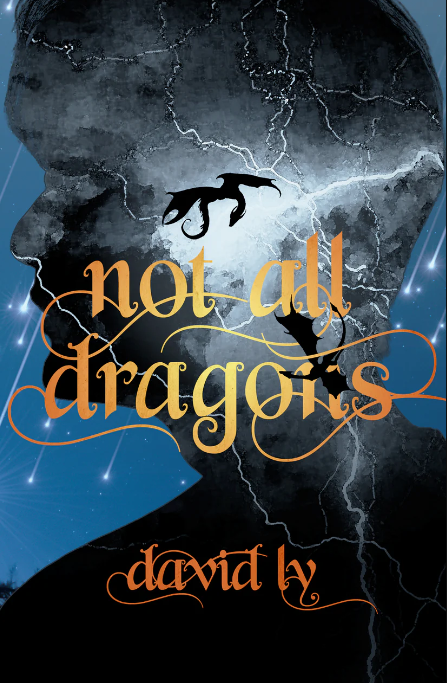
for readers who love speculative fiction, step into a strange, mesmerizing fantasy world called Lanilia, a place where magic and myth flow free
the protagonist Rhys is a descendant of dragons known as a draykin, though he has lost his wings after a tragedy and wakes with no memory of his prior life
a fresh take on the classic tropes of dragons and destiny, and a dangerous, thrilling quest for acceptance and understanding in which Rhys teams up with a mermaid and goes on an unforgettable journey
Half-Earth by Blair Trewartha, forthcoming with Palimpsest Press, May 15, 2026
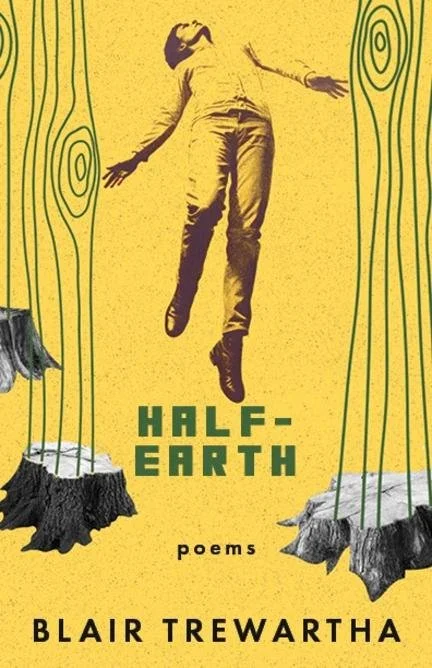
the second full-length poetry collection from one of Canada’s finest contemporary poets, delving into what it means to survive in a world where climate crises and the rise of Artificial Intelligence are ever-prevalent disruptions
experience a masterful demonstration of language as Trewartha weaves dreamlike narratives and digs up scenes of deep history that connect to the themes of family and illness, as well as asking how to move forward in an uncertain future
unforgettable imagery that includes moments of the past and the future paired together, including but not limited to: prehistoric tusks frozen in foreign tundra, firestorms, the zeitgeist by algorithm, and a toddler’s visualization of death
Take This for the Pain: Essays on Writing and Lifeby Alex Boyd, forthcoming with Palimpsest Press, June 15, 2026
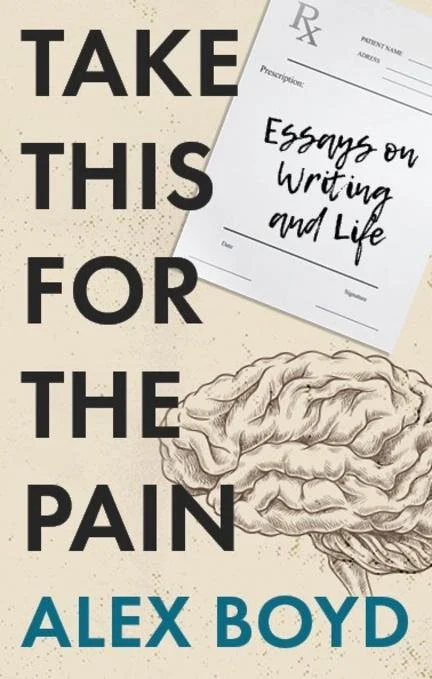
a curious look at how art and culture has changed in the modern world, a world that continues to change rapidly, pulling from twenty-five years of essays, reviews, and articles to explore an array of topics from faith to aging, to industrialism and bookshops
if you’ve ever wondered about the value of poetry in the 21st-century, or whether graffiti is a true art form, this is a read for you, from an award-winning author and editor who’s written for The Globe and Mail, among other publications
includes reviews that dive into overlooked yet deeply worthy books that any literature-enthusiast will find interesting
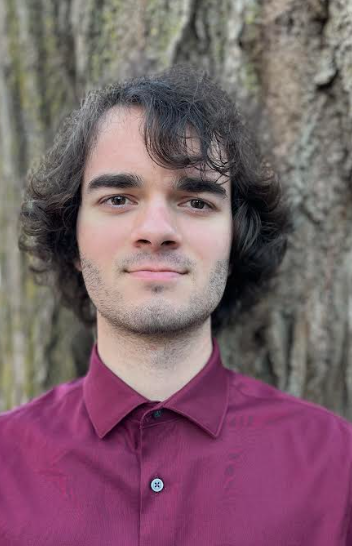
About the author:
Michael Schmidt is an emerging writer from the quiet woods and fields of rural Southern Ontario, with a keen interest in telling stories that explore the fantastical. He completed a BA for English and Creative Writing at Western University in 2022, and then went on to study publishing at Centennial College in 2024. He's had poetry featured in Blank Spaces Magazine. You can find him on Instagram and X (formerly Twitter) as @theepictom_ .
Excerpt from How I Bend Into More by Tea Gerbeza
Based on Tea Gerbeza’s experience with scoliosis, How I Bend Into More (Palimpsest Press, 2024) re-articulates selfhood in the face of ableism and trauma. Meditating on pain, consent, and disability, this long poem builds a body both visually and linguistically, creating a multimodal space that forges Gerbeza’s grammar of embodiment as an act of reclamation.
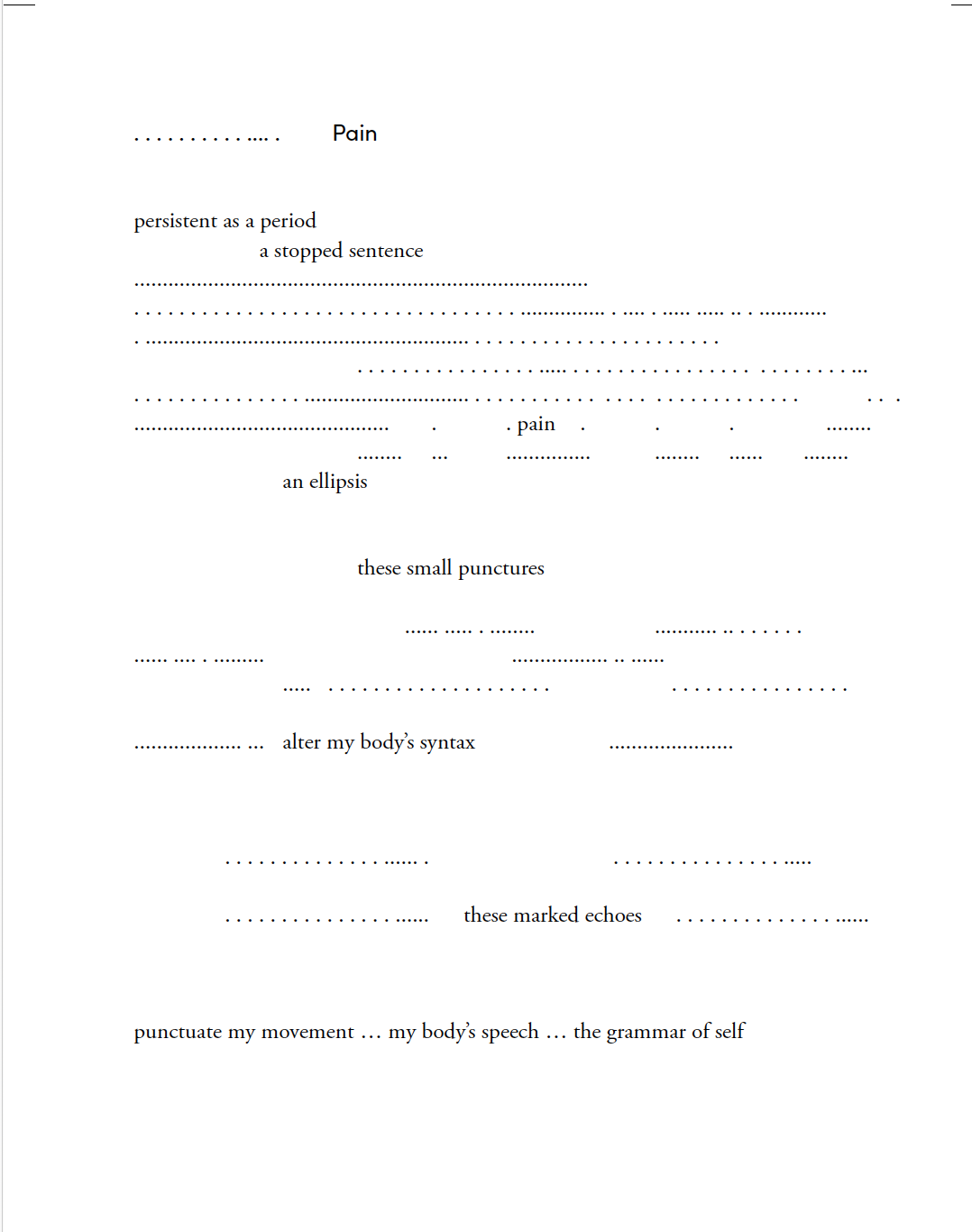
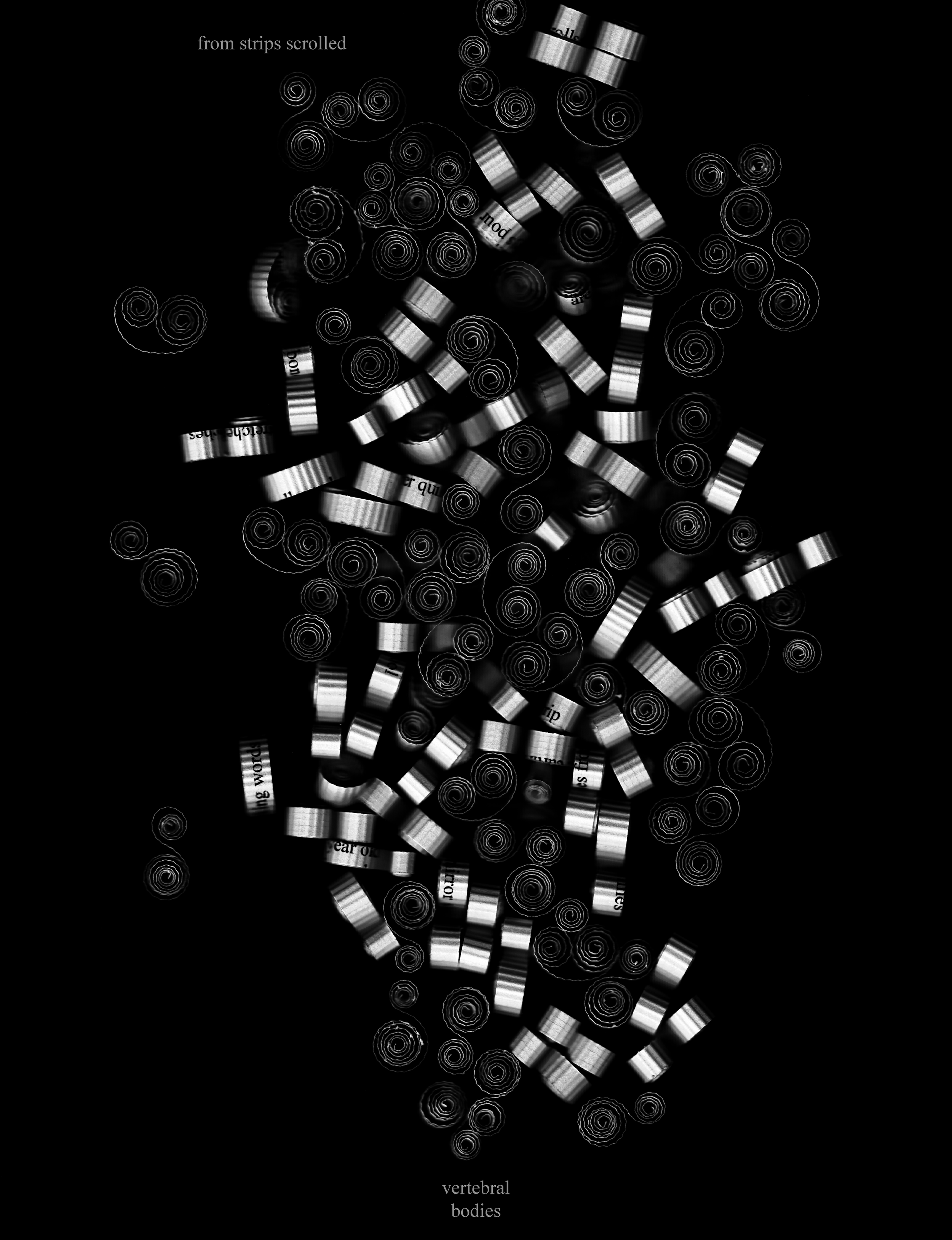
Excerpt from How I Bend Into More by Tea Gerbeza. Published by Palimpsest Press. Copyright Tea Gerbeza, 2024. Reprinted with permission.
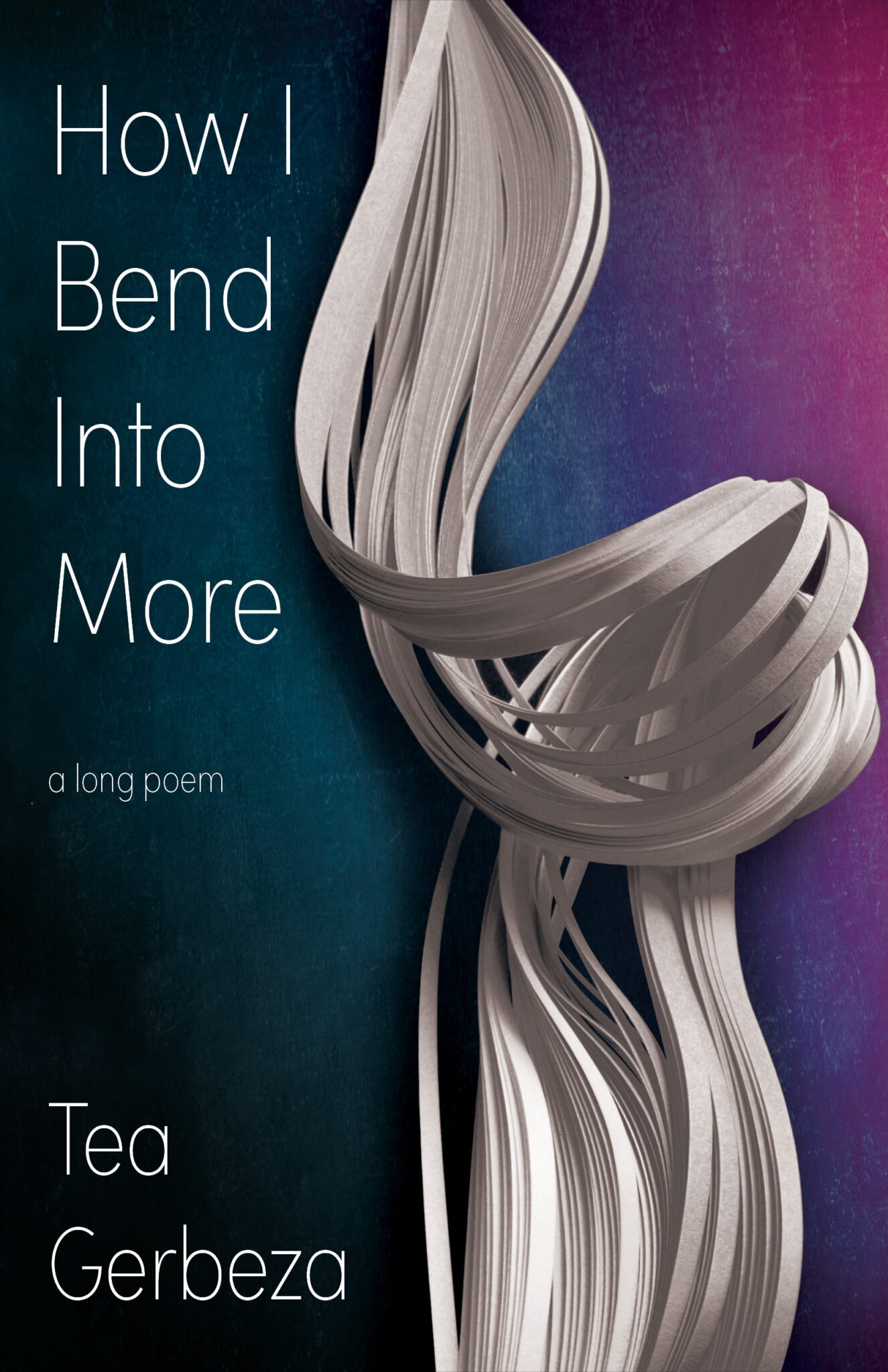
Based on Tea Gerbeza’s experience with scoliosis, How I Bend Into More (Palimpsest Press, 2024) re-articulates selfhood in the face of ableism and trauma. Meditating on pain, consent, and disability, this long poem builds a body both visually and linguistically, creating a multimodal space that forges Gerbeza’s grammar of embodiment as an act of reclamation. Paper-quilled shapes represent the poet’s body on the page; these shapes weave between lines of verse and with them the reclaimed disabled body is made. How I Bend Into More is a distinctive poetic debut that challenges ableist perceptions of normalcy, and centers “the double architecture / of ( metamorphosis (.”
Tea Gerbeza is the author of How I Bend Into More (Palimpsest Press, 2025), which was a finalist for the Writers’ Trust 2025 Dayne Ogilvie Prize for 2SLGBTQ+ emerging writers. She is a neuroqueer, disabled poet, writer, editor, and multimedia artist creating in oskana kâ-asastêki in Treaty 4 territory (Regina, SK) and on the Homeland of the Métis. She primarily works with paper in her visual art, but also creates digital works on her scanner (scanography). Her writing and artwork focus on themes of reclaiming disabled identity, disability justice, the Bosnian-Croatian diaspora, queer platonic friendships, and the complexities of pain. Her artwork has been exhibited at The Art Gallery of Regina. Tea has a very loud laugh, and is one of four Pain Poets.
Most recently, Tea was a finalist for YWCA Regina’s 2026 Women of Distinction awards in the Igniting Equity category. In 2023, She was recognized by SK Arts as one of 75 strong emerging artists that makes the future of Saskatchewan arts exciting. Tea’s poem “Body of the Day” was a People’s Choice Award finalist in Contemporary Verse 2’s 2024 2-Day Poem Contest. In 2022, Tea won the Ex-Puritan’s Austin Clarke Prize in Literary Excellence for poetry. She also made the longlist for Room magazine’s 2022 Short Forms contest. Her scanograph, “My Father Catches Me Confronting Memory,” won an Honourable Mention in Room magazine’s 2020 Cover Art Contest, and she was a finalist for Palette Poetry’s 2021 Emerging Poet Prize.
Tea holds a BA (Hons.) in English (2017) and an MA in Creative Writing and English from the University of Regina (2019). Tea’s thesis work for her MA was SSHRC funded. She also holds an MFA in Writing from the University of Saskatchewan (2021).
Photo of Tea by Ali Lauren.
Power Q & A with Sean Paul Bedell
I wrote the book in the ‘gritty realism’ style. That’s intentional, I want my readers to feel, see, smell and touch – everything that the main character, Steve Lewis, does. I want them trudging to calls in his work boots. Though it’s fiction, Shoebox is loosely based on calls I did or ones my crew mates were involved in.
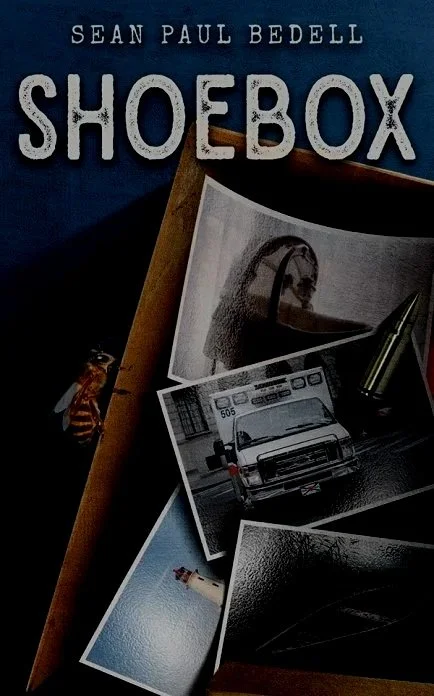
Q: In the novel Shoebox (NoN Publishing, 2025), the paramedic characters deal with trauma and the stress of the job in different ways. Are those portrayals realistic? And what about when you worked as a medic? How did you deal with the stress and the adverse experiences you witnessed?
A: Pranking and laughter is a short-term release for the after-call, adrenaline-fuelled tension. But the laughing, the pranks, using food, coffee, small talk, or watching a movie as distractions, is only a placebo. I hope the book shows that. The stress and memory of the trauma is buried inside and will work its way to the surface. In the story, Steve struggles because he can’t recognize and process all the emotion he feels, not only from his work but from his home life too.
In the story, Steve and his fellow medics are not only co-workers they’re roommates too. When I first started working ambulance, we worked 48-hour shifts. We lived, ate, and bunked together. We dealt not only with the stress and issues of calls, but interpersonal relationships of sharing living space with people including some with annoying habits. Add in too much caffeine and not enough sleep to the stress of constantly being hyper vigilant, and the atmosphere could tense up.
Beyond the paramedic-firefighter angle though, I’m a writer. I created a story to engage people and drive the reader to want to find out what happens next. I need readers to feel and root for a character that has become ’real’ for them. Beyond trauma and stresses of the job, I wanted to create a person people are compelled to find out what happens next for him. I told the story in first person so people could experience what Steve and the others do. I based it on typical calls to make the story as real as possible.
For me, some calls unfolded the way they were meant to. Whether the outcomes were good or bad, those natural-feeling calls don’t linger in my mind. I’ve made peace with those calls knowing I’d done all I could, that I’d followed my protocols to the letter. I have a natural acceptance of their outcomes.
Others – sudden and unexpected events in otherwise healthy people, or trauma, often with the young – children and babies – or situations where people were going on with their regular existence and something beyond their control barges into their life and changes it forever or snuffs it out. Those ones I know will be with me forever, deep in my memories, but always there, lingering below the surface. It never takes much for those memories to roar back.
The second guessing and the doubts can be excruciating. Even if calls are textbook perfect, sometimes things turn out badly. Accepting that is a challenge. It’s hard to live with. It’s easier to beat yourself up over something – something big or small – that I could have, that I should have done, to make things turn out okay. Not everything turns out okay. Calls that turn out stellar because of some intervention I did, stay with me too, but in a positive way. They keep me buoyed during and after the rough ones.
I was never diagnosed with PTSD, but many of my colleagues were. I never sought help for any issues stemming from my first responder work. In retrospect, I’m sure I had issues related to my work. When I first started, the ‘tough guy’ persona was prevalent. It has changed for the better over the years. As a profession, as a calling, and as a society, asking for help can be a weakness. Struggling to process what you’ve experienced is an internal flaw to be ashamed of. I say this: asking for help is no weakness; it is the greatest sign of strength. Asking for help and putting in the effort to understand is a good way to begin healing.
To this day, I avoid some streets in Halifax where I’ve done calls, they trigger a flood of memories I don’t want. Other times simple, everyday things that were present during one bad call or another, bring back a box load of mental souvenirs I’d rather forget. An unremarkable sound, odour or object was etched into my brain during a call that didn’t end well. Feelings are never ‘out of nowhere.’ Somehow a subtle trigger touched the recesses of my brain and brings a vivid reality to the top of my mind.
Writing this book was cathartic for me. I wrestled with my demons by putting ink on the page and creating the realistic life of a medic. Shoebox tells the story of one person who struggles with loss, grief, and guilt. He navigates through life, work, and family the best he can. He makes mistakes, he gets some things right. I created him with everything real that makes us human – despair, sadness, loneliness; but also hope and love and joy.
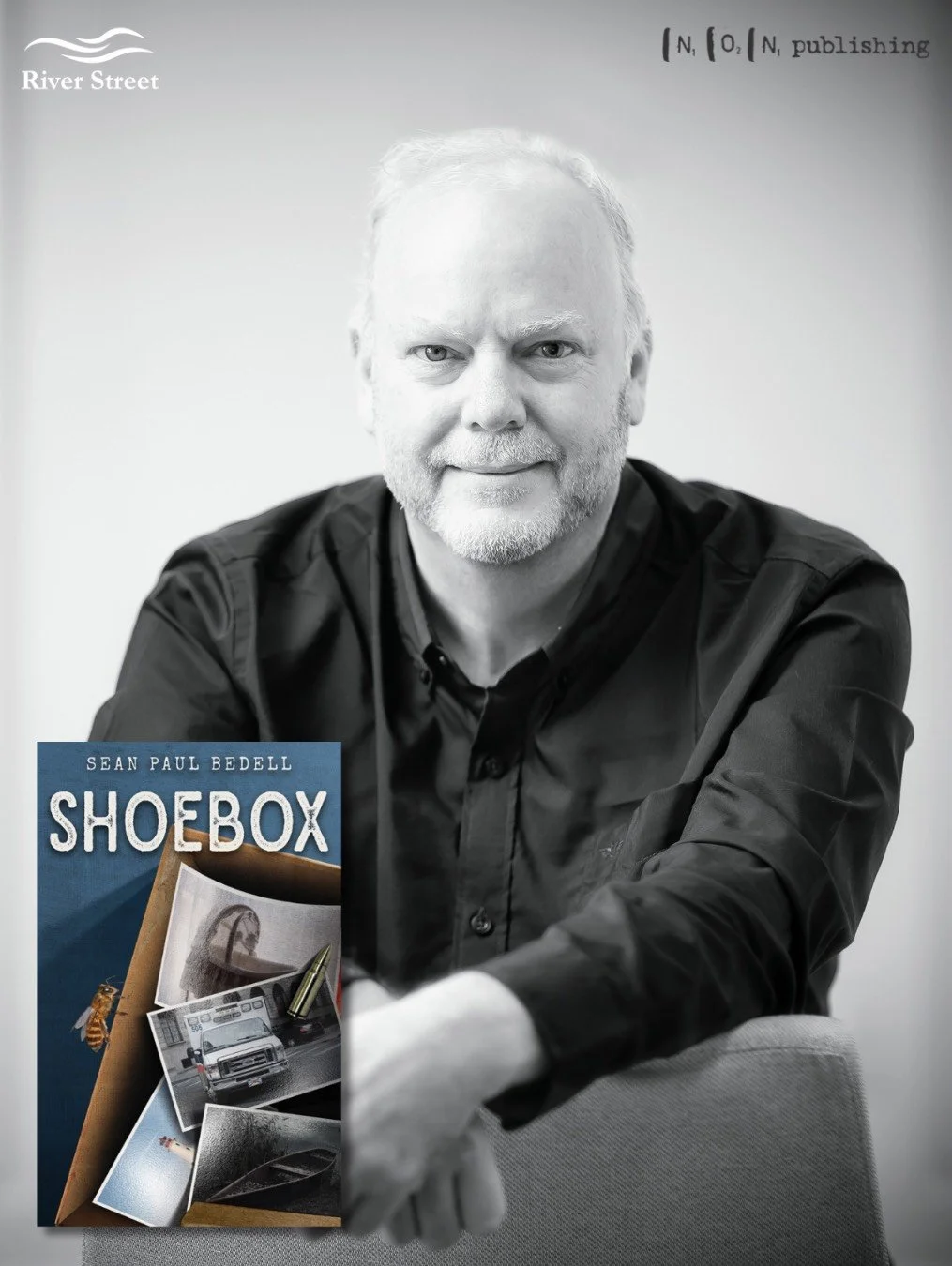
More about Shoebox:
In this gritty and emotional exploration of the human condition, Steve Lewis, a dedicated paramedic, faces the devastating aftermath of a fatal accident that casts a dark shadow over his once-passionate commitment to saving lives. Plagued by guilt and grief, he finds his career, family, and very existence hanging in the balance as he navigates the complexities of trauma both personal and professional. As Steve grapples with the high stakes of his job amidst the scrutiny of a community that admires yet questions him, each life he saves rekindles his passion for his work, reminding him of the profound connections he can forge through compassion and care. A compelling and visceral journey of personal redemption and triumph over adversity, Shoebox explores the human spirit's capacity for healing.
About Sean Paul Beddell:
Author of the novel Somewhere There’s Music, Sean Paul Bedell has been writing and publishing for more than 30 years. A longtime paramedic and captain with the fire service, he lives with his wife Lisa in Dartmouth, Nova Scotia.

Power Q & A with David Giuliano
This past May, I turned sixty-five. Pearl, my beloved, asked what I wanted for my birthday. When she turned sixty-five, she wanted a party. I booked a local venue and chef, put together a 1970s top-ten playlist, and a birth-to-sixty-five video to the tune of “What I Like About You,” by the Romantics. It was a blast.
Me? I wanted a casket. I had stumbled on the Fiddlehead Casket Kits website. “Build your own pine casket in under 30 minutes with this handcrafted casket kit,” it said, “delivered directly to your door.”
I told Pearl, “I want a casket for my birthday.”
Q: How did writing The Upending of Wendall Forbes affect you?
A: This past May, I turned sixty-five. Pearl, my beloved, asked what I wanted for my birthday. When she turned sixty-five, she wanted a party. I booked a local venue and chef, put together a 1970s top-ten playlist, and a birth-to-sixty-five video to the tune of “What I Like About You,” by the Romantics. It was a blast.
Me? I wanted a casket. I had stumbled on the Fiddlehead Casket Kits website. “Build your own pine casket in under 30 minutes with this handcrafted casket kit,” it said, “delivered directly to your door.”
I told Pearl, “I want a casket for my birthday.”
“Okay,” she said.
I wanted a “handcrafted, environmentally friendly … locally made with Eastern Canadian pine casket.” I didn’t know why. I had no plan or desire to die anytime soon. Quite the opposite. I want to truly live. I had, however, spent the previous four years writing about the fictional Wendall and Ruby Forbes, who are twenty years my senior. They got me thinking about entering the final quarter of my life.
I am not in a hurry to use a casket, but I like the idea of having one nearby, reminding me, like Wendall and Ruby do, to love life, to pay attention, to listen, to play and create, and to love vulnerably. No one lives forever. At sixty-five, the possibility of dying becomes more imminent. I wanted a daily reminder to suck the marrow out of life. So, I ordered the kit and sent an email to four of our closest friends. Subject line: Strawberry, Rhubarb Crisp, Ice Cream and Casket Building.
On my birthday, I stacked the pine boards in the living room, poured wine for our friends, lit a candle and read Mary Oliver’s poem, “When Death Comes.”
It begins:
When death comes
like the hungry bear in autumn;
when death comes and takes all the bright coins from his purse
to buy me, and snaps the purse shut;
It is more about life than it is about death:
When it’s over, I want to say: all my life
I was a bride married to amazement.
I was the bridegroom, taking the world into my arms.
And:
I don’t want to end up simply having visited this world.
Our friends assembled the casket and moved it into my writing room, next to my desk, where it serves as a bookshelf. For now. “Love the idea of a simple pine casket, but won’t need it for a while? Put it to work right now!” Suggested the Fiddlehead website. “This bookshelf option adds 5 adjustable solid pine shelves.”
I am gradually adding items to the shelves that feel sacred: the fire pot from my days learning and teaching spiritual direction; the Star Blanket gifted to me by Anishinaabe elders, and the stole from my time as moderator of The United Church of Canada; a cross made of horseshoe nails and copper wire; copies of my books. Each item is a symbol, telling a story I carry.
Then we savoured the crisp and ice cream, our friendship and the end of the wine. It was a rich, perfect and early night. We’re getting old.

Friends!
Leonard Cohen told Interview Magazine, “To keep our hearts open is probably the most urgent responsibility you have as you get older.” Writing The Upending of Wendall Forbes reminded me to keep my heart open.

The Upending of Wendall Forbes by David Giuliano
About The Upending of Wendall Forbes:
Wendall and Ruby Forbes are confronting the vagaries of aging boomers: – sleeplessness, loneliness, memory loss, and the fear Ruby is showing signs of dementia. A blizzard hits their small town of Twenty-Six Mile House and a remarkable, perhaps unbelievable, band of strangers — : an Indigenous Colombian refugee, his environmental academic wife, an environmental academic, and their child; a young man on an accidental journey quest; a teenage activist and her ten-year-old gay half-brother; and a sleep consultant in from Indianapolis —– all take refuge in the Forbeses’ home.
In this heartwarming, funny, wise, and hopeful story, the companionship of strangers, a foul-mouthed raven, and a lynx, restore Wendall and Ruby’s hope for the future.

About David Giuliano:
David Giuliano is an award-winning writer of fiction and non-fiction. His first novel, The Undertaking of Billy Buffone (Latitude 46, 2021), was awarded the 2022 Bressani Prize for Fiction. It’s Good to Be Here: Stories We Tell About Cancer is a memoir about the power of story to heal. Postcards from the Valley, a collection of essays, was a Canadian bestseller. He has also published two illustrated children’s books. David lives on the north shore of Lake Superior.

Excerpt from The Haunting of Modesto O'Brien by Brit Griffin
Lily released the arm of Mr. Johnstone and turned to look at Coffin. “I think you have me confused with someone else. I’m Theodora Bow, here with the travelling show. Colleen Bawn? Perhaps you’ve seen it?”
Coffin, grinning now, said, “You can certainly act. But you can’t lie about those violet eyes of yours, can you?”
Lily rested her hand on Johnstone’s arm to bring him along with her as she took a few steps towards Coffin. She sighed and said, “Sir, you really are confused,” and then smiling patiently turned to Mr. Johnstone and said, “Mr. Johnstone, what colour are my eyes?”
Lily released the arm of Mr. Johnstone and turned to look at Coffin. “I think you have me confused with someone else. I’m Theodora Bow, here with the travelling show. Colleen Bawn? Perhaps you’ve seen it?”
Coffin, grinning now, said, “You can certainly act. But you can’t lie about those violet eyes of yours, can you?”
Lily rested her hand on Johnstone’s arm to bring him along with her as she took a few steps towards Coffin. She sighed and said, “Sir, you really are confused,” and then smiling patiently turned to Mr. Johnstone and said, “Mr. Johnstone, what colour are my eyes?”
He flushed deeply, said, “Miss Bow, by all accounts they appear to be a dark brown to me.”
She turned to Coffin and said, “You see, as Mr. Johnstone can attest, I am not your lady friend, now please, if you don’t mind, I have business to attend to.”
“I know damn well you’re Lily Nail. You and that crazy sister of yours are up here running some sort of swindle.” He then said to the men mesmerized by the scene unfolding before them, “She robbed some fellas back in Butte of their hard-earned money. Not sure what kind of women’s trickery she’s using here, but that there is Lily Nail and there’s a reward on her head. I know that as sure as my name’s Tom Coffin.”
“What an unfortunate name sir, and though I cannot attest to the veracity of your name, I do know the colour of my own eyes. And as everyone here can plainly see with their own eyes, they are brown, not violet. Now I really must be off. I am in quite a hurry,” she said, even as she was still moving slowly towards him.
“Hurrying off to church?”
“The Mining Recording office. I have a claim to register.”
“A prospector as well as an actress Lily?”
“As I said, my name is Miss Bow. And actually, I have an agent working on my behalf,” she was saying as she continued towards him, “A Mr. Campbell, and I believe he has done well by me.”
Coffin frowned. “Campbell?”
“Yes, a Mr. Campbell. I suppose you know his eye colour as well.” A few men snickered and by now Lily was right at his table, able to view the cards laid out there, most face up, the men at the table having just finishing a round.
“What claim?” asked Coffin.
“Oh, I’m really not too sure. Not that it is any of your concern, but Mr. Campbell just said a piece of ground had become available owing to some tragedy. He said other prospectors working in the same area were reluctant to work the property. He further explained that the area had great promise even though there had been accidents, then of course stories began to circulate. Mr. Campbell explained that miners were a superstitious lot. But of course, a woman does not have the same opportunities as a man, we can’t afford such superstitions, so I took it.”
There was a murmur through the crowd, and a man leaning on the bar called, “Out at Kerr Lake?”
“Oh maybe, that sounds familiar.” Smiling, asked him, “Am I going to be rich?”
The man glanced uneasily at the others around him but didn’t answer.
“You’re staking out at Kerr Lake?” Coffin asked.
“As I said, I really can’t say for sure as I was relying on the good nature of Mr. Campbell to assist me. Just before he left town, he contacted me to say he had finalized everything, and I was to stop by the Mining Recorder’s office and pick up my documents. So that is where I’m off to.”
“I was working with Campbell.”
Lily said, “Is that right? Well good luck to you sir”, and then glancing back down at his cards said, “Oh goodness yes, you certainly will be needing it,” her pale hand now reaching and spreading out the cards, murmured, “my, my that is quite the hand you have there.”
“This is poker darling, not one of your parlour games,” Coffin said.
“The cards never lie.”
“What’s he got, Miss,” a man along the bar called out, “a dead man’s hand?” A few men laughing.
“No, he has a pair of fours, and an eight and seven of clubs, and the ace of spades.”
“Not taking home the pot with that one,” someone yelled, and again laughter.
“Oh, but it’s quite the hand.”
“Shut your mouth,” Coffin said, now reddening, mad, not used to being laughed at.
Lily said, “But there is so much to see here, and it’s a bit more complicated than the dead man’s hand. See, look here, this one, the diamond,” then glancing up at Coffin asked, “Sorry, sir? What was your name again?”
A man at the bar shouted, “Coffin.”
“Yes, of course, pardon me, Mr. Coffin,” she said, then focused her attention on the cards, touched the four of diamonds, said, “Seems like you must have a friend you shouldn’t be trusting.”
“That’d be Shitty!” the man at the bar shouted, getting another few laughs.
“And this one, your eight of clubs, a card of caution, for coveting. Do you covet something Mr. Coffin? And here again, dear me, yet another caution with your four of clubs. Imperiled by your short temper perhaps?”
Coffin could not but help glance down at the cards as she said, “But these last two, they really help tell your story. The seven of clubs, danger from a member of the opposite sex, goodness, that could spell rack and ruin for you Mr. Coffin.”
“What about the ace?” the man at the bar calling out.
“Oh that’s simple. Death. Perhaps in a duel. How old fashioned.”
Coffin grabbed her hand, his grip strong, said, “Get out of here.”
“If you want me to leave, sir, you will need to release my hand.”
He stared at her for a few long seconds as she stared back, the men watching rapt, and she said, “Let go of me.”
Then Coffin jerked his hand away as if burned, “You little bitch, I’ll be seeing you later, you can bet on that Lily Nail.”
Excerpt from The Haunting of Modesto O’Brien by Brit Griffin. Reprinted by permission of Latitude 46 Publishing. Copyright Brit Griffin, 2025.
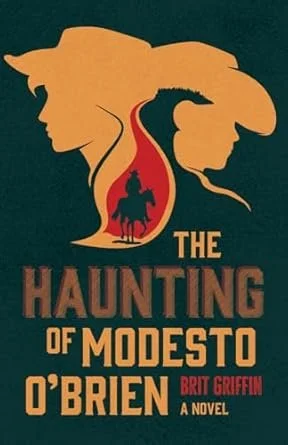
The Haunting of Modesto O’Brien by Brit Griffin, published by Latitude 46 Publishing.
About The Haunting of Modesto O’Brien:
A gothic tale from deep within the boreal forest…
Violence and greed have intruded into a wild and remote land. It’s 1907, and silver fever has drawn thousands of men into a fledgling mining camp in the heart of the wilderness. Modesto O’Brien, fortune-teller and detective, is there too - but he isn’t looking for riches. He’s seeking revenge.
O’Brien soon finds himself entangled with the mysterious Nail sisters, Lucy and Lily. On the run from their past and headed for trouble, Lily turns to O’Brien when Lucy goes missing. But what should have been a straightforward case of kidnapping pulls O’Brien into a world of ancient myths, magic, and male violence.
As he searches for Lucy, O’Brien fears that dark forces are emerging from the ravaged landscape. Mesmerized by a nightmarish creature stalking the wilderness, and haunted by his past, O’Brien struggles to maintain his grip on reality as he faces hard choices about loyalty, sacrifice, and revenge.
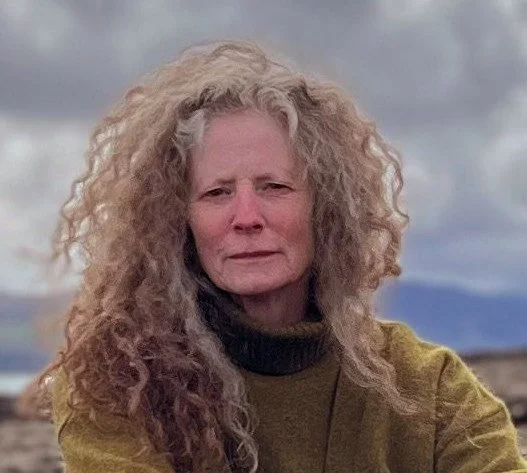
Author Brit Griffin.
ABOUT BRIT GRIFFIN:
Brit Griffin is the author of the climate-fiction Wintermen trilogy (Latitude 46) and has written essays, musings, and articles for various publications. Griffin spent many years as a researcher for the Timiskaming First Nation, an Algonquin community in northern Quebec. She lives in Cobalt, northern Ontario, where she is the mother of three grown daughters. These days, she divides her time between writing and caring for her unruly yard.
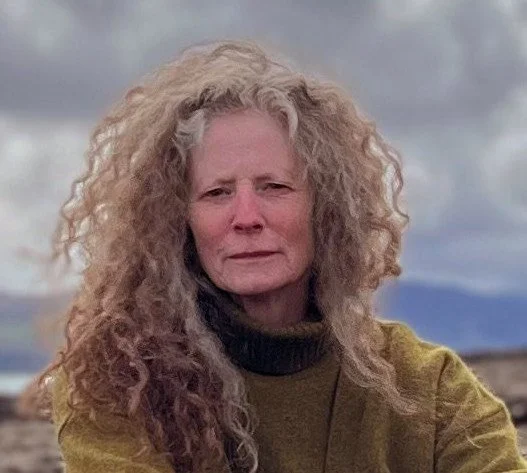
Power Q & A with Brit Griffin
It is maybe odd to only write about where I live — all four of my novels are set in and around Cobalt, and most of my musings & reflections are also generated from this landscape. Odd maybe, but I feel a sense of the imperative to pay attention to the land I inhabit. Scrappy and used up as it is, and still showing the scars of short-lived but hyper-industrial activity, it is a place worth seeing, as in discovering the minutiae, the magic, the vulnerabilities, and the joy, in and of and around this place that I inhabit. It seems to me now obvious, though I wish I had seen it sooner in my life, that any hope we have of being better, of finding a way of being in the world that is non-destructive, lies in seeking atonement from the land we inhabit, its creatures and beings, wherever that happens to find us.
Q: In The Haunting of Modesto O’Brien, the setting seems very important to the story, seems very grounded in a particular place. Why set it in the real-life town of Cobalt?
A: It is maybe odd to only write about where I live — all four of my novels are set in and around Cobalt, and most of my musings & reflections are also generated from this landscape. Odd maybe, but I feel a sense of the imperative to pay attention to the land I inhabit. Scrappy and used up as it is, and still showing the scars of short-lived but hyper-industrial activity, it is a place worth seeing, as in discovering the minutiae, the magic, the vulnerabilities, and the joy, in and of and around this place that I inhabit. It seems to me now obvious, though I wish I had seen it sooner in my life, that any hope we have of being better, of finding a way of being in the world that is non-destructive, lies in seeking atonement from the land we inhabit, its creatures and beings, wherever that happens to find us.
Because it seems to me that the land teaches us things that we have forgotten. But what happens when we are dislocated, removed, moved, from the place that was the homeland of our people — when a person is severed from their connection to their homeland? If this tracery of wisdom and old knowledge comes from a relationship with the land, from understanding and being guided by these age-old traditions and stories and lore, how does one get their moral bearings without them? That is what I was trying to think about in The Haunting of Modesto O’Brien.
For most of us in this country, we are not in our homelands. Where I live is the traditional territory of Timiskaming First Nation, an Algonquin community who have been here for thousands of years. This is their homeland. Their stories and their wisdoms travel through the treetops, glide through the deep waters, live in the rocks. They are not mine. I can learn from, and be respectful, yes, but they are not mine to browse and select from, to pick and choose from. So even as I live here, even as I nurture my ability to know and respect this place, there is a foreignness to it all, an outofplaceness that I try to understand through in my writing. Forge a hybrid? Start from scratch? Not sure, but I keep thinking and writing, because to me it is one of the most important, what? Quests? Maybe, sounds old, fairy tale borne. Maybe that is the word. A quest for atonement across the real/imagined/blurred landscape that I travel every day.
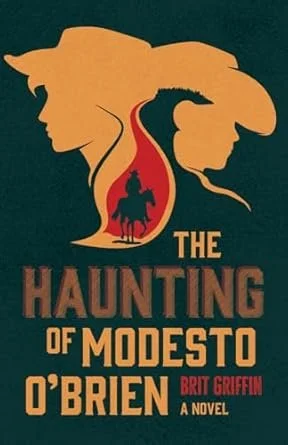
The Haunting of Modesto O’Brien by Brit Griffin, published by Latitude 46 Publishing.
About The Haunting of Modesto O’Brien:
A gothic tale from deep within the boreal forest…
Violence and greed have intruded into a wild and remote land. It’s 1907, and silver fever has drawn thousands of men into a fledgling mining camp in the heart of the wilderness. Modesto O’Brien, fortune-teller and detective, is there too - but he isn’t looking for riches. He’s seeking revenge.
O’Brien soon finds himself entangled with the mysterious Nail sisters, Lucy and Lily. On the run from their past and headed for trouble, Lily turns to O’Brien when Lucy goes missing. But what should have been a straightforward case of kidnapping pulls O’Brien into a world of ancient myths, magic, and male violence.
As he searches for Lucy, O’Brien fears that dark forces are emerging from the ravaged landscape. Mesmerized by a nightmarish creature stalking the wilderness, and haunted by his past, O’Brien struggles to maintain his grip on reality as he faces hard choices about loyalty, sacrifice, and revenge.
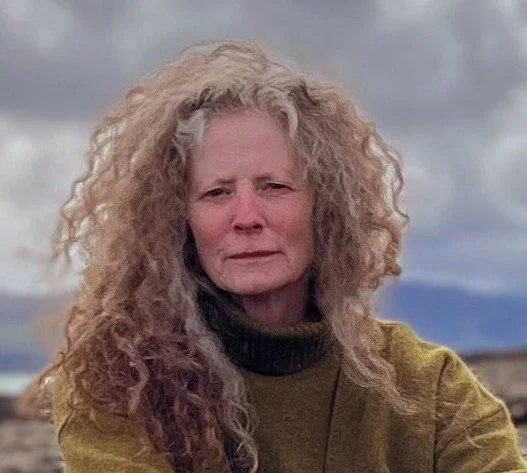
Author Brit Griffin.
About Brit Griffin:
Brit Griffin is the author of the climate-fiction Wintermen trilogy (Latitude 46) and has written essays, musings, and articles for various publications. Griffin spent many years as a researcher for the Timiskaming First Nation, an Algonquin community in northern Quebec. She lives in Cobalt, northern Ontario, where she is the mother of three grown daughters. These days, she divides her time between writing and caring for her unruly yard.

Power Q & A with Melanie Schnell
Several years ago the idea of what exists beneath the ground, beneath our feet, began to worry itself away in my brain. It all began with learning about the scores of indigenous children who died at the Residential Schools. Then I read more stories of mass graves being unearthed, such as hundreds of infant remains at a former home for unwed mothers in Ireland, and a mass grave recently discovered in Syria from Assad’s crackdown on protestors.
Q: What gave you the idea to include a tree as a central character in your novel, The Chorus Beneath Our Feet?
Several years ago the idea of what exists beneath the ground, beneath our feet, began to worry itself away in my brain. It all began with learning about the scores of Indigenous children who died at the Residential Schools. Then I read more stories of mass graves being unearthed, such as hundreds of infant remains at a former home for unwed mothers in Ireland, and a mass grave recently discovered in Syria from Assad’s crackdown on protestors.
Then I started reading books about trees and their root systems, and the massive and complex worlds of fungi, and how without subterranean fungi, we wouldn’t exist. Nothing would. I thought about all the skeletons—human and animal and insect—trillions of them, that lay deep in the ground, along with the fungi and soil and clay, and insects and moss and the massive root systems of plants and trees. And how all of this connects us to our past, and the horrors that lay beneath us as we walk above it on our bipedal bodies, trying to survive in a fleeting, precarious world.
The more I learned about trees, and how they communicate, the more the central tree in the novel—which had been there from the beginning, from the first image I had of the story—clarified. What if what was beneath us could speak? Who or what could be that vessel, who or what could act as their voice?
I knew this particular story wouldn’t be complete unless the tree was able to speak to its own stories of the past, in an attempt to complete a cycle of sorts between the present of the novel and a difficult chapter of our human history.
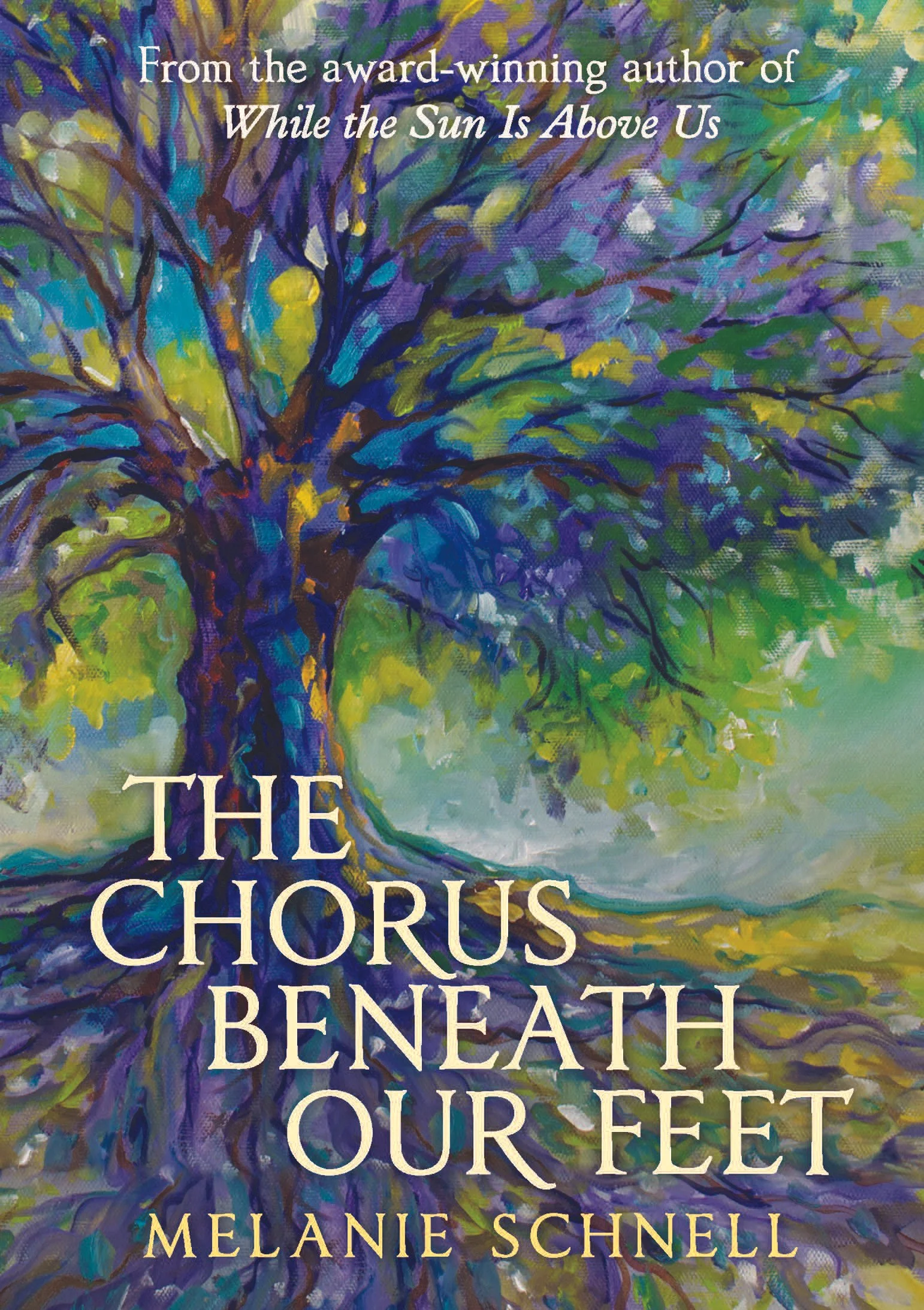
The Chorus Beneath Our Feet by Melanie Schnell, published by Radiant Press.
More about The Chorus Beneath Our Feet:
A grief-stricken soldier accompanies his best friend's body home after eight years away, only to find his mute sister, Mary, missing and wanted for questioning by the police in the murder of an infant in the city's central park. As Mary's life hangs in the balance, Jes must follow the obscure clues she has left behind, the only means to find her and absolve her of wrongdoing. In his labyrinthine search, the mystery of the park's infamous Harron tree and its connection to his sister, and their community, is slowly revealed.

Author Melanie Schnell
About Melanie Schnell:
Melanie Schnell’s novel, While the Sun is Above Us, was shortlisted for The Fiction Award and Book of the Year award and won the Saskatchewan First Book Award and The City of Regina Award in 2013. The novel has been listed as part of the ELA A30 curriculum in both Public and Catholic schools across Saskatchewan. Melanie has published long and short fiction, creative nonfiction, and poetry. Her fiction placed second in the City of Regina Awards in 2010 and 2017. She is currently Assistant Professor of Creative Writing, Rhetoric and Composition at the University of Regina. She lives in Regina, Saskatchewan.

Power Q & A with Ben Zalkind
Satire is tricky. In a free society, it can be a form of entertainment, which confirms for its audience the idiocy and silliness of “that thing we enlightened people are against.” In dicier milieus, such as Putin’s Russia, satire cannot be reckless, lest it disappear. It has to be clever, damning, and opaque enough to cloak its true purpose, which is as a tool of resistance. Making fun of our overlords is serious, political business.
Q: Ben, your debut novel, Honeydew (Radiant Press, October 2025), seems to be a winking satire lampooning tech bros, surveillance capitalism, and maybe even the futility of resistance itself. Many readers look to fiction to sharpen and clarify what might otherwise look smudged and fuzzy, but it’s difficult to figure out where you stand. What do you mean for us to take from your book?
A: Satire is tricky. In a free society, it can be a form of entertainment, which confirms for its audience the idiocy and silliness of “that thing we enlightened people are against.” In dicier milieus, such as Putin’s Russia, satire cannot be reckless, lest it disappear. It has to be clever, damning, and opaque enough to cloak its true purpose, which is as a tool of resistance. Making fun of our overlords is serious, political business.
Here in North America, our most popular satire takes the form of visual media, such as The (late) Colbert Report and South Park, which seem to look right into their targets’ eyes as they subject them to ridicule. This style, though often funny, is at odds with the tradition of literary satire, which tends to lean more comfortably into ambiguity. Some of our finest contemporary satirical novels, such as Paul Beatty’s The Sellout, are satirical only insofar as we can gather. Beatty famously denies that he is a satirical author, though his very funny novel about a man who tries to reinstate slavery in a fictionalized California is, to my mind at least, a crackling and devastating takedown of the idea of a post-racial society in the same US that witnessed George Floyd’s murder.
Honeydew, is most certainly a satirical novel. It is also a farce, equal parts A Confederacy of Dunces and The Monkey Wrench Gang, about a quartet of feckless wannabe saboteurs who have the right idea but can't quite follow through. I know there will be a temptation to see clear topical references in my characters, especially Moses Honeydew himself, who, I'll admit, does bear some resemblance to a few of our less impressive overlords. But my intention was not just to remark on the absurdity of our tech-saturated world. I also wanted to create my own. And Honeydew’s got everything: A billionaire tech bro who plans to pilot a submersible drill to Earth’s mantle, a criminal kingpin who bankrolls an anarchist collective, a Swiss family doctor moonlighting as a spook, and even a direct action splinter cell composed entirely of elderly activists. Though the story shares some of our reality, it also exists in its own milieu, maybe a bit like Boots Riley's Sorry to Bother You, Mervyn Peake's Gormenghast series, Terry Pratchett’s Discworld, and even P.G. Wodehouse’s Edwardian Britain that never was.
I permitted myself the freedom to make my characters eccentric and the setting surreal. And I agree that there is something unsettling beneath Honeydew's humour. Though many of us face the welter of social, climate, and economic injustice with courage and wisdom, Honeydew's freedom fighters resort to harebrained schemes. This is not a commentary so much as a prism through which I filtered my own bewilderment. In my story, I always punch straight up, and I trust readers, who tend to be cleverer than the authors they read, will clock the story as a satire, a comedy, and, in its own way, a pointed critique, not of the resistance, of which I consider myself a part, but the frame in which all of us are forced to resist.
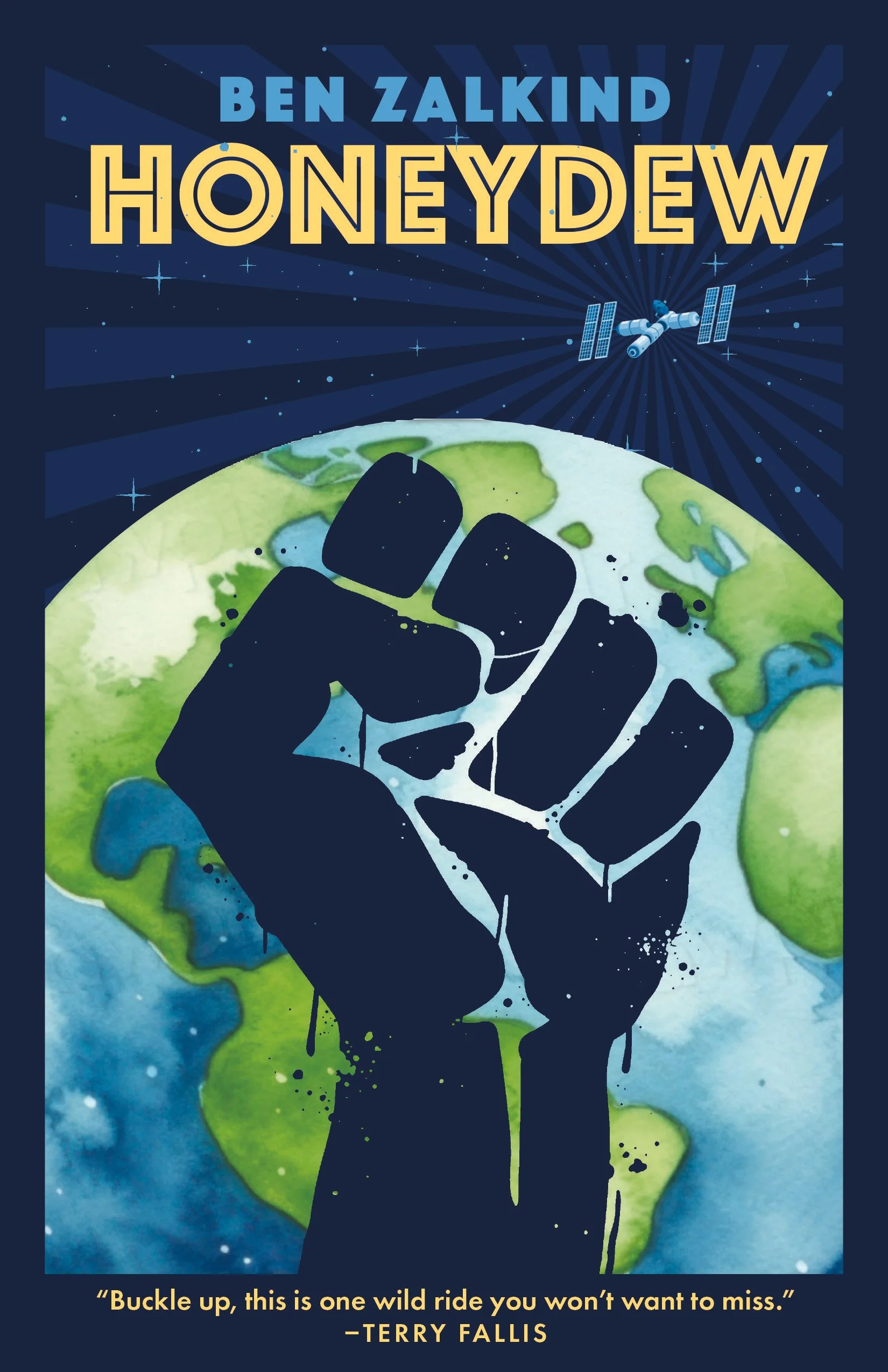
About Honeydew:
Rose Gold can’t catch a break. Her latest “golden opportunity” has given way to a madcap adventure through the soft underbelly of Bonneville City. She finds herself cast in the role of renegade mentor and hero to a trio of idealistic young rebels. Together, they perpetrate an act of subversion targeting “future-mover” and celebrity CEO Moses Honeydew, which puts them in the crosshairs of his Substrate Inc.
Along the way, they join forces with family-doctor-by-day and fixer-by-night, Dr. Hansjorg Winteregg, and go on the lam. Meanwhile, there are rumours about Honeydew’s private space station, The Visionary, which may or may not have forced its first passengers into working off their debt. Rose’s boss and his crew go missing. Honeydew announces his plan to take a manned submersible drill to Earth’s mantle to burnish his brand as a fearless and impossibly cool maverick.
With her faithful charges by her side, Rose finds herself at the centre of an unfolding conspiracy. Did she ever truly have a hand on the rudder of fate? And what chance does a quartet of second-rate saboteurs have against a multinational corporation with a vendetta and a trillion-dollar market capitalization?

Ben Zalkind lives and works in Calgary, Canada. His debut novel, Honeydew, will be released by Radiant Press in October 2025. A Salt Lake City native and naturalized Western Canadian, Ben is happiest outdoors, where he can cycle, drink coffee, and adventure with his wife and fellow traveller.
Addiction, Family, and the Story Behind Lorne Daniel's What is Broken Binds Us
“I initially wrote the story of our family’s journey purely to record what was happening as it happened,” says poet and retired communications consultant Lorne Daniel about his poetry collection What is Broken Binds Us. “The addictive behaviours, the anger, the borderline housing challenges disrupted and changed week by week, month by month, over years and stretched into decades,” he says of one son’s journey. “While we tried to support him, it was often a real challenge to track what was happening, even to track where he was.”
Addiction, Family, and the Story Behind Lorne Daniel's What is Broken Binds Us
“I initially wrote the story of our family’s journey purely to record what was happening as it happened,” says poet and retired communications consultant Lorne Daniel about his poetry collection What is Broken Binds Us. “The addictive behaviours, the anger, the borderline housing challenges disrupted and changed week by week, month by month, over years and stretched into decades,” he says of one son’s journey. “While we tried to support him, it was often a real challenge to track what was happening, even to track where he was.”
As a writer, Daniel began to form his rough notes into something others could understand. “I found that short poems that just shared incidents from the journey were the best form because readers can pick up on the chaos, the jumble of a path that is not simple and not straight.” Even so, he grappled for a long time over whether to share the poems beyond family and friends.
“What convinced me to publish the very personal poems in this book with a broader readership was the experience of running into so many people who have been on similar journeys, but feel disconnected,” Daniel says. “In our society, the narratives often don’t fit the real lived experiences of families. ‘Troubled teens’ don’t always find a way through those troubles, parents become exhausted looking for answers, and there may not always be answers.”
“On multiple occasions,” Daniel says, “we went for years without hearing from our son. Sadly, those were more peaceful times than the full-on crises times.”
“Every family that experiences addictions and mental health challenges is unique, but there are emotional characteristics that we have in common. What is Broken Binds Us is my small gesture of connection.”

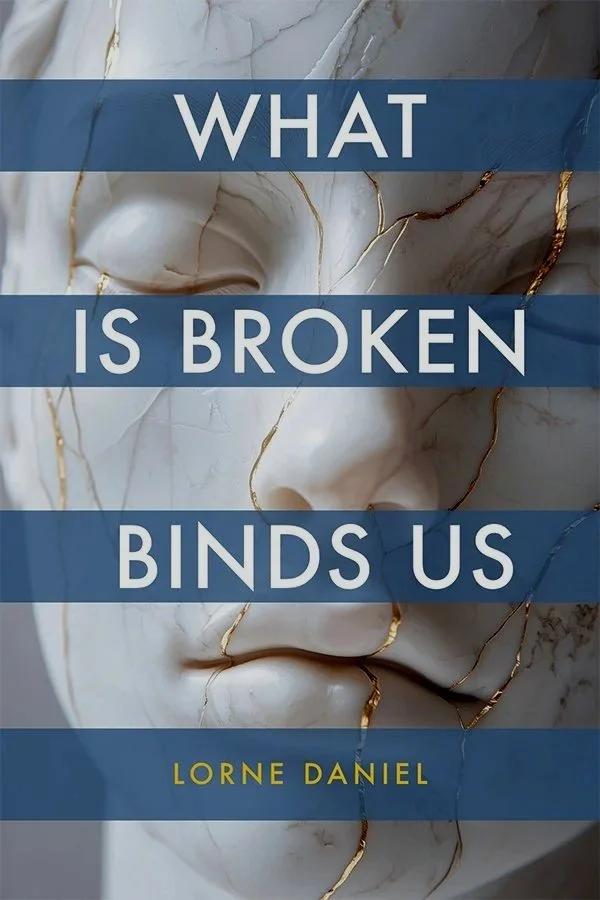
What is Broken Binds Us by Lorne Daniel, published by University of Calgary Press.
What is Broken Binds Us is a collection of poems of the disruptions and emotional tremors that shape us: enslaved families broken and dispersed, histories hidden, addiction and estrangement, and the shocks of bodily trauma.
What is Broken Binds Us shares stories of loss, absence, acceptance, and hope. Returning to the page after a long absence, poet Lorne Daniel provides a unique perspective on crisis that balances raw emotion with vulnerability, thoughtfulness, and care.
In seven sections, Daniel braids the stories of empire, personal traumas, addiction and family estrangement, shifting emergencies, and the wisdom of elders and the natural world. Lessons in Emergency Preparedness traces accident, injury and recovery, facing the trauma of a sudden loss of physical competence through the metaphorical and literal breaks of a shattered body and the slow movement towards mending. When the Tributaries Ran Rich unravels empire and a five-century narrative of hard-working immigrants with the discovery of enslavement in family records, forcing a deep reconsideration of the truth of the past. Episodic Tremor & Slip speaks of the tectonic shifts in family life that occur when facing substance abuse, addiction, and mental health struggles, of the pain of estrangement and the love that continues. In the Family Name is a reflection on time, on people, and on the natural world that revisits and turns over all that came before, exploring it from new angles.
Lorne Daniel writes with calm, conversational assurance. These poems are accessible and evocative, speaking from their specificity to the many people who have faced injury, estrangement, struggle, and pain, and must carry it—and carry on.

Lorne Daniel is a Canadian poet and non-fiction writer. He has been deeply engaged in the literary community, including the emergence of a Canadian prairie poetry scene in the 1970s. He has publsihed four books of poetry, edited anthologies and literary journals, and written freelance journalism. His work has been published in dozens of anthologies, journals, newspapers and magazines in Canada, the U.S. and the U.K. Lorne lives on the traditional territories of the Lək̓ʷəŋən people in Victoria, BC.

Excerpt from A Quilting of Scars by Lucy E.M. Black
Larkin was fifty-one now, almost the same age as his father was when he’d died a quarter century before. And in the last while Larkin had been thinking about his own mortality. About how the past could feel more present the further away you got from it.
Larkin turned and stood motionless, looking at the dark that hid the open fields and beyond them the dense bush surrounding the farm. He was remembering.
Larkin was fifty-one now, almost the same age as his father was when he’d died a quarter century before. And in the last while Larkin had been thinking about his own mortality. About how the past could feel more present the further away you got from it.
Larkin turned and stood motionless, looking at the dark that hid the open fields and beyond them the dense bush surrounding the farm. He was remembering. Entering the house from the back door—the only door that ever got used—Larkin walked straight into the kitchen. The room astonished anyone who saw it for the first time, painted as it was entirely in a shocking, rosy pink. It had been his Ma’s choice, and she’d loved it. His Pa had done it up for her one winter before Larkin was born. The shelves, the cupboards, and even the chairs were painted to match.
“It’s a wonder,” his Pa once said, “that she dint want the floorboards done as well.”
Larkin had laughed. “Shush now, Pa, you’ll be givin’ her ideas.”
He kicked off his boots impatiently and headed upstairs to his bedroom. There he moved across the floor in his stocking feet and knelt down stiffly beside his bedstead. Reaching beneath the overhang of the quilt, he withdrew a flattened flour sack from under the bed. Then, leaning heavily upon the mattress, he pushed himself upright and made his way downstairs again to the kitchen, where he lay the sack and its contents upon the table.
Seated now in a chair thick with paint, he pulled the sack closer. He glanced around quickly. Then, slowly and tenderly, Larkin inserted his hand into the sack and drew out a large scrapbook, its deep blue cover marked at each corner with a delicate pattern of winding vines. Hesitating for only a moment, he opened the cover and pressed it down before him. Larkin nodded, as if to acknowledge a familiar friend. Finally, he began to read the yellowed bits of newspaper that had been carefully glued to brittle, unbending pages.
The clippings came from The Murton County Chronicle. Beside each was the date, written in his mother’s flowing hand, the ink faded now. The first was dated August 8, 1871, almost forty years back.
FIRE BLAZES IN MURTON!
Volunteer firefighters were out in full force Sunday night two miles west of the village after neighbours spotted a blaze. The coroner’s office has stated that two bodies were found in the burned-out farmhouse while another man is under doctor’s care with serious burns to his hands and feet. The fire department continues to investigate.
Then, on August 15th:
SKINNERS LAID TO REST
Funerals were held in Murton for Silas and Elgin Skinner. Both men, father and son, died on Cemetery Hill the night of August 7th. The Skinner farmhouse and barn burned to the ground on the same evening. On the night of the fire, flames from the barn were seen to soar sixty feet in the air. The funerals were well attended by community members who recalled the Skinners as “nice, old-fashioned folk.” They were laid to rest in the Murton Memorial Cemetery. A luncheon was held following the service at the United Methodist Church Hall.
And February 13th, six months later:
MURDER IN CEMETERY HILL!!
Investigators now confirm that they are building a case for murder concerning the suspicious deaths of two men in a farmhouse fire near Murton. The community was shocked to learn that Silas and Elgin Skinner suffered stab wounds prior to the tragic blaze in which the family home and barn were consumed six months ago. A thirteen-year-old boy was badly injured in the fire. He has not been charged with any wrongdoing but remains under the watchful eye of the police.
Larkin sat back from the table and groaned softly. Paul Skinner—the thirteen-year-old who’d remained carefully unnamed in the story, the younger son of Silas—had been his childhood friend. He hadn’t seen or heard from him for twenty years. In their youth, however, they had a closeness he’d not known with anyone else.
Closing the scrapbook, Larkin slid it back into the flour sack and stood stiffly. After pushing aside the chair, he stepped across the kitchen to stow the sack in the sideboard. The face of the north wind puffed at him from the wooden chair’s pressed back. He grimaced at the carving as he hobbled from the room.
It was a bright-lit night with the moon almost full, casting a white glow inside the house. Larkin looked around at his surroundings and smiled. Sure, it was too large for an old bachelor living alone, but it was where he’d been born, and felt as much a part of him as did his legs or arms or feet.
He’d been told that his Pa had ordered the fine red brick from a brickyard near the town line, and that the men had dragged skids of it across the county as soon as the ground froze hard. The windows and quoins were of a soft butter-yellow brick, edging the structure with elegance. Apparently, his Ma had always wanted a “bay winder,” and so Pa had managed two of them, one on top of the other.
The house was built tall, three storeys high, with steeply pitched gables. His father had been a tall man and didn’t want to be stooping over in the rooms. The ceilings on the main floor were fifteen feet high, ten feet on the second, eight feet on the third. There were two parlours, one at the front of the house and one at the back, providing an escape from the blistering sun depending upon the time of day. Upstairs were five bedrooms as well as a little room for washing up and personal conveniences. The third floor had never been finished; it remained an open, expansive attic with unspoiled views stretching across the countryside.
Larkin especially loved the third floor. As a boy he would climb upstairs during a storm to hear the rain pounding overhead. He took a secret delight in being seated close to the raging tempest while the house protected him from the elements. The attic was where he often played his solitary games, wondering what it would be like to have a brother or a sister to share in his childhood.
Another baby in the house was not meant to be. His Ma’s stomach was swollen from time to time with a promise of sorts but nothing ever came of it. When he was young he had wondered aloud, “Why doan Pa reach in and pull it out by the leg like he do with a calf?” When his folks heard this he was given only a vague answer about “God’s timing” that made no sense to him.
Excerpt from A Quilting of Scars by Lucy E.M. Black © 2025 by Lucy E.M. Black. Reprinted by permission of Now or Never Publishing.

A Quilting of Scars by Lucy E.M. Black (Now or Never Publishing)
About A Quilting of Scars:
Filled with the pleasure of recognizable yet distinctively original characters and a deftly drawn sense of time and place, A Quilting of Scars brings to life a story of forbidden love, abuse and murder. Pulsing with repressed sexuality and guilt, Larkin Beattie reveals the many secrets he has kept hidden throughout his lonely life. The character-driven narrative is a meditation on aging and remorse, offering a rich account of the strictures and rhythms of farming in the not-so-distant past, highlighting the confines of a community where strict moral codes are imposed upon its members and fear of exposure terrifies queer youth. As Larkin reflects upon key events, his recollections include his anger at the hypocrisy of the church, and the deep grief and loneliness that have marked his path. There is a timelessness to this story which transcends the period and resonates with heart-breaking relevance.

Lucy E.M. Black
About Lucy E.M. Black:
Lucy E.M. Black (she/her/hers) is the author of The Marzipan Fruit Basket, Eleanor Courtown, Stella’s Carpet, The Brickworks, Class Lessons: Stories of Vulnerable Youth and A Quilting of Scars. Her award-winning short stories have been published in Britain, Ireland, USA and Canada in literary journals and magazines including Cyphers Magazine, the Hawai’i Review, The Antigonish Review, the Queen’s Quarterly and others. She co-ordinates Heart of the Story, an author reading series in Port Perry, writes book reviews for The Miramichi Reader, serves as literary chair for Scugog Arts, is a dynamic workshop presenter, experienced interviewer and freelance writer. She lives with her partner in the small lakeside town of Port Perry, Ontario, the traditional territory of the Mississaugas of Scugog Island, First Nations.

Power Q & A with Guy Elston
To put it simply, because I’m not that interested in myself. Which isn’t true, of course – what poet isn’t obsessed with themselves – but perhaps I'm not that interested in the front-facing, autobiographical concept of ‘Guy Elston’. Memory, identity, the cause and effect of life and its happenings – it’s all a sheer mountain face, senseless. I need an angle, a longer way round.
Q: Your debut collection The Character Actor Convention (The Porcupine’s Quill, 2025) is full of persona poems, monologues and dialogues. The speaker is variously an animal, an object, a chemical element, a season, even someone on a date with King Arthur. Why?
A: To put it simply, because I’m not that interested in myself. Which isn’t true, of course – what poet isn’t obsessed with themselves – but perhaps I'm not that interested in the front-facing, autobiographical concept of ‘Guy Elston’. Memory, identity, the cause and effect of life and its happenings – it’s all a sheer mountain face, senseless. I need an angle, a longer way round.
Poetry can be so many wonderful things, and there’s clearly no one superior model. It can be urgent, timely and important, absolutely. Or, the complete opposite. I like to see my poetry simply as a form of storytelling. I’m most interested in forgotten, impossible, niche encounters and viewpoints, the kind which can thrive best in the literary-popcorn realm of poems. A snatched glimpse through a window into a courtyard you never knew was there. Some kind of masked ritual is happening in the courtyard. Think Invisible Cities, but snack-sized.
This is not to say that my psyche doesn’t fill the book. If anything, the book is even more full of me than if I wrote straight confessional poetry. When I write from the POV of Jonah’s whale, for example, I’m not starting from scratch – I'm necessarily depositing a bunch of my own hang-ups and melodramas into the voice of the whale.
I guess the short answer is, persona poems and odd dialogues are my way of incorporating Emily Dickinson’s famous “Tell all the truth, but tell it slant” into my practice. I approach myself at a slant through these guises. If I see a flash of something I could be, or once was, or that might seem knowable to someone, somewhere, that’s my thrill. As for why – it’s simple. All I ever want is to make you both laugh and cry.

The Character Actor Convention by Guy Elston (The Porcupine’s Quill, 2025)
About The Character Actor Convention:
A pumpkin writes a letter to his father. A sheep recalls a revolution, and love. Hydrogen pens a tell all exposé of Oxygen. The Stick Insect Orders His Tomb. Napoleon counts waves and cheats at cards. A sunflower seeks answers – why sun? A crow considers children in this cruel, spiky world. And all the while, character actors gather for the endless convention...
Guy Elston’s debut is a curious smorgasbord of personas, voices and (un)natural perspectives. Through impossible encounters and strange viewpoints an insistent, ever-shifting ‘I’ questions its relation to itself. Wist, wit, and obsession rise like tides, are forgotten, and start fresh. Authenticity is always just round the corner.
The Character Actor Convention is not urgent, timely or topical. It’s something else.

Guy Elston
About Guy Elston:
Guy Elston was born and raised in Oxford, UK. After various jobs, journeys and other lifetimes he surfaced in Toronto in 2020. He has an MA in History from the University of Amsterdam. Since moving to Canada his poetry has been published by The Malahat Review, Canadian Literature, Event, The Literary Review of Canada, Vallum, The Antigonish Review and other journals. His chapbook Automatic Sleep Mode was published by Anstruther Press in 2023. His debut full-length collection, The Character Actor Convention, is forthcoming from The Porcupine's Quill in 2025. Guy lives in Toronto and can be found at poetry events. He’s a member of the Meet the Presses collective and is a first reader for Untethered magazine.

Excerpt from A Town With No Noise by Karen Smythe
I insisted on having time off this Christmas, which I’ve covered at the café for three years running, to spend the holidays with my mother in Copper Cliff. I’ve had my old room back during visits home ever since my grandmother died five years ago. My mother had moved Sigrid into the apartment for the last two years of her life. She never told me why she made that decision, even when I questioned whether it was the right thing to do, to keep Besta out of a hospital, especially when I knew they had never gotten along.
DECEMBER
I insisted on having time off this Christmas, which I’ve covered at the café for three years running, to spend the holidays with my mother in Copper Cliff. I’ve had my old room back during visits home ever since my grandmother died five years ago. My mother had moved Sigrid into the apartment for the last two years of her life. She never told me why she made that decision, even when I questioned whether it was the right thing to do, to keep Besta out of a hospital, especially when I knew they had never gotten along.
During the drive I think about the last time I had driven up, when my car’s alternator died en route and I’d had to call the CAA to tow me to a garage in Parry Sound. My mother gave me money for Christmas that year, which helped me to pay off most of what I’d had to charge to my credit card to get the car going again.
I haven’t been home in years, but everything looks the same: the wide streets with no sidewalks, old maples on front lawns of modest, wooden bungalows, with a pizza place and a Tim Hortons the only restaurants in town. The Stack—which made the town famous in its day, before the CN Tower was built, for being the tallest structure in the world—still stands, though it isn’t functional anymore; it had been built to solve Copper Cliff’s pollution problem, by pushing the smelter’s poisons up so high in the air that the wind would blow it all someplace else, to become an issue for other people.
My mother must have been looking out her kitchen window as I parked in the lot behind the low-rise building, because she is waiting on the landing for me.
“Hey, Ma! How are you?”
“I’m so happy to see you! You’re still driving that old car?”
“Well, it refuses to die. It has over two hundred thousand klicks on it, but Volkswagens can go over three.”
“I hope it has a good heater, since you have a tarp for a roof. Come on, I’ll make some tea to warm you up.”
Mom looks heavier to me; she seems to have forgotten her golden rule, “If you can pinch an inch, lose it.” Nonetheless, we nibble on the deep-fried fattigmann and the pepperspisser cookies she’d made a few days before my arrival as we catch up. I told her about how the freelance assignment I’d taken from Nick didn’t turn out as planned.
“I got sidetracked from the story when I found out what went on at the vineyards that I was supposed to be promoting. I met one of the foreign workers at a winery and he told me about the horrendous circumstances he and his friends were in. When I got home, I did some research about the situation and got involved with some people who’d organized, to push the government to take action.” I open my laptop and show my mother my blog posts, which had been cited by the group and helped them to get the attention of local politicians.
“I’m so proud of you, honey.”
“Thanks Ma. I want to do more writing like that, about issues under the surface. About things people don’t know about, or don’t want to know about.”
She was smiling at me. “I always thought you should be a writer. You have more going for you than most people who pour coffee for a living.”
“You can’t live on words alone, Ma. Plus, I think you have to hit a certain age before you have anything to say. It took me this long to stumble onto a story—one I wasn’t even supposed to be writing about.”
“I have an idea for a project you could write about,” she says, with a sheepish look on her face. “You could write about immigrants who came here after the war. You could tell your grandmother’s story.”
“Maybe,” I say, stalling and trying to be polite. “She was hardly a typical immigrant, though.” I pause and think of Besta. “She was a tough old broad.”
“I can’t blame her, really. She had a pretty hard life.”
I stop licking sweetened whipped cream from the electric beaters left lying on the kitchen counter. “That’s the first time I’ve heard you say anything like that about Besta. You used to tell me how cruel she could be to you. Like the time she hid in a neighbour’s apartment when you were six, and you got home from school and were calling and calling for her, crying, but she wouldn’t answer.”
“That’s true. She finally walked in and said, ‘Surprise!’ and laughed at the tear stains on my face. She was trying to toughen me up, she said.”
“She was strict when she looked after me. Remember that time when I went for a bike ride to get away from her after she’d scolded me for something, and I took a bad fall? You stopped sending me to spend summers with her, after that.”
“Yes, I did. But I’ve been feeling more sympathetic toward her lately. Maybe it’s because I’m getting close to the age she was when her cancer was diagnosed.”
“Ma, you’re not feeling well?”
“I’m fine, Sam. I get checked every couple of years, don’t worry. You should, too, when you get to be forty or so, by the way.”
“Yeah, yeah. My doctor knows the family history. We’ll be onto it.”
“You know,” she says, softly, “it wasn’t until after my mother died that I was able to forgive her.” Her voice trembled as if she were about to cry, which is not her nature. “I don’t want that to happen between us, Sam.”
“What are you talking about?” I put my hand on hers. “Why so sad? I have no grudges against you.”
“Not now, maybe.”
“I can’t think of anything you could do that I wouldn’t forgive, Ma.”
“We’ll see.”
Excerpt from A Town with No Noise. © 2025 by Karen Smythe. Reprinted by permission of Palimpsest Press.

A Town with No Noise by Karen Smythe (Palimpsest Press, 2025)
About A Town with No Noise:
Samara and J., a struggling young couple, are off to J.’s birthplace, Upton Bay, a small town turned upscale theatre and winery destination. Sam has been hired by an editor friend to write a promotional piece about the place while she and J. stay with his grandfather Otto, a prominent businessman in his day.
But their visit does not go as planned. Sam’s explorations of Upton’s tourist attractions lead her to ugly truths behind the quaint little town’s façade—discoveries that are counterpointed with vignettes of the town’s wealthy, elderly ruling class, painting a different picture than the one Sam’s friend expects her to provide. Tensions between Sam and J. worsen as J.’s true nature emerges and Sam begins to question both his values and his family’s past—especially after Otto tells them stories about his time as a German soldier during WW2.
Back in the city, Sam’s opinions and judgments about what is right and wrong are tested when a shocking truth surfaces about her grandmother’s flight from Norway after the war, profoundly changing Sam’s understanding of who she is and who she wants to become.
In A Town with No Noise, fact and fiction combine to ask difficult questions about the communities we build, questions that are as relevant today as ever: Who stays? Who is chased away? And who decides?

ABOUT KAREN SMYTHE:
Karen Smythe is the author of the novel This Side of Sad (Goose Lane Editions, 2017), the story collection Stubborn Bones (Polestar/Raincoast, 2001), and the ground-breaking critical study Figuring Grief: Gallant, Munro, and the Poetics of Elegy (McGill-Queen’s U.P., 1992). In the 90s, she was the guest fiction editor for The Wascana Review and fiction editor for the Pottersfield Portfolio, and she also guest edited the Michael Ondaatje issue of Essays on Canadian Writing. Several of Karen’s short stories have appeared in Canadian literary journals including The Fiddlehead, Grain, and The Antigonish Review. A Town with No Noise is her second novel. She currently lives in Guelph, Ontario
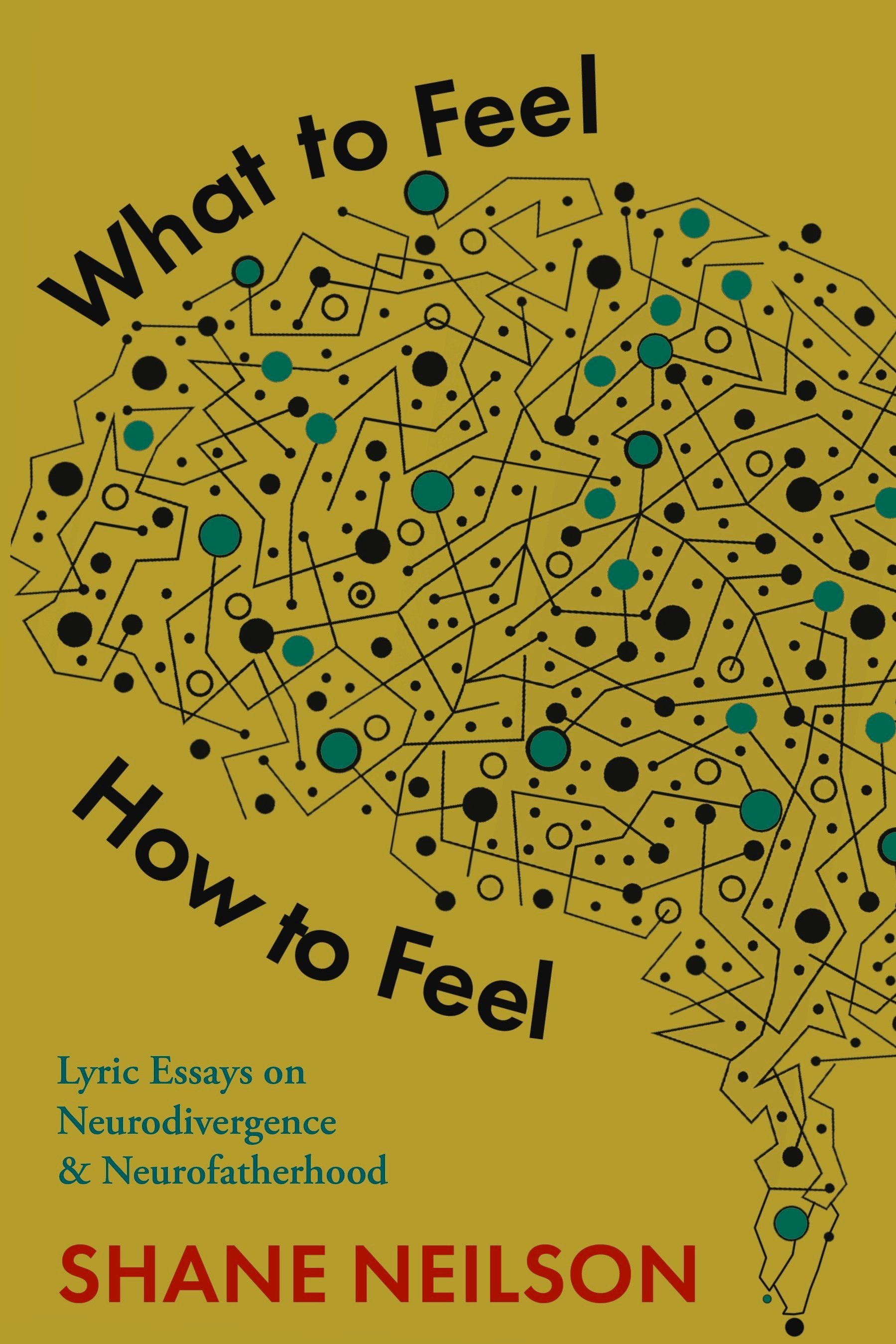
Excerpt from What to feel, how to feel by Shane Neilson
We call it Frink, and Frink it has been since he was able to demand “drink.” Frink it remains, though Frink is specific in a way only his family can know: a carbonated drink from McDonalds as dispensed by an accessible self-serve fountain (a pox on behind-the-counter tyrannical control!). Though cup sizes have escalated over the years, Frink’s always come as an earned reward. Frink as the meaning of life; Frink as the purest joy; Frink as the promise at the end of a long day pining for Frink; Frink if, and only if, one is Good. Frink because he is Good. Consider Frink to be your sex, your drug, your rash internet purchase, but also your wholesome chaste handhold with a first date at a carnival, your sleep stuffy, your comfortable around-the-house lived-in sweater. Frink for a blissful, refill-laden hour. Then the return to normal frinkless life.
Excerpt from “McDonaldsing into the Future-Death”
We call it Frink, and Frink it has been since he was able to demand “drink.” Frink it remains, though Frink is specific in a way only his family can know: a carbonated drink from McDonalds as dispensed by an accessible self-serve fountain (a pox on behind-the-counter tyrannical control!). Though cup sizes have escalated over the years, Frink’s always come as an earned reward. Frink as the meaning of life; Frink as the purest joy; Frink as the promise at the end of a long day pining for Frink; Frink if, and only if, one is Good. Frink because he is Good. Consider Frink to be your sex, your drug, your rash internet purchase, but also your wholesome chaste handhold with a first date at a carnival, your sleep stuffy, your comfortable around-the-house lived-in sweater. Frink for a blissful, refill-laden hour. Then the return to normal frinkless life.
*
At the Toronto Zoo, a spooked middle-aged woman walks alongside a much younger, frowning woman, their age difference thirty years, at least. Woman the Younger seems in a hurry; Older moves in a way I know: slow, subtly uncoordinated, arms slightly flexed. Her clothes (pastel polyester pants, an unflattering white blouse) fit poorly. Her thick, slightly sticky hair is shaped like a hard hat. Ungroomed, not unsightly or unkempt. In contrast, Younger dresses stylishly, in an actual dress – Van Goghian, blue with yellow erupting sunflowers. After a few more seconds of observation, I realize that these two probably unrelated people – they are different races, there is no affection – have been brought together in a care relationship. Older, who’s intellectually disabled in some way, is being led by hand-pull, not hand-hold. Ah. Like my son, she can’t move any faster, it seems. She’s not resisting, she just lacks a faster gear. Younger the Frustrated wants to get somewhere. Always, an abled somewhere to hurry to on the way to another Important Place. Older could be fearful about anything, I suppose. To be fair, Younger could want to get elsewhere for any reason, perhaps a reasonable one. In my gut, though, I interpret this scene as a disabled person taken out on an excursion by a personal support worker, easy gig for them. The relationship is both paid and overtly uncaring. It’s happened before – I sense Older accepts the lack of concern as the cost of coming to the zoo. I ask you: when you were a child, unable to arrange a trip to McDonalds, the movie theatre, or the zoo on your own, wasn’t it enough to just go? When I turn my head to see if anyone else notices the pair, I witness everyone else involved in their own lives, couples and families, my own son and daughter fighting over who saw the first polar bear. Kaz says “Me!” Aria says, “No, me!” I wouldn’t come here if I didn’t love them. I wouldn’t take them if I didn’t love them. I am privileged to love them. They are privileged to be loved. Is that right? That shouldn’t be right.
*
Kaz is late for the special van that couriers him and a few other disabled children to Galt Collegiate. By this point in our lives together, my self-appointed job title is “Leaving Specialist.” From the time he entered kindergarten until now, a strong organizational structure conveyors, coerces, and coaxes Kaz to leave the house in the morning. First, music from downstairs. Then, I climb the stairwell and call to him from his doorway. (Lately, he picks his own clothes.) Then, breakfast after he removes his Invisalign. Breakfast’s intricate movements: for the past few days, he’s attempted to choose an item or two from the fridge. Item choice influences pacing because peanut butter takes minutes to spread on crackers, an apple thirty seconds to slice. Breakfast is carefully arranged – he gets a halfway warning, a 5-minute warning, and then an absolute final warning to leave the table and dress for outside. Ding, louder ding, loudest ding. Waiting by the door, of course, are his bookbag (packed with a lunch made by his mother that he won’t eat, but which we must pack else the school will call us to bring one he also won’t eat), coat, and boots. I have streamlined everything, economized all. Milk in the fridge stands ready to pour, his go-to foods always accounted for and facing frontward, otherwise the routine will be disturbed, Kaz will angrify, and his chances of catching the bus reduce. If we fall behind, there is but one absolute truth and certainty: he will not, cannot accelerate. The factory installed a single low gear. If we fall behind, no admonishment can quicken him. This deep understanding of intellectually disabled (ID) physics enables me to discern the nature of care relationships in the wild. When I encounter ID people in public, I watch their carers. Are the carers in a hurry, at odds with their charges, or in synch? My son may never know this until the day I am gone, but the fact that much has been cleared away for him, that preparation and expertise smooth his progress, is a mark of love through action. Love is also that I understand he cannot be made to go faster, that slowness is his nature. If I were to shout and scare him as I was myself so often scared as a child, then he would startle, yet not move faster and quicker. And when I see him startle, I see myself, and I never want to see myself that way again, too scared to even move. Too heavy to move.
*
At the Toronto Zoo, I order an iced lemonade for Kaz and a croissant for my daughter Aria. Kaz savours the liquid, nursing it for over an hour; my daughter gobbles the croissant. Next to the entrance to Africa Savanna, Kaz sets his lemonade down on a concrete railing and tries to locate the biggest lion, but they hide from the sun, undetectable. When he turns back to his lemonade, yellowjackets swarm the rim. He looks up to me, asks me to get them away. Though I’m not scared of being stung, I know that stinging will happen with so many wasps crawling on the top, several already past the straw aperture soon to reach the sugar water. Plus, he shouldn’t drink the thing now that the wasps are in there. Plus, I want to teach him to respect danger. So I say “Let’s leave the juice for them. They’re yellow. It’s yellow. Yellow things go together.” But he does not accept my silly reasoning and begins to rage, screaming about his Frink, how it’s his, how he should still have it, noowwwwwwwww. The meltdown continues for another thirty minutes. The lions refuse movement, too.
*
Two women sit across a coffee shop table from a middle-aged man. He smiles oddly, askance from them both. Only one woman speaks to him, often in a sing-song voice about his “treat.” Every few minutes, she asks, “Do you want your treat?” Each time, he nods in return, says, “frozey lemonade” while continuing to smile. The one that doesn’t speak to him continues to not speak to him. In a minute, the one that talks to him leaves the table, soon returning with a yellow semisolid liquid in a large plastic cup that she places in front of him. The one who doesn’t speak to the man mentions her previous night spent with a boyfriend and how much of an asshole he is. Apparently, he’s handsy and cheap. The one who singsongs to the man responds with a generic sympathy no more authentic than her singsong interactions with the man. Now it’s her turn to talk, and she describes an aggressive client, pausing only to coo to the man who smiles oddly, who is not aggressive, no no, he is good, good. She talks to him like a dog. Then she complains about another client who soils himself and needs constant watching, otherwise he’ll run away. The one who doesn’t talk to the man mentions how much she hates her ex-boyfriend, who always walked around the house naked. Though she didn’t exactly hate how good he was in bed. The singsong woman watches the liquid level in the smiling man’s cup, as I do: the meniscus vibrates slightly as trucks rumble by the drive-through window. How often does the group home send someone to take him here? How often does he get his treat? Is treating the only activity he does outside the home? Is there anyone to love him?
*
From the time he could walk, Kaz helped me take out the garbage. Once a week, we used to drag the blue, grey, and green containers streetside. Early on, he play-helped, but even when he contributed nothing except trouble, running underfoot, chucking Frink containers out of the bins, overturning the bins, and shoving bins onto the street, I considered this activity his ‘job’ and he would be rewarded with apple juice after we finished. As he became older, repetitively shown what to do week after week, year after year, and given so much juice, he eventually became able to perform the task himself. Once he completes a cycle (garbage out in the morning, bins back in the evening) correctly, without cueing, then the reward comes: a trip to the McDonalds on Main. Frink, from the fountain, classic mix: two-thirds Nestea, one-third red Fruitopia. The visit has its own ritual: we try to sit in the same place in the restaurant, across from the fish tank. We locate the sucker fish who hides in the hollow tree. We look for anyone else disabled. I don’t say what I often wonder: who will take him to McDonalds after I am dead? I know the answer already. Either no one, or people who don’t care about him. After a refill, we leave.
*
Another restaurant, this time Mandarin on King Street in Kitchener. Mando is Kaz’s favourite – he can see all the buffet items and pick exactly what he wants. Fries, onion rings, gravy, and California roll sushi, an undeviating selection. Everyone else at the table – Janet, Aria, me – drink water, Aria with double ice because I spoon out mine and make the exchange. Kaz gets iced tea. Across from us, a disabled pair of young men sit at a small rectangular table. One of the men is dressed as life-size Super Mario, red cap, suspenders, the whole deal. The other man has pronounced retrognathia and strabismus. I hear a speech impediment, a heavy lisp but also dysphonia to boot. As I eat my undeviating meal, chicken fried rice and chicken balls, I map the dynamic between them. Super Mario makes several trips to the buffet, his heaping plates scarfed down and replaced with more. He’s genial, always answering “Yes” to the other’s pleas to hang out after dinner, to hang out at other times. “Let’s hang out later” says the pulled-back jaw man after perhaps the two-dozenth “Yes” to the same question. It’s unclear if the man has been stood up or ghosted by Super Mario before, or whether his anxiety reflects being ignored by others. He pulls out his phone and shows Super Mario something. Retrognathia giggles, Super Mario guffaws. “Isn’t this fun?” Retrognathia asks for the tenth time, adding a new variant, “This is so fun, isn’t it?” As per the ritual, “Yes” comes as response. In time, the waiter comes by, asks “How are you going to pay?” in what I deem a not un-nice way, a not-mean way. A regular way. The normal way. Super Mario points wordlessly to Retrognathia, who volunteers that he will pay. I can tell that this was the deal. Retrognathia’s credit card doesn’t work on tap, so the waiter inserts it into the machine for him, but Retrognathia doesn’t know his passcode. Retrognathia calls someone on the phone, places it on speaker. Someone I assume is his mother patiently recites his code over and over again, a code for a card that is quite possibly hers. The code doesn’t work even when the waiter puts in the numbers. The waiter looks to Super Mario. “Can you pay?” he asks, but Super Mario smiles and says that he cannot. “Can your parents come and fix this?” he asks both of them. Have they been here before? Does he know they have parents? Realizing this interaction is attracting a lot of staring, the waiter commands the two men to stand up and move to the front of the restaurant where the manager will “work things out.” When I finish eating ten minutes later, I walk past the two men sitting at the front. Super Mario stares ahead happily. Retrognathia talks down into his phone, an image of an old woman looking back at him.
*
Excerpt from Shane Neilson’s Imaginary Last Will and Testament, as Written on a Brown McDonalds Napkin Using Red (Provided) Crayon
For my son:
1. Frinks, once weekly
2. Spotify account
3. Gorilla stuffy, medium size
4. Computer with Garageband
5. Someone to love
Excerpt from What to feel, how to feel: Lyric essays on neurodivergence and neurofatherhood © 2025 by Shane Neilson. Reprinted by permission of Palimpsest Press.
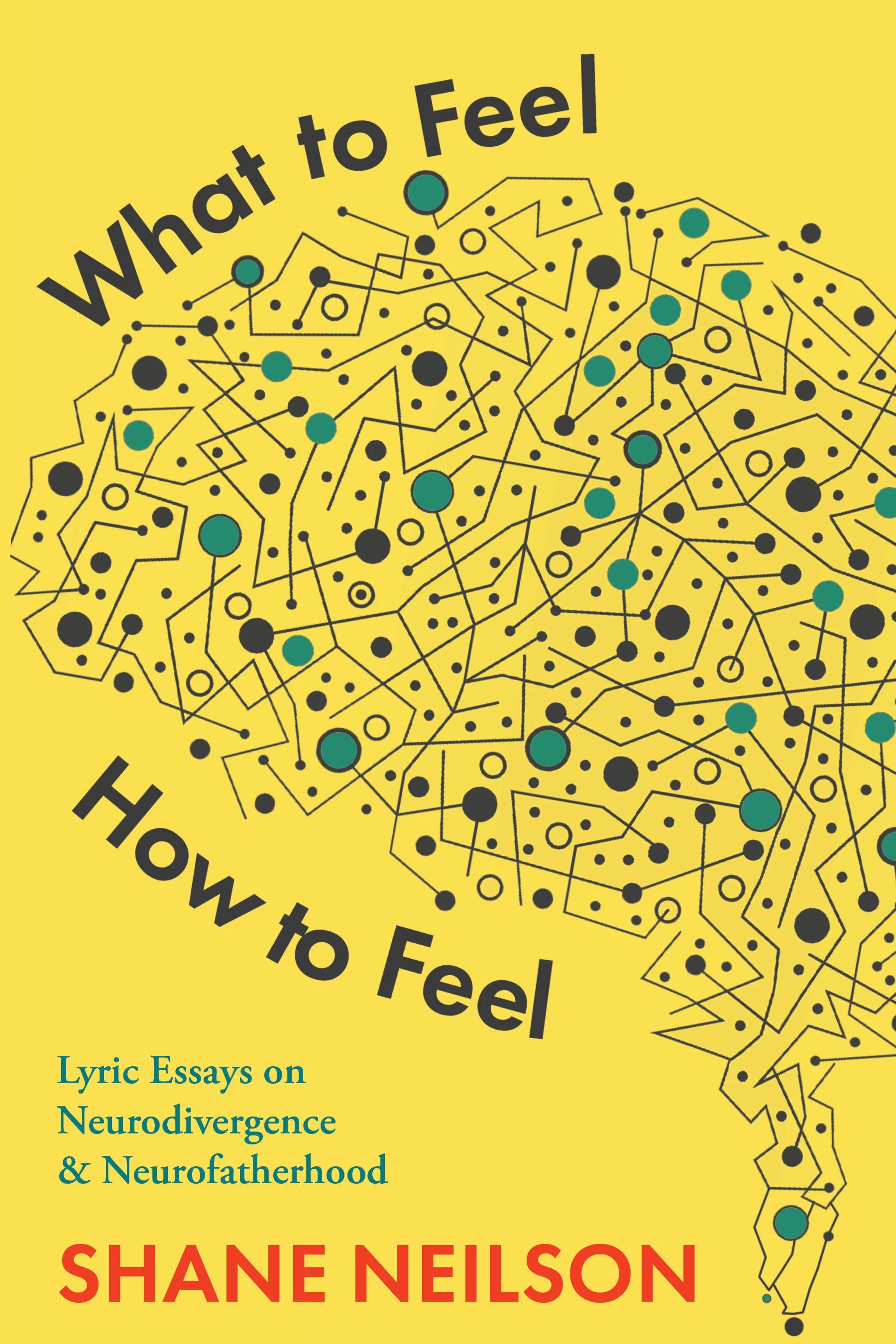
In What to feel, how to feel, Shane Neilson dazzles in the lyric essay form. Focusing on non-neurotypicality, Neilson investigates his supposed difference of self while also holding to account society’s construction of that difference, moving from his early childhood to adulthood and then back again in terms of a neurodivergent fathering of his own son. Covering subjects that have yet to receive attention in Canadian literature, including how the medical profession discriminates against its own, Neilson’s poetic accounts of stigma and self-discovery interleavened with literary history mark a first in our letters.

Shane Neilson. Photo credit: Zdenka Neilson
About Shane Neilson:
Shane Neilson is a mad and autistic poet-physician who practices in Guelph, Ontario and who teaches health humanities at the Waterloo Regional Campus of McMaster University. His prose has appeared in the Walrus, Maisonneuve, Image, the Globe and Mail, and many other places.

Power Q & A with Bruce Hunter
Frontenac House Press has published a gorgeous reissue of Bruce Hunter’s award-winning novel of love, disability, and wildness, In the Bear’s House(May 23, 2025.)
Set in 1960s Calgary and Alberta ‘s backcountry, this reissue of In the Bear’s House tells the story of a creative young mother, Clare Dunlop, raising her deaf son against the insurmountable odds of poverty, mental illness and hardship. In the Bear’s House is ultimately about listening to the wild and the wilderness, and what we lose when it’s gone.
We are honoured to have Bruce join us to answer a question about the rebirth of his much-loved story.
Frontenac House Press has published a gorgeous reissue of Bruce Hunter’s award-winning novel of love, disability, and wildness, In the Bear’s House (May 23, 2025.)
Set in 1960s Calgary and Alberta ‘s backcountry, this reissue of In the Bear’s House tells the story of a creative young mother, Clare Dunlop, raising her deaf son against the insurmountable odds of poverty, mental illness and hardship. In the Bear’s House is ultimately about listening to the wild and the wilderness, and what we lose when it’s gone.
We are honoured to have Bruce join us to answer a question about the rebirth of his much-loved story.
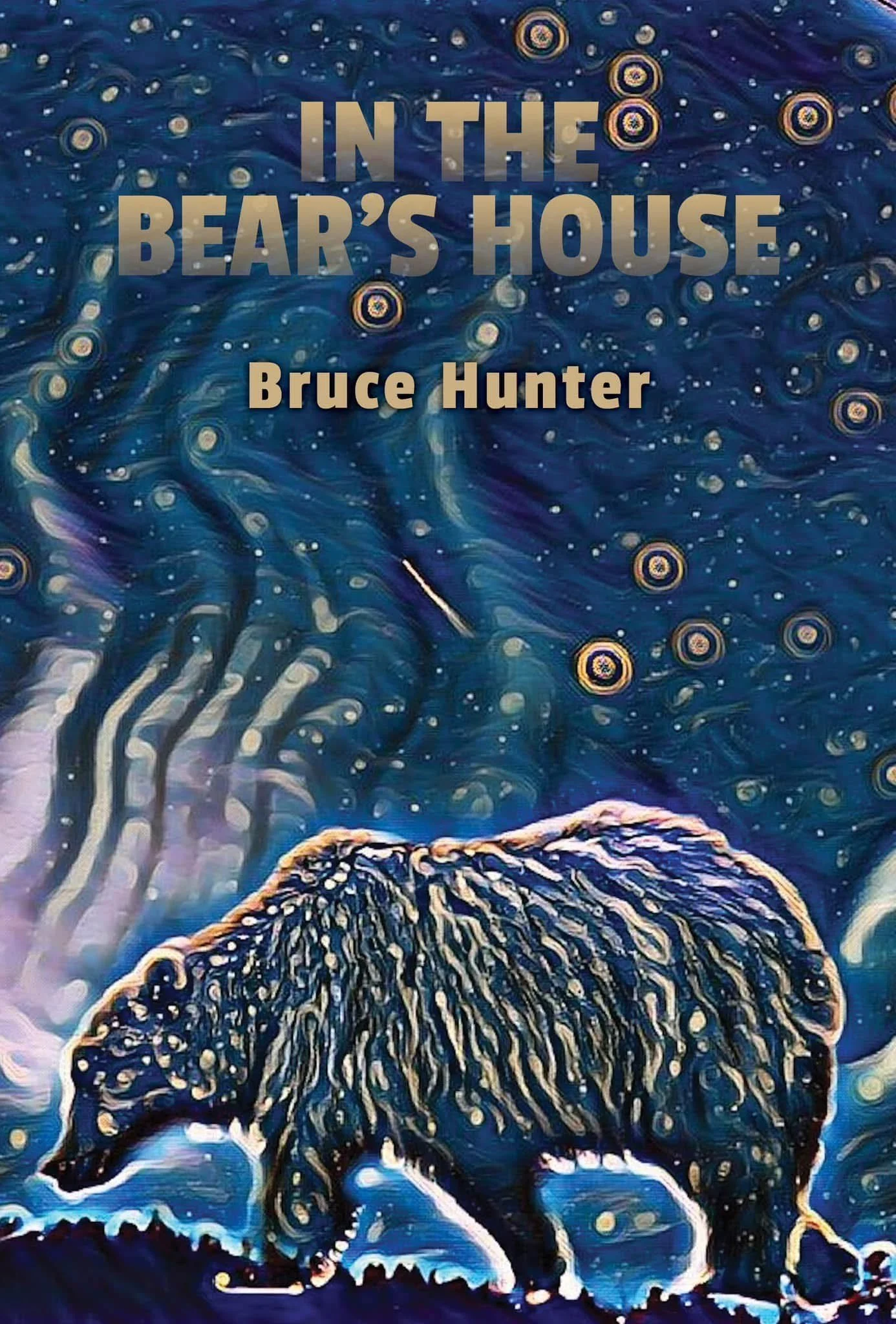
In the Bear’s House by Bruce Hunter
Nella casa dell’orso by Bruce Hunter, translated by Andrea Sirotti, published by iQdB eidizioni.
Q: What has it been like to reissue In the Bear’s House and have it translated?
A: As a mature writer on the eve of his 73rd birthday on May 21, I’m gobsmacked to have in my hands an Italian translation by iQdB eidizioni, and a sparkling new edition by Calgary’s Frontenac House. What a validation of my life’s work. Which I hope is an inspiration to all writers, young and old. To borrow a baseball metaphor, it’s all about staying in the game, whether you strike out or not, and keep getting up to bat.
Both publishers lavished such love on their books, inside and out. Both books radiate that level of professionalism and care.
I first published In the Bear’s House in 2009. It sold well and won an award at the Banff Mountain Film and Book Festival where it was deemed a mountain classic. But the publisher disappeared as did my edited galleys. I gave up all hope of ever seeing it in print again. Then my neighbor, the gifted poet and editor, Elana Wolff read It. It speaks to our times, she said. You must get it out there.
A cousin in IT scanned the hard copy and created a new submissible file. I showed it to the brilliant editor Micheline Maylor-Kovitz at Frontenac House in Calgary who took it to her bosses. There, Micheline, Terry Davies, and Neil Pretunia helped me take In the Bear’s House to a whole new level.
In the meantime, my Italian publisher brought out a translation as Nella casa dell’orso (literally, ln the House of the Bear). In April, I did a four-city tour to Lecce, Copertino, Florence, and Trieste, where the audiences’ enthusiastic response showed the story of a creative young mother and her deafened son in 1960s Alberta transcends time, language, and culture.
I look forward to the Calgary launch on May 23. What a birthday gift. From the bottom of my mended heart, gratitude to every one of you who got me here.
Bruce Hunter
About Bruce Hunter:
Bruce Hunter is a writer, editor, speaker, and mentor. In 2024, his novel, Nella casa dell’orso, was published in Italy by iQdB edizioni. In 2023, his poetry collection, Galestro, was published in Italy, following the release there in 2022 of A Life in Poetry, Poesie scelteda Two O’clock Creek, also by iQdB edizioni. 1n 2021, his memoir essay, “This is the Place I Come to in My Dreams” was shortlisted for the Alberta Magazine Publishers’ Awards. In 2024, his long poem “Dark Water” from Galestro won Gold for poetry for the Alberta Magazine Publishers’ Awards. And he is a proud new grandfather of Alice, Julian and Lucas.
Born in Calgary, Alberta, Bruce was deafened as an infant and afflicted with low vision much of his adult life. He grew up in the working-class neighbourhood of Ogden in the shadow of Esso’s Imperial Oil Refinery and now decommissioned Canadian Pacific Railway’s Ogden Shops. Calgary is located on Treaty Seven lands, in the traditional territories of the Blackfoot Confederacy (Siksika, Kainai, Piikani), the Tsuut’ina, the îethka Nakoda Nations (Chiniki, Bearspaw, Goodstoney), the Otipemisiwak Métis Government (Districts 5 and 6).
In his early teens Bruce discovered writing, for there he could hear everything – and be heard. After high school, he worked for ten years as a labourer, equipment operator, Zamboni driver, and completed his technical education and apprenticeship as a gardener and arborist. In his late twenties, his published poetry won him a scholarship to the Banff School of Fine Arts to study with novelist W.O. Mitchell and poet Irving Layton. From there he went onto York University to study film and literature and taught in the creative writing department before landing a position at Seneca College.
His poetry, fiction, reviews, interviews, and creative nonfiction have appeared in over 90 blogs, journals and anthologies internationally in Italy, Canada, China, India, Romania, the U.K. and the U.S.
Bruce has authored seven poetry books, as well as the best-selling CBC Radio-produced 1996 short story collection, Country Music Country (the third edition, the Reboot appeared in 2018).
In 2009, In the Bear’s House, won the Canadian Rockies Prize at the Banff Mountain Book and Film Festival. In 2010, his book Two O’clock Creek – poems new and selected, won the Acorn-Plantos Peoples’ Poetry Award for Canada.
Bruce was the 2017 Author in Residence for Calgary Public Library. His past residencies include the Banff Centre, Deaf and Hear Alberta, Richmond Hill Public Library, University of Toronto, Mount Royal University, and many others across Canada.
Bruce is an associate member of the Association of Italian Canadian Writers, a full member of the Canadian Authors Association, a life member of the Canadian Hard of Hearing Association (C.H.H.A.), and the Canadian National Institute for the Blind (C.N.I.B.), as well as long-time member of the League of Canadian Poets, the Writers’ Union of Canada, and the Writers’ Guild of Alberta. For more than three decades, Bruce has championed accessibility for those with vision and hearing loss.

Power Q & A with Caitlin Galway
The longer form definitely comes naturally to me, though it’s not something I set out to do, so much as a reflection of how I think. I’ve learned to see my own intuitive approaches more clearly, and how to amplify or deconstruct them, challenge or upend them. Something particular that I’ve realized is that as I write, everything is somewhat of a spiderweb; ideas emerge connected to several other ideas, which connect to one layer, then another, and so on. It’s part of what feeds me electricity as a writer: this instantaneous, sparking interaction between narrative, symbolism, philosophy, psychological and emotional interiority, history, and commentary, and I find that it means the story will probably need more breathing room.

Q: Your short fiction collection, A Song for Wildcats (Dundurn Press, 2025), is remarkable in many regards: it has lilting, poetic language, haunting and gorgeous imagery, and—what we want to ask you about today—an unusual structure. Your book is made up of five longer stories, as opposed to many shorter ones. Would you tell us about writing longer form short fiction?
A: The longer form definitely comes naturally to me, though it’s not something I set out to do, so much as a reflection of how I think. I’ve learned to see my own intuitive approaches more clearly, and how to amplify or deconstruct them, challenge or upend them. Something particular that I’ve realized is that as I write, everything is somewhat of a spiderweb; ideas emerge connected to several other ideas, which connect to one layer, then another, and so on. It’s part of what feeds me electricity as a writer: this instantaneous, sparking interaction between narrative, symbolism, philosophy, psychological and emotional interiority, history, and commentary, and I find that it means the story will probably need more breathing room.
“The Lyrebird’s Bell”, for example, on a narrative level is a story about two young girls and the absorbing, even disturbing bond they form in response to isolation and familial abuse. There’s a prominent layer exploring the complexities of human relationships, and another navigating grief, trauma, and the impulse to retain some shred of love. However, it’s also a story about essentialism, and how metaphysical reflection might manifest in the mind of a child desperate to make sense of the inexplicable. It’s also about imagination, both as joy and necessity, and why it’s so often steeped in myth.
Those layers need to engage with one another thoughtfully and meaningfully, and as a result, I usually feel a certain elasticity to a story. It keeps lengthening because it demands more space to explore itself, and for me, it’s a matter of being receptive and listening.
More about A Song for Wildcats:
Infatuation and violence grow between two girls in the enchanting wilderness of postwar Australia as they spin disturbing fantasies to escape their families. Two young men in the midst of the 1968 French student revolts navigate — and at times resist — the philosophical and emotional nature of love. An orphaned boy and his estranged aunt are thrown together on a quiet peninsula at the height of the Troubles in Ireland, where their deeply rooted fear attracts the attention of shape-shifting phantoms of war.
The five long-form stories in A Song for Wildcats are uncanny portraits of grief and resilience and are imbued with unique beauty, insight, and resonance from one of the country's most exciting authors.

About Caitlin Galway:
Caitlin Galway is the author of the novel Bonavere Howl and the forthcoming short story collection A Song for Wildcats. Her work has appeared in Best Canadian Stories 2025, EVENT, Gloria Vanderbilt's Carter V. Cooper Anthology, House of Anansi's The Broken Social Scene Story Project (selected by Feist), The Ex-Puritan as the 2020 Morton Prize winner (selected by Pasha Malla), Riddle Fence as the 2011 Short Fiction Contest winner, and on CBC Books as the Stranger than Fiction Prize winner (selected by Heather O'Neill).

Power Q & A with Catherine Bush
Like many writers, I started out writing stories but very quickly discovered that a story I cared about deeply was trying to be a novel, so I plunged headlong into long-form fiction and never looked back. That unwieldy story became my first novel, Minus Time. I felt like the novel was my natural breath as a writer. A few years ago, I became intrigued by the wild and meaningful compression of flash fiction – the opposite of a novel. I started writing stories again more intently during the pandemic at a time when I felt exhausted and unable to start a new novel.

Q: How has writing this collection of short stories, Skin (Gooselane Editions, 2025) been different than writing a novel? And how has your publishing experience been different if it has?
A: Like many writers, I started out writing stories but very quickly discovered that a story I cared about deeply was trying to be a novel, so I plunged headlong into long-form fiction and never looked back. That unwieldy story became my first novel, Minus Time. I felt like the novel was my natural breath as a writer. A few years ago, I became intrigued by the wild and meaningful compression of flash fiction – the opposite of a novel. I started writing stories again more intently during the pandemic at a time when I felt exhausted and unable to start a new novel. Writing stories allowed me to enter other worlds on compressed timelines, to play, try out new things, seek pleasure at a time when pleasure was hard to find. I love the challenge of bringing a complex world to life in no more than a few pages. I love aiming for unpredictability in the story form, unusual intimacy, the swerve. The short arc rather than the long one. One of the perhaps unorthodox qualities of my collection is that it assembles stories of truly varied lengths, from flash to novella and those in between. A few of the stories, such as The International Headache Conference, about a woman who has an intense hook-up-type encounter with another migraine sufferer, or Voices Over Water, which draws on stories told to me by my father and grandfather, are older, re-edited for the collection. Benevolence, the long story that opens the collection, takes an idea that I began to explore years ago and totally re-imagines it. The title story, about a woman obsessed with foot washing, and Derecho, in which a man finds himself strangely attracted to extreme winds, are two of the newer stories. Because the stories were conceived over a long span of time I think of them as kind of a fictional autobiography (emphasis on fiction!).
My editor, André Alexis, was the person who said that he thought I should turn the stories into a collection and as I revised them, we both gave a lot of thought about how to order the stories to create a meaningful journey for the reader and, ultimately, a sense of a whole. Honestly, I think that the taxonomic distinction between novels and stories is a bit of a false one: novels come in all sorts of forms and lengths, as do stories. Whatever fiction you’re trying to create, it needs to find its necessary length – and breath!
More about Skin:
Now, for the first time, a blistering book of short fiction from one of Canada’s most loved novelists.
In Skin, Catherine Bush plunges into the vortex of all that shapes us. Summoning relationships between the human and more-than-human, she explores a world where touch and intimacy are both desirable and fraught.
Ranging from the realistic to the speculative, Bush’s stories tackle the condition of our restless, unruly world amidst the tumult of viruses, climate change, and ecological crises. Here, she brings to life unusual and perplexing intimacies: a man falls in love with the wind; a substitute teacher’s behaviour with a student brings unforeseen risks; a woman becomes fixated on offering foot washes to strangers.
Bold, vital, and unmistakably of the moment, Skin gives a charged and animating voice to the question of how we face the world and how, in the process, we discover tenderness and allow ourselves to be transformed.

About Catherine Bush:
Catherine Bush is the author of five novels. Her work has been critically acclaimed, published internationally, and shortlisted for numerous awards. Her most recent novel, Blaze Island, was a Globe and Mail and Writers’ Trust of Canada Best Book of the Year, and the Hamilton Reads 2021 Selection. Her other novels include the Canada Reads longlisted Accusation; the Trillium Award shortlisted Claire's Head; the national bestselling The Rules of Engagement, which was also named a New York Times Notable Book and a L.A. Times Best Book of the Year; and Minus Time, shortlisted for the City of Toronto Book Award. The recipient of numerous fellowships, Bush has been Writer-in-Residence/Landhaus Fellow at the Rachel Carson Centre for Environment and Society in Munich and a Fiction Meets Science Fellow at the HWK in Delmenhorst, Germany. An Associate Professor of Creative Writing at the University of Guelph, she lives in Toronto and in an old schoolhouse in Eastern Ontario.

Special Mother's Day excerpt from Widow Fantasies by Hollay Ghadery
River Street’s Founder Hollay Ghadery is an award-winning author as well as a mother of four humans and a multitude of furred and feathered bairn. As a special Mother’s Day gift to all, she’s agreed to share one of the most beloved stories from her short fiction collection, Widow Fantasies, which was released in 2024 with Gordon Hill Press.
As many critics have noted, in Hollay’s stories, there is a chorus of voices that sing to the multiple ways people can be women and mothers…or not. This inclusive and rangy mosiac has made Widow Fantasies a must-read for short fiction lovers, and we are proud to say, has introduced many members of our community to the wonderful world of flash fiction.
River Street’s Founder Hollay Ghadery is an award-winning author as well as a mother of four humans and a multitude of furred and feathered bairn. As a special Mother’s Day gift to all, she’s agreed to share one of the most beloved stories from her short fiction collection, Widow Fantasies, which was released in 2024 with Gordon Hill Press.
As many critics have noted, in Hollay’s stories, there is a chorus of voices that sing to the multiple ways people can be women and mothers…or not. This inclusive and rangy mosiac has made Widow Fantasies a must-read for short fiction lovers, and we are proud to say, has introduced many members of our community to the wonderful world of flash fiction.
Keep reading for Hollay’s story, “Jaws”.

Widow Fantasies by Hollay Ghadery, published by Gordon Hill Press.
jaws
What if the other fish don’t like her? That was my first thought, and it’s not as silly as it sounds. One never stops being a mother and Jaws was too sweet for her own good. Always had been. Originally, Jaws was one of two goldfish we brought home from the Nowruz bazaar seven years ago, and the other fish—a nasty, mottled thing of white and black—had pecked and picked on Jaws mercilessly. But we found the bully floating wide-eyed and belly up before the final new year celebration on Sizdah Bedar.
Thanks to God.
My second thought was that I would never speak to Reza again. Son of a dog, I told him I liked her in the house with me. But I leave for a day to get Keyvan settled in his dorm and he dumps Jaws in our pond.
What kind of life was that for a fish? Reza stabbed his finger toward the pond, spit flying from his mouth. Stuck in a tank in a house with you all day?
Goldfish aren’t as stupid as people.
Or as people think.
By our second year together, Jaws would eat her flakes right from my fingers. She’d respond to her dinner bell, bobbing excitedly when I rang it at mealtimes.
Whenever I walked by her tank, she’d swim out from behind the screen of her silk plants and follow me back and forth as I dusted and vacuumed and folded laundry. I tried to show Reza how incredible it was—she knew my face—but he only complained the tank was beginning to stink and didn’t I have anything better to do with my time? We should have had more children, he’d say.
1
Keyvan used to be amazed by her tricks until he wasn’t. She doesn’t know you, Mom. She probably can’t even see you. You’re just a blob or shadow or something.
When Reza’s mistress died last year, Jaws was the only one I let see me cry. She understood: it was my loss as much as his. The woman had been oxygen to our little bowl of stagnant water. She’d given me room to breathe.
Now light from shattered glass ricochets skyward from the driveway. A few minutes after I’d heaved the empty tank at Reza’s head, I heard the pop of gravel under his tires as he shot out onto the road. Good riddance to him. I was sorry about the tank though. I hadn’t been thinking.
I lower myself to the grass beside the pond. The cherry blossom tree is alive with bees and soft pink petals freckle the water’s surface. Jaws must be hidden somewhere in the weeds. I see a few of the black moors, the flash of a white and yellow fish, but no sign of Jaws’ telltale Tiger Lily scales. A fern green, three-legged frog sits like a mound of melting butter on a lily pad. He croaks a sonic, deep belch.
Do frogs eat goldfish?
There are at least half a dozen other fish in our decorative pond, but other than plugging in the de-icer every winter, I’ve never thought much about them. They were here when we bought the property and existed fine without my intervention. Even when a green heron began hunting around the water, baiting its surface with twigs and insects, I hadn’t worried. I stood at the living room window and watched, describing the scene to Jaws. She stared at me with her unblinking copper eyes and agreed: life was much better inside.
I put my hand in the pond water and splash a little. “Mahi koochik? Are you there?”
The three-legged frog belches again and leaps into the water. I splash some more, stirring up algae so the pond’s surface becomes opaque.
I think of all the time I spent by the pond with Keyvan when he was a child, watching larvae and tadpoles grow. How did I never think to check if the frogs were eating the goldfish?
I get up and run. Bursting into the house, I find the dinner bell where I left it: on the table where her tank used to be. I’m ringing the bell before I’m even back out the door. “Jaws, bia! Come!”
I continue to ring desperately until two unmistakable orange nares poke through the scum. I scoop her into overflowing palmfuls of water and we greet each other, gasping.
Excerpt from Widow Fantasies by Hollay Ghadery © 2024 by Hollay Ghadery. Published by Gordon Hill Press.
More about Widow Fantasies:
Fantasies are places we briefly visit; we can’t live there. The stories in Widow Fantasies deftly explore the subjugation of women through the often subversive act of fantasizing. From a variety of perspectives, through a symphony of voices, Widow Fantasies immerses the reader in the domestic rural gothic, offering up unforgettable stories from the shadowed lives of girls and women.
"Every story in this book feels like jumping into a lake, like the flare of heat in your throat after a shot, like missing a step on the way down the stairs at night. These are works all the more powerful for their brevity. Hollay Ghadery’s book, in short, has made me a convert to the flash fiction genre." Jade Wallace, for The Miramichi Reader

Hollay and her beautiful brood.
Hollay Ghadery is an award-winning Iranian-Canadian multi-genre writer living in rural Ontario on Anishinaabe land. Fuse, her acclaimed memoir of mixed-race identity and mental illness, was published by Guernica Editions’ MiroLand imprint in 2021 and won the 2023 Canadian Bookclub Award for Nonfiction/Memoir. Her debut collection of poetry, Rebellion Box, was released with Radiant Press in April 2023. Hollay's short-fiction collection, Widow Fantasies, came out with Gordon Hill Press in 2024. Hollay is a board member of the League of Canadian Poets, the co-chair of the League's BIPOC committee, as well as the Poet Laureate of the region in which she lives, and a Poetry, Canadian Studies, and Literature podcast host on The New Books Network. Hollay is also a host of HOWL—the literary arts show—on 89.5 CIUT FM, a member of The Writers Union of Canada, the Creative Nonfiction Collective, and the National Book Critics Circle.

Excerpt from Iris and the Dead by Miranda Schreiber (Book*Hug Press, 2025)
I wrote a story for you in a journal and it vanished. Yes, van- ished. The journal itself disappeared. Where do such missing things go?
In the story I laid down all the things I wanted you to understand. I wanted to write it because, in the years since we lay in the yellow grass, I have come to some knowledge. I cannot recall the contents of the story in full. Because of its loss, I sobbed and felt like the victim of a cruel and unusual fate.
I wrote a story for you in a journal and it vanished. Yes, van- ished. The journal itself disappeared. Where do such missing things go?
In the story I laid down all the things I wanted you to understand. I wanted to write it because, in the years since we lay in the yellow grass, I have come to some knowledge. I cannot recall the contents of the story in full. Because of its loss, I sobbed and felt like the victim of a cruel and unusual fate.
Do you think you can write it again, said my mother when I told her.
In some ways, I said. I mean, only in part.
But the heart of the story is gone and I no longer own it.
Still, my need to speak with you seems to have no end. As I wanted to tell you, in every possible universe, when presented with what you offered me, I take it.
May I begin again?
Part I: Sickness
On My Rights as the Author
What do you remember of me? Is it difficult to make out? I know your mind, which doesn’t take much interest in the past, has possibly let me rot for years. Lacking attention, per- haps the sounds we heard together have shrunk and become difficult to name. The colours you associated with me, mixed together now, present a peculiar new hue. Maybe a bronze, made up of grey lake water and the sun.
Some of my memories of you have been darkened by the things I’ve heard and seen in the time since we knew one another. Seeing pictures of you online almost removes you more from me; an image of you in red light by the water seems to have nothing to do with you. It is only occasionally that something comes up in front of me—in that hard way vir- tual things do, so that the rest of the world recedes—and I’m flooded with feeling. For you, I know these memories might have died. For me, they keep. For you, have they simply been discarded? And if they have, to where? What I want to know is, where are the things that have vanished?
For me, very few things end. I can revisit funny memories and put a different name on them. The uncanny ones I’ve wanted to speak with you about. I am sick to death of being dazzled, of lacking the words. We did not have a love affair.
As I said, I have a story to tell you: a better one than I ever could have come up with at the time I knew you. In many ways, I am teeming with knowledge about what was hap- pening during the time we spent together, and beyond. But I should admit I’m not just trying to pass on the knowledge
I’ve come to. I also have questions to ask you. Even as I write with vital information I’m bewildered. But the answers I need may be in that place where the vanished objects go, because I am unsure that even you have them.
On the Beginning
When I was twelve I lost my mind.
The phrase doesn’t bother me. I think it’s correct. I lost my mind as accidentally as I lost pencils and five-dollar bills. Maybe my mind flew down the sky to a land of the dead. I don’t believe this, of course. But it’s better to think it was somewhere.
On the Study of Strange Things
A gift is frightening. It comes with moorings. I am indebted to you, which makes this whole thing stranger. You overflow, my love. You exceed. For years your gift and its consequences seemed uncontrollable.
Part of you helped me because you wanted to free me. That was the gift you gave. But another part of you wanted to keep me in a contractual relation. Because a gift creates a debtor; gratitude flows forever as all of the gift’s effects play out. And in another way you left me so little. I have letters, a T-shirt. There is some documentation of our time together. My unsent emails are a study in bewilderment. When I was twenty I thought about writing to you: Of course this isn’t to overlook the wonderful things you did for me, but I’ve been thinking about the cost… Still, however, the uninformed archivist would never be able to sort our data from noise. A colossus of evi- dence claims we were meaningless to one another. I myself, evaluating it, could make a strong case for barely knowing you. I could argue the following: there is only one photo of these women together. Neither has ever wished the other merry Christmas. The one card they exchanged said, “Thanks for everything thus far.” Therefore, these two women knew each other briefly and then forgot one another. These two women spent a few months together and didn’t think much about
it after.
But really, the card was written in panic. It implored. “Thus far” actually meant I must have more. “Thus far” was intended to mean I’m old enough now, although I wrote it when I was very young.
Excerpt from Iris and the Dead by Miranda Schreiber copyright © 2025 by Miranda Schreiber. Reprinted by permission of Book*hug Press.

Miranda Schreiber’s Iris and the Dead (Book*hug Press, June 10, 2025).
About Iris and the Dead:
Iris and the Dead unfurls the hidden power dynamics of abuse, offering a beguiling inquiry into intergenerational trauma, moral ambiguity, and queer identity. This haunting exploration of love and desire, disability and madness, and trauma and recovery, is a diaristic marvel for fans of Annie Erneaux.
Weaving personal memory with magic realism and folklore, Iris and the Dead asks: What if you could look back and tell someone exactly how they changed the course of your life?
For our narrator, that someone is Iris, the counsellor with whom she developed an unusual, almost violent bond. There are things she needs to tell Iris: some that she hid during the brief time they knew each other, and some that she has learned since. She was missing her mind the autumn they spent together and has since regained it.

Miranda Schreiber. Photo credit: Sarah Bodri.
MIRANDA SCHREIBER is a Toronto-based writer and researcher. Her work has appeared in places like the Toronto Star, the Walrus, the Globe and Mail, BBC, and the National Post. She has been nominated for a digital publishing award by the National Media Foundation and was the recipient of the Solidarity and Pride Champion Award from the Ontario Federation of Labour. Iris and the Dead is her debut book.

Power Q & A with Amanda Shankland
Speech Dries Here on the Tongue (edited by Hollay Ghadery, Rasiqra Revulva, and Amanda Shankland) is an anthology of poetry by Canadian authors, published by The Porcupine’s Quill, exploring the relationship between environmental collapse and mental health.
It’s been listed as a book to read by Quill & Quire and CBC Books, and we’re honoured to have one of the editors, Amanda Shankland, join us for this Power Q & A to talk about where this anthology started for her.
Speech Dries Here on the Tongue (edited by Hollay Ghadery, Rasiqra Revulva, and Amanda Shankland) is an anthology of poetry by Canadian authors, published by The Porcupine’s Quill, exploring the relationship between environmental collapse and mental health.
It’s been listed as a book to read by Quill & Quire and CBC Books, and we’re honoured to have one of the editors, Amanda Shankland, join us for this Power Q & A to talk about where this anthology started for her.

Speech Dries Here on the Tongue edited by Hollay Ghadery, Rasiqra Revulva, and Amanda Shankland, Porcupine’s Quill, 2025.
The idea for Speech Dries on the Tongue came to me during the long months of the pandemic. We all felt trapped in some way, in our homes, in our families, in our heads. Long walks were an escape from isolation, from uncertainty, and sometimes, from ourselves. Connecting with nature has always brought me peace. I thought about how others around the world might be connecting with nature at a time when we all stood face-to-face with an unclear future.
I started thinking a lot about how the pandemic wasn’t just a health crisis- it was also part of a larger story about disconnection, environmental loss, and how fragile our relationships with each other and the natural world can be.
In early 2021, I lost a dear friend to suicide. It was devastating and sad to know that despite the love of his family and friends, he did not get help in time. It reminded me of how important it is to find ways of connecting, especially in difficult times.
Poetry has always been a space for me to connect, share my inner struggles and remind myself that in spite of how difficult life can be, we are all experiencing similar emotions- grief, anger, love, frustration, and hope- are all part of the human experience.
That’s how this book started- as an idea to gather voices together. To create something honest about how we were living through this moment. About how we are part of the world around us and how who we are is fundamentally shaped by our environment.
Speech Dries on the Tongue is an anthology about isolation, connection, environmental grief, and the ways we care for each other in uncertain times.
More about Speech Dries on the Tongue :
Speech Dries Here on the Tongue is an anthology of poetry by Canadian authors exploring the relationship between environmental collapse and mental health. This threat of environmental collapse has brought with it a sense of impending annihilation and has contributed to the current mental health crisis, made crueller by a global pandemic that highlighted our fragile nature. These are poems by writers who have used their words to both articulate and navigate this crisis, unpacking the complex interplay between mental and environmental health in order to alert, inform, and inspire readers.
Edited by Hollay Ghadery, Rasiqra Revulva, and Amanda Shankland, the collection includes work by Brandon Wint, Jennifer Wenn, Canal Smiley, Amanda Shankland, Concetta Principe, Dominik Parisien, Khashayar Mohammadi, Kathryn Mockler, Tara McGowan-Ross, D.A. Lockhart, Grace Lau, Fiona Tinwei Lam, Aaron Kreuter, gregor Y kennedy, Maryam Gowralli, Elee Kraljii Gardiner, Sydney Hegele, Karen Houle, nina jane drystek, AJ Dolman, Conyer Clayton, Gary Barwin.

Amanda Shankland
About Amanda Shankland:
Amanda Shankland, Ph.D., is a writer, educator, and researcher whose work moves between creative storytelling and critical scholarship. She is the author of Cultivating Community: How Discourse Shapes the Philosophy, Practice and Policy of Water Management in the Murray–Darling Basin (Sydney University Press, 2024) and editor of the poetry collection Speech Dries on the Tongue (Porcupine’s Quill, 2025), which explores mental health, climate grief, and resistance. Her articles and reviews have appeared in Cuizine: The Journal of Canadian Food Cultures and Parvati Magazine, among others.
Shankland’s academic research focuses on water governance, agroecology, and food systems. She has recently published in the Journal of Agricultural and Environmental Ethics, Canadian Food Studies, and the Routledge Handbook of Sustainable Diets. She is also a contributing author to the Elgar Encyclopedia of Food and Society and an editor with Agroecology and Sustainable Food Systems. She holds a Ph.D. in Political Science from Carleton University and a Master’s in Public Policy from Toronto Metropolitan University. She teaches politics and food systems at Carleton University and the University of Ottawa and is currently a post-doctoral research fellow at the Global Center for Understanding Climate Change Impacts on Transboundary Waters.

Power Q & A with Saad Omar Khan
Saad Omar Khan’s gorgeous novel, Drinking the Ocean (Wolsak & Wynn, May 6, 2024) is a tender and absorbing story of love, family, and the complexities facing Muslims in the West. It has been named one of the 49th Shelf’s most anticipated fiction books of the year and is also one of the most anticipated books within our community.
Moving between Lahore, London, and Toronto, Drinking the Ocean is a story of connections lost and found and of the many kinds of love that shape a life, whether familial, romantic or spiritual.
Saad Omar Khan’s gorgeous novel, Drinking the Ocean (Wolsak & Wynn, May 6, 2025) is a tender and absorbing story of love, family, and the complexities facing Muslims in the West. It has been named one of the 49th Shelf’s most anticipated fiction books of the year and is also one of the most anticipated books within our community.
Moving between Lahore, London, and Toronto, Drinking the Ocean is a story of connections lost and found and of the many kinds of love that shape a life, whether familial, romantic or spiritual.
We are delighted to welcome Saad to our Power Q & A to answer a quick question about his book.

Drinking the Ocean by Saad Omar Khan
Q: Would you describe for readers how your book challenges Western perceptions of Muslim life?
A: One of the biggest challenges when representing the lives of Muslims living in the West is being forced to see Muslims only through the lens of geopolitics or the pathologies that non-Muslims assume is typical of Muslim communities.
Drinking the Ocean was, in a way, my rejoinder to this framework. In the course of writing this novel, it was often suggested to me that adding in a storyline on terrorism would make the book more marketable. This was well-intentioned advice, given in the context of a post 9/11 world where what is extreme and bloodthirsty had more appeal than a relatively quieter story where the inner lives of Muslim characters takes the centre stage.
Drinking the Ocean was never intended to be a specifically “political” book. It is an unfortunate reality, however, that Muslim identities have become inherently politicized. For years, we were a community seen as problematic, a source of chaos, a potential “fifth column” in the War on Terror, the antithesis of everything the secular, liberal, democratic, progressive West sees itself as.
Even in our current climate, where non-Muslims recognize the presence of Muslims in society more, and where Islamophobia as a form of bigotry is increasingly acknowledged, it still comes across to me that there is little room for representing the interaction of Muslims with their religious background in ways that are not simplistic, or where the Muslim character, in some fit of self-liberation, divorces themselves from the oppressiveness of Islam in favour of the warm, permissive embrace of a Western, non-religious value system.
I was, frankly, completely uninterested in this narrative template. Western literature has a long, rich tradition of characters from the Judeo-Christian tradition having to reconcile their sacred, spiritual identity and the realities of their profane, emotional existence. Their are many examples of this, but one that resonated strongly with me while I was writing Drinking the Ocean was Graham Greene’s The End of the Affair. In it, an atheist character has a passionate extramarital affair with a Catholic woman, who abandons the affair as part of a promise to God that she would leave her lover if it would spare his life during a V-2 rocket attack during the Second World War. At no point did Greene, a Catholic himself, condescend to the religious worldview of any of the characters. At the same time, Greene never hesitated to show his characters, believers or otherwise, as what they were: flawed, complex, nuanced, and all too human in the messiest sense of what being human means.
I use this example to illustrate one objective I had in writing this book. As I stated above, this book wasn’t intented to be specifically political, yet it has a political tone just underneath the surface that comes out subtly, and perhaps unintentionally, on my part. Writing about my characters and their emotional challenges--grief, mental illness, familial strife, and difficulties finding spiritual and worldly love--is a political act. It is my fight against the conventional framing of Muslims solely in terms of geopolitics or conflict. The challenge I hope to pose to the reader is to experience this inner world as the characters would. The only explosions to be witnessed are those that exist solely within the human heart. The ruptures my characters face are no less dramatic for it, and certainly no less compelling, as they speak to all of our desires, our need for connection, and our hope in experiencing life at its most transcendent.
More about Drinking the Ocean:
The day after his thirty-third birthday, Murad spots a familiar face at a crowded intersection in downtown Toronto. Shocked, he stands silently as Sofi, a woman he’d fallen in love with almost a decade ago, walks by holding the hand of a small child. Murad turns and descends the subway steps to return home to his wife as the past washes over him and he is taken back to the first time they met.
As Murad’s and Sofi’s lives touch and separate, we see them encounter challenges with relationships, family and God, and struggle with the complexities facing Muslims in the West. With compassion and elegance, Saad Omar Khan delicately illuminates the arcs of these two haunted lives, moved by fate and by love, as they absorb the impact of their personal spiritual journeys.

Saad Omar Khan
ABOUT THE SAAD OMAR KHAN:
Saad Omar Khan was born in the United Arab Emirates to Pakistani parents and lived in the Philippines, Hong Kong and South Korea before immigrating to Canada. He is a graduate of the University of Toronto and the London School of Economics and has completed a certificate in Creative Writing from the School of Continuing Studies (University of Toronto) where he was a finalist for the Random House Creative Writing Award (2010 and 2011) and for the Marina Nemat Award (2012). In 2019, he was longlisted for the Guernica Prize for Literary Fiction. His short fiction has appeared in Best Canadian Stories 2025 and other publications.