

BLOG
Power Q & A with Alison Gadsby
There is a story in the collection that doesn’t work, or it’s not doing what it really needed to do when I dreamed it to life years ago. I don’t know if every reader could pick it out before reading this, but I think some might.
Q: Is there a story in your collection, Breathing is How Some People Stay Alive (Guernica Editions, 2026), you wish you could revise or change in some way?
A: Yes. There is a story in the collection that doesn’t work, or it’s not doing what it really needed to do when I dreamed it to life years ago. I don’t know if every reader could pick it out before reading this, but I think some might.
This story came to life after I had spent two weeks in NH losing things – from car keys to my phone, to my bathing suit, my running shoes – and on that trip I lost an expensive pair of sunglasses. We’ve never had a lot of money, but at that time, we were in such deep debt that I knew I’d never be able to replace them. They weren’t even mine, my brother took them from the lost and found at work – after they went unclaimed for six months.
The person who loses things all the time is haunted by the one thing, the one person, he lost, and cannot get back – his sister, who was abducted as a child while in his care. These lost things, or losing track of things, carries through to adulthood where he now writes children’s books. He’s created a popularfictional world where his sister lives, so that he doesn’t have to admit she’s gone, that he lost her.
This loss, the grief, is a fracture that never heals. He limps around unable to connect thoughts and as his dead sister’s 30thbirthday approaches and a detective from the past shows up with evidence that she is, in fact, dead, the main character trips over every thought and cannot function.
I revised this story dozens of times. It has been rejected by a handful of literary magazines. And it was in the final edits with the publisher that my own thoughts fractured and I realized why I couldn’t get inside of it and feel that any part of the story belonged to me. I wanted to remove it entirely, but as a connected collection, two of the characters exist elsewhere and what happens in this story feeds the narrative of later stories.
I wrote the first draft the year my dad died.
Diagnosed with a rare blood disorder, I had dismissed his mortality as easily as one might drop a set of car keys on a table. He once begged me to let him stay over in Toronto an extra night, and I rejected him, told him it would be too complicated. My parents didn’t have a pleasant divorce, and it was my daughter’s birthday that weekend. He was in hospital a week later, dead three months after that.
In all the revisions, I never once made the connection. My father wasn’t a lost child, a set of car keys. Convinced I was trying to write some kind of murder mystery with a provocative hook, I didn’t feel the pain until it was too late. I’d thrown a stone into a swimming pool and now I had to stand on the edge staring at the bottom without any way to retrieve it. I’d written into the story places of my childhood that are most emotionally connected to my dad, to my trauma. The Welland Canal. Orchard Park. St. Alfred’s Church. The QEW. I still can’t drive over the Burlington Skyway without thinking about him, and here I’d written a story about a man who sleep-drives from Toronto to St. Catharines to fish around a dirty creek for evidence his sister is still alive.
Once There Was A World is in the middle of the book, and when you read it, I want you to know that I lost something and there are days, weeks, sometimes months when I dream about how I might get it all back.
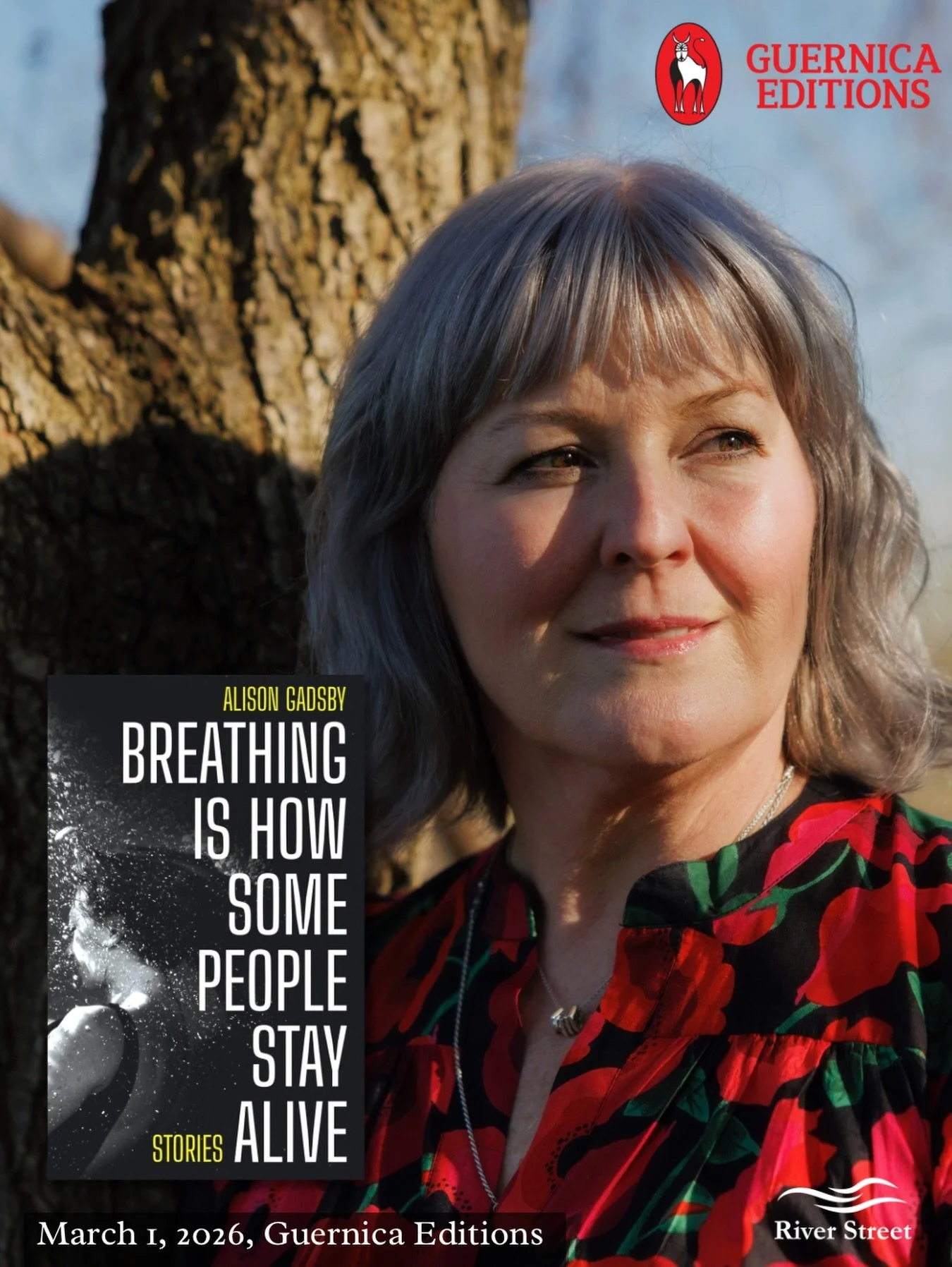
Breathing Is How Some People Stay Alive blurs the lines between horror, catastrophic speculative fiction, and psychological realism in a collection that might best be described as weird fiction. These connected stories offer dark reconstructions of lives brimming with desperate loneliness. They allow us to bear witness to the life-altering love of sisters, brothers, mothers… the life-altering love that buoys them as they struggle to stay afloat in the wake of childhoods they merely survived.
Alison Gadsby writes in Tkaronto/Toronto where she lives in a multigenerational home that includes several dogs. Her writing has appeared in various literary journals, including Blank Spaces, The Temz Review, The Ex-Puritan, Blue Lake Review and more. She is the founder/host of Junction Reads, a prose reading series.

Power Q & A with Caitlin Galway
The longer form definitely comes naturally to me, though it’s not something I set out to do, so much as a reflection of how I think. I’ve learned to see my own intuitive approaches more clearly, and how to amplify or deconstruct them, challenge or upend them. Something particular that I’ve realized is that as I write, everything is somewhat of a spiderweb; ideas emerge connected to several other ideas, which connect to one layer, then another, and so on. It’s part of what feeds me electricity as a writer: this instantaneous, sparking interaction between narrative, symbolism, philosophy, psychological and emotional interiority, history, and commentary, and I find that it means the story will probably need more breathing room.

Q: Your short fiction collection, A Song for Wildcats (Dundurn Press, 2025), is remarkable in many regards: it has lilting, poetic language, haunting and gorgeous imagery, and—what we want to ask you about today—an unusual structure. Your book is made up of five longer stories, as opposed to many shorter ones. Would you tell us about writing longer form short fiction?
A: The longer form definitely comes naturally to me, though it’s not something I set out to do, so much as a reflection of how I think. I’ve learned to see my own intuitive approaches more clearly, and how to amplify or deconstruct them, challenge or upend them. Something particular that I’ve realized is that as I write, everything is somewhat of a spiderweb; ideas emerge connected to several other ideas, which connect to one layer, then another, and so on. It’s part of what feeds me electricity as a writer: this instantaneous, sparking interaction between narrative, symbolism, philosophy, psychological and emotional interiority, history, and commentary, and I find that it means the story will probably need more breathing room.
“The Lyrebird’s Bell”, for example, on a narrative level is a story about two young girls and the absorbing, even disturbing bond they form in response to isolation and familial abuse. There’s a prominent layer exploring the complexities of human relationships, and another navigating grief, trauma, and the impulse to retain some shred of love. However, it’s also a story about essentialism, and how metaphysical reflection might manifest in the mind of a child desperate to make sense of the inexplicable. It’s also about imagination, both as joy and necessity, and why it’s so often steeped in myth.
Those layers need to engage with one another thoughtfully and meaningfully, and as a result, I usually feel a certain elasticity to a story. It keeps lengthening because it demands more space to explore itself, and for me, it’s a matter of being receptive and listening.
More about A Song for Wildcats:
Infatuation and violence grow between two girls in the enchanting wilderness of postwar Australia as they spin disturbing fantasies to escape their families. Two young men in the midst of the 1968 French student revolts navigate — and at times resist — the philosophical and emotional nature of love. An orphaned boy and his estranged aunt are thrown together on a quiet peninsula at the height of the Troubles in Ireland, where their deeply rooted fear attracts the attention of shape-shifting phantoms of war.
The five long-form stories in A Song for Wildcats are uncanny portraits of grief and resilience and are imbued with unique beauty, insight, and resonance from one of the country's most exciting authors.

About Caitlin Galway:
Caitlin Galway is the author of the novel Bonavere Howl and the forthcoming short story collection A Song for Wildcats. Her work has appeared in Best Canadian Stories 2025, EVENT, Gloria Vanderbilt's Carter V. Cooper Anthology, House of Anansi's The Broken Social Scene Story Project (selected by Feist), The Ex-Puritan as the 2020 Morton Prize winner (selected by Pasha Malla), Riddle Fence as the 2011 Short Fiction Contest winner, and on CBC Books as the Stranger than Fiction Prize winner (selected by Heather O'Neill).

Power Q & A with Catherine Bush
Like many writers, I started out writing stories but very quickly discovered that a story I cared about deeply was trying to be a novel, so I plunged headlong into long-form fiction and never looked back. That unwieldy story became my first novel, Minus Time. I felt like the novel was my natural breath as a writer. A few years ago, I became intrigued by the wild and meaningful compression of flash fiction – the opposite of a novel. I started writing stories again more intently during the pandemic at a time when I felt exhausted and unable to start a new novel.

Q: How has writing this collection of short stories, Skin (Gooselane Editions, 2025) been different than writing a novel? And how has your publishing experience been different if it has?
A: Like many writers, I started out writing stories but very quickly discovered that a story I cared about deeply was trying to be a novel, so I plunged headlong into long-form fiction and never looked back. That unwieldy story became my first novel, Minus Time. I felt like the novel was my natural breath as a writer. A few years ago, I became intrigued by the wild and meaningful compression of flash fiction – the opposite of a novel. I started writing stories again more intently during the pandemic at a time when I felt exhausted and unable to start a new novel. Writing stories allowed me to enter other worlds on compressed timelines, to play, try out new things, seek pleasure at a time when pleasure was hard to find. I love the challenge of bringing a complex world to life in no more than a few pages. I love aiming for unpredictability in the story form, unusual intimacy, the swerve. The short arc rather than the long one. One of the perhaps unorthodox qualities of my collection is that it assembles stories of truly varied lengths, from flash to novella and those in between. A few of the stories, such as The International Headache Conference, about a woman who has an intense hook-up-type encounter with another migraine sufferer, or Voices Over Water, which draws on stories told to me by my father and grandfather, are older, re-edited for the collection. Benevolence, the long story that opens the collection, takes an idea that I began to explore years ago and totally re-imagines it. The title story, about a woman obsessed with foot washing, and Derecho, in which a man finds himself strangely attracted to extreme winds, are two of the newer stories. Because the stories were conceived over a long span of time I think of them as kind of a fictional autobiography (emphasis on fiction!).
My editor, André Alexis, was the person who said that he thought I should turn the stories into a collection and as I revised them, we both gave a lot of thought about how to order the stories to create a meaningful journey for the reader and, ultimately, a sense of a whole. Honestly, I think that the taxonomic distinction between novels and stories is a bit of a false one: novels come in all sorts of forms and lengths, as do stories. Whatever fiction you’re trying to create, it needs to find its necessary length – and breath!
More about Skin:
Now, for the first time, a blistering book of short fiction from one of Canada’s most loved novelists.
In Skin, Catherine Bush plunges into the vortex of all that shapes us. Summoning relationships between the human and more-than-human, she explores a world where touch and intimacy are both desirable and fraught.
Ranging from the realistic to the speculative, Bush’s stories tackle the condition of our restless, unruly world amidst the tumult of viruses, climate change, and ecological crises. Here, she brings to life unusual and perplexing intimacies: a man falls in love with the wind; a substitute teacher’s behaviour with a student brings unforeseen risks; a woman becomes fixated on offering foot washes to strangers.
Bold, vital, and unmistakably of the moment, Skin gives a charged and animating voice to the question of how we face the world and how, in the process, we discover tenderness and allow ourselves to be transformed.

About Catherine Bush:
Catherine Bush is the author of five novels. Her work has been critically acclaimed, published internationally, and shortlisted for numerous awards. Her most recent novel, Blaze Island, was a Globe and Mail and Writers’ Trust of Canada Best Book of the Year, and the Hamilton Reads 2021 Selection. Her other novels include the Canada Reads longlisted Accusation; the Trillium Award shortlisted Claire's Head; the national bestselling The Rules of Engagement, which was also named a New York Times Notable Book and a L.A. Times Best Book of the Year; and Minus Time, shortlisted for the City of Toronto Book Award. The recipient of numerous fellowships, Bush has been Writer-in-Residence/Landhaus Fellow at the Rachel Carson Centre for Environment and Society in Munich and a Fiction Meets Science Fellow at the HWK in Delmenhorst, Germany. An Associate Professor of Creative Writing at the University of Guelph, she lives in Toronto and in an old schoolhouse in Eastern Ontario.

Special Mother's Day excerpt from Widow Fantasies by Hollay Ghadery
River Street’s Founder Hollay Ghadery is an award-winning author as well as a mother of four humans and a multitude of furred and feathered bairn. As a special Mother’s Day gift to all, she’s agreed to share one of the most beloved stories from her short fiction collection, Widow Fantasies, which was released in 2024 with Gordon Hill Press.
As many critics have noted, in Hollay’s stories, there is a chorus of voices that sing to the multiple ways people can be women and mothers…or not. This inclusive and rangy mosiac has made Widow Fantasies a must-read for short fiction lovers, and we are proud to say, has introduced many members of our community to the wonderful world of flash fiction.
River Street’s Founder Hollay Ghadery is an award-winning author as well as a mother of four humans and a multitude of furred and feathered bairn. As a special Mother’s Day gift to all, she’s agreed to share one of the most beloved stories from her short fiction collection, Widow Fantasies, which was released in 2024 with Gordon Hill Press.
As many critics have noted, in Hollay’s stories, there is a chorus of voices that sing to the multiple ways people can be women and mothers…or not. This inclusive and rangy mosiac has made Widow Fantasies a must-read for short fiction lovers, and we are proud to say, has introduced many members of our community to the wonderful world of flash fiction.
Keep reading for Hollay’s story, “Jaws”.

Widow Fantasies by Hollay Ghadery, published by Gordon Hill Press.
jaws
What if the other fish don’t like her? That was my first thought, and it’s not as silly as it sounds. One never stops being a mother and Jaws was too sweet for her own good. Always had been. Originally, Jaws was one of two goldfish we brought home from the Nowruz bazaar seven years ago, and the other fish—a nasty, mottled thing of white and black—had pecked and picked on Jaws mercilessly. But we found the bully floating wide-eyed and belly up before the final new year celebration on Sizdah Bedar.
Thanks to God.
My second thought was that I would never speak to Reza again. Son of a dog, I told him I liked her in the house with me. But I leave for a day to get Keyvan settled in his dorm and he dumps Jaws in our pond.
What kind of life was that for a fish? Reza stabbed his finger toward the pond, spit flying from his mouth. Stuck in a tank in a house with you all day?
Goldfish aren’t as stupid as people.
Or as people think.
By our second year together, Jaws would eat her flakes right from my fingers. She’d respond to her dinner bell, bobbing excitedly when I rang it at mealtimes.
Whenever I walked by her tank, she’d swim out from behind the screen of her silk plants and follow me back and forth as I dusted and vacuumed and folded laundry. I tried to show Reza how incredible it was—she knew my face—but he only complained the tank was beginning to stink and didn’t I have anything better to do with my time? We should have had more children, he’d say.
1
Keyvan used to be amazed by her tricks until he wasn’t. She doesn’t know you, Mom. She probably can’t even see you. You’re just a blob or shadow or something.
When Reza’s mistress died last year, Jaws was the only one I let see me cry. She understood: it was my loss as much as his. The woman had been oxygen to our little bowl of stagnant water. She’d given me room to breathe.
Now light from shattered glass ricochets skyward from the driveway. A few minutes after I’d heaved the empty tank at Reza’s head, I heard the pop of gravel under his tires as he shot out onto the road. Good riddance to him. I was sorry about the tank though. I hadn’t been thinking.
I lower myself to the grass beside the pond. The cherry blossom tree is alive with bees and soft pink petals freckle the water’s surface. Jaws must be hidden somewhere in the weeds. I see a few of the black moors, the flash of a white and yellow fish, but no sign of Jaws’ telltale Tiger Lily scales. A fern green, three-legged frog sits like a mound of melting butter on a lily pad. He croaks a sonic, deep belch.
Do frogs eat goldfish?
There are at least half a dozen other fish in our decorative pond, but other than plugging in the de-icer every winter, I’ve never thought much about them. They were here when we bought the property and existed fine without my intervention. Even when a green heron began hunting around the water, baiting its surface with twigs and insects, I hadn’t worried. I stood at the living room window and watched, describing the scene to Jaws. She stared at me with her unblinking copper eyes and agreed: life was much better inside.
I put my hand in the pond water and splash a little. “Mahi koochik? Are you there?”
The three-legged frog belches again and leaps into the water. I splash some more, stirring up algae so the pond’s surface becomes opaque.
I think of all the time I spent by the pond with Keyvan when he was a child, watching larvae and tadpoles grow. How did I never think to check if the frogs were eating the goldfish?
I get up and run. Bursting into the house, I find the dinner bell where I left it: on the table where her tank used to be. I’m ringing the bell before I’m even back out the door. “Jaws, bia! Come!”
I continue to ring desperately until two unmistakable orange nares poke through the scum. I scoop her into overflowing palmfuls of water and we greet each other, gasping.
Excerpt from Widow Fantasies by Hollay Ghadery © 2024 by Hollay Ghadery. Published by Gordon Hill Press.
More about Widow Fantasies:
Fantasies are places we briefly visit; we can’t live there. The stories in Widow Fantasies deftly explore the subjugation of women through the often subversive act of fantasizing. From a variety of perspectives, through a symphony of voices, Widow Fantasies immerses the reader in the domestic rural gothic, offering up unforgettable stories from the shadowed lives of girls and women.
"Every story in this book feels like jumping into a lake, like the flare of heat in your throat after a shot, like missing a step on the way down the stairs at night. These are works all the more powerful for their brevity. Hollay Ghadery’s book, in short, has made me a convert to the flash fiction genre." Jade Wallace, for The Miramichi Reader

Hollay and her beautiful brood.
Hollay Ghadery is an award-winning Iranian-Canadian multi-genre writer living in rural Ontario on Anishinaabe land. Fuse, her acclaimed memoir of mixed-race identity and mental illness, was published by Guernica Editions’ MiroLand imprint in 2021 and won the 2023 Canadian Bookclub Award for Nonfiction/Memoir. Her debut collection of poetry, Rebellion Box, was released with Radiant Press in April 2023. Hollay's short-fiction collection, Widow Fantasies, came out with Gordon Hill Press in 2024. Hollay is a board member of the League of Canadian Poets, the co-chair of the League's BIPOC committee, as well as the Poet Laureate of the region in which she lives, and a Poetry, Canadian Studies, and Literature podcast host on The New Books Network. Hollay is also a host of HOWL—the literary arts show—on 89.5 CIUT FM, a member of The Writers Union of Canada, the Creative Nonfiction Collective, and the National Book Critics Circle.

Power Q & A with Sharon Berg
May is National Short Story Month and we’re kicking it off with a brief and salient interview with award-winning multi-genre writer Sharon Berg, author of many books, including the short fiction collection, Naming the Shadows (Porcupine’s Quill 2019). Never one to shy away from tough conversations, we ask Sharon about writing difficult subjects as a necessary part of the responsibility we bear for one another.
May is National Short Story Month and we’re kicking it off with a brief and salient interview with award-winning multi-genre writer Sharon Berg, author of many books, including the short fiction collection, Naming the Shadows (Porcupine’s Quill 2019). Never one to shy away from tough conversations, we ask Sharon about writing difficult subjects as a necessary part of the responsibility we bear for one another.
Thank you to Sharon for joining us, and for your thoughtful response to our question. Keep reading.

Naming the Shadows by Sharon Berg (Porcupine’s Quill 2019).
Q: We are interested in your advice for writers who want to deal with difficult topics like violence against children, and how to do this with honesty while still being sensitive to readers. We are not readers who feel like we should be spared violence to save our own fragile sense of safety. We never think we should turn from the humanity of others.
A: Yes, I’m dealing with violence against children and young women in my stories and poetry all the time! If people hadn't turned away from the horrible things being done to me as a child or young woman, and if several agencies hadn’t failed me or my children, our lives would have turned out a whole lot differently. A big part of that is the laws protecting children need to be stronger, and the agencies claiming to safeguard them have to be more honest about what they will or cannot [read that as do not] do for them. Andrea Munro’s case against the husband of her mother points this out as she was failed by so many people and agencies in dealing with her trauma. Everyone is quick to point to Alice Munro’s failings but they don’t address the basic fact that neither her father or the several agencies involved truly addressed her pain.
There can be no denial that our laws need to change. When my daughter was sexually abused as a four-year-old by a neighbour in 1979, I was told by a policeman who said he 100% believed her, no child could testify against an adult. He suggested I try to catch him in the act next time. Absurd. I moved within two weeks. But I can tell you nothing is different in 2025 and that is beyond ridiculous. We have a duty as individuals living in a democracy such as Canada... to protect children and each other... or our house is built on a pile of lies.
I can’t be convinced people don’t have a responsibility to each other when we live in community. That’s the definition of community in my eyes. Refusing to review our legal response and neighbourly alert systems to the various trauma suffered by children says we deny our reality. I believe, as a writer, I have a duty. Fiction and poetry can and has addressed the unwilling observor and pulled them into action. Stories can speak to the heart, convincing us through artful writing, to address the trauma suffered by others. What I’m addressing in my stories is mainly the daily skirmishes being fought in our country and others around the world, the hidden casualties of an on-going war with paternalism and criminal mindset. That sort of war is just as important as any other. It gives criminals an arena to practice in. We need to stand on guard for all of those daily victims.
I truly believe I’m broadening people’s awareness through my writing or I wouldn’t bother. As Margaret Atwood has said, nothing I write about hasn’t happened, and I’d lay dollars to donuts the same is true for Alice Munro and Margaret Laurence. For my own female characters, I’d say nothing I write about hasn’t happened to me or a dearly loved one. Who can argue with the truth? I can’t speak for other authors, but I just add some literary devices and stir.
More about Naming the Shadows (Porcupine’s Quill 2019):
Sharon Berg’s quietly insightful collection focuses on relationships between generations, acknowledging the prevalence of the shadows that are everywhere—but also celebrating the light.
The stories in Naming the Shadows are touched with humour and outrage, mystery and shadow. Curious preteens receive an unexpected education at a mall-side carnival show. A lonely dairy farmer develops a special bond with his neighbours’ children, then suffers unexpected consequences. An ageing author manages to get one up on her adversarial interviewer, while another woman’s unsettling way of remembering past lovers confirms her emotional freedom.
In these stories of loss and learning, conflict and memory run through generations, innocence gives way to experience, and all must learn to redefine themselves and the way they see the world.

Author Sharon Berg. Photo credit: Cathi Carr.
More About Sharon Berg:
Sharon Berg’s work appears in Canada, USA, Mexico, England, Wales, Amsterdam, Germany, India, Singapore, and Australia. Her poetry includes To a Young Horse (Borealis 1979), The Body Labyrinth (Coach House 1984), three poetry chapbooks (2006, 2016, 2017), plus Stars in the Junkyard (Cyberwit 2020) was a 2022 International Book Award Finalist. Her short story collection is Naming the Shadows (Porcupine’s Quill 2019). The Name Unspoken: Wandering Spirit Survival School (BPR Press 2019) won a 2020 IPPY Award for Regional Nonfiction. She’s Resident Interviewer for The tEmz Review (London, ON, Canada) and operates Oceanview Writers Retreat out of Charlottetown, Newfoundland, Canada.

Excerpt from On Beauty by rob mclennan
Upon the death of her widower father, there came the matter of dismantling his possessions. Emptying and cleaning the house for resale. It wasn’t as though either of the children were planning on returning to the homestead, both some twenty years removed, but it fell to them to pick apart the entirety of their parents’ lives from out of this multi-level wooden frame, a structure originally erected by their grandfather and great-grandfather immediately following the Great War.
On beauty
Upon the death of her widower father, there came the matter of dismantling his possessions. Emptying and cleaning the house for resale. It wasn’t as though either of the children were planning on returning to the homestead, both some twenty years removed, but it fell to them to pick apart the entirety of their parents’ lives from out of this multi-level wooden frame, a structure originally erected by their grandfather and great-grandfather immediately following the Great War. Theirs was the first house in the area, constructed on seventy-five acres of farmland, long since disappeared to development. Across the street, a smaller house of similar design and build, where the hired man and his family had lived. Where, originally, their widowed great-grandmother spent her final days, sixteen long years past the death of her husband.
The house was a local oddity, an obvious construction decades before the brown brick and stone-grey on either side, and contemporary infills. Where the neighbouring bungalow was once their back garden; another, where livestock spent fallow days. Where most likely a barn stood, then a shed, which now hold driveway and garage. Foundation maintenance that routinely uncovers the roots of an orchard. The difficulty of inground pools, and the puncture of linings.
Their father’s house: now that he was dead, it was though it had died as well. They had no choice but to bury it. Not a word. Silence. My wife and her sister, dismantling what would never exist again, and by dismantling, removing it from all but their memory. This, too, will fade.
—”On beauty” from On Beauty by rob mclennan. Published by University of Alberta Press. © 2024 by rob mclennan.

On Beauty (stories) by rob mclennan, published by University of Alberta Press.
About On Beauty:
The thirty-two stories in On Beauty exist as lyrically dense bursts of short prose that move across wide swaths of narrative in compact spaces, offering explorations of characters working through small or large moments. The stories include parenting, pregnancy, the death of a parent, complications between friends, spouses, etcetera. These stories, in their own ways, explore moments as potential sequence, and how each of those moments might impact each other. To ask where, when, how or who: the “why” is the story; all else are facts.

rob mclennan (Photo credit: Amanda Earl).
About rob mclennan:
Born in Ottawa (Canada’s glorious capital city) and raised on a farm near Maxville, Ontario, rob mclennan lives in Ottawa, where he is home full-time with the two wee girls he shares with Christine McNair. The author of more than thirty trade books of poetry, fiction and non-fiction, he won the John Newlove Poetry Award in 2010, the Council for the Arts in Ottawa Mid-Career Award in 2014, and was longlisted for the CBC Poetry Prize in 2012 and 2017. With recent titles including World’s End, (ARP Books, 2023), essays in the face of uncertainties (Mansfield Press, 2022) and the anthology groundworks: the best of the third decade of above/ground press 2013-2023 (Invisible Publishing, 2023), On Beauty: stories (University of Alberta Press, 2024) is his fourth work of fiction, after the novels white (The Mercury Press, 2007) and Missing Persons (The Mercury Press, 2009), and The Uncertainty Principle: stories, (Chaudiere Books, 2014). An editor and publisher, he runs above/ground press, periodicities: a journal of poetry and poetics and Touch the Donkey [a small poetry journal], and co-founded the ottawa small press book fair in fall 1994, which he’s run twice a year on his own since, The Artistic Director of VERSeFest: Ottawa’s International Poetry Festival, he spent the 2007-8 academic year in Edmonton as writer-in-residence at the University of Alberta, and regularly posts reviews, essays, interviews and other notices at robmclennan.blogspot.com

Jewish Heritage Month Feature: Excerpt from Rubble Children by Aaron Kreuter
May is Jewish Heritage Month, and we are delighted to host an excerpt from Rubble Children (University of Alberta Press, July 2024)—new short fiction from Govenor General Award Finalist Aaron Kreuter.
Rubble Children is an absorbingly timely and necessarily explorative read, tackling Jewish belonging, settler colonialism, Zionism and anti-Zionism, love requited and unrequited, and cannabis culture, all drenched in suburban wonder and dread. Engaging, funny, dark, surprising, this collection is a scream of Jewish rage, a smoky exhalation of Jewish joy, a vivid dream of better worlds.
May is Jewish Heritage Month, and we are delighted to host an excerpt from Rubble Children (University of Alberta Press, July 2024)—new short fiction from Govenor General Award Finalist Aaron Kreuter.
Rubble Children is an absorbingly timely and necessarily explorative read, tackling Jewish belonging, settler colonialism, Zionism and anti-Zionism, love requited and unrequited, and cannabis culture, all drenched in suburban wonder and dread. Engaging, funny, dark, surprising, this collection is a scream of Jewish rage, a smoky exhalation of Jewish joy, a vivid dream of better worlds.
"What if the worldview you were raised in turns out to be monstrous? In the stories that form Rubble Children, Aaron Kreuter examines a Jewish community in flux, caught between its historical fealty to Israel and a growing awakening and resistance to it. Rubble Children is a book of great range: at once political, communitarian, empathetic, funny, revolutionary, touching, and hopeful. This is a work that is essential for our moment."
—Saeed Teebi, author of Her First Palestinian
The passage we are sharing below is from "Mourning Rituals," the first story in the collection, which takes place during the shiva for Joshua and Tamara's father.

Bring home Rubble Children by Aaron Kreuter.
From “MOURNING Rituals”, Rubble Children
That evening, the adults praying in the living room, facing east, worn blue prayer books brought from Kol B’Seder in their hands, bending and calling out, Joshua and Tamara sat with their cousins in the family room in half-tense silence. Simon in his Israeli Defense Forces uniform, Clarissa, her hair in a high bun, sweatpants tucked into woollies snug in Uggs, bent over her phone, thumbs dancing. Shelly, cuddling with Andre, her new boyfriend; he looked lost, out-of-place, the Hebrew rising and falling from the front of the house registering on his face as alien, off-putting cacophony.
Joshua was staring at the rug, the day’s bottomless allotment of grief having finally tipped his meager watercraft. Simon was looking around the house with detached, distant arrogance. His head was smooth, his skin tanned deep brown, his cheek shaven by naked blade. He’d made aliyah two years ago. Tamara was staring at him, her face souring with each passing minute.
She bent over to Joshua.
“It looks like Simon’s itching to pick a fight,” she said into his ear.
“Hmm...”
“He’s holding his babka like a semi-automatic.”
“He probably just misses his gun.”
“He’d rather be with his unit, riding a tank through the desert at dawn, trashing the house of a Palestinian family because the father looked at him funny.”
“Tamara, not now.”
“...I might just oblige him.”
Simon must have known they were talking about him.
“Sorry for your loss,” he said to them from across the room, the first thing he’d said to them since arriving. Tamara smiled sarcastically.
“How’s Panem?” she shot at him. “Get out to the districts much?”
Simon looked startled. “Pardon?” he said. He was affecting a slight Hebrew accent.
“Tamara!” Shelly shouted. Tamara looked at everyone in turn, the flourishes of prayer fluttering through the house. She was in her element.
“What?” she said, feigning innocence. “What? He chose to go over there and play-act as a colonialist, comes here to this house of mourning dressed in his uniform, and we’re supposed to sit here smiling like idiots?”
Now it was Joshua’s turn to put a hand on Tamara’s shoulder, to push pause on the coming confrontation. She shrugged it off but didn’t continue. It was too late, though: the flood gates were open.
Simon smiled. “What, you don’t approve of my joining the army or something? Shit, my dad’s right about you: you’re too far gone to the left to even see reality. I know your dad just died, and, like I said, I’m sorry about that, but do I really have to tell you that if we weren’t keeping the Arab hordes at bay your little North American hippie-dippie pacifist hacker existence would become ancient news?” Simon turned to Joshua now, who was trying not to look at anyone, trying to not get involved. “I hope you haven’t followed your sister to the dark side, Joshua. Especially you.”
He had no choice but to look at Simon. “What’s that supposed to mean?”
“You know what it means. Israel is the only country in the whole Middle East where you wouldn’t be stoned to death for your, for your…lifestyle.”
Joshua laughed, to himself, like he had had a private revelation. Tamara, though, Tamara’s mouth was agape. She was gathering her wits for a full-frontal assault, but Clarissa beat her to it, pivoting from her phone for the first time since she arrived.
“You know, Simon. I wasn’t going to say anything because I was raised better, but you’ve really become an asshole. And, I’m sorry, I’ve got to say it: why is joining the Israeli army, like, given a pass? You know how our parents would react if one of us joined the Canadian army? The Canadian army is for people from Saskatchewan! And the American army, oh, you’re a misguided, bloodthirsty imperialist! But the Israeli army! Ooooh, the Israeli army! Why, then, you’re fighting for the Jewish nation! You’re a hero! You’re rewriting the history of a blighted people! How does it not, like, ring terribly false? Hero! What total horseshit!”
Everybody was silent, stunned, in the wake of Clarissa’s outburst. Later, Joshua would tell Tamara how surprised he was that Clarissa had thoughts or feelings like that. “The last serious conversation we had was five years ago, when we debated which Backstreet Boy we’d rather went down on us.”
Somebody hiccupped and all eyes turned to Shelly. She was crying. Andre was stiff beside her, stuck between wanting to comfort his girlfriend and wanting to get out of this house of strange Jewish customs and head-on battles. Feeling the attention, Shelly looked up. “How could you say those things, Clarissa? And during my Aba’s shiva! Don’t act like you don’t remember how proud he was of Simon when he made aliyah! He is a hero, out there all alone protecting the homeland!” She jumped up and ran to her room, her feet stomping on the stairs echoing through the house.
Tamara and Joshua looked at each other. Andre looked like he had just found out that his father had died. Simon swept a triumphant scowl across the room, stood, smoothed his uniform, and went up the stairs after Shelly, not making a sound as he ascended. Clarissa shrugged, went back to her phone. The steady chatter that rose from the other room and permeated the house meant one thing: the prayers were finished. Soon the house would empty out, and, tomorrow, it would start all over again, the pattern repeating for four more days and then—just like that—ceasing, leaving the mourners alone with their grief, with nothing but time to do what it will.

More about Aaron Kreuter:
Aaron Kreuter's most recent poetry collection, Shifting Baseline Syndrome, was a finalist for the 2022 Governor General's Award, and was shortlisted for the 2022 Raymond Souster Award and the 2023 Vine Awards for Jewish Literature. His other books include the poetry collection Arguments for Lawn Chairs, the short story collection You and Me, Belonging, and, from spring 2023, the academic monograph Leaving Other People Alone: Diaspora, Zionism and Palestine in Contemporary Jewish Fiction. Aaron's first novel, Lake Burntshore, is forthcoming from ECW Press. He lives in Toronto, and is an assistant professor at Trent University.