

BLOG
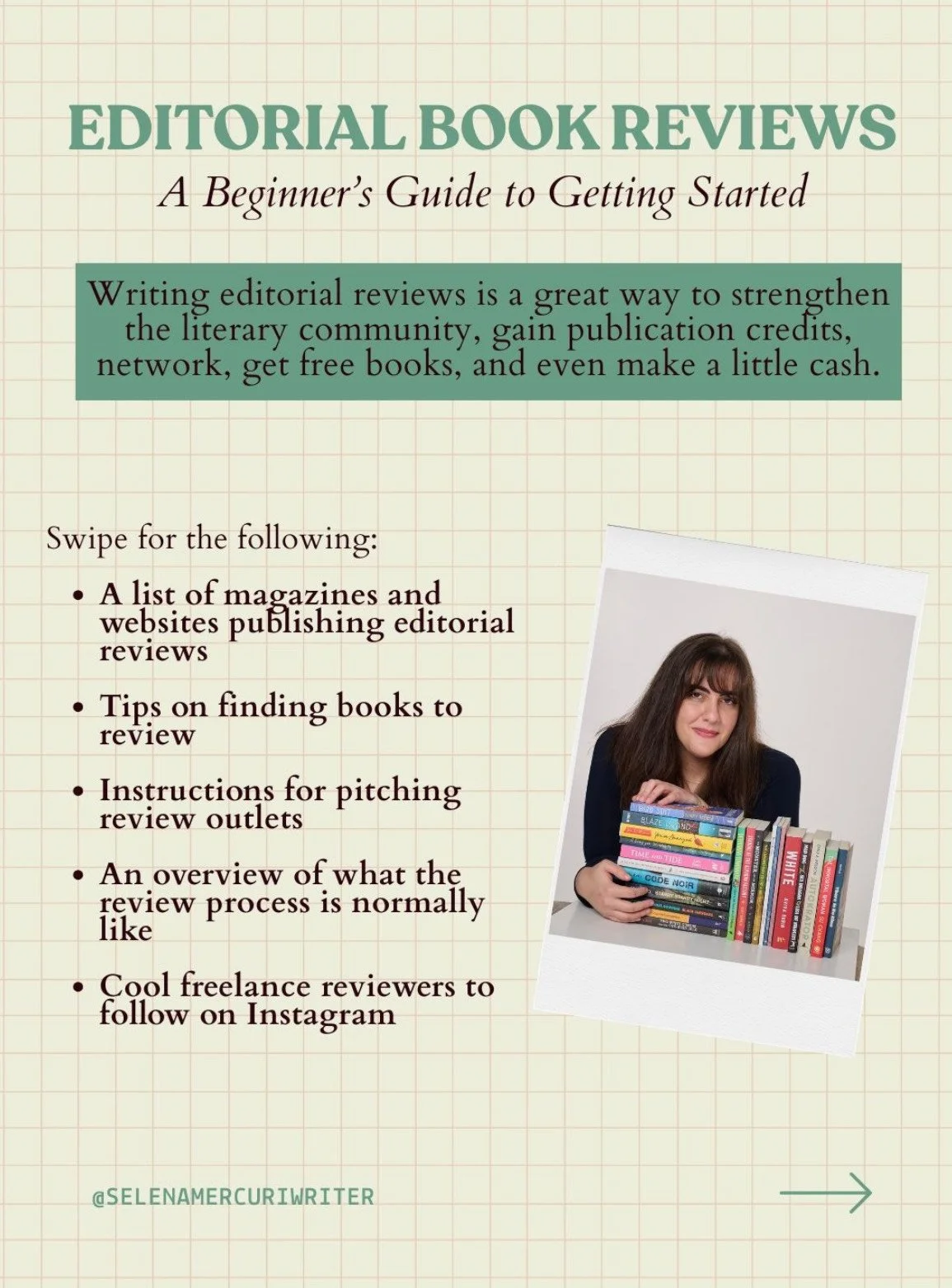
Writing Book Reviews: A Beginners Guide to Getting Started
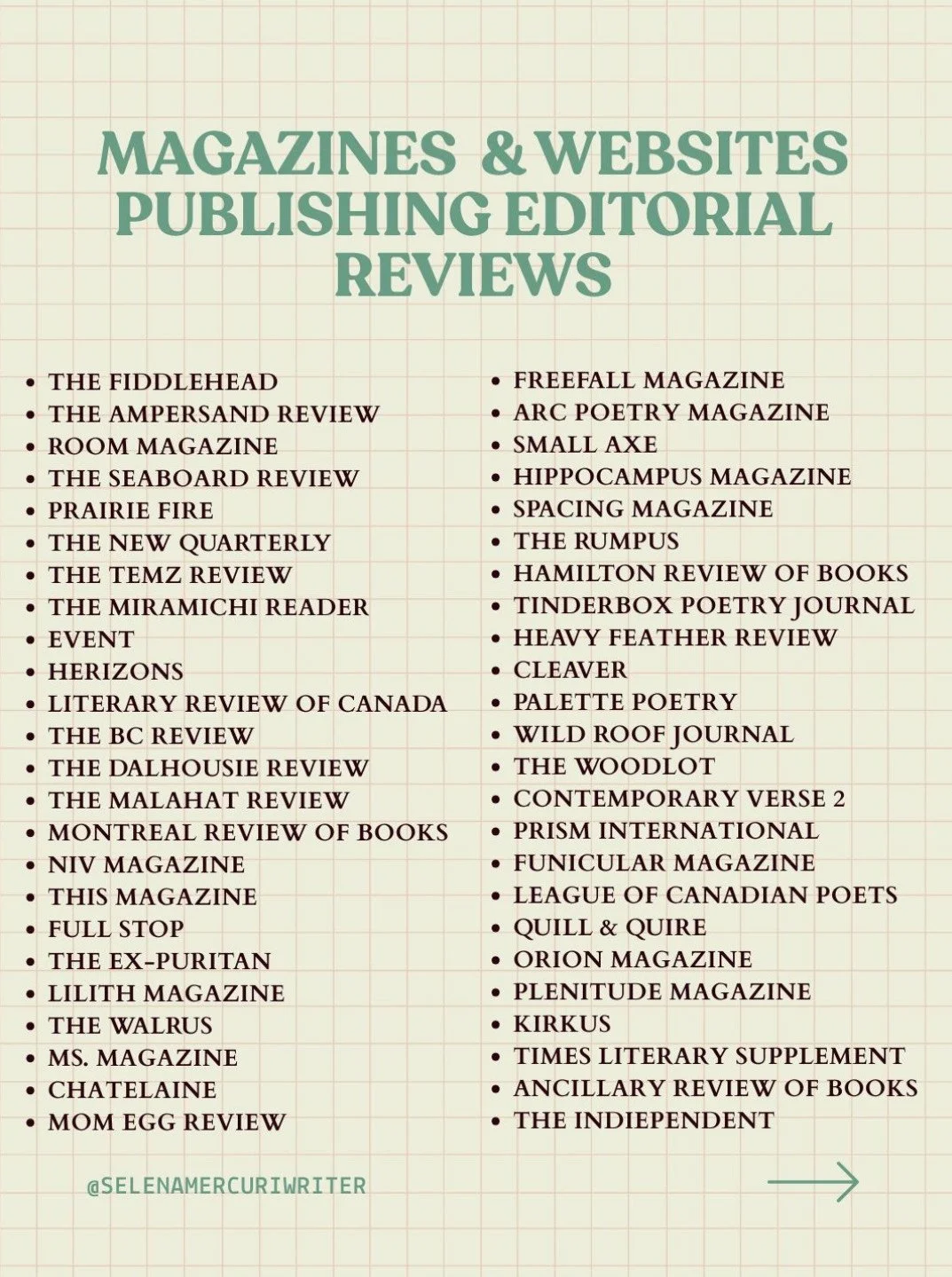
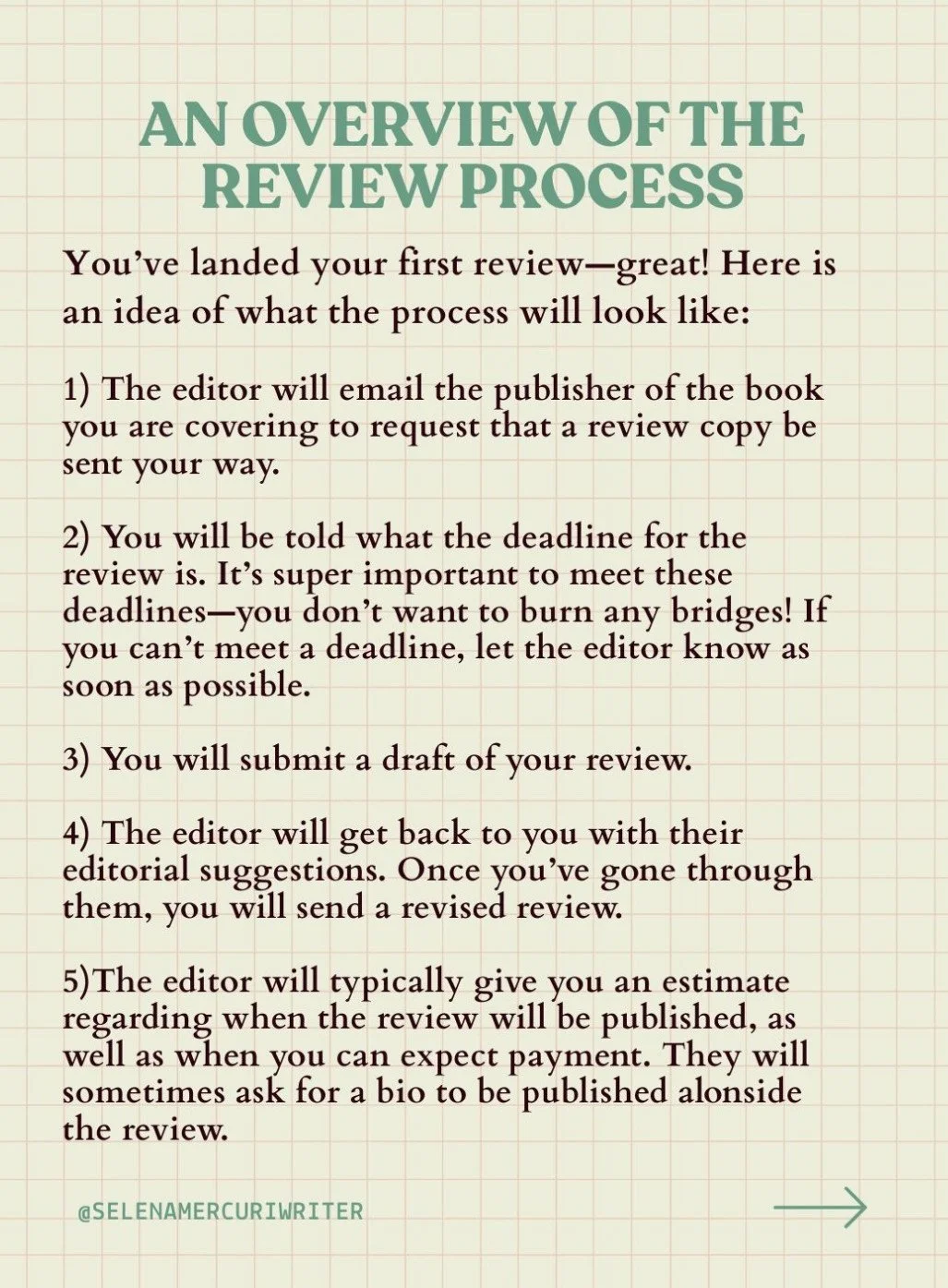
Want to start writing editorial book reviews? This is a great way to strengthen the literary community, gain publication credits, network, get free books, and even make a little cash (usually $25 to $125 per review, although not every outlet offers payment).
Want to start writing editorial book reviews? This is a great way to strengthen the literary community, gain publication credits, network, get free books, and even make a little cash (usually $25 to $125 per review, although not every outlet offers payment).
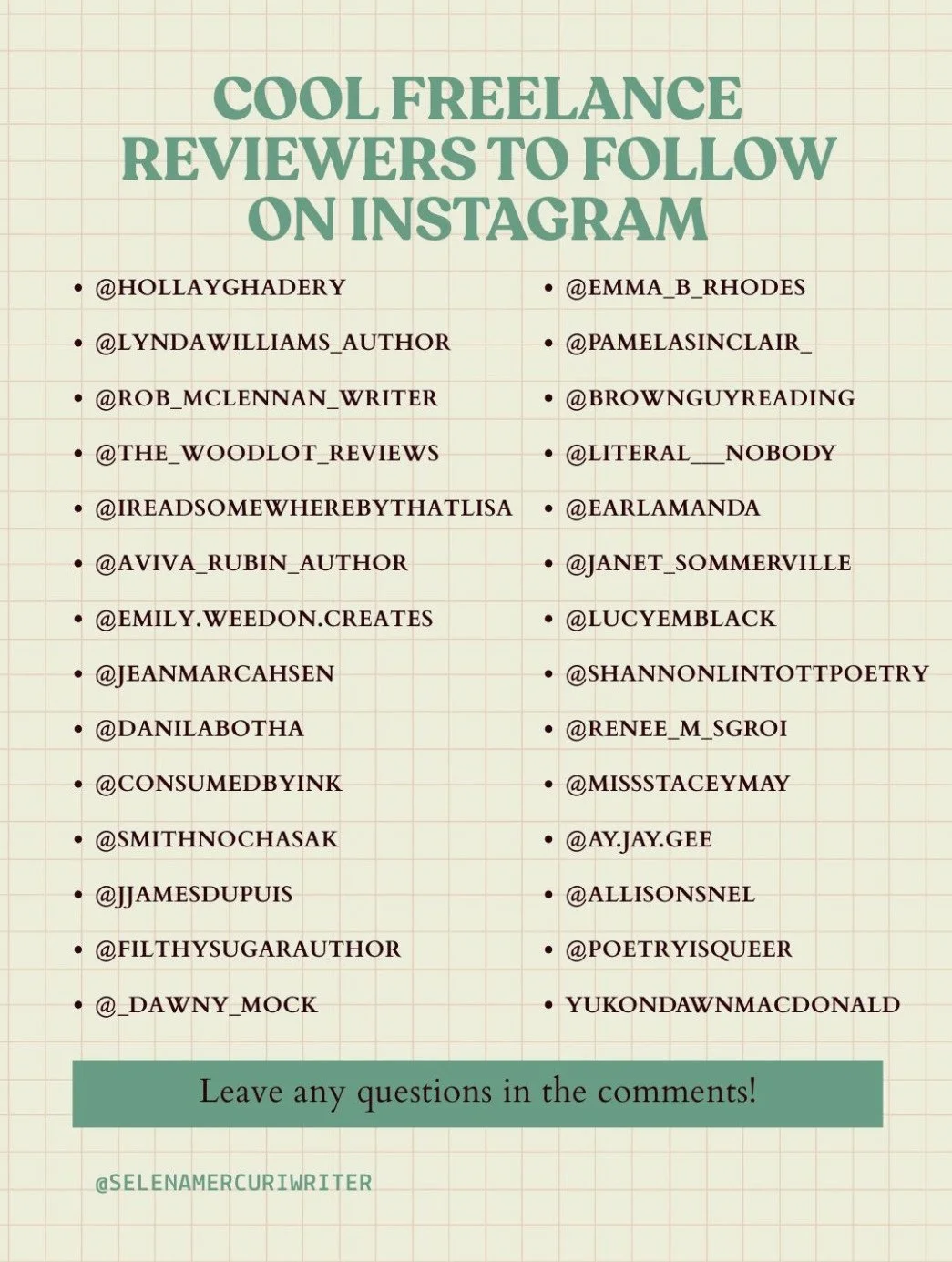
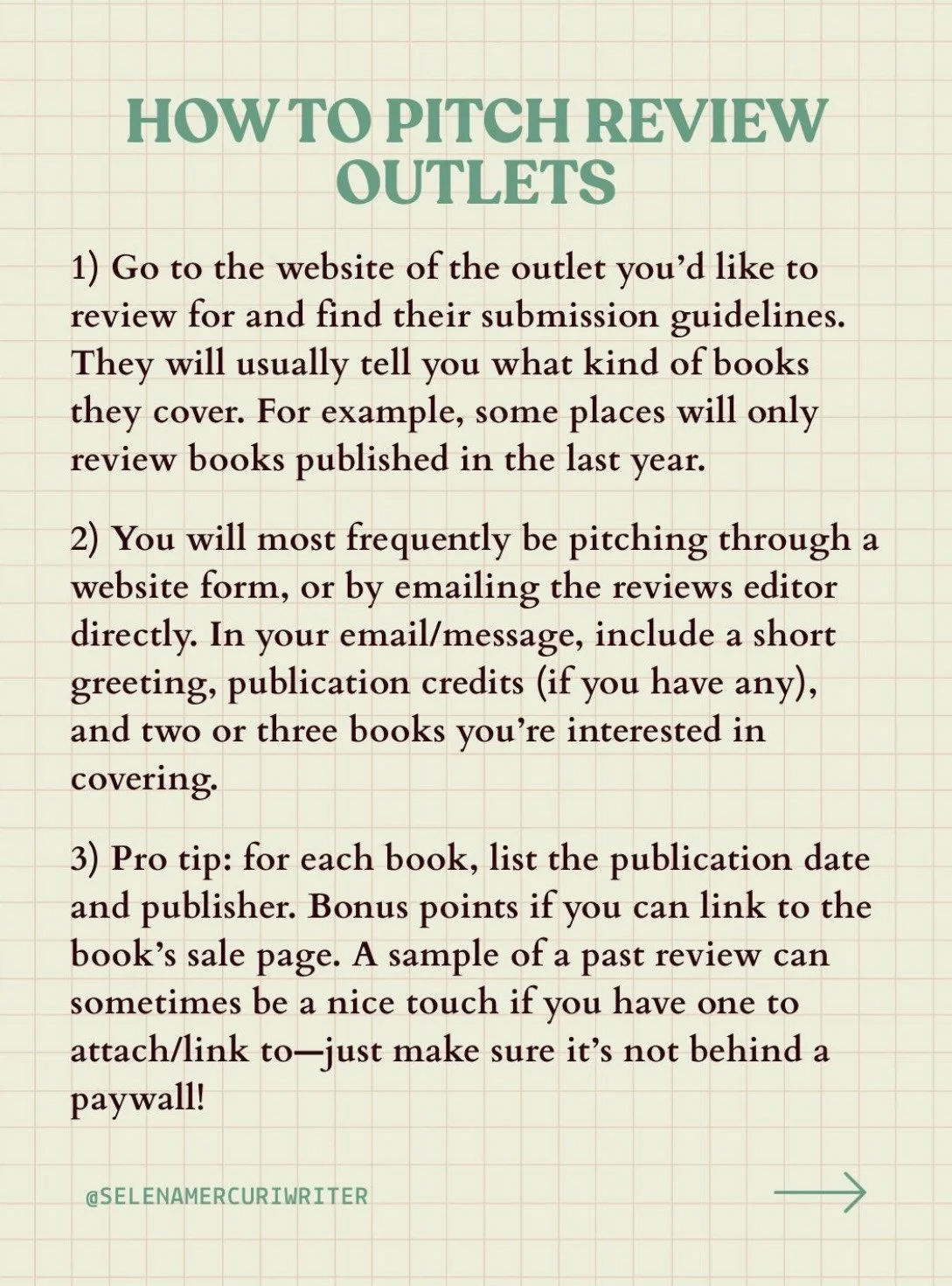
I’ve reviewed dozens of books and now assign reviews as an editor myself. This guide breaks down everything you need to know: where to pitch, how to find books, what the process looks like, and which reviewers to follow for inspiration.

A Workshop Junkie Comes Clean
The last time I attended a writing workshop was in 2014. It was the Tone + Text opera workshop in Vadstena, Sweden at the Vadstena Akademien, a school for opera artists. I was there as a librettist. This was part two of the workshop, which lasted four days, culminating in a showcase of scenes written by librettists who had been paired with composers at part one, also a 4-day affair that took place the previous year.
By: Steven Mayoff
The last time I attended a writing workshop was in 2014. It was the Tone + Text opera workshop in Vadstena, Sweden at the Vadstena Akademien, a school for opera artists. I was there as a librettist. This was part two of the workshop, which lasted four days, culminating in a showcase of scenes written by librettists who had been paired with composers at part one, also a 4-day affair that took place the previous year.
Prior to Tone + Text, I had been attending writing workshops on a fairly regular basis since 2003, at least one, and more often two, a year. With only a couple of exceptions, the majority of these were not merely one-day sessions, but rather fairly intensive week-long workshops. I would describe these as sleepaway camps for writers.
Since those last workshop in Sweden, I have often wondered about this decade of attending writing workshops. I suppose I could have taken a creative writing course at some university, but I doubt it would have been the same. I was in the fortunate position of being able to devote much of my time to writing. The workshops were brief respites from the solitude of my efforts. I was also able to take a variety of workshops that addressed my interest in different forms of writing.
But somewhere along the way, the brief respites became necessary stopgaps.
In 2000, I was still living in Toronto. A playwright friend had suggested that we adapt one of my short stories into a radio play and use it to apply to a radio drama workshop at the CBC. We were accepted into the workshop and developed our rough script into a 10-minute radio play, which aired on CBC the following year, after I had moved to Prince Edward Island. We then wrote a second 10-minute radio play, which aired in 2002. We also attended a second radio drama workshop, this one involving collaborations with composers in Banff, Alberta in 2003. This produced a third 10-minute play, airing that same year.
But the workshop that got me hooked and really started me on my decade-long jag was the Maritime Writing Workshop in 2004 at the University of New Brunswick campus in Fredericton. I didn’t know what to expect and I was nervous. Of the different categories of workshops – poetry, art criticism and fiction – I chose the latter. Along with my application, I had to submit a story that I wanted to work on. I brought a story that I had been sending out to various magazines without much luck. Although in my late 40s, I was still something of an emerging writer with a slowly growing number of literary journal publications under my belt. Perhaps this workshop would illuminate the hidden flaws in this particular story and possibly suggest some helpful tips for getting it into print.
On the first day, after we had registered and been shown to our rooms in the on-campus residence, the writers met with their respective instructors and fellow group members in a brief orientation session that would be followed by an informal meet-and-greet. There were ten of us in total. We sat in a circle, regarding each other warily, as our instructor, the short story writer Richard Cumyn, gamely tried to get us to talk about ourselves. And while everybody seemed nice enough, no shyer or bolder than myself, I started to have doubts about how beneficial this week would be for me.
My fears were quickly dispelled after we broke out of our groups to wander and mingle with each other. I found myself in casual conversation with Richard. He immediately wanted to talk about my story. To my surprise he had a couple of suggestions to improve it. What struck me was the passion he had for writing. It didn’t surprise me to find out he had been a high school teacher. He reminded me of the few good ones I’d had back in the day, the kind that made learning an adventure. Late 40s or not, I suddenly felt the fire in my belly that can shed years off anyone’s psyche. That night in my room I found myself mulling over his advice and happily concocted possible new scenes to write. Things were happening faster than I had expected and I felt pleased.
Even more pleasing was how quickly our group gelled, evident from the first proper session together. A genuine camaraderie seemed to be emerging, not to mention mutual respect for each other’s work. The spirit of constructive criticism was apparent in our assessment of each other’s stories. Unfettered by the fear of hurting a fellow writer’s feelings we always spoke plainly, pointing out flaws, making suggestions, but always with the intention of supporting whoever was in the hot seat.
The suggestions that Richard had made about my story on that first day resulted in me writing two new scenes. I finished first drafts in time for the morning when it was my turn to be in the hot seat. After the group had assessed my story, I read the new scenes to them. I didn’t have that much experience reading to an audience, yet there I was reading these scenes aloud to the group, giving them nuance and point of view, eliciting laughter from my audience. From that moment something in me changed. To say I fell hard for the workshop experience would be a vast understatement when you consider that I went to another week-long workshop only a month later.
That one was with Tapestry New Opera Works in Toronto. The Composer/Librettist Laboratory, or the Lib/Lab for short, was a yearly event. My playwright friend, with whom I’d written the radio plays, had done it, so I thought I’d give it a shot and applied. Although I consider myself primarily a fiction writer, I also write poetry and song lyrics. I had collaborated on a sung-through modernized adaptation of The Picture of Dorian Gray, with a long-time composing partner, so I did have some experience as a librettist, although that was not a requirement to get in the workshop.
The Lib/Lab had four librettists, four composers, two accompanists on piano and six opera-trained singers (three male, three female). There were two instructors, one for the composers and one for the librettists. Librettists and composers were paired together, given a theme, and had to write short scenes, which would then be performed by the singers. It was essentially a series of tag-team matches as, throughout the week, each librettist got to write with each composer and the scenes were performed at the end of each day. There was a certain amount of overlapping, which was nerve-wracking, especially for the composers, but also great fun.
In an attempt to gain some insight as to what drew me to writing workshops, I will look at the years I attended all of the Great Blue Heron Writing Workshops, which took place for one week every summer from 2005 to 2010 at the St Francis Xavier University campus in Antigonish, Nova Scotia. It was there, maybe not so coincidentally, that I first heard the term “workshop junkie” although not pertaining to me specifically. Nevertheless, the term lodged itself in my consciousness and I often wondered if that was what I had become. I still took my interest in going to workshops as a positive sign of my commitment to being a writer and an integral part of my development. I considered my attendance to be part of my ongoing education. There were many things I liked about writing workshops in general and the Great Blue Heron Writing Workshops in particular.
I liked the camaraderie, being with people who were there because of their interest in writing. Some participants, like myself, had published and worked at their writing with serious intent, while others had never written anything before but wanted to improve their ability in expressing themselves on paper or word processor screen. There were many people from other professions, mostly doctors, although once there was a young minister with whom I had some interesting conversations. I remember a psychiatrist who read us an amazing poem about her conflicted feelings when having to commit a patient to an institution.
No matter what brought any of my fellow participants there or their degree of writing experience, I truly felt we were all on a level playing field in wanting to become better writers. While those of us who may have been more accomplished could offer advice to others, I also felt that the so-called neophytes had something to offer as well: an almost innocent sense of wonder that served to remind everyone, or me at any rate, that passion and curiosity, rather than ambition, were at the heart of writing well.
I also liked the instructors and I had some pretty good ones, with whom I felt privileged to study under. Anne Simpson for poetry was one of the GBHWW’s organizers and had won the Griffin Poetry Prize for her collection Loop. Sheldon Currie for screenwriting, even though he was mainly a fiction writer, was best known for his novel The Glace Bay Miner’s Museum, which had been adapted into the film Margaret’s Museum starring Helena Bonham Carter. I also took poetry with Anne Compton, winner of the Governor General’s Award for her collection, Procession. There was Alistair MacLeod, the well-respected writer of short fiction, whose novel No Great Mischief won the Dublin Literary Award. I took fiction workshops with him in 2007 and 2009. In Great Blue Heron’s final year of 2010, I took playwriting with actor, director and playwright Daniel MacIvor, who had won the Siminovitch Prize among many other theatre awards.
It was in that final year that, with teasing affection, I was presented with the Great Blue Heron Writing Workshop’s Extreme Participant Award for returning year after year. The award was a slim folder with brochures from every year of the workshop’s existence. I was touched, even proud, and yet, somewhere in the back of my mind, I questioned what it really said about me. Still, even if there was a silent rebuke in the honour, I accepted it with good humour and what I considered to be a healthy dose of humility.
Looking back, one thing that kept me returning to Great Blue Heron was the noticeable (by me at least) change in my personality. In general, I am a textbook example of an introvert. In groups of two or more I tend to listen rather than speak, unless I have something very specific to contribute. But at the Great Blue Heron, I found myself becoming more outgoing and social. It was a change of personality that I welcomed in myself. Possibly because of the novelty of it. Or possibly, I felt I had found my tribe.
But the main lure was the opportunity to bring with me a work-in-progress and, by the end of the week, be able to return home, knowing what I had to do to take the story, poem or play to the next level. Whatever other pros or cons there were in attending all those workshops, that was what mattered most to me. Being able to push ahead and improve whatever I was working on. It was all part of the process of developing myself as a writer, no matter what anyone else thought.
And I soon became aware of what some thought and the perceived drawbacks of going to workshops for so many years. My first clue came during a week-long workshop in Prince Edward Island.
During some free time away from the group, my instructor and I were chatting about the workshop and the dynamics of our group. My instructor then said she was surprised to have me in the group, that I seemed more like a colleague than a student. I wasn’t sure how to take this. At first it felt like a compliment. I sometimes found that certain instructors treated me seriously as a writer. This was yet another reason I often returned to the workshop environment. While I had some writer friends, it was in workshops that I often felt genuinely recognized as a writer.
I suppose I used workshops as a substitute for not having the kind of recognition I craved after I started getting published.
But when I thought more about my instructor’s comment, how she felt more inclined to treat me like a peer, it seemed that maybe I had outgrown writing workshops but didn’t know how to let go. It was strange to think of my instructor’s comment and feel so empowered yet kind of humiliated at the same time, although I’m sure it was not her intention to make me feel that way.
The second clue was from a much more straightforward comment, this time from an ex-instructor with whom I had stayed in touch for a number of years after our workshop experience together. My second book, a novel, had just come out. My ex-instructor also had a new book coming out and one of us had suggested a straight swap. I’m not sure how workshops came up. Possibly I had mentioned doing the opera workshop in Sweden.
My ex-instructor’s comment left no room for interpretation. He advised me flat out to stop going to workshops because, with two books out now, workshops had become a liability for me. If others in the writing and publishing communities saw that I was still going to workshops it would undermine my credibility. No one would take me seriously as a writer, even though I was getting my work published.
I don’t mind admitting that such a blunt piece of advice was a small blow to my self-confidence, but only because I knew beyond any doubt that what he was saying was true. I was disappointed in myself for not seeing it on my own. Or more to the point, for seeing it and choosing to ignore it.
This gave rise to a different backlash within myself: a need to defend my choices. All I wanted was to facilitate my development as a writer. So what if I did it by going to workshops? Why did I have to knuckle under to the public perception others might have had of me? What’s wrong with experienced writers going to workshops to get a fresh perspective on their ingrained notions of the craft? Why couldn’t I continue going to workshops just as long as it was still working for me?
But then I had to ask myself if workshops were indeed still working for me.
If I was being honest with myself, I had to recognize that, at times, I felt as if I was covering old territory in workshop sessions. I knew I was at a point where this phase of my writing life, the workshop phase, was over. I suppose I was merely embarrassed that I had to be given gentle and maybe not-so-gentle reminders by my ex-mentors.
Yet, I have no regrets.
One of the best things I learned in workshops that served me well later on, was how to critique another writer’s work in group sessions. It was not easy to do at first, because you want to say something intelligent and not come off sounding like an idiot in front of everyone. But on the other hand, it did become easier because it’s always easier to look objectively at someone else’s work rather than your own. And when I started to consider the advice I gave other writers about their work, and then asked myself whether I was taking my own advice, I found the key to what is the most important technique a writer needs to learn: self-editing. Going back to reread one’s own work as if it was somebody else’s. A bit of playacting to fool oneself into a semblance of objectivity.
I met many interesting people during my workshopping years. I even made a few friends who I still stay in touch with to this day. And I won’t lie, I sometimes miss the excitement of arriving on the first day and the relief of going home on the last day. Workshops started off as a nice break from my day-to-day struggles with procrastination and triumphs of productivity. Then they became something else, a substitute for something I lacked: that sense of coming to terms with my journey. Not just the slowness of it, but the big fat question mark that always seemed to loom at the end of the road. Workshops started off as stepping stones toward the writing career that I thought was my due. Then they became bubbles of pretence, a kind of rehearsal for some expected arrival.
While I still justify my years of writing workshops as an ongoing education, it’s been all these years away from them that have become the true learning experience. A change of attitude: the slow transition from coveting a writing career that might or might not be in the cards for me to recognizing, accepting and valuing the writing life that I have been carving out for myself all this time. It still includes struggles and self-doubt and periods when packing it all in feels all too tempting. I guess the only reason I haven’t given it up yet is the same as when I relax with a good book or beaver away at a story. I just want to know what happens next.

Author Steven Mayoff.
About Steven Mayoff:
Steven Mayoff (he/him) was born and raised in Montreal. His fiction and poetry have appeared in literary journals across Canada, the U.S. and abroad. He is the author of the story collection Fatted Calf Blues, winner of the 2010 PEI Book Award for Fiction; the novel Our Lady of Steerage; and two books of poetry Leonard’s Flat and Swinging Between Water and Stone. His acclaimed novel, The Island Gospel According to Samson Grief, was released by Radiant Press in 2023. Steven lives in Foxley River, PEI.

Power Q & A with Michelle Berry
Michelle Berry is an acclaimed author of literary thrillers. Her newest novel, Satellite Image (Wolsak & Wynn, 2024) follows the story of Ginny and Matt, a young married couple from the city who decide to buy a house in a small town and move after Ginny is assaulted.
On the night before the move, however, Ginny and Matt, while looking at a satellite image of their new home, see what is undeniably a body in their backyard. Thus the stage is set for this eerie story.
Michelle Berry is an acclaimed author of literary thrillers. Her newest novel, Satellite Image (Wolsak & Wynn, 2024) follows the story of Ginny and Matt, a young married couple from the city who decide to buy a house in a small town and move after Ginny is assaulted.
On the night before the move, however, Ginny and Matt, while looking at a satellite image of their new home, see what is undeniably a body in their backyard. Thus the stage is set for this eerie story.
We noticed a different feel to Michelle’s novel compared to many other thrillers. While the story delivered on the chills and suspense, there was also a sophisticated rendering of character and events, where the reader was left to fill in what is not explicitly stated. There was also an upending of certain genre-based narrative conventions that offer a subtle commentary on real life and real people. We wondered: is this a signature of the literary thriller genre? What is a literary thriller, exactly? Or even just generally?
Welcome Michelle Berry to our series to help answer our questions.
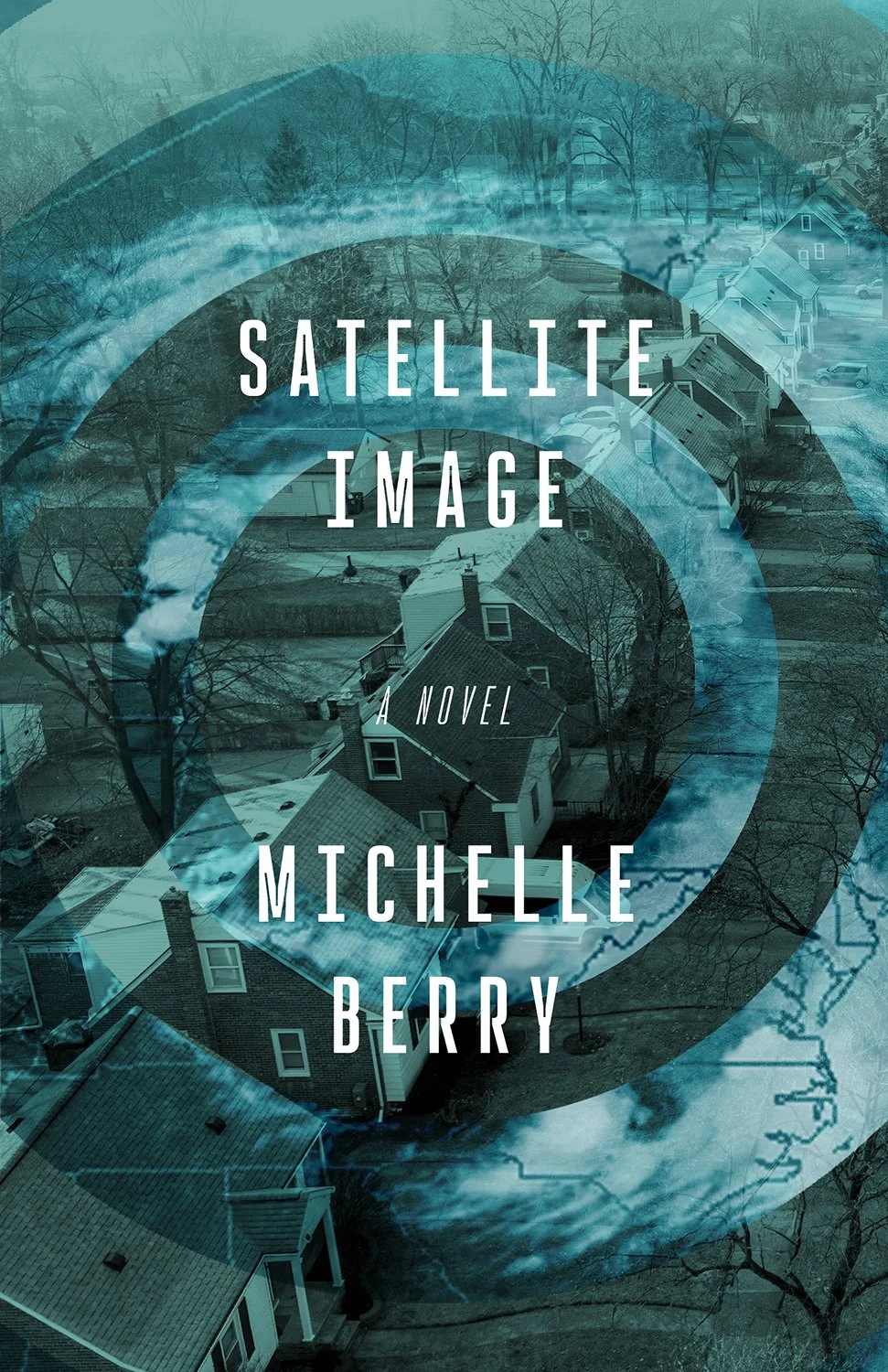
Bring home Satellite Image by Michelle Berry (Wolsak & Wynn, October 15, 2024).
Q: Would you use your book, Satellite Image, to highlight some differences between a literary thriller and a thriller?
A: I’m not sure if this is correct, but this is how I see the differences between a traditional thriller and a literary thriller. I imagine a tightrope. Let’s call it a Literary Thriller Tightrope. I’m walking along it. One foot falls off occasionally but I remain pretty steady to the end. Now I imagine another Tightrope. Let’s call this one a Thriller Tightrope. Again, I’m walking along and suddenly I really fall off. Both are tight ropes, but on one my foot just dips into the unknown, on the other I fall completely in.
I see a literary thriller, like Satellite Image, tipping back and forth between the frightening situation and the reality of the situation (in it I’m losing my balance, a foot falls off, but I don’t fall). This book focuses more on the psychological effects of the fear, on misperceptions and misunderstandings – what is real? What is not real? Ginny and Matt – are they really seeing/hearing/feeling something in their house or is their previous anxiety (seeing the satellite image of the body in their yard, Ginny’s attack in the city) playing havoc on their minds? On the other hand, a traditional thriller to me would look at things that are actually happening which are frightening and the reader would fall completely into those things. A threatening figure would be a threatening figure. But in Satellite Image the fear is more about perception—is the threatening figure real or is this just my imagination?
I also think that traditional thrillers generally give you more detail—things are explained and portrayed in ways that don’t demand you use too much of your own imagination and instead just fall into the writer’s thoughts. In a literary work the author may leave the reader with a lot to be figured out—do we know exactly what the characters are wearing or what they look like? Do we know what their house looks like? etc… I sometimes think thrillers are more entertaining in that they let you sink into what the author directs, whereas literary thrillers are maybe asking the reader to do a little more work in some way.
I’m probably completely wrong about the differences (and there are, of course, many books that are exceptions to the rule), but that’s kind of how I see Satellite Image. Ginny and Matt’s odd house, the things that make them nervous, their year of fear and what really happened is left up in the air – is anything real? Is anything easily explained? Or is it all psychological? Is it all a misunderstanding?
More about Satellite Image:
Reminiscent of the works of Barbara Gowdy and Joy Williams, Berry’s Satellite Image fully embraces the uncanny as it straddles the line between reality and unreality. When newly married couple, Ginny and Matt, move from the bustling, expensive rat race of the city to a sleepy, innocent, affordable small town two hours away, they assume life will be easier. Little do they know that they have bought a house with a baffling history. Life in this town is not all it’s meant to be. Odd neighbourhood dinner parties, and a creepy ravine just out their back door have Ginny and Matt quickly questioning their move.
Read an excerpt of Satellite Image here.
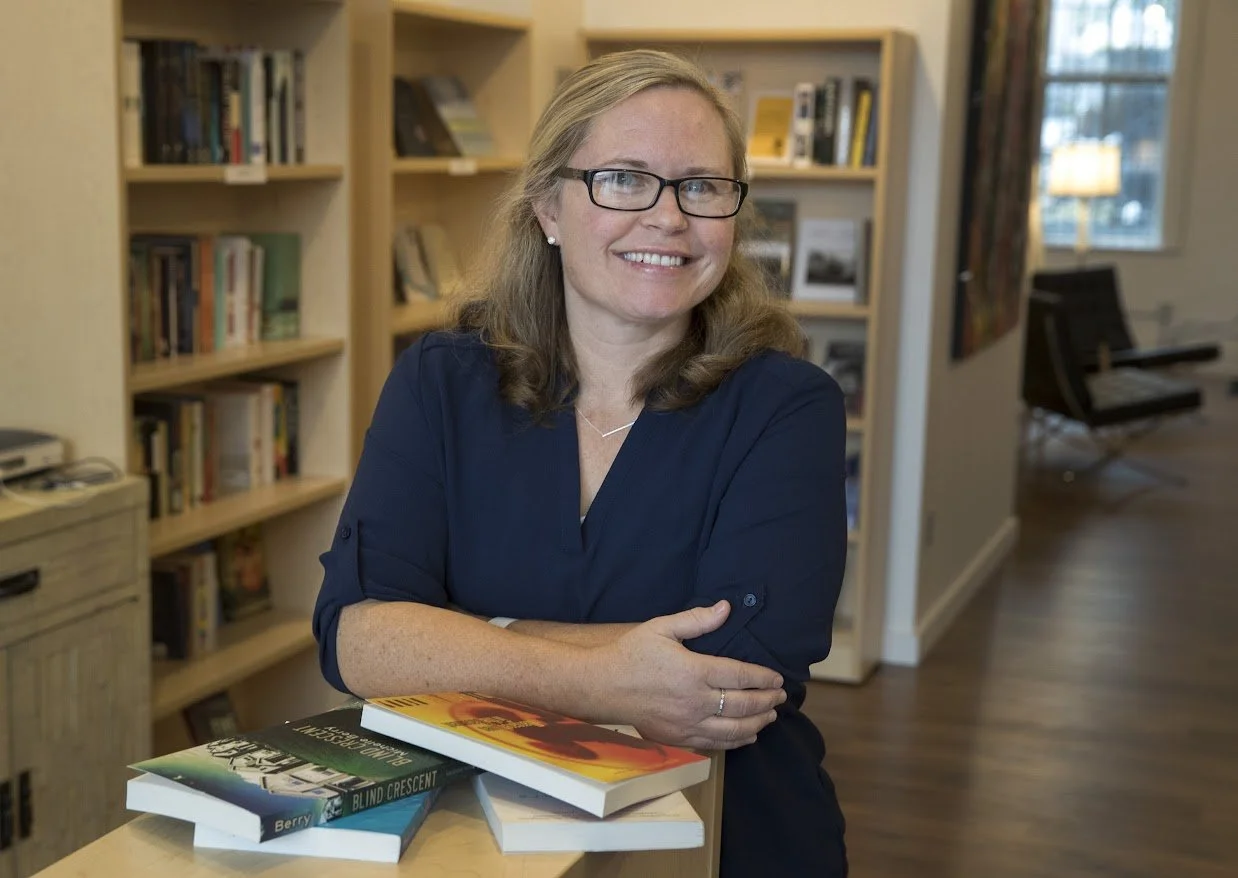
Michelle Berry. Photo credit: Fred Thornhill.
More about Michelle Berry:
Michelle Berry is the author of seven novels and three books of short stories. Her books have been shortlisted, long listed and have won multiple awards. Much of Berry’s writing has been optioned for film several times, with The Prisoner and the Chaplain currently in the works. Berry was a reviewer for the Globe and Mail for many years and currently teaches at the University of Toronto in the Continuing Education department. She has served on the board of PEN Canada, the Writer’s Union and on the Author’s committee of the Writer’s Trust. For five years, Berry owned and operated her own independent bookstore in Peterborough, Ontario, called Hunter Street Books.

Power Q & A with Ian Colford
Books have long lives, but if it’s possible to be late to the party celebrating an amazing book, we are definitely late to this one. Ian Colford’s 2023 Guernica Prize-winning novel, The Confessions of Joseph Blanchard, is a mesmerizing read that runs a dazzling gamut of human emotion: love, greed, grief, jealousy, rage. You name it: the characters in this novel—particularly our protagonist, Joseph—sing with range that would make Mariah Carey weak with envy.
Books have long lives, but if it’s possible to be late to the party celebrating an amazing book, we’re definitely late to this one. Ian Colford’s 2023 Guernica Prize-winning novel, The Confessions of Joseph Blanchard, is a mesmerizing read that runs a dazzling gamut of human emotion: love, greed, grief, jealousy, rage. You name it: the characters in this novel—particularly our protagonist, Joseph—sing with range that would make Mariah Carey weak with envy.
In Joseph—a man who falls in love with his 19-year-old cousin—we find a person to rally against and even (surprisingly and often against our better judgment) a person to rally for, despite his slippery moral footing. We are delighted to welcome Ian to our series today to ask him about creating the complex, haunting, and fascinating character of Joseph.

The Confessions of Joseph Blanchard by Ian Colford (Guernica Editions, 2023)
Q: One of the great feats of your book, to our mind, was the character of Joseph: a man who is repugnant in many ways but who we also couldn't help feel compassion toward—a surprising and disturbing realization. What is your advice to writers who want to create morally murky characters?
A: As I noted in a recent blog post about writing The Confessions of Joseph Blanchard, the character of Joseph came to me more or less fully formed. At the time I was writing the book, I wasn’t giving much thought to his status in the reader’s eyes, as someone they would like or dislike. My aim on days when I sat down to write was simply to keep the story moving forward. But as I got deeper into the story and saw what Joseph was doing, I grew more aware of the notion of sympathy. And after I finished it and started letting people read it, I had to wonder what they’d think of him.
Writing the book was a learning process and a lot of the time I was writing on instinct. But one thing I was sure of was that I didn’t want Joseph to be a nefarious schemer. I knew that if his intention from the get-go was to cause harm, the story would be boring, for me and for the reader. Instinct told me to dig deep into his history and find ways to give his character complexity and nuance. I wanted Joseph to be a puzzle for the reader to unravel. Because people behave in puzzling ways. They behave badly. Sometimes they even act against their own best interests. For the novel to work, the reader had to see Joseph as flawed and vulnerable. What makes our response to him so complicated is that we’re witnessing a fundamentally decent man struggling against base impulses. He knows he’s behaving badly. It eats at him, and yet he comes up with justifications that make it possible for him to carry on with behaviour that the reader will regard as unforgivable.
My advice for writers who want to create a morally murky character is to get to the root of why the character acts the way he does. If the reasons are simplistic (he’s doing it for revenge, or for kicks), then—probably but admittedly not always—the character you create will be one dimensional. If your character isn’t engaged in a struggle, not only will the reader quickly lose interest, but you, the writer, will tire of him. As a writer of fiction, your first responsibility is to write something the reader will find interesting, and a dependable compass to help you navigate your way through a novel manuscript is your own sense of what’s interesting. If you find your character boring, it’s likely the reader will too. But if you’ve endowed your character with the kind of depth that brings them convincingly to life and fires up your imagination every time you sit down to write, then there’s a reasonable chance your reader will be transfixed by what you’ve written.
More about The Confessions of Joseph Blanchard:
The Confessions of Joseph Blanchard is a contemporary tale of obsessive love, sexual transgression, and tragic loss. Bachelor and professional accountant Joseph Blanchard has led a socially active but emotionally cautious life until his late thirties. When he discovers that his beautiful cousin Sophie, a talented concert pianist, is in love with him, he finds he is powerless to resist her youthful charms, and against his better judgment embarks on a passionate affair. To avoid causing pain to her parents, the two lovers conspire to keep their relationship a secret. For a time, they are happy. But Sophie's career forces her to spend time in the company of other musicians, many of them young men. Consumed by jealousy, Joseph allows rage to take control, with tragic results. Grieving, he prepares to destroy all evidence of the affair. But when a family secret is exposed, it reveals the past in a new light. Eventually, his health in decline and with nothing but memories, he reveals his secret to a confidant.

Author Ian Colford.
More about Ian Colford:
Ian Colford was born, raised and educated in Halifax. His reviews and stories have appeared in many print and online publications. He is the author of two collections of short fiction and two novels and is the recipient of the Margaret and John Savage First Book Award for Evidence.

Power Q & A with Rod Carley
RuFF is Rod Carley’s highly-anticipated fourth novel. This historical fiction, which is published by Northern Ontario’s Latitude 46 Press, transports us to Elizabethan England, where we witness Shakespeare struggling through a midlife crisis while trying to win a national play competition to secure the King’s business. Hilarious hijinks ensue, with whip-smart dialogue and a captivating tale that touches on salient social issues that persist today, including equality, justice, and censorship.
Humour and incisive wit combine to create a compulsively readable and thought-provoking novel from this Leacock Award long-listed author. We know RuFF will be a favourite book of the year for many and we are tickled to have Rod Carley here with us to talk about humour writing.
RuFF is Rod Carley’s highly-anticipated fourth novel. This historical fiction, which is published by Northern Ontario’s Latitude 46 Press, transports us to Elizabethan England, where we witness Shakespeare struggling through a midlife crisis while trying to win a national play competition to secure the King’s business. Hilarious hijinks ensue, with whip-smart dialogue and a captivating tale that touches on salient social issues that persist today, including equality, justice, and censorship.
Humour and incisive wit combine to create a compulsively readable and thought-provoking novel from this Leacock Award long-listed author. We know RuFF will be a favourite book of the year for many and we are tickled to have Rod Carley here with us to talk about humour writing.

Bring home RuFF by Rod Carley, published by Latitude 46.
Q: What advice do you have for aspiring humour writers?
A: Everyone has a different sense of humour. We all find different things funny for different reasons. This is why it’s important that before you sit down and try to write, you think about your own personal sense of humor and how you want to mine that to produce a piece of humor writing.
Accept that you have the potential to be funny. Writing humour might come more easily to some, but everyone has the potential to be funny. Find a voice—maybe it’s your main character—to channel your humor through. Trying to mimic other people’s styles in humour writing won’t work. If you try and write in a style that isn’t your own, or if you try and force yourself to be funny in a way that isn’t you, the effort behind your writing will show.
Humour is subjective. When you write a novel or collection of short stories that you hope will be funny, you can be guaranteed that not everybody will find it funny – you just hope some people will find it funny! Readers have the same reaction (to various degrees) to a romance novel, horror novel, or a mystery novel. But with a humour novel, some readers will find it the funniest thing they’ve ever read. Others won’t find it funny at all. It’s a challenge. Much like trying to catch a dragon. So, all you can do, is hope your sense of humour coincides with enough readers to make it worthwhile.
Use humour sparingly. Don’t overdo it; be specific. Your purpose is to grab the reader’s attention and help you make points in creative ways. Be sure your humour doesn’t distract from or demean the true purpose of your narrative.
Above all, make it fun for yourself. If it ain’t fun for you, it won’t be fun the reader.

Rod Carley.
More about RuFF:
Rod Carley is back with another theatrical odyssey packed with an unforgettable cast of Elizabethan eccentrics. It’s a madcap world more modern than tomorrow where gender is what a person makes of it (no matter the story beneath their petticoats or tights). Will Shakespeare is having a very bad year. Suffering from a mid-life crisis, a plague outbreak, and the death of the ancient Queen, Will’s mettle is put to the test when the new King puts his witch-burning hobby aside to announce a national play competition that will determine which theatre company will secure his favour and remain in business. As he struggles to write a Scottish supernatural thriller, Will faces one ruff and puffy obstacle after another including a young rival punk poet and his activist-wife fighting for equality and a woman’s right to tread the boards. Will and his band of misfits must ensure not only their own survival, but that of England as well. The stage is set for an outrageous and compelling tale of ghosts, ghostwriting, writer’s block, and the chopping block. Ruffly based on a true story.
More about Rod Carley:
Rod is the award-winning author of three previous works of literary fiction: GRIN REAPING (long listed for the 2023 Leacock Medal for Humour, 2022 Bronze Winner for Humour from Foreword Review INDIES, a Finalist for the 2023 Next Generation Indie Book Award for Humor/Comedy, and long listed for the ReLit Group Awards for Best Short Fiction of 2023); KINMOUNT (long listed for the 2021 Leacock Medal for Humour and Winner of the 2021 Silver Medal for Best Regional Fiction from the Independent Publishers Book Awards); A Matter of Will (Finalist for the 2018 Northern Lit Award for Fiction).
His short stories and creative non-fiction have appeared in a variety of Canadian literary magazines including Broadview (winner of the 2022 Award of Excellence for Best Seasonal Article from the Associated Church Press), Cloud Lake Literary, Blank Spaces, Exile, HighGrader, and the anthology 150 Years Up North and More. He was a finalist for the 2021 Carter V. Cooper Short Fiction Prize.
Rod was the 2009 winner of TVO’s Big Ideas/Best Lecturer Competition for his lecture entitled “Adapting Shakespeare within a Modern Canadian Context. He is a proud alumnus of the Humber School for Writers and is represented by Carolyn Forde, Senior Literary Agent with The Transatlantic Agency. www.rodcarley.ca.

Embracing the Random: Various Writing Tips
I usually pride myself on the organization of my writing. My mind typically flies all over the place, and writing is where I sort out those thoughts into coherency. But for this blog, I wanted to share a sort of messy array of various writing tips. They all pertain to writing and they are all (in my opinion) very useful, though other than that they share no unifying quality to make an articulate blog post.
By: Margaret Huntley
I usually pride myself on the organization of my writing. My mind typically flies all over the place, and writing is where I sort out those thoughts into coherency. But for this blog I wanted to share a sort of messy array of various writing tips. They all pertain to writing and they are all (in my opinion) very useful, though other than that they share no unifying quality to make an articulate blog post.
So please join me in embracing the random:
Read a Diverse Set of Authors: While the publishing industry is making progress in the way of celebrating texts from a diverse set of authors, there is still a long way to go. Making a point to read texts by authors of colour, authors who are members of the LGBTQ+ community, or authors of other minority groups that you may or may not be a part of, is so beneficial. Not only does it help them succeed in a society that stacks the odds against them, but it broadens your understanding of people who are different from you. And understanding people is a great foundation for writing.
Read Your Work Aloud: This is a pretty popular editing tip, and for a good reason. Reading aloud helps you catch errors in your writing that are easily glossed over while reading in your head. I want to expand on this tip by encouraging you to read your text out loud after the editing is done as well. I started reading my finished stories out loud to my boyfriend as he is a very slow reader on his own. While doing this, I realized that reading my completed stories out loud helped me solidify them as an actual story, and not just something I threw together on my keyboard.
Write What You Feel: I’m actively exercising this tip while writing this blog. I don’t feel like organizing one cohesive thought, so I’m writing this miscellaneous list. But this tip goes beyond my personal blog posts. Writing what you feel can mean writing a story that conveys a particular emotion, or it can mean writing something that you just think would be fun to write. Your writing will be better when you are excited about it than if you try to force something that you’re not feeling.
Ask for Help: Asking for help is not something I really like to do. Taking that first step is pretty difficult, whether it’s asking about a job, asking for someone to edit your work, or asking to run your ideas by someone. Despite the fact that each instance of asking for help makes me nervous and reluctant, I’m always grateful that I did in the end. I’m confident that the same will be true for you.
I hope you were able to get something out of my various writing tips, unified only by their mutual disunity.

So, How Do You Qualify Good Writing?
Good writing is extremely hard to define as there’s a level of subjectivity to it. It’s easy to know what good math is, because you either get the right answer or you get a wrong one. But writing is different. I could read a book and think it’s the best thing I’ve ever read, and you could read the exact same book and think it’s the worst thing you’ve ever read. So, was the book good or bad?
By: Margaret Huntley
Good writing is extremely hard to define as there’s a level of subjectivity to it. It’s easy to know what good math is, because you either get the right answer or you get a wrong one. But writing is different. I could read a book and think it’s the best thing I’ve ever read, and you could read the exact same book and think it’s the worst thing you’ve ever read. So, was the book good or bad?
It’s hard to define what good writing is, but it’s fun to try. That’s why people study English at school, host book clubs, or publish book reviews. There are opinions on pretty much everything that’s ever been written. There are some pieces of writing that have more unanimous opinions, but there’s no single text that has good reviews across the board. Take for instance Shakespeare, he’s worshipped by English fanatics, though if you ask the average high schooler, they’ll say he sucks. On the other hand, there’s widely enjoyed writing that literary critics rip apart, like Hallmark movies.
If you can’t trust public opinion, what can you trust? Well, all the years people have spent studying English haven’t been a total waste, there are some general principles of good writing that aren’t up for debate:
Theme: The piece must say something important, and it needs to be communicated in a way that resonates with the reader.
Originality: Is the theme being conveyed in a new, creative manner, or is it just rehashing countless other texts?
Wording: The words have to be strung together in a way that makes sense. They should also utilize literary devices that bring a semblance of poetry to the piece, to demonstrates cleverness, and the beauty of language (Not every sentence needs to do this, but there should be a good number of them that do).
Plot Structure: Events have to happen for a reason, and they need to occur in an order that’s coherent. There should be a beginning, middle, and end. You can experiment with the format, but these need to be present.
When a text doesn’t have any of these, it’s safe to consider it bad writing. When it does, it should be considered good writing. You don’t have to like a piece of writing in order to consider it good. There are lots of books that I’ve read that I did not enjoy one bit, but I recognized that they were well written. I’ve also read and enjoyed many books that I would not consider to be good writing.
Subjectivity is natural in a field vastly dependent on public opinion. But there are some concrete aspects that makes writing good. So don’t get too discouraged if someone doesn’t like your piece. And don’t get too cocky if someone does. Always examine your piece with objectivity.

How to Rediscover the Joy of Reading When You're Burnt-Out
I think it’s safe to say that all writers began as avid readers. Just as all painters look at other pieces before painting their own piece, all writers read the works of others before crafting their own work. You’d be hard-pressed to find a writer who has never enjoyed reading. From a young age I always loved to read. However, recently I have found myself not desiring to read as much as I used to. Fortunately, in my university program I am forced to read anyways, but without this imperative I know wouldn’t be reading nearly as much as I should be.
By: Margaret Huntley
I think it’s safe to say that all writers began as avid readers. Just as all painters look at other pieces before painting their own piece, all writers read the works of others before crafting their own work. You’d be hard-pressed to find a writer who has never enjoyed reading.

River Street’s talented junior copywriter, Margaret Huntley.
From a young age I always loved to read. However, recently I have found myself not desiring to read as much as I used to. Fortunately, in my university program I am forced to read anyways, but without this imperative I know wouldn’t be reading nearly as much as I should be. In the back of my mind I know it is important to read so that I can improve my craft, but I just find myself very unmotivated. I think that this is at least partially due to the fact that reading just feels like work now.
When I was in high school, I worked as a cashier and after a long day at work, it made sense for me to come home and read on my downtime because reading was nothing like what I had spent my entire day doing. But now that I am a full-time student, after a long day of reading over drafts, novels, and essays the last thing I want to do is read more. Especially if my motivation for reading is so that I can be better at my career. I’d much rather do something unrelated like scroll through social media or talk on the phone with friends, neither of which are inherently bad, but they shouldn’t replace reading altogether.
Now, I don’t think that there is anything wrong with not wanting to have your job bleed into your personal hobbies (there’s a good reason that I didn’t scan things when I got home from work in high school). However, it’s different when your favourite hobby has become your career. After all, I chose to write as a career because I love reading and writing and wanted to keep doing that.
I’ve spent enough time talking about a problem, so I think it’s about time I start discussing a solution. When I was a kid, I read books not to analyze or dissect the plot points, but just for the pure entertainment, but I still learned without even realizing it. I learned things like what aspects of a storyline are most compelling, what character details are realistic, what genres I’m comfortable with, and so much more. As a kid I learned this without even thinking about it because I didn’t put any pressure on it to be “for work.” I just read for fun and learning was a natural by-product.
This is precisely the resolution to the issue I have described. If I think of all reading as work, then it will always feel like work and I won’t want to do it anymore. But when I choose to read on my own time, for the sole purpose of entertaining myself, then I will have fun while unconsciously learning, just like I used to. So, if you find yourself facing the same problem that I have been recently, then I advise you to stop thinking so much and just read!

Learning to Put Yourself Out There
If you say that putting yourself out there doesn’t scare you at all, I’m sorry, but you’re lying. Whether you’re asking someone on a date, applying for a job, or submitting drafts to a journal, the possibility of rejection is always imminent and always terrifying. Keep reading to see what River Street’s Margaret Huntley has to say about putting yourself out there as a writer.
By: Margaret Huntley.
If you say that putting yourself out there doesn’t scare you at all, I’m sorry, but you’re lying. Whether you’re asking someone on a date, applying for a job, or submitting drafts to a journal, the possibility of rejection is always imminent and always terrifying.
Unfortunately, putting yourself out there is a necessity for emerging writers. If you want to be published, you have to send your work to journals. This means you have to send your very intimate drafts out to complete strangers. These are the drafts you have slaved over for months, maybe even years. The drafts you have hated and then loved and then hated and then loved again. The drafts that if you find one more thing wrong with, you swear you’ll delete the whole thing altogether.

The very thought of sending these drafts to someone who doesn’t know the work you’ve put into them is horrifying. This fear is amplified by the fact that this person’s job is to judge their value impartially. Yet, it’s a requirement of the career you’ve chosen. You’re not Emily Dickenson; you can’t just hoard your drafts until they’re discovered after your death. The modern writing world is competitive and always advancing so there is no time to waste waiting around. You have to submit to journals, contests, and publications as soon as possible.
Well, if you weren’t scared before, you’re probably scared now. Sorry, I don’t mean to scare you. But as a struggling young writer, still in university, trying to get ahead, I’m scared too. So, I wanted to share what helps motivate me to put myself out there despite my fears.
My advice is simple: do it. Life is all about doing things that scare you. Think about where you’d be if you never took off your training wheels, never jumped into the deep end, or never spoke to that person who is now your best friend. Submitting your work is just the same. You have to do it, and once you do, you’ll be glad that you did.
While you’re submitting it, do it with the knowledge that you’ll likely get rejected more than a few times before it works out. It would be amazing if you could submit whatever and get published on your first try, but that is just not realistic. After all, you still wobbled on your bicycle before you could ride effortlessly. It might sound counter-intuitive but once you get over the initial hurdle of your first rejection, it gets easier. Once you’ve already put yourself out there, you may as well do it again. Eventually, with persistence and adaptability, you’ll get published and you’ll feel great about it because you know how hard you worked to accomplish it.
You’ll find that the best part of putting yourself out there isn’t actually the act of getting published, but it’s the satisfaction of not letting fear rule your life.

No Writer is an Island: The Competitive Nature of Writing
I am an insanely competitive person. I blame it on my older brother. He’s two years my senior, which was just young enough to play games with me but still old enough to be better than me at them all. This, of course, annoyed me to no end. To this day, I am constantly grappling with a desire to be the best at whatever I do and when I am not, I hate it.
By: Margaret Huntley
I don’t know about you, but I am an insanely competitive person. I blame it on my older brother. He’s two years my senior, which was just young enough to play games with me but still old enough to be better than me at them all. This, of course, annoyed me to no end. To this day, I am constantly grappling with a desire to be the best at whatever I do and when I am not, I hate it.
Now, this would probably benefit me if I chose to pursue a career as an athlete. Instead, I chose to be a writer, whose merit is decided not on objective rules and regulations but the subjective, ever-changing opinions of the public. And I won’t lie, this stresses me out. A lot.
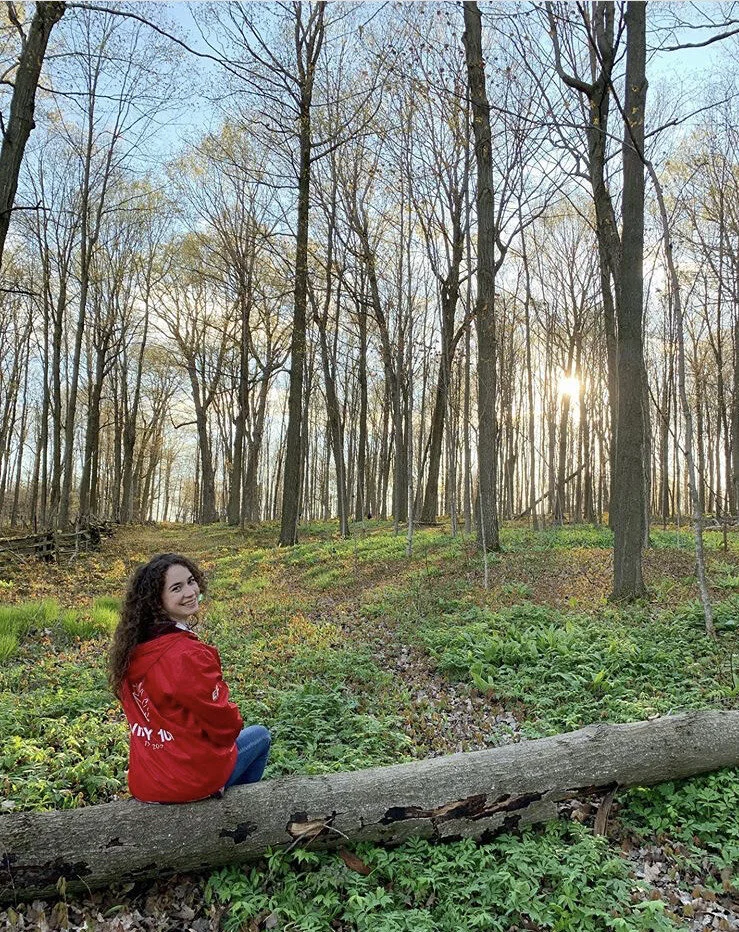
River Street Writer Margaret Huntley.
When I received a second-place award for one of my pieces in high school, I felt like I wasn’t a good enough writer to make it. I thought that because my piece was second place, I was a second-place writer and that wasn’t good enough. More recently, when I was published in a magazine, I found myself critiquing the whole magazine to determine if I had the best article in there.
But this is not healthy!
I used to think that writers worked alone. I thought that it was just up to me and me alone to succeed, so if I didn’t do things right, I was a failure. But this is not how the writing industry works. Sure, JK Rowling wrote her own series, but she needed a publisher before she got off the streets. Even Shakespeare needed talented actors to bring his plays to life.
I am grateful to be studying creative writing at university in such a team-oriented environment. It has taught me that all writers need inspiration, third party opinions, and colleagues to bring their works to completion. Even then, they rely on the public to consume and support their material.
Once I understood this, my competitiveness started to diminish. I know the writing accomplishments in my future will not be my own. If I continue to pit myself against others, I will hurt my career more than I will help it. The more I help other writers with their craft, the more they will help me. Not only will they be more likely to return the favour, but by analyzing their craft, I can improve upon my own.
The reality is that we are all in this together. We are all working hard to get our names out there and we all have unique writing that appeals to different sections of the public. By working together, we are able to put more quality writing out into circulation, and that is a win for everyone.
So, if you’re competitive like me, next time someone gets published in your place, learn from the experience and use it to become a team player. But the next time you lose Mario Kart to your brother, feel free to throw the remote.
Learn more about Margaret and other River Street writers here.

How to Become a Freelance Writer: Tips from the Trenches
Interested in learning how to become a freelance writer? River Street’s Hollay Ghadery gives you her top tips for making it in this paper-cut-throat industry.
I'll admit it, when I first dreamed of being a writer, I envisioned romantic bursts of inspiration, fancy parties, and, of course, major windfall for all my creative efforts. I was eight years-old at the time, so granted, my vision was idealised through the sugared-glaze of childhood. Even over a decade later, when I started writing professionally and could call myself a capital 'W' writer, I was not prepared for what it would entail to really make it in this profession over the long-haul.
And it is a long-haul. I've been a freelance writer for 15 years now, and this profession is not for the faint of heart. That's the bad news. The good news is that it is for the full of heart, so if words are your life and you have at least a smidgen of workable innate talent, then you stand a good chance of making it as a freelance writer. Of course, passion alone isn’t enough.
Keep reading. Here are my top tips how to become a freelance writer.
1. Don't Quit Your Day Job
Most of us don't have the luxury of living off savings (if we have any) while we wait for our freelance gig to pick up—and it will probably take some time to pick up. Even if you worked as a company writer for years, going freelance means you have to establish a reputation of your own: you can't rely on the reputation of a brand to back you up. So, while you're establishing yourself as a freelancer, it's always a good idea to have a reliable source of income as well. Even if it's just part-time, these funds will help support you through the dry-spells that are an inevitable part of freelancing at any stage in the game.
Quick word, though: if you already work as a writer for a company or organisation and plan to go freelance, be sure that your freelance work isn't gained through poaching any of your current employers clients. This is not only bad form, but likely, against company contract. You want clients? Go out and find your own.
2. Build a Social Presence
On the day I am writing this, our Instagram account is only a week old. Yep. It's a baby. (But, to our credit, we’ve been on Facebook a mite longer.) What took us so long to get on board the undeniable, seemingly unstoppable social media trend? Well, you know the old adage: the cobbler's children go barefoot. Our services include doing social copy and social media management for our clients, and we just never seemed to get around to doing it ourselves. Brutal, right? It is. With over three billion people using social media worldwide, social platforms are essential to building your brand as freelancer. A consistent social presence will help you gain an audience, increase awareness of your services, engage with current and prospective clients, build your authority and, the icing on the cake—it's free. All you need to do is invest a little time in creating engaging, like-worthy posts.

3. Don't Be Too Precious
I wrote a whole article being overly precious and it boils down to this simple fact: part of learning how to become a freelance writer involves learning how to cultivate your interests outside your established interests. You may live for travel writing, but National Geographic likely won't hire you off-the-hop. By all means, do as much travel writing as you can, but also, be willing to take on other projects in other fields. As a fledgling freelancer, you can't be too precious about what you will and will not write. As long as it isn't morally offensive or illegal, you should at least consider it. Besides, you never know what fascinating fields you can stumble into with an open-mind.
4. Don't Write for Free
Many, many online and print publications will tell you that "exposure" is your payment. Unless you work in the sex trade, exposure, unfortunately, does not pay the bills. What exactly you will be able to charge will depend on variable factors like your experience and the scope of the project in question, but if you want to become a successful freelance writer, you need to charge something. We sometimes do pro-bono work when the cause moves us, but this is the exception: certainly not the rule. Charge for your efforts.
Also, be sure to manage your money properly. Until you build a steady client-base—which can take years— your revenue will usually vary significantly from month-to-month. Feast and famine is part of #ThatFreelanceLife, so, when you get a cushy payment, after you pay your essentials, be sure to tuck some of it away for when times are tight.
How much should you charge as a freelance writer? Standard junior freelance rates can start as low as $20 per ~500 word article ($0.04 per word) while senior rates can go upwards of $150 for the same length ($0.30 per word). Rates also depend on what you're writing. For instance, $20 per 500 word article is decent for a piece you can knock-out in under an hour and requires little research, but if it takes more than that, you either have to increase your rate, or become more efficient. And speaking of which...

5. Get in the Grind
When you're writing for a living, the time-suck of writer's block is a luxury you cannot afford. Writing is a grind, and you simply need to write and write and revise and write and edit until the project is done. Don't sit there waiting for divine inspiration: just nail your butt to the chair, and start writing. Sure, the first paragraph or three may turn out to be a warm-up to get you to the real meat of the piece, but the time it took you to write those paragraphs (which will ultimately be scrapped) is far less than the time you would have spent staring at your blinking cursor doing nothing. Learning how to become a freelance writer largely involves the simple, unwavering commitment to just writing.
6. Keep Learning
Read. Voraciously. Anything you can get your hands on. Whether you're a creative writer or technical writer, reading is a wonderful way to keep refining your craft. Also, take courses to keep your qualifications tip-top. Enrol in an editing certification course, like the one at Simon Fraser. Read up on best practices for keyword optimisation. Take a Google business writing course. Some of these resources are free; others...not so much. But there is some truth to the saying, "It takes money to make money." Of course, you don't want to bankrupt yourself, so just do what you can, as you are able. Any advantage you give yourself is an advantage over your competition. Maintaining this edge is why our rag tag team of writers is constantly updating our certifications, learning, and honing our skills.
Read up on our top recommended resources for writers here.

7. Be Professional!
You’d think this would be self-explanatory, but sadly, it’s not. Just because you can work in your jammies doesn’t mean you can toss basic professionalism to the wind. Answer emails in a timely fashion. Manage your time so you can deliver on deadline. Correspond in complete sentences. If you have questions, ask. Be accountable. Don’t give excuses—no one’s interested. Do. Your. Job. Yes, life happens and sometimes the scat hits the fan, but if you’ve managed your time properly, there is usually no reason your clients have to know about your life’s mishaps. And, if you’ve cultivated a professional and dependable reputation, in the rare instances that you do need to adjust a deadline or step away from a project entirely, your clients will understand. They’ll still contact you when they need something done in the future. They’ll still recommend you to others.
Listen, freelance writing affords many freedoms, but freedom from accountability isn’t one of them. Unlike many other jobs, there is no one to stand in for you if you don’t show up. When you’re a freelance writer, your word really is your bond. Make it count.
Have questions or tips of your own? Share in the comments! Interested in our services? Contact us now.
Creative Prostitution: What to Expect When You're Expecting to Write for a Living
For most people who write for a living, it’s not all sonnets and short stories; you’ve got to sell a bit of yourself. Or a lot of yourself, depending on the project. Is it worth it?
The summer my family moved out of Toronto and north to small town Ontario, my parents sent my brothers and me off to Port Coquitlam, British Columbia to stay with our aunt and uncle while they oversaw the building of our new house.
It was the summer we ate so many freezies that their plastic slit the corners of our mouths. It was the summer my younger brother refused to bathe for days and had to be physically dumped in the shower. It was the summer that I read Francine Pascal's Sweet Valley High Sagas in three days.
Like many writers, this is how my writing life began: through the voracious, unquenchable need to read. So Pascal is not Thomas Hardy, but as the 10 year old only girl in an all male array of brothers and cousins, she was to me.
She was to me.
It was not the first summer I spent reading. As a child, you're usually at the mercy of your parents to supervise - or at least take you to- outings with school friends. Combine this with the fact I spent most of my summers at my grandfather’s cottage on the lake, and my friends from school may as well have been on Mars.

Me reading at my Gramps' cottage.
Oh boo-freakin-hoo. Poor me. Yeah, yeah. I know. As much as I love Hardy, I am no Jude and these are not the tragedies he wrote of. But these minor isolations are where my writing life began.
In part.
The other part I share with many writers. Namely, I'm a big baby.
That’s a cute way of saying that I feel raw to the world. Even encounters and feelings I’ve experienced before feel new almost every time, often painfully so, and I can either hold it in, or let it out in a long, self-indulgent wail.
And boy do I wail.
As a fledging writer, I filled at least 5 notebooks a month. Mostly drivel, of course, but it helped me realize what I was capable of. It made me feel powerful, and as a preteen who entitled her autobiography, Memoirs of a Fat Kid on Track and Field Day, I can’t tell you how incredible it is get a taste of invincibility.
It’s addictive.
When I told my conservative Islamic father I was dropping the idea of law school to become a writer, he asked me why I couldn’t just be a lesbian. Or a prostitute.
This response was the first of many like reactions.
Telling people I’m a writer is not always met with what I consider due awe and admiration of my craft. When my 7 year old nephew asked me what I actually do for a living – understanding that I am home all day and that I also claim to be working –he didn’t believe me.
“People don’t really do that. Not as a real job.”
If I’d told him I was an astronaut, I would have been met with less disbelief.
But writing is often an act of disbelief - in yourself, in the world - and I knew I’d never be happy doing anything else.
The only other time I've felt this way is when I've come home from the ballet, mind full of music, gesture, grace, and danced around my nightly absolutions, face washed, arms poised, toes, tipped. Brain baffled and free. How lovely.
But not every night can be the ballet.
I’ve been writing professionally for over a decade, and if you’re writing professionally, full-time, chances are you’ve dabbled in or are dabbling in some form of creative prostitution.
For most people who write for a living, it’s not all sonnets and short stories; you’ve got to sell a bit of yourself. Or a lot of yourself, depending on the project.
Is it worth it?
Well, I get asked that a lot, and all I can say is it’s a personal call.
I know many writers who make their living in entirely unrelated fields (e.g. as software engineers) - or even semi-related fields (e.g. as professors or in communications) – who work best when they save their writing time for their writing. The act remains pure, chaste, and relatively free of corruption.
I know others writers who rent out their minds (and sometimes, especially in the beginning when you can't always afford to be as choosy, a wee bit of their dignity) on an almost daily basis and are OK with that. Obviously, I fall into this category.
I can’t speak for others, but I can speak for myself when I say that my dignity is one thing, and my morality is quite another. While I have definitely written about topics that I deem trivial or silly, I have never written about anything I find morally objectionable.
Which isn’t to say I go into every project wholeheartedly believing in what I am hired to write about. I do a hell of a lot of ghostwriting, and though I always know that I can nail the content, it doesn’t mean I'm initially passionate about the topic. You can only write so much about BBC period dramas, body dismorphia and Bea Arthur.
I do, however, have faith in my powers of compassion. I have total faith in my empathetic abilities. If I agree to a project, I have no doubt I can get out of myself enough to look at it from another angle. I can learn to see what others see.
I don’t think I could stomach hunting for sport, but writing for conservation-minded waterfowling experts has made me see what they love about it.
I know my acceptance of mortality is far too fragile for me to work in the funeral business, but writing content for a company in the industry has given me a whole new understanding and deep respect for people who not only trod death’s terrain magnanimously, but help others navigate it too.
Even though I love playing poker, it wasn’t until I began writing for a truly inspired professional player and coach that I understood poker will always be a straight out gamble unless you develop the mental, physical and spiritual acuity outside of the game to carry you during play.
Creative prostitution forces me to write from perspectives and in voices that are totally foreign. It forces me into other worlds, and sometimes, uncomfortable corners.
It has not only made me a better writer, you see, but a better person, so for me, it works. The juice is always worth the squeeze. And what a squeeze.

Q & A with Tanis Rideout
Tanis Rideout, author of award winning novel, Above All Things, talks to us about how research shapes her writing.
Q: Tell us about the importance of research in making a novel work. Really work.
A: I tend to write rather research intensive work – maybe because I enjoy that part of the writing process so much. I’ve been lucky. Research has afforded me the chance to travel to cities, to meet people, to spend time in places that I never would have otherwise. And there’s something about being in a place that your characters occupy or have occupied, I think, particularly if they are historical figures, but even if they’re people who exist in some version of the real world.
If you can walk down the streets that you characters walk down, look at the buildings, feel the air, it gives you new tools to draw them. You can understand how they move down the street, is it quick and easy, slow and painful? You realise what places sound like, what they smell like. All of which can be the things you don’t think of, if you’re conjuring a place entirely out of your head.
And it’s the small things, the weight of paper, the colour of ink, the size of envelopes – tiny things that have changed over time, or from place to place, that help to conjure a world in its entirety, I think. The right detail can do so much for a reader to build a world that they can believe in.

Of course, it means that as a writer I often know more than I could ever possibly incorporate, and knowing where to draw that line is hugely important, you don’t want to bog down narrative of character in too much research. And I hate reading stuff that feels like the writer is showing off how much research they have done. I want it to feel seamless. I want the world to feel wet with its own reality, is how I often think of it.
So yes, for me, the background work, the reading, the wandering, the staring, the chasing down strange bits of information, is hugely important. Without the characters, the ideas only exist in a vacuum.
More about Tanis...
Tanis Rideout is the author of a novel, Above All Things, which was long-listed for the Dublin IMAPC Award, a NYT Editor's Choice, and winner of ITAS Premio Montagna and a poetry collection, Arguments with the Lake.