

BLOG

Power Q & A with Susan Wadds
Mere days from the official release of her glorious debut, we are delighted to have author Susan Wadds join us to answer a burning question about her much-anticipated, super salient novel, What the Living Do (Regal House Press, 2024).
Mere days from the official release of her glorious debut, we are delighted to have author Susan Wadds join us to answer a burning question about her much-anticipated, super salient novel, What the Living Do (Regal House Press, 2024).
Welcome, Susan!
Q: What the Living Do offers an intense, complex, and incisive look at questions and concerns surrounding women's reproductive rights (among other things). Was this something you set out to address in the novel, or was it something that emerged as the story developed?

What the Living Do by Susan Wadds. Bring it home!
A: Story elements tend to emerge organically. I often begin with an idea, or as Sherry Coman says, a sacred image. In the case of this story, it began with an image and a dilemma. My image was a blond woman holding a Stop/Slow sign for a road crew. I wondered who she was, how she came to the job, how it was to work in that environment, and then thought, what if she didn’t just hold signs but worked side-by-side with the men? Who would that woman be? The dilemma driving the story ties into the theme of reproduction—something I’d wanted to write about for a long time.
In this story, the protagonist has left a toxic relationship in which her partner refused to father the child they conceived. Raising a child with no partner and no father was not a life she wanted for herself or for a child. Abortion seemed to be her only option.
One of the conflicts in the story involves her closest friend who has conceived twice within her marriage but has miscarried both times. Although I didn’t set out to have this particular dynamic play out, a situation in my life offered itself to serve the story. My dearest friend had been desperately and unsuccessfully trying to conceive and I, without trying or wanting to, conceived. In our case it didn’t cause a rift, but it inspired me to use a similar tension around two women’s disparate lenses on motherhood. One, who has lost babies judges the other who willingly “discarded” one.
In What the Living Do, the weight of guilt for the death of her three-year-old sister isn’t the only reason Brett would rather not have children. She believes that she cannot “bear” children--it’s a dangerous world and there are predators out there, so not only does she feel unworthy to be a mother, perhaps it’s better not to bring a child into a dangerous world where they may be exploited.
To answer the question simply, I didn’t think about “rights” per se as I headed into the narrative, and that may have to do with the medical system with which I’m familiar; one where a safe abortion is available to those who need such an intervention. Luckily, the protagonist’s dilemma didn’t involve having to choose between an unsafe abortion and single motherhood.
Later in the story, Brett encounters a male doctor with a shockingly cavalier attitude toward abortion, a scenario based on personal experience. So, as I said, many of the elements present themselves organically as I write, many of them inspired by my own experienced events and encounters. I think what I want to say here is that I didn’t set out to “make a point” but rather to tell a story about a headstrong woman mired in guilt and grief finding her way back to wholeness and health.
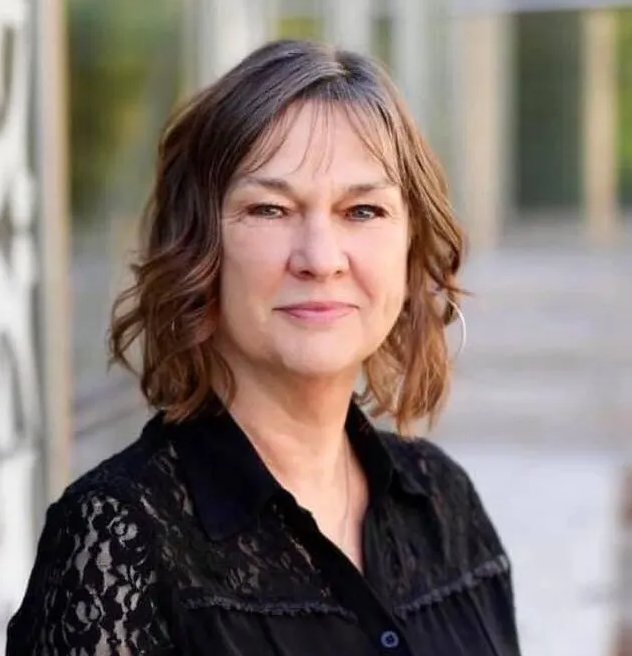
Author Susan Wadds.
Winner of The Writers’ Union of Canada’s prose contest, Susan Wadds’ work has appeared, among others, in The Blood Pudding, Room, Quagmire, Waterwheel Review, Funicular, Last Stanza, and carte blanche magazines. The first two chapters of her debut novel, published by Regal House Publishing, “What the Living Do” won Lazuli Literary Group’s prose contest, published in Azure Magazine.
A graduate of the Humber School for Writers, Susan is a certified Amherst Writers and Artists (AWA) writing workshop facilitator.
She lives in Kawartha Lakes in the former Dalton township by a quiet river on Williams Treaty Territory in South-Central Ontario with an odd assortment of humans and cats.

Power Q & A with Marion Agnew
We first came to admire the writing of Marion Agnew when we read her debut book, a memoir: Reverberations: A Daughter’s Mediations on Alzheimer’s. When her second book—the novel Making Up the Gods was published—we knew we had to invite her on our Power Q & A series. Even though the books are markedly different, in narrative approach as well as genre, there was a major similarity readers were picking up on, and we had a question.
We first came to admire the writing of Marion Agnew when we read her debut book, a memoir: Reverberations: A Daughter’s Mediations on Alzheimer’s. When her second book—the novel Making Up the Gods was published—we knew we had to invite her on our Power Q & A series. Even though the books are markedly different, in narrative approach as well as genre, there was a major similarity readers were picking up on, and we had a question.
Welcome Marion, and thank you for taking the time to answer it!
Q: Your essay collection, Reverberations: A Daughter’s Mediations on Alzheimer’s, is about the grief of your mother's dementia and your family's response. Each of the characters in your novel Making Up the Gods (Latitude46, 2023) is dealing with grief, too. What keeps drawing you to that subject?

A: I didn’t recognize the level of grief in Making Up the Gods until the blurbs came in! I’ve always assumed that everyone carried around a backpack of grief, and that all of life and writing is about dealing with that grief—it just seemed normal to me.
Actually, it still does. Some people are well-acquainted with grief early in life—they lose a parent or have other traumatic experiences. But even privileged people like me have tiny losses and disappointments—failing a test, not making the varsity team, a shocking diagnosis, a failed relationship. We might not use the word “grief” to describe them. But, as in my case with the illness and loss of my mother, eventually the word “grief” obviously matches an experience, and then it’s easier to look back through life events and become more aware of grief’s companionship all along the way.
More about Making Up the Gods
Making Up the Gods is equal parts quirky and sincere in its thoughtful exploration of tragedy and recovery, of new and old relationships, and of deeper questions of when to let the past rest.
Simone, a retired widow, would live a quiet and isolated life, if not for the lingering ghosts of her family. One day, Simone is visited at her home by a man named Martin claiming to be her cousin. When Martin asks if Simone is willing to sell her cottage by the lake, a proposition made sweeter by the prospect of a condo in Florida, Simone, though pleased at the thought of a cousin, also questions his intentions.
Where among her past has Martin even come from, and why has he emerged in this moment? The burden of making a decision is all the more difficult because Simone has agreed to take care of a friend’s nine-year-old boy, Chen, for a short time while his mother enjoys a much-needed vacation. Simone finds her match in Chen, a curious and precocious boy grieving the loss of his father and stepbrother in an accident that has shaken the entire community.
Can Simone hide her ability to see her family ghosts? Will Martin succeed in extorting Simone’s beloved home—and worse, is he a danger to Chen? Because of Chen and Martin, Simone is caught between her ties to the past and her desire to embrace the company of the living.

More about Marion Agnew:
Marion Agnew is the author of a personal essay collection, Reverberations: A Daughter’s Meditations on Alzheimer’s (Signature Editions, 2019). It was shortlisted for the Louise de Kiriline Lawrence award for nonfiction. Her essays have been nominated for a Pushcart Prize and a National Magazine Award. She lives in Shuniah, Ontario, mere yards from Lake Superior, on Anishinaabe/ Robinson-Superior Treaty territory.

Power Q & A with Sahar Golshan
We’re delighted to have Sahar Golshan, the author of SO LOUD! (Annick Press, 2024), join us for this Power Q & A. Sahar speaks about the power of reading and representation in childhood, and how this compelled her to tell this story of finding your voice in her new, incredibly fun, and touching children’s picture book.
We’re delighted to have Sahar Golshan, the author of SO LOUD! (Annick Press, 2024), join us for this Power Q & A. Sahar speaks about the power of reading and representation in childhood, and how this compelled her to tell this story of finding your voice in her new, incredibly fun, and touching children’s picture book.
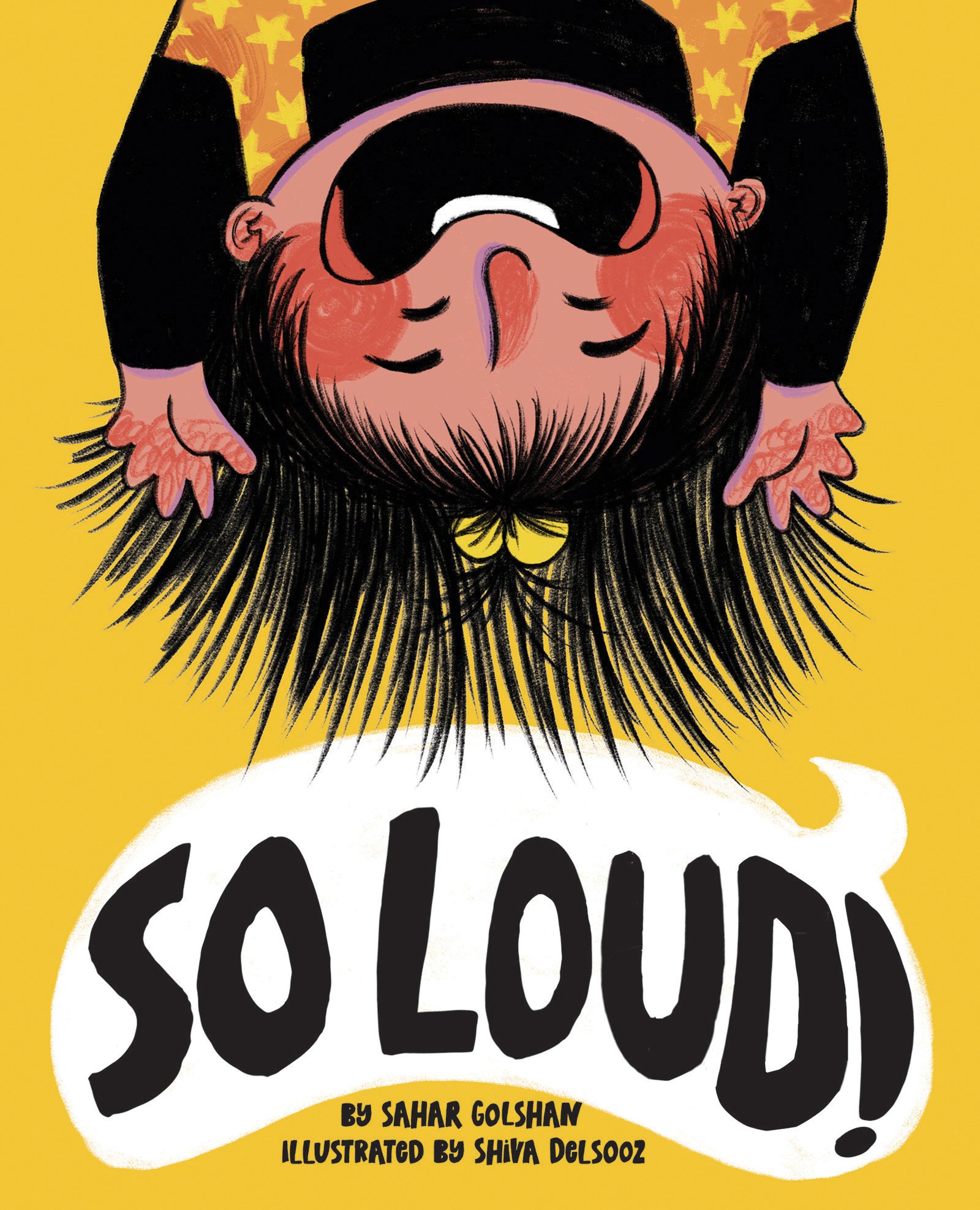
Bring SO LOUD! home.
Q: Why did you choose the form of a children’s picture book to tell this story?
A: Picture books are powerful. They are the very first books that a person reads in their lifetime. Adults often remember the first titles they read in childhood. I want kids, especially girls and gender-diverse children, to read this book and feel emboldened to be their true selves. No matter if they’re loud, quiet, or somewhere in between.
I have vivid childhood memories of being read to in libraries. I remember being in grade one and being shuffled into the school library. The librarian read a picture book called A Promise Is a Promise by Michael Kusugak and Robert Munsch. She read it very well. Maybe too well. I was both scared and moved by its powerful message of keeping to your word. I reflect now on how important it was for me, a non-Indigenous child growing up in Canada’s largest city, to have been read a story about Inuit folklore and contemporary Inuit life.
I was also gifted a picture book called From Far Away by Saoussan Askar and Robert Munsch as a kid. It was the first time I’d seen a woman wearing hijab depicted in a book. My father’s family in Iran are Muslim and it was powerful for me to see a Muslim woman represented in this story. From Far Away is also about the culture shock of moving to a new country. It resonated with me as a mixed-race child who grew up in between many cultures. The main character of So Loud! is named Rudy. I don't often see mixed-race children with two racialised parents depicted in children's literature, so in this way telling Rudy's story in picture book form was really meaningful to me.
More about SO LOUD!
Rudābeh (Rudy for short) loves to talk, sing, jump and shout. There’s just one problem: the adults in her life are always telling her that she is SO LOUD. When her grandmother (Māmān Bozorg) visits from Iran for the first time, Rudy worries that she might be too loud for her. But as she tries to be quieter, Rudy starts to feel less and less like herself. Listening closely to the many sounds in her world—from husky howls and streetcar chimes to Māmān Bozorg’s roaring sneezes—Rudy tries to figure out the full range of her own voice, discovering along the way the joy in being loud.
With exuberant illustrations by Shiva Delsooz, this charming story will resonate with readers who love to make noise and are still learning where and when to take up space.

More about Sahar Golshan:
Sahar Golshan is the author of the picture book So Loud! (Annick Press, March 2024) So Loud! is illustrated by Shiva Delsooz. Sahar is a writer, a language learner, and the director of the short documentary KAR (2019). She is a winner of the Marina Nemat Award for Creative Writing in Non-Fiction and a recipient of the Air Canada Short Film Award. Her writing has appeared in Room, Taclanese, Shameless, The Ex-Puritan, The Ampersand Review, and Tongues: On Longing and Belonging through Language. She enjoys teaching and facilitating workshops in academic and community spaces such as the University of Toronto and the Toronto Public Library.

Power Q & A with Kate Rogers
Kate Rogers is the author of The Meaning of Leaving, a tender and unflinching collection of poems that strives to show society's thoughtless acceptance of violence towards the vulnerable: women, the natural world, and the unhoused who struggle with mental health and addiction issues. These are brave and tender poems that will ignite and unite.
These are also incredibly personal poems, many of which Rogers identifies as autobiographical. In this Power Q & A, we ask Kate about the impetus and challenges of this project.
Kate Rogers is the author of The Meaning of Leaving, a tender and unflinching collection of poems that strives to show society's thoughtless acceptance of violence towards the vulnerable: women, the natural world, and the unhoused who struggle with mental health and addiction issues. These are brave and tender poems that will ignite and unite.
These are also incredibly personal poems, many of which Rogers identifies as autobiographical. In this Power Q & A, we ask Kate about the impetus and challenges of this project.
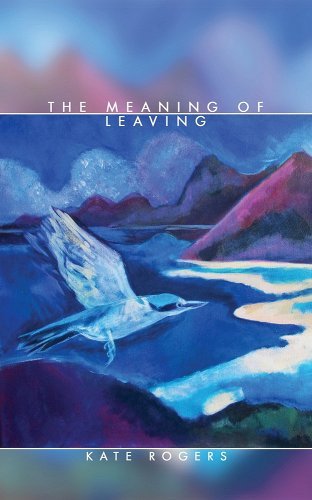
What a cover! The Meaning of Leaving by Kate Rogers is now available.
Q: Your book deals with intensely personal but also, sadly far-reaching themes and materials. Can you speak to the challenges of working with difficult autobiographical material?
A: There were days when it was particularly challenging to work on the poems about intimate partner violence in The Meaning of Leaving. Most of the challenge came from returning to the poems again and again to craft them from raw experience and emotion into art. And yet, the most important part of writing poetry is the revision. That process, like shaping any experience, moment or narrative on the page, can also be liberating. There were both challenges and rewards in working on my poems inspired by five years in an abusive marriage.
A series of losses and discoveries led me to write The Meaning of Leaving. One catalyst was the death of my abusive ex-partner during the pandemic. I suppose his death freed me and my unconscious to return to the painful experiences of abuse I’d had with him, but on my own terms.
While it was challenging to craft art from my years in an abusive marriage, I found that literary devices and the associative nature of poetry took me from literal experiences to metaphorical truth. I used metaphor, simile and form to evoke emotion. At times, free association helped me expand on my experience in unexpected ways. Repetition was helpful for emphasis. At all times, I was striving to evoke the impact of physical and psychological violence and seeking emotional truth.
Two linked reasons I wrote The Meaning of Leaving were to chronicle the journey of leaving my abusive ex-husband and to take back control of the narrative of my life. A tactic abusive partners often use to maintain control is to isolate the partner they are abusing from friends, family and community. Isolation means she has no external validation for her feelings and doubts the reality of her own suffering. I hope reading my poetry collection, reading this mini essay on the challenges of crafting autobiographical material into art, or hearing an interview with me helps anyone in an abusive relationship who needs to feel they are not alone. I hope they would be empowered by that recognition and ultimately, be able to leave their abusive partner.

Poet Kate Rogers.
More about Kate Rogers:
Kate Rogers' poetry and critical writing have appeared in many literary journals and anthologies both in Canada and abroad, including The Montreal International Poetry Prize Anthology (Véhicule Press), Looking Back at Hong Kong (CUHK Press), subTerrain, ARC, PRISM, and many others. Her most recent poetry collection is Out of Place (Aeolus House/Quattro Books 2017.) She is a co-director of the Art Bar Poetry Reading Series in Toronto.

Power Q & A with Patrick Grace
Patrick Grace's collection of poetry, Deviant, is one of the most anticipated debuts of the year, tracing a tender and salient exploration of queer identity and belonging, as well as Patrick's personal experiences with the systemic dismissal of intimate partner violence that occurs in 2SLGBTQ+ relationships.
We're stoked to have him on this Power Q & A to ask one of our most pressing questions about the collection.
Patrick Grace's collection of poetry, Deviant, is one of the most anticipated debuts of the year, tracing a tender and salient exploration of queer identity and belonging, as well as Patrick's personal experiences with the systemic dismissal of intimate partner violence that occurs in 2SLGBTQ+ relationships.
We're stoked to have him on this Power Q & A to ask one of our most pressing questions about the collection.

Deviant is available from University of Alberta Press.
Q: Many of your poems concern agency, and often a lack of it. We’re thinking of your poems about childhood and also, the poems later in the collection about stalking and gaslighting. Would you tell us about how you approached these poems, and the challenges you faced addressing these issues?
A: There's an intentional dreamlike quality in these poems, a blurriness that kept me safe when writing the childhood ones, to counter the fear and trauma of writing about my ex-partner's stalking and gaslighting. I spent months writing about the house I grew up in, the streets, the boys I crushed on and the fantasies I had. Some are real and some are imaginary. This was intentional, a blurry dream for the reader to get lost in. In my memories I'm safe in childhood with my secrets and my desires, even if this wasn't reality. In adulthood, in the abusive relationship with my ex, I couldn't hide. I wasn't safe. My biggest challenge was questioning whether to send the poems out into the world. When "A Violence" won The Malahat Review's Open Season Award for Poetry in 2020, I remember being frightened, thinking of what repercussions would come from this. It's one of the most intimate poems in the collection about what I went through. The only truth I hold is my writing. My words give me agency over my life, to take back what was stolen from me over months of psychological abuse.

Poet Patrick Grace.
More about Deviant:
Deviant traces a trajectory of queer self-discovery from childhood to adulthood, examining love, fear, grief, and the violence that men are capable of in intimate same-sex relationships. Richly engaged with the tangible and experiential, Patrick Grace’s confessional poetry captures profound, sharp emotions, tracking a journey impacted equally by beauty and by brutality. Coming-of-age identity struggles are recalled with wry wit, and dreamlike poems embrace adolescent queer love and connections as a way to cope with the fear and cruelty that can occur in gay relationships. Later poems in the collection recall vivid moments of psychological trauma and stalking and explore the bias of the justice system toward gay men. Collecting memories, dreams, and fears about sexual identity, makes important contributions to queer coming-of-age and intimate partner violence narratives.
More about Patrick Grace:
Patrick Grace is an author and teacher who divides his time between Vancouver and Victoria, BC. His poems have been published widely in Canadian literary magazines, including Arc Poetry Magazine, Best Canadian Poetry, Columba, EVENT, The Ex-Puritan, The Fiddlehead, The Malahat Review, Prairie Fire, and more. His work has been a finalist for literary contests with CV2 and PRISM international, and in 2020, his poem "A Violence" won The Malahat Review's Open Season Award for poetry. He has published two chapbooks: a blurred wind swirls back for you (Turret House Press, 2023), and Dastardly (Anstruther Press, 2021), both of which explore aspects of love, fear, and trauma that represent a personal queer identity. Deviant, his first full-length poetry collection, continues to explore these themes. Follow him on IG: @thepoetpatrick.

"Afternoons are my favourite time for sex": A Sexual Health Week CanLit Special!
February 12-16 is 2024 Sexual Health Week here in Canada, and we’re always up for raising awareness about sexual health, education, and care—especially when we can do that through amazing CanLit. That’s why we’re almost inappropriately excited to be featuring an excerpt of award-winning author Susan Wadds’ upcoming novel, What the Living Do, due out with Regal House Publishing on March 18, 2024.
February 12-16 is 2024 Sexual Health Week here in Canada, and we’re always up for raising awareness about sexual health, education, and care—especially when we can do that through amazing CanLit. That’s why we’re excited (almost inappropriately excited) to be featuring an excerpt of award-winning author Susan Wadds’ upcoming novel, What the Living Do, due out with Regal House Publishing on March 18, 2024. (Available for pre-order now.)

What the Living Do, by Susan Wadds.
About the book…
Sex and death consume much of thirty-seven-year-old Brett Catlin's life. Cole, ten years her junior, takes care of the former while her job disposing of roadkill addresses the latter. A cancer diagnosis causes her to question her worth, suspecting the illness is payback for the deaths of her father and sister. Thus begins a challenging journey of alternative healing that she doubts she deserves. Just as Brett surrenders to the prescribed cure, a startling discovery sends her on a more profound exploration of cause and effect. Encounters with animals, both living and dead, help her answer the question: who is worth saving?
Excerpt from What the Living Do:
Cole’s warm voice streams into the room. I sit with my side nestled into his back. I think about leaving all the time. It’s one thing I do very well, but there’s always one thing or another to put off the leaving. Cole’s hands for one thing. His mouth for another. He likes old songs, particularly folk songs from my parents’ time. He’s singing “Fire and Rain” now, which is nice. I close my eyes, letting the vibration from his ribs move mine. But right after the part about things in pieces on the ground, he stops singing and turns to me. “Let’s have a baby,” he says.
“Cole,” I say, trying to breathe some air back into my lungs.
“We could. It’s not too late.” He looks so earnest, so innocent, so trusting. He wants to assure me that I’m not too old, as if that’s the reason.
“Is the air conditioning on?” I say, unbuttoning my blouse.
Stroking my upper arm, Cole says, “You’d be a great mom.”
I catch his hand and bring it to my mouth, kissing the cup of his palm. “I’m sorry, Cole,” I say. “We’re not doing this.”
He draws away his hand to finger the frayed set list on the side of his guitar and drops his head so I can’t see his face.
“You want to fuck or eat first?” I ask into his ear.
“I hate it when you talk like that.”
I straighten my shirt and push myself off the ottoman.
Cole strums, his gaze floating out through the window and over the roofs of our neighborhood. Beckett follows me to the kitchen, quiet except for the clicking of his nails. Across the counter are four small plates littered with crumbs, two cereal bowls with gluey flakes, a coffee mug with congealed sugar, a yogurt cup, and a glass tumbler stuck with bits of pulp.
“Cole…”
“Norah called.”
I stretch out of my crouch. I don’t want to think about Norah, not her flushed hopeful face and not her crumpled one either.
“She wants you to call,” Cole says when I don’t answer.
“She has my cell number,” I say.
Beckett’s eyes track from mine to his dish. It’s still half-full of dry food. The guitar strings twang as the wood’s hollow sound reverberates against the wall. I set the dishes into the sink, turn on the tap, and squeeze out dish soap in a green line. Beside me Beckett sits, shifting from paw to paw, the skin lifting over each eye into alternate wrinkles. I turn off the tap and reach under the counter to dig into his bag of treats. The guitar is quiet, and now Cole is leaning on the archway to the kitchen, one thumb hooked into the front pocket of his jeans.
Beckett takes the chicken-cheese strip in one gulp.
“You should call her,” Cole says, moving close. “What’s with you two anyway?”
“I’ll call her,” I say, although I’m not sure I want to. It’s been sort of strangled between us ever since she had her second miscarriage. I brought her flowers, but I couldn’t stay with her for long. We’ve both created ghosts, their breath like those tiny white flowers that show up in sympathy arrangements.
Cole takes my face in both hands. “You okay?”
I kiss him hard, pushing my tongue into his mouth, and drop my hand to his crotch. We do a quickstep, with me leading and Cole back-stepping, until we fall onto the couch. Hoisting one leg over his thighs, I straddle him and unzip his jeans.
“Well, hello there,” I say, running my fingers along the length of his penis.
“Hush, baby,” Cole says, reaching for my face with one hand, my breast with the other. “Come here.” I love the saw-against wood sound of his voice when he’s aroused. Afternoons are my favorite time for sex. Cole hasn’t been up for long, so he’s full of young male wake-up horniness, and I’m letting down from the stink of the road, my body aching for release. It’s quick and satisfying. I propel myself off him, leaving a slippery trail across his belly. “I’m starving,” I say.
He doesn’t answer. When I turn to ask him what he wants to do about dinner, it doesn’t surprise me that his eyes are closed, one arm arched across his forehead, one leg sloping to the floor, his chest with its fine ginger curls circling the nipples in the slow rise and collapse of sleep.
Cole was twenty-two when I met him, squatting in the aisle of Zehrs with a sliver of skin showing between the knot of his apron sash and the top of his jeans, his hair the color of arbutus inner bark.
“Aisle four, about halfway, on the right.” He rose. His eyes were gold-brown with dark flecks. “Here, let me take you. It’s a bit hard to find,” he said, slowing so we could walk side by side.
“You like Thai food?”
I nodded, taking him all in. “You?”
“I love all kinds of food. Just put it in my mouth and I’ll eat it.”
Oh my, I wanted to say, but instead asked him, “What’s the strangest thing you’ve ever eaten?”
His grin revealed perfect teeth. “Frogs. Octopus. Crickets. You?” He indicated a left turn at the end of the aisle.
I gripped his eyes with mine. “Bulls’ balls.”
He took in a quick breath and then shot it out with a laugh. “No kidding? Here we are,” he said, pointing at the shelves of Asian foods. He hesitated, those fawn eyes scanning me in a way that made me heat and swell. “Bulls’ balls, eh? Did it work?”
I hoped that the look I returned made him heat and swell. “I guess it did.”
“Okay then,” he said, wiping his hands down the length of his green apron. Big hands, smooth skin. “I’d better get back to my spices.”
“I’m making cold rolls,” I said, reaching for a pad of rice paper.
“Cool,” he said, taking a small step backward.
“I could make enough for two?”
Five years later he is still almost eleven years younger than I am.
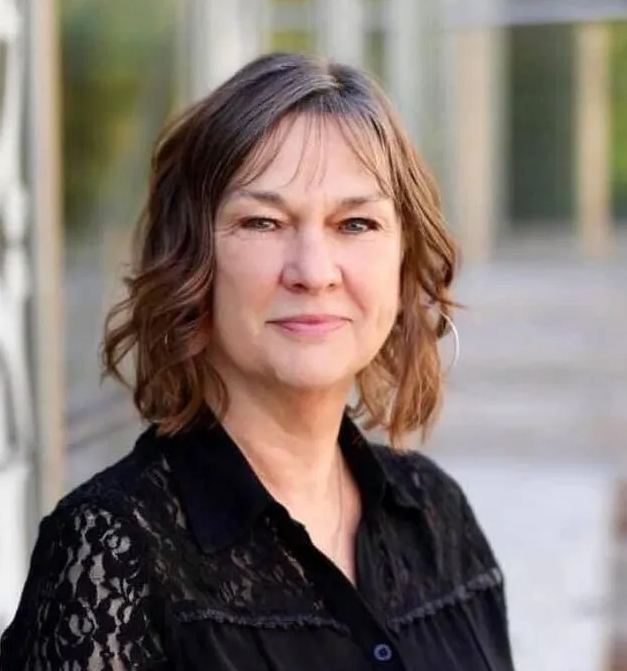
Author Susan Wadds.
More about Susan Wadds:
Winner of The Writers’ Union of Canada’s prose contest, Susan Wadds’ work has appeared, among other publications, in The Blood Pudding, Room, Quagmire, Waterwheel Review, Funicular, Last Stanza, WOW-Women on Writing, and carte blanche magazines,. The first two chapters of her debut novel, published by Regal House Publishing, “What the Living Do” won Lazuli Literary Group’s prose contest, and were published in Azure Magazine.
A graduate of the Humber School for Writers, Susan is a certified Amherst Writers and Artists (AWA) writing workshop facilitator.
She lives by a quiet river on Williams Treaty Territory in South-Central Ontario with an odd assortment of humans and cats.

Power Q & A with Carmela Circelli
Our Power Q & A guest today is Carmela Circelli—a Toronto psychotherapist and philosophy professor at York University, and also the author of the novel, Love and Rain (Guernica Editions, 2023). Love and Rain is a stunning story that explores the human cost of political ideology against the backdrop of the FLQ movement in Quebec and the Red Brigades in Italy. Carmela's work resounds with the depth and immediacy of the human psyche, and shows, with painful clarity, how we flail and suffer in times of civil unrest.
Our Power Q & A guest today is Carmela Circelli—a Toronto psychotherapist and philosophy professor at York University, and also the author of the novel, Love and Rain (Guernica Editions, 2023). Love and Rain is a stunning story that explores the human cost of political ideology against the backdrop of the FLQ movement in Quebec and the Red Brigades in Italy. Carmela's work resounds with the depth and immediacy of the human psyche, and shows, with painful clarity, how we flail and suffer in times of civil unrest.
Our question for Carmela is about this book’s irrepressible moodiness: of theme and language.
Q: We love what a deeply moody story this is: how the narration echos the internal unrest of the characters. Was this style something you consciously thought about while writing, or was it an unconscious response to the themes you were addressing?

The equally moody and goregous cover of Love and Rain, by Carmela Circelli.
Q: Numerous people have made the comment that they like the moodiness of Love and Rain. I find this very interesting, as it is not at all something I consciously strove for, or was even aware of till people started mentioning it. One thing I was aware of, is that I wanted to focus on the weather, that I wanted to address environmental concerns without being explicit about it. So I did set some of the scenes against the backdrop of extreme weather events. But I did not consider that, in some cases, this actually correlated with the internal, emotional states of the characters.
A couple of things come to mind, that might have unconsciously contributed to the 'moodiness' of the book. One has to do with the reason why I write, which is mainly to process big emotions that I have nowhere else to put. Of course, thoughts come into it too. But despite having a philosophical background, it's feeling and not thinking that compels me to write or makes writing something I cannot seem to live without.
When I first decided to write a novel, I was afraid that my philosophical studies would interfere with my ability to construct narrative, that I would fall into being abstract and dry, and be unable to create a sensuous, living world. But now, I think that maybe, even my philosophical interests may have unconsciously contributed to the 'moodiness' of the book. That is because Existential Phenomenology, which was my main area of study, is very much concerned with prioritizing and describing 'experience' of which mood and feeling are a central part. In the context of philosophy, I have written quite a bit about the importance of mood, about how moods are not just random states that interfere with the clarity of thought, but are in fact revelatory, and can tell us important truths about our existence. And now that I think about it, the chapter on Mara is a kind of explicit expression of that belief on the value of moods, and the importance of sometimes, just letting them be, rather than muting them with medications.
But no, none of this was conscious. I was just trying to tell a story and out it came, in a moody way.

Author Carmela Circelli.
More about Carmela Circelli:
Carmela Circelli was born in Southern Italy and grew up in Montreal. She has been teaching on contract for the Philosophy Department at York University for 30 years, and also works as a psychotherapist in private practice in Toronto. In 2014, Quattro Books published her philosophical memoir Sweet Nothing: An Elemental case for Taking out Time. Love and Rain is her debut novel.
More about Love and Rain:
Love and Rain is a novel that explores the nature of love, its pain, and the near impossibility of its enduring happiness. Moving back in space and time from Rome to Montreal in the sixties and seventies, it also traces the individual rebellion and social revolution that marked the FLQ movement in Quebec and the Red Brigades in Italy in the late 1970s. The power of love, music and politics intertwine in a tale that spells the mysterious alchemy of fate and chance.

Power Q & A with Gail Kirkpatrick
Gail Kirkpatrick is our esteemed guest for this Power Q & A. Gail is the author of the beautiful novel, Sleepers and Ties (Now or Never Publications, 2023)—a story about the importance of rebuilding community and friendships, and how these connections are often missing from (but necessary to) our everyday lives. This lack of connectivity is something so many of us feel, despite our increasingly digitally-tethered productivity-obsessed existences. We had to ask Gail: how does she take it slow?
Gail Kirkpatrick is our esteemed guest for this Power Q & A. Gail is the author of the beautiful novel, Sleepers and Ties (Now or Never Publications, 2023)—a story about the importance of rebuilding community and friendships, and how these connections are often missing from (but necessary to) our everyday lives. This lack of connectivity is something so many of us feel, despite our increasingly digitally-tethered productivity-obsessed existences. We had to ask Gail: how does she take it slow?
Q: Could you speak to your writing practice, which you’ve described as slow. How do you maintain and importantly, honour this pace, in a world that can often feel oppressively obsessed with speed? We’re also thinking of how the message in your book seems to encourage resisting this modern-day pressure, and reconnecting with ourselves and each other.

Sleepers and Ties, by Gail Kirkpatrick (NoN Publications, 2023)
A: Thank you for this most interesting question.
For the last many years I have lived within a five minute walk of PKOLS (Mount Douglas Park) on Vancouver Island. I have a very visceral need to be deep in the forest as often as I can be. Here nature keeps its own pace; the leaves fall when it is their time and the camus and white fawn lily bloom in their own season. This revealing, the mystery and magic is never hurried.
I believe that landscape plants itself in us if we allow it to. If in small measure I have somehow osmosed that process or that it is reflected in the way I work, and certainly as I’ve gotten older, in the way I connect with people, in patience or being a better listener, then I am very grateful.
Of course, when there are deadlines to meet, when I was the mother of young children, I got up early to get the day’s writing done in a two-hour window, or I wrote when everyone else was asleep. There was more pressure to hurry. Then, I mostly wrote short magazine pieces that didn’t need a whole overarching time-line or plot and character development. Still, I am not immune to checking my phone too often in the day, and when I am writing I often write ‘offline.’
In the case of my protagonist, Margaret, in Sleepers and Ties, she is trying to hurry through her grief, get her executor duties over with so she can get back to her job as a museum curator, get ‘back to her life,' whatever that is. Events take place that force her to slow down and to see with fresh eyes a changed and changing landscape, to examine her oldest friendship, her marriage, and the legacy of her sister, for whom she grieves. It is largely through taking time in the landscape in which she finds herself, both physically and emotionally and she is able to reconnect. I planted her there and as the work evolved, though I may have been honouring a pace, the words in my book were revealed at their own pace too.

Gail Kirkpatrick. Visit her website.
More about Sleepers and Ties:
Grieving museum curator Margaret returns to her childhood home to leave behind her sister Shirley’s ashes and attend the final reading of her will. Unbeknownst to Margaret, Shirley has left her eight million dollars and a letter asking Margaret to return to its former glory an abandoned railway line—a fanciful notion, everyone tells her, with no real legal binding. Embarking on an adventure that will test more than just an executor’s duty and loyalty to her sister’s legacy, Margaret is forced to make decisions now and for the future that will challenge and forever change a landscape, her career, her marriage, her friendships, and her very own legacy.
More about Gail Kirkpatrick:
After receiving her undergrad at the University of Victoria, Gail Kirkpatrick completed her MA in writing at Lancaster University where she explored the parallel and converging lines of memory, shared history, and landscape. Her writing has been published in various literary and trade magazines in Canada and the UK, and Sleepers and Ties is her first novel. She currently resides in Victoria, BC.

Power Q & A with Catherine Owen
The incomparable Catherine Owen is our guest for this Power Q & A, and we are honoured to welcome her. Catherine is a vital member of the CanLit community and she has published 16 collections in four genres. Today, we wanted to ask Catherine about her upcoming poetry collection, Moving to Delilah, (Freehand Books, April 1, 2024). Having been on 12 cross-Canada book tours, she’s chosen a distinctly different approach to launching this most recent collection, hosting salon-like in-home performances and discussions. We were fascinated and we had to ask: why?
The incomparable Catherine Owen is our guest for this Power Q & A, and we are honoured to welcome her. Catherine is a vital member of the CanLit community and she has published 16 collections in four genres. Today, we wanted to ask Catherine about her upcoming poetry collection, Moving to Delilah, (Freehand Books, April 1, 2024). Having been on 12 cross-Canada book tours, she’s chosen a distinctly different approach to launching this most recent collection, hosting salon-like in-home performances and discussions. We were fascinated and we had to ask: why?
Q: We are intrigued by your approach to introducing your new book, Moving to Delilah, to readers. We are wondering if you’d tell us more about the book, and the reasoning behind these intimate and interactive gatherings?

Moving to Delilah by Catherine Owen.
A: Moving to Delilah is a collection of poems about a Westcoaster buying and inhabiting a 1905 house in Edmonton, AB from 2018 to the present. The book is in three sections: Home, Garden, and Neighbourhood, each representing the challenges and joys of renovations, growing things, relationships and re-learning the parameters of space and place in an entirely alternate environment. The thematic undercurrent is the realities of economic itinerancy so many face in Canada now and the impossible housing market that has undoubtedly redefined notions of home. Having been on national tours for most of my books, I aim to shift my performative style and my approach to undertaking workshops with each one. Now, I've realized what I value most about being on tour is the chance not only to do readings but to gather with other artists in informal settings to read and discuss poetry and undertake material explorations that spur us to new ways of thinking and feeling, in this case, about the themes and forms of house and home. As Stephen Dunn reminds us, the usual "prompt-based" method behind workshopping can "regularize what should be rarified." With Moving to Delilah, I want to dance around the subject with those individuals who care to participate: drawing, assembling, resonating and articulating and leave the choreography of the poem itself to the later "rooms of their own."

Catherine herself!
More about Catherine Owen:
Catherine Owen is a Vancouver writer who now lives in Edmonton in a 1905 house where she edits, hosts the performance series 94th Street Trobairitz, reviews, and runs the podcast Ms Lyric's Poetry Outlaws. She's published 16 collections in 4 genres, including her latest, Riven (ECW 2020) and her next Moving to Delilah (Freehand Books 2024). She's been on 12 cross-Canada book tours, played bass in metal bands and worked in the BC film industry in the Props department.
More about Moving to Delilah:
In search of stability and rootedness, in 2018 Catherine Owen moved from coastal Vancouver to prairie Edmonton. There, she purchased a house built more than one hundred years earlier: a home named Delilah.
Beginning from a space of grief that led to Owen’s relocation, the poems in this collection inhabit the home, its present and its past. These poems share the stories of decades of renovations, the full lives of Delilah’s previous inhabitants, and Owen’s triumphs and failures in the ever-evolving garden. The poems ultimately whirl out in the concentric distances of the local neighbourhood and beyond — though one house can make a home, home encompasses so much more than one house.
In this exceptional and lyrical collection, Catherine Owen interrogates her need for economic itinerancy, traces the passage of time and the later phases of grief, and deepens her understanding of rootedness, both in place and in poetic forms.

Power Q & A with Niloufar-Lily Soltani
Zulaikha is the gripping and gorgeous debut novel by Iranian-Canadian author Niloufar-Lily Soltani (published by Inanna Publications). The novel takes place over a forty-year period of war and upheaval in the Middle East—specifically, in Zulaikha's home territory of Khuzestan, which boasts the bulk of Iran's oil reserves. We’re delighted to have Lily with us for this Power Q & A to talk about the inspiration for this book and her world-building through language.
Zulaikha is the gripping and gorgeous debut novel by Iranian-Canadian author Niloufar-Lily Soltani (published by Inanna Publications). The novel takes place over a forty-year period of war and upheaval in the Middle East—specifically, in Zulaikha's home territory of Khuzestan, which boasts the bulk of Iran's oil reserves. We’re delighted to have Lily with us for this Power Q & A to talk about the inspiration for this book and her world-building through language.
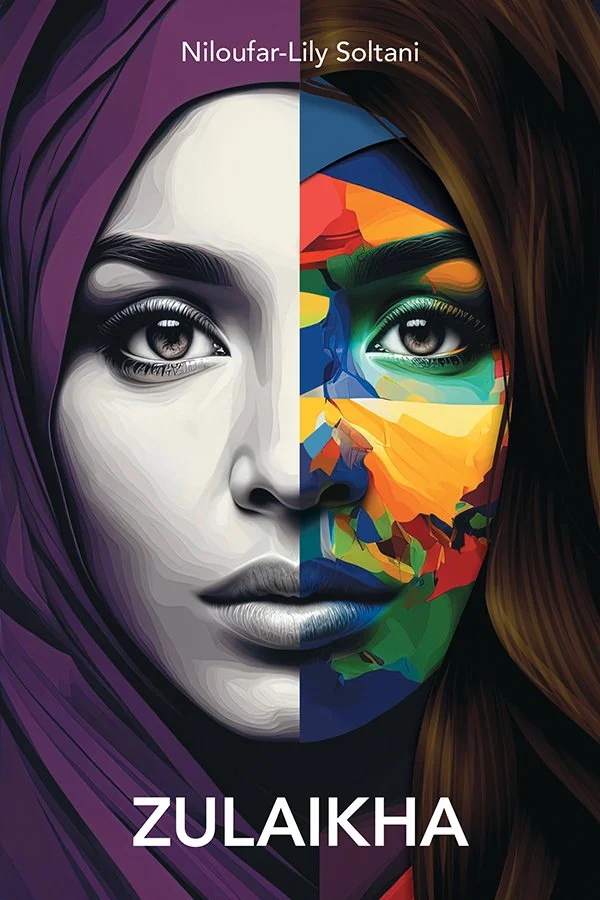
Grab Zulaikha from Inanna Publications.
Q: One of the aspects of your book we loved the most is how you immerse the reader in a world that is likely vastly different than the world many English-language readers are familiar with, and while making the story absorbing, you don't pander to these readers. The protagonist's name, Zulaikha, is a good example of this balance: it's not a name that's easy to pronounce for native English speakers—but you do provide a pronunciation guide. Did you consider this approach to be a risky one?
A: I have prepared for this question regarding Zulaikha's name since the beginning. "Zulaikha," pronounced as "Zuli-Ka," (approximately: the “kh” sound in Farsi is often difficult for English language speakers) is the title for my debut novel, a modern story characterized by its complexity, covering vast periods with numerous characters. A debut novelist should be extra careful about the risk-taking approach, which is why I gave this a lot of thought.
According to the textbooks, the title must be attention-grabbing, memorable, informative, and easy to say. Did my chosen title or my protagonist's name represent all these qualities? Certainly not at first glance.
The inspiration for "Zulaikha" came from my cousin. Certain aspects of her life, mainly Abadan, the place she was from, lingered in my mind for many years. Choosing any other name would have left me with a lingering sense of guilt. But I kept an open mind.
I began writing my first draft, not changing her name, but I picked most other characters' names, like Kia, Assef, and Abdul, as easy to pronounce as possible, in anticipation that an editor would ask me to change Zulaikha's name at one point. My first mentor was Karen Connelly at Humber Creative, whose editorial notes showed she was knowledgeable about the mythical figure. Neither did my publisher when they sent me their acceptance letter or later. I could be wrong then; people might be familiar with the historical figure, Zulaikha.
But no, there is no documentary, no movies, and very few mentions of this mythical figure in the popular media.
Comparatively, Cleopatra, another historical figure of the exact origin, enjoys widespread popularity in the West. Several debates surrounding how she looked like, Hollywood movies, classics, modern adaptations, and documentaries. This triggered me to introduce Zulaikha to Western audiences. Her sensational and provocative nature, along with the mysterious and fascinating love story with Joseph, deserves some attention. Jami's book of poetry, "Yusuf and Zulaikha," offers further insight, and I encourage additional research into the literary materials available.
There are several other difficult names in my novel, the names of the places, like Khuzestan province, Bakhtiari or Chaharlangi ethnicities. These difficult names are a part of our history, shaping the most important parts of the novel's setting and themes. Even in Iran, the name Zulaikha is rarely used in recent years. Like endangered species, our historical names and their cultural significance deserve our attempt to survive them.
Finally, in my risk-taking approach I chose to trust the readers, their open mind, or their eagerness to research would prove that if given a chance, Zulaikha, both in the historical/ mythical context and, hopefully, in my novel, is attention-grabbing, memorable, and informative.
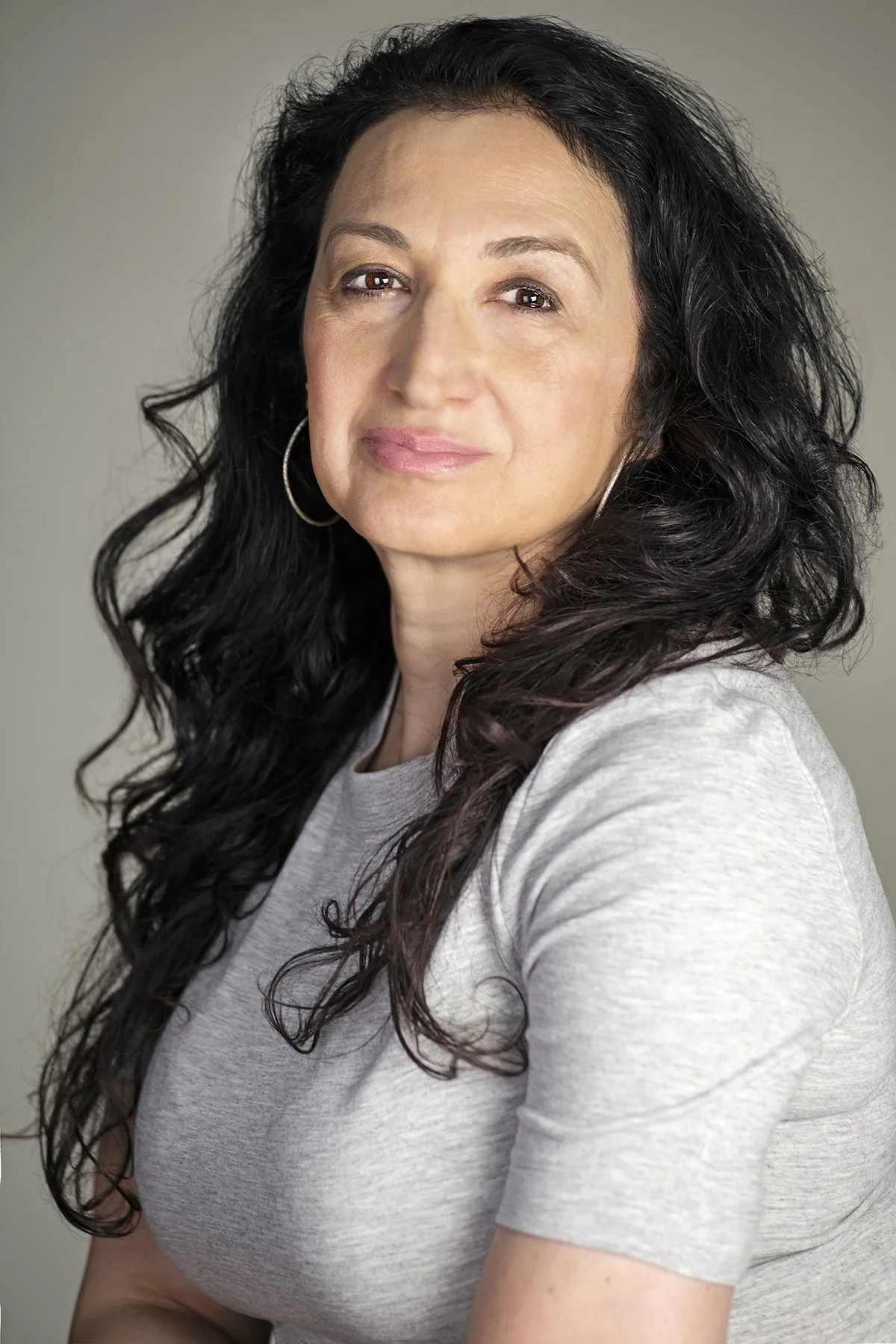
Author Niloufar-Lily Soltani.
More about Zulaikha:
In the winter of 2007, returning home from visiting her son in Amsterdam, Zulaikha accidentally runs into Kia, a family friend she hasn't seen for many years. Kia's father has passed away and he is flying home to attend his funeral. In a shocking twist, Zulaikha suspects that Kia may have had information about Zulaikha's missing brother, Hessam, who disappeared shortly following the murder of their mutual friend, Abbass, during the Iran–Iraq War. When the flight is suddenly cancelled, Zulaikha is taken into custody and questioned about her relationship with Kia by the European airport security. A day later, in Tehran, the Iranian authorities have their own agenda for intimidating her. A tense thriller explores the impacts of war and oppression through a sprawling, tender, imperfect love story, scored with the notes of the Arabic and Persian music and poetry that grace so many Middle Eastern lives.
More about Niloufar-Lily Soltani:
Niloufar-Lily Soltani is a fiction writer, poet and translator based in Vancouver. She is a graduate of the Humber College creative writing program. Zulaikha is her debut novel.

Power Q & A with David Neil Lee
Today we’re entering exciting new worlds on our Power Q & A! Join us in welcoming Canadian sci-fi author David Neil Lee to talk about his latest Hamilton, Ontario-based YA novel, The Great Outer Dark (published by Wolsak & Wynn, 2023).
Today we’re entering exciting new worlds on our Power Q & A! Join us in welcoming Canadian sci-fi author David Neil Lee to talk about his latest Hamilton, Ontario-based YA novel, The Great Outer Dark (published by Wolsak & Wynn, 2023).
Q: Tell us more about how your trilogy responds to and builds on the work of H.P. Lovecraft, with a particular focus on how real-world places and spaces are transformed into the sites of “cosmic horror”?
A: Lovecraft believed deeply in modernity – the idea that overall, European culture and its accompanying technologies were a tremendous force for good in the world. He was also an old-fashioned United Empire Loyalist who admitted he felt English at heart. In reality, he never had the money to actually visit the UK, but he had read a lot and was steeped in English literature.

Grab the Great Outer Dark from Wolsak & Wynn!
His belief in modernity is a big part of his work’s powerful imagery: modernity as a system that is staving off enormous dark extraterrestrial forces, although it doesn’t always succeed, and those forces break through.
You can see a literary response to this trope in Lovecraft Country. Lovecraft’s fiction says, “the human race is actually suborned to an enormous malignant power that is willing to let humanity exist only provided that no one tries to step out of its shadow or bring themselves to its attention, or god forbid, resist – then it will reach out and squash them.”
And the Black American response to that – at least in the Misha Green TV series, I haven’t read the Matt Ruff novel – is “tell us something we don’t already know!”
In the Midnight Games books, that extraterrestrial force – the Great Old Ones – was mysteriously repelled from Earth many years ago, and they’re struggling to get back and reassert their dominance. When Nate gets in trouble with the cult who are trying to help the Great Old Ones, he finds all sorts of people, including a local Persian family, and in The Medusa Deep, west coast Salish – are aware of the Great Old Ones and have their own ways of dealing with them.
I like sci-fi and horror settings that are very close to everyday life. In the trilogy, Nate and his Dad live in the same house my wife and I live in, two blocks from the stadium in east Hamilton. The North End, just across Barton with its diminished industrial base, vacant parking lots, overgrown train tracks etc., is very much a presence. Friends have even asked to be taken on tours of the routes Nate takes in the books, though when David Prentice and I did that, we had to scramble up an embankment to get out of the way of a freight train.
What this does, I hope is give a certain perspective on the powers that shape our own lives. It’s no coincidence that the name Raphe Therpens, the leader of the cult in the first book, that came out in 2015, is an anagram of a prominent Canadian political leader of the time.

David Neil Lee.
More about David Neil Lee:
David Neil Lee is a writer and double bassist. Originally from BC, he spent years in the Toronto art scene and on BC’s Sunshine Coast, and currently lives in Hamilton, Ontario. He has just finished a PhD in English at the University of Guelph. In addition to the Midnight Games trilogy, he is the author of Commander Zero, Chainsaws: A History, and The Battle of the Five Spot: Ornette Coleman and the New York Jazz Field.
More about The Great Outer Dark:
After his voyage across the galaxy, Nate Silva arrives home to find Hamilton in the grip of a monstrous triumvirate. The Resurrection Church of the Ancient Gods has returned, with the human form of the shape-changing nightmare from the Medusa Deep as its leader. And closely guarded in a downtown tower a mind-devouring entity called Oracle lurks. The city is infested with invasive species that have slithered into our world during the Church’s occult ceremonies – many-legged dritches, bat-like thrals and the eerie, flying night-gaunts. Caught in the middle of this are Nate’s friends Megan and Mehri, who are leading the resistance with the Furies, along with a mysterious double agent, the enigmatic Dr. Eldritch and his Cosmic Wonder Circus. For the safety of everyone he loves, Nate and his friend H.P. Lovecraft hijack the antique airship Sorcerer for one last voyage, to free Earth from the Great Old Ones once and for all.

Power Q & A with Kate Jenks
It’s a first on our River Street Power Q & A series: we have a children’s book author joining us! In our experience, we’ve found writing children’s books quite challenging, but kidlit author Kate Jenks (Beatrice & Barb, Kid Can Press, 2023) is here to make an important distinction and dole out some advice for those of us who may struggle writing this genre.
It’s a first on our River Street Power Q & A series: we have a children’s book author joining us! In our experience, we’ve found writing children’s books quite challenging, but kidlit author Kate Jenks (Beatrice & Barb, Kid Can Press, 2023) is here to make an important distinction and dole out some advice for those of us who may struggle writing this genre.
Q: Writing for children can be incredibly difficult. What is one thing you’ve learned to make it easier for you?
A: It’s not so much that I find writing for children difficult. In my experience, children are the very best audience. They’re often bolder, more enthusiastic readers than adults. If you give kids a really great story, one that’s worthy of their attention, they’re willing to take great imaginative leaps.
It’s more that the picture book as a form can be exceptionally challenging to write. Most people don’t realize, for example, that they’re are almost always exactly 32 pages long (including front and back matter), and are generally between 0 and 800 words long. Because of this, picture book authors must be masters of pacing, ensuring their stories have exactly the right number of beats, and that the story begin and end in just the right places. They need to know how and when to speed the action up and when to slow it down.

Beatrice & Barb by Kate Jenks. Kid Can Press, 2023.
Picture books share qualities with many different forms—they’re part short story, part poem, part comic book, part theater script— but they’re also unlike anything else. To write picture books well requires you to accept that what you’ve signed up for is a team sport, particularly if you are not also the illustrator. It is a bit like running a relay race — you do your part the best you can and then you pass the batton to the next runner.
A great picture book manuscript has to leave room for the artist to collaborate equally in the storytelling, but it’s a unique sort of collaboration, because traditionally author and illustrator are not encouraged to communicate during the creation of the book. You can include art notes in your manuscript if absolutely necessary, but adding too many of these is generally frowned upon. I do my best not to dictate what the pictures should look like, but instead to make sure the scenes I write are rich with visual possibility.
At the same time, picture books are oral texts as much as they are visual ones, because they’re so often read out loud. You’re essentially writing a script that parents, teachers, and librarians are going to have to preform. Because of this, you need to make sure your text is a pleasure to read, with sentences that flow, imagery that captivates, and, above all, jokes that land.
The very best picture books also leave lots of imaginative space for the reader. There should be gaps where they can decide what has happened, and what the story means. Failing to do this almost guarantees your book will not be picked up a second time.
All of this is a lot to hold in your mind when you sit down to write. It’s almost impossible to create anything that feels as loose and free as you want it to if you’re trying to consciously take all this into account. The trick, I’ve found, is to invest a great deal of time into studying other picture books I love, the ones I jealously wish I had wrote myself. I do this by typing them out into the same template I use when I draft my own stories. I look at how many words are in the manuscript, and consider what proportion of that word count is taken up with narration versus dialogue. I note how much time elapses over the course of the plot, and how many different settings there are. How many of the spreads consist of spot illustrations, moving the story along at a clip, versus how many are taken up by a single image depicting a single emotional beat. How many pages are wordless? How do the images relate to the words? How long are the sentences? Is there much repetition? How challenging is the vocabulary? What compels the reader to the page?
This practice has given me a reasonable grasp of the form, so that when I sit down to draft a story, a lot of these considerations are addressed by a more automatic part of my brain. It also means that when a manuscript isn’t working, I’m better able to diagnose and fix the problem myself before sending it off to critique partners or editors.
There’s another benefit, too. By closely reading the work of others, I have been able to cultivate my own tastes and to calibrate my own voice. Closely reading the work of others helps me understand where my writing sits in relation to the work of other authors, how it is alike and how it is different from what is already out there.
This gives me the best possible shot at achieving the ultimate goal—landing a manuscript in the center of the Venn diagram where the stories I feel compelled to tell overlap with the stories the market is hungry for. I’m not saying it allows me to do it every time—not even close! I’ve only had two “yeses” for the hundreds of “nos” I’ve endured. But it tips the odds just far enough in my favor to keep me moving forward.

The respledent Kate Jenks!
More about Beatrice & Barb:
In this heartfelt story of friendship, a young girl is determined to save her most unlikely pet. Beatrice desperately wants a pet of her own. Her mom has other ideas. No dog. No cat. No hedgehog. They finally reach a compromise, and Beatrice gets ... a Venus flytrap. Being a good sport, Beatrice makes the best of things. She gives her new friend a name, Barb. She does all the things with Barb that good pet owners do, such as taking walks and playing fetch. Only, now, despite all the love and care, Barb is starting to look sick, with black spots on her leaves and some parts of her turning mushy. Beatrice knows she has to find a way to save Barb. But how? The debut picture book from author Kate Jenks Landry offers a universal and powerful message about how to take care of those we love. It also celebrates differences, unique friendships and what makes each of us special (like how Barb needs to eat bugs to survive!). This story has strong curriculum connections to social-emotional learning and offers excellent character education lessons on caring, perseverance and responsibility. Vivian Mineker's illustrations are imbued with the soft greens of plant life and beautifully convey the warmth and affection at the heart of the story.
More about Kate Jenks:
Kate is a graduate of OISE, and of the MA in Creative Writing program at the University of Toronto. She's also the creator of the blog The Needle and The Knife, where she shares interviews with other creatives, exploring questions of craft, community, and creative process.
Her debut picture book, Beatrice and Barb, was published with Kids Can Press in October, 2023. Her second book will follow in spring, 2025.
Kate lives with her partner Michael, their children Zoe and Mae, and a wily bernedoodle named Leo in Kitchener, Ontario, on the traditional territory of the Neutral, Anishinaabe, and Haudenosaunee peoples.
Connect with Kate online:
Website: katejenkslandry.com
Instagram: @katejenkslandry
Blog: theneedleandtheknife.com

Power Q & A with Gary Barwin
Welcome Gary Barwin to our Power Q & A! Gary is, most recently, the author of Imagining Imagining: Essays on Language, Identity and Infinity (Wolsak & Wynn, 2023). This transfixing collection of personal essays offers a wide-eyed exploration of identity, language, belonging, and the unruly wonder of our existence. Gary’s writing is a timely and vital antidote to the desensitization of the news cycle, and a reminder of the importance of belonging—a topic as relevant now as ever.
Welcome Gary Barwin to our Power Q & A! Gary is, most recently, the author of Imagining Imagining: Essays on Language, Identity and Infinity (Wolsak & Wynn, 2023). This transfixing collection of personal essays offers a wide-eyed exploration of identity, language, belonging, and the unruly wonder of our existence. Gary’s writing is a timely and vital antidote to the desensitization of the news cycle, and a reminder of the importance of belonging—a topic as relevant now as ever.
We’re chuffed to have Gary here today to talk with us about what inspired this wondrous book.
Q: How did this collection of essays come to you? Did you always know it was going to be a book or did it just start with one essay, then another, then a theme began to take shape? Or something else entirely?

Bring home Imagining Imagining.
A: I was tricked, I tell you. I was tricked! I submitted an MS of poems with illustrations to Wolsak & Wynn publisher Noelle Allen and she agreed to publish it if I interleaved some essays between the poems. She’d been trying to convince me to write a book of essays for a few years but I never really felt the impulse. But poet me, blinded by the opportunity of publication, immediately agreed to her proposal. I had just submitted a draft of a novel to my agents and had a few months of waiting before they would report back, and so I began writing about whatever energized me. It was a revelation! I had so much to say, or rather, as soon as I began, I realized how much the act of writing, of being curious, of following the unfolding of the essays revealed to me. Connections that I had only vaguely intuited emerged. The energy of the language, of the possibilities of creative non-fiction, of form, captured my imagination and writing brain. And as I wrote more essays, I realized that I was making next-level connections between the different essays: in the way they were written as well as in their themes.
Of course, Noelle being an astute editor and a great judge of writers, knew that this would happen. Very quickly, I understood that I should ditch the poems (which weren’t that good anyway) because the essay collection had become its own thing. I also realized that I had some past writing (some speeches and some non-fiction) that belonged with the new work. I rewrote them in light of the just-written essays and then the entire book felt like it came from the same place, that it was defining its own book-space, its own essay-world. There were a few essays that Noelle wisely suggested that I omit, and I agreed with her. You know that thing when you show your writing to someone, secretly knowing that it isn’t that good, but, hoping against hope, that they will tell you it is marvelous and you’re a genius. I might have been tricked into writing these essays, but Noelle wasn’t tricked into including all of them. I’m so grateful that Noelle steered me toward the essay. I’m so thrilled to discover what it helped me discover, what new part of my writing self it brings out, how it facilitates such compelling exploration and discussion, how I have the opportunity as a writer to engage with readers in a new way.

Gary Barwin, Canadian icon!
More about Imagining Imagining:
In Imagining Imagining: Essays on Language, Identity and Infinity Barwin thinks deeply about big ideas: story and identity; art and death; how we communicate and why we dream. From his childhood home in Ireland to his long-time home in Hamilton, Barwin shares the thoughts that keep him up at night (literally) and the ideas that keep him creating. Filled with witty asides, wise stories and a generosity of spirit that is unmistakable, these are essays that readers will turn to again and again.
More about Gary:
Gary Barwin is a writer, composer and multidisciplinary, artist and the author of thirty books including Nothing the Same, Everything Haunted: The Ballad of Motl the Cowboy, which won the Canadian Jewish Literary Award. His national bestselling novel Yiddish for Pirates won the Leacock Medal for Humour and the Canadian Jewish Literary Award, was a finalist for the Governor General’s Award for Fiction and the Scotiabank Giller Prize, and was long-listed for Canada Reads. It was also optioned for TV by the Jim Henson Company. Barwin is a PhD in music and publishes and performs his work internationally.

Power Q & A with Gina Leola Woolsey
Welcome to our Power Q & A with the amazing Gina Leola Woolsey, author of Fifteen Thousand Pieces: A Medical Examiner’s Journey Through Disaster, published by Guernica Editions. Fifteen Thousand Pieces is a moving and fast-paced biography intertwining the Swiss Air disaster that happened off the coast of Nova Scotia with the life of the province’s Medical Examiner at the time, Dr. John Butt—a closeted gay man who was coming to terms with his own sexuality at the same time this tragedy was unfolding.
In this interview, we ask Gina about the challenges of telling this story.
Welcome to our Power Q & A with the amazing Gina Leola Woolsey, author of Fifteen Thousand Pieces: A Medical Examiner’s Journey Through Disaster, published by Guernica Editions. Fifteen Thousand Pieces is a moving and fast-paced biography intertwining the Swiss Air disaster that happened off the coast of Nova Scotia with the life of the province’s Medical Examiner at the time, Dr. John Butt—a closeted gay man who was coming to terms with his own sexuality at the same time this tragedy was unfolding.
In this interview, we ask Gina about the challenges of telling this story.
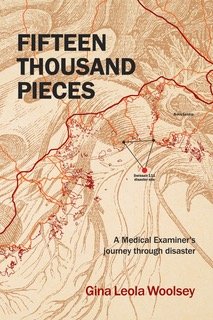
Bring home Fifteen Thousand Pieces.
Q: What was the most personally challenging part of writing this book?
A: This story of death teaching us how to live fell into my lap at the same time my husband was diagnosed with prostate cancer.
I met my subject, a forensic pathologist named John Clulow Butt, and we immediately hit it off. I was drawn to his story, and curious about how he chose his profession. How, and why, does a person who has gone through the rigours of medical school, and studied life-saving to the nth degree, decide to work with the dead? Of course, life isn’t ever that straightforward, and the answer to that question proved to be long and winding.
I traversed the country twice conducting interviews with several people who were a big part of Dr. Butt’s personal and professional life. I asked them probing questions about the deaths of sons, daughters, mothers, and fathers, all the while considering how it would feel to be the one answering. I often found it difficult to keep my emotions in check. Though I was already in my late forties when I started the work, I hadn’t been touched by the death of loved one yet. My husband’s illness was always at my elbow as I gingerly asked about grief and loss, wanting to understand, but afraid of the answers.
My husband’s prognosis worsened as I began to weave the story of Dr. Butt’s life together to form a compelling narrative. A person’s life is filthy with minutia, and I was searching for the thread to sew it all together while my life was coming apart. The cancer had spread and it was clear I would be a widow before the story I was crafting became a book. It was hard to stay on track, to find a reason to keep writing. But my husband was my biggest fan. He refused to let me give up. He died in August of 2018, at home, with my daughter and me by his side. Though he didn’t get to see the book published, he did read the completed manuscript two months before he left us. Fifteen Thousand Pieces is dedicated to him.

Gina, hard at work!
More about Gina Leola Woolsey:
CBC award-winning author Gina Leola Woolsey writes about people striving to find love, self-acceptance, and belonging in an ever-changing world. She left her corporate career mid-life to pursue an education in creative writing, earning a BFA from the University of British Columbia and an MFA from the University of King’s College. Currently, her time is split between her home in downtown Montréal, her birthplace in small-town Alberta, and her previous hometown, Vancouver.
More about Fifteen Thousand Pieces:
On Wednesday, September 2nd, 1998, an international flight carrying 229 souls crashed into the Atlantic Ocean off the coast of Nova Scotia. There were no survivors. By Friday, Sept 4th, thousands of dismembered body parts had come through Dr. John Butt's makeshift morgue in Hangar B at the Shearwater military base. The Chief Medical Examiner faced the most challenging and grisly task of his career. Five years prior to the plane crash, John had lost his prestigious job as Alberta’s Chief Medical Examiner. After 14 years of marriage, John began to think of himself as gay, but remained closeted professionally. Then, after serving a handful of years as Nova Scotia's Chief Medical Examiner, the devastating crash in Nova Scotia cracked his carefully constructed façade. Fifteen Thousand Pieces explores one man's journey to accept his true nature and find his place in the world. Chapters alternate between the fast-paced story of the crash, and the history of the man in the making. It is both fast-paced and introspective; gruesome and touching. Ultimately, it is the story of how death teaches us to live. Bring home the book.

Power Q & A with m. patchwork monoceros
mel patchwork monoceros wrote one of our favourite poetry collections of the year, Remedies for Chiron (Radiant Press, 2023). Remedies for Chiron is told through the eyes of a queer, disabled, Black poet trying to navigate love and an often inaccessible and inhospitable world. mel is also an immensely talented visual artist (their book cover features their gorgeous work) and we’re stoked to have them join us for this Power Q & A to talk about their work.
mel patchwork monoceros wrote one of our favourite poetry collections of the year, Remedies for Chiron (Radiant Press, 2023). Remedies for Chiron is told through the eyes of a queer, disabled, Black poet trying to navigate love and an often inaccessible and inhospitable world. mel is also an immensely talented visual artist (their book cover features their gorgeous work) and we’re stoked to have them join us for this Power Q & A to talk about their work.
Q: Are there intersections in your visual and written art?
A: While creating my first collection of textile works and accompanying poems, Point of Origin (2016), I worked on the series of quilts and tapestries for over a year, all the while composing text-kin to go with them when they were complete. I didn't know I had ADHD and was autistic at the time but I did recognize an interesting way of working. I was spinning stitches up to the last minute and despite having the poems held in my brain, I couldn't proceed with them until the textiles were done. A matter of days before opening, once the pieces had been delivered to the gallery I came home and finally had the mental clarity to sit at my typewriter and tap away all nights, scribing each of the 6 connected poems in the order of the textiles one after the other. Though the words weren't written in tandem with the creation exactly, the chaotic cosmos of my mind was working vigorously, holding the words until my hands could receive them. Sewing, weaving, etc. leaves ample room for thought mapping and scripting passages as they arise. Writing asks to have a tactile output often, to support puzzling any foggy elements out. Since then, while I haven't created an exactly analogous series of one-to-one text/iles or films there is an energy when I am in the creation-station zone that ignites the form next to it like kindling. It is all language to me and they are in constant conversation.
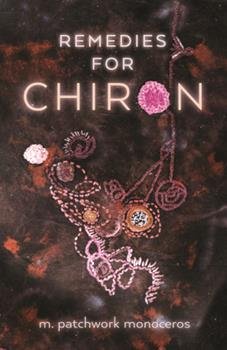
Bring home Remedies for Chiron from Radiant Press.
Q: What are you working on now?
A: I am mid-way into a new series of fiber portraits featuring microscopic views of frequented areas of my home. The series Mourning Microcosmmutes explores how as a disabled person and at-risk covid cautious person, my entire life has been within the walls of my home for nearly five years. Every year the pandemic continues and mandates and policies lessen, thus endangering immunocompromised people further. There is deep grief watching the world go on from behind my curtains. I have missed milestones, my own and my loved ones' because it is not safe for me to go to a mall much less get on an airplane. Myself and other covid shielders have felt and witnessed our lives shrink and shrink as more and more becomes toxic to our presence. We miss each other and understand with full comprehension why we may not see each other for years, possibly a decade, but it isn't easy, comfortable, enjoyable. A play on microcosm and commutes, my quilted photographs document spaces like stained glass squares, the transom between floors of different rooms, etc. and categorizes them in the context of going to a "workplace". I was able to exhibit a set of the pieces this Fall during Rendezvous With Madness festival at Workman Arts in Toronto. I will create the next set over the next few months. Other than that I am continuing tilling the turmoil of writing a memoir, eagerly anticipating tucking into my cozy writer cocoonland as the winter approaches and settles.

The respledent m. patchwork monoceros.
More about m. patchwork monoceros:
m. patchwork monoceros (Treaty 1/Winnipeg, MB) is a poet and polydisciplinary artist exploring tactility and somatic grief through text, fiber, and film. Their collection Remedies for Chiron (poetry, Radiant Press) was released in 2023.

Power Q & A with rob mclennan
rob mclennan is a CanLit institution and an iconic example of the power of good literary citizenship. In addition to being one of the most prolific writers we know, rob regularly amplifies the voices of other writers through his blogs. You can find more about rob below. For now, let’s get to the burning question!
rob mclennan is a CanLit institution and an iconic example of the power of good literary citizenship. In addition to being one of the most prolific writers we know, rob regularly amplifies the voices of other writers through his blogs. You can find more about rob below. For now, let’s get to the burning question!
Q: You have a new book coming out: tell us all about it and how/if it stems from any themes addressed in your earlier work.
A: Well, the new poetry title is World’s End, (ARP Books, 2023), out but a few weeks back. With “new” being a relative term, after all, this is a poetry title composed across the three years prior to the year I spent composing the book of smaller (University of Calgary Press, 2022). The poems across World’s End, (the comma is part of the title) work to articulate the space of moving beyond my twenty-five years of living in Ottawa’s Centretown to what was built as a 1950s suburb, into a house with recent wife and newborn, and subsequent newborn. “World’s End,” of course, is a term the British used for a pub that sat beyond the city’s gates, and with this particular move, I felt outside the boundary of what had long surrounded me, and the differences were worth examining. Just as much, this collection leans hard into structural examinations of the lyric sentence and the prose poem, something that subsequently evolved into a full collection of short, sharp, single-stanza prose poems with the book of smaller, a collection of poems entirely wrapped around being home full-time with two small children. While World’s End, focuses more generally on that space of newness (children, geography, travel, household etcetera), the book of smaller is more overtly focused on being home with a one-year-old and a toddler (after Christine returned to work post-maternity leave), composing poems on naps, walks, park outings and scattered reading. There’s always been a Frank O’Hara “I did this, I did that” element to my poems, although one that has evolved over the years to first focus on structure.

Order World’s End, from ARP.
Given I asked you for clarification on whether your question referred to the current work or the forthcoming one and you suggested I respond around both, I’ll mention I’ve a collection of short stories, On Beauty: stories, out next fall with University of Alberta Press. Each story is roughly three manuscript pages in length, sectioned across an accumulation of short, lyric prose bursts that examine elements of intimacy, silence and how small moments can impact future decisions. Nothing happens in any of these stories, but the lives of the characters within are simultaneously in motion: one never knows where any of these people might end up, and that’s what I find most fascinating about one step, one step and a further step. So much nothing is essential for absolutely everything.
I consider that my approach for writing always begins with language and literary structure—whether thinking about a particular shape of short prose or a line break or a consideration of the prose poem, for example—while elements of theme or content regularly echo across much of what I’m working on. The goal, naturally, is the perfect blend of form and content, with form always the particular prompt of any project or manuscript, approaching writing from the perspective of language and structure, and elements of story, content, theme, what have you, emerging through that process. For the book of smaller and World’s End, say, I’m not deliberately or overtly working to write on fatherhood, geography or family, but utilizing that material as a means to a particular end, perhaps. I approach from language and structure, and themes emerge: home, family, domestic, reading, history, poetic structure. There are certain arguments that writers, no matter what they produce throughout their lives, are but working on a single, extended work, and that might possibly be true of me as well. I’m currently fifty or so pages into working a book-length genealogical non-fiction project, examining my own genealogical threads and my own potential implications around such, structured around the form of a research-heavy lyric essay. It all goes back to the beginning.

The indomitable rob mclennan.
More about rob mclennan:
Born in Ottawa, Canada’s glorious capital city, rob mclennan currently lives in Ottawa, where he is home full-time with the two wee girls he shares with Christine McNair. The author of more than thirty trade books of poetry, fiction and non-fiction, he won the John Newlove Poetry Award in 2010, the Council for the Arts in Ottawa Mid-Career Award in 2014, and was longlisted for the CBC Poetry Prize in 2012 and 2017. In March, 2016, he was inducted into the VERSe Ottawa Hall of Honour. His most recent titles include the poetry collection World’s End, (ARP Books, 2023), a suite of pandemic essays, essays in the face of uncertainties (Mansfield Press, 2022) and the anthology groundworks: the best of the third decade of above/ground press 2013-2023 (Invisible Publishing, 2023). His collection of short stories, On Beauty (University of Alberta Press) will appear in fall 2024. An editor and publisher, he runs above/ground press, periodicities: a journal of poetry and poetics (periodicityjournal.blogspot.com) and Touch the Donkey (touchthedonkey.blogspot.com). He is editor of my (small press) writing day, and an editor/managing editor of many gendered mothers. He spent the 2007-8 academic year in Edmonton as writer-in-residence at the University of Alberta, and regularly posts reviews, essays, interviews and other notices at robmclennan.blogspot.com

Power Q & A with gillian harding-russell
On this Power Q & A, we are absolutely chuffed to welcome the wonderful Saskatchewan poet, gillian harding-russell, who answers our question about how her visually stunning poems take shape on the page. gillian’s 2018 poetry collection, In Another Air, was published by Radiant Press, and her 2020 collection, Uninterrupted, was published by Ekstasis Editions. Both were short-listed for Saskatchewan Book Awards.
Welcome, gillian!
On this Power Q & A, we are absolutely chuffed to welcome the wonderful Saskatchewan poet, gillian harding-russell, who answers our question about how her stunning poems take shape on the page. gillian’s 2018 poetry collection, In Another Air, was published by Radiant Press, and her 2020 collection, Uninterrupted, was published by Ekstasis Editions. Both were short-listed for Saskatchewan Book Awards.
Welcome, gillian!
Q: When thinking of how a poem should present itself on the page, how do you make decisions about a poem’s appearance?
A: My first answer is that I allow the poem to shape itself – I do not make conscious decisions about the poem’s presentation ahead of writing it. Since the eye and convention have taught me to read left to right, I do, however, favour a left justification and use the left margin as a point of departure for various kinds of expression.
Some poems write themselves in longer meditative or narrative lines. As an example, the voice in “Returning from the dead” (In Another Air, Radiant Press) uses longer lines to tell a story that begins with the refurbishing of the warships, the Erebus and Terror, that would take Franklin on his infamous last expedition. Similarly, “My Dearest John,” which is a fictitious letter written by an imagined fiancée of the shipboy John Hartnell who died on Beechey Island, uses long reminiscing and candid lines with dream imagery that carries the speaker’s voice, and I hope at once captures her first love and her need to carry on without him, her torn conscience and honest sentiments.

Some poems write themselves in short lines, as for example “Like an Albatross across the Beaufort” and “Off Track between Back Bay and Frame Lake” – which, interestingly, both have long titles! In these poems the images shape the verses and the short lines allow us to pause and reflect on particular images, whether it is a fox’s hole near the path or the implicit image of an albatross that finds its way into a poem about receding icebergs. One of the poems with the shortest lines is “Raven at -40” in which the quick images in the first stanza are intended to catch the reader’s attention to tell a story rather rapidly while assembling the details. Also, the short verses capture a tempo for wit. The raven plays a trick on the light sensor by sitting on it to make it turn on in Yellowknife where it is cold and the light is short in the depth of winter. Here, again, the length of lines and the dimensions of the poem are not a conscious decision but instead a reflection of the voice in the particular poem.
Some poems are written in irregular lines, some short and others longer, and an example might be the poem “Albatross” in which an albatross is discovered filled with plastic and has died of an artificial hunger due to our industries’ mismanagement. The long and short lines are intended to capture the solemnity and curt facts of the bird’s death, while alluding to a larger environmental situation against the echo of a literary albatross. Another poem with dramatically irregular lines is another raven poem, “Raven Talk” in which the idea is to capture the raven’s raucous and lively, not predictable and unfathomable intelligence that is “other” than our own.
Although I have never set out to write a shaped poem, there is one in In Another Air. As I started writing “Inukshuk,” I found myself thinking of that landmark, and so the poem shaped itself around its subject. An inukshuk is a type of landmark used widely in the north in which stones are placed on top of each other and often in a human-like form with a headstone. Although the poem begins in a single column to resemble its subject matter, the base of the pedestal is left-justified on one side and parted with another leg-like column to suggest that it may be walking over the landscape. I suddenly wanted the inukshuk in the poem to stride into life!
Last, there is a prose poem. Although prose poems for some poets may simply be poetic short prose, I tend to make breaks as in more traditional verse where the enjambments dramatize the action or the content in some way. And here I would point to “Outer Galactic Reports from Planet Z3” as an example of a prose poem with un-accidental line breaks. The block shape of the two reports, “Preliminary Report (2025 C.E.)” and “Secondary Report (3018 C.E.)” is also intended to suggest either a journalist’s or scientist’s reporting in the future.

The respledent gillian harding-russell.
More about gillian harding-russell:
Regina poet, editor and reviewer gillian harding-russell has published in journals across Canada and her poems have been anthologized in seventeen anthologies. Her most recent collections include In Another Air (Radiant Press, 2018) and Uninterrupted (Ekstasis Editions, 2020), both shortlisted for Saskatchewan Book Awards. In 2016, the suite “Making Sense” won first place in the Gwendolyn MacEwen Chapbook Award. A short chapbook, Megrim (The Alfred Gustav Press) was released in 2021.

Power Q & A with Mariam Pirbhai
For this Power Q & A, we’re delighted to be joined by author and academic, Mariam Pirhabi, to talk about her lastest book, Garden Inventories: Reflections on Land, Place and Belonging (published by Wolsak & Wynn). In this book, Pirbhai looks carefully at the pocket of land she has called home in Southern Ontario for the past seventeen years, which she notes is a milestone for her, and asks how long it takes to be rooted to a place? And what does that truly mean? Today, we ask her about the roots of this beautiful book.
For this Power Q & A, we’re delighted to be joined by author and academic, Mariam Pirhabi, to talk about her lastest book, Garden Inventories: Reflections on Land, Place and Belonging (published by Wolsak & Wynn). In this book, Pirbhai looks carefully at the pocket of land she has called home in Southern Ontario for the past seventeen years, which she notes is a milestone for her, and asks how long it takes to be rooted to a place? And what does that truly mean? Today, we ask her about the roots of this beautiful book.

Grab a copy of Garden Inventories wherever books are sold, including directly from the publisher at Wolsak & Wynn.
Q: What inspired you to write this book and would you say there was a certain reader you were writing it for?
A: I’m of the view that a book is inspired by an amalgamation of experiences and reflections. For me, the pivotal experience is the fact that I lived in several other countries and continents before my family immigrated to and settled in Canada. This got me thinking about how, as first-generation immigrants, we task ourselves with trying to determine what it means to belong to the cultures and communities of an adopted country, but we leave little energy to focus on what it means to belong to or interact with the land—that is, its natural environment, its sense of itself as a geographic space, and also how that space is shaped and reshaped, often destructively so, by multiple waves of human migration and settlement, including our own. So, in fact, the first inspiration was a set of questions I posed for myself: what is your relationship to this land? And how does your awareness, as someone who has also lived in some very different lands (e.g., Pakistan, England and the Philippines), inform or influence the way you have come to see Canada and its landscapes?
In a book titled Garden Inventories, it goes without saying that the other major inspiration for this book is nature and gardening. As my husband and I really started to dig, so-to-speak, into this wondrous world of creating a garden, we quickly realized just what novices we were, and just how little we understood about gardening in a place that is considered the most southerly region of Canada and yet also a distinctly northern environment with a fleeting growing season. We realized that this land has a lot of stories to tell us, not only through plants and the history of plants in this place, but also through the wider environment to which our gardens are invariably connected—from storm drains to neighbourhood creeks, to woodlands and conservation areas. In fact, while this is a book inspired by gardening in a southern Ontario suburb, it is not, by any means, written by a gardening expert! Far from it, it is a book about what it means to take that first tentative step into a garden and, with it, into a land. This was my inspiration, I suppose: the journey that gardening has set me on. It’s both like and unlike all of my other migrations: on the one hand, I know it will be a constant journey because that is what is so magical (and challenging) about gardening: the nature of nature is change, so the learning curve is not only steep but perpetual. On the other hand, gardening has invited me to stand still for a moment and, perhaps for the first time in the 30+ years I’ve lived in Canada, helped me rethink my original question: namely, instead of asking, what is my relationship to this land, I now ask, what does it mean to bear the gift of this land in my earth-scented fingertips?
My answer to your second question about readers goes something like this: this book is for anyone who lives and walks through the natural world that is their proverbial backyard and takes their sense of place in it for granted; and this book is for anyone who lives and walks through the natural world that is their proverbial backyard and takes their sense of outsidership in it for granted. That is to say, this book is intended for everyone.

Mariam Pirbhai in her garden.
More about Garden Inventories:
Seeing the landscape around her with the layered experience of a childhood spent wandering the world, in Garden Inventories, Pirbhai shares her efforts to create a garden and understand her new home. From the strange North American obsession with non-fruiting fruit trees to the naming conventions of plants that erase their heritage, she casts a sharp eye on the choices that have shaped our gardens, and our society. Pirbhai considers wildflowers and weeds, our obsession with lawns, the choices in our plant nurseries and even our Canadian dedication to the cottage with warmth and humour. The result is a delightful collection of essays that invites the reader to see the beautiful complexity of the land around us all in a new way.
More about Mariam Pirbahi:
Mariam Pirbhai is an academic and creative writer. She is the author of a newly released book of creative nonfiction titled Garden Inventories: Reflections on Land, Place and Belonging (Wolsak & Wynn, 2023), a debut novel titled Isolated Incident (Mawenzi 2022) and a short story collection titled Outside People and Other Stories (Inanna 2017), winner of the Independent Publishers’ and American BookFest awards. She is Full Professor in the Department of English and Film Studies at Wilfrid Laurier University, where she specializes in postcolonial literatures, diaspora studies and creative writing. She is the author and editor of pioneering scholarly works on the global South Asian diaspora and its literatures, including Mythologies of Migration, Vocabularies of Indenture: Novels of the South Asian Diaspora in Africa, the Caribbean, and Asia-Pacific (University of Toronto Press, 2009). From 2017-2019, she served as President of the Canadian Association for Postcolonial Studies (formerly known as CACLALS, the Canadian Association for Commonwealth Literature and Language Studies), Canada's longest-running scholarly association devoted to postcolonial and global anglophone literatures. Mariam was born in Pakistan and she and her husband live in Waterloo, ON.

Power Q & A with Amanda Earl
We’re thrilled to have fellow creative misfit and community builder Amanda Earl join us today to talk about her incredible Small Machine Talks podcast, which celebrates and amplifies the voices of artists who have been traditionally excluded from conversations on creation and focuses on the joys and frustration of the creative process.
Welcome, Amanda!
We’re thrilled to have fellow creative misfit and community builder Amanda Earl join us today to talk about her incredible Small Machine Talks podcast, which celebrates and amplifies the voices of artists who have been traditionally excluded from conversations on creation and focuses on the joys and frustration of the creative process.
Welcome, Amanda!

Q: One of the things that strikes us about your podcast is how it seems to be artist-centric. What we mean by this is that while it is absolutely relevant for people who don’t live and work in the arts (and would be a powerful way for them to tap into this creative force in their world) it is especially honed into the process of creating, as opposed to a promoting a marketable finished product. Is this an angle you intentionally set out to pursue, or one that arose organically?
Also, your new book! Tell us about it!
A: The Small Machine Talks, since its beginning in 2016, has always been at the intersection of community and creativity. Over the years, we have moved from focusing on the poetry scene of Central Canada to prioritizing creators and cultural workers who have been systematically excluded from the literary canon all over the world. This falls in line with the mission of AngelHousePress, the sponsor of the podcast. All of AngelHousePress’s activity is centred on promoting and publishing these voices.
I started AngelHousePress in 2007 to be what I expected would be a press that made chapbooks. We did that for several years, along with two online magazines: NationalPoetryMonth.ca to celebrate poetry beyond borders and boundaries, and Experiment-O to celebrate the art of risk, with a separate imprint for transgressive prose, DevilHouse.
Through the work we were doing, and my other creative endeavours: writing and editing poetry, prose and visual poetry I learned about many writers, artists and visual poets from all over the world. After a few years, I started to publish chapbooks by writers and visual poets outside of North America, which I loved to do, but shipping overseas to contributors and their fans is expensive, and my husband and I live in a small apartment. We don’t have room to store chapbooks.
With AngelHousePress, I didn’t want my focus to be publishing only Canadians or locals. I do this already with Bywords.ca, a twenty-year-old online magazine and site that publishes poetry by current and former Ottawa students, residents and workers and promotes Ottawa’s thriving literary, spoken word, storytelling and nonfiction events through a calendar.
I liked what we were able to do with our online magazines, NationalPoetryMonth.ca and Experiment-O. I liked that we didn’t have to limit ourselves to a small number of copies as we did with chapbooks, or black and white only, and that we could publish creators from all over the world, especially those who are being systematically excluded by the literary and artistic canons.
For Bywords.ca, we’ve always been able to pay our contributors, thanks to funding from the City of Ottawa. For AngelHousePress, because we do not focus on just one specific region or genre, we aren’t eligible for funding.
We didn’t pay our contributors until 2021, when we launched The first AngelHousePress Caring Imagination crowdfunding campaign. We combined this campaign with the promotion of small presses around the world, who have generously donated bundles of limited edition chapbooks, books and merchandise to help us raise money to pay our artists. The campaign was successful and has now become a regular part of our program, taking place in February yearly so that we can pay contributors for both NationalPoetryMonth.ca and Experiment-O.
I think paying artists is important, particularly those who are systematically excluded. As Jacqueline Valencia writes, “"Many writers of colour struggle to get a foot in the door of the literary scene and do not have the privilege of giving away their time and labor for free." Conceptualism in the Resistance, The Town Crier, Puritan Magazine, April, 2017.
In 2022, we were able to start a site, https://caringimagination.com/, which provides resources for creators and cultural workers who want to do their work with compassion. It includes links to resources with advice about choosing sensibility editors, workshops and residences for BIPOC writers, making accessible sites, writing descriptive text and more. I also have a bit of money that was donated separately that I’m using to commission guides, aimed directly at writers and artists. We have had two guides so far, one by me on running a crowdfunding campaign, and another by Rae White on gender inclusivity recommendations for literary events and festivals.
The Caring Imagination has an advisory committee made up of women and nonbinary artists from Australia, Canada, India, UK, and USA.
Other AngelHousePress initiatives are an essay series on AngelHousePress.com.
I am very happy with what we’ve achieved and will achieve in the future with lots of learning and listening to the voices that matter. AngelHousePress is a defiant and feisty intersectional feminist, queer and quirky small press, a home for those that have been silenced for too long.
Beast Body Epic is a collection of long poems provoked by my near-death health crisis in 2009. I published it through AngelHousePress and it came out in September. Beast Body Epic is for anyone who’s circled the drain or knows someone who has. The book is about having the shit kicked out of you and surviving. More information is available on AngelHousePress.com. There will be a virtual reading from Beast Body Epic on Sunday, November 12, 2023 2pm EST with Amanda, Sandra Ridley and Christine McNair. You can sign up here: www.tinyurl.com/beastbodyepicNov1223

More about Amanda:
Amanda Earl (she/her) has been a working writer in multiple genres for over twenty years. Her mission is whimsy, exploration, and connection with fellow misfits. She has published poetry, visual poetry, short fiction and a novel. Earl is a pansexual polyamorous feminist writer, visual poet, editor, and publisher who lives on Algonquin Anishinaabeg traditional territory. Earl is managing editor of Bywords.ca, editor of Judith: Women Making Visual Poetry (Timglaset Editions, Sweden, 2021) and fallen angel of AngelHousePress.
Her poetry books include Beast Body Epic (AngelHousePress, 2023), Trouble (HemPress, 2022), and Kiki (Chaudiere Books, 2014; Invisible Publishing, Canada, 2019). In 2024 a digital chapbook entitled Seasons, an excerpt from Welcome to Upper Zygonia will be published by Full House Literary.
More information is available at AmandaEarl.com and https://linktr.ee/amandaearl. You can also subscribe to her newsletter, Amanda Thru the Looking Glass for sporadic updates on publishing activities, chronic health issues and the inner workings of AngelHousePress, calls for submissions and more.
Social Media:
https://twitter.com/kikifolle
https://www.facebook.com/AmandaEarlWriter
https://www.instagram.com/earlamanda
https://zirk.us/@AmandaEarl
amandaearl.bsky.social

Power Q & A with Maria Zuppardi
Maria Zuppardi, host of the Publisher’s Weekly recommended podcast, Get (Can)Lit, joins us today to talk about one of our favourite bookish topics ever: small press CanLit. Her answer to our question about reading books from small presses astounds and reminds us of why we started reading in the first place: to lose a bit of ourselves, and find a bit we never knew existed.
Maria Zuppardi, host of the Publisher’s Weekly recommended podcast, Get (Can)Lit, joins us today to talk about one of our favourite bookish topics ever: small press CanLit. Her answer to our question about reading books from small presses astounds and reminds us of why we started reading in the first place: to lose a bit of ourselves, and find a bit we never knew existed.
Welcome, Maria!

Get (Can)Lit—listen now!
Q: You’re obviously a voracious reader and one who vehemently supports small press CanLit. What would you tell someone who only reads—or reads predominantly—books by multinationals, to get them into reading more books by indie presses?
A: I have so many thoughts on this, what a topic to discuss! For those who read books that get all the social media hype, or the best placement in bookstores, congratulations, because you just fell for some great marketing plan that’s been in action for literally months. No shade though, because I’ll be honest, I totally fall for those blockbuster reads as well. I can’t deny reading a book I’ve seen a million times! But that’s what drives Big 5 publishing today - thousands of dollars (perhaps even hundreds of thousands?) being poured into printing ARCs, mailing costs, paid advertising geared towards librarians and booksellers, NetGalley costs and ads, conference fees, author travel….all to make sure that one of the books you read is THEIR book. By the time the book gets published, it’s all we see until the next big thing releases, and it’s up to us consumers to make up the financial hole this book is in, and help balance out those accounting reports for the publishers, or not.
It’s easy to walk into a bookstore or library and pick up the first thing we see because it’s on a table or other display, or on sale for that matter. But you know what? If you take your time and get lost in those bookshelves, you’re guaranteed to find a hidden gem, and it might not even be a book you’ve ever heard about! If you want to be a little more conscious of the types of books you read, here are my best tips:
Do a little bit of research. Simply googling “Toronto authors” or whatever province you live in will yield results, which will ultimately land you on an independent publishers list. We’re known for championing local authors before they’re snatched up by the Big 5!
Find out who your independent presses are. Again, a simple Google search that you can tailor to your needs. Canada has so many different types of publishers who specialize in unique books like travel, poetry, nonfiction, or again, specifically local authors.
Ask your local bookstore. Booksellers at indie bookstores are THE BEST. They know anything and everything about what you need even before you know you should read it. They have to be magical beings of some sort, I swear! Indie bookstores always keep indie presses in stock, and they are huge supporters for local indie authors. If you don’t have a local bookstore near you, you can always send them an email or see what types of books are on their social media, and find some new reads through there.
Scope out literary festivals. Even if you can’t attend, there’s always a great mix of Big 5 and indie press authors. See who’s on what panel, find out who published what and pick up that book that interests you. Just don’t regret not going to see the author talk about their book live when you had the chance!
At the end of the day, making slight behaviour changes to how you shop in bookstores or search for books online will go a long way. Authors from independent publishers face a unique set of challenges in the industry, and their books deserve to be read as much as anyone else. Especially for BIPOC authors. It’s so tough at the Big 5, let alone at an indie. But I promise you, #DiverseCanLit from Canadian publishers is literally superior to anything else that comes out internationally. Give it a try, agree with me, and keep buying those books from independent publishers! And when you find that little press you love, champion them on your own social media, share their books with others. You’ll have a very appreciative author, and press, behind you!

More about Maria:
Maria Zuppardi is an avid reader, book lover, and coffee drinker in Toronto. You can find her talking about all books at @readingmaria, and also talking about Canadian authors on the Get (Can)Lit Podcast available on your favourite platform.