

BLOG
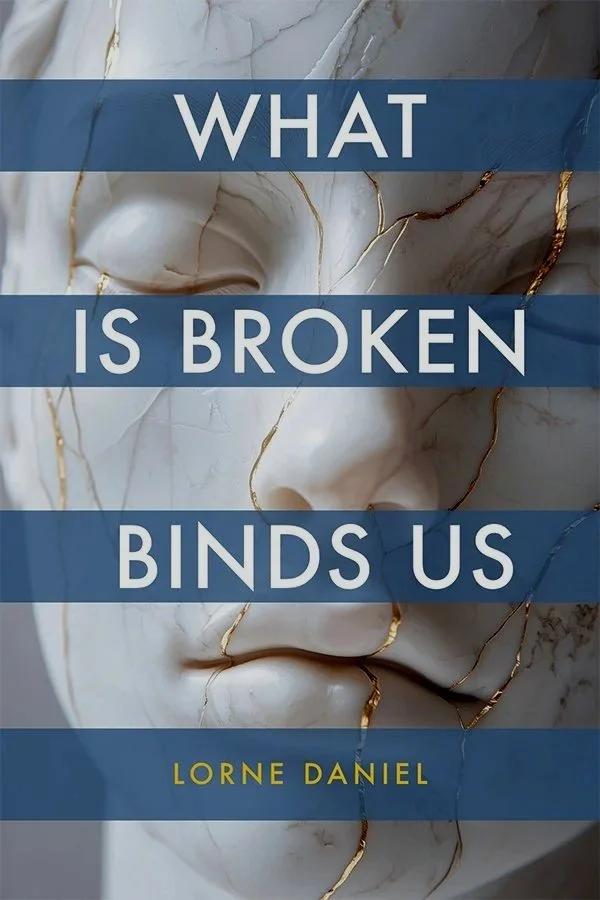
Addiction, Family, and the Story Behind Lorne Daniel's What is Broken Binds Us
“I initially wrote the story of our family’s journey purely to record what was happening as it happened,” says poet and retired communications consultant Lorne Daniel about his poetry collection What is Broken Binds Us. “The addictive behaviours, the anger, the borderline housing challenges disrupted and changed week by week, month by month, over years and stretched into decades,” he says of one son’s journey. “While we tried to support him, it was often a real challenge to track what was happening, even to track where he was.”

Excerpt from Votive by Annick MacAskill
Votive considers various forms of devotion and our often fraught attempts to respond to “our confusion, our curiosity.” These are poems concerned with the way we use stories, old and new, to connect our experiences, and the way we persist in our quest for love, hope, and meaning when language falters —“What we couldn’t say we found in the skies.” MacAskill’s great gift resides in her facility for coaxing things evasive and intuitive into crisp form and language, in voicing what “so quickly I /knew and knew and knew.”

Excerpt from Long Exposure
After Hurricane Katrina, the photographer Robert Polidori flew to New Orleans to document the devastation. In the wreckage he witnessed, and in her questions about what she saw in what he saw, Stephanie Bolster found the beginnings of a long poem. Those questions led to unexpected places; meanwhile, life kept pouring in. The ensuing book, Long Exposure, is Bolster’s fifth, a roaming, associative exploration of disasters and their ongoing aftermaths, sufferings large and small, and the vulnerability and value of our own lives. Incremental, unsettling, Long Exposure rushes to and through us.

Power Q & A with Sean Minogue
I know I’m hardly the first writer to use my hometown as a setting for a fictional story. I came upon this totally by accident, though. When I set out to “become” a writer in my early twenties, I was trying to latch onto anything except where I grew up. And that’s not because I had negative feelings about Sault Ste. Marie – I just hadn’t processed anything about my experiences there.

River Street Reviews: Mariam Pirbhai reviews In Crisis, On Crisis: Essays in Troubled Times by James Cairns
Tell me, who would you want by your side at a time of crisis, personal or other?
I imagine it might be someone to help navigate us through this haze of unpredictable futures and tempestuous presents with collective wisdom culled from an informative range of sources: political, historical, philosophical, economic, sociological, classical, contemporary, local, global. Someone perspicacious enough to ably distil this gathered knowledge but introspective enough not to look for easy answers, pat solutions. Someone who can anticipate your various and sundry interrogations and objections—all those what ifs, why-nots and buts—with openness and latitude.

Excerpt from Ajar by Margo LaPierre
Do you like my braids? Pinterest taught me.
Curls come tumbling.
I have a room just for this. Night terrors and vanity.
Pigeons, rroux rroux.
Rroux, rroux. It sounds like American poets.
Sounds like opaque familiarity.

Power Q & A with Lorne Daniel
Some of the poems about family estrangement in this book started simply with me wanting to record what was going on – to create a record. But then, I have an urge to do more with it, to explore the nuances of the experiences and to create relationships.
Excerpt from A Quilting of Scars by Lucy E.M. Black
Larkin was fifty-one now, almost the same age as his father was when he’d died a quarter century before. And in the last while Larkin had been thinking about his own mortality. About how the past could feel more present the further away you got from it.
Larkin turned and stood motionless, looking at the dark that hid the open fields and beyond them the dense bush surrounding the farm. He was remembering.

Excerpt from The Character Actor Convention by Guy Elston
My sister says How could you
bring a child into this world.
I get it—not like galvanised iron
is the ideal nest lining.

Power Q & A with Guy Elston
To put it simply, because I’m not that interested in myself. Which isn’t true, of course – what poet isn’t obsessed with themselves – but perhaps I'm not that interested in the front-facing, autobiographical concept of ‘Guy Elston’. Memory, identity, the cause and effect of life and its happenings – it’s all a sheer mountain face, senseless. I need an angle, a longer way round.

Power Q & A with Christy Climenhage
I hope that readers will take away the idea that just because we are capable of doing a thing, doesn’t mean we should do the thing. We need to use our own critical thinking and ethical judgement to determine our way forward and make decisions in a complex world. We live in an era of marvels where so much is possible. But just because something is possible doesn’t mean that it serves any kind of public good. We shouldn’t do it just because we can. This applies to genAI, it applies to resurrecting dire wolves (which were not resurrected at all, not really), and it applies to deep-sea mining. And of course, it applies to the central premise of my novel – adapting humans to live in the ocean depths.

Power Q & A with Aamir Hussain
The core inspiration of the story does come from my lived experience of coming from a family of Muslim women who are incredibly accomplished in many different fields and my attempt to reconcile this with the image of my faith in the West of being incredibly misogynistic and oppressive towards women. An image that has been a part of Western culture for hundreds of years but came into prominence as a part of the incessant drumbeats successfully justifying wars against Muslim Majority countries for the past few decades.

Power Q & A with Kevin Andrew Heslop
The work of a good book or a good art or an et cetera is to make it harder to live, to invite the reader to stretch beyond the settled narratives and reduplicative forms to which they’ve become habituated, an injunction ever the more keen in a world so stricken with capitalist call and response, itch and scratch, that the moral obligation to look longer, allow greater complexity to be revealed, and not categorically to encapsulate one’s satisfaction by acquiring the product of an echo is the greater.

Excerpt from What Shade of Brown by John Brady McDonald
Someone said today
That I belong to the
“Cree Race”
Well, madam,
Allow me to educate
As well as disseminate
That which I wish to illuminate
What one they tried to eradicate
Permit me to
Elucidate….

Power Q & A with Lucy E.M. Black
This novel began in an antique store when I fell in love with a reproduction poster from May 1874. The splendid horse, young Netherby, was available as a proven foal-getter at $4 a single leap. I was charmed by the poster but also intrigued by the idea of a farmer advertising his horse’s services in this way. I began to wonder about the farmer and gradually Larkin’s story revealed itself and the novel unspooled.

Excerpt from Grandfather of the Treaties by Daniel Coleman
If we are to survive long term, we need to give the land back, first, to Yethi’nihstenha Mother Earth herself, to her rules and practical laws, and, second, to Indigenous governance and ways of proceeding, which were fashioned within the framework of her rules. To do this, we need to align our laws, as Indigenous people have been telling us all along, with earth’s laws, with what Onondaga naturopathic doctor Johanne McCarthy calls Mother Earth’s house rules, her “ground rules.” Western legal systems cannot give the land back to its own ground rules because they are grounded in a foreign and inappropriate set of basic philosophical assumptions about what land is and what its laws are.

Power Q & A with Daniel Coleman
The 16th and 17th century encounters between Indigenous people in Turtle Island and merchant sailors coming from Europe constitutes the meeting of two very different ways of seeing and living in the world, two very different approaches to trade. The French, Dutch, and English who arrived at the mouths of rivers flowing into the Atlantic were the envoys of a new way of making wealth. These were not aristocrats who stood to inherit their fathers’ land and properties, they were sailors from Europe’s emerging merchant class who were looking for trade goods and resources—spices from Asia, minerals from “El Dorado,” manufactured items from China or India. They had recently developed the capacity to navigate across huge oceans, and they were learning that they could become independently wealthy by exploring the world’s coastlands and islands and bringing back objects they could sell at home.

Excerpt from A Town With No Noise by Karen Smythe
I insisted on having time off this Christmas, which I’ve covered at the café for three years running, to spend the holidays with my mother in Copper Cliff. I’ve had my old room back during visits home ever since my grandmother died five years ago. My mother had moved Sigrid into the apartment for the last two years of her life. She never told me why she made that decision, even when I questioned whether it was the right thing to do, to keep Besta out of a hospital, especially when I knew they had never gotten along.

Power Q & A with Karen Smythe
y novel began as a book about the hidden lives of wealthy retired people living in a fictional small town in Ontario that had transitioned from agricultural to a winery- and tourist-based economy. When one character with a past in wartime Germany emerged, threads opened up that I turned into storylines about the responsibility to remember and be accountable for atrocities in World War 2.

Power Q & A with Shane Neilson
A question I’ve asked myself since my son Kaz suffered the neurological catastrophe that rendered him intellectually disabled: Who will look out for him after I am gone?
I touch my left popliteal fossa. Left wrist. Left index. I ask the question again. Who will look out for him after I am gone? My right hand repeats the cycle.