
Power Q & A with David Ly
Q: Your novel, Not All Dragons (Wolsak & Wynn, 2026) is a wildly entertaining examination of acceptance, and destiny, told through the prismatic lens of fantasy. What does it feel like to invent the invisible architecture of a fantasy world?
A: It was like laying beams in the dark, trying to trust that something will hold even though I could not see or understand the entire structure yet. There was a tenacious fear that I was imagining incorrectly, that I was misunderstanding my own creation, and mistaking whim for truth.
I tried my best to ignore the voice in my head that whispered, "this is wrong." I latched onto facets of the world (foods, clothing, the smell and taste of air and water) to motivate me to keep imagining and writing. This made the journey of writing fantasy as unnerving as it was joyful. But it was within this liminal space, between fear and joy, where the world of Lanilia was constructed.
For a long time, the earlier drafts of Not All Dragons was set in a land simply called the “Country.” I think I feared that, in naming, it would give it a power over me that I could not wield or understand. In retrospect, I think this was my way of trying (my best!) to avoid world-building; to see if I could build a story not so integrally tied to a setting.
This did not work as well as I wanted it to. My characters drifted in a vacuum. The myths I wanted to write them into weren’t anchored anywhere. I needed to world-build to give Rhys, Delia, the other Mernese, and witches places to belong to and exist in to feel real enough for me.
But the fear of creating in a new genre was huge. I didn’t like feeling so out-of-place while writing a story that I wanted so badly out of my mind and onto a page.
So, I turned elsewhere (more familiar) for guidance. I thought of poetry’s ability to paint landscapes with imagery, how it can envelope me in unexpected sensations through surprising combinations of words; how they fell off my tongue.
Not All Dragons was, in a large way, my attempt at expanding the micro world-building I feel is a constant pillar in my poems.
How do I take readers into a world beyond just what they can see, in order to fully ground and immerse them in the make-believe? It led me to the other four senses: what does it feel like for Rhys to find himself in this strange world? Grounding his existence, firstly within his own body, opened the doorway to showing how the rest of Lanilia felt.
Still, the unsureness in creating the world persisted. I felt it the most when imagining proper nouns, like titles of individuals or ceremonies, and, especially, with words and concepts foreign even to my characters.
It was a lot of mumbling aloud to myself. Testing different sounds with my lips, and on my tongue. When it came time to spell them out, I always did so with apprehensive keystrokes. After many variations of the letters within “Lanilia,” I felt what I arrived at was spoken the smoothest. The letters of the name sat on the tip of my tongue with ease, and it flowed as well as I wanted.
But when it came to creating the intricacies of Lanilia, I found myself using already-known words, but combining them to produce new meaning. The ceremony of Breath Gathering, for example. What was most fun to create was naming Lanilia’s flora to show how the land is nuanced to its inhabitants. Fruits like sunpearls, mourningberries, and hushmangos created a framework for how Lanilians understand their home.
In the end, Not All Dragons has taught me that world-building was less about inventing perfectly, and more about listening carefully. My fear never faded, but it softened into a kind of vigilance, a reminder to stay attentive to the pulse of the place I was shaping.
Lanilia began to feel real not when I controlled it, but when I allowed it to surprise me: when its textures, rituals, and names felt inevitable rather than forced.
What once felt like laying beams in the dark, became a slow attunement to weight and balance. The world of Lanilia held steady. And in holding it, I found that I could, too.
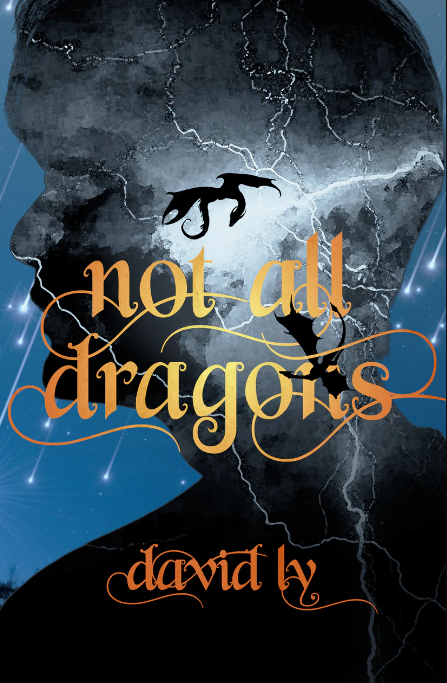
About Not All Dragons:
In a land of magic and myth, Rhys awakens on the shore of Lanilia with mysterious wounds on his back and no memory of his life before. Disoriented, he stumbles on the Mernese estuary protected by the mermaid Delia, who Rhys convinces to help him begin a dangerous quest to discover who, and what, he is as they hunt for the truth beneath story and prophecy. A fascinating and fresh take on dragons and destiny.
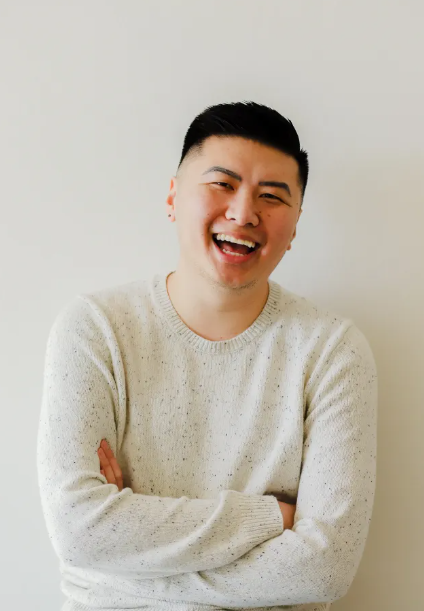
David Ly is the author of Mythical Man (Anstruther Books, 2020) and Dream of Me as Water (Anstruther Books, 2022), both shortlisted for ReLit Awards for Poetry. He co-edited, with Daniel Zomparelli, Queer Little Nightmares: An Anthology of Monstrous Fiction and Poetry (Arsenal Pulp Press, 2022). He is the Poetry Editor at This Magazine. More at davidlywrites.ca.
Author photo credit: Joy Gyamfi