
That Was Me Haunting Me: A Review of Margo LaPierre’s Ajar: Poems by Tea Gerbeza
Margo LaPierre’s Ajar is a poignant collection on LaPierre’s experience with bipolar disorder 1 with psychotic features. This collection is not one that shies away from harsh realities of Madness; instead LaPierre reclaims and makes real the Mad self with tender honesty. Ajar is an account of “what it is to have [LaPierre’s] body” and how the ill self cannot be separate from the “well” self.
LaPierre makes terrific use of form to communicate the various ways in which the body becomes a palimpsest of experience and knowledge. For instance, there are several Centos (a poetic form that relies on multiple poets’ lines to form one coherent voice) in the book. Through this engagement with other poets, the act of constructing a Cento becomes a metaphor for assembling disparate selves.
A major repetition throughout the book is that the self is haunting themselves: “I mistook real for unreal and I haunted me.” “I haunted me” is a repeated phrase that traces the book and takes on more meaning as we encounter more of LaPierre’s experiences. This deliberate self haunting is itself a palimpsest of timelines existing at once, past-present-future converging as it often does for the speaker’s Mad self. In fact, the speaker acknowledges that their experience of bipolar disorder 1 with psychotic features is one that blurs and blends time. This blending of timelines suggests that a body does not separate its memories like the mind does. Instead, a body remembers with no linearity, and all bodily experiences exist at once. Therefore, there cannot be a separation between the Mad self and the “well” self. They will always exist together.
LaPierre’s speaker asks, “if we are echo only, what sonic boom will shock the gloom right out of this place?” There is a sense of loss here because if the speaker is merely an echo, how will they tell what needs to be told? LaPierre answers this question by enacting a body-telling through ghosts, selves haunting selves, palimpsests, centos. She shows how a self disassociated eventually comes back and makes space for past selves.
In the poem “Characteristics of Nonlinear Systems,” the past is the body and what happens to her—a flu, a “mysterious cold spot,” and how the past ripples throughout the body again and again. This cyclical ripple can oftentimes be confusing, but it also becomes a natural rhythm for the Mad self. The speaker also recognizes that their body experiences “hysteresis”: “the name / for stress in an organism / or object when effects / of the stressor lag.” This definition is an important one when addressing the catastrophic effects of gendered physical violence and how the body remembers those events. These effects lag, sometimes take years to show up in the bodymind. In the subsequent poem, “Brute,” LaPierre writes, “Hysteresis is the past / gripping the body.” The offset “g” in the poem makes the line read two ways: the past is ripping the body and the past is gripping the body. This dual meaning points to how trauma nestles in a body, how it lives within the mundane. Mundanity becomes an integral aspect of Ajar in discussing how bipolar disorder 1 affects daily life. There is a kitchen that leads to a patio and a “slanted rooftop perfect for writing”, and yet among these positive mundanities, LaPierre slips in how she tried to die by suicide. Ajar does not romanticize suicide or villainize it; instead, suicidality is shown to be a symptom of bipolar disorder 1 with psychotic features that the speaker copes with, something that comes with living “in this body.” There are moments of desire to die, but also moments with a desire to live. There is no cure for bipolar disorder 1, but LaPierre makes it clear that there are ways to understand, to have tools to survive. With other symptoms like delusions and the perception of time being permanently altered, Ajar asks how do we put words to such things? How do we parse the real from the unreal?
I don’t think Ajar wants its reader to be able to parse the real from the unreal because it becomes clear that regardless of what is “unreal,” the experience the speaker has is real to her body and self in that moment. In “Chatoyant,” we are told, “It’s delusion only because I lift myself from our mutual system of reality. My mind sees what now means. I contain my past, present, future self, existing simultaneously. I’m complete. I have access to all my timeline.” This access the speaker mentions is a wisdom of the Mad self. A realization that frees the Mad self from a system that doesn’t cohere with LaPierre’s experiential knowledge, a knowledge that is incredibly important in healing and reclaiming the self. While LaPierre’s poems spend ample time focusing on remembrances all the selves in the book have, there is a significant shift in “On Friendship” where the mind doesn’t remember, but the body does. LaPierre writes, “I don’t remember this” when her friends tell her that she insisted on wearing heels to the hospital. Memory here is fraught, only given through other people. The self, then, only exists in what the body knows, in an unknowable language one needs to work to understand. Ajar’s self does this work.
Later in the collection, the speaker states, “As I write this poem, I revisit me.” This change in pattern from a self haunting a self to one revisiting signals an important shift to how the Mad self is perceived. To visit is an act of connection, which leads us to LaPierre’s affirmation and reclamation of the Mad self. LaPierre writes, “I am old and aimless as the sun, and just as radiant.” Describing the self as “radiant” is indicative of a small act of reclamation. Then, in “Regeneration,” LaPierre makes an even more powerful statement: “I am cell renewal, membranes kissing / within my body project: / tongue and speech turn / silence inside out—look, grace.” Here, the self finally sees themselves as grace. The self reclaims the Mad self and embraces them.
Margo LaPierre’s Ajar reminds us that there is power in connecting to the selves we are taught to separate from. She reminds us that we are recurring like the sun in the sky. Ajar is an exquisite book, one that I will turn to again and again in the years to come.
—by Tea Gerbeza
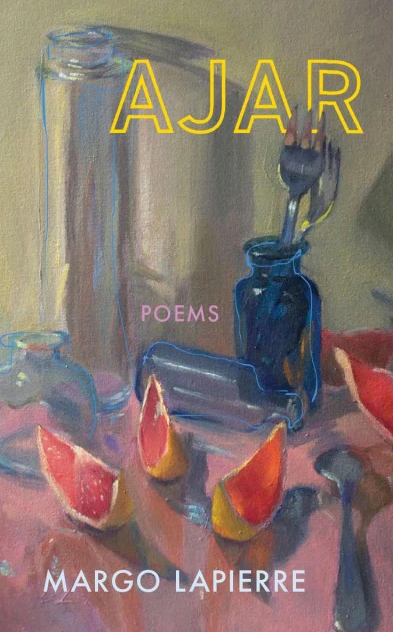
About Ajar:
The poems in Ajar navigate the physical and psychological dangers of womanhood through the flattening lens of mood disorder. Psychosis isn’t the opposite of reality—it’s another perceptual system. If neurotypical thought measures the world in centimetres, this collection measures it in inches, gallons, amperes. Ajar celebrates radical recovery from gendered violence and psychotic paradigm shifts, approaching madness through prismatic inquiry. As time converges within us, we find new ways to heal and grow. From the emergency room to the pharmacy to the fertility clinic to the dis/comfort of home and memory, this collection humanizes bipolar psychosis.
Margo LaPierre is a writer and freelance literary editor. With multi-genre work published in The Ex-Puritan, CV2, Room, PRISM, and Arc, among others, she has won national awards for her poetry, fiction, and editing. She holds an MFA in Creative Writing from UBC. Ajar is her second poetry collection.
Tea Gerbeza (she/her) is the author of How I Bend Into More (Palimpsest Press, 2025). She is a neuroqueer, disabled poet, writer, editor, and multimedia artist.