

BLOG

Excerpt from The Haunting of Modesto O'Brien by Brit Griffin
Lily released the arm of Mr. Johnstone and turned to look at Coffin. “I think you have me confused with someone else. I’m Theodora Bow, here with the travelling show. Colleen Bawn? Perhaps you’ve seen it?”
Coffin, grinning now, said, “You can certainly act. But you can’t lie about those violet eyes of yours, can you?”
Lily rested her hand on Johnstone’s arm to bring him along with her as she took a few steps towards Coffin. She sighed and said, “Sir, you really are confused,” and then smiling patiently turned to Mr. Johnstone and said, “Mr. Johnstone, what colour are my eyes?”
Lily released the arm of Mr. Johnstone and turned to look at Coffin. “I think you have me confused with someone else. I’m Theodora Bow, here with the travelling show. Colleen Bawn? Perhaps you’ve seen it?”
Coffin, grinning now, said, “You can certainly act. But you can’t lie about those violet eyes of yours, can you?”
Lily rested her hand on Johnstone’s arm to bring him along with her as she took a few steps towards Coffin. She sighed and said, “Sir, you really are confused,” and then smiling patiently turned to Mr. Johnstone and said, “Mr. Johnstone, what colour are my eyes?”
He flushed deeply, said, “Miss Bow, by all accounts they appear to be a dark brown to me.”
She turned to Coffin and said, “You see, as Mr. Johnstone can attest, I am not your lady friend, now please, if you don’t mind, I have business to attend to.”
“I know damn well you’re Lily Nail. You and that crazy sister of yours are up here running some sort of swindle.” He then said to the men mesmerized by the scene unfolding before them, “She robbed some fellas back in Butte of their hard-earned money. Not sure what kind of women’s trickery she’s using here, but that there is Lily Nail and there’s a reward on her head. I know that as sure as my name’s Tom Coffin.”
“What an unfortunate name sir, and though I cannot attest to the veracity of your name, I do know the colour of my own eyes. And as everyone here can plainly see with their own eyes, they are brown, not violet. Now I really must be off. I am in quite a hurry,” she said, even as she was still moving slowly towards him.
“Hurrying off to church?”
“The Mining Recording office. I have a claim to register.”
“A prospector as well as an actress Lily?”
“As I said, my name is Miss Bow. And actually, I have an agent working on my behalf,” she was saying as she continued towards him, “A Mr. Campbell, and I believe he has done well by me.”
Coffin frowned. “Campbell?”
“Yes, a Mr. Campbell. I suppose you know his eye colour as well.” A few men snickered and by now Lily was right at his table, able to view the cards laid out there, most face up, the men at the table having just finishing a round.
“What claim?” asked Coffin.
“Oh, I’m really not too sure. Not that it is any of your concern, but Mr. Campbell just said a piece of ground had become available owing to some tragedy. He said other prospectors working in the same area were reluctant to work the property. He further explained that the area had great promise even though there had been accidents, then of course stories began to circulate. Mr. Campbell explained that miners were a superstitious lot. But of course, a woman does not have the same opportunities as a man, we can’t afford such superstitions, so I took it.”
There was a murmur through the crowd, and a man leaning on the bar called, “Out at Kerr Lake?”
“Oh maybe, that sounds familiar.” Smiling, asked him, “Am I going to be rich?”
The man glanced uneasily at the others around him but didn’t answer.
“You’re staking out at Kerr Lake?” Coffin asked.
“As I said, I really can’t say for sure as I was relying on the good nature of Mr. Campbell to assist me. Just before he left town, he contacted me to say he had finalized everything, and I was to stop by the Mining Recorder’s office and pick up my documents. So that is where I’m off to.”
“I was working with Campbell.”
Lily said, “Is that right? Well good luck to you sir”, and then glancing back down at his cards said, “Oh goodness yes, you certainly will be needing it,” her pale hand now reaching and spreading out the cards, murmured, “my, my that is quite the hand you have there.”
“This is poker darling, not one of your parlour games,” Coffin said.
“The cards never lie.”
“What’s he got, Miss,” a man along the bar called out, “a dead man’s hand?” A few men laughing.
“No, he has a pair of fours, and an eight and seven of clubs, and the ace of spades.”
“Not taking home the pot with that one,” someone yelled, and again laughter.
“Oh, but it’s quite the hand.”
“Shut your mouth,” Coffin said, now reddening, mad, not used to being laughed at.
Lily said, “But there is so much to see here, and it’s a bit more complicated than the dead man’s hand. See, look here, this one, the diamond,” then glancing up at Coffin asked, “Sorry, sir? What was your name again?”
A man at the bar shouted, “Coffin.”
“Yes, of course, pardon me, Mr. Coffin,” she said, then focused her attention on the cards, touched the four of diamonds, said, “Seems like you must have a friend you shouldn’t be trusting.”
“That’d be Shitty!” the man at the bar shouted, getting another few laughs.
“And this one, your eight of clubs, a card of caution, for coveting. Do you covet something Mr. Coffin? And here again, dear me, yet another caution with your four of clubs. Imperiled by your short temper perhaps?”
Coffin could not but help glance down at the cards as she said, “But these last two, they really help tell your story. The seven of clubs, danger from a member of the opposite sex, goodness, that could spell rack and ruin for you Mr. Coffin.”
“What about the ace?” the man at the bar calling out.
“Oh that’s simple. Death. Perhaps in a duel. How old fashioned.”
Coffin grabbed her hand, his grip strong, said, “Get out of here.”
“If you want me to leave, sir, you will need to release my hand.”
He stared at her for a few long seconds as she stared back, the men watching rapt, and she said, “Let go of me.”
Then Coffin jerked his hand away as if burned, “You little bitch, I’ll be seeing you later, you can bet on that Lily Nail.”
Excerpt from The Haunting of Modesto O’Brien by Brit Griffin. Reprinted by permission of Latitude 46 Publishing. Copyright Brit Griffin, 2025.
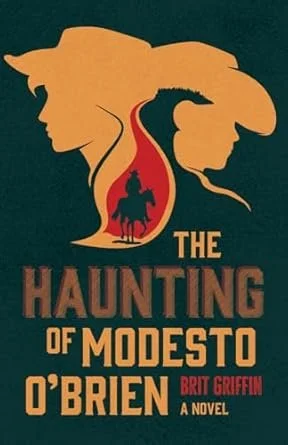
The Haunting of Modesto O’Brien by Brit Griffin, published by Latitude 46 Publishing.
About The Haunting of Modesto O’Brien:
A gothic tale from deep within the boreal forest…
Violence and greed have intruded into a wild and remote land. It’s 1907, and silver fever has drawn thousands of men into a fledgling mining camp in the heart of the wilderness. Modesto O’Brien, fortune-teller and detective, is there too - but he isn’t looking for riches. He’s seeking revenge.
O’Brien soon finds himself entangled with the mysterious Nail sisters, Lucy and Lily. On the run from their past and headed for trouble, Lily turns to O’Brien when Lucy goes missing. But what should have been a straightforward case of kidnapping pulls O’Brien into a world of ancient myths, magic, and male violence.
As he searches for Lucy, O’Brien fears that dark forces are emerging from the ravaged landscape. Mesmerized by a nightmarish creature stalking the wilderness, and haunted by his past, O’Brien struggles to maintain his grip on reality as he faces hard choices about loyalty, sacrifice, and revenge.
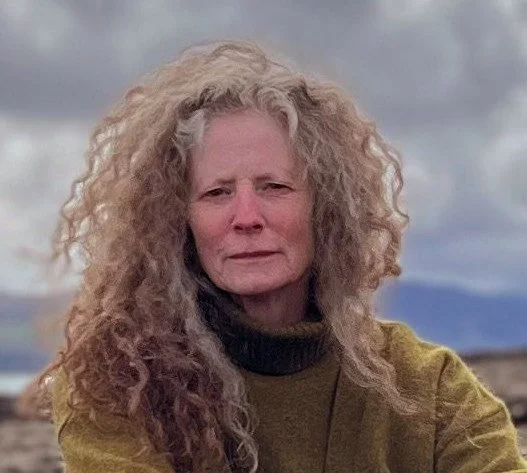
Author Brit Griffin.
ABOUT BRIT GRIFFIN:
Brit Griffin is the author of the climate-fiction Wintermen trilogy (Latitude 46) and has written essays, musings, and articles for various publications. Griffin spent many years as a researcher for the Timiskaming First Nation, an Algonquin community in northern Quebec. She lives in Cobalt, northern Ontario, where she is the mother of three grown daughters. These days, she divides her time between writing and caring for her unruly yard.

Excerpt from Iris and the Dead by Miranda Schreiber (Book*Hug Press, 2025)
I wrote a story for you in a journal and it vanished. Yes, van- ished. The journal itself disappeared. Where do such missing things go?
In the story I laid down all the things I wanted you to understand. I wanted to write it because, in the years since we lay in the yellow grass, I have come to some knowledge. I cannot recall the contents of the story in full. Because of its loss, I sobbed and felt like the victim of a cruel and unusual fate.
I wrote a story for you in a journal and it vanished. Yes, van- ished. The journal itself disappeared. Where do such missing things go?
In the story I laid down all the things I wanted you to understand. I wanted to write it because, in the years since we lay in the yellow grass, I have come to some knowledge. I cannot recall the contents of the story in full. Because of its loss, I sobbed and felt like the victim of a cruel and unusual fate.
Do you think you can write it again, said my mother when I told her.
In some ways, I said. I mean, only in part.
But the heart of the story is gone and I no longer own it.
Still, my need to speak with you seems to have no end. As I wanted to tell you, in every possible universe, when presented with what you offered me, I take it.
May I begin again?
Part I: Sickness
On My Rights as the Author
What do you remember of me? Is it difficult to make out? I know your mind, which doesn’t take much interest in the past, has possibly let me rot for years. Lacking attention, per- haps the sounds we heard together have shrunk and become difficult to name. The colours you associated with me, mixed together now, present a peculiar new hue. Maybe a bronze, made up of grey lake water and the sun.
Some of my memories of you have been darkened by the things I’ve heard and seen in the time since we knew one another. Seeing pictures of you online almost removes you more from me; an image of you in red light by the water seems to have nothing to do with you. It is only occasionally that something comes up in front of me—in that hard way vir- tual things do, so that the rest of the world recedes—and I’m flooded with feeling. For you, I know these memories might have died. For me, they keep. For you, have they simply been discarded? And if they have, to where? What I want to know is, where are the things that have vanished?
For me, very few things end. I can revisit funny memories and put a different name on them. The uncanny ones I’ve wanted to speak with you about. I am sick to death of being dazzled, of lacking the words. We did not have a love affair.
As I said, I have a story to tell you: a better one than I ever could have come up with at the time I knew you. In many ways, I am teeming with knowledge about what was hap- pening during the time we spent together, and beyond. But I should admit I’m not just trying to pass on the knowledge
I’ve come to. I also have questions to ask you. Even as I write with vital information I’m bewildered. But the answers I need may be in that place where the vanished objects go, because I am unsure that even you have them.
On the Beginning
When I was twelve I lost my mind.
The phrase doesn’t bother me. I think it’s correct. I lost my mind as accidentally as I lost pencils and five-dollar bills. Maybe my mind flew down the sky to a land of the dead. I don’t believe this, of course. But it’s better to think it was somewhere.
On the Study of Strange Things
A gift is frightening. It comes with moorings. I am indebted to you, which makes this whole thing stranger. You overflow, my love. You exceed. For years your gift and its consequences seemed uncontrollable.
Part of you helped me because you wanted to free me. That was the gift you gave. But another part of you wanted to keep me in a contractual relation. Because a gift creates a debtor; gratitude flows forever as all of the gift’s effects play out. And in another way you left me so little. I have letters, a T-shirt. There is some documentation of our time together. My unsent emails are a study in bewilderment. When I was twenty I thought about writing to you: Of course this isn’t to overlook the wonderful things you did for me, but I’ve been thinking about the cost… Still, however, the uninformed archivist would never be able to sort our data from noise. A colossus of evi- dence claims we were meaningless to one another. I myself, evaluating it, could make a strong case for barely knowing you. I could argue the following: there is only one photo of these women together. Neither has ever wished the other merry Christmas. The one card they exchanged said, “Thanks for everything thus far.” Therefore, these two women knew each other briefly and then forgot one another. These two women spent a few months together and didn’t think much about
it after.
But really, the card was written in panic. It implored. “Thus far” actually meant I must have more. “Thus far” was intended to mean I’m old enough now, although I wrote it when I was very young.
Excerpt from Iris and the Dead by Miranda Schreiber copyright © 2025 by Miranda Schreiber. Reprinted by permission of Book*hug Press.

Miranda Schreiber’s Iris and the Dead (Book*hug Press, June 10, 2025).
About Iris and the Dead:
Iris and the Dead unfurls the hidden power dynamics of abuse, offering a beguiling inquiry into intergenerational trauma, moral ambiguity, and queer identity. This haunting exploration of love and desire, disability and madness, and trauma and recovery, is a diaristic marvel for fans of Annie Erneaux.
Weaving personal memory with magic realism and folklore, Iris and the Dead asks: What if you could look back and tell someone exactly how they changed the course of your life?
For our narrator, that someone is Iris, the counsellor with whom she developed an unusual, almost violent bond. There are things she needs to tell Iris: some that she hid during the brief time they knew each other, and some that she has learned since. She was missing her mind the autumn they spent together and has since regained it.

Miranda Schreiber. Photo credit: Sarah Bodri.
MIRANDA SCHREIBER is a Toronto-based writer and researcher. Her work has appeared in places like the Toronto Star, the Walrus, the Globe and Mail, BBC, and the National Post. She has been nominated for a digital publishing award by the National Media Foundation and was the recipient of the Solidarity and Pride Champion Award from the Ontario Federation of Labour. Iris and the Dead is her debut book.

Pock-Marked and Pun-Spinning: Steven Mayoff Reviews RuFF by Rod Carley
The major achievement of RuFF (Latitude 46 Publishing, 2024) is the artful way in which author Rod Carley weaves the slender threads of historical fact into a broader fictional tapestry to create a raucously pun-driven tale of Elizabethan politics, theatre, magic, and mayhem. The novel features a relatively familiar cast of characters from the theatrical scene in that era, including William Shakespeare, Thomas Middleton, Kit Marlowe, Richard Burbage, and Will Kempe. Women are given equal time in the form of Anne Hathaway, daughter Judith, and Magdalene Marbecke, known here as Maggie. Rounding out the motley crew are an assortment of allies, enemies, soldiers, peasants, peers, and political toadies – but most importantly, animals – specifically Shakespeare’s three-legged beagle, Biscuit; Judith’s cat, Gray-Malkin; and a crow named Cawdor.
The major achievement of RuFF (Latitude 46 Publishing, 2024) is the artful way in which author Rod Carley weaves the slender threads of historical fact into a broader fictional tapestry to create a raucously pun-driven tale of Elizabethan politics, theatre, magic, and mayhem. The novel features a relatively familiar cast of characters from the theatrical scene in that era, including William Shakespeare, Thomas Middleton, Kit Marlowe, Richard Burbage, and Will Kempe. Women are given equal time in the form of Anne Hathaway, daughter Judith, and Magdalene Marbecke, known here as Maggie. Rounding out the motley crew are an assortment of allies, enemies, soldiers, peasants, peers, and political toadies – but most importantly, animals – specifically Shakespeare’s three-legged beagle, Biscuit; Judith’s cat, Gray-Malkin; and a crow named Cawdor.

RuFF by Rod Carley (Latitude 46).
Carley spins a sprawling story set in Elizabethan England but evokes many modern-day echoes, such as the Plague with much of the public eschewing masks and other preventative measures that would keep them healthy. As well, there are the Puritan reformers, a minority who wield power by fusing religion and politics while reducing important issues, like women’s rights, into reigning culture wars. They are clearly recognizable as the Moral Majority from the last century or the growing Christian Nationalist movement of today.
The opening chapter acts as a prologue in which we see Marlowe as mentor to Shakespeare. When two child-catchers go after a young Tommy Middleton to “recruit” him into a theatre company, it is Kit and Will to the rescue with much help from an aggressive crow.
Jump ahead eighteen years and Will is a celebrated playwright, part of the establishment that is derided by a new breed of playwrights and pamphleteers known as punks, one of whom is Middleton, having forgotten his earlier history with the Bard of Avon. The punks want to usher in a new cultural order, such as having women playing themselves on stage rather than being portrayed by boys. This idealism, along with a strong sexual attraction, is what binds Middleton and theatre seamstress Maggie Marbecke, who has ambitions to be the first woman to act on stage.
After the death of the Queen and the ascension of King James of Scotland, Middleton and Maggie are both locked in the Tower at the mercy of head torturer, the Catholic-hating Trapdoor, who forces them to falsely ally themselves to Shakespeare in order to find evidence that would expose him as a secret Catholic so he can be arrested.
That’s about as much of the plot as I dare to get into. And while the plot and pacing are as intricate as they are absorbing, with Carley’s background as a theatre artist clearly bolstering his novelist’s chops, it is his obvious love of language that carries the reader literally from page to page. Here’s a passage, chosen at random, that will give you an idea of what I’m talking about:
Will opened the door. Burbage’s presence filled the room. He was a mortal god on earth with sharp wolfish features and mesmerizing blue eyes, big of both beard and appetite, his hair being his most prized possession. His barber stiffened, starched, powdered, perfumed, waxed, and dyed it a fashionable red which he wore shoulder-length and curled with hot irons. He produced a bottle of sack and plunked himself down on the bed. After tossing Biscuit a bone, the bigger-than-life actor found two dirty cups under a stack of papers, filled both to near overflowing, and handed one to Will. “Imported from Spain,” he said, raising his cup like a mighty stage king. “Here’s a toast to animal pleasures, to imagination, to rain on a roof and fine tobacco, to summer tours and full houses, to sack and good-hearted landlords, to music and warm bodies and rich conversation, to the actor’s life -- whatever it is and wherever it happens to be.” He took a long sip of the sweet, fortified wine. “May we be who our dogs think we are.”
A good example of Carley’s wit, although it’s not a toast I’d apply to cats. Nor to crows. And here is the way Carley introduces us to King James:
“These bog-biting biscuits are drier than a nun’s crack on Good Friday.”
He was not a kingly man.
The Protestant clergy of the Kirk bowed their heads in resigned embarrassment. To describe him as vulgar was a Scottish understatement. He had none of the beauty of his mother, nor the straight-backed grace of the English Queen. Yet, he was born to be a king. Jimmy was only eight-months old when his father was murdered. The suspected involvement of his mother in the murder forced her to abdicate to England; he never saw her again.
“You bastards!” Diaper-Rag Jimmy wailed at his political advisors. They were the first two words all Scottish babies learned. The mewling King was little more than a pawn in his advisors’ political machinations.
I could go on with more excerpts, but then I’d end up reproducing most of this thoroughly engaging novel and deprive you of the chance to discover it’s rat-infested, poetry-spouting, pock-marked, pun-spinning, beer-soaked, vomit-spewing, pie-gorging, witch-fearing, politics-bashing, Puritan-blaspheming, mud-caked and ghost-shimmering delights for yourself. From start to finish, you will be stepping into the days of yore only to keep finding yourself, for better or for worse, in the present moment.

Rod Carley. (Photo Credit: Virginia MacDonald.
About Rod Carley:
Rod is the award-winning author of three previous works of literary fiction: GRIN REAPING (long listed for the 2023 Leacock Medal for Humour, 2022 Bronze Winner for Humour from Foreword Review INDIES, a Finalist for the 2023 Next Generation Indie Book Award for Humor/Comedy, and long listed for the ReLit Group Awards for Best Short Fiction of 2023); KINMOUNT (long listed for the 2021 Leacock Medal for Humour and Winner of the 2021 Silver Medal for Best Regional Fiction from the Independent Publishers Book Awards); A Matter of Will (Finalist for the 2018 Northern Lit Award for Fiction).
His short stories and creative non-fiction have appeared in a variety of Canadian literary magazines including Broadview (winner of the 2022 Award of Excellence for Best Seasonal Article from the Associated Church Press), Cloud Lake Literary, Blank Spaces, Exile, HighGrader, and the anthology 150 Years Up North and More. He was a finalist for the 2021 Carter V. Cooper Short Fiction Prize.
Rod was the 2009 winner of TVO’s Big Ideas/Best Lecturer Competition for his lecture entitled “Adapting Shakespeare within a Modern Canadian Context. He is a proud alumnus of the Humber School for Writers and is represented by Carolyn Forde, Senior Literary Agent with The Transatlantic Agency. www.rodcarley.ca.

Steven Mayoff
About Steven Mayoff:
Steven Mayoff (he/him) was born and raised in Montreal. His fiction and poetry have appeared in literary journals across Canada, the U.S. and abroad. He is the author of the story collection Fatted Calf Blues, winner of the 2010 PEI Book Award for Fiction; the novel Our Lady of Steerage; and two books of poetry Leonard’s Flat and Swinging Between Water and Stone. His acclaimed novel, The Island Gospel According to Samson Grief, was released by Radiant Press in 2023. Steven lives in Foxley River, PEI.

Power Q & A with Caroline Topperman
Caroline Topperman’s memoir is not only highly anticipated but powerfully titled. Your Roots Cast a Shadow: One Family's Search Across History for Belonging (HCI, December 17, 2024), arises from Caroline’s 2013 move from Vancouver to her family’s homeland, Poland, and encourages readers to examine the ways in which family histories shape our understanding of ourselves and society.
Caroline Topperman’s memoir is not only highly anticipated but powerfully titled. Your Roots Cast a Shadow: One Family's Search Across History for Belonging (HCI, December 17, 2024), arises from Caroline’s 2013 move from Vancouver to her family’s homeland, Poland, and encourages readers to examine the ways in which family histories shape our understanding of ourselves and society.
We’re honoured to have Caroline join us today to speak to why she decided to share her family history with readers from around the world. Welcome, Caroline!

Your Roots Cast a Shadow: One Family's Search Across History for Belonging by Caroline Topperman (published by HCI).
Q: Sharing family stories can be fraught with tension and uncertainty. What made you decide to write this book—and share these stories—now?
A: In 2015 (when I started writing this book) Poland was very different than it is now, and frankly much of what I saw scared me. It was an eye-opening experience to participate in a Pride parade and have rows of police officers decked out in tactical gear on either side of our float. I was shocked each time I saw neo-Nazis and fascists and ultra-Nationalists marching through the streets. I participated in counter-marches; I signed petitions and it became more and more obvious that history is easily forgotten. I decided that I couldn’t stay silent.
More about Your Roots Cast a Shadow: One Family's Search Across History for Belonging:
Your Roots Cast a Shadow: One Family's Search Across History for Belonging is a gripping and powerful narrative of cultural translation, identity, and belonging. The thrill of a new place fades quickly for Caroline Topperman when she moves from Vancouver to Poland in 2013. As she delves into her family’s history, tracing their migration through pre-WWII Poland, Afghanistan, Soviet Russia and beyond, she discovers the layers of their complex experiences mirror some of what she felt as she adapted to life in a new country. How does one balance honouring both one’s origins and new surroundings?

Author Caroline Topperman.
More about Caroline Topperman:
Caroline Topperman is a European-Canadian writer, entrepreneur, and world traveller. Born in Sweden, raised in Canada with a recent stint of living in Poland, she holds a BFA in screenwriting. She is a co-founder of Mountain Ash Press and KW Writers Alliance, and currently runs Migrations Review, and Write, They Said. Her book, Tell Me What You See, serves as a toolkit for her writing workshops. She has written articles for Huffington Post Canada, Jane Friedman’s blog, was the Beauty Editor for British MODE Magazine, and served as managing editor for NonBinary Review. Her hybrid memoir, Your Roots Cast a Shadow, explores explosive intergenerational histories that link war zones and foreign shores with questions of identity and belonging. Her next book, The Road to Tang-e Gharu, integrates Afghan folktales and family memories with the story of one of the greatest roads ever built.

Jewish Heritage Month Feature: Excerpt from Rubble Children by Aaron Kreuter
May is Jewish Heritage Month, and we are delighted to host an excerpt from Rubble Children (University of Alberta Press, July 2024)—new short fiction from Govenor General Award Finalist Aaron Kreuter.
Rubble Children is an absorbingly timely and necessarily explorative read, tackling Jewish belonging, settler colonialism, Zionism and anti-Zionism, love requited and unrequited, and cannabis culture, all drenched in suburban wonder and dread. Engaging, funny, dark, surprising, this collection is a scream of Jewish rage, a smoky exhalation of Jewish joy, a vivid dream of better worlds.
May is Jewish Heritage Month, and we are delighted to host an excerpt from Rubble Children (University of Alberta Press, July 2024)—new short fiction from Govenor General Award Finalist Aaron Kreuter.
Rubble Children is an absorbingly timely and necessarily explorative read, tackling Jewish belonging, settler colonialism, Zionism and anti-Zionism, love requited and unrequited, and cannabis culture, all drenched in suburban wonder and dread. Engaging, funny, dark, surprising, this collection is a scream of Jewish rage, a smoky exhalation of Jewish joy, a vivid dream of better worlds.
"What if the worldview you were raised in turns out to be monstrous? In the stories that form Rubble Children, Aaron Kreuter examines a Jewish community in flux, caught between its historical fealty to Israel and a growing awakening and resistance to it. Rubble Children is a book of great range: at once political, communitarian, empathetic, funny, revolutionary, touching, and hopeful. This is a work that is essential for our moment."
—Saeed Teebi, author of Her First Palestinian
The passage we are sharing below is from "Mourning Rituals," the first story in the collection, which takes place during the shiva for Joshua and Tamara's father.

Bring home Rubble Children by Aaron Kreuter.
From “MOURNING Rituals”, Rubble Children
That evening, the adults praying in the living room, facing east, worn blue prayer books brought from Kol B’Seder in their hands, bending and calling out, Joshua and Tamara sat with their cousins in the family room in half-tense silence. Simon in his Israeli Defense Forces uniform, Clarissa, her hair in a high bun, sweatpants tucked into woollies snug in Uggs, bent over her phone, thumbs dancing. Shelly, cuddling with Andre, her new boyfriend; he looked lost, out-of-place, the Hebrew rising and falling from the front of the house registering on his face as alien, off-putting cacophony.
Joshua was staring at the rug, the day’s bottomless allotment of grief having finally tipped his meager watercraft. Simon was looking around the house with detached, distant arrogance. His head was smooth, his skin tanned deep brown, his cheek shaven by naked blade. He’d made aliyah two years ago. Tamara was staring at him, her face souring with each passing minute.
She bent over to Joshua.
“It looks like Simon’s itching to pick a fight,” she said into his ear.
“Hmm...”
“He’s holding his babka like a semi-automatic.”
“He probably just misses his gun.”
“He’d rather be with his unit, riding a tank through the desert at dawn, trashing the house of a Palestinian family because the father looked at him funny.”
“Tamara, not now.”
“...I might just oblige him.”
Simon must have known they were talking about him.
“Sorry for your loss,” he said to them from across the room, the first thing he’d said to them since arriving. Tamara smiled sarcastically.
“How’s Panem?” she shot at him. “Get out to the districts much?”
Simon looked startled. “Pardon?” he said. He was affecting a slight Hebrew accent.
“Tamara!” Shelly shouted. Tamara looked at everyone in turn, the flourishes of prayer fluttering through the house. She was in her element.
“What?” she said, feigning innocence. “What? He chose to go over there and play-act as a colonialist, comes here to this house of mourning dressed in his uniform, and we’re supposed to sit here smiling like idiots?”
Now it was Joshua’s turn to put a hand on Tamara’s shoulder, to push pause on the coming confrontation. She shrugged it off but didn’t continue. It was too late, though: the flood gates were open.
Simon smiled. “What, you don’t approve of my joining the army or something? Shit, my dad’s right about you: you’re too far gone to the left to even see reality. I know your dad just died, and, like I said, I’m sorry about that, but do I really have to tell you that if we weren’t keeping the Arab hordes at bay your little North American hippie-dippie pacifist hacker existence would become ancient news?” Simon turned to Joshua now, who was trying not to look at anyone, trying to not get involved. “I hope you haven’t followed your sister to the dark side, Joshua. Especially you.”
He had no choice but to look at Simon. “What’s that supposed to mean?”
“You know what it means. Israel is the only country in the whole Middle East where you wouldn’t be stoned to death for your, for your…lifestyle.”
Joshua laughed, to himself, like he had had a private revelation. Tamara, though, Tamara’s mouth was agape. She was gathering her wits for a full-frontal assault, but Clarissa beat her to it, pivoting from her phone for the first time since she arrived.
“You know, Simon. I wasn’t going to say anything because I was raised better, but you’ve really become an asshole. And, I’m sorry, I’ve got to say it: why is joining the Israeli army, like, given a pass? You know how our parents would react if one of us joined the Canadian army? The Canadian army is for people from Saskatchewan! And the American army, oh, you’re a misguided, bloodthirsty imperialist! But the Israeli army! Ooooh, the Israeli army! Why, then, you’re fighting for the Jewish nation! You’re a hero! You’re rewriting the history of a blighted people! How does it not, like, ring terribly false? Hero! What total horseshit!”
Everybody was silent, stunned, in the wake of Clarissa’s outburst. Later, Joshua would tell Tamara how surprised he was that Clarissa had thoughts or feelings like that. “The last serious conversation we had was five years ago, when we debated which Backstreet Boy we’d rather went down on us.”
Somebody hiccupped and all eyes turned to Shelly. She was crying. Andre was stiff beside her, stuck between wanting to comfort his girlfriend and wanting to get out of this house of strange Jewish customs and head-on battles. Feeling the attention, Shelly looked up. “How could you say those things, Clarissa? And during my Aba’s shiva! Don’t act like you don’t remember how proud he was of Simon when he made aliyah! He is a hero, out there all alone protecting the homeland!” She jumped up and ran to her room, her feet stomping on the stairs echoing through the house.
Tamara and Joshua looked at each other. Andre looked like he had just found out that his father had died. Simon swept a triumphant scowl across the room, stood, smoothed his uniform, and went up the stairs after Shelly, not making a sound as he ascended. Clarissa shrugged, went back to her phone. The steady chatter that rose from the other room and permeated the house meant one thing: the prayers were finished. Soon the house would empty out, and, tomorrow, it would start all over again, the pattern repeating for four more days and then—just like that—ceasing, leaving the mourners alone with their grief, with nothing but time to do what it will.

More about Aaron Kreuter:
Aaron Kreuter's most recent poetry collection, Shifting Baseline Syndrome, was a finalist for the 2022 Governor General's Award, and was shortlisted for the 2022 Raymond Souster Award and the 2023 Vine Awards for Jewish Literature. His other books include the poetry collection Arguments for Lawn Chairs, the short story collection You and Me, Belonging, and, from spring 2023, the academic monograph Leaving Other People Alone: Diaspora, Zionism and Palestine in Contemporary Jewish Fiction. Aaron's first novel, Lake Burntshore, is forthcoming from ECW Press. He lives in Toronto, and is an assistant professor at Trent University.

BOOK REVIEW: The Home Stretch: A Father, a Son, and All the Things They Never Talk About
Everyone has parents. Everyone’s parents die. Yet the stories where parents and death intersect are unique.
George K. Ilsley’s recent memoir tells one such story. As a young adult, George left his Nova Scotia home, heading west, eventually landing in Vancouver—as far away as he could get while remaining in North America. Then, as he turns 50, his father turns 90, and his father needs, but doesn’t especially want, Ilsley’s care.
The Home Stretch: A Father, a Son, and All the Things They Never Talk About, by George K. Ilsley. Arsenal Pulp Press, 2020. ISBN: 9781551527956. $19.95, 230 pages.
Review by Marion Agnew.
“There is only one way this story is going to turn out.”
Everyone has parents. Everyone’s parents die. Yet the stories where parents and death intersect are unique.
George K. Ilsley’s recent memoir tells one such story. As a young adult, George left his Nova Scotia home, heading west, eventually landing in Vancouver—as far away as he could get while remaining in North America. Then, as he turns 50, his father turns 90, and his father needs, but doesn’t especially want, Ilsley’s care.
Narrated in a gently self-deprecating voice, this book was surprisingly funny and a pleasure to read—not easy, mind, but a pleasure.

Available to purchase wherever books are sold. Grab it from Arsenal Pulp Press.
Part of my pleasure comes from recognition. I had similar experiences with my mother, whose death from dementia came twenty years ago, and with my father, who died seven years later. I, too, lived far away from them, and my siblings, for various reasons, weren’t able to take a more active role as our parents aged. So much of what Ilsley describes was familiar, especially the push-pull of leaving a life you’ve built to spend time with a parent, always feeling guilty for not being in the other place.
But this book has much to offer beyond any personal identification with its situation. It’s also a good example of how the untidy elements of nonfiction make the nonfiction interesting. Writers often try softening memories to make them more palatable or changing events to “fit” a traditional narrative arc. The biggest temptation is to manufacture something “inspirational” or “redeeming” in an account of a difficult time with a difficult person with whom you had a difficult relationship—to say, “It was all worthwhile, because ….”
Deftly, Ilsley avoids these temptations. Everyone else thinks his father is sweet, with a quirky tendency to save things and a charming, if odd, interest in growing peanuts. But Ilsley shows his father’s serious hoarding issues, his disinterest in the reality of others’ lives, his unhealthy obsessions with peanuts and long underwear. We see the dangers present in Ilsley’s father’s stubborn refusal to answer direct questions, his denial that he needs help with walking and eating, and his bitterness when his sons try to help. Nothing soft there.
And no tidy redemption story, either. The last time George sees his father, who’s in the hospital, Ilsley says, “There is, of course, a last scene with Dad in the hospital, tray-locked in his chair, him confused and me sad. Wondering if this is the last time, as I have wondered so many times, with increasing levels of certainty.” But Ilsley can’t know whether this actually is the last time—he’s experienced years of anticipatory grief, waves of anger and sadness, and even moments of acceptance.
All relationships in a family change as parents age, and I admire the honesty with which Ilsley shares his family’s difficulties and silences. He describes a moment with his older brother, who lives with their father: “It is hard to be fifty years old and treated like children by a parent whose welfare consumes our time, energy, and money.”
In fact, the book’s great strength is its insight and candour about the kaleidoscope of emotions involved in loving someone who doesn’t want to be cared for, but who needs it. Anger alone takes many forms: exasperation, impatience, truculence, stubbornness meeting stubbornness.
Fear, too, has many facets. You’re afraid for your parent’s safety and for your ability to survive their suffocating needs. You dread being happy when they die; you dread their death will kill you, too. You’re terrified that all your efforts won’t help make their lives bearable at the end, and that you’ll leave something undone that could have made a huge positive difference in their last years.
But then again, you know—we all do—that there’s only one way this story is going to turn out.
Anyone who’s ever had parents, and anyone who loves the creative chaos of real life, will find rewards in reading this book.
About Marion:
Marion Agnew’s essay collection, Reverberations: A Daughter’s Meditations on Alzheimer’s, came out in 2019. For more about her, see www.marionagnew.ca.

Marion Agnew.