

BLOG
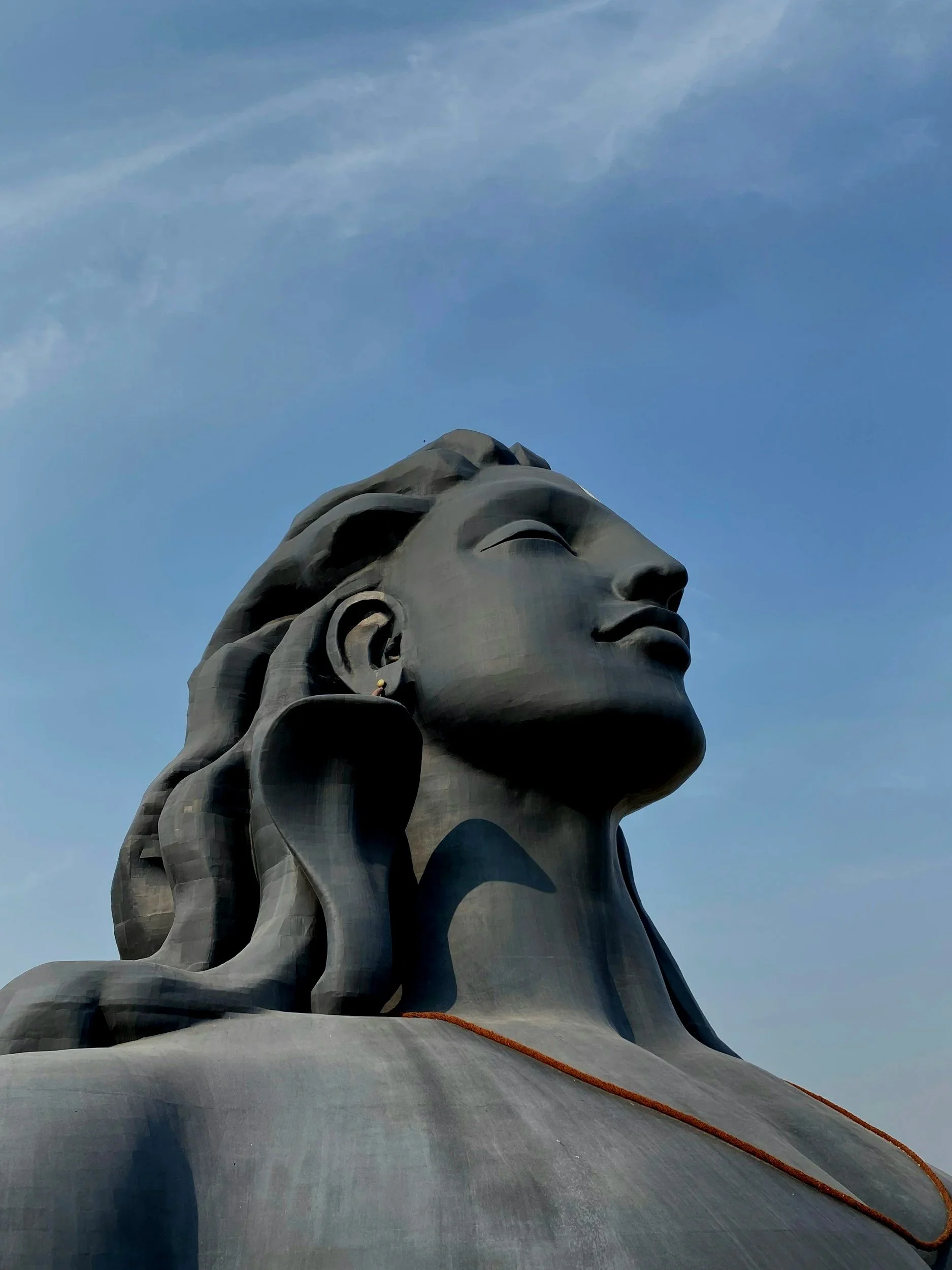
Excerpt from WOMEN AMONG MONUMENTS Solitude, Permission, and the Pursuit of Female Genius by Kasia Van Schaik
This story begins in 2022, Padua, midwinter. Across the city a debate is raging. It concerns a woman whose name I only recently learned: Elena Lucrezia Cornaro Piscopia, the first woman in the world to earn a Ph.D. City councillors Margherita Colonnello and Simone Pillitteri have proposed to place a statue of Piscopia in the town square — a notable historical woman to join the effigies of notable historical men. This suggestion has sparked outrage across the country.
This story begins in 2022, Padua, midwinter. Across the city a debate is raging. It concerns a woman whose name I only recently learned: Elena Lucrezia Cornaro Piscopia, the first woman in the world to earn a Ph.D. City councillors Margherita Colonnello and Simone Pillitteri have proposed to place a statue of Piscopia in the town square — a notable historical woman to join the effigies of notable historical men. This suggestion has sparked outrage across the country.
It hadn’t occurred to me to type “first woman Ph.D.” into Google. I kicked myself for my lack of curiosity. After all, I was going to be the first woman in my family to earn a doctorate. It had been the hardest thing I’d attempted in my life so far, partly because I still felt, deep down, that I wasn’t entitled to the pursuit of an intellectual or creative life. I felt I was getting away with something, fooling the academy, and it was only a matter of time until I was exposed. As I’ve come to understand, this isn’t an uncommon experience, particularly for first-generation scholars, or scholars who have disabilities, or who identify as queer, BIPOC, or women.
I wondered if Piscopia had felt this way, too. As a woman in the 1600s, she’d had to fight for her education. Piscopia was born to unmarried parents, a peasant woman and a nobleman. Her father tried to arrange betrothals for his daughter, but she rebuffed each suitor’s advances, preferring the company of her harpsichord and philosophy books. Women weren’t allowed to enter university at the time, but her father was able to pull a few strings for his prodigious daughter. Even then, the residing Cardinal Gregorio Barbarigo opposed Piscopia’s request to graduate with a doctorate in theology, arguing that it was a “mistake” for a woman to become a “doctor.” He eventually let her graduate with a degree in philosophy instead.
I looked up the year 1678. Le Griffon, the first European ship to sail on the Great Lakes of North America, prepares for her maiden voyage. The first fire engine company in what will become the United States goes into service in Boston. The Pilgrim’s Progress, a text that 334 years later I’d be forced to read in an undergraduate literature class, is published in London, England. Rebel Chinese general Wu Sangui takes the imperial crown and dies of dysentery months later; Franco-Dutch battles are instigated, ceasefires called, and in Padua, at the age of thirty-two, Piscopia receives her Ph.D.
•••
At almost 90,000 square metres, Prato della Valle, or “Meadow of the Valley,” is the second-largest square in Europe. At its centre is a green island surrounded by a small canal and bordered by two rings of statues, all of historical men. I recognize some of the names: Galileo, father of observable astronomy; the artist Mantegna, famous for his use of perspective and anatomical detail; and the eighteenth-century sculptor Canova, renowned for turning stone into flesh.
Two of the pedestals in Padua’s elliptical square are empty. It seemed fitting, the city councillors proposed, that Piscopia might rest on one of the empty pedestals, that hers might become the first monument honouring a woman in the city’s historic centre. As art historian Federica Arcoraci points out, spending time among the square’s all-male statues has “an impact on our lives and collective imagination,” and the “Prato della Valle regulation of 1776 never ... prohibited the representation of women.”
Across the country, critics protested Piscopia’s inclusion in the square. Some claimed that a statue of the first woman Ph.D. would be out of context with the square’s history. Others believed that to include a female statue within the pantheon of male statues would be an act of “cancel culture.”
Colonnello and Pillitteri walked back their original proposal, but they still insisted that a statue of a woman be allowed in the square. It didn’t have to be Piscopia — they were willing to erect her monument elsewhere. But the city had to decide on another historical woman instead — for instance, the nineteenth-century painter Elisabetta Benato-Beltrami or the writer Gualberta Alaide Beccari.
“The important thing,” said Colonnello, “is that we have raised the debate about the underrepresentation of women among monuments and it is now very clear to all politicians that we need a very good statue of a woman in a very good place.” She pressed on: “We now need to decide where and who. But I think we will eventually settle on the square — it is very huge and there is lots of space.”
I looked up an image of Prato della Valle. Colonnello is right. At the size of almost two football fields, it’s massive.
Why was there such opposition to the inclusion of a woman in such an enormous space? It appeared that the controversy wasn’t about the square itself but what the square symbolized. It represented the boys’ club, cultural memory, the legacy of genius. The square represented representation itself.
What the Piscopia debate exposed wasn’t just the scarcity of statues celebrating notable women — of the thousands of statues in Italy, fewer than two hundred depict women — but the historical resistance to simply recognizing women’s achievements. This resistance isn’t unique to Italy.
After reading about Elena Piscopia, I went walking through the squares, parks, and boulevards of Montreal, my own city. This was where I’d lived for much of my life — a place I kept returning to for its promise of art, freedom, and community. Yet, like the Prato della Valle, it was still filled with statues of European men.
Where were the women? I found myself asking this as I stood below the Sir George-Étienne Cartier monument at the foot of Mont Royal. Not the angels and goddesses but the monuments to historical women. Where could I find them?
Excerpt from Women Among Monuments by Kasia Van Schaik. Published by Dundurn Press. Copyright Kasia Van Schaik, 2026. Reprinted with permission.
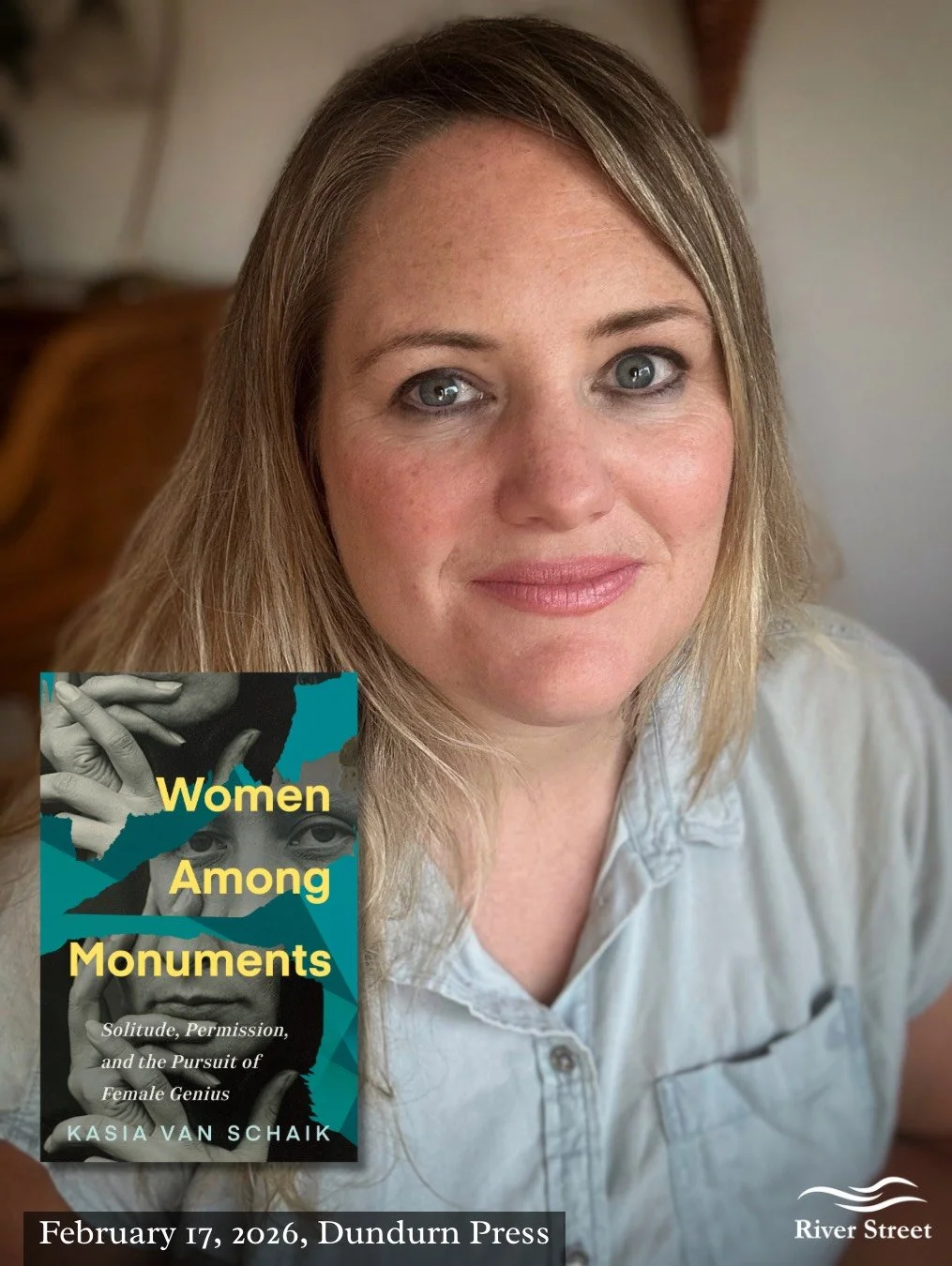
Women Among Monuments by Kasia Van Schaik
About Women Among Monuments:
A lyrical meditation on the enduring obstacles women artists and writers face in a world still unaccustomed to recognizing female genius.
What does it take for a woman to don the mantle of genius — a title long reserved for male artists? From her studies in Montreal to a dead-end job in Berlin, a midnight tour of Paris, a bankrupt art residency on the Toronto Islands, and a mysterious sculpture garden in the Karoo desert, South African—Canadian author and professor Kasia Van Schaik considers what it means for a young woman to call herself an artist and claim a creative life.
Drawing on a diverse web of literary and cultural sources and artistic icons — from Georgia O’Keeffe to Ana Mendieta, Gertrude Stein to Jamaica Kincaid, Leslie Marmon Silko to Bernadette Mayer — Women Among Monuments asks, What, beyond a room of one’s own, are the necessary conditions for female genius? Where does the inner flint of artistic permission come from? What is the oxygen that keeps it burning?
In her memoir interwoven with incisive biographies of female solitude, constraint, and perseverance, Van Schaik blazes a trail for more inclusive artmaking practices, communities, and monuments.
Kasia Van Schaik is the author of the linked story collection We Have Never Lived On Earth, which was longlisted for the Scotiabank Giller Prize. Her writing has appeared in Electric Literature, the LA Review of Books, the Best Canadian Poetry, and the CBC. Kasia holds a PhD in English Literature from McGill University and lives in Montreal.

Power Q & A with Kevin Andrew Heslop
The work of a good book or a good art or an et cetera is to make it harder to live, to invite the reader to stretch beyond the settled narratives and reduplicative forms to which they’ve become habituated, an injunction ever the more keen in a world so stricken with capitalist call and response, itch and scratch, that the moral obligation to look longer, allow greater complexity to be revealed, and not categorically to encapsulate one’s satisfaction by acquiring the product of an echo is the greater.
Q: You have a book coming out this fall, The Writing on the Wind’s Wall: Dialogues about Medical Assistance in Dying (The Porcupine’s Quill, 2025)—a collection of moving, thought-provoking dialogues about Medical Assistance in Dying (MAiD) with a wide range of voices—doctors, doulas, faith leaders, survivors, and prospective recipients—set in the healthcare hub of London, Ontario. What question’s answer will make somebody buy a thing? In this case, your book?
A: In the context of this book, the trouble with the question-answer format are several. But don’t worry: dopamine comes later.
First, a question that can be answered is a bore, is a solved proof, partakes of an understanding of exchange whereby a need inherent in the opening is satisfied resolutely in the reply; worse than a linear A-B, it is A-Z, a beginning and an ending. This is not the work of the humanities; this is the work of marketing, the simple satisfaction of a need.
The work of a good book or a good art or an et cetera is to make it harder to live, to invite the reader to stretch beyond the settled narratives and reduplicative forms to which they’ve become habituated, an injunction ever the more keen in a world so stricken with capitalist call and response, itch and scratch, that the moral obligation to look longer, allow greater complexity to be revealed, and not categorically to encapsulate one’s satisfaction by acquiring the product of an echo is the greater.
Second and carrying on from there, an answer, being contained, is a product, is a complete thing, is separable from its environment, an individual ego bereft of an understanding of its context, unconnected to more than the dyad of commercial exchange in which it partakes.
Fourth, it is the product of what Paolo Freire calls the “banking model of education:” an answer replicates an old order, limned with Grecian dust, in which the questioner (the student), knowing nothing, appeals to the teacher (knowing everything), but this fundamentally neglects to recognize the subjectivity of the student (whom Freire calls the student-teacher in complement to the teacher-student, both of whom are enjoined to the process of conscientisization, of mutual liberation through continuous subjective exchange) while also anticipating that every student is equally blank of history—you hear overtones of Skinnerian and Pavlovian programmatic call-response/stimulus-reaction here—rather than full of unique experience, rich and complex and individuated. The same could be said for the interview format, which after over a decade in practice I’ve foregone in favour of dialogue.
Zebrath, if the sequencing of paragraphs “second” followed immediately by “fourth” troubled you, allow me to invite the poor proverbial cat out of the bag by offering a paragraph begun as this one is to remind you that the expected sequence in response to a simple provocation is not living reality but habit, rather what we might expect of the algorithm. When you are open to it, meaningful dialogue, like reality—trigger warning—is full of unexpected surprises by the provoked torsion and friction of whose incoming difference demands you differ yourself in response to the novel (which, #TLDR, this “answer” is becoming).
What I love about dialogue is exampled by the practice of a wonderful artist Pascal Hachem I spoke with a few days ago.
Pascal and I met following the installation of his first solo show in São Paulo which he created during a residency in Brasilia—to which he arrived, as he always arrives to residencies, with nothing more than a notebook. No paints, no glue, no objects or ideas preconceived and therefore unresponsive to the environment: he simply showed up with “trust” enough that what “dots” would need to be “connected” would present themselves simultaneous to his apprehension of how to connect them. The result was Whispering Skies, a relational cat’s cradle between Brasilia and Lebanon, analogizing the kite-fights of Brazil to the military drones forever whispering from Lebanese skies coupled with notice of locations that will be bombed, with or without warning, an element of Pascal’s representation of which was a tongue-in-cheek invocation of the smart phone locals will hold up from the street next to an anticipated bombing to watch; red string, evocative of the glass-covered string of battling kites, evocatively strewn along pieces of corrugated roof, themselves indicative of favelas, of stubborn life persisting despite, and connective personally to Pascal because of how he was taught in Lebanon to seek shelter under as many layers of roof as he could to survive—usually, because a storage space is often to be found in the ceiling of a bathroom in Lebanon, meaning these layered ceiling structures provide more protection from incoming explosives, in a bathroom—an edict made obsolete by the development and deployment of modern drone technology that will level a building with a single modern bomb; roofs which “I’m not used to this, but in Brasilia, the roof was like this: it depicts everything: one tiny lizard walking on the roof; it depicts one bird walking; it depicts the leaves and the wind, et cetera. So for me it was interesting to understand this project until one day, one mango fell on the roof. And this [incomprehensible]. And by forming this, it made the sound of, like, BOOM. Suddenly I was like—It’s interesting, because suddenly my perception of what’s the roof is completely different from what I’m surrounded. So, I said, I should place it and exchange it as a story because it’s very crucial and I’m amazed by nature how it’s very close to me—and I’m not against that, but—it was like a ping-pong of things between my experience of life and where I am now.” (Here is a link to Pascal’s show.)
Falafelth, many of the above words would have been characterized as run-on sentences and dismissed by institutions of learning that obstructed the education meaningful long-form dialogue would provide me through my twenties—along with extracurricular study and production of theatre and publication of poetry and art, music, and film criticism—a consequence of which dialogic practice is this book, The Writing on the Wind’s Wall: Dialogues about Medical Assistance in Dying, to which I’ll address myself more directly now.
The book is not written in the digressive, performative, syntactically complicated, and lexically stunting style of the foregoing. Rather the book is written for as wide an audience as possible because it aspires to an accessible act of service in line with the lives and careers of the two people whom by their fatal encounters with the Canadian healthcare industry prompted the book—my late father, a professional public servant of thirty-eight years in London, Ontario, a dedicated past president of the Optimist Club of Oakridge Acres, the local chapter of a charity designed to raise money for children’s sport, including what has become the world’s largest sledge-hockey tournament (The London Blizzard Invitational, which my dad helped found in the early aughts), retired professionally for nearly five years before a furious cancer spread throughout splitting his bones, a man entitled to MAiD but who for a fugue of reasons died without the good quick death he requested in Victoria Hospital on July 10th, 2020; and his mother, a nurse and teacher of forty years and a dedicated community servant for longer, a woman who was knitting sleeping bags for the unhoused until despite requesting MAiD died days after her 91st birthday by conscious phlegmatic asphyxiation at that same hospital on February 8th, 2025.
By the book I sought to catch and enlotus their tortures into polyphony defiant of public discourse as binary and it’s on the image of the lotus that I’ll close: as I aspired in microcosm here to do in response to an iterative invitation to partake of a banking model of education, the itch a scratch solves—capitalism as psoriasis—the lotus sits upon and among the swamp, transmuting the stink of the muck into many-petalled balance, fragrant presence, and radiant light; and so do I daily and so might we all aspire to that invitational act of transmutation in—I trust you’ll agree—fertile times.
P.S. Allow me to address you directly with an invitation. This book on Medical Assistance in Dying has led me to another, First Do No Harm: Ten Years as a Death Doctor, as well as that second book’s limited-series adaptation to the screen, Death Doctor, which I bring to your attention because I’m looking for visionary collaborators in the publishing and film-and-television industries to contribute to making these happen.
I’m also developing a feature film, The Phoenix, about the life and work of revolutionary theatre director Zé Celso, with Teatro Oficina of São Paulo, Brazil; a dystopian news-parodying sketch-comedy limited series; a dozen titles of world-class IP from leading Canadian publishers for adaptation to the screen; multiple books of dialogue with avant-garde artists from around the world; multiple books of formally unique poetry; and multiple collaborative art installations.
In addition to my work in the arts, as one of the first venture capital investors in Revolve Surgical, which recently made its first sale for pioneering a minimally invasive surgical robotic device capable of mending the splitting spine of a foetus in utero, I’m also actively seeking to engage additional companies in the field of medical robotics provided their ambit is to minimize suffering; and as an Ambassador for Green Field Paper Company, on whose recycled seed-paper two of my recent books have been published, and as Vice-Chair of the Board of Directors of Changing Ways, a non-profit in my hometown dedicated to ending violence against women, I’m always open to connections and collaborations in the non-profit, ecological, and social-justice sectors too.
If you wish to support my or my international community’s work in any way, or if you want to connect or collaborate on any imaginable project in any of the arts, you can always reach out to me at kevin@astoriapictures.ca.

The Writing on the Wind’s Wall: Dialogues about Medical Assistance in Dying (The Porcupine’s Quill, 2025) by Kevin Heslop.
About The Writing on the Wind’s Wall:
The Writing on the Wind’s Wall listens at length to the voices of those affected by 'Medical Assistance in Dying' in the city of London, Ontario, a national healthcare hub: a death doula, a sound-healer, a psychiatrist, a scholar, a doctor, a medium, an ethicist, a prospective recipient, a politician, a reverend, and several recipients' survivors. Facilitated by Kevin Andrew Heslop, these dialogues are informed by the work of a wide variety of cultural leaders, including Paolo Freire, John Cage, Li-Young Lee, Thích Nhất Hạnh, and Robert Hass. The collection documents how euthanasia, while in the spirit of individual liberty, increases proportional to the world’s socioeconomic, ideological, and (therefore) ecological unsustainability. The Writing on the Wind’s Wall is a testament to what a community felt and believed in the 2020s about living, and dying, together.

Kevin Andrew Heslop
About Kevin Andrew Heslop:
Kevin Andrew Heslop (b. 1992, Canada) is the author, most recently, of The Writing on the Wind’s Wall: Dialogues about Medical Assistance in Dying (The Porcupine’s Quill, 2025).
Currently serving his hometown as Vice-Chair of the Board of Changing Ways, a non-profit dedicated to ending violence against women, Kevin is also one of the first venture-capital investors in Revolve Surgical, which recently made its first sale for pioneering a minimally invasive surgical robotic device capable of mending the splitting spine of a foetus in utero, and an ambassador to Green Field Paper Company, on whose recycled seed-paper two of his recent books have been published.
Supported by the London, Ontario, and Canada Councils for the Arts, Kevin’s directorial work with Nicole Coenen—notably White, Things She Wants, and Ripley’s Aquarium—has won prizes from the Toronto Short Film Festival, the Vancouver Independent Film Festival, the Independent Shorts Awards, the Berlin Shorts Awards, and the Los Angeles International Film Festival, screening at dozens of festivals around the world. In 2022 he founded Astoria Pictures to develop, finance, and distribute projects in film and television for which to will serve as writer, director, and/or producer.
Kevin’s poetry has been published by The Blasted Tree Art Collective, Frog Hollow Press, Anstruther Press, Gordon Hill Press, Baseline Press, Rose Garden Press, and, mostly recently, The Fiddlehead; collaborative art installed with McIntosh Gallery, Westland Gallery, and Centre [3] for artistic and social practice; and dialogues amplified via Parrot Talks, The Miramichi Reader, and The Seaboard Review, a selection of which are forthcoming from Guernica Editions as Craft, Consciousness: Dialogues about the Arts (2027, vol. i & 2028, vol. ii).

Power Q & A with Daniel Coleman
The 16th and 17th century encounters between Indigenous people in Turtle Island and merchant sailors coming from Europe constitutes the meeting of two very different ways of seeing and living in the world, two very different approaches to trade. The French, Dutch, and English who arrived at the mouths of rivers flowing into the Atlantic were the envoys of a new way of making wealth. These were not aristocrats who stood to inherit their fathers’ land and properties, they were sailors from Europe’s emerging merchant class who were looking for trade goods and resources—spices from Asia, minerals from “El Dorado,” manufactured items from China or India. They had recently developed the capacity to navigate across huge oceans, and they were learning that they could become independently wealthy by exploring the world’s coastlands and islands and bringing back objects they could sell at home.
Q: Your book, Grandfather of the Treaties: Finding our Future Through the Wampum Covenant (Wolsak & Wynn, 2025) is being hailed as an essential read for Canadians looking to understand our nation’s complicated history. What do the founding wampum agreements have to offer us today?
A: They can teach us a better understanding of trade at a time when trade wars are giving us lots of grief. The 16th and 17th century encounters between Indigenous people in Turtle Island and merchant sailors coming from Europe constitutes the meeting of two very different ways of seeing and living in the world, two very different approaches to trade. The French, Dutch, and English who arrived at the mouths of rivers flowing into the Atlantic were the envoys of a new way of making wealth. These were not aristocrats who stood to inherit their fathers’ land and properties, they were sailors from Europe’s emerging merchant class who were looking for trade goods and resources—spices from Asia, minerals from “El Dorado,” manufactured items from China or India. They had recently developed the capacity to navigate across huge oceans, and they were learning that they could become independently wealthy by exploring the world’s coastlands and islands and bringing back objects they could sell at home.
These new bourgeoisie met Haudenosaunee people on the Hudson River, who were also traders. But traders of a very different mindset. These inhabitants of Turtle Island understood “trade” as conducted between all the beings of the living world, not just between humans. So they were interested in the goods that the Dutch brought in their ships—copper kettles or iron knife blades—but they knew that the plants and animals and water systems all around them were influenced by trade, not just the people. Trade, to them, meant that whoever was involved, including non-humans, were part of the equation of exchange. Good trade meant exchanging what was necessary to the flourishing of the entire environment.
This is what makes the early wampum agreements that the Haudenosaunee made with the Dutch and then with the English so unique and so relevant for us today. When the Haudenosaunee diplomats explained that the Two Row Wampum (circa 1613) represented the Dutch trading ship and their own canoes as two vessels traveling down the river of life, they were emphasizing that the agreement made between the two vessels’ “culture, beliefs, and laws” must benefit not just the people in the vessels but also the river itself, which, after all is what kept everyone afloat (let alone hydrated). The Two Row Wampum which was renewed as the “Silver Covenant of Friendship” wampum agreement with the British (1674) is as much ecological philosophy as it is political philosophy. To make peaceful, healthy agreements between humans was not a separate undertaking from making agreements to secure the peace of the land, the earth, the watershed. “No one can claim Mother Earth,” the Haudenosaunee said when they were working out the Two Row agreement with the Dutch, “except the faces rising in the earth to be born.” Those “faces” were like seeds, the embryos of future plants, animals, or humans. The point is that the wampum agreements that shaped Dutch and then British relations with Indigenous North Americans understood that the eco (Gk: “home”) of “economy” is the same as the eco of “ecology.”
The Covenant Chain-Two Row Wampum agreements have been called the “Grandfather of the Treaties,” because the British learned these ground rules for treaty-and-trade-making from them, and they went on to make wampum covenants with First Nations all across northeastern Turtle Island. They then expanded from these to the written and numbered treaties, so these principles lie latent in our country’s constitutional DNA. We need to renew these understandings today. Our ancestors’ first agreements for how to live in this continent, how to share the river of life, were framed within these ground rules—because, in the end, ground rules.
So many of our legal arrangements have been twisted away from these early agreements. The extractive and exploitative understanding of trade, which disregards non-humans as participants in, let alone beneficiaries of, trade, has polluted and abused the river of life. The current battles over trade tariffs show how twisted our understanding has become. An obsessive focus on asserting sovereignty over dead objects (“resources”), distracts us from trade agreements aimed at benefitting the faces waiting in the ground to be born.

Grandfather of the Treaties: Finding our Future Through the Wampum Covenant by Daniel Coleman (Wolsak & Wynn, 2025)
More about Grandfather of the Treaties: Finding our Future Through the Wampum Covenant:
Grandfather of the Treaties shares Coleman’s extensive study of Haudenosaunee wampum agreements with European nations. It was written in close consultation with many Indigenous scholars and shows how we can chart a new future for everyone living in what we now call Canada—Indigenous, settler, more recent arrival—by tracing wampum’s long-employed, now-neglected past. The Covenant Chain-Two Row treaty tradition models how to develop good minds so that we can live peacefully together on the river of life that sustains us all. It is a philosophy, an ethical system, a way of learning to live as relatives with our human and more-than-human neighbours. This covenant has been called the “grandfather of the treaties,” and is also considered the grandmother of Canada’s Constitution.

Daniel Coleman
More about Daniel Coleman:
Daniel Coleman is a recently retired English professor who is grateful to live in the traditional territories of the Haudenosaunee and Anishinaabe in Hamilton, Ontario. He taught in the Department of English and Cultural Studies at McMaster University. He studies and writes about Canadian Literature, whiteness, the literatures of Indigeneity and diaspora, the cultural politics of reading, and wampum, the form of literacy-ceremony-communication-law that was invented in by the people who inhabited the Great Lakes-St. Lawrence-Hudson River Watershed before Europeans arrived on Turtle Island.
Daniel has long been fascinated by the poetic power of narrative arts to generate a sense of place and community, critical social engagement and mindfulness, and especially wonder. Although he has committed considerable effort to learning in and from the natural world, he is still a bookish person who loves the learning that is essential to writing. He has published numerous academic and creative non-fiction books as an author and as an editor. His books include Masculine Migrations (1998), The Scent of Eucalyptus (2003), White Civility (2006; winner of the Raymond Klibansky prize), In Bed With the Word (2009), and Yardwork: A Biography of an Urban Place (2017, shortlisted for the RBC Taylor Prize).
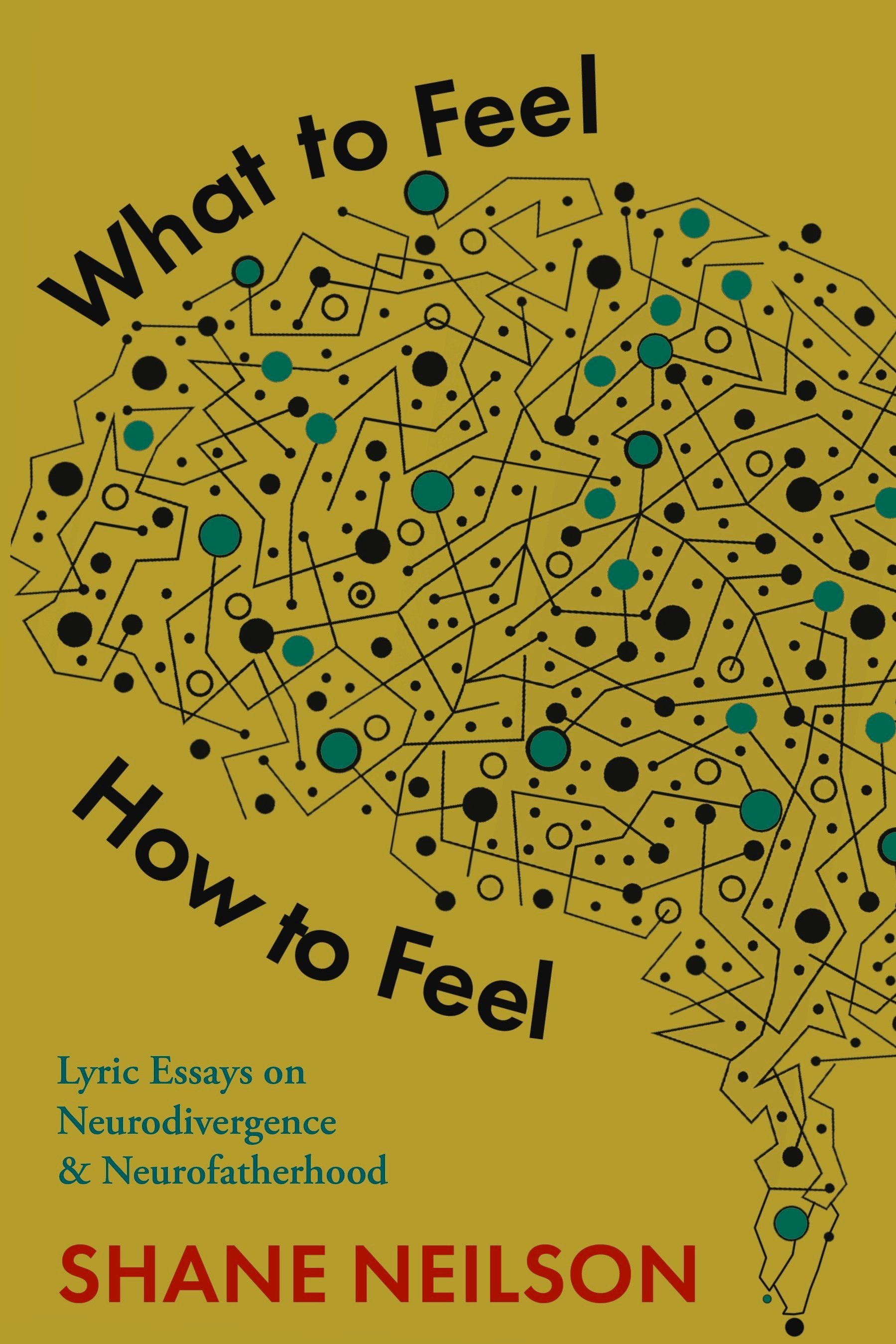
Excerpt from What to feel, how to feel by Shane Neilson
We call it Frink, and Frink it has been since he was able to demand “drink.” Frink it remains, though Frink is specific in a way only his family can know: a carbonated drink from McDonalds as dispensed by an accessible self-serve fountain (a pox on behind-the-counter tyrannical control!). Though cup sizes have escalated over the years, Frink’s always come as an earned reward. Frink as the meaning of life; Frink as the purest joy; Frink as the promise at the end of a long day pining for Frink; Frink if, and only if, one is Good. Frink because he is Good. Consider Frink to be your sex, your drug, your rash internet purchase, but also your wholesome chaste handhold with a first date at a carnival, your sleep stuffy, your comfortable around-the-house lived-in sweater. Frink for a blissful, refill-laden hour. Then the return to normal frinkless life.
Excerpt from “McDonaldsing into the Future-Death”
We call it Frink, and Frink it has been since he was able to demand “drink.” Frink it remains, though Frink is specific in a way only his family can know: a carbonated drink from McDonalds as dispensed by an accessible self-serve fountain (a pox on behind-the-counter tyrannical control!). Though cup sizes have escalated over the years, Frink’s always come as an earned reward. Frink as the meaning of life; Frink as the purest joy; Frink as the promise at the end of a long day pining for Frink; Frink if, and only if, one is Good. Frink because he is Good. Consider Frink to be your sex, your drug, your rash internet purchase, but also your wholesome chaste handhold with a first date at a carnival, your sleep stuffy, your comfortable around-the-house lived-in sweater. Frink for a blissful, refill-laden hour. Then the return to normal frinkless life.
*
At the Toronto Zoo, a spooked middle-aged woman walks alongside a much younger, frowning woman, their age difference thirty years, at least. Woman the Younger seems in a hurry; Older moves in a way I know: slow, subtly uncoordinated, arms slightly flexed. Her clothes (pastel polyester pants, an unflattering white blouse) fit poorly. Her thick, slightly sticky hair is shaped like a hard hat. Ungroomed, not unsightly or unkempt. In contrast, Younger dresses stylishly, in an actual dress – Van Goghian, blue with yellow erupting sunflowers. After a few more seconds of observation, I realize that these two probably unrelated people – they are different races, there is no affection – have been brought together in a care relationship. Older, who’s intellectually disabled in some way, is being led by hand-pull, not hand-hold. Ah. Like my son, she can’t move any faster, it seems. She’s not resisting, she just lacks a faster gear. Younger the Frustrated wants to get somewhere. Always, an abled somewhere to hurry to on the way to another Important Place. Older could be fearful about anything, I suppose. To be fair, Younger could want to get elsewhere for any reason, perhaps a reasonable one. In my gut, though, I interpret this scene as a disabled person taken out on an excursion by a personal support worker, easy gig for them. The relationship is both paid and overtly uncaring. It’s happened before – I sense Older accepts the lack of concern as the cost of coming to the zoo. I ask you: when you were a child, unable to arrange a trip to McDonalds, the movie theatre, or the zoo on your own, wasn’t it enough to just go? When I turn my head to see if anyone else notices the pair, I witness everyone else involved in their own lives, couples and families, my own son and daughter fighting over who saw the first polar bear. Kaz says “Me!” Aria says, “No, me!” I wouldn’t come here if I didn’t love them. I wouldn’t take them if I didn’t love them. I am privileged to love them. They are privileged to be loved. Is that right? That shouldn’t be right.
*
Kaz is late for the special van that couriers him and a few other disabled children to Galt Collegiate. By this point in our lives together, my self-appointed job title is “Leaving Specialist.” From the time he entered kindergarten until now, a strong organizational structure conveyors, coerces, and coaxes Kaz to leave the house in the morning. First, music from downstairs. Then, I climb the stairwell and call to him from his doorway. (Lately, he picks his own clothes.) Then, breakfast after he removes his Invisalign. Breakfast’s intricate movements: for the past few days, he’s attempted to choose an item or two from the fridge. Item choice influences pacing because peanut butter takes minutes to spread on crackers, an apple thirty seconds to slice. Breakfast is carefully arranged – he gets a halfway warning, a 5-minute warning, and then an absolute final warning to leave the table and dress for outside. Ding, louder ding, loudest ding. Waiting by the door, of course, are his bookbag (packed with a lunch made by his mother that he won’t eat, but which we must pack else the school will call us to bring one he also won’t eat), coat, and boots. I have streamlined everything, economized all. Milk in the fridge stands ready to pour, his go-to foods always accounted for and facing frontward, otherwise the routine will be disturbed, Kaz will angrify, and his chances of catching the bus reduce. If we fall behind, there is but one absolute truth and certainty: he will not, cannot accelerate. The factory installed a single low gear. If we fall behind, no admonishment can quicken him. This deep understanding of intellectually disabled (ID) physics enables me to discern the nature of care relationships in the wild. When I encounter ID people in public, I watch their carers. Are the carers in a hurry, at odds with their charges, or in synch? My son may never know this until the day I am gone, but the fact that much has been cleared away for him, that preparation and expertise smooth his progress, is a mark of love through action. Love is also that I understand he cannot be made to go faster, that slowness is his nature. If I were to shout and scare him as I was myself so often scared as a child, then he would startle, yet not move faster and quicker. And when I see him startle, I see myself, and I never want to see myself that way again, too scared to even move. Too heavy to move.
*
At the Toronto Zoo, I order an iced lemonade for Kaz and a croissant for my daughter Aria. Kaz savours the liquid, nursing it for over an hour; my daughter gobbles the croissant. Next to the entrance to Africa Savanna, Kaz sets his lemonade down on a concrete railing and tries to locate the biggest lion, but they hide from the sun, undetectable. When he turns back to his lemonade, yellowjackets swarm the rim. He looks up to me, asks me to get them away. Though I’m not scared of being stung, I know that stinging will happen with so many wasps crawling on the top, several already past the straw aperture soon to reach the sugar water. Plus, he shouldn’t drink the thing now that the wasps are in there. Plus, I want to teach him to respect danger. So I say “Let’s leave the juice for them. They’re yellow. It’s yellow. Yellow things go together.” But he does not accept my silly reasoning and begins to rage, screaming about his Frink, how it’s his, how he should still have it, noowwwwwwwww. The meltdown continues for another thirty minutes. The lions refuse movement, too.
*
Two women sit across a coffee shop table from a middle-aged man. He smiles oddly, askance from them both. Only one woman speaks to him, often in a sing-song voice about his “treat.” Every few minutes, she asks, “Do you want your treat?” Each time, he nods in return, says, “frozey lemonade” while continuing to smile. The one that doesn’t speak to him continues to not speak to him. In a minute, the one that talks to him leaves the table, soon returning with a yellow semisolid liquid in a large plastic cup that she places in front of him. The one who doesn’t speak to the man mentions her previous night spent with a boyfriend and how much of an asshole he is. Apparently, he’s handsy and cheap. The one who singsongs to the man responds with a generic sympathy no more authentic than her singsong interactions with the man. Now it’s her turn to talk, and she describes an aggressive client, pausing only to coo to the man who smiles oddly, who is not aggressive, no no, he is good, good. She talks to him like a dog. Then she complains about another client who soils himself and needs constant watching, otherwise he’ll run away. The one who doesn’t talk to the man mentions how much she hates her ex-boyfriend, who always walked around the house naked. Though she didn’t exactly hate how good he was in bed. The singsong woman watches the liquid level in the smiling man’s cup, as I do: the meniscus vibrates slightly as trucks rumble by the drive-through window. How often does the group home send someone to take him here? How often does he get his treat? Is treating the only activity he does outside the home? Is there anyone to love him?
*
From the time he could walk, Kaz helped me take out the garbage. Once a week, we used to drag the blue, grey, and green containers streetside. Early on, he play-helped, but even when he contributed nothing except trouble, running underfoot, chucking Frink containers out of the bins, overturning the bins, and shoving bins onto the street, I considered this activity his ‘job’ and he would be rewarded with apple juice after we finished. As he became older, repetitively shown what to do week after week, year after year, and given so much juice, he eventually became able to perform the task himself. Once he completes a cycle (garbage out in the morning, bins back in the evening) correctly, without cueing, then the reward comes: a trip to the McDonalds on Main. Frink, from the fountain, classic mix: two-thirds Nestea, one-third red Fruitopia. The visit has its own ritual: we try to sit in the same place in the restaurant, across from the fish tank. We locate the sucker fish who hides in the hollow tree. We look for anyone else disabled. I don’t say what I often wonder: who will take him to McDonalds after I am dead? I know the answer already. Either no one, or people who don’t care about him. After a refill, we leave.
*
Another restaurant, this time Mandarin on King Street in Kitchener. Mando is Kaz’s favourite – he can see all the buffet items and pick exactly what he wants. Fries, onion rings, gravy, and California roll sushi, an undeviating selection. Everyone else at the table – Janet, Aria, me – drink water, Aria with double ice because I spoon out mine and make the exchange. Kaz gets iced tea. Across from us, a disabled pair of young men sit at a small rectangular table. One of the men is dressed as life-size Super Mario, red cap, suspenders, the whole deal. The other man has pronounced retrognathia and strabismus. I hear a speech impediment, a heavy lisp but also dysphonia to boot. As I eat my undeviating meal, chicken fried rice and chicken balls, I map the dynamic between them. Super Mario makes several trips to the buffet, his heaping plates scarfed down and replaced with more. He’s genial, always answering “Yes” to the other’s pleas to hang out after dinner, to hang out at other times. “Let’s hang out later” says the pulled-back jaw man after perhaps the two-dozenth “Yes” to the same question. It’s unclear if the man has been stood up or ghosted by Super Mario before, or whether his anxiety reflects being ignored by others. He pulls out his phone and shows Super Mario something. Retrognathia giggles, Super Mario guffaws. “Isn’t this fun?” Retrognathia asks for the tenth time, adding a new variant, “This is so fun, isn’t it?” As per the ritual, “Yes” comes as response. In time, the waiter comes by, asks “How are you going to pay?” in what I deem a not un-nice way, a not-mean way. A regular way. The normal way. Super Mario points wordlessly to Retrognathia, who volunteers that he will pay. I can tell that this was the deal. Retrognathia’s credit card doesn’t work on tap, so the waiter inserts it into the machine for him, but Retrognathia doesn’t know his passcode. Retrognathia calls someone on the phone, places it on speaker. Someone I assume is his mother patiently recites his code over and over again, a code for a card that is quite possibly hers. The code doesn’t work even when the waiter puts in the numbers. The waiter looks to Super Mario. “Can you pay?” he asks, but Super Mario smiles and says that he cannot. “Can your parents come and fix this?” he asks both of them. Have they been here before? Does he know they have parents? Realizing this interaction is attracting a lot of staring, the waiter commands the two men to stand up and move to the front of the restaurant where the manager will “work things out.” When I finish eating ten minutes later, I walk past the two men sitting at the front. Super Mario stares ahead happily. Retrognathia talks down into his phone, an image of an old woman looking back at him.
*
Excerpt from Shane Neilson’s Imaginary Last Will and Testament, as Written on a Brown McDonalds Napkin Using Red (Provided) Crayon
For my son:
1. Frinks, once weekly
2. Spotify account
3. Gorilla stuffy, medium size
4. Computer with Garageband
5. Someone to love
Excerpt from What to feel, how to feel: Lyric essays on neurodivergence and neurofatherhood © 2025 by Shane Neilson. Reprinted by permission of Palimpsest Press.
In What to feel, how to feel, Shane Neilson dazzles in the lyric essay form. Focusing on non-neurotypicality, Neilson investigates his supposed difference of self while also holding to account society’s construction of that difference, moving from his early childhood to adulthood and then back again in terms of a neurodivergent fathering of his own son. Covering subjects that have yet to receive attention in Canadian literature, including how the medical profession discriminates against its own, Neilson’s poetic accounts of stigma and self-discovery interleavened with literary history mark a first in our letters.

Shane Neilson. Photo credit: Zdenka Neilson
About Shane Neilson:
Shane Neilson is a mad and autistic poet-physician who practices in Guelph, Ontario and who teaches health humanities at the Waterloo Regional Campus of McMaster University. His prose has appeared in the Walrus, Maisonneuve, Image, the Globe and Mail, and many other places.

Power Q & A with Connor Lafortune & Lindsay Mayhew
What surprised me the most about editing an anthology was the length of the process itself. When I was first approached to co-edit with Lindsay [Mayhew], I was surprised by the timeline. I could not imagine it taking over two years from initial conversations to publications.
Q: What was something that surprised you about co-editing the anthology, A Thousand Tiny Awakenings (Latitude 46, 2025)?
Connor Lafortune: What surprised me the most about editing an anthology was the length of the process itself. When I was first approached to co-edit with Lindsay [Mayhew], I was surprised by the timeline. I could not imagine it taking over two years from initial conversations to publications. However, I quickly realized that many of the pieces needed a lot of time in between. I learned to take my time and be patient throughout the process.
Something else that surprised me was the cohesion between all of the submissions. There was an incredible throughline among the poems and short stories. As an editor, I was surprised we could tell a larger story among its smaller pieces.
Miigwetch!
Lindsay Mayhew: This collection brought about many discoveries. I was especially surprised by the weight of responsibility I felt as an editor. The contributors trusted us not only with their art, but also their personal stories. We rarely discuss the importance of ethical practice as editors, but it’s a conversation I look forward to starting often!
It was an honour and delight to work on these pieces with the contributors. This experience has inspired me to continue editing, and I am excited for the never-ending learning involved.
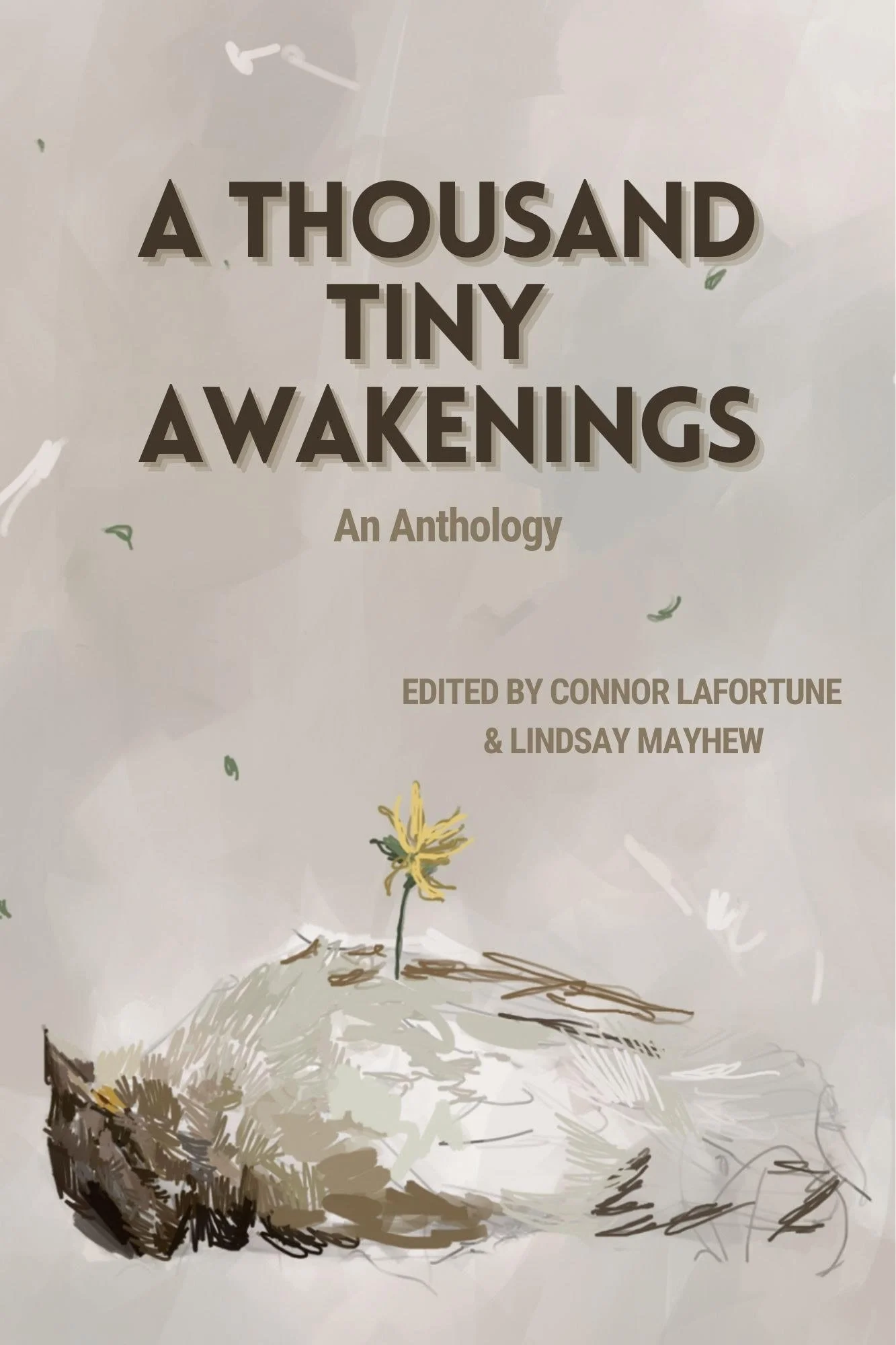
A Thousand Tiny Awakenings (Latitude 46), editied by Connor Lafortune and Lindsay Mayhew.
About A Thousand Tiny Awakenings (Latitude 46):
A Thousand Tiny Awakenings is a collection of genuine and heartfelt expressions from young and marginalized creators who challenge the oppressive structures that shape our world. These narratives, poems, and artworks echo across Turtle Island, transcending borders to offer a stirring testament to resilience and hope. Discover 15 young writers, and 23 unique and powerful pieces that embody the spirit of resistance and resurgence; uplifting the upcoming generation in their pursuit to dismantle boundaries that define their bodies, lives, and futures. Through art and storytelling, these voices call for action and inspire revolution, reminding us that our words have the power to transform the world.
A Thousand Tiny Awakenings features contributions by:
Carson Bohdi Michelle Delorme Brennan Gregoire
Waed Hasan Tyler Hein Jesse June-Jack
Kay Kassirer Nicole Robitaille Blaine Thornton
Lisa Shen Lindsay Mayhew Sydney Read
Connor Lafortune Ra'anaa Yaminah Ekundayo
Chimdi Kingsley-Emereuwa
About Connor Lafortune & LINDSAY MAYHEW:
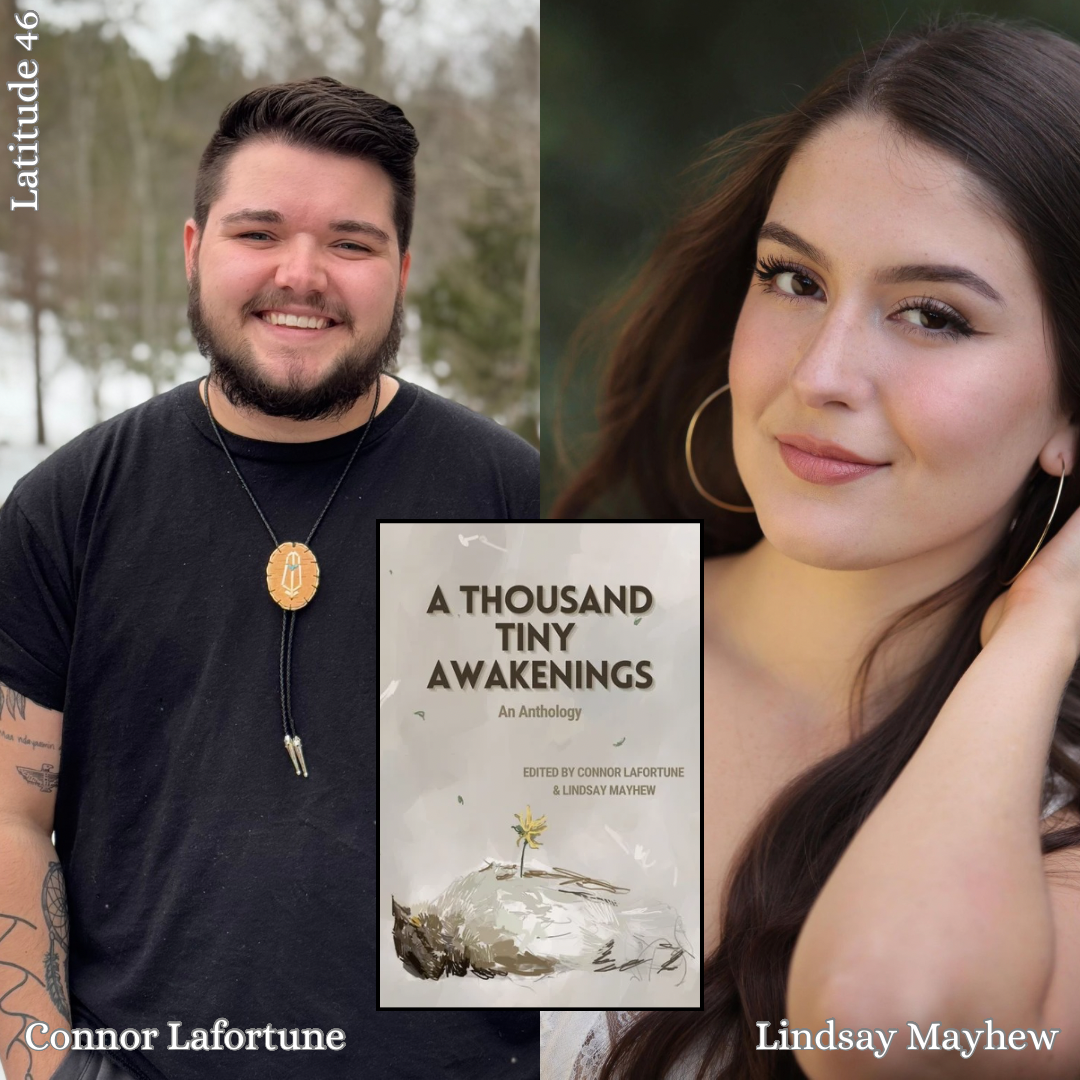
Connor Lafortune is from Dokis First Nation on Robinson Huron Treaty territory of 1850 in Northeastern Ontario. He works primarily in Life Promotion, harm-reduction, mental health, and Indigenous education. He completed his Bachelor’s Degree at Nipissing University with a Double Honors Major in Indigenous Studies and Gender Equality and Social Justice. He is currently in the Masters in Indigenous Relations at Laurentian University. Connor is Anishinaabek, Queer, and Francophone; he uses his understanding of the world to shape his creations as a writer, spoken word poet, and musician. Connor often combines the written word with traditional Indigenous beadwork and sewing to recreate the stories of colonization, showcase resilience, and imagine a new future. He recently released a single in collaboration with Juno Award winner G.R. Gritt titled “Qui crie au loup? ft. Connor Lafortune.” Above all else, Connor is an activist, a shkaabewis (helper), and a compassionate human being.
Lindsay Mayhew (she/her) is a spoken word artist, poet, and writer from Sudbury, Ontario. She recently graduated with a Master’s in English Literature from the University of Guelph. Lindsay is the multi-year champion of Wordstock Sudbury’s poetry slam, and she has featured in events across Ontario, including JAYU Canada, Hamilton’s 10th Fashion Week, and Nuit Blanche. She represented Canada in the 2024 Womxn of the World poetry slam. Lindsay’s written work is featured in multiple editions of Sulphur. Her spoken word and written work seeks to combine art and theory to voice feminist futures.

Power Q & A (Part II) with Kathryn Kirkpatrick
Talk about wonder! Paula Meehan's work came to me in the mail as a request for a book review! Poet and editor R.T. Smith certainly kept channels open for synchronicities, and I'll always be grateful for that request. I think currently we're suffering from the Cartesian dualisms inherent in our capitalist version of modernity, and we've got some horrendous fixes floating around. Paula's beautiful work combines a compassionate, progressive politics (for lack of a better word) through a thoroughgoing critique of the class exploitations underwriting modernity as we know it.

Q: Your book, Enraptured Space: Gender, Class, and Ecology in the Work of Paula Meehan
(West Virginia University Press, 2025) opened our world to a poet we, admittedly, had never heard of before. Would you tell us why the work of Paula Meehan is particularly salient today and how you came to her writing?
A: Talk about wonder! Paula Meehan's work came to me in the mail as a request for a book review! Poet and editor R.T. Smith certainly kept channels open for synchronicities, and I'll always be grateful for that request. I think currently we're suffering from the Cartesian dualisms inherent in our capitalist version of modernity, and we've got some horrendous fixes floating around. Paula's beautiful work combines a compassionate, progressive politics (for lack of a better word) through a thoroughgoing critique of the class exploitations underwriting modernity as we know it. I think her work invites us to find a third way through the dualisms of culture/nature, man/woman, head/heart, reason/feeling. What does that world look like? How might we feel and think our way into it? Can we keep what we've learned through this human passage through capitalist modernity and come through it with the insight and lessons, while being open to what might come next? I think she's always on the border of this kind of seeing, and I want to be there with her, and to be there also in my own life and writing.
More about Enraptured Space: Gender, Class, and Ecology in the Work of Paula Meehan:
Drawing on her own lived experiences as a practicing poet, Kirkpatrick explores how scholarship is grounded in an imaginative exchange between words on the page and the material conditions of the scholar who works to inhabit them. With chapters of literary analysis swimming in a conversation between poets, this book breaches the boundaries between criticism and memoir, suggesting the ways that every scholar is transformed by the subjects they study.
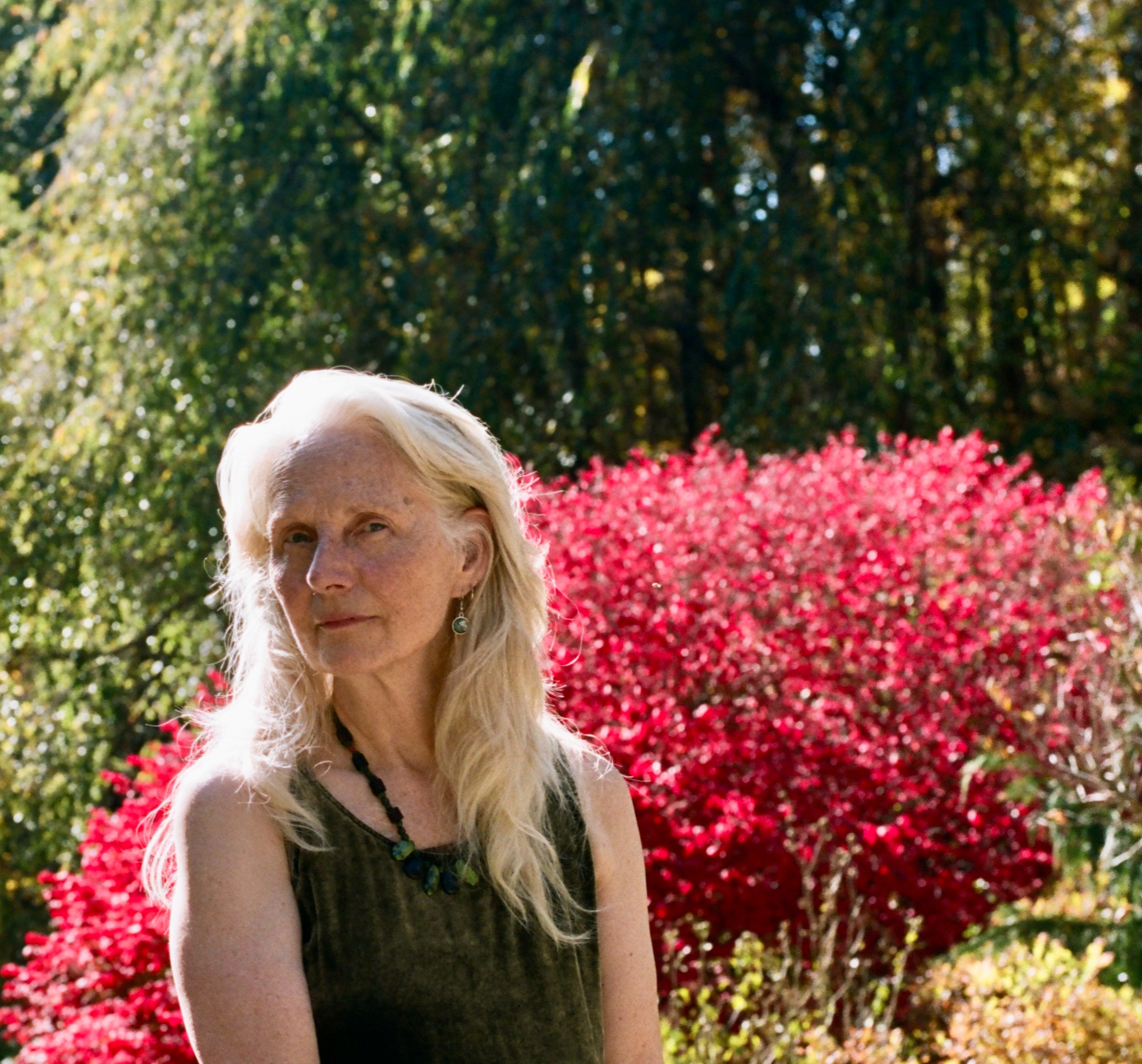
About Kathryn Kirkpatrick:
Kathryn Kirkpatrick is the author of seven collections of poetry, including three recipients of the NC Poetry Society’s Brockman-Campbell award. The Fisher Queen: New & Selected Poems (Salmon, 2019) received the NC Literary and Historical Society’s Roanoke-Chowan Poetry Prize. Although she grew up in the nomadic subculture of the U.S. Air Force and spent my childhood in the Philippines, Texas, and Germany, she has lived in the Blue Ridge Mountains for many years, where she teaches environmental literature, animal studies, Irish studies, and creative writing as Professor of English at Appalachian State University.

Excerpt from In Crisis, On Crisis: Essays in Troubled Times by James Cairns
The move itself was frigid. Men in boots tracking snow and salt through two houses. Half of our plants died in cold moving trucks. My big orange tabby shat in his cat carrier riding next to me in the car from Hamilton to Paris. An omen? Those first weeks in Paris, I saw omens everywhere. Worst was what I found in the attic. Kneeling and feeling for drafts by a small window, I saw bones lying on the floor next to me. They comprised a full skeleton. It was as though the skeleton had been picked clean and preserved for a science class. Not a bone missing or chipped. No rotting flesh or feathers attached. A bird? Squirrel? Baby raccoon? An offering to dark gods left by previous owners? I couldn’t tell.
Excerpt from “Crisis Moves”
[…]
The move itself was frigid. Men in boots tracking snow and salt through two houses. Half of our plants died in cold moving trucks. My big orange tabby shat in his cat carrier riding next to me in the car from Hamilton to Paris. An omen? Those first weeks in Paris [Ontario], I saw omens everywhere. Worst was what I found in the attic. Kneeling and feeling for drafts by a small window, I saw bones lying on the floor next to me. They comprised a full skeleton. It was as though the skeleton had been picked clean and preserved for a science class. Not a bone missing or chipped. No rotting flesh or feathers attached. A bird? Squirrel? Baby raccoon? An offering to dark gods left by previous owners? I couldn’t tell.
In Paul Auster’s Winter Journal he talks about finding a dead crow in the house he and Lydia Davis lived in in upstate New York during their short, doomed marriage. Auster doesn’t believe in ghosts, but feels that their house is haunted. In the crow, he saw “the classic omen of bad tidings”; and their marriage collapsed within a year of finding it. I didn’t have a bag or anything to put the bones in, and I didn’t want Jess or the kids to see them, so I left them lying where I’d found them for a few days. The skeleton lay on the floor of the attic, ten feet above our bed. Before falling asleep, I lay there thinking of it lying above me.
Our first months in Paris were isolating. It was the coldest, snowiest winter in memory. We couldn’t really go outside even if we’d wanted to because it was the peak of the omicron variant of COVID. Nearly everything about the move we’d been excited about – hikes, building community, exploring the town – felt unattainable. While the thing we dreaded most – feeling physically and socially isolated – was now our daily reality.
To make matters worse, there were all kinds of trouble with the house itself. Our first night in the home, the pipes connected to the bathtub leaked through the ceiling onto the basement stairs (talk about omens). The upstairs toilet moaned for fifteen seconds after every flush. We called it the “Paris-saurolophous” – because Gus loves dinosaurs, and the Parasaurolophus is the dino with the crest on its head that honks. You flush the toilet and wait. Then yell, “A Paris-saurolophus is running down the street!” while smiling at Gus and wondering what will break next.
The washing machine ran only hot water. Gus’ room was very cold, despite our covering the window in plastic. The door to the basement wouldn’t close. Neither would the bedroom door. Gus’ door didn’t have a handle. The gas fireplace stank. The whole main floor stank (of gas?). The bathroom sink faucet sprayed water on your clothes when running at normal pressure. Hammering a nail into the upstairs hall, I heard something large drop inside. Was this a normal level of move-in trouble, or had we bought a lemon? I imagined being interviewed for a TV show about people who unwittingly move into wrecks. Then the basement flooded.
Standing in the kitchen in morning darkness, bleary-eyed, waiting for coffee to brew, I heard unidentifiable splashing. With Gus in my arms, I ran down the basement stairs to see water gushing through the stone foundation. It had rained overnight for the first time since we moved. Snow melting in the yard poured into our utility room. In one spot, water was coming through the wall so rapidly, with such force, that it spurted into the room as if from a backyard garden feature. Weeping walls, a crumbling foundation – the contrived symbolism, the on-the-nose pathetic fallacy of an unimaginative poet. Was our house about to collapse? We were falling apart.
[…]
“Crisis Moves” is excerpted from In Crisis, On Crisis: Essays in Troubled Times by James Cairns copyright © 2025 by James Cairns. Reprinted by permission of Wolsak & Wynn.

In Crisis, On Crisis: Essays in Troubled Times by James Cairns
More about In Crisis, On Crisis: Essays in Troubled Times :
Drawing on social research, pop culture and literature, as well as on his experience as an activist, father and teacher, James Cairns explores the ecological crisis, Trump's return to power amid the so-called crisis of democracy, his own struggle with addiction and other moments of truth facing us today. In a series of insightful essays that move deftly between personal, theoretical and historical approaches he considers not only what makes something a crisis, but also how to navigate the effect of these destabilizing times on ourselves, on our families and on the world.

James Cairns
About James Cairns:
James Cairns lives with his family in Paris, Ontario, on territory that the Haldimand Treaty of 1784 recognizes as belonging to the Six Nations of the Grand River in perpetuity. He is a professor in the Department of Indigenous Studies, Law and Social Justice at Wilfrid Laurier University, where his courses and research focus on political theory and social movements. James is a staff writer at the Hamilton Review of Books, and the community relations director for the Paris-based Riverside Reading Series. James has published three books with the University of Toronto Press, most recently, The Myth of the Age of Entitlement: Millennials, Austerity, and Hope (2017), as well as numerous essays in periodicals such as Canadian Notes & Queries, the Montreal Review of Books, Briarpatch, TOPIA, Rethinking Marxism and the Journal of Canadian Studies. James’ essay “My Struggle and My Struggle,” originally published in CNQ, appeared in Biblioasis’s Best Canadian Essays, 2025 anthology.

Excerpt from The Unravelling: Incest and the Destruction of a Family by Donna Besel
Call me “Incested.”
I earned that name. I struggled long and hard to be able to say those words.
I cannot speak for husbands, children, sisters, brothers, cousins, wives, ancestors, friends,
or any of the hundreds involved; I speak only for myself. I tell this from my vantage point, my version of vision, my fractured reality.
PROLOGUE
Call me “Incested.”
I earned that name. I struggled long and hard to be able to say those words.
I cannot speak for husbands, children, sisters, brothers, cousins, wives, ancestors, friends, or any of the hundreds involved; I speak only for myself. I tell this from my vantage point, my version of vision, my fractured reality.
"She's lying. She's always been crazy and angry. What in hell is she trying to do?"
To that I say - this is my story. I earned it. I will call myself “Incested.”
CHAPTER ONE
August 15, 1992
This story begins, strangely enough, with a wedding.
As is often the case with incest, it had gone on for years, but the unraveling began when my family gathered for my younger sister's marriage. Even before the bride began to plan the nuptials, family members muttered, mumbled, and tried to think happier thoughts. We knew it needed to come out. I liked to call it the "constipated memory syndrome.”
Three months before the wedding, my brother David had decided to have his daughter christened. He suggested, since we might all be in the same city, we could gather to discuss incest. The time had come. Furtive and terrified, we freaked - we couldn't do this now- we had a wedding to plan, besides, what would the groom's mother think?
On the previous Christmas, the avalanche had already started. When my brother Robin dropped by for a visit, we had this strained conversation.
"Well, Shannon finally left home. He was still doing it to her. Did you know?"
"I'm not surprised. He did it to me for a long time."
"He did it to you? How come you never told me?"
"You never asked. I hoped he had stopped. We are so dumb."
"Who else?"
"Who knows?"
"What happens now? What can we do?"
"It's gonna be shitty, no matter what."
And then I felt a sinking feeling, like flunking a test, blowing an interview, only one hundred thousand times worse.
"Let's wait and see. Maybe it will work out. Maybe we won't have to do anything."
But we had come to a ledge, whether we wanted to or not.
And then ... we stepped off the cliff. Notice I say "We." I am mindful of pronouns, in writing and in speaking. Some of my siblings shared the same thoughts, fears, inklings of disaster. I wasn't on that precipice by myself.
First, some relevant numbers: my family of origin consisted of ten children, five sons and five daughters. I am sixth in birth order. We were raised in poverty, in a rural setting, in a small bush community called West Hawk Lake. My birth mother died of brain cancer at forty-eight, two years after her last child, Tom, was born. I was fourteen. My father remarried just as I turned eighteen, in my final year of high school. After a few years, my stepmother, Joan, adopted a daughter, Shannon, fours years old.
The arrivals of my brothers and sisters spanned about twenty-five years, in intervals of roughly every two years. Most managed to get educated, get married, and get children. Some managed all three, to greater or lesser success. At the time of the wedding, I was married, with two kids.
In the months prior to the wedding, my siblings silently transmitted the following message - the ceremony must be dealt with, before the incest bomb could be defused.
Not surprisingly, our family excelled at weddings. This would be our seventh. Wendy, the youngest daughter of our birth mother, deserved to have it done up right.
I gave the toast to the bride.
"Once upon a time, there was a girl with straight blonde hair, big blue eyes, and wrap-around grin. Her mother had so many children she didn't know what to do ...Whoops! Wrong story! Anyway, this girl seemed so old and so wise that everyone called her "Little Old Lady." When she was around six years old, her mother got sick and died, just before Christmas. The little girl became even older and wiser."
And so it went, on and on and on.
We raised our glasses, flung jackets on chairs, posed for photos, danced the polka - so boisterous and photogenic. For the moment, we could overlook the old man clutching and fondling the bridesmaids.
Wendy and her new husband Bill drove off into the darkness. Thankfully, they were far enough down the road and across the prairie, before the detonation. After the honeymoon ended, they returned to a changed family, smoldering, grieving, wounded; no semblance of the happy, bright wedding crowd remained.
CHAPTER TWO
While Wendy and Bill headed west, my second oldest sister, Belle, lingered in West Hawk Lake. She had arrived with lots of baggage, physical and other kinds. For four days, she asked questions, revealing glimpses of her own story. She pressed books about "survivors" into reluctant hands. Belle bothered people. She bothered our oldest sister, Jean, once too often.
Jean chose to enlighten Belle. But she did not talk about improprieties done to her, or any of our sisters. She told Belle about the sexual activity between Belle's adult daughter, Rena, and Belle's husband, Terry. He had been molesting her for years.
While Rena attended college, she worked as a seasonal employee for the local Parks Branch and lived in the big family home with our stepmother Joan and our father Jock. During those summers, she disclosed Terry’s sexual assaults to Joan and Jean. Both chose to keep quiet about these disclosures.
The day after the wedding, I returned home with my husband and children so I was not there when Jean told Belle about Terry abusing Rena. Belle called me later to tell me how she had lost control of every bodily function - screaming, puking, weeping, passing out, shaking, screaming some more.
Somehow, she managed to get to David's house in Winnipeg. David, one of the younger brothers, had hosted the christening in the spring. Belle spent three days with him and his wife, Sandra, vomiting and weeping, sedated at times.
In spite of her anguish, Belle phoned her husband.
— from The Unravelling: Incest and the Destruction of a Family by Donna Besel. Published by Univeristy of Regina Press. © 2021 by Donna Besel.

The Unravelling: Incest and the Destruction of a Family
By Donna Besel (Published by University of Regina Press)
About The Unravelling: Incest and the Destruction of a Family:
It’s the antithesis of why a wedding should be memorable. In 1992, at a sister’s nuptials, Donna Besel’s family members discovered that their father, Jock Tod, had molested their youngest sister. After this disclosure, the other five sisters admitted their father had assaulted them when they were younger and had been doing so for years. Despite there being enough evidence to charge their father, the lengthy prosecution rocked Besel's family and deeply divided their small rural community.
The Unravelling is a brave, riveting telling of the destruction caused by sexual assault, and the physical, psychological, emotional, financial, and legal tolls survivors often shoulder.
Donna Besel offers an honest portrayal of the years-long police process from disclosure to prosecution that offers readers greater insight into the challenges victims face and the remarkable strength and resilience required to obtain some measure of justice.

Author Donna Besel
About Donna Besel:
Donna Besel loves writing of all kinds, and does presentations for schools, libraries, universities, conferences, and retreats. Her work has gained recognition from CBC Literary Awards (three times), won national contests, and appeared in literary journals, magazines, and anthologies. Both of her books, a short story collection and a memoir, have been bestsellers.

Excerpt from Seeking Spirit: A Vietnamese (Non)Buddhist Memoir by Linda Trinh
After two thousand years, the historical truth of the two sisters, Trưng Trắc and Trưng Nhị, has evaporated into the winds of time, carried along by gusts of myth throughout the centuries. In the most traditional account of events, the one most widely reported by historians, the Trưng sisters were born into a noble family, their father part of the Lạc lords living in the Red River Delta valley, in Giao Chỉ province.
After two thousand years, the historical truth of the two sisters, Trưng Trắc and Trưng Nhị, has evaporated into the winds of time, carried along by gusts of myth throughout the centuries. In the most traditional account of events, the one most widely reported by historians, the Trưng sisters were born into a noble family, their father part of the Lạc lords living in the Red River Delta valley, in Giao Chỉ province. Presently, this is close to Hà Nội in northern Vietnam. The Lạc lords believed they were descendants of the Hùng kings as part of the origin story of the Vietnamese people. The mountain fairy Âu Cơ and the sea dragon Lạc Long Quân had one hundred children together. When they parted ways, fifty children went with their mother to the mountains where they became the highlanders. Fifty children went with their father to the seashore where they became the Hùng kings of the Lạc people.
Even after two hundred years of governance, the Lạc people had no love for their Chinese rulers of the Han Dynasty. In an act intended to secure obedience, the Chinese Administrator had Trưng Trắc’s husband, Thi Sách, executed for insurrection. This act had the opposite effect. Trưng Trắc set aside her mourning clothes and took up sword and shield in 40 C.E.
The sisters raised a rebellion army of women and men and drove out the Chinese through quick and decisive raids and battles. Trưng Trắc was crowned queen and she ruled for three years. Yet in 43 C.E., the Chinese came back, and defeated the Trưng sisters.
The historical accounts do not mention the sisters riding elephants into battle. There are different accounts of their deaths. The account closest to the hearts of the Vietnamese is that the sisters drowned themselves in the Hát River, preserving their honour for eternity. Yet others have written they were captured, executed, and their heads delivered back to the Han capital.
The Trưng sisters had fallen.
And the legend of Hai Bà Trưng, two sisters Trưng, was born.
The first time I saw the dance of Hai Bà Trưng performed, tears welled up in my eyes and goose pimples dotted along the back of my neck and down my bare arms. The Duckworth Centre at the University of Winnipeg where the Pavilion was held was well air-conditioned during muggy August. Yet I felt heat rise to my cheeks and out through the top of my head. I crossed my arms over my chest to hold myself together, my reaction was so immediate.
Mighty warrior women. Mighty Vietnamese women. I felt this story deep in my bones, resonating through my blood. This was my introduction to the two sisters, my first glimpse into my own history. The Trưng sisters were certainly not part of the curriculum at General Wolfe School in the West End.
Growing up in Canada, I knew about European explorers and I knew about ancient Egypt. Yet I knew very little about the history of the country of my birth. I was three when we emigrated, and I had visited Vietnam only once before entering junior high. The Vietnam War, phở noodle soup, and people on motorbikes came quickest to mind when I thought about where I was born.
I focussed on Jen standing stationary on her war elephant. What was going through her mind? She had just deployed her army to battle the greater force of the Chinese. Was she fearful? Was she determined to see this to the end? When did Trưng Trắc know she was going to be defeated? When did she decide to give up her mortal life? Trưng Trắc, channelled through my sister, reached out from the past. Trưng Trắc illuminated my path through the mists of the spirit realm, highlighting the Vietnamese pull to the otherworldly.
Ever since the summer of the Saigon Pavilion, Trưng Trắc has been nearby. She became my role model; I was a shy girl who loved to read and play games of imagination, but I did not see myself in my cherished Lucy Maud Montgomery books and blonde Barbie dolls. It was the first time I saw myself, a Vietnamese girl, represented anywhere.
Trưng Trắc was a whisper in the wind after I closed the front door. She was a flash of light after I turned off the lamp in my bedroom. She was a heroine from the land of my ancestors. Powerful and proud. A thread wove its way from Trưng Trắc through the generations to me. She was not far, she was close.
I followed the thread that linked me to Trưng Trắc. Through her, I discovered the threads that bound me to my family, that bound me to my dad, in the realm of the spirits.
Ba had passed on before I celebrated my eighth birthday. He went into the hospital and never came out. I only recall flashes—wavy black hair and brown sunglasses, a belly laugh that was contagious and hands tanned like leather, wrinkled yet warm. Everyone said I’d inherited my darker skin from Ba, while Jen took after Má. My memories of him as bone and flesh are faded and fragmented.
And yet, after his passing, I saw him everyday staring through his photo from his altar. We shared meals together of rice, bi soup, pan fried pork, after Má cúnged. I saw him when I cleaned his altar every month. When I envision Ba, I see him in black and white as a young man in his mid-twenties from his altar photo. Even though I never knew that man in real life, the man from the picture has been a presence in my life.
The veil between the living and the dead is thin. Family passes on and yet they remain. My family swirls around me, ghosts without form yet true to essence. A hand at my back, a caress on my cheek. Whispering to me, steadying my feet. They are never far from this world. Not peering down from heaven but walking alongside me. Slipping in between the veil of human breath and shadow existence.
A crack in the window, a doorway not quite shut, a lid slightly ajar.
Enough of an opening through which
light may pass,
air may flow,
water may seep,
and spirit may come.
— from Seeking Spirit: A Vietnamese (Non)Buddhist Memoir by Linda Trinh. Published by Guernica Editions. © 2025 by Linda Trinh

Seeking Spirit by Linda Trinh
About Seeking Spirit:
Linda Trinh says she had everything she thought an immigrant woman should want: motherhood, career, and security. Yet she felt empty. Growing up in Winnipeg, Linda helped her mom make offerings to their ancestors and cleaned her late dad's altar. These were her mother's beliefs, but was Buddhism Linda's belief? In her late-twenties, Linda sought answers in Egypt and China and prayed during corporate downsizing, seeking meaning in contemporary life. Via a collection of essays, she plays with form and structure to show the interconnection of life events, trauma, and spiritual practice, to move from being a passive believer to an active seeker.

Author Linda Trinh.
About Linda Trinh:
Linda Trinh is an award-winning Vietnamese Canadian author of fiction and nonfiction for children and adults. She is the author of The Nguyen Kids series. Her work has appeared in various anthologies and literary magazines, and has been nominated for numerous awards. The Secret of the Jade Bangle co-won the Manitoba Book Award for best first book. Linda immigrated to Canada with her family from Vietnam when she was three years old. She and her older sister were raised by a single mother, surrounded by extended family in the West End of Winnipeg, after her father passed away when she was seven. Growing up, she did not see herself represented in books and that absence influences her exploration of identity, cultural background, and spirituality. She lives with her husband and two kids in Winnipeg, on ancestral lands, Treaty 1 territory, traditional territory of the Anishinaabeg, Cree, Oji-Cree, Dakota, and Dene Peoples, and on the National Homeland of the Red River Métis.

Power Q & A with Laine Halpern Zisman
Laine Halpern Zisman’s latest book Conceivable: A Guide to Making 2SLGBTQ+ Family (Fernwood, 2024) is the first book of its kind in Canada.
Laine Halpern Zisman is an adjunct professor at the School of Public Health and Social Policy at the University of Victoria. She is founder and project lead on Family Building Canada (familybuildingcanada.com) and a Certified Fertility Support Practitioner with Birth Mark in Toronto. Her research traverses the intersections of 2SLGBTQ+ equity, culture, and reproductive care.
Laine Halpern Zisman’s latest book Conceivable: A Guide to Making 2SLGBTQ+ Family (Fernwood, 2024) is the first book of its kind in Canada.
Laine Halpern Zisman is an adjunct professor at the School of Public Health and Social Policy at the University of Victoria. She is founder and project lead on Family Building Canada (familybuildingcanada.com) and a Certified Fertility Support Practitioner with Birth Mark in Toronto. Her research traverses the intersections of 2SLGBTQ+ equity, culture, and reproductive care.
We are honored to have Laine here with us today to talk about about her work.

Concievable by Laine Halpern Zisman (Fernwood, 2024)
Q: What is one thing you think people would be surprised to learn about the state of reproductive care in Canada?
A: Fertility care in Canada might not always be what you expect, which is why I always say to 'expect the unexpected.' There’s no national standardization of cost, wait times, and access, and that can lead to major gaps. Access, funding, and finding a clinic that fits your needs can vary drastically depending on your province or territory (and even your city). For example, some provinces have many clinics in city centres, while others have one clinic or none at all. Some provinces offer coverage for treatments like IVF, while others provide nothing at all, leaving patients to pay out of pocket (anywhere from $10,000-$100,000). On top of that, there’s no consistent system to help you navigate options, policies, or timelines. This lack of standardization is why advocacy is so critical—people need to know their rights, push for transparency, and demand equitable, accessible care no matter where they live.
About Conceivable:
Conceivable: A Guide to Making 2SLGBTQ+ Family moves beyond the birds and the bees to consider the politics, challenges, choices and opportunities for agency and joy involved in 2SLGBTQ+ fertility, conception and family building in Canada. With contributions from healthcare workers, mental health professionals and support people in the field of reproductive health and 2SLGBTQ+ sexual care, this book is an honest and thorough look at growing your family.
Conceivable is for birthing parents, non-gestational parents, families seeking a surrogate or donor, and those who do not yet know what they need. With illustrations, worksheets and activities to help you think about the intimate questions of communication, relationship building and community, this guide will prepare you with the knowledge you need to navigate advocacy, rights and regulations.

Laine Halpern Zisman
More about Laine Halpern Zisman:
In addition to Conceivable, Laine has published two collected volumes, Women and Popular Culture in Canada (2020) and the second edition of Queerly Canadian, co-edited with Professor Scott Rayter (2023), as well as multiple scholarly articles in academic journals and collected volumes.
Halpern Zisman received a SSHRC Partner Engage Grant (2023) and SSHRC Connection Grant (2022) to support activities related to HIV In My Day at the University of Victoria, as well as a Community One Foundation Grant (2023) to launch a new online platform for 2SLGBTQ+ Family Building (familybuildingcanada.com). She is the recipient of a CIHR Health Hub fellowship (2022); CATR O'Neill Book Prize (2022); a Graduate Mellon Fellowship (2017); and Course Instructor Teaching Excellence Award.

Excerpt from Your Roots Cast a Shadow by Caroline Topperman
I am standing in the middle of the street, crying. “I hate this coffee. Why does everything taste so weird? Why is surówka served with everything?” To this day I don’t get what’s to love about a type of coleslaw. Why did we come here? What was I thinking? My poor husband stands helpless, watching my meltdown. He later tells me he was concerned by my extreme reaction, and worried that I was going to unravel. He felt bad, he said. He had no idea how to help me. We haven’t found our support system. For now it is just the two of us trying to navigate our daily existence.
ASSIMILATION (OR NOT) BY WAY OF FOOD
I am standing in the middle of the street, crying. “I hate this coffee. Why does everything taste so weird? Why is surówka served with everything?” To this day I don’t get what’s to love about a type of coleslaw. Why did we come here? What was I thinking? My poor husband stands helpless, watching my meltdown. He later tells me he was concerned by my extreme reaction, and worried that I was going to unravel. He felt bad, he said. He had no idea how to help me. We haven’t found our support system. For now it is just the two of us trying to navigate our daily existence.
The honeymoon period in a new place lasts about a month. That’s when everything feels new and shiny—before your new reality takes you by surprise. I have to wonder: is this how my parents felt when they first lived in Baghdad or Paris, in Sweden or Toronto? No wonder they didn’t hang on to the foods they knew. Or to the traditions. How could they? They learned it was easier to adapt than to blindly cling to old conventions. My father grew up in postwar Poland when food was heavily rationed. For years my parents had to be financially creative to put healthy meals on our table. Food was the bridge to our life in Canada and all the places my parents called home.
Adjusting to our new life in Poland is demanding. Having breakfast at Vincent’s, a Parisian café in the heart of the city, helps, and in a couple of days we fall into a routine that leads us daily to this tiny piece of Paris, complete with flags, those iconic wicker chairs, and the best baguettes outside of France. Each morning we leave our flat for a small park with sweeping views of Powiśle, an indie neighborhood bordering the Vistula River and the escarpment where we live. There are always lots of people, all walking dogs off leash, so we pick our way through dog poop and garbage left by partygoers, local drunks, and students. Pristine the park is not, but we have a prime view of the church grounds—one of the many, many churches in Warsaw—and a view of the river and the rooftops. Walking down a steep hill where kids toboggan in the winter, we come to the Chopin University of Music, where we’re serenaded by students practicing the piano or violin or occasionally a flute, creating that alluring cacophony heard at the start of a classical concert, then make our way up to Nowy Świat, a part of the Royal Route.
This daily walk to Vincent’s makes us happy. The general societal mood is electric, despite a certain heaviness that lingers. Warsaw is a city that displays its memories, especially those that contrast starkly with the modern world. Memorials and statues stand out on prominent streets. Buildings show off shell holes from World War II assaults. Every few steps there is a plaque commemorating a death or a war event, like the beautiful old library around the corner from our home that saw its books burned during the Nazi regime. Even with history at every turn, the pink, blue, and yellow buildings perk up the gray wintry feel of Warsaw.
Pixie, with her laid-back West Coast disposition, putters along at our side as we pass restaurants and cafés that will soon be bustling. Pixie loves Vincent’s as much as we do. Why wouldn’t she? The owner hand-feeds her fresh croissants, sometimes with jam. Those croissants are the best part of our mornings. Breaking apart the buttery flakes, each bite a melting morsel, and washing them down with rich cappuccinos is the only sane way to start the day. Actually, there are three Parisian cafés to choose from on this street, each with its own flavor. Petit Appetit has vintage French music, and each baguette is named after a different city. A few meters away is Croque Madame, with whitewashed walls and bunches of lavender strategically displayed. Vincent’s is my favorite because it reminds me the most of Paris, but each café is filled with the aroma of fresh bread. From flaky pastries to cream-filled macarons to warm, melt-in-your-mouth pain au chocolat to delicate madeleines, every day brings some new indulgence. In the weeks to come, when we finally rejoin society, we will drop by Vincent’s on Saturday mornings to pick up a freshly baked baguette that is still warm to the touch, to pair with runny cheeses, fragrant meats, juicy red tomatoes, and crisp pickles. This is the meal that grounds us, that makes us feel we are home.
For now, walking to faux Paris every morning is our escape from the obvious. At some point, we will have to find work. At some point, we will have to eat healthier food. That means I will have to cope with grocery shopping.
When I finally try, some items really stump me. The tomato sauce tastes sweet, and the only milk I find is boxed up, on a shelf. Eggs aren’t in the fridge either, which makes for a confusing run around the market. It takes days of dipping into different stores before finally working up the nerve to ask a clerk about this strange new-to-me milk. Actually, I have no idea what to ask, which is why the conversation goes as follows. “Przepraszam? Prosze pana, jakie to mleko, czy można je pić normalnie?” This roughly translates as, “Excuse me, sir? What kind of milk is this? Can I just drink it normally?” Or at least that’s what I want to say. Whether it comes out like that, I can’t be sure. “O co pani chodzi?” he scoffs. This term I will come to know intimately over the next four years. It translates roughly as, “What are you talking about?” said harshly. Dismissively. To be fair, I probably sounded odd asking about milk I can drink “normally.” I went to Poland thinking I spoke Polish. Which I do. I speak Polish fluently, but I was used to speaking Polish with my family over dinner and throwing in the occasional English word or modifying a Polish word when I didn’t know how to conjugate. Conversation went like this, “Jak dzisiaj było w szkole?” (How was your day at school?) “Okay. Miałam, science test i myślę że, that I passed.” Do I even need to translate? But in Poland, it will take a year before I figure out that I should smile my biggest smile and say, “I’m sorry I haven’t learned that word yet,” so people will laugh and possibly go out of their way to help me.
— from Your Roots Cast a Shadow: One Family’s Search Across Histoy for Belonging by Caroline Topperman. Published by HCI. © 2024 by Caroline Topperman.

Your Roots Cast a Shadow: One Family’s Search Across Histoy for Belonging by Caroline Topperman. Published by HCI.
About Your Roots Cast a Shadow: One Family’s Search Across Histoy for Belonging :
A narrative of cultural translation, identity, and belonging.
The thrill of a new place fades quickly for Caroline Topperman when she moves from Vancouver to Poland in 2013. As she delves into her family’s history, tracing their migration through pre-WWII Poland, Afghanistan, Soviet Russia and beyond, she discovers the layers of their complex experiences mirror some of what she felt as she adapted to life in a new country. How does one balance honoring both one’s origins and new surroundings?
Your Roots Cast a Shadow explores where personal history intersects with global events to shape a family’s identity. From the bustling markets of Baghdad to the quiet streets of Stockholm, Topperman navigates the murky waters of history as she toggles between present and past, investigating the relationship between migration, politics, identity, and home. Her family stories bring history into the present as her paternal grandmother becomes the first woman allowed to buy groceries at her local Afghan market while her husband is tasked with building the road from Kabul to Jalalabad. Topperman’s Jewish grandfather, a rising star in the Communist Party, flees Poland at the start of WWII one step ahead of the Nazis, returning later only to be rejected by the Party for his Jewish faith. Topperman herself struggles with new cultural expectations and reconciling with estranged relatives.
A study in social acceptance, Topperman contends with what one can learn about an adopted culture while trying to retain the familiar, the challenges of learning new languages and traditions even as she examines the responsibilities of migrants to their new culture, as well as that society’s responsibility to them.

Author Caroline Topperman.
More about Caroline Topperman:
Born in Sweden and raised in Canada, in 2013 Caroline Topperman returned to her ancestral roots in Poland to live, and to explore her love of traveling and experiencing different cultures. From sampling authentic Neapolitan Pizzas in Naples, to photographing a piano, frozen in a river in Užupis, an independent artist’s republic in Lithuania, to pitching Poutine as a great comfort food to a local French baker in Poland. She speaks fluent English, Polish, and French. Caroline holds a BFA in screenwriting from York University (Toronto). Her book credits include Tell Me What You See: visual writing prompts for the wandering writer (One Idea Press) and a complementary guide to her blog, FitWise: straight talk about being fit & healthy. Caroline has written a column for Huffington Post Canada and was the Beauty Editor for British MODE.

Power Q & A with Margaret Nowaczyk
Today’s Power Q & A features best-selling Polish-Canadian author and pediatric clinical geneticist Dr. Margaret Nowaczyk. Dr. Nowaczyk’s most recent book, Marrow Memory: Essays of Discovery invites readers to examine her DNA under a microscope, sharing her vast life experiences in a series of invariably absorbing and beautifully-crafted personal essays. From growing up in Communist Poland, to immigrating to Canada as a teen, to working as a pediatric clinical geneticist and professor at McMaster University, Nowaczyk bares her soul while encouraging readers to explore the ways in which our experiences and identities are entangled with our ancestral history.
Today’s Power Q & A features best-selling Polish-Canadian author and pediatric clinical geneticist Dr. Margaret Nowaczyk. Dr. Nowaczyk’s most recent book, Marrow Memory: Essays of Discovery invites readers to examine her DNA under a microscope, sharing her vast life experiences in a series of invariably absorbing and beautifully-crafted personal essays. From growing up in Communist Poland, to immigrating to Canada as a teen, to working as a pediatric clinical geneticist and professor at McMaster University, Nowaczyk bares her soul while encouraging readers to explore the ways in which our experiences and identities are entangled with our ancestral history.
We’re honoured to have Dr. Nowaczyk join us for this short and sweet interview series.
Bring home Marrow Memory: Essays of Discovery (Wolsak & Wynn, 2024).
Q: You’re an advocate of narrative medicine. Would you explain what that is and how—if at all—it shaped your writing of this collection of essays?
A: Narrative medicine trains physicians to be better listeners and diagnosticians. Narrative medicine is not a therapeutic modality; it is not narrative-based therapy with which it is sometimes confused. After training in narrative medicine, by paying close attention to the patient’s story, the text of the patient, so to speak, doctors are better able to determine the cause of illness and the optimal approach to therapy. In addition, narrative medicine has been shown to increase empathy and to prevent physician burnout.
How does that training happen? Narrative medicine recommends close reading of literary texts, writing about patient encounters in non-medical language, and reflective and creative writing. In the essay “Reading Dostoevsky in New York City” in “Marrow Memory”, my collection of essays, I describe the process of close reading; in my memoir “Chasing Zebras”, I wrote how attending a narrative medicine workshop opened my eyes to the power and potential of writing and sharing my stories. Both experiences were paradigm-shifting for me. I have always been an avid reader, but it is the attention paid during the process of close reading that trains one to notice nuances in patient’s behavior, the gaps in her story, the tell-tale signs of illness and distress. By paying attention to those subtle signs, a physician is better able to attend to the patient’s needs, both in terms of diagnosing her condition and of treating it. Writing about a patient encounter in non-medical language (done in what is called “parallel chart”), after the heat and stress of often too-brief a patient encounter, allows the physician to identify the many preconceptions and biases that medical language frequently hides. It is then that the writer has the luxury of time and reflection to do so. This practice fosters empathy. And creative writing, the final pillar of narrative medicine training? It allowed me to express my deepest fears, explore my darkest obsessions, and pay attention to my well-being in the safety of the ever so patient blank page.
Simply, without training in narrative medicine, I would not have become a writer. There would have been no stories, no essays, and no memoir.

MARGARET NOWACZYK (photo credit: Melanie Gordon)
More about Margaret Nowaczyk:
Margaret Nowaczyk was born in Poland in 1964 and emigrated to Canada with her family in 1981, having spent six months as a stateless person in Austria. She finished high school in Toronto in 1982. After receiving a B.Sc. in biochemistry in 1985, she graduated with honours from the University of Toronto Faculty of Medicine in 1990. For six years, she trained in pediatrics and genetics at the Hospital for Sick Children in Toronto, with elective training at Boston Children's Hospital in pediatric neurology and at Hôpital Enfants Malades in Paris, in inborn errors of metabolism. In 1997, she was offered a university faculty position as a clinical geneticist at McMaster Children’s Hospital. Since then, she has been caring for children with genetic disorders and providing prenatal diagnosis and genetic counselling for adults. She has authored 120 peer-reviewed papers in genetic journals, and rose to the rank of professor in 2014. She is a great advocate of the narrative approach to medical care. Her short stories and essays have appeared in Canadian, Polish and American literary magazines and anthologies. She lives in Hamilton, ON, with her husband and two sons.