

BLOG

Power Q & A with Tim Bowling
Tim Bowling is the author of twenty-four works of fiction, nonfiction, and poetry. He is the recipient of numerous honours, including two Edmonton Artists’ Trust Fund Awards, five Alberta Book Awards, a Queen Elizabeth II Platinum Jubilee Medal, two Writers’ Trust of Canada nominations, two Governor General’s Award nominations and a Guggenheim Fellowship in recognition of his entire body of work.
We are joined by this phenomenally accomplished and internationally-acclaimed CanLit icon for our Power Q & A series, to ask a quick question about his latest book, a collection of poems, In the Capital City of Autumn (published by Wolsak & Wynn, 2024).
Tim Bowling is the author of twenty-four works of fiction, nonfiction, and poetry. He is the recipient of numerous honours, including two Edmonton Artists’ Trust Fund Awards, five Alberta Book Awards, a Queen Elizabeth II Platinum Jubilee Medal, two Writers’ Trust of Canada nominations, two Governor General’s Award nominations and a Guggenheim Fellowship in recognition of his entire body of work.
We are joined by this phenomenally accomplished and internationally-acclaimed CanLit icon for our Power Q & A series, to ask a quick question about his latest book, a collection of poems, In the Capital City of Autumn (published by Wolsak & Wynn, 2024).
Tim is in top form in this collection. Threading through autumnal themes such as the loss of his mother and the demolition of his childhood home, his children growing and the inevitable passage of time, Bowling writes with rich lyricism and imagery. Sweet William and loosely woven woollen mitts for his mother, the moon as “an egg in the pocket of a running thief” for time, salmon for eternity. In the Capital City of Autumn, the characters of The Great Gatsby come to life, and three a.m. brings wisdom. These are masterful poems, lightened with a touch of whimsy, poems to sink into on a quiet evening.
Welcome, Tim!

Q: The title of your collection is an arresting throughline for this collection. Would you tell us how you came up with it?
A: I have always been more of a poet of autumn than of spring (are there poets of summer and winter? I guess there must be!). And as I've grown older, I've felt increasingly like an exile, not from place, but from place-in-time. That is, I don't miss the West Coast so much as I miss being young on the West Coast. And judging by all the oldsters on YouTube music reactor video channels, that sense of longing for the freshness of the past is a pretty powerful drug, even if the past was really only the present and therefore lacked the golden hue in which it is routinely cast. Anyway, I was born in a city that seems like a capital but isn't one (Vancouver), and I live in a city that is a capital but doesn't seem like one (Edmonton), so capital cities have always been a part of my imagination. Add to that my sense of living more in time than in place, and a melancholy awareness of entering the autumn of my years, and—voila—the title emerged. But if that sounds rather grim, I'm happy to report that the long title poem, like the collection overall, is a mix of buoyant imagery and musical phrases huddling together for warmth in the cooling shadows, rather like septuagenarian Led Zeppelin fans all over the world holding butane lighters up to their computer screens.

The incomparable Tim Bowling. Picture credit: Jacqueline Baker.

Jewish Heritage Month Feature: Excerpt from Rubble Children by Aaron Kreuter
May is Jewish Heritage Month, and we are delighted to host an excerpt from Rubble Children (University of Alberta Press, July 2024)—new short fiction from Govenor General Award Finalist Aaron Kreuter.
Rubble Children is an absorbingly timely and necessarily explorative read, tackling Jewish belonging, settler colonialism, Zionism and anti-Zionism, love requited and unrequited, and cannabis culture, all drenched in suburban wonder and dread. Engaging, funny, dark, surprising, this collection is a scream of Jewish rage, a smoky exhalation of Jewish joy, a vivid dream of better worlds.
May is Jewish Heritage Month, and we are delighted to host an excerpt from Rubble Children (University of Alberta Press, July 2024)—new short fiction from Govenor General Award Finalist Aaron Kreuter.
Rubble Children is an absorbingly timely and necessarily explorative read, tackling Jewish belonging, settler colonialism, Zionism and anti-Zionism, love requited and unrequited, and cannabis culture, all drenched in suburban wonder and dread. Engaging, funny, dark, surprising, this collection is a scream of Jewish rage, a smoky exhalation of Jewish joy, a vivid dream of better worlds.
"What if the worldview you were raised in turns out to be monstrous? In the stories that form Rubble Children, Aaron Kreuter examines a Jewish community in flux, caught between its historical fealty to Israel and a growing awakening and resistance to it. Rubble Children is a book of great range: at once political, communitarian, empathetic, funny, revolutionary, touching, and hopeful. This is a work that is essential for our moment."
—Saeed Teebi, author of Her First Palestinian
The passage we are sharing below is from "Mourning Rituals," the first story in the collection, which takes place during the shiva for Joshua and Tamara's father.

Bring home Rubble Children by Aaron Kreuter.
From “MOURNING Rituals”, Rubble Children
That evening, the adults praying in the living room, facing east, worn blue prayer books brought from Kol B’Seder in their hands, bending and calling out, Joshua and Tamara sat with their cousins in the family room in half-tense silence. Simon in his Israeli Defense Forces uniform, Clarissa, her hair in a high bun, sweatpants tucked into woollies snug in Uggs, bent over her phone, thumbs dancing. Shelly, cuddling with Andre, her new boyfriend; he looked lost, out-of-place, the Hebrew rising and falling from the front of the house registering on his face as alien, off-putting cacophony.
Joshua was staring at the rug, the day’s bottomless allotment of grief having finally tipped his meager watercraft. Simon was looking around the house with detached, distant arrogance. His head was smooth, his skin tanned deep brown, his cheek shaven by naked blade. He’d made aliyah two years ago. Tamara was staring at him, her face souring with each passing minute.
She bent over to Joshua.
“It looks like Simon’s itching to pick a fight,” she said into his ear.
“Hmm...”
“He’s holding his babka like a semi-automatic.”
“He probably just misses his gun.”
“He’d rather be with his unit, riding a tank through the desert at dawn, trashing the house of a Palestinian family because the father looked at him funny.”
“Tamara, not now.”
“...I might just oblige him.”
Simon must have known they were talking about him.
“Sorry for your loss,” he said to them from across the room, the first thing he’d said to them since arriving. Tamara smiled sarcastically.
“How’s Panem?” she shot at him. “Get out to the districts much?”
Simon looked startled. “Pardon?” he said. He was affecting a slight Hebrew accent.
“Tamara!” Shelly shouted. Tamara looked at everyone in turn, the flourishes of prayer fluttering through the house. She was in her element.
“What?” she said, feigning innocence. “What? He chose to go over there and play-act as a colonialist, comes here to this house of mourning dressed in his uniform, and we’re supposed to sit here smiling like idiots?”
Now it was Joshua’s turn to put a hand on Tamara’s shoulder, to push pause on the coming confrontation. She shrugged it off but didn’t continue. It was too late, though: the flood gates were open.
Simon smiled. “What, you don’t approve of my joining the army or something? Shit, my dad’s right about you: you’re too far gone to the left to even see reality. I know your dad just died, and, like I said, I’m sorry about that, but do I really have to tell you that if we weren’t keeping the Arab hordes at bay your little North American hippie-dippie pacifist hacker existence would become ancient news?” Simon turned to Joshua now, who was trying not to look at anyone, trying to not get involved. “I hope you haven’t followed your sister to the dark side, Joshua. Especially you.”
He had no choice but to look at Simon. “What’s that supposed to mean?”
“You know what it means. Israel is the only country in the whole Middle East where you wouldn’t be stoned to death for your, for your…lifestyle.”
Joshua laughed, to himself, like he had had a private revelation. Tamara, though, Tamara’s mouth was agape. She was gathering her wits for a full-frontal assault, but Clarissa beat her to it, pivoting from her phone for the first time since she arrived.
“You know, Simon. I wasn’t going to say anything because I was raised better, but you’ve really become an asshole. And, I’m sorry, I’ve got to say it: why is joining the Israeli army, like, given a pass? You know how our parents would react if one of us joined the Canadian army? The Canadian army is for people from Saskatchewan! And the American army, oh, you’re a misguided, bloodthirsty imperialist! But the Israeli army! Ooooh, the Israeli army! Why, then, you’re fighting for the Jewish nation! You’re a hero! You’re rewriting the history of a blighted people! How does it not, like, ring terribly false? Hero! What total horseshit!”
Everybody was silent, stunned, in the wake of Clarissa’s outburst. Later, Joshua would tell Tamara how surprised he was that Clarissa had thoughts or feelings like that. “The last serious conversation we had was five years ago, when we debated which Backstreet Boy we’d rather went down on us.”
Somebody hiccupped and all eyes turned to Shelly. She was crying. Andre was stiff beside her, stuck between wanting to comfort his girlfriend and wanting to get out of this house of strange Jewish customs and head-on battles. Feeling the attention, Shelly looked up. “How could you say those things, Clarissa? And during my Aba’s shiva! Don’t act like you don’t remember how proud he was of Simon when he made aliyah! He is a hero, out there all alone protecting the homeland!” She jumped up and ran to her room, her feet stomping on the stairs echoing through the house.
Tamara and Joshua looked at each other. Andre looked like he had just found out that his father had died. Simon swept a triumphant scowl across the room, stood, smoothed his uniform, and went up the stairs after Shelly, not making a sound as he ascended. Clarissa shrugged, went back to her phone. The steady chatter that rose from the other room and permeated the house meant one thing: the prayers were finished. Soon the house would empty out, and, tomorrow, it would start all over again, the pattern repeating for four more days and then—just like that—ceasing, leaving the mourners alone with their grief, with nothing but time to do what it will.

More about Aaron Kreuter:
Aaron Kreuter's most recent poetry collection, Shifting Baseline Syndrome, was a finalist for the 2022 Governor General's Award, and was shortlisted for the 2022 Raymond Souster Award and the 2023 Vine Awards for Jewish Literature. His other books include the poetry collection Arguments for Lawn Chairs, the short story collection You and Me, Belonging, and, from spring 2023, the academic monograph Leaving Other People Alone: Diaspora, Zionism and Palestine in Contemporary Jewish Fiction. Aaron's first novel, Lake Burntshore, is forthcoming from ECW Press. He lives in Toronto, and is an assistant professor at Trent University.

2024 Mother’s Day Book Recs
By its very nature, reading embodies two things so many mothers could use more of: downtime and connection. That’s why we’ve created a list of some of our favourite forthcoming and recently released books by Canadian authors. From wildly absorbing novels to tender, poignant poetry, to nonfiction that evokes reflection and joyous, kindred solidarity, these are reads that circle and explore ideas of mothering and motherhood for people who know you never stop growing up: there are always new things to learn, and perspectives to share.
By its very nature, reading embodies two things so many mothers could use more of: downtime and connection. That’s why we’ve created a list of some of our favourite forthcoming and recently released books by Canadian authors. From wildly absorbing novels to tender, poignant poetry, to nonfiction that evokes reflection and joyous, kindred solidarity, these are reads that circle and explore ideas of mothering and motherhood for people who know you never stop growing up: there are always new things to learn, and perspectives to share.
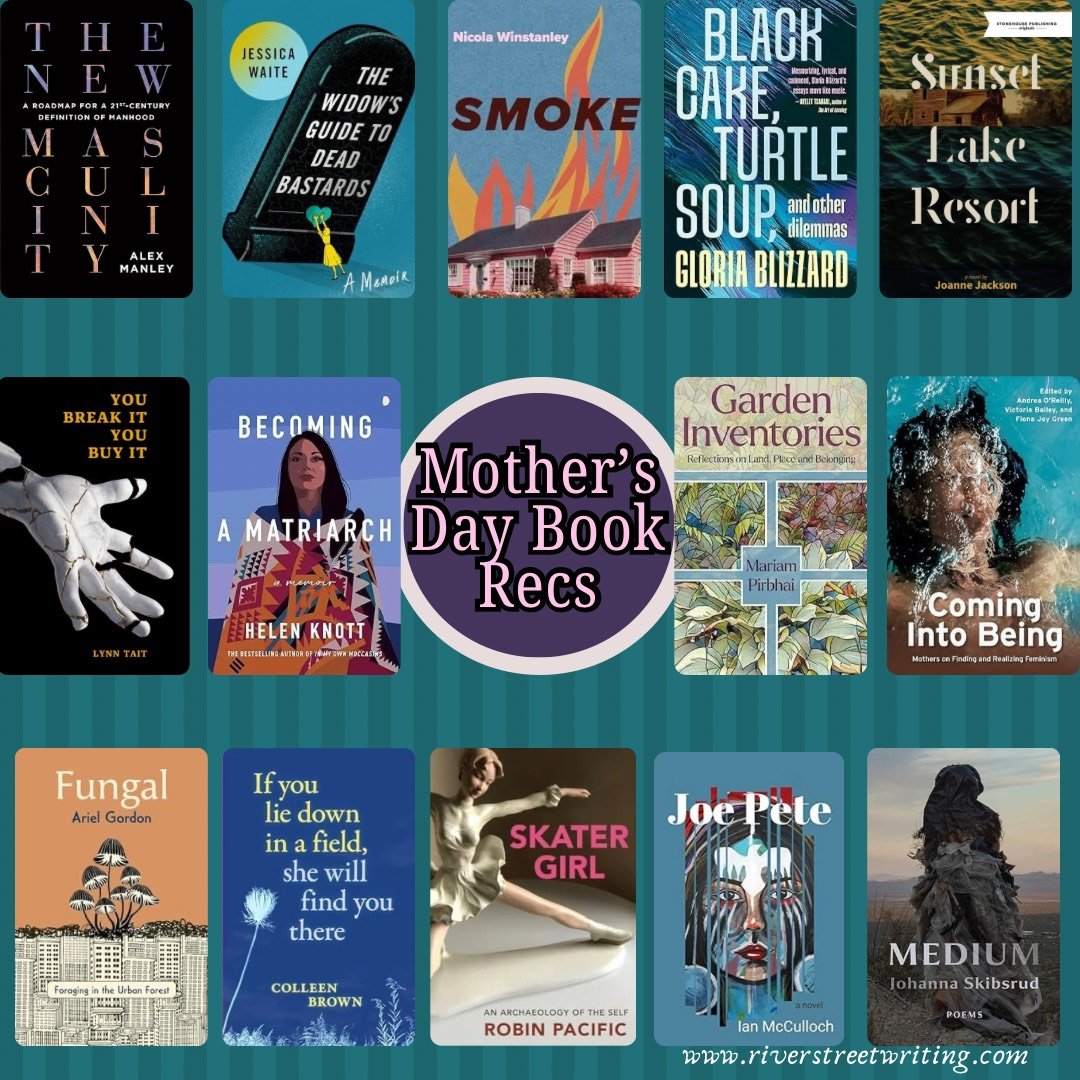
14 Mother’s Day Book Recs

Coming into Being: Mothers on Finding and Realizing Feminism, edited by Andrea O’Reilly, published by Demeter Press, 2023.
Coming into Being: Mothers on Finding and Realizing Feminism explores how becoming and being a mother can be shaped by—and interconnected with—how mothers realize feminism and/or become feminists. For many women and mothers, the pieces included in this anthology—which range from personal essays to academic work, to creative nonfiction, poetry, art, and interviews—marks a seismic and long-awaited recognition of how mothering is not at odds with feminism, but one of the most powerful extensions of it. The recognition and solidarity we found in this book were not only affirming but perspective-shattering, especially during this time in history, where the ideas of mothering and motherhood have been co-opted as an extension of oppressive values. With brilliance and heart, Dr. O'Reilly (and her book) afford all mothers (“‘mother’ [referring] to any individual who engages in motherwork; it is not limited to cis-gender women'') a synergetic vantage point from which to find solidarity and strength.

Fungal: Foraging in the Urban Forest by Ariel Gordon, forthcoming with Wolsak & Wynn, June 4, 2024.
Both personal and entertaining, Fungal: Foraging in the Urban Forest is the highly anticipated second book of a trilogy and shows Gordon at her best: interweaving the personal with the easily-overlooked local and natural and local world around her, and passing on her contagious delight for the world at—and under—our feet.
Mothering and motherhood are recurring themes in Gordon’s work. The essay, "Mushrooming" in particular is about Gordon'’s decision to add pets to their household after choosing to have only one child. It's about living with a depressed cat and then a depressed teenager, about suddenly being a household with three cats, about adapting to change. Gordon’s essays are fascinating and offers a refreshingly realistic perspective on motherhood and mothering: one that’s far from perfect, but founded in love.

Sunset Lake Resort by Joanne Jackson, forthcoming with Stonehouse Publishing June 1, 2024.
Sunset Lake Resort is the captivating new novel from Crime Writers of Canada winner, Joanne Jackson. Full of thrilling twists, exciting reveals, and gorgeously drawn characters, Sunset Lake Resort tells the story of Ruby whose father passes away but fails to leave her the millions some expected—particularly Steve, her husband of 35 years, who moves out on learning the news. Alone, but in control of her own affairs for the first time in her life, Ruby is torn between panic and relief. When she investigates the remote beach cabin her father had left her instead of his estate, she discovers a dilapidated beach resort in a remote location, seemingly untouched since its former owner, Cecelia Johansen, died under mysterious circumstances. Despite the condition of the property and rumours it is haunted, Ruby decides to move to Sunset Lake Resort, determined to find out why her father bought it, and why he left it to her.
What we particularly love about this story is how it champions the lives of women who are passed middle age, positioning them as the fascinating, vital people they are.

Black Cake, Turtle Soup, and Other Dilemmas by Gloria Blizzard, forthcoming with Dundurn Press, June 4, 2024.
In this powerful and deeply personal collection, award-winning poet, writer, and song-writer, Gloria Blizzard uses traditional narrative essays, hybrid structures, and the tools of poetry to negotiate the complexities of culture, geography, and language in an international diasporic quest.
The word mother appears in the book 133 times. This speaks to the importance of motherhood’s glorious imperfections. As we cross generations and eras, we attempt and sometimes succeed to engender the growth of another being—a child, an elder, a stranger, a culture—while striving to stand upright. Black Cake, Turtle Soup is a moving and beautiful testament to wayfinding and the complexities and marvels of mothering.

You Break It You Buy It by Lynn Tait, published by Guernica Editions, 2023.
With humour and aplomb, Lynn speaks up with insight and tenderness from a distinctly feminist perspective about our personal and collective failings in her debut poetry collection, You Break It You Buy It. Whether they address narcissistic mothers, racism, climate change, or her son's accidental death from a fentanyl overdose, Tait’s poems resound as she defies a generational standard of silence. Since its release last fall, readers from all over the country have been responding to Lynn's singular voice with passionate enthusiasm, showing that generational divides are not as strong as we think and that our capacity to come together to call out injustice can unite us.
The effect is absorbing and resounds with a sonic call to empathy. Now more than ever, we need this message.

The Widow’s Guide to Dead Bastards by Jessica Waite, forthcoming with Simon & Schuster, July 30, 2024.
When her husband dies, Jessica Waite finds out he wasn’t exactly who she thought he was. Affairs, addictions, debt, and other betrayals emerge as Waite tries to find her bearings in her new life as a widow and single parent, and reconcile the love she feels for her husband with the pain he continues to inflict in the wake of his sudden passing.
What we love about this book is how lyrical and thrilling it is—thrilling in the sense Waite lays bare how she feels with a heady mix of unflinching rage and tenderness. She writes the book and tells this story—her story, which she has every right to tell—in bold, beautiful technicolour. The Widow’s Guide to Dead Bastards is a gripping and stunning example of a woman who is not silenced by taboo or the outdated and ultimately, harmful, notion that mothers have to sacrifice their voices and selfhood. This book is a testament to a powerful legacy of love and truth, as messy and complicated as it is.
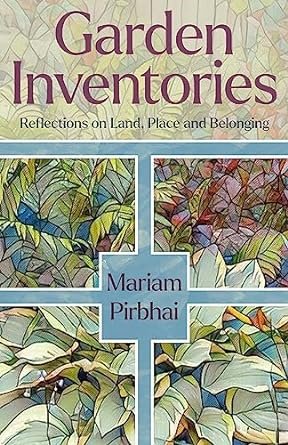
Garden Inventories: Reflections on Land, Place and Belonging by Mariam Pirbhai, published by Wolsak & Wynn, 2023.
Not all mothers mother people. Mothering can take many forms. In Garden Inventories: Reflections on Land, Place and Belonging, Mariam Pirbhai turns a nurturing eye to the land, looking carefully at the pocket of earth she has called home in Southern Ontario for the past seventeen years. She asks how long it takes to be rooted to a place? And what does that truly mean? Seeing the landscape around her with the layered experience of a childhood spent wandering the world, Pirbhai shares her efforts to create a garden and understand her new home while encouraging others to do reconsider the land on which they live, and how they treat it. The result is a delightful collection of essays that invites readers to decolonize their mindset and see the beautiful complexity of the land around us all in a new way.

Joe Pete by Ian McCulloch, published by Latitude 46, 2023.
Joe Pete tells the story of a young girl, Alison, nicknamed “Joe Pete” because as a child, when her parents were employed at a lumber camp, she used to play in a field of Joe Pye weeds. Much to her mother’s dismay, the nickname spread through the camp and the stuck.
This is a novel of gorgeously sticky stories that lull even as they awaken. When Joe Pete’s father falls through the ice and is never recovered, she lives for and in stories, plumbing their depths for meaning. Weaving them around herself for strength and comfort. There are the stories of her relatives who fought and were maimed in “The Great War.” Of parents who fled to the bush to spare their children the horror of residential schools. Of perseverance and loss and language and voice and purpose; of family and love.

Skater Girl: An Archaelogy of Self by Robin Pacific, published by Guernica Editions, 2024.
Skater Girl, which is artist and activist Robin Pacific’s debut book at 77 years old, traces themes of art, feminism, aging, loss and regret, bringing to brilliant light the ecstatic joy and fragility of our lives. With wisdom, cheek, and defiance, Robin’s essays explore her experiences through spiritual seeking, political activism, mental breakdowns, and breakthroughs. It's a rally against ageism and shows an older woman living authetically and against myopic stereotypes, and thriving in all her multitudes. We love Robin’s equally frank and lyrical writing, and her electric and contagious shit-disturbing attitude.

The New Mascunlity: A Roadmap for a 21st Century Definition of Manhood by Alex Manley, published by ECW Press, 2023.
The New Masculinity : A Roadmap for a 21st-Century Definition of Manhood by AskMen Senior Editor, Alex Manley, is an absorbing and sophisticated exploration of how masculinity got to where it is today, and a prescription of where it could go to stay relevant, and most importantly, healthy. Manley deftly picks their way through a minefield of issues, from toxic masculinity to violence to enjoying anal sex and penetration to men’s mental health, effectively making one question what it really means to be masculine. There are so many crucial insights in this timely book, which in this era, we deem essential reading not just for mothers of boys, or for men, but for everyone. The New Masculinity is singular and stunning for the way it sees men and supports them; how it acknowledges their fear and frustration. It’s a book that provides a way out. A way forward.

If You Lie Down In a Field, She Will Find You There by Colleen Brown, published by Radiant Press, 2023.
If you lie down in a field, she will find you there by Colleen Brown is a stunning and shattering memoir of Brown's mother's life, which had been brutally distorted by the spectacle of her murder by a serial killer. It’s a book that, through Colleen’s struggle to piece together her mother’s life, calls out the dehumanizing effects of our society’s true crime obsession, as well as the difficulties of making sense of someone's humanity through the lens of the criminal justice system. Most of all, this book is a beautiful tribute to love and Colleen’s mother, through the stories of her children.
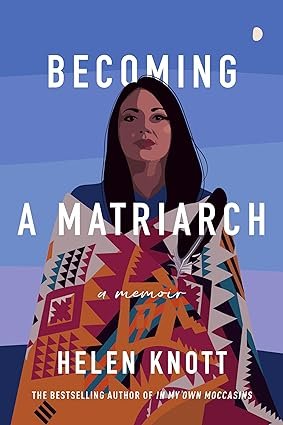
Becoming a Matriarch by Helen Knott, published by Penguin Random House, 2023.
Becoming a Matriarch by Helen Knott details Helen’s story as she transitions into be a matriarch in her family, after the passing of her grandmother and mother. The book is replete with tenderness and wisdom, and moments of sonic lyricism. “Papa’s blue eyes matched the colour of the mountain waters he’d never see again. They were the kind of blue that made you believe in God and other wholesome things.” This is a gorgeous and powerful story of someone coming into themselves—into womanhood with all the frustrations and fears that comes with being a woman, and an Indigenous woman, specifically.

Medium by Johanna Skibsrub published by Book*hug Press, 2024.
Medium by Johanna Skibsrud is a sweeping and powerful exploration of the lives of women who have shaped history in their roles as mediums—and mediums has a broad meaning. Mediums for life, knowledge, science, spirituality: a medium can be a conduit to a great many things but also, the medium is a thing itself—not merely a means to an end. We love the way the book is structured: with a brief introduction to the woman—just a paragraph—and then the poem follows. Skibsrud’s writing is throaty, beautiful and sonic.

Smoke by Nicola Winstanley, published by Wolsak & Wynn, 2024.
Smoke is children’s author Nicola Winstanley’s first adult work, an unforgettable collection of short stories that is both searing and thought-provoking. Smoke features a cast of characters across Canada and New Zealand, showing us glimpses into their lives of loss and heartbreak. In these eleven linked stories, Winstanley takes a hard look at intergenerational trauma and their impact on characters from multiple points of view. Guilt, self-reflection, compassion, forgiveness, and familyare central themes in this collection of stories that help us understand the degree of responsibility we hold toward the events that happen to us in life.

Power Q & A with Mark Foss
The jury of the Guernica Prize called Borrowed Memories, Mark Foss’s third novel, “an evocative and nuanced story.” Borrowed Memories (8th House Publishing, 2024) juxtaposes a Canadian couple in their winter years against the rage and hope of the Arab Spring. In this tale of shifting identities, Ivan Pyefinch—a divorced translator—cares for his aging parents in the Thousand Islands while trying to find room in his heart for Mia Hakim, an immigrant filmmaker exploring her lost childhood in Tunisia. When Mia turns up unexpectedly at the Pyefinch home on the eve of Remembrance Day, a family health crisis puts all their stories on a collision course.
This poignant novel is about memories in all their forms—the ones slipping through our grasp, the ones we hold onto for others, the ones we never had but are trying to find, the ones we are trying to create.
The jury of the Guernica Prize called Borrowed Memories, Mark Foss’s third novel, “an evocative and nuanced story.” Borrowed Memories (8th House Publishing, 2024) juxtaposes a Canadian couple in their winter years against the rage and hope of the Arab Spring. In this tale of shifting identities, Ivan Pyefinch—a divorced translator—cares for his aging parents in the Thousand Islands while trying to find room in his heart for Mia Hakim, an immigrant filmmaker exploring her lost childhood in Tunisia. When Mia turns up unexpectedly at the Pyefinch home on the eve of Remembrance Day, a family health crisis puts all their stories on a collision course.
This poignant novel is about memories in all their forms—the ones slipping through our grasp, the ones we hold onto for others, the ones we never had but are trying to find, the ones we are trying to create.
Welcome, Mark!

Borrowed Memories by Mark Foss.
Q: Much of your novel Borrowed Memories revolves around the narrator caring for his mother who has Alzheimer’s and his father who has lost his driver’s licence and eventually has a small stroke. How many of these memories, if any, did you “borrow” from your own life, and how many did you invent?
A: I would say the main plot lines, including the details you mention, closely mirror my own life, but only up to a point. Ivan’s parents are very much based on my own. But while they talk and act like them, not everything happened in my life the way it does in the novel. That said, I use details from my life like my mother’s interest in decoupage. In my childhood, she would make these gorgeous jewel boxes with images of butterflies and flowers. Towards the end of her life, she would spend hours painstakingly cutting out images but could never get to the next stage of pasting, sanding and varnishing.

One of Mark’s mother’s creations.
As another example, I borrowed from my mother’s travel diary to explore how memory loss might have affected her. I elaborate on some of these elements in a series of essays I’ve been writing. My flash piece “For People Who Like to Draw”, for example, looks at my mother’s mental decline through the lens of arts and crafts.

Author Mark Foss.
More About Mark Foss:
Mark Foss, born and raised in Ottawa, has lived in Montreal since 2012. He holds two undergraduate degrees from Carleton University: Bachelor of Journalism (Highest Honours) in 1985 and Bachelor of Arts in Film Studies (With Distinction) in 1986.
Apart from his books, his short stories and creative non-fiction have appeared in more than two dozen Canadian and American journals and anthologies. In Canada, these include The New Quarterly, Prism International, sub-Terrain, untethered, Existere, and This Will Only Take a Minute: 100 Canadian Flashes. His creative non-fiction, which has been nominated for The Pushcart Prize, was supported by an artist residency at The Marble House Project in Vermont in 2023. Meanwhile, his arts journalism has appeared in The Globe and Mail, Ottawa Magazine and other publications. Apart from his own writing, he is the co-editor of The Book of Judith (New Village Press, 2022), an homage to the life of American poet, writer, and teaching artist Judith Tannenbaum and her impact on incarcerated and marginalized students.
Outside print media, Foss hosted and produced When the Lights Go Down, a one-hour program on CKCU-FM featuring interviews, reviews and documentaries related to the film industry. His radio drama Higher Ground, which inspired his first novel, was broadcast on CBC New Voices. In the 2010s, he researched and hosted 12 podcasts for Progzilla Radio on progressive rock, a musical genre he playfully skewered in his novel Molly O.

Power Q & A with Dave Margoshes
Dave Margoshes’ new novel, A Simple Carpenter (Radiant Press, 2024) , is one of our most anticipated fiction releases of the year, and today, we are honoured to have this Saskatoon-area poet and fiction writer on our blog to speak to his remarkable book.
Set in the early and mid-‘80s in the Middle East, A Simple Carpenter plays out against a backdrop of strife in Lebanon and ethnic/religious tensions between Jews and Arabs in Israel and Palestine. This historical backdrop serves as an empathetic and thoughtful commentary on our modern political climate.
Dave Margoshes’ new novel, A Simple Carpenter (Radiant Press, 2024) , is one of our most anticipated fiction releases of the year, and today, we are honoured to have this Saskatoon-area poet and fiction writer on our blog to speak to his remarkable book.
Set in the early and mid-‘80s in the Middle East, A Simple Carpenter plays out against a backdrop of strife in Lebanon and ethnic/religious tensions between Jews and Arabs in Israel and Palestine. This historical backdrop serves as an empathetic and thoughtful commentary on our modern political climate.
Part biblical fable, part magic realism, and part thriller, the story follows the epic journey of a ship’s carpenter stranded on a small Mediterranean island and visited by a frightening mysterious creature. He’s lost his memory but has acquired the ability to speak, write and understand all languages. After his rescue, he spends time in a Lebanese coastal village recuperating with a group of nuns who, observing him perform what appear to be small miracles, take him to be the second coming of Jesus Christ. Later in Beirut he’s hired as a translator for the UN peacekeeping force, and is recruited as a messenger for a group named Black September. On a quest to find his true identity he travels on foot across the hills to the Sea of Galilee, encountering a series of strange and magical communities evoking biblical times along the way.
We are captivated by this staggering story, and welcome Dave to our Power Q & A series with a burning question. Keep reading!

Bring home A Simple Carpenter by Dave Margoshes!
Q: From the first line of the first chapter of your book, there is an overwhelming immersion in the senses, particularly sound and smell. It’s a breathtaking opening. Can you tell us about creating this scene—why it was important to start in this place?
A: For the benefit of those who haven’t yet read the novel, let me first explain, it begins with a sailor onboard a ship adrift in the Mediterranean, regaining consciousness after being in a coma for several days. He’s lost his memory so has no idea who he is, where he is, or what’s happened to him. Here’s the first 2 sentences:
“The blood in my veins sang and boiled. The sheets of my bunk were awash with sweat and other foul emanations of my body. I slept and slept, slipping in and out of consciousness. Through the haze of my own mind, I heard voices babbling in a stew of languages, their words clear and indistinct at the same time, their meaning incoherent.”
So yes, as you noted in your question, “sound and smell.” The narrator is a blank slate, hungry for information, and he can only rely on his senses.
Actually, in my first draft, the novel began with a scene that opens what is now Chapter 4, after a shipwreck leaves the narrator alone on a desert island. It begins this way:
“Later, during what I now think of as my sojourn of sand, I had ample time to ponder the implications of my lack of memory. … I thought of all [that had happened to him] as I lay in the sand of the small island I had washed up on, but I thought also of sand…. I lay, often for hours, in a bed of sand with a view of the sea, each portion of the back of my body, from skull to shoulder to buttock to calf to heel of foot, developing a deep intercourse with those crystals, my fingers threading through the sand at my sides, my lips engaging deeply in conversation with the grains of sand upon them, my eyelids and the hairs of my nostrils tugging and pushing against their incessant current.”
Here too, the narrator is dependent on his senses – the feel of the sand he’s lying on, the sound of waves on the beach, the heat of the sun.
In both cases, senses are extremely important. And both scenes set the tone for the novel’s main storyline, the narrator’s search for identity.
I switched those two scenes so the novel unfolds primarily in “real time,” relying less on flashback and memory.

Dave Margoshes
More about Dave Margoshes:
Dave Margoshes began his writing life as a journalist, working as a reporter and editor on a number of daily newspapers in the U.S. and Canada, and has taught journalism and creative writing. He has published twenty books of fiction, nonfiction and poetry. His work has appeared widely in literary magazines and anthologies, in Canada and beyond, including six times in the Best Canadian Stories volumes; he’s been nominated for the Journey Prize several times and was a finalist in 2009. His Bix’s Trumpet and Other Stories won two prizes at the 2007 Saskatchewan Book Awards, including Book of the Year. He also won the Poetry Prize in 2010 for Dimensions of an Orchard. His collection of linked short stories, A Book of Great Worth, was named one of Amazon. CA’s Top Hundred Books of 2012. Other prizes include the City of Regina Writing Award, twice; the Stephen Leacock Prize for Poetry in 1996 and the John V. Hicks Award for fiction in 2001.
Excerpt from Fungal: Foraging in the Urban Forest
We’re tickled to be sharing an excerpt from the lastest book from the original “fun-gal”, mushroom hunter and author extraordinaire, Ariel Gordon.
Both personal and entertaining, Fungal: Foraging in the Urban Forest is the highly anticipated second book of a trilogy and shows Gordon at her best: interweaving the personal with the easily-overlooked natural world around her, and passing on her contagious delight for the world at—and under—our feet.
We’re tickled to be sharing an excerpt from the lastest book from the original “fun-gal”, mushroom hunter and author extraordinaire, Ariel Gordon.
Both personal and entertaining, Fungal: Foraging in the Urban Forest is the highly anticipated second book of a trilogy and shows Gordon at her best: interweaving the personal with the easily-overlooked natural world around her, and passing on her contagious delight for the world at—and under—our feet.
In a diverse range of essays, Gordon takes us deep into the fungal world, exploring mushrooms both edible and not, found and foraged, and the myriad ways in which mushrooms and trees make up our ecosystem and are in fact a reflection of the way we build our personal communities and connections.

Fungal: Foraging in the Urban Forest by Ariel Gordon, published by Wolsak & Wynn. Preorder here.
Excerpt from “Morel Hunter”
in Fungal: Foraging in the Urban Forest
by Ariel Gordon
It was May 2022 when I dragged my partner Mike out of the house to go looking for morels. I guess you could call him my “morel support.” (Ahem.)
I have always wanted to find mushroom kindred spirits and the Winnipeg Mycological Society // Société mycologique de Winnipeg group on Facebook had them in every shape and size, from newbies dumping a hatful of random mushrooms to experts sharing a trunk full of morels. The group currently has 4,800 members and is led by Alexandre Brassard, the Dean of Arts and Science at the Université de Saint-Boniface and a political scientist by training.
The threshold for membership is gloriously low: “Intrigued by mushrooms? This is a forum to learn more about them and to talk about the fungi of Manitoba and the Canadian Prairies. This Facebook page is the ideal place to discuss Prairie species and sites, to share foraging and cultivation tips, to support the correct identification of local mushrooms, and to share news about mycological events in Winnipeg.”
Serious mushrooming is often about research. What trees are the mushrooms you’re after in association with? What kind of soil/moisture level do they prefer? Do they flush the year after forest fires? Where were the most recent forest fires? What Crown land (or property owned by a friend) meet all of these criteria. I have done the bulk of my mushrooming in a few spots. I’ve become a specialist of mushrooms in aspen/oak parkland, but, more specifically, in Assiniboine Forest, a never-developed urban forest in the south end of Winnipeg. I’m not good at mushrooms in coniferous forests or even mixed deciduous forests.

Ariel in her element!
I’d only ever found a handful of morels, in in this one spot on the Harte Trail in Assiniboine Forest and then another handful in the Belair Forest. But the group had lots of people finding morels or talking about finding morels, with tips on where/when to find them.
People are secretive about their ‘spots’, the locations on crown land that produce the mushrooms they’re looking for in profusion, year over year. But enough people had let slip that poplar forests in SE Manitoba, and specifically in Sandilands Provincial Forest, were good sites.
So Mike and I got up early on a Saturday and drove out. Given that Sandilands is a big place, I did some searching and discovered that the Sandilands Ski Club had two parking lots, one of which was described as being hillier. So we headed towards that one, using the GPS tag from their website.
We parked and set out on one of their cleared ski trails, which had long since melted. And of course the trees were wrong: conifers and birches. We kept walking, scanning the horizon for white/grey trunks. One whole section was completely swamped with water, where we had to walk from shoal to shoal or just try to avoid the bigger pools.

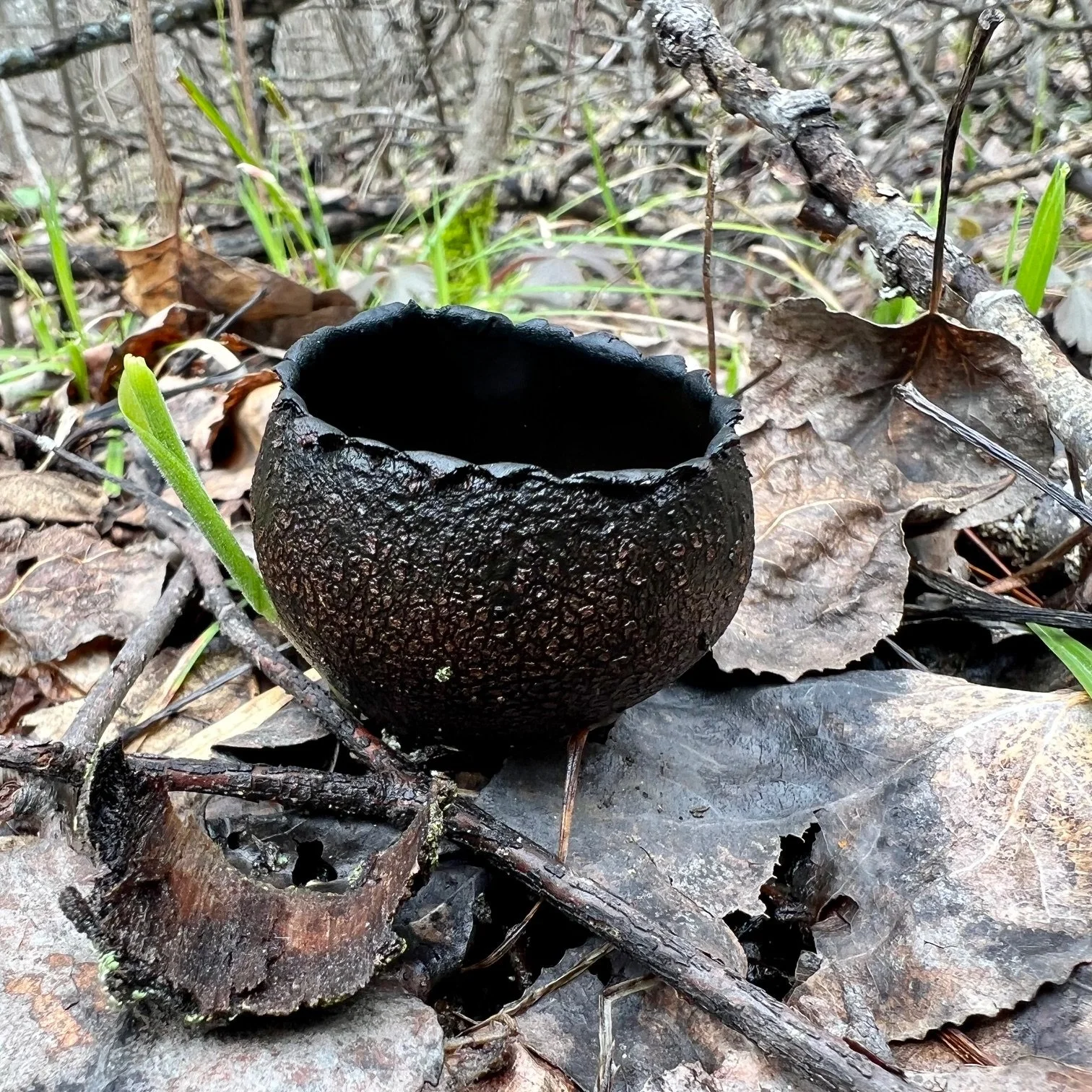
Of course, that’s also where all the non-morel mushrooms where. Mike spotted devil’s urn (Urnula craterium), a black mushroom that’s the shape of a cauldron. I’d never seen it before, but people had been posting it to the WMS, alongside a similar looking species, witches’ cauldron (Sarcosoma globosum), which is brown instead of black. I spotted three types of jelly fungi, including blobs of yellow witches’ butter, a brown variety, and a black variety that completely covered sections of trunk on young trees. There were also mushrooms on stumps and downed trees.
Another pleasure, while walking through higher sandy areas, were all the prairie crocuses. One of my spring requirements is finding and photographing prairie crocuses while they’re blooming. Before two years ago, I hadn’t seen them very often, even though they’re the provincial flower. I think it’s because the areas I regularly walk in aren’t prime territory for them: like morels, they like sand. Previously, I’d go find them in Little Mountain Park, a city park that is mostly an off-leash dog park. I’d wait until a friend who took her dog there regularly posted about them. But we’d had good luck finding at least one prairie crocus the last two years and one was all I needed.

This year, I had heard that they were blooming, but I hadn’t had the chance to head to LMP yet. There were some blooming in the native prairie garden in the Wolseley Community Garden’s Vimy Ridge Garden, and I was there anyways, helping to shovel mulch into the beds, so I took a photo of them. But they were a placeholder for me until I could find something more wild. “Someone came and dug one of the crocuses out,” one of the garden organizers said, surveying the bed. She shrugged: that kind of activity was part of what happened in community gardens. And at least whoever it was hadn’t taken every plant. But prairie crocuses were everywhere in Sandilands, even by the side of the road. They became common, so I eventually only stopped for large clusters of them.
We trudged through the swamped area, skipped through the crocus area, and eventually found an area that was mostly poplars. We walked through that for twenty minutes before we found our first mushroom.
We found one, and then a handful, and then a bagful, moving slowly, trying to look sideways. We would often call out to each other: “There’s one by your foot. And another and oh, look, another.” I got out my mushroom knife, given to me at Xmas, and was using them to cut the stems, though they were delicate and often snapped between our fingers. I also used my knife to collect a handful of fiddleheads, the early coiled leaves of ostrich ferns, which were also coming up in that area.
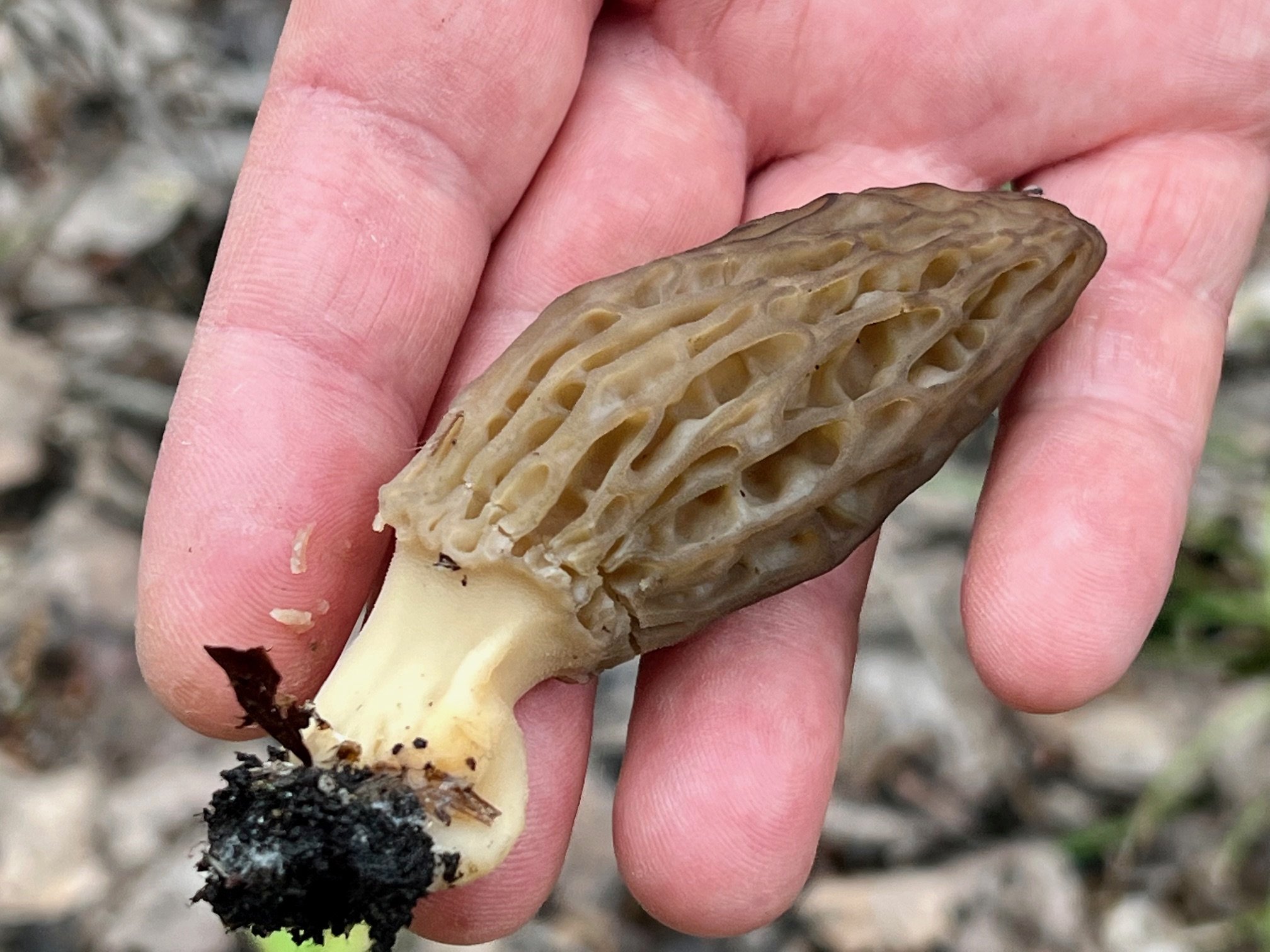
I knew that these were early spring morels, sometimes also called false morels: Verpa bohemica. But verpas are in the Morchella family with the more standard M. americana, and so should be called true morels. I’d seen verpas on the WMS group. Unlike morels, which were empty inside, verpas had a cotton-candy like fuzz inside of their stems and caps. Also, they were much taller than morels, and the texture of the cap was different.
We also found two small black morels. All in all, we felt very successful, walking back to the car.
*
There is some debate in the broader community as to whether verpas are edible, but I decided to try them.
I found a recipe online for verpas in a shallot vermouth sauce, but was mostly reading for the cooking instructions: “To begin the preparation fill a bowl with lightly salted cold water. Add the verpa bohemica mushrooms and give a shake. After 15 minutes pour out the water and refill the bowl with more cold water. Do this 3 times. After the 3rd time, lay your morels out on some paper towel and pat dry.” I’d read elsewhere that they should be parboiled or even just boiled twice. But I elected to use this method: given how delicate they were, I was worried that they’d fall apart if they were boiled. Even the soaking process disconnected most of the caps from the stems. I spent two hours soaking and draining my mushrooms, which had already started to soften in the mesh bag I’d collected them in.
I made a soup with the caps and some of the stems, with store-bought pho-flavoured broth, with onions and garlic and cilantro. When it was done, Mike and I each had a spoonful, as is recommended with all new foods but specifically wild mushrooms, and also wild mushrooms that are sort of…questionable.
The next day, neither of us had any aches and pains that were out of the ordinary for middle-aged people. We should have been fine to have big bowls of soup, which had looked and smelled delicious. Part of the reason we didn’t was that we had several meals out of the house in the days following and that our fridge was full of other options, but part of it was fear. The soup was in the bottom of the fridge, waiting. And food waste was one of my least favourite things. Was I going to let my fear win? Or was I going to wait until it went bad and throw it out? Finally, two days later, I reheated a bowl, adding some shredded pork that had been cooked carnitas style. And it was delicious. Mushroomy but not overly so. It was meaty and not just because I’d added the pork. My soups are not always great: I’m much better at making meatballs and stirfries for some reason. But this was probably the best soup I’d ever made.
I made a point of telling Mike how good it was. But he said he wasn’t sure if it was worth it, given the potential side effects. I experienced no side effects. So the next day, I had another bowl. I felt sustained by the soup, by the idea that I’d collected the mushrooms and carefully prepared them, but also because I’d overcome my fear. There’s one bowlful left. Mike still hasn’t had any, but he’s not as passionate about mushrooms as I am. And I have to respect his wariness.
But if the pandemic has taught me anything, it’s that we’re always assuming risk.
More About Ariel:
Ariel Gordon (she/her) is a Winnipeg/Treaty 1 territory-based writer, editor, and enthusiast. She is the ringleader of Writes of Spring, a National Poetry Month project with the Winnipeg International Writers Festival that appears in the Winnipeg Free Press. Gordon’s essay “Red River Mudlark” was 2nd place winner of the 2022 Kloppenberg Hybrid Grain Contest in Grain Magazine and other work appeared recently in FreeFall, Columba Poetry, Canthius, and Canadian Notes & Queries. Gordon's fourth collection of poetry, Siteseeing: Writing nature & climate across the prairies, was written in collaboration with Saskatchewan poet Brenda Schmidt and appeared in fall 2023.
--

Power Q & A with George Lee
Author and attorney George Lee’s novel, Dancing in the River, won the Guernica Prize, and draws on Lee’s own life experiences growing up in China. It tells the coming-of-age story of a young boy during Mao’s Cultural Revolution—a boy named Little Bright living in a small, riverside town who is heavily indoctrinated by the anti-Western sentiment of the time and place. The perspectives afforded in this stunning novel—the insights into culture, politics, and personal experience—are crucial to a national and global understanding of Chinese history.
Author and attorney George Lee’s novel, Dancing in the River, won the Guernica Prize, and draws on Lee’s own life experiences growing up in China. It tells the coming-of-age story of a young boy during Mao’s Cultural Revolution—a boy named Little Bright living in a small, riverside town who is heavily indoctrinated by the anti-Western sentiment of the time and place. The perspectives afforded in this stunning novel—the insights into culture, politics, and personal experience—are crucial to a national and global understanding of Chinese history.
But just because a book is informed by an author’s experience doesn’t make it autobiographical. However, it could make it autofictional. After reading this book and being swept up in the stunning narrative, we had to ask: how much of this incredible story was founded in George’s life?
Welcome George!
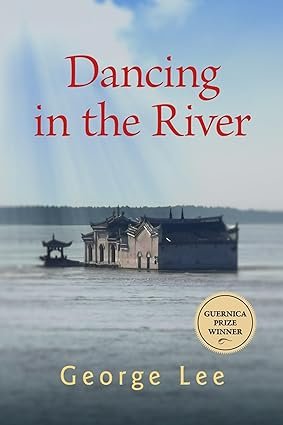
Bring home Dancing in the River by George Lee.
Q: Your novel Dancing in the River reads like a memoir and you’ve said it’s inspired by your life. We’re curious if you’d go as far as saying it could be classified as autofiction—a genre that blend details of your life with fictional plot points and characters.
A: I would call it an autobiographical novel or fictional memoir.
Little Bright's story is deeply informed by my personal experiences. There's always a delicate dance between fact and fiction. I used my emotional truth as the compass.
When I started it, I intended to write an autobiography. Still, eventually, I decided to break free from the strict confines of facts, so I was able to explore more universal themes by crafting fictional characters that breathe the air of authenticity.

More about George Lee:
George was born and raised in China. He earned an M.A. in English literature from University of Calgary, and a Juris Doctor degree from University of Victoria. Dancing in the River, won the 2021 Guernica Prize for Literary Fiction. He practices law in Vancouver, Canada.

Power Q & A with Elena Bentley
Erasure poetry—it’s one of the best ways to get almost anyone to try creating a poem. All you’ve gotta do is black out some words and leave others. Simple right? Well yes. Simple, but not easy. Erasure poetry, also known as blackout poetry, isn’t burdened by many rules but it’s no small feat to turn a text saying one thing into a poem saying something different.
Elena Bentley (MA English, University of Toronto) is a multi-genre writer and proud Métis aunty. Her ecent poetry chapbook, taliped (845 Press), was a finalist in the 2022 Vallum Chapbook Award. And the poetry is all erasure.
We welcome her to our Power Q & A series today to talk with us about choosing erasure poetry for this project.
Erasure poetry—it’s one of the best ways to get almost anyone to try creating a poem. All you’ve gotta do is black out some words and leave others. Simple right? Well yes. Simple, but not easy. Erasure poetry, also known as blackout poetry, isn’t burdened by many rules but it’s no small feat to turn a text saying one thing into a poem saying something different.
Elena Bentley (MA English, University of Toronto) is a multi-genre writer and proud Métis aunty. Her recent poetry chapbook, taliped (845 Press), was a finalist in the 2022 Vallum Chapbook Award. And the poetry is all erasure.
We welcome her to our Power Q & A series today to talk with us about choosing erasure poetry for this project.

Grab taliped by Elena Bentley.
Q: What was it about this particular project that inspired you to use erasure poetry?
A: I read Randolph Bourne’s essay, “The Handicapped—by One of Them,” which was originally published anonymously in 1911 in The Atlantic Monthly, years ago when I was an undergrad researching for my Honours Thesis.
In his essay, Bourne muses on life with a disability as it relates to work, school, friendship, and relationships. After I read it, I was, to be honest, very shocked. This essay was published over one hundred years earlier, yet I felt that I could’ve written it. How could this man have captured, so accurately, my experience of disabled life when more than a century separated us? My shock turned to sadness. I felt, and still feel, saddened to know things have changed very little for those with disabilities.
Having rather masochistically thrown myself into grad school, I didn’t have time for anything extra, so I pinned Bourne’s essay as a piece of writing to return to in the future. Fast forward and cue the pandemic. Anxiety doesn’t often leave room for creative thoughts, at least in my case, so I figured I’d revisit my three-ring, five-inch-thick, papers-falling-out-because-it’s-so-full-of-honours-thesis-research-notes, binder for inspiration. And there was Bourne’s essay. I thought, I have to do something with this.
I’d been wanting to try my hand at erasure poetry, and his essay seemed like the perfect source text. After I’d finished taliped and sent it out for consideration, an editor told me that taliped didn’t stray far enough away from the source text. My intention wasn’t to write in opposition to Bourne—I wanted to stay close. To be in conversation with him. To locate my individual experience of disability within his individual experience, and to show that while our diseases may be different, the country and time period may be different, we also have a collective, shared experience. Erasure allowed me to do what I set out to do.
That’s not to say we, meaning Bourne and I, feel and think the same. No, we certainly don’t. Where my long poem and Bourne’s essay differ the most is in our internalized beliefs about ableism and disability. Bourne can “see the way to happiness,” and believes any future misfortunes aren’t a direct result of his disability. Sorry, Bourne, I don’t buy it. I’m much more glass-half-empty in taliped. Though I hope to one day see my way to happiness, too.

Elena Bentley (MA English, University of Toronto) is a multi-genre writer and proud Métis aunty. Her poetry chapbook, taliped, was a finalist in the 2022 Vallum Chapbook Award and was recently published by 845 Press. Her poems can be found in literary journals like Arc Poetry, Room, The Malahat Review, PRISM international, and Grain. She received an Honourable Mention in Grain’s 2022 Short Grain Contest (poetry category), and in 2021 she was a finalist for CV2’s 2-Day Poem Contest. In addition, she is the author of the children’s picture book The Pickle in Grandma’s Fridge, and she was shortlisted for CANSCAIP’s 2023 Writing for Children Competition (Young Adult category). She is the Interim Editor for Grain Magazine. elenabentley.com | @_elenabentley_

Power Q & A with Ellen Chang-Richardson
Poems are playful, precocious, and powerful things, and these are just some of the reasons we are so giddy to celebrate National Poetry Month by hosting the incomparable Ellen Chang-Richardson on our blog, as part of our Power Q & A series.
Ellen’s poems use the power of blank space to make bold, breathtaking statements and allow room for exploration. In their just-released debut poetry collection, Blood Belies (Wolsak & Wynn, 2024), Ellen writes of race, of injury, and of belonging in stunning poems that fade in and out of the page. They bring their father’s, and their own, stories to light, writing against the background of the institutional racism of Canada, the Chinese Exclusion Act, the head tax and more. From Taiwan in the early 1990s to Oakville in the late 1990s, Toronto in the 2010s, Cambodia in the mid-1970s and Ottawa in the 2020s, Blood Belies takes the reader through time, asking them what it means to look the way we do? To carry scars? To persevere? To hope?
Poems are playful, precocious, and powerful things, and these are just some of the reasons we are so giddy to celebrate National Poetry Month by hosting the incomparable Ellen Chang-Richardson on our blog, as part of our Power Q & A series.
Ellen’s poems use the power of blank space to make bold, breathtaking statements and allow room for exploration. In their just-released debut poetry collection, Blood Belies (Wolsak & Wynn, 2024), Ellen writes of race, of injury, and of belonging in stunning poems that fade in and out of the page. They bring their father’s, and their own, stories to light, writing against the background of the institutional racism of Canada, the Chinese Exclusion Act, the head tax and more. From Taiwan in the early 1990s to Oakville in the late 1990s, Toronto in the 2010s, Cambodia in the mid-1970s and Ottawa in the 2020s, Blood Belies takes the reader through time, asking them what it means to look the way we do? To carry scars? To persevere? To hope?
Welcome, Ellen!
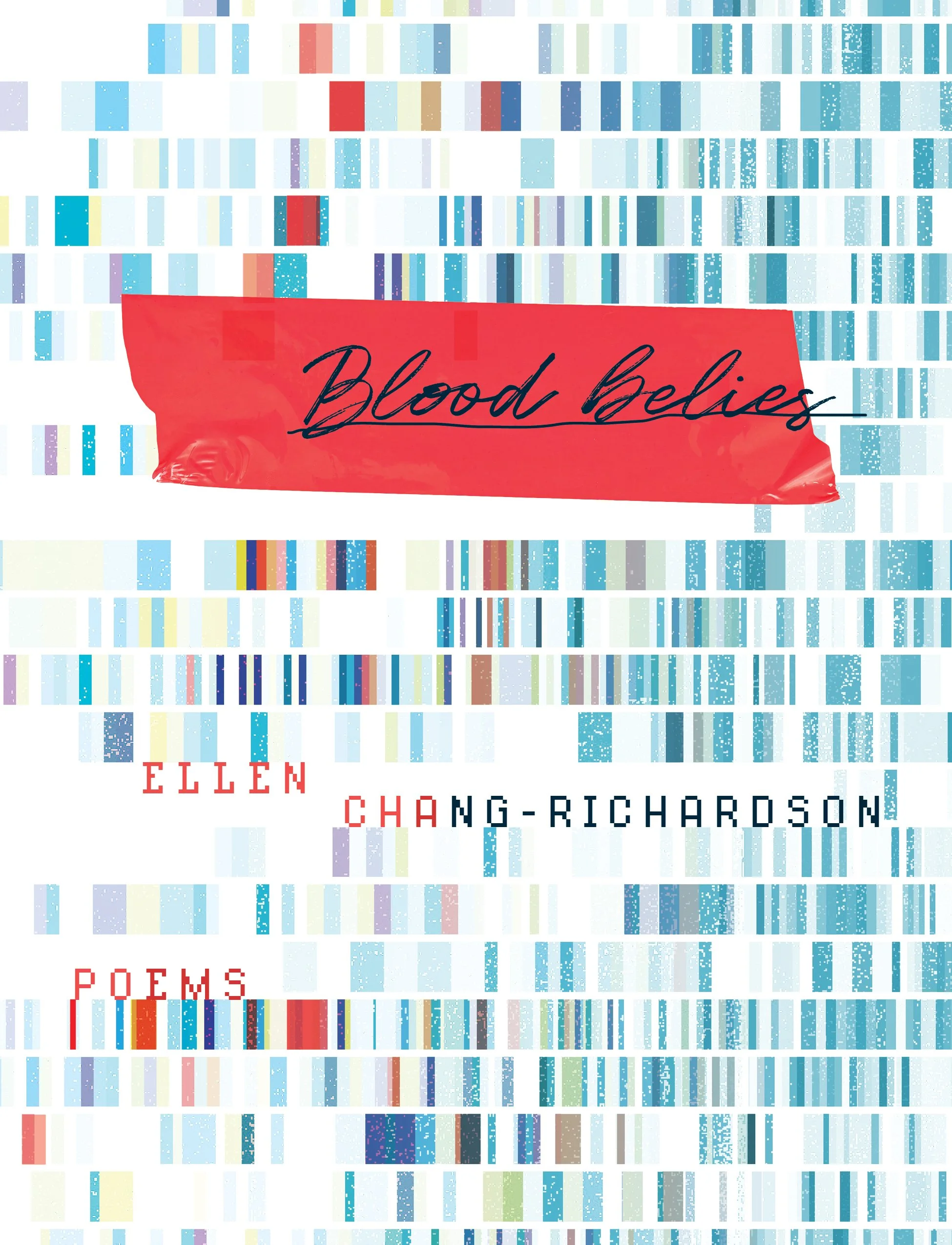
Bring home Blood Belies by Ellen Chang-Richardson.
Q: What advice do you have for poets who want to play with visual space on the page?
A: Be intentional — ask yourself: what do you want the words, spacing, enjambment, marks (i.e., commas, dashes, etc.) and blank page to say? What are the reasons behind your visual choices?
In “only sunken areas hold weight,” for instance, the poem’s placement on the page speaks to the physical weight of covering up disability and living with anxiety disorder, as much as it does the process of intaglio printmaking and the use of fire and crystals in healing rituals. The poem starts low on the page and finishes with words that flutter down like sparks off a flame.
Visual space is about intentionality but it’s also about gut instinct. Pull inspiration from all aspects of your life and remember to play.

Ellen Chang-Richardson (Photo credit: Curtis Perry.)
More about Ellen Chang-Richardson:
Ellen Chang-Richardson is an award-winning poet of Taiwanese and Chinese Cambodian descent whose multi-genre writing has appeared in Augur, The Fiddlehead, Grain, Plenitude, Watch Your Head: Writers and Artists Respond to the Climate Crisis, The Spirits Have Nothing to Do with Us: New Chinese Canadian Fiction and others. The co-founder of Riverbed Reading Series, they are a member of Room’s editorial collective, long con magazine’s editorial board and the creative poetry collective VII. They are represented by Tasneem Motala at the Rights Factory and currently live on the traditional unceded territory of the Algonquin Nation (Ottawa, Canada).

Power Q & A with Pat Connors
Today we welcome to our blog Patrick Connors, a poet living in Toronto and contributing to its rich poetic landscape. Patrick’s latest collection. The Long Defeat, is coming out with Mosiac Press.
In this new book, Connors explores the depths of human experience, influenced by personal challenges and global crises. Reflecting on his own experience of pandemic-induced unemployment, Connors captures universal themes of dissatisfaction and the desire for renewal.
Intrigued by the title, we asked Patrick to speak about what he hopes people will take away from this timely collection.
Today we welcome to our blog Patrick Connors, a poet living in Toronto and contributing to its rich poetic landscape. Patrick’s latest collection. The Long Defeat, is coming out with Mosaic Press.
In this new book, Connors explores the depths of human experience, influenced by personal challenges and global crises. Reflecting on his own experience of pandemic-induced unemployment, Connors captures universal themes of dissatisfaction and the desire for renewal.
Intrigued by the title, we asked Patrick to speak about what he hopes people will take away from this timely collection.

Bring home The Long Defeat by Patrick Connors.
Q: What is the main message you want to get across to your readers?
A: We are in times of great strife. We have been through a pandemic, war throughout the world, and unrest within our own borders. It seems very dark, and hopeless. But this could be the beginning of a great victory. Holding onto this belief gets me through the hardest days.

The wonderful Pat Connors!
More about Patrick Connors:
Patrick Connors’ first chapbook, Scarborough Songs, was released by Lyricalmyrical Press in 2013, and charted on the Toronto Poetry Map. He contributed 18 poems to Bottom of the Wine Jar, published in 2017 by SandCrab Press, and launched in Gibara, Cuba.
He has had work printed in Belgium, India, and the United Kingdom, in addition to the United States and Canada.
Past publication credits include: Blue Collar Review; The Toronto Quarterly 4; Spadina Literary Review; Tamaracks; and Tending the Fire, released in spring 2020 by the League of Canadian Poets.
Recent publication credits include: Rabble; Poetry and Covid; Devour; Lummox 9 Anthology; Canadian Stories; Harbinger Asylum; Silver Birch Press; and Poetry Pause.
He has performed at the Austin International Poetry Festival; featured in numerous reading series such as The Art Bar, Wild Writers, and Plasticine Poetry; hosted events under the 100,000 Poets for Change banner, as well as the United May Day Committee; and was on the organizing committee for The Great Canadian PoeTrain Tour.
His first full collection, The Other Life, is available from Mosaic Press.
His next full collection is forthcoming.
Power Q & A with Nicola Winstanley
We love hearing from authors who move between genres, and Nicola Winstanley has some poignant insight into her transition from children’s literature to her first book for adults, Smoke (Wolsak & Wynn) a collection of short stories. Smoke is an unforgettable collection of short stories that is both searing and thought-provoking.
Smoke features a cast of characters across Canada and New Zealand, showing us glimpses into their lives of loss and heartbreak. In these eleven linked stories, Winstanley takes a hard look at intergenerational trauma and their impact on characters from multiple points of view, but her characters are not victims—anything but. Guilt, self-reflection, compassion, and forgiveness are central themes in this collection of stories that help us understand the degree of responsibility we hold toward the events that happen to us in life.
We love hearing from authors who move between genres, and Nicola Winstanley has some poignant insight into her transition from children’s literature to her first book for adults, Smoke (Wolsak & Wynn) a collection of short stories. Smoke is an unforgettable collection of short stories that is both searing and thought-provoking.
Smoke features a cast of characters across Canada and New Zealand, showing us glimpses into their lives of loss and heartbreak. In these eleven linked stories, Winstanley takes a hard look at intergenerational trauma and their impact on characters from multiple points of view, but her characters are not victims—anything but. Guilt, self-reflection, compassion, and forgiveness are central themes in this collection of stories that help us understand the degree of responsibility we hold toward the events that happen to us in life.
Welcome, Nicola!

Bring home a copy of Smoke by Nicola Winstanley.
Q: Can you speak to your move from children’s literature to fiction for adults? Having read your books in both genres, it seems to have come naturally, if a little darkly.
A: When my daughter was born, I desperately clung to writing to keep my head above water, and because I had been working at a children’s publishing house, and because I was now immersed in mothering and children, I ended up writing picture books. But I’ve always thought of myself as a writer for adults, and if you read Smoke, which to put it mildly is not pretty or fun, you will be surprised that I ever wrote for children—except that my first three children’s books have the same core emotions that I have explored in my stories: a deep fear of abandonment; the desperate need to be loved.
It's not surprising that my most popular children’s book is the funny, silly How to Give Your Cat a Bath in Five Easy Steps (brilliantly illustrated by John Martz), because on the other hand, one child said my book The Pirate’s Bed, was the most terrifying thing he had ever read. I thought I had written a jolly pirate book! But reading it again, I could see exactly what he meant. In one of the spreads, the anthropomorphic bed who has been separated from his ship and pirate mates, floats in on inky black sea, lost and alone. Matt James’ illustration underlines the feelings of loss, fear, depression that I was circling in the story without really knowing it at the time. It is a terrifying page—and now, if I read that book aloud to children, I tend to skip it.
I think maybe I was not ready to dig into these feelings at that stage of my life and writing for children was a way of not only of expressing fear and need but of imagining having it met by a loving mother. The pirates’ bed is found and restored by a little boy’s mother, and in A Bed Time Yarn, the gentle, patient mother teaches her child to sleep by using yarn to show that they are always connected.
Writing these picture books prepared me, I think, for writing the autofiction that makes up Smoke, because a loving mother is the absence at the heart of the book and my own life. My own mother died suddenly when I was six and for a long time I floated on an inky black sea, lost and alone, and there was no restoration until much later in my life. And that’s what Smoke is ultimately about: restoration. But you have to read it to the end.

Author Nicola Winstanley.
More about Nicola Winstanley:
Nicola Winstanley is a writer for adults and children. She has been shortlisted for the Governor General’s Literary award is the recipient of the Alvin A. Lee Award for Published Creative Non-Fiction. Nicola’s fiction, poetry and comix have been published in The Windsor Review, Geist, the Dalhousie Review, Grain Magazine, Untethered, and Hamilton Arts and Letters, among others. She holds an MA from the University of Auckland, NZ, and an MFA from UBC. Nicola works at Humber College in Toronto and lives in Hamilton, Ontario.

Power Q & A with Michael Trussler
Three-time Saskatchewan Book Award winner Michael Trussler’s latest book, Realia, (Radiant Press, 2024) grapples with the black fire of mental illness, revels in the joy inherent to colours, and probes what it means to be alive at the beginning of the Anthropocene. Perfectly clear, perfectly opaque, Trussler’s poetry implodes the lyric to channel the bright disintegration of our contemporary moment. We’re honoured to have Michael join us for this Power Q & A to speak to his experience of writing as a neurodivergent individual.
Three-time Saskatchewan Book Award winner Michael Trussler’s latest book, Realia, (Radiant Press, 2024) grapples with the black fire of mental illness, revels in the joy inherent to colours, and probes what it means to be alive at the beginning of the Anthropocene. Perfectly clear, perfectly opaque, Trussler’s poetry implodes the lyric to channel the bright disintegration of our contemporary moment. We’re honoured to have Michael join us for this Power Q & A to speak to his experience of writing as a neurodivergent individual.

Realia by Michael Trussler (Radiant Press, 2024)/
Q: Do you think being neuro-divergent influences your writing?
A: Definitely, though of course for the longest time, I had no idea that I was neuro-divergent. As a child I had no way of knowing that all minds weren’t like mine. I knew that something was off with me, but then again, not fitting in is something most children and many adults face. So, I didn’t give it much thought, didn’t talk about it. Also, I was a child a long time ago and people simply weren’t very aware of the incredible variety in human brains as we are now. However, it turns out that I don’t only have the learning disability but I also have Autism Spectrum Disorder (ASD). I’ve only learned about this in the past few weeks. The ASD has been here for all my life, but the spectrum is broad. Not all autistics are alike. Because I’ve needed to learn to use words well, my teachers didn’t pay much attention to my other difficulties. Other people have essentially perceived me as being a bit eccentric and quirky. Let me explain it like this: when I did an interview for Accidental Animals, the interviewer noticed that my work is “very optically driven” and my poems combined “surrealism and animism.” He was spot-on, but I didn’t then know that my sensation that non-human objects are sentient isn’t widely shared. Being optically-driven and living in a world of perpetual voices is part of the ASD. To me, things and living beings vibrate, each with their own personality, as it were. The window of my left is alive in a way that the window in front of me and the other on my right isn’t. Every book in this room has an identity apart from the text it holds. This of course goes down to the level of individual words.
Words are objects, and they’re self-aware. I’ve always felt this way, but I’ve had no diagnosis to explain it for almost all of my life. So, yes, it seems that being neuro-divergent has likely been instrumental in how my work functions through associative patterning rather than synthetic, logical thought. I suspect that what drew me to poetry in the first place is that its rhythms felt familiar to the way I repeat nonsensical sounds throughout the day—stimming—and that the sense that many lyric poems have that the world is ablaze and alive, that was familiar too. Here’s an example of what I mean:
Stories are for Children
Yammers the lyric
ice pick with absolutely
zero fear
of surrendering to
memories, meandering creatures
with no capacity
to mate for life. A breadline
roped in and waiting. The migrating
womb of the moral
community, its agile
and disintegrating mind. Each day
an obituary, the psyche composed
of rivals and sends—a birthday party
trampoline, the mescaline flare
of smoked paprika in the wild, the pulse of
unhurry
and the world to come, the world’s soon-to-be
extinct
technique
of info-washing, its disavowal of
endless
scarcity. Heat. Roped in
and what happened
↔
when things happen

The incomparable Michael Trussler.
More about Michael Trussler:
Michael Trussler lives in Regina. He writes poetry and creative non-fiction. Three-time winner of the Saskatchewan Book Award, Trussler’s work has appeared in Canadian and American journals and has been included in domestic and international anthologies. Also a photographer, Trussler has a keen interest in the visual arts and is neuro-divergent. He teaches English at the University of Regina.

Power Q & A with Christopher DiRaddo
An accomplished and acclaimed writer in his own right, we first heard of Christopher DiRaddo through his work with The Violet Hour Reading Series. We were immediately struck by Chris’ openness, kindness, and generosity, and knew we wanted to ask him about his experience organizing and maintaining his vital series for queer writers in our current cultural landscape.
We’re honoured to have Chris join us for this Power Q & A.
Welcome, Chris!
An accomplished and acclaimed writer in his own right, we first heard of Christopher DiRaddo through his work with The Violet Hour Reading Series. We were immediately struck by Chris’ openness, kindness, and generosity, and knew we wanted to ask him about his experience organizing and maintaining his vital series for queer writers in our current cultural landscape.
We’re honoured to have Chris join us for this Power Q & A.
Welcome, Chris!

Chris DiRaddo.
Q: You began hosting The Violet Hour after your first book came out and you noticed a lack of reading spaces for queer writers. Would you tell us about this experience? The challenges and triumphs?
A: Like most aspiring queer authors, the gay bookstore was my sanctuary. Before I knew what story I wanted to tell, there was L’Androgyne. I would go in and peruse the stacks (I can still smell the paper). I’d check out the new releases, examine the classics. Sometimes I’d be there for over an hour, talking to the staff about what we’d just read or gossiping about the crushes we had. There was never really anything like that space again. I’m sorry it closed in the early 2000s the way so many of them did.
When I finally did find my story, when I wrote it down and got it published, it broke my heart that there was no queer bookstore in Montreal to house it (there is one now, L'Euguélionne). No places for new discoveries of queer books of any kind. As a debut author, I wondered how I was going to find readers if readers couldn’t discover me the same way I discovered the ones that have remained on my shelves over the years.
I also received few invitations to read at mainstream venues. And it wasn’t just me. I noticed that some of my peers were dealing with the same issues. Canada publishes so many queer books every year, yet here we were struggling to find a way to reach our audiences.
So, I decided to create that space again even if it was for one night. A space where queer writers could find new readers, where queer readers could discover new books, and where queer book lovers could discover each other. Ten years later and Violet Hour is still going strong. Since its inception, we’ve created a platform for more than 250 writers to court new audiences.
There have been challenges, surely. It can be difficult to find partners or venues to house you. And it’s hard to make things happen when you don’t have a budget. I’ve been lucky from time to time, but I hope to be able to adequately pay the authors I program.
Overall, though, Violet Hour has been a success I’d say. One of the triumphs for me has been the creation of the Violet Hour Book Club, which serves as a companion piece to the series. For the past five years, two dozen Montrealers (and some folks joining us from out of town on Zoom) have been gathering every month to discuss classic and contemporary works of LGBTQ literature. We’ve also been forging wonderful friendships.
What’s been made clear to me over the years is how vibrant queer writing is in Canada. There are so many of us writing and publishing so many books. And people are hungry for it. Hungry for queer books, hungry for discussion about queer literature, hungry for literary friendships. I’m happy to keep feeding them.

The Family Way (Vehicule Press, 2021) by Christopher DiRaddo.
More about Christopher DiRaddo:
Christopher DiRaddo is the author of the novels The Family Way (2021), shortlisted for the F.G Bressani Literary Prize, and The Geography of Pluto (2014). His essays and short stories have appeared in First Person Queer: Who We Are (So Far), Here & Now: An Anthology of Queer Italian-Canadian Writing and The Globe and Mail. He has also written for several publications, including Elle Canada, Xtra magazine and enRoute magazine, for which he won a National Magazine Award. In 2014, he created the Violet Hour Reading Series & Book Club, which has to date provided a platform for more than 250 LGBTQ writers in Canada. He lives in Montreal.

The Geography of Pluto (Vehicule Press) by Christopher DiRaddo

Power Q & A with Robin Pacific
Robin Pacific’s memoir, Skater Girl, (Guernica Editions, 2024) is an electric and disruptive examination of a life that challenges assumptions of not only how a memoir should read, but also, how women should act. It is definitely one of our favourite nonfiction reads this year, and we’re thrilled to have Robin on our Power Q & A to share a little bit more about her scrappy and sensational book.
Welcome Robin!
Robin Pacific’s memoir, Skater Girl, (Guernica Editions, 2024) is an electric and disruptive examination of a life that challenges assumptions of not only how a memoir should read, but also, how women should act. It is definitely one of our favourite nonfiction reads this year, and we’re thrilled to have Robin on our Power Q & A to share a little bit more about her scrappy and sensational book.
Welcome Robin!

Grab a copy of Skater Girl from Guernica Editions, or your local independent bookstore.
Q: What is the significance of the subtitle to Skater Girl: “An Archaeology of the Self”?
A: In the final essay in the book, I describe “sifting through the midden of consciousness, examining potsherds, shells, a broken piece of mirror.” As I wrote, I was digging down deep to find different parts of myself, in different eras and in different narratives. In the first essay in the book I talk about the mutability of the self, a concept propounded by Montaigne in his Essays in the sixteenth century. In some ways, and the book attests to this, I’ve been many different people in my life, and have even had different surnames. In other crucial ways the book is a spiritual odyssey, an attempt to find the “true self” as Thomas Merton called it. Living through the crucible of grief and loss, I came to believe in God and in the immutable soul. This is, I understand, completely irrational and indefensible. But it saved my life.
Similarly, memory in the book, as both concept and imaginative act, is slippery. The image of a broken piece of mirror is an apt metaphor. Even as I recount detailed memories from childhood and beyond, I question the authenticity of memory. Remembered details blossom into whole stories, the veracity of which I wouldn’t defend in a court of law. But the emotional truth is there, the colour and tone of the experiences, and I hope that is what readers respond to.

The wonderful Robin Pacific!
More about Skater Girl:
Skater Girl is a collection of intensely personal essays, an archaeology of the self. Robin Pacific sifts through the midden of consciousness to find shells, potsherds, a broken piece of mirror. Themes of art, spirituality and social justice run like a current through otherwise disconnected pieces and fragments, many as short as one paragraph. Further, ideas about aging, loss and mortality colour many of them. The book is about the formation of Robin Pacific's many selves, about creativity, spiritual seeking, and the dream of a more equal society.
More about Robin Pacific:
Robin Pacific‘s work has spanned thirty years and a wide variety of media. In addition to writing personal and critical essays, she has produced artworks in a variety of media, encompassing painting, drawing, video, installations, performance, and numerous community-based collaborations. Robin holds a PhD in English Literature from York University, a Masters in Theological Studies from Regis College, and a Masters in Fine Art, Creative Nonfiction, from Kings College. Skater Girl is her first full-length book.

Power Q & A with Melanie Marttila
It’s National Poetry Month, and we are celebrating by showcasing poet Melanie Marttila. Her debut collection, The Art of Floating (Latitude 46) is a testament to years of honing her craft. The collection of five sections of free verse poems is wide-ranging and eclectic, bringing to life her deep connection with the earth and sky of Ontario. The aptly named collection describes her learned ability to ride the unpredictable waves of mental illness and prevent herself from drowning within it, while seeking solace in the natural world around her. These lyric poems are stunning and transportative, absorbing the reader with captivating imagery, complex diction, and highly relatable themes most pivotal in life, such as loss, grief, and hope.
It’s National Poetry Month, and we are celebrating by showcasing poet Melanie Marttila. Her debut collection, The Art of Floating (Latitude 46) is a testament to years of honing her craft. The collection of five sections of free verse poems is wide-ranging and eclectic, bringing to life her deep connection with the earth and sky of Ontario. The aptly named collection describes her learned ability to ride the unpredictable waves of mental illness and prevent herself from drowning within it, while seeking solace in the natural world around her. These lyric poems are stunning and transportative, absorbing the reader with captivating imagery, complex diction, and highly relatable themes most pivotal in life, such as loss, grief, and hope.
We’re honoured to have Melanie join us for this Power Q & A.

The Art of Floating by Melanie Marttila, published by Latitude 46.
Q: What is a piece of advice you have for poets (or writers in general) who wish to write about mental health?
A: I'll preface my answer by saying that I am not a health care professional and none of what follows constitutes medical advice. If you're in distress, please seek out the qualified professionals who can best support you in your mental health journey.
If you are on a journey with your mental health, you will write about it. There is no question. You may not even realize you're doing it, but it's there. In my case, it wasn't until after I received my late autism diagnosis that I realized that most of my fictional protagonists were neurodivergent in some respect and thus struggle with various mental health issues. Now that I'm aware of the pattern, I can craft my stories more intentionally.
If you want to approach writing poetry about mental health deliberately and from inception, self-care, in the true sense of the word, is paramount. Delving into mental health can be fraught and triggering. Be gentle with yourself. This journey is a long and difficult one for many of us, and writing about mental health, while it can be therapeutic, can also retraumatize. Start out by journalling. It's a safe space where you can "let it all hang out." Go through your journal at the end of each week and see if you can pull out some themes or images that feel right for you to explore in the moment. Then, get curious rather than judgemental about what you've chosen to explore. Ask yourself questions in the same tone as you would ask questions of a loved one who reaches out to you for help. Then, get playful. Returning to your journal, freewrite and brainstorm. Don't cross anything out. Again, your journal is a safe space. This is just for you. Can you reinterpret an event in an evocative way? What metaphors speak to you most clearly? Is your voice "what you see is what you get" or is it more "tell it slant"? Writing should be fun, at least in the early stages. Revising and editing are where the more demanding work comes in.
Me? I write a lot of moon poetry because the moon is my solace (and I may be a wee bit pagan).

Poet Melanie Marttila
More about Melanie Marttila:
Melanie Marttila has been writing since the age of seven, when she made her first submission to CBC's "Pencil Box." She is a graduate of the University of Windsor’s Masters program in English Literature and Creative Writing and her poetry has appeared in Polar Borealis, Polar Starlight, and Sulphur. Her short fiction has appeared in Pulp Literature, On Spec, Pirating Pups, and Home for the Howlidays. She lives and writes in Sudbury, Ontario, in the house where three generations of her family have lived, on the street that bears her surname, with her spouse and their dog, Torvi.

Power Q & A with Courtney Bates-Hardy
In one of the year’s most anticipated poetry releases, Anatomical Venus (Radiant Press, 2024), author Courtney Bates-Hardy offers a visceral collection that invokes anatomical models, feminine monsters, and little-known historical figures. It’s a journey through car accidents and physio appointments, 18th-century morgues, and modern funeral homes. Grappling with the cyclical nature of chronic pain, these poems ask how to live with and love the self in pain. Magic seeps through, in the form of fairy tales, in the stories of powerful monsters, in the introspection of the tarot, and the transcendence of queer love.
We’re excited to have Courtney join us for this Power Q & A to speak to the slick and writhing vitality of her work.
In one of the year’s most anticipated poetry releases, Anatomical Venus (Radiant Press, 2024), author Courtney Bates-Hardy offers a visceral collection that invokes anatomical models, feminine monsters, and little-known historical figures. It’s a journey through car accidents and physio appointments, 18th-century morgues, and modern funeral homes. Grappling with the cyclical nature of chronic pain, these poems ask how to live with and love the self in pain. Magic seeps through, in the form of fairy tales, in the stories of powerful monsters, in the introspection of the tarot, and the transcendence of queer love.
We’re excited to have Courtney join us for this Power Q & A to speak to the slick and writhing vitality of her work.
Welcome, Courtney!

The gorgeous cover of Anatomical Venus by Courtney Bates-Hardy, published by Radiant Press, 2024.
Q: Why was it important for you to write so viscerally, and in some cases, graphically, in Anatomical Venus?
A: Living with chronic pain is a kind of body horror. It would have felt disingenuous not to acknowledge how scary it can be to have your body turn against you. The pain I experience is invisible to others, so writing graphically about anatomical dissections was a way for me to make the invisible, visible.
I also included poems about various monsters in Anatomical Venus, such as the Bride of Frankenstein, Mothra, and Medusa. Writing about these monsters allowed me to explore how chronic pain, disability, and queerness can other us in the eyes of society. But I also wanted to show how being seen as monstrous can empower us to know ourselves, to fight for what we deserve, and to find others like us.
Writing viscerally about my experiences was cathartic, and I don’t expect that everyone will feel comfortable reading about them. The car accidents I’ve experienced were violent. The pain I feel is violent. The pressure I feel to be silent about my pain is also a kind of violence. Anatomical Venus is a way for me to speak openly about my pain and no longer be silent. It’s an opportunity to connect with others who know what it’s like to be in pain and don’t know how to talk about it. I hope that Anatomical Venus helps those people feel less alone.
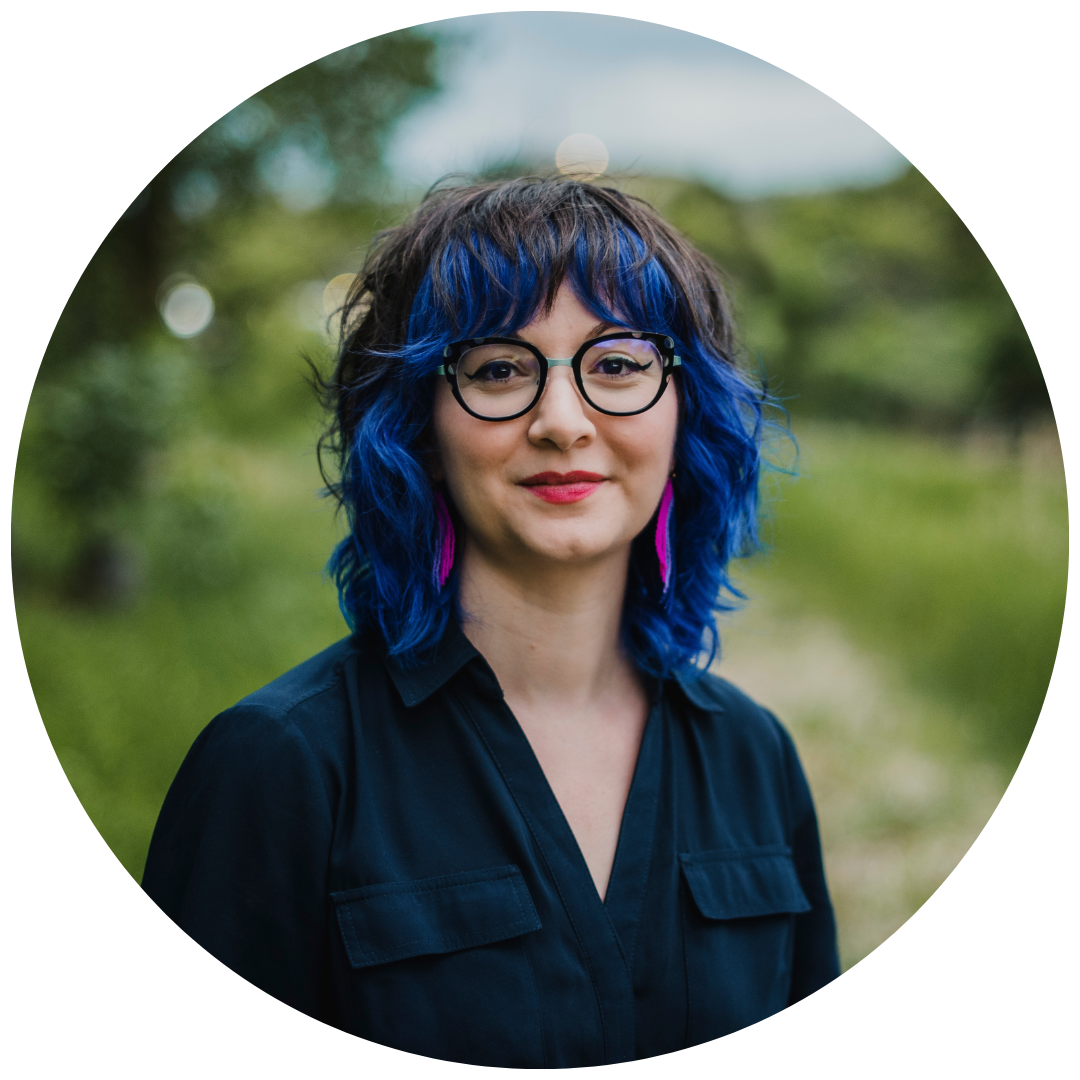
Poet Courtney Bates-Hardy
More about Courtney Bates-Hardy:
Courtney Bates-Hardy is the author of House of Mystery (ChiZine Publications, 2016) and a chapbook, Sea Foam (JackPine Press, 2013). Her poems have been published in Grain, Vallum, PRISM, and CAROUSEL, among others. She has been featured in Best Canadian Poetry 2021 (Biblioasis) and nominated for a Pushcart Prize. She is queer, neurodivergent, and disabled, and one-third of a writing group called The Pain Poets. She lives in Regina, Saskatchewan.

Power Q & A with : melanie brannagan frederiksen
This doesn’t happen often around here, but we are excited to welcome a poetry reviewer to our Power Q & A series. melanie brannagan frederiksen is the poetry columnist for The Winnipeg Free Press, to our series to speak to the review landscape in Canada.
Welcome, melanie!
This doesn’t happen often around here, but we are excited to welcome a poetry reviewer to our Power Q & A series. melanie brannagan frederiksen is the poetry columnist for The Winnipeg Free Press, to our series to speak to the review landscape in Canada.
Welcome, melanie!
Q: How would you like to see the cultural landscape around reviews and reviewing change?

melanie! Find out more about melanie here.
A: I’m coming at your question from the position of someone who has almost exclusively reviewed for non-specialist audiences: that is, for about the last 10 years, my reviews have mostly been published in the books pages of The Winnipeg Free Press, and since 2022, I’ve been the monthly poetry reviewer there. I’m also thinking specifically about poetry reviewing.
Newspapers were also where I first read book reviews: Every Saturday when I was an undergraduate, I would pick up a copy of the Globe and Mail, which at that time had a substantial books section. This isn’t in any way to discount literary magazines and trade publications, as well as individuals publishing reviews online or in newsletters. All of these are, of course, vital to Canada’s ongoing literary conversation.
I’m insisting on my own positioning as one answer to your question: I don’t think there’s one cultural landscape surrounding reviewing — or, more accurately, that landscape looks different depending on where you’re standing on the field. From where I stand, there are so few generalist publications that cover poetry regularly, and that informs my approach to the entire enterprise. From my perspective, there aren’t enough poetry reviews. Someone who writes in more specialist spaces would talk about the weakness in Canadian reviewing culture differently.
There are so many poets in Canada working to turn our culture and ourselves inside out in smart, complicated, and intricate ways, and someone just coming to poetry (someone who may have read some poems in English class; who doesn't know where to find a literary magazine; who, for whatever reason, can’t easily access their area’s artistic communities) might not know that.
Related to that — I think one of the failures of literary culture, in general, is that we assume that everyone who might be interested in books has a certain level of access to a variety of books and a baseline cultural knowlege about where to look for more and different ones. We assume people who are interested both know about and can access the conversations around books, and conversations that connect books to other conversations in the world. Newspapers and generalist publications can contribute to filling that gap: they did for me when I was growing up, but could that still be the case?
A last thought: Increasingly I return to the question not only of who has access to reading reviews, but who has access to writing them — which is not unrelated to the masses of under- and un-paid work that scaffolds so many aspects of literary culture in Canada, but encompasses too those who have been harmed by bad actors in literary communities or marginalized by class, gender, race, disability, or age. We need to reckon with all of these marginalizations in order to build a more just and more robust literary and reviewing culture.
About melanie brannagan frederiksen:
melanie brannagan frederiksen (she/her) lives and writes in Winnipeg, on Treaty One territory. She is the poetry columnist for The Winnipeg Free Press, the author of the chapbook poseidon's cove, athena's cave (Model Press 2021), and her poems have been published in various venues.

Get Away to Go Home: How To Plan A Writing Retreat
As a special feature, we welcome the phenomenal author and workshop facilitator Lauren Carter to our blog to talk about something many writers dream about often, and execute less: we’re talking about writer’s retreats—those elusively but oh-so beneficial companions to a healthy writing practice.
Lauren Carter is the award-winning author of five books, with news of the sixth coming soon. She holds an MFA in Creative Writing and a certificate in teaching and training adult learners and regularly teaches writing. From June 7-9, 2024, she will be co-leading Stillwater: A Trauma-Informed Writing Retreat at a gorgeous historic estate on Ontario’s Lake Simcoe.
As a special feature, we welcome the phenomenal author and workshop facilitator Lauren Carter to our blog to talk about something many writers dream about often, and execute less: we’re talking about writer’s retreats—those elusively but oh-so beneficial companions to a healthy writing practice.
Lauren Carter is the award-winning author of five books, with news of the sixth coming soon. She holds an MFA in Creative Writing and a certificate in teaching and training adult learners and regularly teaches writing. From June 7-9, 2024, she will be co-leading Stillwater: A Trauma-Informed Writing Retreat at a gorgeous historic estate on Ontario’s Lake Simcoe.

You can find out more about Stillwater and other retreats at www.wildgroundwriting.com or by emailing Lauren directly at lauren@wildgroundwriting.com
For now, let’s hand the reigns over to Lauren, and learn more about why and how you should go about planning a writing retreat.
Get Away to Go Home: How To Plan A Writing Retreat
By Lauren Carter
Every morning I get up and have coffee in a cozy recliner in front of the bird-song-filled meadow that my husband likes to play on our T.V.
I crack open my journal or notebook, wait for a first line to bloom in my head.
Hold the pen. Stare at the blank page.
Ignore headache, tinnitus, fatigue, my nearby phone.
Or try to.
Lately the world feels so full of pressures, and anxiety. Maybe this is just me, but I don’t think so. So much terrible news. So much fear for the future. So much straining for perfection, constant engagement, to be seen.
All. The. Time.
This is bad for art because it’s bad for artists. For our ability to grow quiet, calm, immerse ourselves with attention into the quiet place where art grows.
More and more it seems we have to guard these quieter spaces: like George Orwell escaping to the wild island of Jura, or Virginia Woolf’s room of one’s own (“…I must ask you to imagine a room, like many thousands, with a window looking across people's hats and vans and motorcars to other windows, and on the table inside the room a blank sheet of paper..”), or writer Carol Bruneau’s plant-filled space.
That’s why I love getting away, carving out time for creative retreat whether it’s on my own or through Saskatchewan’s Sage Hill Writing Experience or other organized events.
Fuel the Fire
A couple of years ago, I planned my own solo Manitoba writing retreat at a historic Mennonite house in the province’s southern prairies.
Filled with antiques, the cottage had a composting toilet, a wood-fired sauna out back, a couple of rattling baseboard heaters and a central Russian bake oven. As luck would have it (depending on your perspective, of course), we plunged into a prairie deep-freeze. I had to keep that central oven fully fueled to stay alive as the thermometer bottomed out.
I spread my work out on the long table and that’s what I did: stoked the fire, wrote, ate, repeat. The pleasure of it: simple, focused activity, an external task to keep me on track, the space and time to consider nothing but my work and my immediate physical needs.
Heaven.
But, I admit, it got a bit lonely. Plus, the cottage had wi-fi so I had to wrestle with my desire to check on the world every fifteen minutes…
Junot Diaz, the Pulitzer Prize-winning writer says, “The whole culture is telling you to hurry, while the art tells you to take your time. Always listen to the art.”
And he’s right, but this takes intention. We have to do the work to create creative retreats or to find skillfully-built writing retreats that can guide us into the trance of writing, so we can sink deep, either alone or with others who are also yearning, as E.M. Forster wrote, “to only connect.”

Author Lauren Carter.
Create Your Escape
How do you create the conditions “to only connect the prose and the passion”? Here are some tips from my experience as a retreat attendee, organizer, and facilitator:
1. Book the time.
Setting aside time for yourself can be difficult and scary. It means that you are claiming your work, asserting its importance, setting the intention to go off and write. But, as Pat Schneider says, “Whatever you do, don’t stay in the never-never land of wanting and not doing. It will make your soul sick. If you want to write, claim for yourself what you need in order to learn, grow, practice. There is no other way to be an artist.”
2. Find the space.
What do you need? A lake view, a city apartment close to coffee shops. Wi-fi or not? Dog friendly or does it matter? Take time to scroll Airbnb or VRBO but try not to get lost in the hunt or hung up on needing “the perfect place” and procrastinating. Every place has it’s pros and cons. Or, if you want someone else to do the work—including feeding you!—book a ready-made writing retreat dedicated to offering supportive instruction in inspiring locations.
3. Plan your work.
What are you going to do? Revise the short story you’ve been meaning to get to? Get started on an idea for a novel? If you’re going off on your own, without planned writing workshops and sessions, this is really important. Going off to “just write” can derail you like shopping without a list when you’re hungry: you’ll go home with things you don’t need or, worse, empty bags because you panicked and couldn’t decide.
4. Be kind to yourself.
This is a big thing to do! You are asserting the importance of the most intimate relationship you have: the one with yourself and your stories. Bring the cheesecake selection if that makes you happy, or the ready-made gluten-free pizza you never, ever buy because who spends $20 on a frozen meal? Plus, your coziest clothes, your music, something delicious and inspiring to read.
5. Slow down and get grounded.
When you walk through that door into your cabin, loft apartment, room in the bed and breakfast, you might feel nervous and keyed up. For me an inner pressure rises: I need to have this novel done NOW. Cue panic and the rattling of my tender nervous system. I’ve learned how helpful it is to consciously slow down, sit on my butt, and do a grounding exercise to help me settle into the space and calm my nervous system. Try the 54321 technique or taking a few diaphragmatic breaths.
6. Ditch perfectionism.
Natalie Goldberg offers a bit of advice about creating a writing routine that I love: give yourself a checkmark on the calendar for each day you write but if you skip a day, or even two days, don’t let it derail you. In other words, don’t let your inner perfectionist blow up the whole plan. Same with being on a retreat. You write, you don’t write; you read instead, you spend too much time playing a stupid cell phone game. Don’t go to war with yourself. Learn, grow, and fail again, but fail better.
7. Be proud of yourself.
Regularly I go on a women’s weekend with a couple of writer friends of mine. We talk, we eat, we write, we laugh. We hot tub or sit by the fire. I met E. when she sucked up all her courage and came on our first Wild Writing in the Boreal retreat as an introvert who desperately needing writerly connection. I got to know C. on the same retreat because she’d booked herself a spot as well, in her own cabin, newly prioritizing herself and her creative needs.
Whether you go off on your own or find a retreat to support you, these acts of self-nourishment and support are huge, especially for women. Go home knowing that no matter if you wrote a hundred pages or ten, you’ve done this for yourself. The next time will be easier.

Power Q & A with Jade Wallace
For this Power Q & A, we are delighted to welcome author Jade Wallace! Jade is known not only for their individual work—like their upcoming release, Amonia (Palimpsest Press, 2024) but also, for their incredible collaborations with other artists. Today, we want to know a little bit about what makes these collaborations work.
For this Power Q & A, we are delighted to welcome author Jade Wallace! Jade is known not only for their individual work—like their upcoming release, Amonia (Palimpsest Press, 2024) but also, for their incredible collaborations with other artists. Today, we want to know a little bit about what makes these collaborations work.
Welcome Jade!
Q: You do collaborative projects and we are wondering: what’s one piece of advice you’d give people thinking about entering into collaborative writing?

Amonia is forthcoming with Palimpsest Press in June, 2024. Preorder here.
A: Writing collaboratively is a type of relationship, and you should treat it like one, so all the wisdom of maintaining human relationships applies (ensure you're compatible, be clear about expectations, yes it is fun but it also requires work to sustain, etc.) And like any other relationship, collaborative writing can allow you to experience (artistic) realms that you simply would not be able to enter alone. Open yourself up to that unfamiliarity—it's what makes collaboration so thrilling.

Jade Wallace. Photo credit Mark
About Jade Wallace:
Jade Wallace (they/them) is a queer, non-binary, and disabled writer, editor and critic. Their debut poetry collection, Love Is A Place But You Cannot Live There, (Guernica Editions) came out in 2023. Wallace is co-founder of MA|DE, a collaborative writing entity, whose debut collection ZZOO came out from Palimpsest Press. Anomia, their novel, is also forthcoming from Palimpsest Press on June 15, 2024. Pre-order here.
About Anomia:
In Euphoria, a small, fictional town that feels displaced in time and space, an affluent but isolated couple have vanished from their suburban home. Their estranged friend, Fir, a local video store employee, is the only person who notices their disappearance. When the police refuse to help, Fir recruits Fain, who moonlights as a security guard, and they set off on a seemingly hopeless search for the lost lovers. Their chance at an answer, if they can ever find it, lies on the wooded edge of Euphoria, where Slip, an elderly trailer park resident, finds a scattering of bones that cannot be identified. Distrusting everyone, Slip undertakes a would-be solitary quest to discover the bones’ identity. Yet secretly, Limn and Mal, two bored, true crime-loving teenagers from the trailer park, are dogging Slip. Determined to bring justice to the dead, Limn and Mal will instead bring the lives of all seven characters into fraught and tangled confrontation.
Beneath the familiar surface of this missing-persons novel lies an unparalleled experiment: the creation of a folkloric alternate reality where sex and gender have been forgotten. Expanding on the work of Anne Garréta’s Sphinx and Jeannette Winterson’s Written on the Body, and joining gender-confronting contemporaries like Joshua Whitehead’s Jonny Appleseed and Akwaeke Emezi’sThe Death of Vivek Oji, Anomia is an atmospheric exploration of a possible world, and a possible language, existing without reference to sex or gender.


Epilepsy Month Excerpt: In Sickness and In Health, by Nora Gold
March is Epilepsy Month, and we are honoured to be featuring an excerpt from Nora Gold’s new novella, In Sickness and In Health, which is part of a set of novellas published earlier this month by Guernica Editions.
The narrative around epilepsy has been, historically, fraught with misinformation and prejudice, and Nora explores this stigma and shame in her writing.
March is Epilepsy Month, and we are honoured to be featuring an excerpt from Nora Gold’s new novella, In Sickness and In Health, which is part of a set of novellas published earlier this month by Guernica Editions.
The narrative around epilepsy has been, historically, fraught with misinformation and prejudice, and Nora explores this stigma and shame in her writing.

In Sickness and In Health & Yom Kippur in a Gym by Nora Gold (Guernica Editions, March 1, 2024)
As Nora explains, “When I was a child and teen about 55 years ago, medical knowledge was much less advanced, the drug treatments cruder and with more troubling side effects, and societal attitudes toward people with epilepsy were far less accepting. In general, people with epilepsy encounter a higher level of social stigma than people with other medical conditions because epileptic seizures – which can seem frightening and bizarre – were seen historically as evidence that an individual was possessed by a demon, and therefore evil. This moral condemnation of people with epilepsy persisted even after epilepsy was determined to be a neurological (and not a moral) disorder, but in some circles it still persists to this day.”
Thank you to Nora for writing this important story, and for sharing a bit of it with us here. You can grab a copy of In Sickness and In Health wherever books are sold, including your independent bookstore and directly from the publisher at Guernica Editions.
Excerpt from In Sickness and In Health
In ninth grade she turned fourteen, and on this birthday she was perfectly normal again. Her doctor had taken her off meds the year before, gushing over her progress – no seizures (or, as her father called them, dreams) for three years, and a good EEG – as though this was a personal achievement on her part like learning to high jump, and she now merited a reward. In any case, she was thrilled with the reward she received: an end to those horse pills, which had made her feel as monstrously big and ungainly as a horse. It took a couple of weeks to transition back to normal; and as this was occurring, she was acutely aware of the two different lives (drugged/abnormal and undrugged/normal) that she lived, the two realities she inhabited, and the two versions of herself, the two Lilys, that existed. She didn’t know back then that Tegretol, the pill she’d just been taken off of, was being prescribed also for schizophrenia, but she did feel that her life was schizophrenic. Joseph in the Bible – known as “Joseph the Dreamer” (if he “dreamed” so much, perhaps he, too, had epilepsy?) – had interpreted Pharaoh’s dream as meaning seven good years would be followed by seven bad ones. In her life she’d had three good years followed by three bad ones, then four good ones, then four more bad ones. And three and four added up to seven, just like the years in Joseph’s prophecy.
Now at age fourteen (two times seven), it was a relief and a joy to be Normal Lily again. Her own face looked back at her in the mirror, not the weird one swollen by medication. The awful fatigue and heaviness were gone, her body was coordinated, and at school she was friendly with her classmates and perceived as smart. In English they’d been reading Flowers for Algernon, a novel about an intellectually disabled man named Charlie who undergoes experimental surgery and briefly becomes a genius before the effects wear off and he returns to his original state. Lily – not that she thought she was a genius – identified deeply with Charlie’s transformation from moron to genius and back, even though in her case (the opposite of Charlie’s), the drugs made her stupider, not smarter. She produced a book report of such quality it surprised her English teacher, and also, when it got an A, her classmates, who knew she rarely invested effort in homework assignments. When someone asked her about this one, she replied cryptically, “Charlie’s life is a metaphor,” and turned away. Like Charlie, who’d observed his own transformation from stupid to smart and back to stupid, she was sometimes filled with dread at the likelihood, or even inevitability, that at some point – probably in four or five years, when some other incident happened and they put her back on drugs – she too would revert to moronhood. Her lifelong vacillation between on-pills and off-pills, stupid and smart, was like the flicking of a light switch on and off, and ensuing periods of light and darkness. Sometimes she wasn’t certain who, or what, she really was: dumb or smart, good or bad, beautiful or ugly. Maybe she was all these things.

Author Nora Gold. Photo credit: Yaal Herman
More about Nora:
Dr. Nora Gold is the author of four acclaimed books and the winner of two Canadian Jewish Book/Literary awards, as well as praise from Alice Munro. A former professor and an activist, Gold is the editor-in-chief of the prestigious literary journal Jewish Fiction .net, which has readers in 140 countries.
More about In Sickness and In Health. Lily had epilepsy as a child, so her most cherished goal has always been to be “normal”. By age 45 she has a “normal” life, including a family, friends, and an artistic career, and no one, not even her husband, knows the truth about her past. But now some cartoons she drew threaten to reveal her childhood secret, and destroy her marriage and everything she has worked so hard for. A moving novella about shame, secrets, disabilities, and the limits and power of love.
More about Yom Kippur in a Gym. Five strangers at a Yom Kippur service in a gym are struggling with personal crises. Lucy can’t accept her husband’s Parkinson’s diagnosis. Ira, rejected by his lover, plans suicide. Ezra is tormented by a mistake that ruined his career. Rachel worries about losing her job. Tom contemplates severing contact with his sisters. Then a medical emergency unexpectedly throws these five strangers together, and in one hour all their lives are changed in ways they would never have believed possible.