

BLOG

Excerpt from The Mona Lisa Sacrifice by Peter Derbyshire
In the beginning was an angel, a church and a knife.
I hunted down the angel, Remiel, in Barcelona. He was working as a living statue, one of those street performers whose job it is to separate tourists from their money before someone else does. His office was a wooden pedestal on La Rambla, the pedestrian boulevard by the harbour that every visitor has to hit before they start exploring the real city. He was tucked away among the kiosks that sold everything from postcards and magazines to live birds. A silver robot stood on a box to the left of him, while a clockwork man dressed in gears, wheels and pistons was on his right. Remiel was made up like a demon with golden skin, bat wings and two tails, holding a leather tome bound with three locks. He looked like just another out-of-work circus performer vying for tips. Apparently even angels have to make a living these days.
IN THE BEGINNING
In the beginning was an angel, a church and a knife.
I hunted down the angel, Remiel, in Barcelona. He was working as a living statue, one of those street performers whose job it is to separate tourists from their money before someone else does. His office was a wooden pedestal on La Rambla, the pedestrian boulevard by the harbour that every visitor has to hit before they start exploring the real city. He was tucked away among the kiosks that sold everything from postcards and magazines to live birds. A silver robot stood on a box to the left of him, while a clockwork man dressed in gears, wheels and pistons was on his right. Remiel was made up like a demon with golden skin, bat wings and two tails, holding a leather tome bound with three locks. He looked like just another out-of-work circus performer vying for tips. Apparently even angels have to make a living these days.
If you’ve been to Barcelona, or any other city with a tourist district, you know the scene: People with cameras and sunburns wandering around, the statues, jugglers and magicians competing with each other to earn a few of the local coins, while pickpockets go for the money the easy way.
And me.
You wouldn’t notice me. I’d be just another passing face, another man from somewhere else with a hat, sunglasses and backpack. I’m a pretty convincing nobody, thanks to centuries of experience.
But Remiel turned his head and scanned the crowd as soon as I caught sight of him. Angels have a sense for each other. He was looking for me. Trying to find me like I’d found him.
The problem for him was he was looking for the wrong thing. I’m not one of them. I can never be one of them. I’ll let you worry about whether that’s a curse or a gift.
— from The Mona Lisa Sacrifice by Peter Derbyshire. Published by Wolsak & Wynn. © 2024 by Peter Derbyshire. Used with permission of Wolsak & Wynn.

Bring home The Mona Lisa Sacrifice by Peter Derbyshire.
About the Mona Lisa Sacrifice:
This compulsively readable novel is the first in The Cross series and follows the reluctant hero Cross across time as he battles renegade angels trying to start a new holy war on Earth, hunts down a deadly ghost that is haunting Hamlet productions and assembles a crew of Atlanteans, pirates, vampires and the damned to stop Noah from ending the world. It’s a wild romp through history and literary culture, with a cast of characters that includes a band of very mischievous faerie, literary characters such as Alice from the Wonderland tales and a modern-day Frankenstein’s creature, an enigmatic Christopher Marlowe, gorgons, and much more.
The Mona Lisa Sacrifice will enchant readers who love the classics, and supernatural thrillers with a literary bent.

Author Peter Derbyshire.
About Peter Derbyshire:
Often referred to as Canada’s Neil Gaiman, Peter Darbyshire is the author of six books and more stories than he can remember. He lives near Vancouver, British Columbia, where he spends his time writing, raising children and playing D&D with other writers. It’s a good life.

Excerpt from RuFF by Rod Carley
The pendulum of literary fashion usually swung violently once it began.
The disillusioned young moderns of the new century turned their backs on their elders under the impression that they had made a completely new discovery about the world they lived in. For that great Renaissance characteristic – love of action – they substituted the conviction that the world was a pit of iniquity and the only thing worth doing was to sit down and point out its sins. For that other great Renaissance characteristic – love of beauty – they substituted a kind of horrified fear of sex coupled with a fascinated interest in its abnormalities. And for vigour they substituted cleverness: “I’m not insulting you; I’m describing you.”
Drunks, children, and Tommy Middleton always told the truth.
FOUR
The pendulum of literary fashion usually swung violently once it began.
The disillusioned young moderns of the new century turned their backs on their elders under the impression that they had made a completely new discovery about the world they lived in. For that great Renaissance characteristic – love of action – they substituted the conviction that the world was a pit of iniquity and the only thing worth doing was to sit down and point out its sins. For that other great Renaissance characteristic – love of beauty – they substituted a kind of horrified fear of sex coupled with a fascinated interest in its abnormalities. And for vigour they substituted cleverness: “I’m not insulting you; I’m describing you.”
Drunks, children, and Tommy Middleton always told the truth.
Tommy was a roaring boy, meaning he wore his satchel slung low, and his opinions even lower. He bought all his clothes second-hand at London pawnshops. His spiky black hair, black-and-white striped stockings, and black leather doublet signalled a new brand of writers – rebellious and aggressive young men who’d fallen from their upper-class stations.
While still a student at Oxford, Tommy published his first political pamphlet criticizing society’s treatment of the less fortunate. “Enjoying a long life in London requires a robust constitution, good luck, and a poor sense of smell,” he wrote. “We live in tough times. Life’s cheap. The average man’s dead by the time he’s twenty-five. There are few precincts NOT teeming with vermin and vice. I’m not referring to the four-legged variety – although there are plenty of those to go around. I’m talking about slumlords. If I were to drop a rat and a slumlord off London Bridge, do you know which one would hit the Thames sooner? Neither do I, but at least there’d be one less. Do you know what happens when you cross a slumlord with a rat? Absolutely no change whatsoever. Lie down with a rat and you wake up with fleas. Lie down with a slumlord and you wake up with a disease. I haven’t seen my landlord in eight months. All he does is raise my rent and take my money. Yesterday, I joined a group of tourists visiting St. Paul’s Cathedral. ‘This place,’ the guide told us, ‘is one-thousand years old. Not a stone in it has been touched, nothing altered, nothing replaced in all those years.’
‘Well,’ I said drily, ‘they must have the same slumlord I have.’
“And what is St. Paul’s doing to help? There are children so poor the only toy they have to play with is a dead rat, and they have to share it. Citizens so poor the pigeons throw bread at them. People so poor they can’t afford to pay attention to what’s killing them. I’m a university student. My stepfather stole my inheritance. I’m so broke that when I leave my one-room flat to walk to my morning class, I inhale the smell of the bacon cooking next door. THAT’S breakfast.
“And what does the Church have to say? ‘Pull yourself up by your bootstraps, people.’ These people can’t afford boots, much less a strap. Still the Church loves to give them a good strapping. Archbishop, instead of pretending someone else’s sin is worse than your own, confess yourself. That first step off your high horse is going to be a bitch. Tuck and roll, Archbishop.”
It was that last bit that got Tommy into trouble. The pamphlet fell into the hands of the Archbishop of Canterbury, who, incensed by Tommy’s slander, ordered all copies burnt as part of a massive public display. The university gave Tommy the boot and he and his notorious reputation were on their way.
For Tommy, taking a step backward after taking a step forward was not a disaster; it was more of a galliard. He was a sassy twenty-one-year-old, eager to put the boots to WILLIAM SHAKE-SHIT. His graffiti declared it on a wall on the south side of London Bridge.
—from RuFF by Rod Carley. Published by Latitude 46. © 2024 by Rod Carley. Used with permission of Latitude 46 Publishing.

Bring home RuFF by Rod Carley, published by Latitde 46.
More About RuFF:
Rod Carley is back with another theatrical odyssey packed with an unforgettable cast of Elizabethan eccentrics. It’s a madcap world more modern than tomorrow where gender is what a person makes of it (no matter the story beneath their petticoats or tights). Will Shakespeare is having a very bad year. Suffering from a mid-life crisis, a plague outbreak, and the death of the ancient Queen, Will’s mettle is put to the test when the new King puts his witch-burning hobby aside to announce a national play competition that will determine which theatre company will secure his favour and remain in business. As he struggles to write a Scottish supernatural thriller, Will faces one ruff and puffy obstacle after another including a young rival punk poet and his activist-wife fighting for equality and a woman’s right to tread the boards. Will and his band of misfits must ensure not only their own survival, but that of England as well. The stage is set for an outrageous and compelling tale of ghosts, ghostwriting, writer’s block, and the chopping block. Ruffly based on a true story.

Author Rod Carley. Photo credit Virigina MacDonald.
More About Rod Carley:
From Brockville, Rod is the award-winning author of three previous works of literary fiction: GRIN REAPING (long listed for the 2023 Leacock Medal for Humour, 2022 Bronze Winner for Humour from Foreword Review INDIES, a Finalist for the 2023 Next Generation Indie Book Award for Humor/Comedy, and long-listed for the ReLit Group Awards for Best Short Fiction of 2023); KINMOUNT (long listed for the 2021 Leacock Medal for Humour and Winner of the 2021 Silver Medal for Best Regional Fiction from the Independent Publishers Book Awards); A Matter of Will (Finalist for the 2018 Northern Lit Award for Fiction).
His short stories and creative non-fiction have appeared in a variety of Canadian literary magazines including Broadview (winner of the 2022 Award of Excellence for Best Seasonal Article from the Associated Church Press), Cloud Lake Literary, Blank Spaces, Exile, HighGrader, and the anthology 150 Years Up North and More. He was a finalist for the 2021 Carter V. Cooper Short Fiction Prize.
Rod was the 2009 winner of TVO’s Big Ideas/Best Lecturer Competition for his lecture entitled “Adapting Shakespeare within a Modern Canadian Context. He is a proud alumnus of the Humber School for Writers and is represented by Carolyn Forde, Senior Literary Agent with The Transatlantic Agency. www.rodcarley.ca.

Excerpt from I Think We've Been Here Before by Suzy Krause
Having your heart broken is like finding out you have bedbugs—not in an emotional sense, but practically. Both broken hearts and bedbugs require extreme treatment. You can’t just wash your sheets and think that’s enough. Not only is it not enough, you’ve likely made the problem worse by carting your dirty laundry all over the place.
You can get your house fumigated (this could be a metaphor for therapy), but even that won’t be enough, because the memories will be as bad as the bugs themselves. They’ll continue to plague you whether they’re there or not, crawling all over your legs and feet as you lie awake at night, unable to sleep. When you put on that T-shirt, you’ll feel them running up your neck into your hair. They’ll make their home in all the quiet, innocuous places in your life, burrowing into memories and holidays and songs and smells, and every time you think you’ve gotten rid of the last one, you’ll discover that you were an idiot to think there would ever be a last one.
That’s not how bedbugs work, and it’s not how broken hearts work.
OCTOBER
1
Having your heart broken is like finding out you have bedbugs—not in an emotional sense, but practically. Both broken hearts and bedbugs require extreme treatment. You can’t just wash your sheets and think that’s enough. Not only is it not enough, you’ve likely made the problem worse by carting your dirty laundry all over the place.
You can get your house fumigated (this could be a metaphor for therapy), but even that won’t be enough, because the memories will be as bad as the bugs themselves. They’ll continue to plague you whether they’re there or not, crawling all over your legs and feet as you lie awake at night, unable to sleep. When you put on that T-shirt, you’ll feel them running up your neck into your hair. They’ll make their home in all the quiet, innocuous places in your life, burrowing into memories and holidays and songs and smells, and every time you think you’ve gotten rid of the last one, you’ll discover that you were an idiot to think there would ever be a last one.
That’s not how bedbugs work, and it’s not how broken hearts work.
No, a broken heart requires more than a trip to the dumpster or a visit from a licensed exterminator. You have to get rid of the mattress, the rug, the other furniture, the pillows, the clothing in the closet. The closet.
The house.
Replace it all. New Everything.
Nora doesn’t know that starting over like this is a privilege reserved almost exclusively for the young. She doesn’t know that metaphorical fumigation is often the only option when you’re, say, forty, and you have a job and a mortgage and responsibilities and friends and New Everything is just a lot of work, a lot of money you don’t have. She doesn’t think about it because she doesn’t have to; she simply does what young people do, what young people are uniquely able to do: in the face of her first real broken heart, she gets on an airplane and finds New Everything.
She finds a fifth-floor apartment on Greifswalder Strasse and a view of reddish-brown rooftops out the slanted ceiling window. Thin daisy curtains and unframed band posters and fake chrysanthemums in a dollar store vase by the sink. Two roommates, one from the States and one from Germany.
She finds a new language and a new currency. Air that feels and smells new and people who interact with each other in a new way and new things to look at (mostly buildings, all of them ironically very old, with giant, brightly colored murals painted all over them).
She finds a new coffee shop, named Begonia, on a street with a long, hyphenated name she doesn’t know how to pronounce yet. It’s a modern place, lots of tile and wood, a neon-
pink sign behind the counter spelling out its name in sharp calligraphy. You can buy indie electronica albums with your freshly squeezed orange juice, and you can sit by the window and watch all the fascinating strangers walk by on the sidewalk outside.
Everything here feels like it is trying specifically, pointedly, to be the opposite of where she grew up—a rural Saskatchewan village full of quiet, blond Norwegian Canadians; no lights, neon or traffic; no indie electronica albums. No sidewalks, even.
She appreciates the effort Berlin has made to help her feel emphatically not at home. Maybe her brain can be persuaded that this is not just a new beginning, but that it is the beginning. Nora’s beginning. That nothing has ever happened to her before, that she came into existence in Berlin at nineteen years old, has never been in love, has never been hurt.
Maybe an alternative to what feels impossible—healing a broken heart—could be to convince it that it had never been broken to begin with, that it, the heart itself, is new.
—from I Think We’ve Been Here Before by Suzy Krause. Published by Radiant Press. © 2024 by Suzy Krause. Used with permission of Radiant Press.

Bring home I Think We’ve Been Here Before by Suzy Krause, published by Radiant Press, September 24, 2024.
About I Think We’ve Been Here Before:
Marlen and Hilda Jorgensen’s family has received two significant pieces of news: one, Marlen has been diagnosed with a terminal illness. Two, a cosmic blast is set to render humanity extinct within a matter of months. It seems the coming Christmas on their Saskatchewan farm will be their last. Preparing for the inevitable, they navigate the time they have left together. Marlen and Hilda have channeled their energy into improbably prophetic works of art. Hilda’s elderly father receives a longed-for visitor from his past, her sister refuses to believe the world is ending, and her teenaged nephew is missing. All the while, her daughter struggles to find her way home from Berlin with the help of an oddly familiar stranger. For everyone, there’s an unsettling feeling that this unprecedented reality is something they remember.
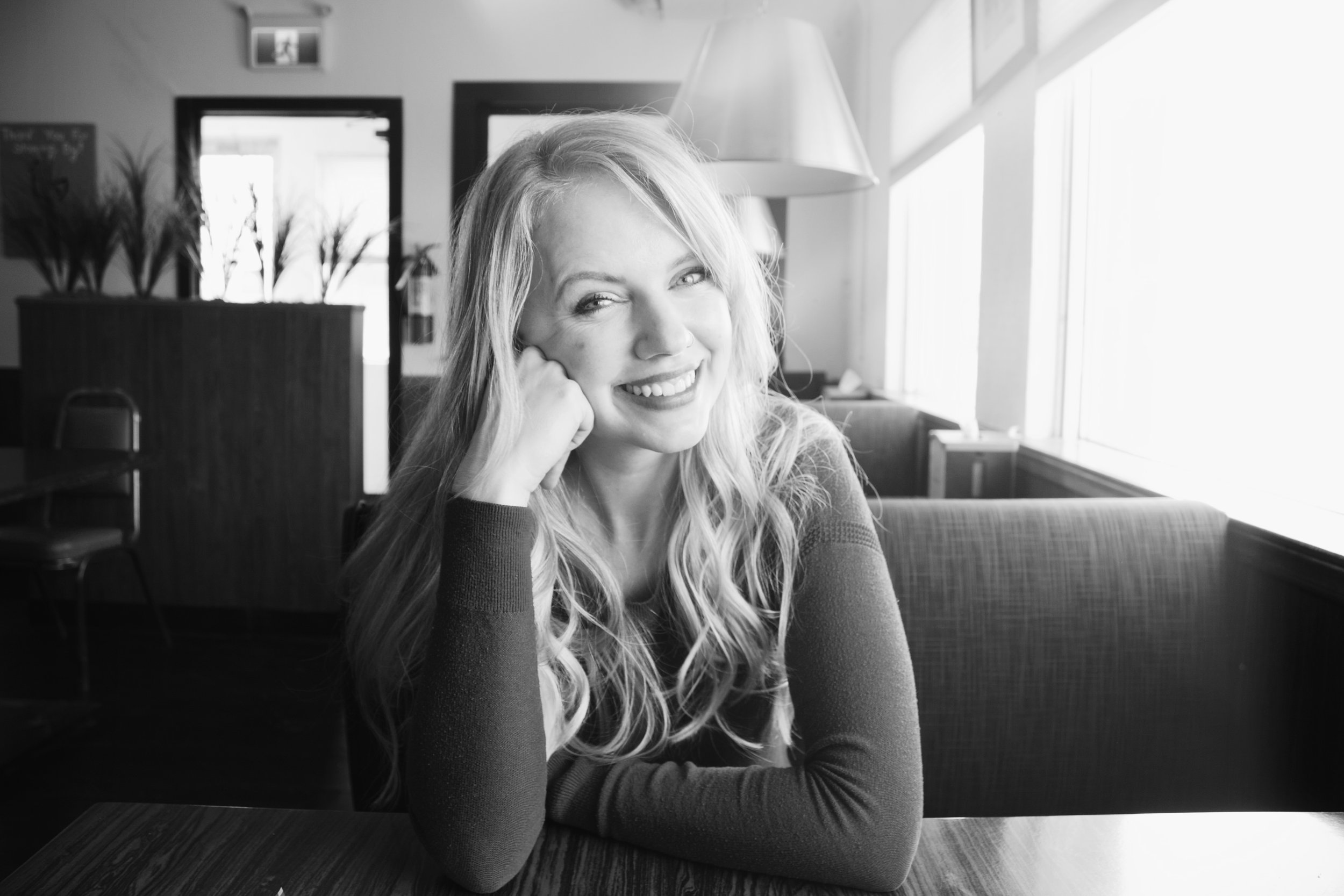
Author Suzy Krause.
About Suzy Krause:
Suzy Krause is the bestselling author of Sorry I Missed You and Valencia and Valentine. She grew up on a little farm in rural Saskatchewan and now lives in Regina, where she writes novels inspired by crappy jobs, creepy houses, personal metaphorical apocalypses, and favorite songs. Her work has been translated into Russian and Estonian.

Excerpt from Yellow Barks Spider by Harman Burns
it started with a little black box, past a door and down a hall, one with a light switch that didn’t seem to work. old corridor with a draft, a sound, voice; there might have been someone talking to you.
kid was shaping coloured plasticine between his finger and thumb, shaping it into a figure, a man, cowboy maybe — here’s a head, funny little legs, an arm, arms. the revolver. surrounded on the dining room table by clay sculptures, buildings and streets, a spacecraft, a whale. a world was unfolding in the structures spread out there, pushed and pressed into shapes and bodies and things, and someone might have been talking to him but kid didn’t mind it at all.
PART ONE
it started with a little black box, past a door and down a hall, one with a light switch that didn’t seem to work. old corridor with a draft, a sound, voice; there might have been someone talking to you.
kid was shaping coloured plasticine between his finger and thumb, shaping it into a figure, a man, cowboy maybe — here’s a head, funny little legs, an arm, arms. the revolver. surrounded on the dining room table by clay sculptures, buildings and streets, a spacecraft, a whale. a world was unfolding in the structures spread out there, pushed and pressed into shapes and bodies and things, and someone might have been talking to him but kid didn’t mind it at all.
as the figure took shape in his hands, kid’s thoughts wandered into memory: it might have been the night before, but kid was sure he had a dream at some point. he was almost sure of it.
he remembered telling his mom about the dream, and she listened to him and paused what she was doing to nod attentively as he told her. when kid finished, she said grandma understood what dreams meant, and she told kid to ask grandma what she thought of the dream.
his fingers were sticky with plasticine and the heel of his right hand was silvery gray from drawing with pencils and kid found grandma in the living room getting ready to play cards.
he climbed onto a chair across from her and she dealt him some cards and while he struggled to get them in order he chewed on his lip and asked her if she knew much about dreams.
i know about dreams, she said. tell me about yours.
she laid down a card, then another, and so did he. They played some cards, and kid told her. kid told her about the first time he dreamed about the shed. he told her about waking up
clawing at his pyjamas throwing off his covers trying to pull the spiders from his body. he told her about his dreams of spiders.
well, she said, dreaming about spiders means you’re growing up.
is that true.
yes. when you dream about spiders it means you’re changing. you’re growing up.
she laid down a card, then another, and so did he. While they played cards kid thought about that. kid thought about the little black box he’d built in his head where he kept the spiders.
the little black box at the end of the hall where the light switch didn’t work. kid thought about the things he promised himself he’d forget, the things he promised he’d bury forever in the deepest place a memory can go. he wondered if that’s what adults meant when they talked about growing up: learning to forget.
stepdad came downstairs and kid could hear the ice clink in his glass as he whispered something into mom’s ear and she gave him a playful push. stepdad came into the living room and stood beside the table and watched grandma beat kid at another hand.
careful, she’s ruthless, kid. she’ll go for the jugular at the first sign of weakness.
he came around behind kid’s chair and poked a finger into his ribs and when grandma beat kid at another hand stepdad said something like i told you so and everyone laughed. mom came in with a bowl of snacks and kid ate by the handful.
—from Yellow Barks Spider by Harman Burns. Published by Radiant Press. © 2024 by Harman Burns. Used with permission of Radiant Press.

Bring home Yellow Barks Spider, Radiant Press, October 22, 2024.
About Yellow Barks Spider:
Yellow Barks Spider (Radiant Press, 2024) akes place in the Canadian prairies, but it seeks to explore this landscape through the intimate lens of a ten-year-old trans kid. Set against the backdrop of the placid countryside, dusty summers and barren winters, it is both a queer coming-of-age novella as well as a deeply psychological character study, reflecting on the nature of memory, trauma, and self-discovery.
In the threadbare prairie town where Kid grew up, life moves slowly. For a troubled ten-year-old, the vast landscape of open skies and barren winters is a place of elemental magic and buried secrets. As the summers pass by, Kid explores a world of weed-choked yards, murky lakes, and a traveling carnival. But when Kid finds himself increasingly haunted by strange spider-infested visions of his next door neighbor’s shed, he falls deeper and deeper into his haunted inner world, eventually turning to mind-altering substances to combat his growing torment. Confronted by this psychic pressure, the book itself begins to crumble, splintering into disparate narrative voices as the workings of Kid’s imagination become animate, tactile—and language self-destructs.
Emerging from this crucible, Kid surfaces into adulthood as she moves through love, sex, and self-discovery as a trans woman. But when she returns to her hometown following the death of a family member, she is forced to reckon with all the fears she once left behind. Yellow Barks Spider is an unforgettable portrait of trauma, isolation, and self-compassion. At its heart, it is a deeply-felt exhumation of memory, love, and the human spirit.

Author Harman Burns
About Harman Burns:
Harman Burns is a Saskatchewan-born trans woman, filmmaker, sound artist and writer. Her practice is informed by folklore, nature, the occult and bodily transfiguration. Her writing has been published in Untethered Magazine and Metatron Press, and was shortlisted for The Malahat Review’s Far Horizons Award for Short Fiction. Burns currently resides on the unceded ancestral territories of the Musqueam, Squamish, and Tsleil-Waututh peoples (Vancouver).

Excerpt from Baby Cerberus by Natasha Ramoutar
Baby Cerberus
Twice I’ve read eulogies for blood
relatives tempering the steel in my voice,
but right now I can’t pen a word for you
without waves churning inside.
I was twelve when you first appeared,
tongue lolling out the side of your mouth,
your teeth sinking into every pair of shoes,
shredding Stephen King paperbacks to confetti.
Baby Cerberus
Twice I’ve read eulogies for blood
relatives tempering the steel in my voice,
but right now I can’t pen a word for you
without waves churning inside.
I was twelve when you first appeared,
tongue lolling out the side of your mouth,
your teeth sinking into every pair of shoes,
shredding Stephen King paperbacks to confetti.
Every wrong was undone with a wolfish grin
or the begging of your puppy-dog eyes.
You were always chunky, huddled
into the curves of my body,
the vacant space of an outstretched arm,
your snout pressing against my bent knees.
But in the end, you were only flesh and fur
barely clinging to a skeletal frame, sleeping
away most days in a stupor. In this myth,
baby Cerberus curls up to Persephone,
lets her cry into his soft fur, licks her hand,
rests his three heavy heads across her lap.
I’d like to remember you like that:
a young girl’s best friend and confidant.
I am sitting on the concrete blocks where
you used to zoom up and down. Notebook
balanced on my knees, pen in hand,
I’m trying to find the words
to memorialize you. The first line
of my eulogy is this: “I would cross
the River Styx for you.” I would,
I honestly would.
—”Baby Cerberus” from Baby Cerberus by Natasha Ramoutar. Published by Wolsak & Wynn. © 2024 by Natasha Ramoutar. Used with permission of Wolsak & Wynn.

Bring home Baby Cerberus by Natasha Ramoutar.
About Baby Cerberus:
Ethereal, soul-stirring, and playful, Baby Cerberus traces joy and kinship across a multitude of lives. Flitting from myths and folklore to video games to imagined futures, each piece asks us to consider how we care for one another. As we move through sentient galleries, swashbuckling adventures, and the doors of Atlantis, the collection reorients us in each section with the riddles as two lost souls try to find each other through time. These poems tug on the invisible threads between us all, trying to find what tethers us together and, in turn, what keeps us here.
While Baby Cerberus centers fun and nostalgia with allusions to video games, internet lore, and Tamagotchis, there are still heavy themes throughout which address misogyny, racism, and colonization. The unique integration of high-brow topics with some of the more low-brow pop culture references distinguishes the book in the minds of readers by expanding what we can ask of poetry.

Author Natasha Ramoutar. Photo credit: Abynaya Kousikan.
More about Natasha Ramoutar:
Natasha Ramoutar is a writer of Indo-Guyanese descent from Toronto. Her debut collection of poetry Bittersweet, published in 2020 by Mawenzi House, was shortlisted for the Gerald Lampert Memorial Award. She was the editor of FEEL WAYS, an anthology of Scarborough literature. She is a senior editor with Augur Magazine and serves on the editorial board at Wolsak & Wynn.

Excerpt from Class Lessons: Stories of Vulnerable Youth by Lucy E.M. Black
Fuck you, you fuckin’ crusty fucker. An eloquence of fucks. Adjective. Verb. Noun. There was an English lesson in there somewhere. She was fifteen and suspended from school. Irony.
Her teacher was, according to Summer, a fuckin’ perv, but the real reason for skipping was a shift change. At three o’clock, the lines formed at the east gate, past the wooden security shack and the twelve-foot-high fencing with barbed wire. The line snaked back, curled around the plant, engines running, while the short-of-breath security guard, in a grey Stainmaster shirt and pants, checked the truck beds and trunks, searching for stolen bumpers and hand tools. The line could take forty-five minutes to clear.
South End
Fuck you, you fuckin’ crusty fucker. An eloquence of fucks. Adjective. Verb. Noun. There was an English lesson in there somewhere. She was fifteen and suspended from school. Irony.
Her teacher was, according to Summer, a fuckin’ perv, but the real reason for skipping was a shift change. At three o’clock, the lines formed at the east gate, past the wooden security shack and the twelve-foot-high fencing with barbed wire. The line snaked back, curled around the plant, engines running, while the short-of-breath security guard, in a grey Stainmaster shirt and pants, checked the truck beds and trunks, searching for stolen bumpers and hand tools. The line could take forty-five minutes to clear.
They’re all fuck’in pervs. They like it when I jump in and show them my tits. For a twenty, I go down on them, and they don’t lose their place. I pull my hair back. They like that. Short skirts and t-shirts with no bra. Makes ’em hard. I can do five in a row easy. Then I puke it up. Bet you can’t make no fuckin’ hunered bucks in half’en hour.
She was in Grade Nine. I was shocked to discover that thirty minutes from my safe, middle-class life, people lived in such circumstances. No hydro. No water. Whole families squatting in abandoned buildings. Street kids sleeping in wrecked cars. Kids coming to school in deep winter without coats or boots, sitting at their desks with bleeding gums and teeth loose from scurvy.
Summer was a survivor. She had already found a way to look after herself. The monthly cheque her mother received paid the rent and a few bills. There was never enough left for a full month of food. It was her mother who had sent Summer to “work.” Told her where to find the men and what to say to them. How to swallow.
—from “South Side” from Class Lessons: Stories of Vulnerable Youth by Lucy E.M. Black. Published by Demeter Press © 2024 by Lucy E.M. Black. Used with permission.

Bring home Class Lessons (Demeter Press) by Lucy E.M. Black
About Class Lessons: Stories of Vulnerable Youth
Today’s schools are meant to be all things to all people, but can they be? Schools are responsible for socialization, skills development and knowledge acquisition which take place within an institution serving disparate student populations. Unfortunately, school success is not experienced by all students, especially those for whom chaotic home lives are overwhelming. Schools should provide an important safe haven for students, offering advocacy and wraparound care. Fictionalized to protect the identities of those involved, the narratives between these pages shine a spotlight on the vulnerability of youth, and in particular, young people living in heart-breaking circumstances. Upholding the work that takes place in schools and embracing those support systems which are shared between school and community is crucial to enacting lasting and positive change. Drawn from the life experiences of a career educator, this collection seeks to highlight a broad range of needs while also reinforcing the way forward through school-community partnerships.

Author Lucy E.M. Black
More about Lucy E.M. Black:
Lucy E.M. Black (she, her, hers) is an educator and retired high school principal with a deep concern for imperiled youth. Having first worked as a corporate trainer before moving into public education in the GTA, she has had many rich experiences in a variety of community settings teaching both adolescents and adults. An acclaimed author, her new short story collection, Class Lessons: Stories of Vulnerable Youth, is released on October 16, 2024 with Demeter Press.

Women in Translation Month: Sugaring Off by Fanny Britt, translated by Susan Ouriou
August is Women in Translation Month—a perfect time to celebrate Fanny Britt’s Governor General Award-winning novel, Sugaring Off, which has an English translation forthcoming this fall with Book*hug Press, translated by seven-time Governor General Award-winner, Susan Ouriou.
The Governor General Literary Award jury called Sugaring Off , “[a]n accurate, uncomplacent depiction of Western society and of the disparity that exists between classes and ethnicities, this brilliantly written story joins the family of great North American novels and asks one fundamental question: however privileged we may be, is it possible to live without relying on others? In this clever and lucid fresco, complex characters are confronted with crises which are not unconnected to the paradoxes inhabiting them.”
August is Women in Translation Month—a perfect time to celebrate Fanny Britt’s Governor General Award-winning novel, Sugaring Off, which has an English translation forthcoming this fall with Book*hug Press, translated by seven-time Governor General Award-winner, Susan Ouriou.
The Governor General Literary Award jury called Sugaring Off , “[a]n accurate, uncomplacent depiction of Western society and of the disparity that exists between classes and ethnicities, this brilliantly written story joins the family of great North American novels and asks one fundamental question: however privileged we may be, is it possible to live without relying on others? In this clever and lucid fresco, complex characters are confronted with crises which are not unconnected to the paradoxes inhabiting them.”

Bring home Sugaring Off (Book*hug Press, October 8, 2024).
More about Sugaring Off:
On the surface, Adam and Marion are the embodiment of success: wealthy, attractive, in love. While holidaying in Martha’s Vineyard, Adam surfs into a local young woman, Celia. The accident leaves her injured and financially at risk; for Adam and Marion it opens a fault of loneliness, rage, and desires that have too long been ignored.
Like a modern Virginia Woolf, Fanny Britt abrades the surface layer of our outward personas, delving into the complexity and contradictions of relationships. In this eviscerating critique of privilege, she asks what happens when one can no longer play a role—whether in a couple, family, or social structure—and the resulting friction between pleasure and consequence.
We are pleased to share an excerpt from this remarkable novel, as well as more information about author Fanny Britt and translator Susan Ouriou.
Excerpt: Sugaring Off by Fanny Britt, translated by Susan Ouriou
Félix claimed that the time for Facebook had come and gone, that only old fogies and activists still used it, and that you had to wade through the swamp of spiteful or trivial comments before finding anything of interest.
People his age, he said, were found on Instagram.
Well, if Celia had signed up for Instagram, it must be under a pseudonym because Marion hadn’t found her there. She did show up on on Facebook, and Marion managed to find out that three years earlier, she had gone on a school trip to Washington, where she posed in front of the statue of Abraham Lincoln.
Next came a few group photos taken in restaurants that had been posted by members of her family—in fact, almost nothing on Celia’s page had been posted by her.
For no particular reason, Marion went back to the page a few hours before the choir’s Christmas concert. She should have been drinking herbal tea to soothe her throat and using the flatiron to look presentable, but there she sat at the kitchen table in front of the computer as evening fell. Adam wasn’t home— he’d meet up with her at the church, he said in his text message; he was held up with some task or other at the Sweets’.
She didn’t find anything much that was new. Two or three pictures and a video of the small saltwater taffy factory where Celia worked. The workshop doubled as a shop: customers could choose among over forty flavours of soft taffy. Lemon, caramel, strawberry, mint, licorice, grape. The video showed how the taffy was made using a machine with large hooks that stretched the rope, and Celia’s hands and arms could be seen inserting it into some sort of gear the equipment looked to be straight out of another era—from which emerged machine-wrapped candies in wax paper.
Marion had to watch the video twice to be sure it really was her since her face could only be seen for a few seconds and her hair was hidden beneath a white hairnet. She looked so young. But Celia was, in fact, young, wasn’t she? She had the open gaze of a child; her face shadowed by huge bags under her eyes, and her oversize T-shirt sporting the logo of the taffy shop made her look like an orphan, one who was trundled here and there, her only clothing ill-fitting odds and ends that had been scrounged from a lost-and-found bin.
Captions with catchy phrases were designed to attract tourists to Martha’s Vineyard for a taste of the authentic east coast. So, this was how Celia spent her days before the tragedy? Had she hoped to take over the family business and, after much hard work and many a setback, open a branch and make her ancestors proud?
Except that, since July, she’d written nothing on social media. Only one comment in response to a girlfriend’s post on her page, something cryptic and innocuous about a kitsch reality show the two seemed to find amusing. The comment, written a few weeks earlier, was proof that Celia was still alive and able to write, two things Marion found reassuring. But the girl’s inactivity bothered her. Alive and able to write did not mean she might not be in a pitiful state. Maybe she was bedridden, in a wheelchair, paralyzed by chronic shooting pain that left her haggard and depressed. Maybe she’d lost her boyfriend, too much of a coward to look after a young woman who’d been disabled. Not to mention the barbarity of the U.S. health system and Celia was not well-to-do; everything pointed to that fact, her clothes, the places she hung out, no, she probably had very little insurance coverage and had to work herself ragged to pay for her treatment. Not to mention the trips to the hospital, calculating the cost of gas and compensating for her disability at work. Under those kinds of conditions, who would feel carefree enough to write rubbish on a dying social network, as though life still went on? Marion shuddered and turned off the computer.
—from Sugaring Off by Fanny Britt: original French text © 2021 by Le Cheval d’août Éditeur. English translation © 2024 by Susan Ouriou. Used with permission of Book*hug Press.

FANNY BRITT is a playwright, writer, and translator. She is the winner of multiple Governor General’s Literary Awards, a Libris Award, a Joe Shuster Award, and was nominated for a Governor General’s Literary Award for Children’s Literature. Sugaring Off won the Governor General’s Literary Award for French language Fiction in 2021. Britt has written a dozen plays and translated more than fifteen works by many American, Canadian, British, and Irish playwrights. Born in northern Quebec, Britt lives in Montreal.
SUSAN OURIOU is an award-winning literary translator (French and Spanish to English) and fiction writer. She has been a finalist for the Governor General's Literary Award for Translation on seven occasions, winning for her translation of Pieces of Me by Charlotte Gingras. She also translated Catherine Leroux's The Future, winner of 2024 CBC Canada Reads. Ouriou is also the author of two novels, Damselfish, and the critically acclaimed Nathan, and the editor of two anthologies, the trilingual Beyond Words: Translating the World and the bilingual Languages of Our Land: Indigenous Poems and Stories from Quebec. She lives in Calgary.

Power Q & A with Rod Carley
RuFF is Rod Carley’s highly-anticipated fourth novel. This historical fiction, which is published by Northern Ontario’s Latitude 46 Press, transports us to Elizabethan England, where we witness Shakespeare struggling through a midlife crisis while trying to win a national play competition to secure the King’s business. Hilarious hijinks ensue, with whip-smart dialogue and a captivating tale that touches on salient social issues that persist today, including equality, justice, and censorship.
Humour and incisive wit combine to create a compulsively readable and thought-provoking novel from this Leacock Award long-listed author. We know RuFF will be a favourite book of the year for many and we are tickled to have Rod Carley here with us to talk about humour writing.
RuFF is Rod Carley’s highly-anticipated fourth novel. This historical fiction, which is published by Northern Ontario’s Latitude 46 Press, transports us to Elizabethan England, where we witness Shakespeare struggling through a midlife crisis while trying to win a national play competition to secure the King’s business. Hilarious hijinks ensue, with whip-smart dialogue and a captivating tale that touches on salient social issues that persist today, including equality, justice, and censorship.
Humour and incisive wit combine to create a compulsively readable and thought-provoking novel from this Leacock Award long-listed author. We know RuFF will be a favourite book of the year for many and we are tickled to have Rod Carley here with us to talk about humour writing.

Bring home RuFF by Rod Carley, published by Latitude 46.
Q: What advice do you have for aspiring humour writers?
A: Everyone has a different sense of humour. We all find different things funny for different reasons. This is why it’s important that before you sit down and try to write, you think about your own personal sense of humor and how you want to mine that to produce a piece of humor writing.
Accept that you have the potential to be funny. Writing humour might come more easily to some, but everyone has the potential to be funny. Find a voice—maybe it’s your main character—to channel your humor through. Trying to mimic other people’s styles in humour writing won’t work. If you try and write in a style that isn’t your own, or if you try and force yourself to be funny in a way that isn’t you, the effort behind your writing will show.
Humour is subjective. When you write a novel or collection of short stories that you hope will be funny, you can be guaranteed that not everybody will find it funny – you just hope some people will find it funny! Readers have the same reaction (to various degrees) to a romance novel, horror novel, or a mystery novel. But with a humour novel, some readers will find it the funniest thing they’ve ever read. Others won’t find it funny at all. It’s a challenge. Much like trying to catch a dragon. So, all you can do, is hope your sense of humour coincides with enough readers to make it worthwhile.
Use humour sparingly. Don’t overdo it; be specific. Your purpose is to grab the reader’s attention and help you make points in creative ways. Be sure your humour doesn’t distract from or demean the true purpose of your narrative.
Above all, make it fun for yourself. If it ain’t fun for you, it won’t be fun the reader.

Rod Carley.
More about RuFF:
Rod Carley is back with another theatrical odyssey packed with an unforgettable cast of Elizabethan eccentrics. It’s a madcap world more modern than tomorrow where gender is what a person makes of it (no matter the story beneath their petticoats or tights). Will Shakespeare is having a very bad year. Suffering from a mid-life crisis, a plague outbreak, and the death of the ancient Queen, Will’s mettle is put to the test when the new King puts his witch-burning hobby aside to announce a national play competition that will determine which theatre company will secure his favour and remain in business. As he struggles to write a Scottish supernatural thriller, Will faces one ruff and puffy obstacle after another including a young rival punk poet and his activist-wife fighting for equality and a woman’s right to tread the boards. Will and his band of misfits must ensure not only their own survival, but that of England as well. The stage is set for an outrageous and compelling tale of ghosts, ghostwriting, writer’s block, and the chopping block. Ruffly based on a true story.
More about Rod Carley:
Rod is the award-winning author of three previous works of literary fiction: GRIN REAPING (long listed for the 2023 Leacock Medal for Humour, 2022 Bronze Winner for Humour from Foreword Review INDIES, a Finalist for the 2023 Next Generation Indie Book Award for Humor/Comedy, and long listed for the ReLit Group Awards for Best Short Fiction of 2023); KINMOUNT (long listed for the 2021 Leacock Medal for Humour and Winner of the 2021 Silver Medal for Best Regional Fiction from the Independent Publishers Book Awards); A Matter of Will (Finalist for the 2018 Northern Lit Award for Fiction).
His short stories and creative non-fiction have appeared in a variety of Canadian literary magazines including Broadview (winner of the 2022 Award of Excellence for Best Seasonal Article from the Associated Church Press), Cloud Lake Literary, Blank Spaces, Exile, HighGrader, and the anthology 150 Years Up North and More. He was a finalist for the 2021 Carter V. Cooper Short Fiction Prize.
Rod was the 2009 winner of TVO’s Big Ideas/Best Lecturer Competition for his lecture entitled “Adapting Shakespeare within a Modern Canadian Context. He is a proud alumnus of the Humber School for Writers and is represented by Carolyn Forde, Senior Literary Agent with The Transatlantic Agency. www.rodcarley.ca.

Power Q & A with Hollay Ghadery
In the many years we’ve been doing this series and through two previous books, River Street’s founder, Hollay Ghadery, has never been a part of our Power Q & A series—but that all changes now! Hollay’s debut collection of short fiction, Widow Fantasies, (Gordon Hill, September 1, 2024) has scored some pretty sweet advance reviews, being praised for its “jewel-tone richness” (Molly Peacock) and “tight, sharp-witted, and expertly crafted stories” (Kathryn Mockler).
The form of Hollay’s short fiction is particularly interesting to many readers. The stories, which explore fantasy and the act of fantasizing as a way to subvert and explore misogyny, are not only short but really short. Many pieces are flash fiction and knowing Hollay as we do, we know she never wrote flash fiction before this collection.
So, we wanted to know, why? And also, how?
In the many years we’ve been doing this series and through two previous books, River Street’s founder, Hollay Ghadery, has never been a part of our Power Q & A series—but that all changes now! Hollay’s debut collection of short fiction, Widow Fantasies, (Gordon Hill, September 1, 2024) has scored some pretty sweet advance reviews, being praised for its “jewel-tone richness” (Molly Peacock) and “tight, sharp-witted, and expertly crafted stories” (Kathryn Mockler).
The form of Hollay’s short fiction is particularly interesting to many readers. The stories, which explore fantasy and the act of fantasizing as a way to subvert and explore misogyny, are not only short but really short. Many pieces are flash fiction and knowing Hollay as we do, we know she never wrote flash fiction before this collection.
So, we wanted to know, why? And also, how?

Bring home Widow Fantasies by Hollay Ghadery.
Q: Is there a reason the stories in Widow Fantasies are often shorter than the average short story? Do you have any advice for people looking to write flash fiction?
A: I definitely didn’t begin writing these stories knowing why I was adamant on sticking to flash fiction (though as mentioned, some are a little longer than conventional flash). I just knew I wanted to try my hand at flash. I was drawn to the form. Later, when my publisher and I were emailing about the collection, he asked if I’d consider changing the length of a few, to make them longer. My response was immediate: no.
Now, understand: I am not overly precious about my writing and am always open to suggestions so I was surprised by how certain I felt about my reply. The reason for my certainty revealed itself immediately. In my experience, as a woman of multitudes forced to slosh around the heteronormative confines of domesticity, I don’t have time to fantasize for prolonged periods. I can grab a few minutes while washing dishes or folding laundry, but before long, something or someone almost always interrupts me. The length of my stories felt like a natural reflection of the space I was inhabiting at the time. It also felt like a natural reflection of the space I was writing from. I have four children and when I began this collection, not all of them were in school and I was working full-time. I couldn’t commit to long, involved storylines but I could manage shorter short fiction.
Which is not to say flash is easy. It’s not. There’s an attention to detail and precision that’s painstaking. It’s just that, with flash fiction, I don’t find myself consumed in a world the same way I am when writing longer forms. I don’t forsake my family and live in my head for months and months. But of course, I still did a lot of work to complete the collection. Even before I began writing. I devoured copious amounts of flash fiction. Crucially, I read Brevity: A Flash Fiction Handbook by David Galef, which was a game changer. The book provided examples, tips, and exercises. A few of the stories in Widow Fantasies are the result of the Galef’s exercises. I’d recommend Brevity to anyone looking to write flash fiction and flash fiction to any writer looking to tighten up their craft.

Hollay Ghadery
More about Widow Fantasies:
Fantasies are places we briefly visit; we can’t live there. The stories in Widow Fantasies deftly explore the subjugation of women through the often subversive act of fantasizing. From a variety of perspectives, through a symphony of voices, Widow Fantasies immerses the reader in the domestic rural gothic, offering up unforgettable stories from the shadowed lives of girls and women.
More about Hollay Ghadery:
Hollay Ghadery is a multi-genre writer living in Ontario on Anishinaabe land. She has her MFA in Creative Writing from the University of Guelph. Fuse, her memoir of mixed-race identity and mental health, was released by Guernica Editions in 2021 and won the 2023 Canadian Bookclub Award for Nonfiction/Memoir. Her collection of poetry, Rebellion Box was released by Radiant Press in 2023, and her collection of short fiction, Widow Fantasies, is scheduled for release with Gordon Hill Press in fall 2024. Her debut novel, The Unraveling of Ou, is due out with Palimpsest Press in 2026, and her children’s book, Being with the Birds, with Guernica Editions in 2027. Hollay is the host of the 105.5 FM Bookclub, and a co-host of HOWL on CIUT 89.5 FM. She is also a book publicist and the Poet Laureate of Scugog Township. Learn more about Hollay at www.hollayghadery.com.
A Wolf's Tale: Susan Wadds on the life-changing experience that inspired her acclaimed debut novel, What the Living Do
Alisa York, author of Fauna and Far Cry, calls Susan Wadds debut novel, What the Living Do, “a fierce and fearless novel about a woman drawn to self-destruction yet desperate to live – and maybe even love. A deeply moving and memorable debut.”
These words sum up what many readers have felt while immersed in the pages of this remarkable novel: a dogged persistence that seems at once a surrendering of one’s will to live and a testament to life. We asked Susan to join us for this special guest post to share about where this opposing and equal pull comes from. Her response was staggering.
Alisa York, author of Fauna and Far Cry, calls Susan Wadds debut novel, What the Living Do, “a fierce and fearless novel about a woman drawn to self-destruction yet desperate to live – and maybe even love. A deeply moving and memorable debut.”
These words sum up what many readers have felt while immersed in the pages of this remarkable novel: a dogged persistence that seems at once a surrendering of one’s will to live and a testament to life. We asked Susan to join us for this special guest post to share about where this opposing and equal pull comes from. Her response was staggering.

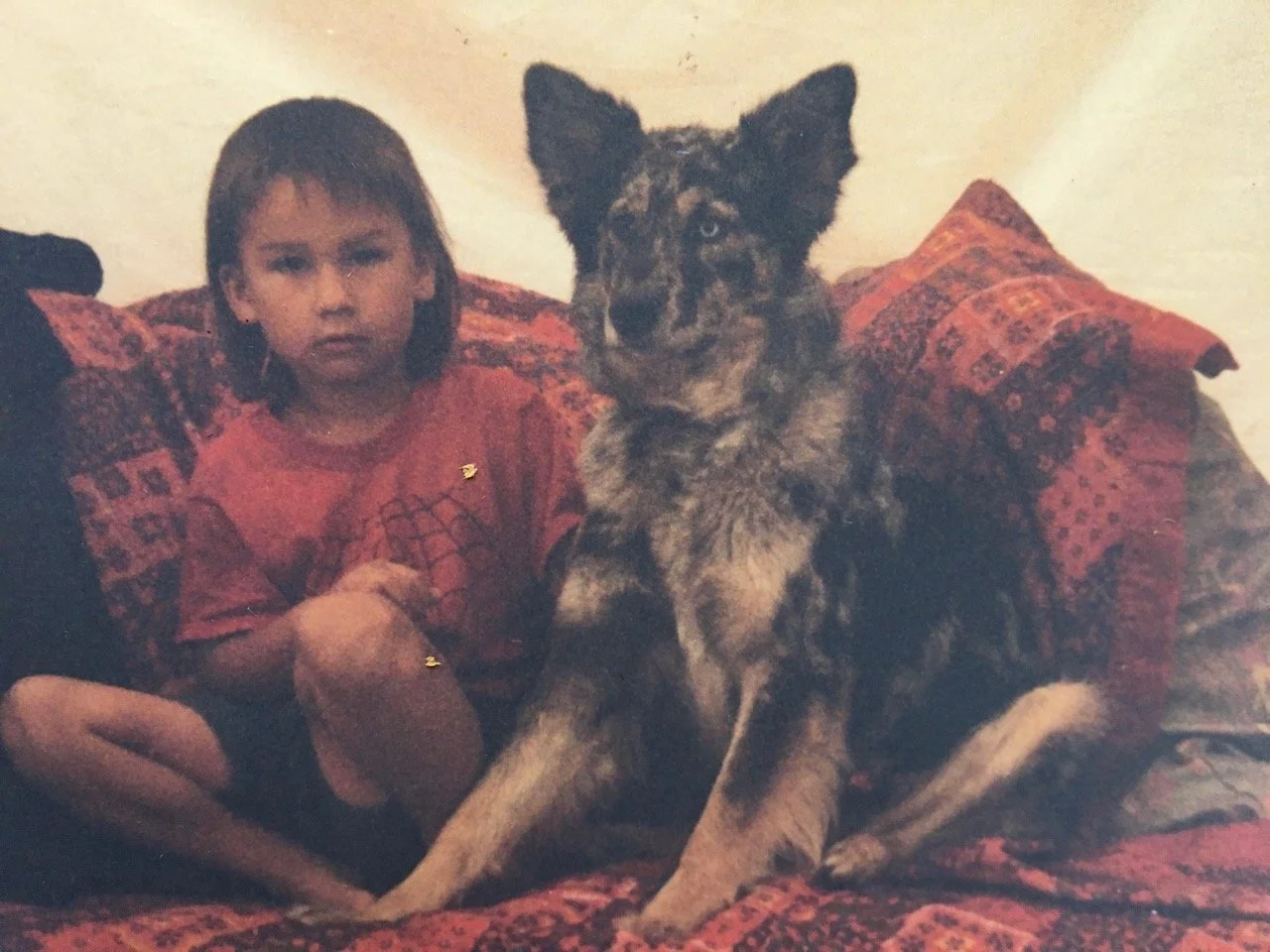
Susan Wadds and her son.
A Wolf’s Tale
By Susan Wadds
At eighteen I was diagnosed with a rare blood disease. After many medical interventions, including the final “cure” of a splenectomy, I was healed and able to carry on with my life.
As a teenager I had suspected there was more to the disease than some random occurrence; a system gone “off,” but at the time had no resources to investigate the possibility that ITP had its roots in my psyche and not simply in my blood. So in my thirties, when diagnosed with cervical cancer, I challenged the medical system by refusing the prescribed hysterectomy and chose instead a myriad of alternative healing approaches. Always watchful through regular checkups, it was clear the cancer wasn’t progressing, but neither was it retreating. The common wisdom was, have the damn surgery. I agreed to a LEEP incision but the margins weren’t clear. Still, I wanted to understand why the disease had manifested. If I was to blame, either for a past wrong or because there was something rotten at my core that needed to be exposed and excised.
After leaving the doctor’s office in Thornhill where I’d had a PAP smear, I drove along Rutherford Road, just south of Wonderland where there was still a lush little forest. It was early winter with a dusting of snow in the ditches. On the shoulder of the road, a small wolf stood, as if waiting to cross. Without a thought, I pulled off the road and got out of the car.
We stood watching each other for moment after moment. No cars passed. The sky a quiet grey. Something wild stirred in my chest but I stood still, waiting. Inside I craned to hear what this creature was telling me. At last, it turned and jogged lightly back towards the forest, turning periodically as if to check if I was following.
I wept in the car, knowing this encounter was unspeakable magic. When I received the results of the test, saying no cancer was detected, I felt the wolf had been there to reassure me. However, the next test found some cancer, so I decided that the wolf’s message had been to be patient and to stay the course.
At forty-one, I discovered that I was pregnant. With active cancer. My oncologist advised a full hysterectomy in order to “kill two birds with one stone,” since he was of the opinion that birthing a child would spread cancer throughout my body.
I disregarded his insistence. I also turned away from the invasion of amniocentesis, a recommendation for geriatric mothers.

I’ve been reluctant to share my story because I would never want anyone to assume this is anyone’s else’s healing path. I acknowledge that mine were a series of dangerous choices. I’ve never been able to logically explain any of my questionable decisions, but I’m here, thirty-three years after my initial diagnosis, to tell the tale.
I also did want to tell this story, just not as a memoir. So I created Brett, gave her a job I would never be able to stomach—that of clearing roadkill—and gave her cervical cancer to see what she would do. Like me, she couldn’t explain her stubbornness. Like me, she suspected her disease was payback. And like me, it was an encounter with a wolf that opened her eyes and gave her hope.
What the Living Do is a work of fiction. It was the best way I could tell my story and have it not be my story.
When Benjamin Rain Meenghun (wolf in Ojibwe) was almost six years old, I agreed to a hysterectomy. I found a sympathetic doctor who agreed to leave my ovaries if he felt them to be healthy. The surgery was an oddly blissful experience. Doctor Will told me my ovaries were “beautiful.”

Susan and her son, Benjamin Rain Meenghun.
My son and my birthdays are a week apart. On August twentieth, I will be seventy, on the twenty-seventh, he will be twenty-eight.

Bring home What the Living Do (Regal House, 2024) by Susan Wadds.
More about What the Living Do:
Sex and death consume much of thirty-seven-year-old Brett Catlin’s life. Cole, ten years her junior, takes care of the former while her job disposing of roadkill addresses the latter. A cancer diagnosis causes her to question her worth, suspecting the illness is payback for the deaths of her father and sister. Thus begins a challenging journey of alternative healing that she doubts she deserves. Just as Brett surrenders to the prescribed cure, a startling discovery sends her on a more profound exploration of cause and effect. Encounters with animals, both living and dead, help her answer the question: who is worth saving?
More About Susan Wadds:
Winner of The Writers’ Union of Canada’s prose contest, Susan Wadds’ work has appeared, among other publications, in The Blood Pudding, Room, Quagmire, Waterwheel Review, Funicular, Last Stanza, WOW-Women on Writing, and carte blanche magazines,. The first two chapters of her debut novel, published by Regal House Publishing, “What the Living Do” won Lazuli Literary Group’s prose contest, and were published in Azure Magazine.
A graduate of the Humber School for Writers, Susan is a certified Amherst Writers and Artists (AWA) writing workshop facilitator. She lives by a quiet river on Williams Treaty Territory in South-Central Ontario with an odd assortment of humans and cats.

Power Q & A with Myna Wallin
Mental illness is one of those subjects that always seems ripe for interrogation, especially when it comes to investigating our collective societal response to it. Myna Wallin’s new poetry collection, The Suicide Tourist (Ekstasis Editions, 2024), explores mental illness with verve, grace, and wisdom. It’s a collection that dives into the darkness and creates light; not by virtue of exposing any levity in living with mental illness, but by examining mental illness and neurodivergence frankly and with compassion, thereby alleviating, just a little, the burden of loneliness so many of us who live with it experience.
We’re honoured to have Myna on our Q & A series to talk about her beautiful and moving collection.
Mental illness is one of those subjects that always seems ripe for interrogation, especially when it comes to investigating our collective societal response to it. Myna Wallin’s new poetry collection, The Suicide Tourist (Ekstasis Editions, 2024), explores mental illness with verve, grace, and wisdom. It’s a collection that dives into the darkness and creates light; not by virtue of exposing any levity in living with mental illness, but by examining mental illness and neurodivergence frankly and with compassion, thereby alleviating, just a little, the burden of loneliness so many of us who live with it experience.
We’re honoured to have Myna on our Q & A series to talk about her beautiful and moving collection.
Welcome, Myna!
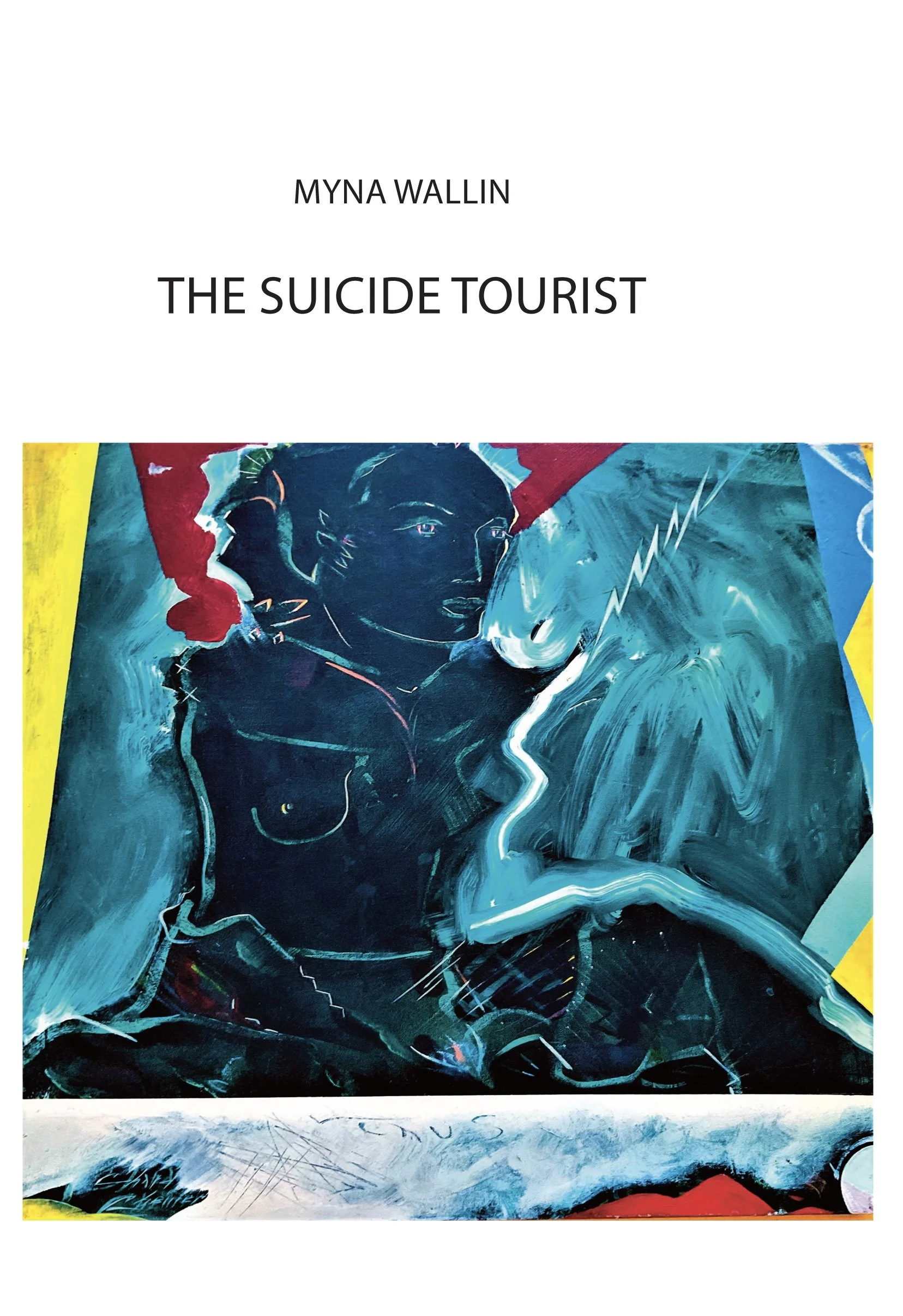
Bring home The Suicide Tourist by Myna Wallin.
Q. What does it feel like to “come out” as bipolar after so many years of keeping it quiet?
A. It’s a strange feeling to finally “come out.” As a Boomer, we didn’t talk about things like mental illness; the stigma was worse then and I felt ashamed about having bipolar disorder. My family and a handful of close friends knew, but that was all. Now there’s a flood of confessional books, documentaries, and plenty of famous actors, writers, and musicians who have shared their stories. Gen Z, for example, speak openly about mental illness.
There’s a common misconception around those with bipolar disorder: It’s the romanticizing of mental illness in films and books that is so misleading, as though it’s a fascinating and rarefied life we lead. It’s nothing like that at all. It’s “take your meds, get your sleep, stay balanced, and don’t succumb to the allure of mania.” Sounds easy but when the chemicals in your brain misfire, chaos and disorientation take over.
The term “bipolar disorder” was coined in the third edition of the Diagnostic and Statistical Manual of Mental Disorders (DSM), published in 1980. It was the first time it was identified that way. The term “manic-depressive” became highly stigmatized before that; “manic” was too close to “maniac.” Changing the label was meant to change attitudes. But I would argue that before very long the term “bipolar” became stigmatized as well.
I don’t know what I thought would happen if I admitted I was bipolar to the world-at-large. But the fear was there, nagging at me. I remember once being at a small party and someone said, “Oh, he’s bipolar, what can you expect,” and I don’t recall who they were talking about, but the connotation was entirely negative. I cleared my throat, said, “I’m bipolar,” and I watched them do a furious backpedal.
I think, finally, there’s a relief in exposing my authentic self, even if it involves some unsavory past experiences. It comes at a point in my life where I have done extensive psychotherapy. I’ve also come to terms with the fact that mine is a disorder that can’t be conquered, only managed. So, the journey continues. And perhaps the poems I’ve written may help someone else—that’s the hope.

Myna Wallin.
More about Myna Wallin:
Myna Wallin got her MA in English from the University of Toronto and is the author of A Thousand Profane Pieces and Confessions of a Reluctant Cougar (Tightrope Books, 2006 and 2010 respectively), as well as Anatomy of An Injury (Inanna Publications, 2018). She has a beautiful senior cat named Star, and at last count twenty-seven thriving houseplants.
More about The Suicide Tourist:
The Suicide Tourist (Ekstasis Editions, 2024) confronts themes of depression, anxiety, and bipolar disorder with unflinching boldness and compassion. In this mental health confessional, poems about depression, mania, suicidal ideation, and the challenge of living with these disabilities are tackled with naked honesty and deep humour. In The Suicide Tourist, Wallin supersedes the stigma surrounding mental illness and excavates the themes of anxiety, fear, instability, mortality, and ultimately, liberation.

Power Q & A with Suzan Palumbo
A queer Count of Monte Cristo in space? Count us in!
We were fascinated by the premise of Countess (ECW Press) by Trinidadian-Canadian dark fiction speculative fiction author and editor Suzan Palumbo from the moment we heard of it, and our enthusiasm only compounded exponentially after reading this subversive and compelling novella. We’re delighted Suzan agreed to join us on our Power Q & A series. We had many burning questions about her thrilling adventure but wanted to ask specifically about bringing her culture into space.
A queer Count of Monte Cristo in space? Count us in!
We were fascinated by the premise of Countess (ECW Press) by Trinidadian-Canadian dark fiction speculative fiction author and editor Suzan Palumbo from the moment we heard of it, and our enthusiasm only compounded exponentially after reading this subversive and compelling novella. We’re delighted Suzan agreed to join us on our Power Q & A series. We had many burning questions about her thrilling adventure but wanted to ask specifically about bringing her culture into space.
Welcome Suzan!

Bring home Countess by Suzan Palumbo.
Q: Why was it important for you to specifically write a Caribbean space opera and what about Caribbean and/or Trinidadian culture did you want to see thriving in space?
A: I’ve always enjoyed speculative fiction and I wanted to see people like me, Trinidadians and people from the other Caribbean islands, in space. For most of my life, the books I read and movies I watched did not have anyone like me represented in the future. I think it’s vital for people to be able to see themselves depicted beyond the present. It is a hopeful exercise. It signals that you are worth protecting. It says your culture, art and history have value, and that the world wants to make sure it doesn’t lose them for everyone's benefit.
Also, the history of the Caribbean and its peoples provide a natural parallel to stories of space colonization and exploration. We have lived through colonial projects like many other regions throughout the world. I think our perspective on it is unique as descendants of enslaved and indentured people brought to these islands to serve extractive colonial interests. My book does contain adventure and romance but, at its heart, it is about the main character, Virika Sameroo, decolonizing her mind. This type of story and its ramifications are crucial to consider now that many have their eyes on outer space as a place to exploit and colonize.
Finally, it was just so fun to include the cultural traditions my family brought to Canada with them and situate them in space. Come on, Trinidadian food across the galaxy? Curry, roti and pepper sauce? Calypso and carnival? Friendship and community? Why not entertain the possibility of these joyous aspects of my heritage surviving into the future? Despite Countess being a dark novella, there are moments of celebration. These moments are distinctly flavoured by my culture. Who says the future has to be cold and sterile? What if it’s filled with people who love fiercely? Who are resilient and creative? And, who are hopeful against all odds?
That’s the kind of future I want. It’s a Caribbean space opera kind of future.

The resplendent Suzan Palumbo.
More about Suzan Palumbo:
Suzan Palumbo is a Trinidadian-Canadian dark speculative fiction writer and editor. Her short stories have been nominated for the Nebula, Aurora, and World Fantasy Awards. Her debut dark fantasy/horror short story collection, Skin Thief: Stories, is out now from Neon Hemlock and her debut novella is forthcoming from ECW Press.
More about Countess:
A queer, Caribbean, anti-colonial sci-fi novella in which a betrayed captain seeks revenge on the interplanetary empire that subjugated her people for generations.
Virika Sameroo lives in colonized space under the Æerbot Empire, much like her ancestors before her in the British West Indies. After years of working hard to rise through the ranks of the empire’s merchant marine, she’s finally become first lieutenant on an interstellar cargo vessel.
When her captain dies under suspicious circumstances, Virika is arrested for murder and charged with treason despite her lifelong loyalty to the empire. Her conviction and subsequent imprisonment set her on a path of revenge, determined to take down the evil empire that wronged her, all while the fate of her people hangs in the balance.

Power Q & A with Jeff Dupuis
It’s Power Q & A time, and we are delighted to welcome author Jeffery Dupuis to our series to talk about his thrilling Creature X series (published by Dundurn Press). This trilogy follows Laura Reagan and her team as they travel the world in search of mysterious creatures unknown to science and find murder and intrigue. After reading the first book in the series, we wanted to know more about how Jeff created this cryptozoological adventure, which (let’s face it), must have involved a fair number of weird discoveries.
It’s Power Q & A time, and we are delighted to welcome author Jeff Dupuis to our series to talk about his thrilling Creature X series (published by Dundurn Press). This trilogy follows Laura Reagan and her team as they travel the world in search of mysterious creatures unknown to science and find murder and intrigue. After reading the first book in the series, we wanted to know more about how Jeff created this cryptozoological adventure, which (let’s face it), must have involved a fair number of weird discoveries.
Welcome, Jeff!

Roanake Ridge, the first book in the Creature X series.
Q: What is the strangest thing you uncovered while researching your Creature X series?
A: In the world of tall, ape-like creatures, giant eels, and bioluminescent pterosaurs that feed on the unburied dead, it’s a real challenge to say what is the “strangest” thing I uncovered while researching the Creature X series. A stand-out is an incident known in cryptozoological circles as “The Battle of Ape Canyon.”
In the summer of 1924, Fred Beck and four other gold prospectors had been working their claim just east of Mount St. Helens. This was decades before any large footprints were found and the name “Bigfoot” was coined. While collecting water from a nearby spring, Beck and one of the other prospectors came across a 7-foot-tall ape-like creature and shot at it. They returned to their cabin, telling the other prospectors their story. They decided to pack up and leave the next morning.
That night, a group of these creatures attacked the cabin, pelting it with large rocks, banging on the door and climbing on the roof. The prospectors fired their rifles through gaps in the walls, through the door and the roof to drive the creatures away. Once the sun came up, the men took only what they could carry and fled the site, leaving their equipment. Beck claims to have shot one of these creatures as they were fleeing, watching its body drop into a nearby canyon. That area has since been known as “Ape Canyon,” which you can find on Google Maps.
Beck later claimed that these creatures were entities from another dimension, which is not an uncommon school of thought in the Bigfooter community. Some people believe that the creature is “extradimensional,” able to move between our world and another. There’s a substantial amount of overlap between those who think Bigfoot can travel across dimensions and those who think it can read minds and communicate telepathically. There really are as many variations of Bigfoot encounters as there have been encounters. No two are alike, but some are definitely stranger than others.

More about Jeff:
J.J. Dupuis is the author of the Creature X Mystery series. When not in front of a computer, he can be found haunting the river valleys of Toronto, where he lives and works.

Power Q & A with Margaret Nowaczyk
Today’s Power Q & A features best-selling Polish-Canadian author and pediatric clinical geneticist Dr. Margaret Nowaczyk. Dr. Nowaczyk’s most recent book, Marrow Memory: Essays of Discovery invites readers to examine her DNA under a microscope, sharing her vast life experiences in a series of invariably absorbing and beautifully-crafted personal essays. From growing up in Communist Poland, to immigrating to Canada as a teen, to working as a pediatric clinical geneticist and professor at McMaster University, Nowaczyk bares her soul while encouraging readers to explore the ways in which our experiences and identities are entangled with our ancestral history.
Today’s Power Q & A features best-selling Polish-Canadian author and pediatric clinical geneticist Dr. Margaret Nowaczyk. Dr. Nowaczyk’s most recent book, Marrow Memory: Essays of Discovery invites readers to examine her DNA under a microscope, sharing her vast life experiences in a series of invariably absorbing and beautifully-crafted personal essays. From growing up in Communist Poland, to immigrating to Canada as a teen, to working as a pediatric clinical geneticist and professor at McMaster University, Nowaczyk bares her soul while encouraging readers to explore the ways in which our experiences and identities are entangled with our ancestral history.
We’re honoured to have Dr. Nowaczyk join us for this short and sweet interview series.
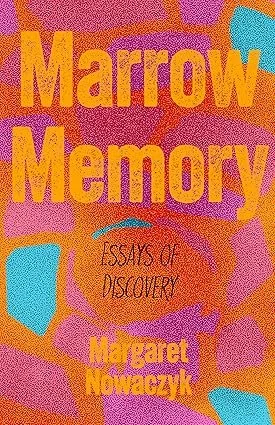
Bring home Marrow Memory: Essays of Discovery (Wolsak & Wynn, 2024).
Q: You’re an advocate of narrative medicine. Would you explain what that is and how—if at all—it shaped your writing of this collection of essays?
A: Narrative medicine trains physicians to be better listeners and diagnosticians. Narrative medicine is not a therapeutic modality; it is not narrative-based therapy with which it is sometimes confused. After training in narrative medicine, by paying close attention to the patient’s story, the text of the patient, so to speak, doctors are better able to determine the cause of illness and the optimal approach to therapy. In addition, narrative medicine has been shown to increase empathy and to prevent physician burnout.
How does that training happen? Narrative medicine recommends close reading of literary texts, writing about patient encounters in non-medical language, and reflective and creative writing. In the essay “Reading Dostoevsky in New York City” in “Marrow Memory”, my collection of essays, I describe the process of close reading; in my memoir “Chasing Zebras”, I wrote how attending a narrative medicine workshop opened my eyes to the power and potential of writing and sharing my stories. Both experiences were paradigm-shifting for me. I have always been an avid reader, but it is the attention paid during the process of close reading that trains one to notice nuances in patient’s behavior, the gaps in her story, the tell-tale signs of illness and distress. By paying attention to those subtle signs, a physician is better able to attend to the patient’s needs, both in terms of diagnosing her condition and of treating it. Writing about a patient encounter in non-medical language (done in what is called “parallel chart”), after the heat and stress of often too-brief a patient encounter, allows the physician to identify the many preconceptions and biases that medical language frequently hides. It is then that the writer has the luxury of time and reflection to do so. This practice fosters empathy. And creative writing, the final pillar of narrative medicine training? It allowed me to express my deepest fears, explore my darkest obsessions, and pay attention to my well-being in the safety of the ever so patient blank page.
Simply, without training in narrative medicine, I would not have become a writer. There would have been no stories, no essays, and no memoir.

MARGARET NOWACZYK (photo credit: Melanie Gordon)
More about Margaret Nowaczyk:
Margaret Nowaczyk was born in Poland in 1964 and emigrated to Canada with her family in 1981, having spent six months as a stateless person in Austria. She finished high school in Toronto in 1982. After receiving a B.Sc. in biochemistry in 1985, she graduated with honours from the University of Toronto Faculty of Medicine in 1990. For six years, she trained in pediatrics and genetics at the Hospital for Sick Children in Toronto, with elective training at Boston Children's Hospital in pediatric neurology and at Hôpital Enfants Malades in Paris, in inborn errors of metabolism. In 1997, she was offered a university faculty position as a clinical geneticist at McMaster Children’s Hospital. Since then, she has been caring for children with genetic disorders and providing prenatal diagnosis and genetic counselling for adults. She has authored 120 peer-reviewed papers in genetic journals, and rose to the rank of professor in 2014. She is a great advocate of the narrative approach to medical care. Her short stories and essays have appeared in Canadian, Polish and American literary magazines and anthologies. She lives in Hamilton, ON, with her husband and two sons.

Who is Blaise Cendrars? A special guest post by translator and author David J. MacKinnon
Like his contemporary Picasso, who also appeared to be locked in mortal combat with the tsunami of modernity, Blaise Cendrars’ kaleidoscopic lives can be viewed through the lens of successive periods, each of which mark Cendrars’ merging of art and life so radically, that the more he revealed, the more he appeared unfathomable, enigmatic and extraordinary.
“Only a soul full of despair can ever attain serenity and, to be in despair, you must have loved a good deal and still love the world.”
—Blaise Cendrars
Like his contemporary Picasso, who also appeared to be locked in mortal combat with the tsunami of modernity, Blaise Cendrars’ kaleidoscopic lives can be viewed through the lens of successive periods, each of which mark Cendrars’ merging of art and life so radically, that the more he revealed, the more he appeared unfathomable, enigmatic and extraordinary.
Cendrars was born Frédéric Sauser to a sickly Anabaptist mother and a failed inventor of a father. By age 15, he is already a runaway, his choice of destination random and his vehicle of choice the train, taking him through Germany, onwards to St Petersburg, Russia, where he works as a jeweller, discovers the Imperial Library, witnesses the Tzars’ Guards shoot into a crowd of demonstrating citizens on Russia’s Bloody Sunday in 1905, and first picks up a pen to compose poetry. He later travels along the Transsiberian route by rail, selling coffins and knives and jewels, finds his way to New York and conjures up his epic poem, “Easter in New York”, that hits the turgid world of French poetry like a hurricane, starting his own review, Les Hommes Nouveaux. In 1911, he publishes “Prose of the Transsiberian”, his epic, Homerian saga of his adventures in Russia on 2 metre pages, illustrated by Sonia Delaunay. When placed end-to-end, the 150 pages are the same height as the Eiffel Tower. The poet vagabond has burst onto the Paris literary scene, like his contemporaries Chagall, Léger, Modigliani, and his old carnie pal, Charlie Chaplin. He develops a technique in his Kodak series of poems, where each poem is a “snapshot”.

Blaise Cendrars.
The poet turns warrior at the outbreak of World War I, and then the inevitable cataclysm, as he is wounded by German machine gunfire, and loses his right arm.
Cendrars elects his strategy of choice – fugue - finding refuge with the tziganes, and peace of mind in the tranquil village of Tremblay-sur-Mauldre, where he is now buried.
In 1918, Cendrars buries his past with “I have killed”, describing his killing of a German soldier, and moves on, as writer and man, ready to mine the vein of the horrors he has endured, and the men he has crossed.
He emerges as Cendrars the novelist, charting adventures and political scandals with the international best-sellers Gold, Rum, Hollywood and Dan Yack. These are tales of adventure, greed and corruption. Moravagine, the tale of a serial killer, is another seismic event, not only a prophecy, but a diatribe against the corruption of culture by psychiatry. Cendrars is moulding a new style, literary reportage, in a hard-boiled version evocative of James Ellroy, writing on Hollywood, Basque people smugglers, the Marseilles mob as an insder who frequented these milieux.
While the Paris literary scene degenerates into movements and sub-movements; Cendrars moves on, takes his literary and physical distance, crosses the ocean to Brazil, becomes one of the prime movers in samba becoming Brazil’s national music.

Blaise Cendrars, 1907.
In the late 1930s, Cendrars crosses another Rubicon, and writes a series of True Tales, commissioned by Paris-soir, where the real life adventurer becomes the first-person narrator of the adventures he is describing. Cendrars the adventurer and Cendrars raconteur are now one and the same.
In 1939, while preparing to sail around the world, war breaks out and Cendrars becomes a war correspondent. When France falls, he resorts once again to fugue. There is no truth, only action. He disappears to Aix-en-Province behind a wall of self-imposed silence. For three years. Reborn again after the war, retaking his position at his Remington N° 1 Portable at age 56, he produces some of his best work. At its nexus, a story of his life and times as self-portrait, in a spectacular triptych: Bourlinguer (Vagabond), Le Lotissement du Ciel (The celestial subdivision) and the Severed Hand. The prose is torrential, rhythmic, musical, and the energy is driven by atavistic blood and violence.
Adventurer, poet, interpreter of modernity, precursor of Marshall Mcluhan, soul mate of Robert Graves and Erich Maria Remarque, Blaise Cendrars fearlessly sought out the ultimate sense of life beyond appearances, and one forged through action. He frequently expressed an enormous compassion for the suffering of the ordinary man.

Cendrars.
Blaise Cendrars died on January 21, 1961. Yet another fugue. And, behind him, as with the great Chinese ascetics, his personal thoughts are unknown to us, only his aphorisms and his koan-like observations, dropped like a thousand petals in late Spring. A man whose imagination and lust for the world could not be quenched, an ascetic whose message is contained in the following words:
“Only a soul full of despair can ever attain serenity and, to be in despair, you must have loved a good deal and still love the world.”
—by David J. MacKinnon
About David J. MacKinnon:
From the day when he discovered Moravagine, the great Cendrarsian saga of madness, escape, revolution and the perils of psychiatry, David J. MacKinnon has ceaselessly tracked the paths of the man reborn out of his own ashes, from the Batignolles cemetery nearby Pigalle, to China, to Kerliou Brittany to Tremblay-sur-Mauldre and the alleyways of Aix-en-Provence. He translated a series of Cendrars’ radio interviews in Blaise Cendrars Speaks, and once attempted to send the vagabond-poet’s ashes inside an eel to the Sargasso Sea from a Loire estuary. MacKinnon now spends his waking hours decoding Cendrarsian hieroglyphics and messages within his 15-volume collected works and plotting potential uses of sargassum in the world that is yet to come.
David’s newest translation of Cendrars’ work, A Dangerous Life – Sewermen, Bank Robbers & the Revelations of the Prince of Fire: True Tales from the Life and Times of Blaise Cendrars, The World’s Greatest Vagabond, is forthcoming with Guernica Editions on November 1, 2024.

A Dangerous Life – Sewermen, Bank Robbers & the Revelations of the Prince of Fire: True Tales from the Life and Times of Blaise Cendrars, The World’s Greatest Vagabond by Blaise Cendrars, translated by David J. MacKinnon.
This essay series features seven Cendrars works, The Sewerman of London: a tale of a secret passage leading to the Bank of England, gleaned from a fellow legionnaire while trapped in the trenches of the Great War; River of Blood (J’ai saigné), the first-hand narrative of the killing fields of Champagne, and the day in 1916 he lost his writing hand to a German machine-gunner; Fébronio—Cendrars’ chilling and compelling interview with Brazil’s most infamous serial voodoo killer; The Diamond Circle: the tale of the discovery of a diamond with a curse; Hip-flask of blood (Bidon de sang): translation by Cendrars of an unpublished spaghetti-western novel by the bank robber lawyer Al Jennings; Le Saint Inconnu (The Anonymous Saint); Anecdotique: On Saint-Exupéry.
Translator David J. MacKinnon has brought Cendrars’ to brilliant life for English-speaking audiences, immersing readers in Cendrars’ attention to the forgotten of the world—of those who are not necessarily impoverished, but off the beaten track.

Two Years In: What I’ve Learned as a Reviewer on Bookstagram
When I set out to start a book-focused account on Instagram two-and-a-half years ago, I hadn’t even heard the term Bookstagram. But when I retired from my busy professional life and rediscovered my love of reading, the idea of a book-focused social media venture took hold and wouldn’t let me go. I wanted to share my passion for all things books with others, so I made my first ever Instagram account, and I haven’t looked back.
Two Years In: What I’ve Learned as a Reviewer on Bookstagram
By: TrishTalksBooks
When I set out to start a book-focused account on Instagram two-and-a-half years ago, I hadn’t even heard the term Bookstagram. But when I retired from my busy professional life and rediscovered my love of reading, the idea of a book-focused social media venture took hold and wouldn’t let me go. I wanted to share my passion for all things books with others, so I made my first ever Instagram account, and I haven’t looked back.
I’ve since found a wonderful community of like-minded readers on Bookstagram, the book-focused corner of Instagram where avid readers, writers and reviewers meet to discuss all things literary and exchange bookish content.
If you’re considering a Bookstagram account, a good starting point is to identify your goals. Each of us is different. Maybe you’d like to read a couple of books per month, photograph them, and write a brief caption so that you can remember them. Perhaps you only read classics, or cosy mysteries, and want to design your page that way. That’s the magic: you can make your Bookstagram page your very own.
As a Bookstagram neophyte, I knew that I wanted to read and review each book that I read. I had no idea what I was doing, but I dove right in! It’s been fun but there was a steep learning curve. If, like me, you’d decided to try your hand at reviewing books on Bookstagram, I’ve discovered some tricks and tips along the way.
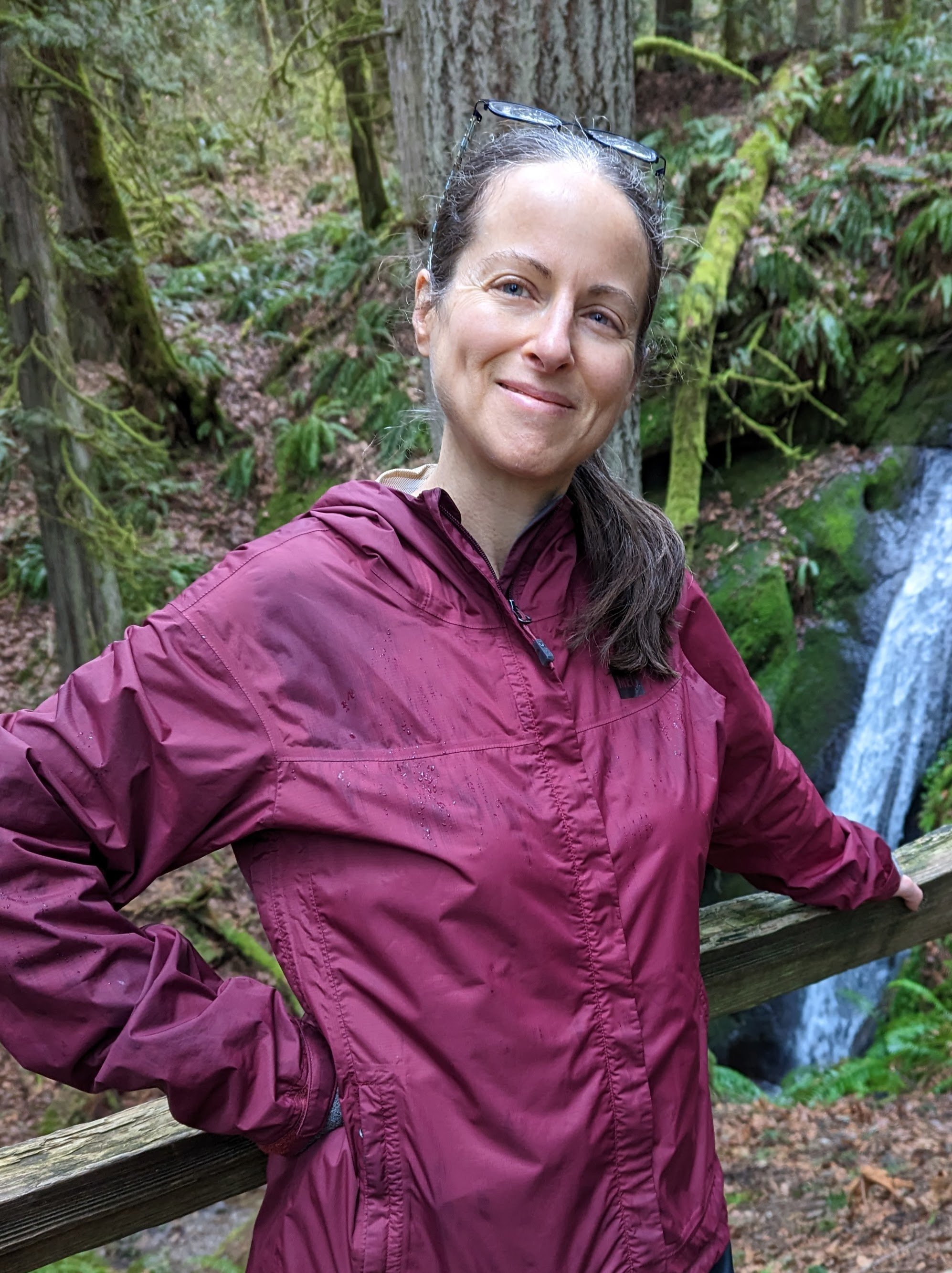
TrishTalksBooks!
Starting and Growing Your Account
My first challenge in starting a Bookstagram account was to create an online identity that would define and encapsulate my vision. I soon realised this was more difficult than it sounds. It forces you to think hard about how you can showcase your literary life by choosing a handle and image that is easily identifiable, and using a tagline that captures your vision.
For example, I tossed around several ideas for a good Instagram handle, testing them out on friends and family members. I learned how to design a basic graphic on Canva for my icon, using my moniker, and selecting colours and fonts. It was worth taking time for this because I use it across several platforms like Goodreads, The Storygraph and X. I came up with a tagline, typed a few words about myself and activated my Instagram account. Done!
With zero followers. Hm.
After I got all of my family and close friends to follow me, I had about 10 followers. Double digits!
It turns out that there are lots of ways to grow your followers on IG. I discovered the world of follow trains (where a group of Instgrammers mutually follow each other) and engagement groups (where a group of you commit to liking and commenting on each others’ posts). I flirted with both of these strategies, and you can too, but ultimately I decided against them. They can increase your followers, but generally lead to a decrease in meaningful interaction on your page.
I have found that the best way to grow my followers is through genuine interaction with other Bookstagram accounts. I try to put out great content regularly. I post a review several times a week, with daily stories about my bookish adventures. As a reviewer, I make sure to post about all of the books that I receive in the mail, and highlight them again on their publication day if I have received them in advance. I follow other Bookstagram accounts whose taste in reading overlaps somewhat with mine and I try to scroll through them daily, liking and commenting on their content.
It’s like anything in life: you get back what you give, and this has led to amazing and genuine interactions on Bookstagram. My account may have grown more slowly than many, but I value every follower, and every account that I follow.
As to the number of followers? It does matter, to an extent. It will depend on your goals.
One of my goals is to share my love of books and my reviews with others. To do this, having a dedicated group of followers, and following accounts in turn, is vital. It's genuinely amazing when people read and comment on what you write or pick up a book you’ve suggested. Interacting with authors has been a huge bonus.
I also like to access books before publication so that I can read and share my thoughts in a timely way on my page. You may think you need to have thousands of followers for this type of access. Not so! By the time I had about 500 followers, I was able to join publishers’ influencer programs and request books from publishers that I wanted to read and review, with decent success.
Find Your Book Reviewing Niche
I’m an eclectic reader. I’ll read almost anything, but I’m happy to report that Bookstagram has broadened even my reading horizons. I’ve always been partial to horror and literary fiction, but the world of book reviewing has spurred me to take up genres that I’d left neglected for years, like poetry and graphic novels.
Many Bookstagrammers dedicate their pages to reviewing horror, or romance or even centre their reviews around literary prize winners. Go with what brings you joy! I read and review anything that takes my fancy, from pulp fiction to literary prize-winners, but I’ve discovered that it helps to identify a couple of overarching goals to shape your review page.
These are some areas that are always front of mind for me:
Canadian literature
It’s always satisfying for me to highlight Canadian publishers and authors and the amazing books that they produce. I’ve learned so much about my own country, and championing both new releases and Canadian backlist books has become a constant on my Bookstagram page.
Small Presses
An independent publisher (small press) is a traditional publisher, but one that publishes independently of a large corporate entity, so they’re apt to pursue works that don’t fit with a conventional publishing house.
Self-Published Writers
Some authors forgo a publisher and self-publish. Discovering a hidden hem by a writer who’s flown under the radar is bookish magic.
Genres outside my usual comfort zone
I hadn’t read poetry for years, but I’m loving it for Bookstagram. I find it takes a different skill-set to review poetry. Reviewing outside of my comfort zone is refreshing and keeps me growing as a reviewer. Your focus may be different, but consider what challenges you.
Beware of the Overwhelm (Or, there are SO MANY BOOKS!)
When I started my BG account in January 2022, one of my goals was to get one free book. That’s it. I thought that would be the be all and end all of my book hobby. I would have arrived.
Within the first year, without trying, I had about a dozen books sent from authors and publishers who’d reached out to me and offered books for review. I signed up for a couple of mainstream publishers’ “influencer” programs, then got on lists to request books from some wonderful book publicity firms that send out books for review. Not to mention Netgalley, which is a platform for industry professionals and influencers to request Advanced Reading Copies (ARCs) of books.
Now, I am drowning in books. I love it, but it can be a lot. I commit to reading and reviewing every gifted book that I receive.
Of course, I also read the library books that I’ve put on hold, books from my neighbourhood’s Little Free Libraries, and any books that I’ve bought, so there is a balance to be struck between these books and gifted ones.
It can get entirely overwhelming. I’d recommend learning to be selective when it comes to gifted books. It’s nice to receive free books, but don’t forget that you need to read them all too! After reading myself out of a literary hole created by overenthusiasm, I’m now much better at saying no.
The Art of the Negative Review
There’s nothing more satisfying than posting a glowing review of a book you loved. As a reviewer, though, I sometimes read books that I don’t love and am faced with writing a negative review.
Sometimes I catch myself thinking, Who am I to criticise any author’s work? Especially in a public forum. My answer? We’re the readers! Like any piece of art, an author publishes their best work and then it is open to discussion. The beauty of a book is that it will resonate with different readers in wholly different ways, and that’s what makes sharing our literary views with each other valuable and interesting.
There are different ways to approach the negative book review on Bookstagram. One option is to post only the books you enjoy and forgo the negative review: it’s your page to curate the way that you like. However, if you’re like me and want to post on each book with honest takes, it pays to be thoughtful about criticism.
An honest review is important, even if it is negative. Having a range of reviews gives your followers a more accurate picture of your literary taste, and builds trust. In turn, I appreciate a thoughtful negative review from the reviewers I follow and trust, to guide my own reading
I’m still learning the art of the negative review, but here are some things I consider carefully:
Compare apples to apples
It seems basic, but I’ve found it valuable to rate a book as compared to its peers. A rom-com isn’t the same as a literary fiction prize winner, and it needn't be. It also shouldn’t be held to the same metrics. I’ll give a rave review to a rom-com that punches above its weight in its genre, and pan a prize-winner if it’s not up to that standard.
What did the book do well?
Maybe it's just me, but I do like to find the good in each book. Even if I didn’t like it overall, most every book has some redeeming qualities. I believe most authors have given us their all, so I want to find the best bits and highlight them. I see it as fair play, even if I give a negative review on balance.
Even if the book wasn’t to my taste, did the book accomplish its goals?
If a book doesn’t move me and I’m inclined to review it negatively, I ask myself if the book was true to its goals. Sometimes I just don’t connect with a book’s theme or characters but I realise that I’m not the target audience, or perhaps I was not in the mood for that book at that time. To me, it's perfectly fine to say that the book didn’t resonate with me, then speculate why this might have been so.
And if all else fails…
Usually, if a book is just terrible–genuinely poor writing, incoherent plot, ideas, or values that I object to–I decide not to finish the book and don’t review it. If I do persist, I’ll call it as I see it and write the negative review, but I’ve decided that I need to keep it civil and respectful. This can be hard to do on social media at times, but I’ve given a couple of slightly snarky reviews, and will try not to do it again.
Beyond the Bookstagram Review
Of course, there’s more to the life of a Bookstagrammer than reviewing. I had no idea that I’d have so many opportunities to try new things and meet new bookish friends. I’ve learned that I benefit from not only posting reviews, but also engaging socially on Bookstagram.
I've joined–and even hosted!–buddy reads and readalongs. Buddy reading is an opportunity for two to four people to read a book together and discuss in a DM group as they go. A readalong is similar, with a larger group of participants chatting as they read a book. I was shy at first, but there’s no need to be. This is a fun way to get to know other readers. And then you can all review the book together.
I also enjoy a good Bookstagram challenge. Reading challenges are true motivators, and there’s a challenge for everyone. Reading a short story a day for a year? Reading poetry all month? Reading literature in translation? There are challenges for that!
And for something truly beyond Bookstagram, I decided to start my own book blog. Sometimes a book simply begs for a longer, more in-depth review and the reality of a Bookstagram caption is its 2200 character limit. That hard limit has given me excellent editing skills, but I started my blog so that I could write longer pieces. My blog significantly enhances my Bookstagram reviews and vice versa; they’re highly inter-related and I’d suggest looking into this as you become a more experienced reviewer.
It’s been a great two years with Bookstagram and there’s no looking back! I’ve made friends and discovered new authors. I’ve revisited genres that I’d put aside for years, like poetry and graphic novels. I’m also reading more intentionally because I know I’m going to be writing about the book, which has deepened my appreciation for the text. Reviewing books is an art anyone can develop, and Bookstagram provides a great platform to try it out. Happy reading and reviewing!
Trish Bowering lives in Vancouver, where she is immersed in reading, writing and vegetable gardening. She has an undergraduate degree in Psychology from the University of Victoria, and obtained her M.D. from the University of British Columbia. Now retired from her medical practice, she focuses on her love of all things literary. She blogs at TrishTalksBooks.com and reviews on Instagram @trishtalksbooks.

Power Q & A with Emily De Angelis
Coming in at the perfect time for your summer reading list, The Stones of Burren Bay by Emily De Angelis, published by Latitude 46, is a moving, heartfelt, and fast-paced YA novel set on Manitoulin Island that combines magical realism, Irish Celtic spiritualism, and the core themes of YA fiction to which readers are drawn: the need to belong, self-discovery, and overcoming obstacles.
Coming in at the perfect time for your summer reading list, The Stones of Burren Bay by Emily De Angelis, published by Latitude 46, is a moving, heartfelt, and fast-paced YA novel set on Manitoulin Island that combines magical realism, Irish Celtic spiritualism, and the core themes of YA fiction to which readers are drawn: the need to belong, self-discovery, and overcoming obstacles.
The story begins with a tragic accident that kills Norie’s father and leaves her mother injured and emotionally fragile, after which Norie vows never to draw again. With the help of a mother/daughter duo in Burren Bay and the spiritual world that’s more easily accessed in such a hallowed place, Norie and her mother rebuild their relationship and Norie learns to deal with her grief and guilt through the power of art.
The fictional place of Burren Bay feels like one of the most powerful characters in this beautiful book, so in this Power Q & A, we had to ask Emily about how and why she chose to set her story here.
Welcome, Emily!

Bring home The Stones of Burren Bay by Emily De Angelis.
Q: Place itself is a character in your novel—a character that changes and develops like any compelling character. Would you tell us about how Burren Bay came to you, and why it was the place this story needed to be told?
A: The Stones of Burren Bay is set on beautiful Manitoulin Island, the world’s largest freshwater island situated on the Canadian side of Lake Huron, west of Georgian Bay along the North Channel. Manitoulin Island, often referred to as Spirit Island, has been home to the Anishinaabe people for centuries, long before white settlers arrived. When you’re there, it’s clear that it’s a place steeped in spirit and sacredness. This divine atmosphere makes you take a deep breath and relax into the otherworldliness of the hills, forests and lakes. The deep, restorative mood was definitely the impetus for my story being told from this place. This is especially true in a world full of social and political dysfunction, global conflict and fear. There is much healing for the protagonist, 15-year-old Norie, to experience. Furthermore, as a magical realism novel, the very nature of the setting lent itself to the thread of Irish Celtic spiritualism woven through the novel. Norie’s spirit guide Oonagh, the ghost of a young immigrant girl from Ireland, moves effortlessly between the contemporary and the past because the veil between the past and present is thin in this hallowed place.
I have been visiting the Island, as it is known to locals, since I was a child and have had the opportunity to explore its many nooks and crannies. Originally The Stones of Burren Bay was set in a real location, but over time I realized that a real place in such a small community had its pitfalls. I needed characters to be in locations that were impossible to get to easily and in a timely manner, especially since my protagonist is a young teenager. Real places have real people too, and I feared that readers would try to find themselves or others in the story, even when assured that none of the characters were actual living people. Finally, any flexibility with known history is out of the question when the setting is a real place. A forest fire that took place in 1910 in a real location cannot magically take place in 1892. This is especially true when considering Indigenous history at the beginning of settler occupation on the Island. I wanted to tell a story that reflected rather than retold the historic account. I wanted to be respectful, appropriate and accurate while having the flexibility to tell a fictionalized tale. So the fictional Burren Bay and its bordering First Nation, Rocky Plain, emerged.
As a continuation of the Niagara Escarpment, parts of the Island share similar and somewhat rare exposed limestone surfaces called alvar pavements, characterized by grooves, grikes, and glints cut into the limestone rock by glacial movement and erosion. The Burren, an ecologically sensitive area in County Clare, Ireland, also has these limestone karst formations. Through early drafts and research, I knew rock and stones would figure into the story and the similarities between Manitoulin Island and The Burren solidified my plans. The stone in both places holds memory—geological memory, historical memory, and the memory of the characters. The stone allows for an attachment or a sense of belonging to place and time. The fact that early explorers and surveyors liked to name new places with names from their home countries gave me a link between the past and the present, with Burren Bay on Manitoulin Island as the contemporary fictional setting and The Burren in Ireland as the historic setting.
Like any well-developed character, the landscape in The Stones of Burren Bay seems to change and develop while holding on to its fundamental identity. The use of two timelines and settings gives the impression that the landscape itself has responded to the changes in both the historic record and the human world. Norie and Oonagh are both products of their time and place, but time and place are not static. Burren Bay and the Rocky Plain First Nation feel real and alive because they exist in the spiritual landscape that is Manitoulin Island.

Author Emily De Angelis.
More about Emily De Angelis:
Emily De Angelis comes from a long line of visual artists, musicians and storytellers.
She wrote her first novel when she was 11-years-old on an old manual typewriter with a well-worn ribbon and keys that had to be hammered to get letters and words onto the page.
This first novel was called The Mystery of the Golden Ankh and was not unlike the many Nancy Drew novels she read.
Prior to a long career as a teacher in Sudbury, Ontario, where she was born and raised, Emily was a Children/YA Librarian with both the City of York and the City of Toronto.
She has spent many years developing her writing through independent study, workshops, conferences and courses.
An active member of the literary community, Emily has had western-style poems as well as short stories published in various anthologies. She has also won or placed in the top three of four short story contests.
Emily wrote and performed original tales as storyteller Madame Garbanzo in daycares, schools and library.
She served as the President of the Sudbury Writers’ Guild 1998–2000, and recently served as Treasurer as well as Facilitator of the Guild’s Children/Young Adult Inner Circle.
Emily has recently completed a magical realism YA manuscript entitled The Stones of Burren Bay, which has been accepted for publication by Latitude 46 Publishing. The story follows the protagonist Nori on her journey through grief and healing. This novel will be coming out some time in 2024.
Her current YA project, entitled For the Sake of Mercy, is also a magical realism story exploring forgiveness in the face of unspeakable tragedy.
Emily De Angelis is wintering in Woodstock, Ontario, while spending summers on her property on Manitoulin Island.

Power Q & A with Ariel Gordon
The original “fun-gal” of CanLit is back for a Power Q & A. We welcome the exubriant Ariel Gordon to the blog to talk about how she selected the home for her newest book, Fungal: Foraging in the Urban Forest (June 4, 2024).
Both personal and entertaining, Fungal: Foraging in the Urban Forest is the highly anticipated second book of a trilogy and shows Gordon at her best: interweaving the personal with the easily overlooked local and natural and local world around her, and passing on her contagious delight for the world at—and under—our feet.
The original “fun-gal” of CanLit is back for a Power Q & A. We welcome the exubriant Ariel Gordon to the blog to talk about how she selected the home for her newest book, Fungal: Foraging in the Urban Forest (June 4, 2024).
Both personal and entertaining, Fungal: Foraging in the Urban Forest is the highly anticipated second book of a trilogy and shows Gordon at her best: interweaving the personal with the easily overlooked local and natural and local world around her, and passing on her contagious delight for the world at—and under—our feet.
In a diverse range of essays, Gordon showcases her background in biology, taking us deep into the fungal world, exploring mushrooms both edible and not, found and foraged, and the myriad ways in which mushrooms and trees make up our ecosystem and are in fact a reflection of the way we build our own personal communities and connections.
This collection of essays will resonate with anyone who’s ever thought, “can I eat that?” when seeing a mushroom, but also those with larger questions about our place in the natural world.

Fungal: Foraging in the Urban Forest by Ariel Gordon.
Q: Tell us about working with Wolsak & Wynn. What made you want to publish with them?
A: After publishing two books of poetry, Wolsak & Wynn’s nature-y non-fiction is what made me want to start writing non-fiction. I loved Jenna Butler’s A Profession of Hope and Daniel Coleman’s Yardwork, how they considered land-use, history, colonialism, and the more-than-human. And suddenly I was writing things that combined all my experience and training: my science and journalism degrees, which taught me curiosity; my experience writing poetry, which was all about compression, about writing beautifully; and the decades I’d spent taking macro photographs of mushrooms and peering at trees.
Part of my interest in being published by W&W in particular was that I knew publisher Noelle Allen edited their non-fiction. I trust Noelle implicitly, which is saying a lot as someone who has worked in publishing a long time AND who is sort of professionally ambivalent, given late-stage capitalism, given climate change. Noelle’s also an excellent publisher and a leader among independent publishers. I would follow her anywhere (with a battered suitcase full of manuscripts neeeeeeeeding a home…).

Author Ariel Gordon.
More about Ariel Gordon:
Ariel Gordon (she/her) is a Winnipeg/Treaty 1 territory-based writer, editor, and enthusiast. She is the ringleader of Writes of Spring, a National Poetry Month project with the Winnipeg International Writers Festival that appears in the Winnipeg Free Press. Gordon’s essay “Red River Mudlark” was 2nd place winner of the 2022 Kloppenberg Hybrid Grain Contest in Grain Magazine and other work appeared recently in FreeFall, Columba Poetry, Canthius, and Canadian Notes & Queries. Gordon's fourth collection of poetry, Siteseeing: Writing nature & climate across the prairies, was written in collaboration with Saskatchewan poet Brenda Schmidt and appeared in fall 2023.

Power Q & A with Joanne Jackson
We’re delighted to host Crime Writers of Canada Award-winning author Joanne Jackson on our blog. Her thrilling new novel, Sunset Lake Resort (Stonehouse Publishing, June 1, 2024), is a captivating narrative full of thrilling twists, exciting reveals, and gorgeously drawn characters. It is inspired in part by Joanne's own life. leaving the city to go to the lake, and her observations about the importance of community, and the cost of technological progress to our peace of mind.
This book is a perfect pick for an exciting and poignant summer read, and on this Power Q & A, we’re asking Joanne about one of our favourite parts of the book: namely, the championing of an older woman as a protagonist.
We’re delighted to host Crime Writers of Canada Award-winning author Joanne Jackson on our blog. Her thrilling new novel, Sunset Lake Resort (Stonehouse Publishing, June 1, 2024), is a captivating narrative full of thrilling twists, exciting reveals, and gorgeously drawn characters. It is inspired in part by Joanne's own life. leaving the city to go to the lake, and her observations about the importance of community, and the cost of technological progress to our peace of mind.
This book is a perfect pick for an exciting and poignant summer read, and on this Power Q & A, we’re asking Joanne about one of our favourite parts of the book: namely, the championing of an older woman as a protagonist.
Welcome, Joanne!

Bring home Sunset Lake Resort by Joanne Jackson.
Q: It’s refreshing to read a book with a protagonist who is an older woman coming into her own; it shows what we feel is an undersold reality. Namely, that we are never truly done growing up. It’s a perspective that pushes back against the ageism hurled at women in particular. Would you tell us about how Ruby came to you as a character, and what you felt was important to convey through her development?
A: Being an older woman myself, who has experienced both sexism and ageism, and who was born into a generation where many women still stayed at home to raise their children, (and were financially able to stay home) I suppose Ruby is part of me. I decided to create her; a woman who, out of no fault of her own, was afraid to make her own way in the world. When independence is thrust upon her, she sees it as the difficult path but one she now has no choice but to navigate, discovering that it’s never too late to live your life.

Joanne Jackson!
More about Joanne Jackson:
Joanne Jackson is an award-winning author of three novels. Her most recent, A Snake in the Raspberry Patch, was the winner of Best Crime Novel set in Canada for 2023, and short-listed for Saskatchewan Book Awards 2023. Her first novel, The Wheaton, was released in 2019. Joanne lives in Saskatoon with her husband, Tom, and an old border collie named Mick. If you keep your eyes peeled you will see Joanne and her dog walking come rain, shine, snow, or whatever weather Saskatchewan throws at them.

Excerpt: Dancing in the River by George Lee
May is Asian Heritage Month and we are honoured to be sharing an excerpt from the award-winning novel, Dancing in the River (Guernica Editions) by Vancouver lawyer and author George Lee.
Dancing in the River, won the Guernica Prize, and draws on Lee’s own life experiences growing up in China. It tells the coming-of-age story of a young boy during Mao’s Cultural Revolution—a boy named Little Bright living in a small, riverside town who is heavily indoctrinated by the anti-Western sentiment of the time and place. The perspectives afforded in this stunning novel—the insights into culture, politics, and personal experience—are crucial to a national and global understanding of Chinese history.
May is Asian Heritage Month and we are honoured to be sharing an excerpt from the award-winning novel, Dancing in the River (Guernica Editions) by Vancouver lawyer and author George Lee.
Dancing in the River, won the Guernica Prize, and draws on Lee’s own life experiences growing up in China. It tells the coming-of-age story of a young boy during Mao’s Cultural Revolution—a boy named Little Bright living in a small, riverside town who is heavily indoctrinated by the anti-Western sentiment of the time and place. The perspectives afforded in this stunning novel—the insights into culture, politics, and personal experience—are crucial to a national and global understanding of Chinese history.
George Lee was born and raised in China. He earned an M.A. in English literature from University of Calgary, and a Juris Doctor degree from University of Victoria. Dancing in the River, won the 2021 Guernica Prize for Literary Fiction. He practices law in Vancouver, Canada.
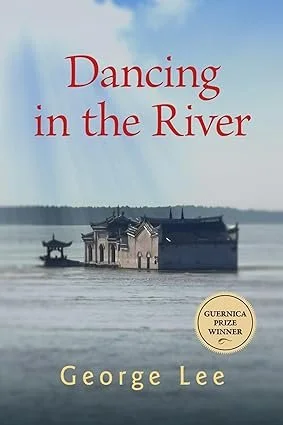
Dancing in the River by George Lee (Guernica Editions).
Prologue
“What’s the best early training for a writer?” a young writer once asked Ernest Hemingway.
“An unhappy childhood,” Hemingway famously replied.
I grew up in a mountain village on the Yangtze River in China. For a long time, I had been pondering whether to pen the story of my early life as a coming-of-age tale like David Copperfield.
Before long, though, I discovered that I’m no Charles Dickens. As I recall, my writing journey began on my third birthday when I was given a fountain pen, which I’ve kept to this day. After a pair of tiny hands gingerly uncapped the pen, I tried, for the first time in my life, to draw an “I” (我), which, however, looked like a “search” (找). Seeing my error, my father added the last stroke on the top of the latter character to make “me” complete. To my young eyes, the two Chinese words looked identical. (Chinese characters are very complicated, as are Chinese minds.)
Late at night, in our home in Canada, I would imagine that I— now very old—was reading my own novel to my grandchildren lying beside me on the comfy couch, mentally rehearsing this dialogue:
“Is this a true story, Grandpa?” A pair of young, curious eyes fixed on mine.
“Surely it is,” I replied, looking down at him from above my reading glasses.
“Is the Yangtze a long river?”
“Yes, it’s very, very long. That’s why it’s also called the Long River.”
“Are you the boy in the novel, Grandpa?”
I paused for a moment, unsure how to reply. “Sort of. But he’s like every other boy in China in those days.”
From time to time I felt called to write about my early life through the lens of my blended cultural sensibilities. At one point I even attempted to write the book in my mother tongue; however, my tongue refused to agree with my thoughts. I was stunned when words failed to flow out, as if clogged in the underwater channel.
For some reason my audacious goal was stalled for many years. I invented alibis, as many of us do when facing confession of a task too challenging. However, every day I devoted time to mental con- struction of the plot. By this time, I had learned that a plot is dif- ferent from a story. For me, a plot is synchronicity, karma, fate.
Looking back, I realized my life stories had unfolded themselves, not from the outside, but from the inside. No coincidences in life. For me, this is a multi-dimensional book.
In it, I am both the author and reader, the experiencer and the experienced, the thinker and watcher, the dreamer and the dream, the father and the son. Most importantly, between the two ends of the spectrum, I am a silent witness as well. To that end, the characters in this book walked into my life both literally and symbolically. Some of them represent the unfathomable depth of reality. My grand- mother is such a character; so are some of my childhood friends.
This book carries an allegorical burden: to unearth the truth about the mystery of life and of myself. My journey began at the river, travelling from body to mind, then to soul, from learning to becoming, from the visible to the invisible.
Over the years, in the deep corners of my mind I kept hearing the waves of the river crashing against every cell of my inner being until, one day, I could no longer ignore them when my mind was thrown into a swirl of great tides as the memories flooded back.
To my surprise, I discovered that my memory is like a multi- layered onion. As I peeled it layer after layer, tears welled up at the hurts deeply buried in the corners. But soon after I embarked on this journey, the healing process had also begun.
Most of the events in this book occurred in my early life. My memory knows what I have remembered, and it agrees with me.
As green as I was about the world, I stood, still and alone, on the edge of the river, observing myself with a young, distanced eye, listening to the solemn whisper of the waves, attempting to catch a glimpse of light hidden behind the clotted clouds. The sentences rattled in my brain and banged on the door of my heart. Finally, the pages opened in the wind and carried this tale far and wide.
As I was writing this book, I felt as though a mighty hand was guiding my thoughts and my pen. The mind is like a river flowing through human consciousness into a deep ocean. Upon entering the depth of my soul, I found a stream as it trickled down toward a long river. And when I waded into the river, currents of dreams and emotions flooded wordlessly through my consciousness.
I use English words to bridge the gap.