
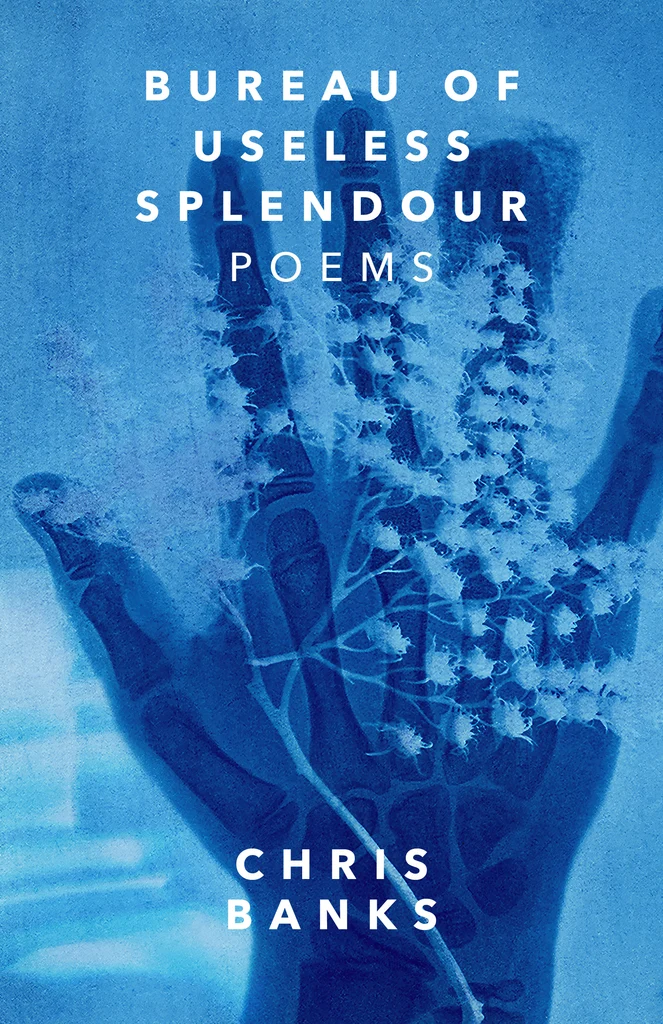
Title: Bureau of Useless Splendour
Author: Chris Banks
Publisher ECW Press
Genre: Poetry
Reviewer: Micheline Maylor
Chris Banks, Bureau of Useless Splendour, is based on the Centre for Useless Splendour, a part of the Post-Graduate Research Hub, an online collaborative research space. Banks himself describes the poems in the book as “a repository for both high and low culture. The Hub describes itself as, “a set of relationships and dialogues between creative and intellectual enquiries organised as imaginary rooms.” (danhayes.org).
Of course, the poem as little room, or “little song” is centuries old, as in the word sonnet. Stanza is Italian for “room” and meant to be the small chamber within the larger house of the poem. Banks likes large rooms, unbroken poems frequently unbothered by interrupting stanza breaks. He like long poems that leave room for a shoving the furniture of words to the side, so that the dancefloor of his mind might have space to groove.
The opening of the book immediately parallels the narrator with Prospero, the learned magician who commands the elements. Prospero’s Island is a kind of useless splendour, one of illusion, masque, music, and one where Shakespeare said goodbye to the stage, threw his books away and retired to the countryside. Banks’ narrator parallels thus:
All that remains is an old man in rumpled
robes. Maybe the ashes of a family phone
number. I take off my glasses. Flirt with
throwing my books into the sea. Sometimes . . . “
Even the footloose five-foot lines do a dance in this room, mimicking the Bard, himself. Ironically, Banks’ self-aware narrator decries in the last lines, “No matter / how many books, books are not enough.”
Now, if an opening poem is meant to teach a reader how to read the collection to follow, here we have a potential Swan Song framed by the hanging question, “what is enough? and why read this book if it can’t be enough?”
Harold Bloom would answer, “place Shakespeare at the centre of your reading, prepare for your own mortality, and wisdom comes from contemplating change, loss, and death.” Banks is a master practitioner of marrying the sacred and the profane. In “What Can Be Said of Space and Time,” he quotes the best minds of the twentieth century, Herman Minkowski, and Albert Einstein on a backdrop of Flamin’ Hot Doritos, as snacky-little-asteroids while contemplating creativity. “Gravity is / a distortion of spacetime, but so is writing a poem / that condenses the world to a nutshell, a grape, over / eight billion humans coexisting on the head of a pin.” The narrator is agog with wonder and awe at the expanse of it all. “I touch my stardust head, feeling for my skull underneath: / infinity thinks through me, my feet planted firmly on Earth.” Contrasts are everywhere and our rumpled tour guide carries on with the ink-stained continuum.
“Fortune Cookie’s Fool” is a call-and-response, wisdom or bullshit, couplet-a-ganza. Some of my favourites include:
2. Every love letter received is the soul’s pardon for
letting the head gaslight the heart’s small wants.
22. No matter how much you waste of it, Time accumulates.
25. Full disclosure: hot-air balloons flying above the city’s suburbs
remind us we live in an age of wonder and indifference.
Banks has a way with opening lines. As with time, as mentioned above, they accumulate with startling regularity and efficient wisdom of a self-reflective soul (almost evoking the ghost of Steven Heighton). It’s a kind of existential commentary that keeps me wanting to raise my glass and toast to the elemental knowingness at hand. Each of these is a platform for Banks’ masterful leaping lines and images.
“Today, I am steering myself into fresh agonies.”
“Except different. I mean we are 99% identical / to white supremacists, SJWs, and Bonobo apes.”
“My official title is emeritus of the imagination.”
“A fake restaurant climbs to number one online. / Can I impeach this era? Metaphysics is my side hustle:”
The collection has an occasional lapse into personalized nostalgia and navel gazing that can become slightly indulgent. “Shoegaze” is not everyone’s cuppa. Specifically, “Frontier Psychiatrist” has specific moments only attuned to the narrator’s specific experience, and there’s an abundance of mentions of historic relics of the recent past that leave me wanting to return to the more universal wisdoms of previous works. With this particular poem, I felt like I walked into a private conversation and sitting awkwardly as a third wheel waiting for it to finish while staring blandly at something else pretending not to listen to the details.
Throughout, the poetic cannon has many walk-on cameos that delight. I spy Walt Whitman, Emily Dickinson, Gwendolyn MacEwan, Ezra Pound. And Banks’ quotable lines ubiquitous. A narrative control over flirtations between realism and surrealism is maintained, and they are, as a mini-series, dramatic and engaging. Existential questions are asked and explored in both meta reflections and expansive contemplations.
The entirety of the collection has a sort of Hieronymus Bosch pleasure/hell pastiche, coupled with a grappling for significance in a ridiculous world of wonder and trashy projections of reality. Wisdom, delight, and repulsion are pervasive in this enjoyable and re-readable collection where the books of Prospero are not tossed into the sea but rather become food for restless reflections slick with wisdom.
“I have been told not
to lick hardbound books in used
bookstores, the kind with gold gilt
lettering, because they poison people
more quickly than living in a cold,
sterile, heartless house.”
Chris Banks is a Pushcart-nominated Canadian poet with eight collections of poems. He has won two national awards, and his poems have appeared across Canada and the United States. Banks runs The Woodlot, a Canadian poetry reviews and essays website. He lives and writes in Kitchener, ON.
Dr. Micheline Maylor is a Poet Laureate Emerita of Calgary (2016-18). She was awarded the Queen’s Platinum Jubilee Award for literary contributions to Alberta in 2022. She is a Walrus talker, a TEDX talker, and she a past Calgary Public Library Author in Residence (2016). Her most recent book is The Bad Wife (U of A Press 2021) won the BPAA Robert Kroetsch Award for best book of Alberta poetry. She was short-listed for the Exile Robert Kroetsch award for experimental poetry. She won the Lois Hole Award for Editorial excellence for poetry in Alberta (2019). Her poems have recently been translated into Farsi, Chinese, and Italian.