
Power Q & A with Anna Veprinska
Q: What is the origin story of the forthcoming poetry collection,Wound Archive?
A: Although a collection of minimalist poems (or one long poem composed of minimalist fragments), Wound Archive has a lengthy origin story. In 2016-2017, I was a Fellow at the Mandel Center for Advanced Holocaust Studies at the Holocaust Memorial Museum in Washington, D.C. I was researching instances of Holocaust survivors reading poems as part of their testimonies and was deeply invested in exploring the place poetry held in survivor testimony. Day in and day out, I was immersed in painful, shattering histories. In the background was also the painful personal history I was living. I had been recently diagnosed with an invisible chronic illness, which had also coincided with the ending of a long-term relationship. Both my academic and personal life were steeped in grief. And I found myself – perhaps unsurprisingly, as writing had always served this role in my life – turning to my own poetry as refuge, as processing, as survival. I began writing one poetic fragment a day.
The collection that emerged by the end of the Fellowship was first titled Light (as in a flashlight in the dark), then A Little Dust (as in W.B. Yeats’s, “Everything exists, everything is true, and the earth is only a little dust under our feet”). At that time, all the poem-fragments were tercets, nods to the haiku form, though they were not exactly that either.
For the next seven years, I prodded and poked at the manuscript. During this period, I sent it out to a few publishers, and it came close to publication, but it wasn’t quite ready. Finally, I saw that Gordon Hill Press / The Porcupine’s Quill had a call for poets with invisible disabilities, and that felt like the right place for the manuscript – a work not only about invisible illness but also one concerned with the blank spaces of the page, with, as one poetic fragment explains, “what language cannot do.” So, in spring of 2024, I overhauled the entire manuscript, focusing especially on form, on the ways in which each fragment needed to stretch into its own structure, not into a preformed mold. The manuscript also came into its current title, an archive of the emotional and physical wounds it documents. And I submitted Wound Archive to Gordon Hill Press / The Porcupine’s Quill. Five days later, it was accepted for publication: both the briefest and lengthiest journey to publishing a book I have had to date. I am grateful to everyone at Gordon Hill Press / The Porcupine’s Quill, especially Jeremy Luke Hill and Shane Neilson, for publishing this work.
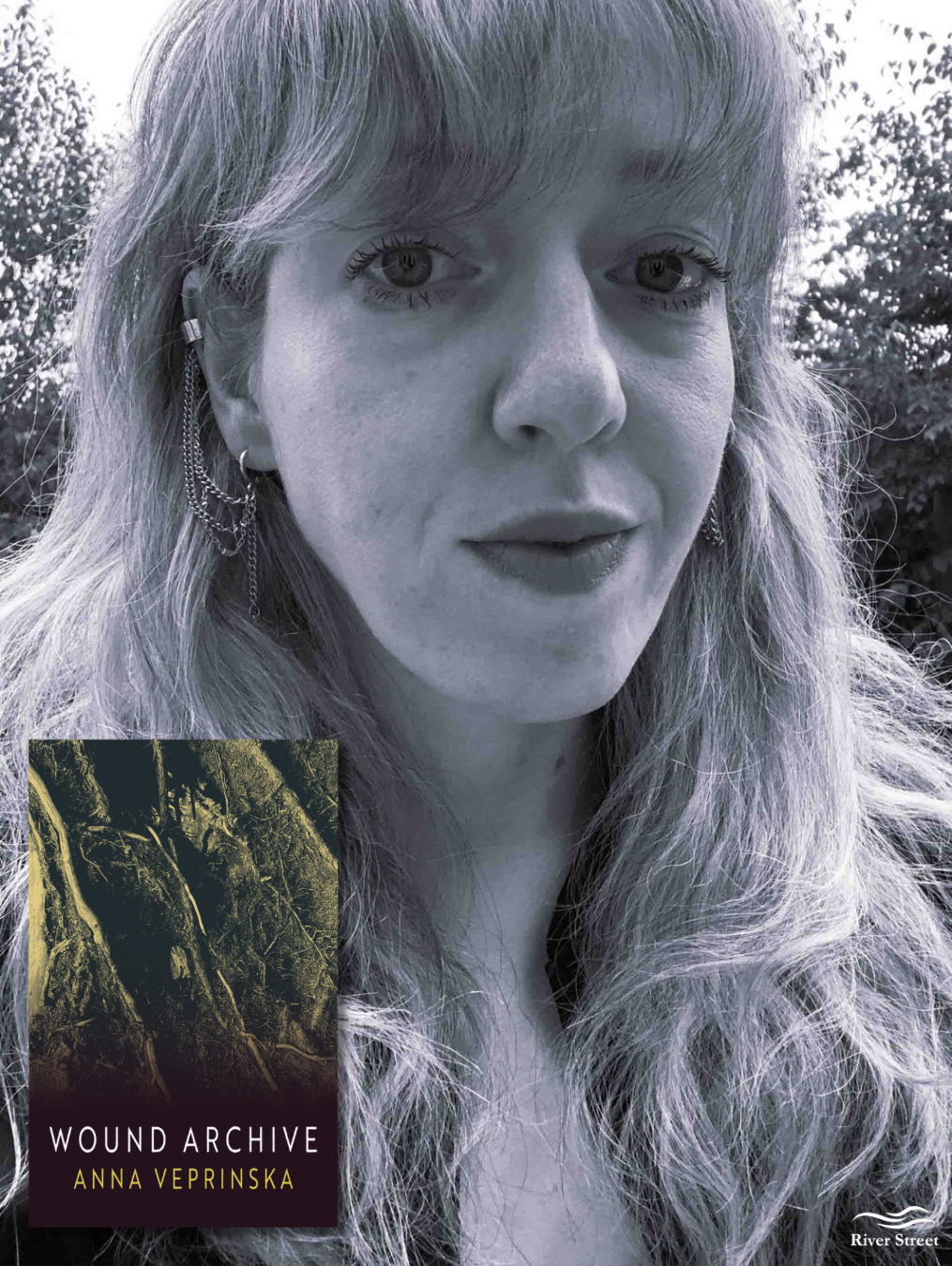
Wound Archive is a collection of minimalist poems that archives the wound left by the concurrent ending of a relationship and the beginning of a chronic invisible illness. These poems comprise a fragmented archive in which woundedness turns language—figuratively and at times formally—upside down. The symbol of the wound recurs throughout, punctuating the ways both heartbreak and illness are experienced in the body. While these poems are often rooted in the body— mouths, tongues, legs—they also employ the corporeal to reach for the incorporeal—god, ghosts, healing. This tender text articulates the capacity of brevity to hold the expansiveness of ache.
Anna Veprinska has published three collections of poetry, Wound Archive (The Porcupine’s Quill, 2026), Bonememory (University of Calgary Press, 2025), and Sew with Butterflies (Steel Bananas, 2014). She is also the author of the monograph Empathy in Contemporary Poetry after Crisis, which received Honourable Mention in the Memory Studies Association First Book Award. She has been a two-time finalist for the Ralph Gustafson Poetry Contest, has been twice shortlisted for the Austin Clarke Prize in Literary Excellence, and won the Chinook Poetry Contest. She is an Assistant Professor in the Department of English at the University of Calgary.