
Q: What does it mean to lose a mother tongue—and to write your way back to it?
A: This is precisely the question I explore in Descântec For My Split Tongue (Palimpsest Press, 2026). When I moved to Edmonton, Canada from Jilava, Romania in elementary school, I felt so much pressure to assimilate that within a few years, I almost completely lost the capacity to express myself in my mother tongue. Since then, I’ve felt this desperate dor, or longing, for limba română. Writing these bilingual poems has helped me reclaim my Romanian. When we lose a language, we don’t just lose words, but also their embedded wisdom—ways to marvel, grieve, heal, pray, curse, banter, remember. Throughout the book, I try to translate “untranslatable” Romanian words and proverbs. For example, the first poem in the manuscript is centred on the word “hărnicie,” which offers a different way to conceive work beyond capitalist/colonial modes that glorify being hyperproductive, grinding, burning out, and exploiting ourselves and the planet. Instead, hărnicie is about working with joyful rigour on our craft, proudly resting, and making things with our whole bodies. The Romanian proverb, hărnicia întrece arta, meaning “hărnicie surpasses even art,” conjures a daily ritual of creating and working unobserved, without having to prove or perform. Hărnicie is relevant to any important work, such as well-being, teaching, allyship, anti-oppression work, writing, organizing—or being a good friend, family member, neighbour, and citizen. Like other words in this collection, hărnicie informs who I am and why I feel called to do the work I do in education, poetry, academia, and community arts organizations. Each Romanian word is like a compressed zip file, and writing these poems has been liberating because it has opened up endless ways to fail and succeed at translating the “untranslatable,” while stretching the limits of both English and Romanian.
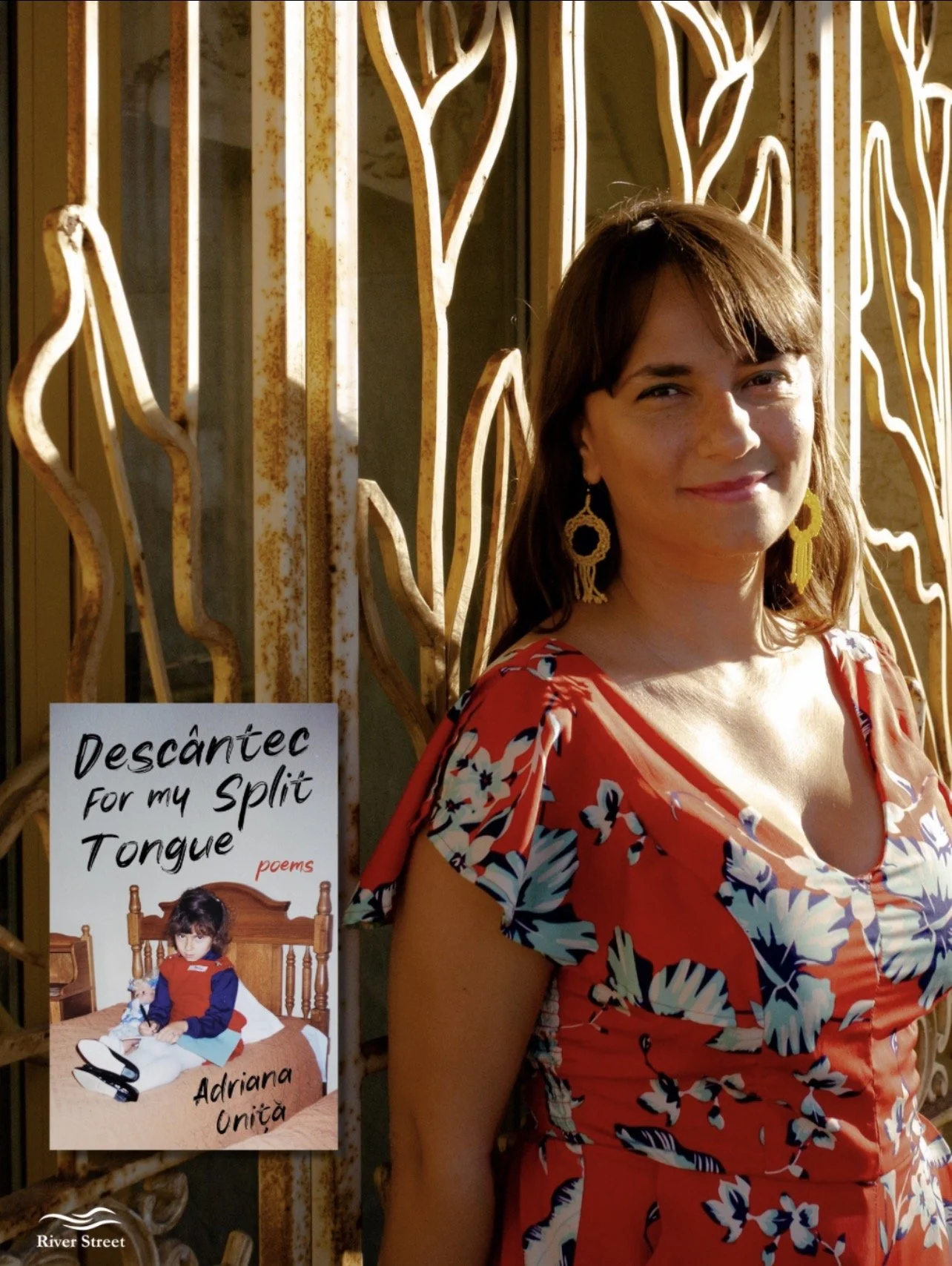
Descântec For My Split Tongue, Adriana Oniță’s first book of poetry, gathers English-Romanian poems that travel across generations, homelands, and dreamscapes to ask: what do we lose when we lose a language? Drawn from Oniță’s childhood and her immigration from Jilava to Edmonton, the poems explore dor—a Romanian word for deep longing—for her mother tongue. Along the way, Oniță unpacks “untranslatable” Romanian words and proverbs, each a compressed zip file of culture, humour, grief, and courage. The book itself becomes a descântec—part incantation, part prayer, part spell—summoning both the failures and the triumphs of translation into a ritual of healing.
Adriana Oniță is a poet, artist, educator, translator, and researcher with a PhD in arts-based language education. She writes and teaches in English, Romanian, Spanish, French, and Italian. Her multilingual poems appear in CBC Books, The Globe and Mail, The Ex-Puritan, Canthius, Tint Journal, and in her chapbooks: Misremembered Proverbs (above/ground press, 2023) and Conjugated Light (Glass Buffalo, 2019). As founder of The Polyglot, she is proud to have published more than 250 writers, translators, and artists working in over 60 languages. She lives between Edmonton and Italy. Discover her work at adrianaonita.com