

BLOG

Mind's Microscope: Steven Mayoff reviews Realia by Michael Trussler
The reality of poetry is its ability to speak to a part of ourselves that is asleep much of the time. When that part awakens, what is real and what is metaphor can seem indistinguishable. A sense of unreality enters our belief systems, altering how we see the world.
The reality of poetry is its ability to speak to a part of ourselves that is asleep much of the time. When that part awakens, what is real and what is metaphor can seem indistinguishable. A sense of unreality enters our belief systems, altering how we see the world.
The poetic world of Realia by Michael Trussler (Radiant Press, 2024) takes nothing for granted. It opens with When Eyelids, an ekphrastic essay that compares two seemingly disparate works of art: the 1810 painting The Monk by the Sea by Caspar David Friedrich and Kevin Carter’s 1993 photograph of a starving child in Sudan being watched by a vulture. Trussler describes both monk and vulture as a Rückenfigur, “a figure seen from the back, an optical technique…recognized as a means for the viewer to move inside the painting.” Although the essay is not necessarily meant to be an introduction to this collection, it works well as such in two ways. The first is how its subject matter of visual art lays the groundwork for the visual techniques Trussler employs, including arrows and other pictorial images as punctuation or dividing points, some actual photographs that accompany certain poems, interesting use of white space, inventive line breaks and, at times, boxed-in footnotes that appear in the middle of a poem. The second way is his use of quotations throughout, mostly as epigraphs for each chapter, or the aforementioned footnotes. One can think of these as Rückenfigurs, ways to allow the reader to move inside the collection by giving context to the, sometimes cryptic, nature of his poems.

Realia by Michael Trussler, published by Radiant Press (2024).
One of the book’s epigraphs gives the definition of realia, adapted from Merriam-Webster, in part as “… also sometimes used philosophically to distinguish real things from theories about them – a meaning that dates to the early 19th century.” In his book Why Poetry, poet Matthew Zapruder points out that it is important to take the words in a poem at face value, rather than trying to read some hidden meaning or oblique symbolism in them. In this way, words are the realia of poetry.
Trussler’s relationship to language can feel both alienating and deeply personal, often at the same time, as in the relatively short This Poem is the Human Equivalent (ii), which continues from the title:
of some
worn tires, a
classic snowglobe, a fitbit fetish. No, it’s
really the feral
umbrella growling following me I am behind
myself I am lost I’m lost I am an edgeless obstacle
gone astray—
The impressive section titled Inside Oceans Is: A Lyric Essay for Katherine Mansfield, mixes verse, prose and epigraphs to create a paean to a literary heroine while also weaving in one of Trussler’s go-to themes: the questioning of perception.
It astonished you how a house made
of words is always
better than anything we
can be or forget or say: a house
made of words lifts, flings
us away from our times. And yet
without your rage, your quicksilver delights, and anarchy, your
vigilance, no words can happen, pool
beneath each other, each story
of yours saying
No
each story saying
No
once again to the long betrayal, each story
the encounter between faces, and still, even now, no one
knows for whom stories
are told.
As the book’s title, Realia, implies, Trussler covers a lot of ground as his mind’s microscope explores the minutiae of existence, until the only evidence he can trust is his own sense of doubt. But in the end, the only reality is language. As he writes in There’s Been a Murmur “Words are objects. They have multiple dimensions on the screen, in my mind and on a page in a book. Each with its own personality, a core that persists over time.”

Realia author Michael Trussler.
Michael Trussler lives in Regina. He writes poetry and creative non-fiction. Three-time winner of the Saskatchewan Book Award, Trussler’s work has appeared in Canadian and American journals and has been included in domestic and international anthologies. Also a photographer, Trussler has a keen interest in the visual arts and is neuro-divergent. He teaches English at the University of Regina.

Reviewer Steven Mayoff
About the reviewer, Steven Mayoff:
Steven Mayoff (he/him) was born and raised in Montreal. His fiction and poetry have appeared in literary journals across Canada, the U.S. and abroad. He is the author of the story collection Fatted Calf Blues, winner of the 2010 PEI Book Award for Fiction; the novel Our Lady of Steerage; and two books of poetry Leonard’s Flat and Swinging Between Water and Stone. His acclaimed novel, The Island Gospel According to Samson Grief, was released by Radiant Press in 2023. Steven lives in Foxley River, PEI.

Power Q & A with Anna Rosner
Having a middle-grade author on our blog is a first for us, and we are delighted to kick off what will hopefully be the first of many middle-grad lit features with Anna Rosner, the award-winning author of Eyes on the Ice (Groundwood Books, 2024).
This story follows ten-year-old Lukas and his brother Denys, who want nothing more than to play hockey, but it’s 1963, and they live in Czechoslovakia, where everyone is on the lookout for spies of the state.
This is a thrilling read, and one young readers have been enjoying.
Welcome to the Power Q & A series, Anna!
Having a middle-grade author on our blog is a first for us, and we are delighted to kick off what will hopefully be the first of many middle-grad lit features with Anna Rosner, the award-winning author of Eyes on the Ice (Groundwood Books, 2024).
This story follows ten-year-old Lukas and his brother Denys, who want nothing more than to play hockey, but it’s 1963, and they live in Czechoslovakia, where everyone is on the lookout for spies of the state.
This is a thrilling read, and one young readers have been enjoying.
Welcome to the Power Q & A series, Anna!

Eyes on the Ice by Anna Rosner.
Q: What is the importance of historical fiction in the high-speed world of young readers today?
A: In his 2015 article from Le Devoir, “Our era traps us in immediacy” (Notre époque nous enferme dans l’immédiateté), Marc Chabot explains that everything in our lives is instantaneous. He laments our detachment from history and literature, or “the permanent”. And this was in 2015, before the creation of TikTok! The immediacy problem has increased exponentially in the past decade. We view thousands of fleeting images, read copious online news bites, and stare blankly at Tweets and videos. We forget scandals and tragedies the moment they are replaced by new scandals and tragedies. It’s almost impossible to navigate this fast-paced world of “now”, and it’s that much harder for a young person.
Which leads me to reading. My years as a doctoral student were easily the calmest of my life, which runs contrary to the experiences of most students. During that time, I lived in books, the primary sources written 300-400 years ago. Reading those early works taught me so much: how women lived, how class systems functioned, how revolutions came to be. I engaged with my work slowly, leisurely, gathered information, and thought about one single sentence for a week or more.
When we encourage a child to read from a young age, their attention span increases. A good book enables them to leave this world of Instagram and the immediate, and take a long, deep breath. Turning a page can be therapeutic. Through the written word, children can visit and learn about places that would otherwise be unknown to them; places that are impossible to grasp in a fifteen second video. Studying history in school can be a challenge for young people, especially when they are obligated to memorize facts and statistics for exams. But when they read historical fiction, it’s less of a struggle. Historical fiction transports the child back in time, teaches them about where we came from and where we went afterwards. It helps them connect past and present. The narrative is history, written in a child’s voice, and it makes learning so much easier. Which is what I hope I accomplished in Eyes on the Ice. Those who read the book won’t be able to explain the effects of Stalin’s tyranny, but they’ll have a general understanding of what life was like behind the Iron Curtain. And it’s stories that we remember best.

Author Anna Rosner.
More about Anna Rosner:
ANNA ROSNER is a teacher and writer who holds a PhD in French literature. She is the award-winning author of two hockey biographies for young readers — Journeyman: The Story of NHL Right Winger Jamie Leach and My Left Skate: The Extraordinary Story of Eliezer Sherbatov. Anna is the director of Books with Wings, which provides new, quality picture books for Indigenous children living in isolated communities. She lives in Toronto, Ontario.

Power Q & A with Aurora from It's Just Feminism
There’s nothing like connecting with other passionate, inclusive feminists to make our day. That’s why we were so thrilled to learn about Aurora, host of It’s Just Feminism. On this show, which runs on YouTube, Instagram, and TikTok , Aurora interviews other feminists from a delightfully dizzing array of backgrounds and explores what it means — and what it doesn’t mean — to be a feminist.
Aurora is an international PhD student of Feminist and Gender Studies who moved to Canada from her home country of Croatia—and we are so happy to have her here in Canada, and on this Power Q & A.
Welcome, Aurora!
There’s nothing like connecting with other passionate, inclusive feminists to make our day. That’s why we were so thrilled to learn about Aurora, host of It’s Just Feminism. On this show, which runs on YouTube, Instagram, and TikTok , Aurora interviews other feminists from a delightfully dizzing array of backgrounds and explores what it means — and what it doesn’t mean — to be a feminist.
Aurora is an international PhD student of Feminist and Gender Studies who moved to Canada from her home country of Croatia—and we are so happy to have her here in Canada, and on this Power Q & A.
Welcome, Aurora!

Aurora, host of It’s Just Feminism.
Q: Why did you start the It’s Just Feminism platform?
A: It all started, as passion projects often do, as a result of procrastination and utmost frustration! Half a year ago, I was writing a journal for a PhD course in Feminist and Gender Studies. I was stuck, struggling to understand a specific concept in feminist theory, so I foolishly turned to YouTube on a quest to find an interview with the author who introduced it to contemporary feminist theory, or at least a video essay discussing it critically. And I did find it - after endless scrolling through content that was absurd, disturbing, and sometimes even dangerous.
A parade of infamous antifeminists, TERFs-who-must-not-be-named, trad wives, religious fundamentalists, and pick-up artists flooded my screen. There they are, promoting the return to traditional gender roles based on values of patriarchy, religion and nationalism. They don’t hide their discrimination towards queer and BIPOC communities, justifying it under the excuse of “protecting women” which is ironic as they try to undermine the frameworks of support and justice for survivors of sexual and domestic violence…because they believe the victim is always to blame, even though they are the ones sometimes openly calling for violence.
Their arrogance made me confront my imposter syndrome. If these people, who have never read a piece of feminist theory or research, seen a feminist meme, let alone participated in a feminist movement, feel confident to say that “feminism has gone too far” then maybe I, as a feminist academic and activist, have a right to take up space to talk about feminism too. With help from my friend Domenika, a new feminist platform was launched in July 2024.
“What is feminism? Who are feminists? What do feminists do? Can feminism change the world?”
These are the questions we’re trying to answer through “It’s just feminism” - a platform for anybody interested in finding out more about feminism from actual feminists who are sharing information rooted in scientific research and their lived experiences.
There is not one way to live a feminist life, just as there is not one feminist theory. Our guests come from different walks of life to offer nuanced perspectives and a wild variety of feminist principles applied to topics of mental health, sexuality, disability, wage equality, migrations, colonialism, art, war, ethics and much more. Some guests are feminist academics; others never studied feminism but use feminist approaches in their work as activists, artists, archivists, authors, comedians, therapists, professors, musicians, carpenters, lawyers... These feminists are community builders in countries around the world - from Canada all the way to Australia. Representation is so important to us, there is even an episode with a white cis straight man! This feminist platform is intended as a safe space for all to learn and grow together no matter
who we are. Collaboration based on empathy for the sake of bettering the lives of all is the vibe we’re going for!
Fun fact: The name “It’s just feminism” is connected to “It’s just fashion”, my other passion project on sustainable fashion. The sentiment behind it is the same as it symbolizes that many are quick to dismiss the importance of both. It’s not just fashion. It’s a way of communicating with the world around us, and giving ourselves a confidence boost, but it’s also an industry that pollutes the planet and exploits the workers. It's not just feminism. It’s a movement connecting generations of people trying to imagine a better world. Feminism helps us stay vocal and resilient in our efforts to claim and keep the rights we all deserve. “It’s just feminism” is here to amplify those voices and praise the efforts of those who are wholeheartedly doing their parts in the fight for human rights.
Feel free to join us every Feminist Friday at 5 pm EST for new episodes with feminists around the world!
Links for “It’s just feminism” social media:
YouTube
TikTok
More about Aurora:
Aurora is an international PhD student of Feminist and Gender Studies doing feminist ethnographic research with female survivors of wartime sexual violence and genocide. She recently moved to Canada with her husband and their dog, partially because feminist studies don’t exist in their home country of Croatia. However, she was lucky to study History, Sociology and Anthropology. This path unlocked an interdisciplinary approach to social issues and gained her a deeper understanding of systems that perpetuate them. To take a break from heavy-loaded PhD work, she paints mediocre fashion illustrations and feminist portraits, runs from the Canadian geese on dog walks, and watches the cringiest of TV shows with her husband. She’s also trying to learn French, but so far, it's all pain, sans chocolat.

Excerpt from Eyes on the Ice by Anna Rosner
On a cool night, Denys, Andrej and I make our way to what will likely be our last evening with Coach Peter. The ice on the rink is thin, and there are bits of weeds and twigs poking through.
As I’m climbing up the chain-link fence, the last one over, I see a man emerge from the shadows. He moves differently than Coach Peter. I do a double take in the darkness. He is definitely shorter than our coach, and his back is more curved.
Denys and Andrej see him, too.
On a cool night, Denys, Andrej and I make our way to what will likely be our last evening with Coach Peter. The ice on the rink is thin, and there are bits of weeds and twigs poking through.
As I’m climbing up the chain-link fence, the last one over, I see a man emerge from the shadows. He moves differently than Coach Peter. I do a double take in the darkness. He is definitely shorter than our coach, and his back is more curved.
Denys and Andrej see him, too.
“Run,” I whisper, and the three of us begin to climb back over the fence like animals, trying to throw our sticks and skates over first.
“Do you know where your fathers are?” the man yells.
The three of us freeze. Our fathers.
This man wants something. He knows something.
“Come,” he beckons. “I’d like to speak with you.”
Denys looks at us. “His accent. He’s Russian,” he hisses.
I start walking toward him. “I don’t care who he is. He knows something about Papa.” I notice Denys is keeping his hockey stick in his hand.
“Don’t say a word about Coach Peter,” Denys whispers. “Not a word.”
The man pushes his thick glasses onto the bridge of his nose and gives us a plastic smile. “Boys,” he greets us. “I see I’ve piqued your interest. So.”
We wait for him to speak.
“Still playing, I see?” he asks.
We don’t respond. I can hear the faraway conversations of people walking in the park.
He gestures to the rink. “Do you really think we don’t know you play here with Coach Peter? Really, boys, you underestimate us. If you come here twice a week, it’s because we allow it.”
The three of us look at one another nervously. They’ve been tracking us. How could we have been so stupid?
Andrej speaks first. “Where are they?”
The man laughs. “It’s not quite that easy, I’m afraid. I work on the basis of quid pro quo. You know what that means? It means we exchange. One for another. Quid pro quo. Understand?”
Denys grips his stick until his hands turn white.
“What could you possibly want from us?” he asks. “You’ve already taken everything we have.”
The oko seems to think this over. “I agree.” He sniffs. “So perhaps you’d like something back. Do you know there is a Soviet tournament next month, to end the season?”
“Of course,” I reply. “But we won’t be a part of it.”
“Mother Russia will be here,” he continues, “to compete against a few teams from Prague. The Soviets are excellent players.”
The oko looks across the rink, kicks at a shard of ice and then stares directly at me, narrowing his eyes.
“Tell me, Lukas. How do you feel about the motherland?”
He knows my name.
“I feel fine about it,” I lie.
“Wonderful,” smiles the oko. “So, you agree. I think it would be very distressing if the Russian teams were to go home empty-handed, don’t you?”
Andrej stares at him, furious. “Someone always goes home empty-handed,” he growls. But I am beginning to understand.
“Oh, no,” replies the oko. “I think it would be a great shame. I think I should feel very badly. Don’t you think so.” This last part is not a question.
“No,” Andrej says again, his jaw clenched. “I don’t.”
“I think you boys would like a chance to play again, am I right?” He sucks on his teeth. “So, like I was saying, a little exchange.”
Andrej laughs bitterly. “You want us to play badly on purpose, so the Russians win. To throw the game.” The man smiles, though the rest of his face remains somehow motionless.
“Why us?” I ask him. “We don’t even play on the team anymore!”
Andrej answers for him. “Because they can blackmail us, that’s why.”
The oko sniffs again, searching for a handkerchief in his coat pocket.
“I think you have questions about your fathers,” he muses. “Do what I’m asking, and my people will see what we can find out. Don’t, and you will likely not see them for a very, very long time.”
—from Eyes on the Ice by Anna Rosner. Published by Groundwood Books. © 2024 by Anna Rosner.

Eyes on the Ice by Anna Rosner (Groundwood Books, 2024)
About Eyes on the Ice:
Ten-year-old Lukas and his brother Denys want nothing more than to play hockey, but it’s 1963, and they live in Czechoslovakia, where the secret police (the “Eye”) are constantly on the lookout for anyone committing crimes against the state — whether that be reading a magazine about the NHL or saying anything negative about the Communist regime. Lukas’s father works for a newspaper, and printing the truth is a dangerous activity.
The family is poor, but hockey is the one bright light for the boys. They learn to skate on a bumpy outdoor rink in a city park. And when their talent is noticed, they are encouraged to try out for a local youth league, where they are thrilled to play in a real arena for the first time.
Then the boys’ father is arrested. No one knows where he has been taken or when he might be coming home. Lukas and Denys soon realize they are being watched, too, and when the secret police promise them information about their father if they help throw a game against a visiting Soviet team, Lukas must make some difficult decisions that may endanger his family and his friends, as he faces some tough questions about what loyalty really means.

Author Anna Rosner.
About ANNA ROSNER:
Anna Rosner is a teacher and writer who holds a PhD in French literature. She is the award-winning author of two hockey biographies for young readers — Journeyman: The Story of NHL Right Winger Jamie Leach and My Left Skate: The Extraordinary Story of Eliezer Sherbatov. Anna is the director of Books with Wings, which provides new, quality picture books for Indigenous children living in isolated communities. She lives in Toronto, Ontario.

Excerpt from Yellow Birds by Karen Green
That first night, the audience seemed to know the music was about to begin even before the bright lights of the concert bowl went down. There was a tiny, brief silence; a wave of anticipation that rippled through the stands—and then everything changed. Lights out, plunging 26,000 screaming Yellow Birds into a momentary darkness somehow made even more impenetrable by the roar of the audience. Soon, spotlights brightened the stage, illuminating the drumkit, the guitar stands, the keyboard, moving across the stadium over hands raised above heads. And then the lights returned to the front as the five members of the Open Road walked onto the stage, walked to their instruments, and paused.
That first night, the audience seemed to know the music was about to begin even before the bright lights of the concert bowl went down. There was a tiny, brief silence; a wave of anticipation that rippled through the stands—and then everything changed. Lights out, plunging 26,000 screaming Yellow Birds into a momentary darkness somehow made even more impenetrable by the roar of the audience. Soon, spotlights brightened the stage, illuminating the drumkit, the guitar stands, the keyboard, moving across the stadium over hands raised above heads. And then the lights returned to the front as the five members of the Open Road walked onto the stage, walked to their instruments, and paused.
“Welcome home,” said lead singer Ernest, strumming the first notes on his guitar. I threw my arms in the air as the crowd erupted again.
***
Birds weren’t just fans of the Open Road; they were the ambassadors, the insiders. I was just beginning to learn the secret language, the hidden code the Yellow Birds all seemed to share, but it didn’t take long to figure out that getting to shows, and helping other Birds get to the shows, was part of that code. I would not have considered myself a Yellow Bird only weeks earlier but in my desire to stay on Open Road Tour, to only move forward, I learned enough of the language to pass for one. And the longer I stayed on Tour, the more fluent I became.
Pulling into Eugene, Oregon, as Nick and Nicole argued over whether or not there was time for a Target grocery run, the only words I could say were Get me out of here.
The West Coast leg of summer Tour was about to begin and I was thousands of miles from where I began without a plan, a ride, or even a place to drop my small bundle of belongings. I was starting to think I should have just gone home, while home still seemed like an option for me.
And then I crossed paths with Skate and Easy and Vivi and I hoped they were my answer, and then I met Eartha, and that was that.
“Aren’t you new and shiny,” said Eartha, in the way that I would come to know as affectionate. “I’m Eartha.”
“I’m Kait,” I said. And then I was.
This crew called their van Big Blue Bertha, and as far as I could tell, the five people in it had been friends for a long time and travelling together the entirety of summer Tour, criss-crossing the country as I had. And like me, they were Canadian, though all five of them were from the West Coast; British Colombia and Alberta. They had road-tripped out to Vermont to start Tour for the very first Open Road shows of the season, but according to Easy, the van’s tall, lanky owner and seemingly defacto leader of the crew, Bertha had just made her last cross-country trek.
“She won’t be doing that again,” he said, tucking his long blond hair behind his ear, as I sat outside the van that afternoon for the first time. “She’s a good Bird, but she’s an old Bird.” Vivi, his girlfriend, was the van’s resident goddess: tall, slim, and graceful, with gorgeous long ringletted locks the colour of Swiss chocolate, and eyes to match. It would be easy to hate Vivi for her perfection if she hadn’t also been such a sweet, welcoming person. Vivi sat atop the blankets on the ground, leaning against Easy’s chair. Her eyes were closed as she angled her head against his leg, up towards the sun. Easy twirled a ringlet lazily around his finger.
“She’s a shitbird who’s falling apart,” said Skate.
“Why don’t you hop right on that board of yours and freeload your way into someone else’s van,” said Easy, pointing to what I gathered was the four-wheeled source of Skate’s nickname.
“Nah, he can’t,” said a girl who was introduced to me with the unexpected moniker of JuJube. “There’s nobody left on Tour that he hasn’t slept with, owes money to, or both. Except her.” JuJube motioned towards me.
“Don’t bother, Skate,” I said, “I need a ride too.”
Everybody sitting around the circle laughed and I expected that these barbs were well-rehearsed and trod out often.
Skate had a baby face anchored by a slightly crooked smile and eyes that were dark shining pools made even darker under the shade of the baseball cap he wore. He was flirtatious and quick-witted and I got the feeling these traits were a definite asset on Tour. Skate had been the one to invite me into the company of Bertha’s crew; he had been sitting in one of the folding chairs outside the van and I had stopped to ask him if he had a line on a ticket to the show that night. He said he didn’t, but that he thought a friend of his would; she’d be back soon, I was welcome to wait. I sat in another of the folding chairs, Skate passed me a beer, and we started chatting.
Easy and Vivi showed up next, then JuJube, then Eartha, who did in fact, have a line on a ticket. She was the line, and the extra ticket was hers, a fluke, a mistake in an order she had placed months earlier. I was welcome to it at face value. I loved Eartha immediately, I couldn’t help it. She was familiar and a bit gruff and funny and I just wanted to be around her.
“There’s just one condition to the sale of this ticket,” she said, holding it out, but not releasing it to me.
“What?” I asked, wondering if I had misjudged her and she was going make some sketchy request like procuring mushrooms for her or something.
“I can’t let you go into the show alone. You gotta come with me.”
“How do you know I’m alone?”
Eartha made a face and pressed the ticket into my hand. “You’d have to be alone or desperate to spend all afternoon with these fools.”
I didn’t tell her that for the first time in a long time, I finally felt neither of those things.
—from Yellow Birds by Karen Green Published by RE:BOOKS Publishing © 2024 by Karen Green.
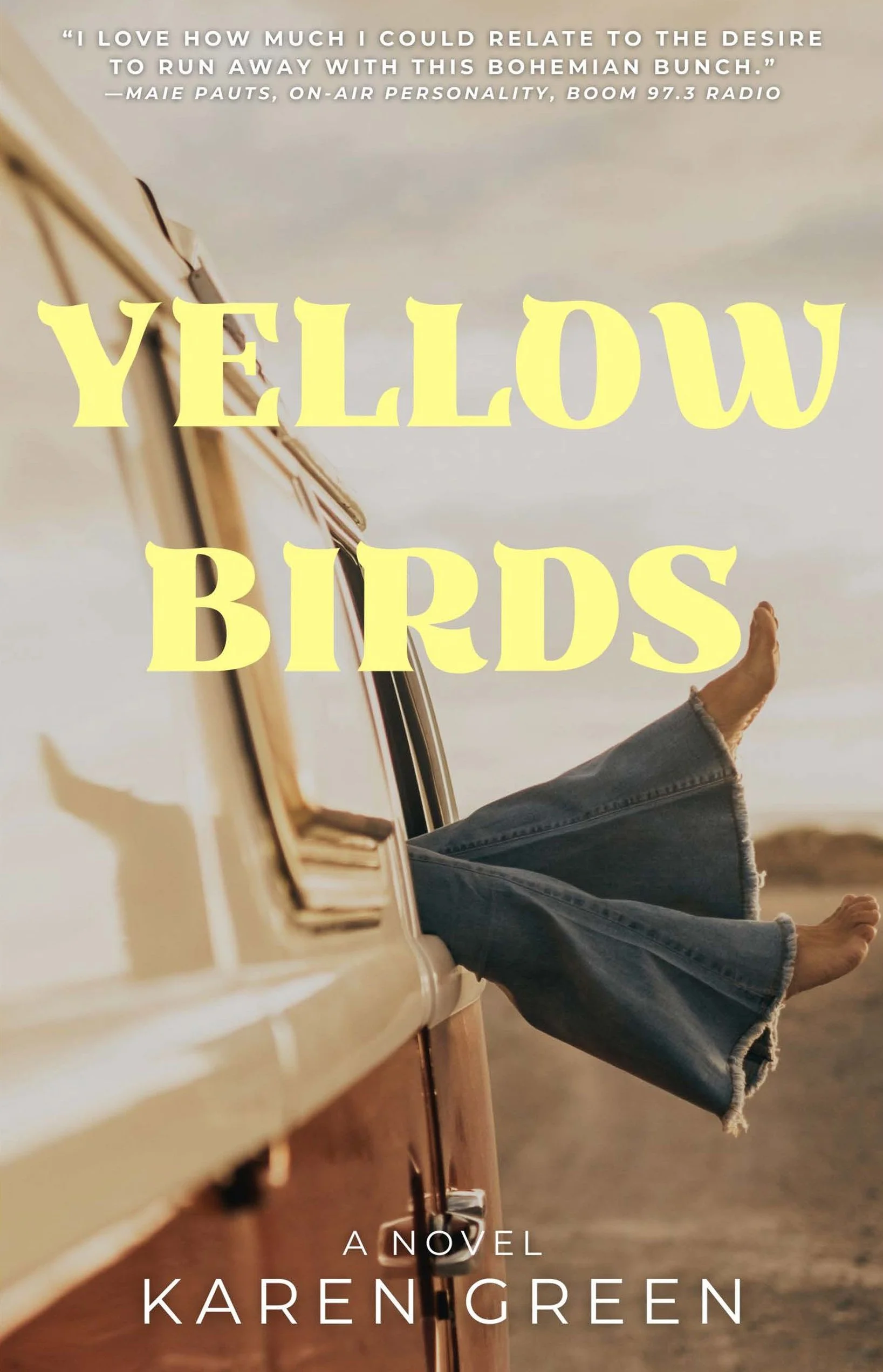
Yellow Birds by Karen Green (Re:Books, 2024)
MORE ABOUT YELLOW BIRDS:
Sex, drugs, rock and roll, and even cults … take a “trip” in this bohemian love story.
Set just before the digital revolution, Kait is a young woman searching for identity and community among the cast-outs, cast-offs, and other “misfit toys” who refer to themselves as the Yellow Birds and follow a band called the Open Road from town to town.
Just as Kait believes she has found her place among a group of Birds travelling together in a messy van, a young man with the eye-roll worthy name of Horizon sits beside her one night and alters her fragile plan for the foreseeable future.
Amidst the whirlwind of the Open Road Tour, their growing feelings for one another soar to ecstatic heights, while propelling them toward an impending reckoning with their troubled pasts.
Filled with sex, drugs, music, and even cults, readers won't be able to get enough of this bohemian love story, the groupie lifestyle, and the party within the party.

Author Karen Green.
MORE ABOUT KAREN GREEN:
Karen Green is a successfully published writer who has had her poetry, essays, and fiction featured in Room Magazine, Chicken Soup for the Soul, The Globe and Mail, and more. She has also contributed to Juno-winning and platinum-selling albums during her tenure as a senior copywriter. She is the author of two young reader books (Fisher Price).

Power Q & A with Daniel Maluka
Toronto’s Daniel Maluka may be a debut poet, with his collection, Unwashed, recently released by Mawenzi House Press, but he’s no stranger to the world of art. Daniel has been writing much of his life and his striking visual art has been exhibited throughout the city and beyond. Both Daniel’s writing and visual art are a means to share narratives and he does this with an intricate yet unadorned style that’s singular and absorbing.
Daniel joins us for this Power Q & A to talk about being a multidisciplinary artist.
Toronto’s Daniel Maluka may be a debut poet, with his collection, Unwashed, recently released by Mawenzi House Press, but he’s no stranger to the world of art. Daniel has been writing much of his life and his striking visual art has been exhibited throughout the city and beyond. Both Daniel’s writing and visual art are a means to share narratives and he does this with an intricate yet unadorned style that’s singular and absorbing.
Daniel joins us for this Power Q & A to talk about being a multidisciplinary artist.
Welcome, Daniel!

Unwashed by Daniel Maluka.
Q: How would you say your work as a visual artist influences your poetry? If it does at all?
A: This question has come up a few times and people are always surprised by the answer, which is barely at all. My brain for whatever reason views my art and writing as separate things. If I draw or paint something I feel that I have already communicated all the things I wanted to in the visual piece. Adding a written component or imposing words on a drawing or painting seems redundant. If I’ve already “said it” visually why then write something for it. This was always my mindset towards the two but something changed a few months back.
I did a watercolour painting of a mango in 2017 that I never got around to showing anyone. It was just meant for practice as this was years ago when I first started using watercolour. There are few pieces of art of mine that stay in the vault. Within the past year I participated in an excellent workshop with Tender Possibilities at Guild Park in Scarborough. Hoa Nguyen, one of my professors at TMU, led the workshop. She had us walk around the park and write poetry in response to one of the plants while connecting that to a childhood memory. There were no mangos at the park but I recalled a memory of eating mangos under a mango tree as a kid back home in South Africa. My mother found me fast asleep surrounded by mangos.
So, I now had that poem and the mango painting from years ago but I still did not connect them. It wasn’t until I went to Malcom’s of A.B.C (Actual Book Club) magazine launch that the idea of connecting them came to mind. Malcom had asked me to send in some writing or artwork for issue two of the magazine and I first wanted to send the poem alone; forgetting about the mango painting. While in the submission process I remembered the painting and sent in both for A.B.C. I view both of those works as naturally connected now even though they were created years apart. This might be more of my mindset moving forward, but I still don’t want to force a writing painting companion piece just to do it.
More about Unwashed:
Unwashed is a deeply personal collection of poetry, centering on themes of growing up, loss of innocence, love, the immigrant experience, and alienation. The title of the collection is a reference to the urgency of the work. These are not romantic or quiet poems; they are loud and in-your-face. They speak directly to the collective anxieties of urban life and reflect the author’s experience as an immigrant in Canada and a family man in the diverse setting of Toronto. What we are given here is a tapestry of intense, image-rich poetry.
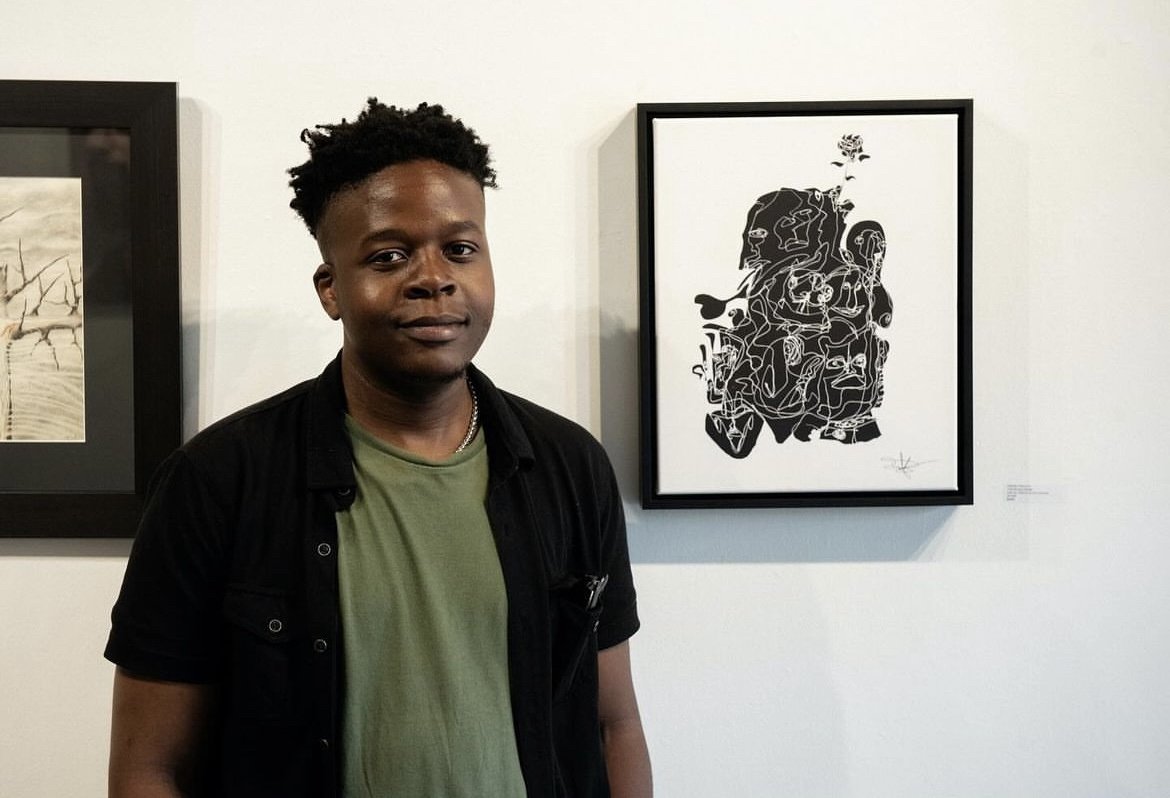
Daniel Maluka.
More about Daniel Maluka:
Daniel Maluka is a self-taught, Toronto-based artist and writer originally from South Africa. He merges Afrocentric influences with surrealist elements to explore the depths of the subconscious in his art. Daniel’s visually captivating pieces have gained international recognition, being featured in galleries across Toronto and collected worldwide.
In addition to his visual art, Daniel has made notable contributions to literature. His works have been published in various magazines, and he has led numerous poetry workshops. His debut poetry collection, Unwashed, published by Mawenzi House, was featured in CBC’s “37 Most Anticipated Poetry Books for Spring 2024.” The collection is known for its visceral, image-rich poetry.

Power Q & A with Ruth Abernethy
Whether you know it or not, you have probably seen the art of Ruth Abernethy. Ruth is the sculptor who created the installation of Queen Elizabeth II at Queen's Park, the Glenn Gould sculpture in front of CBC studios, and the Liu Xiaobo piece in Ottawa. Her art, which has been installed coast to coast, has inspired many conversations among many Canadians. (She's also the only non-American to sculpt Abraham Lincoln!)
Whether you know it or not, you have probably seen the art of Ruth Abernethy. Ruth is the sculptor who created the installation of Queen Elizabeth II at Queen's Park, the Glenn Gould sculpture in front of CBC studios, and the Liu Xiaobo piece in Ottawa. Her art, which has been installed coast to coast, has inspired many conversations among many Canadians. (She's also the only non-American to sculpt Abraham Lincoln!)
“Ruth's work and this book give substance to any discussion on what it means to be Canadian. This book offers a glimpse of her unique perspective as an artist, moving from an Ontario farm through the collaborative craftsmanship of mainstream theatre to navigating the rarified worlds of royalty and celebrity.”
—Marilyn Norry
Ruth’s new book In Form: Life and Legacies in Bronze, is due out with FireFly Books on September 21, 2024. We’re honoured to have her join us for this Power Q & A to talk with us about her singular path to international acclaim.
Welcome, Ruth!

In Form: Life and Legacies in Bronze by Ruth Abernethy.
Q: You’ve said you don’t have “formal arts training.” We couldn’t help but wonder if you think your lack formal training is what makes you such a powerful public artist?
A: I propose that my 'lack of formal art training' is effectively offset by a 20-year apprenticeship with the finest stage designers in the world. Designing/building for theatre demands mental flexibility and a refined practice of resolving visual solutions that guide viewers’ imaginations and help 'tell the tale'. I developed a respect for audiences! As a parallel idea, I also admire what's 'real' about theatre. In curiously inverted escapism, the onstage and backstage creative processes are incredibly real, intense, and pragmatic.
The compulsion to create, to work hands-on, and explore materials, is initially satisfying to the maker. The fascinating results become red herrings for non-creators. AI may contrive music or visuals, but it's ME who gets IMMENSE reward from making things, and I suspect a 'bot' DOES NOT!
Artists are Cultural First Responders
Every milestone that humans 'highlight', from a child's birthday to a funeral or a political convention, are heightened by music and visuals with impact. Artists observe and participate in the world but, like a prism, we reassemble elements that exist for everyone. Society has a depth of 'standardization' that's difficult to offload. Focus on the 'products' of artists could lead to presumptions of equivalent skill sets, like other trades/professions. In separating creators from their 'product' they're revealed as problem solvers whose efforts are akin to the work of interesting people in any walk of life. Those who think deeply and carefully about what they do, are interesting people who are predictably effective at whatever tasks they undertake. What problems do we choose to solve?
The word playful is a true compliment! Thank you. Playfulness is a joyful expression of human contact.
Humour is often shared and it rests on common ground, welcomed because it poses no challenge
I learned/used many hand skills as a kid, and I learned to play music, so I had the discipline and persistence to tackle hand work (and hard work).
I was hired at the theatre because I was useful, and a very quick study! It was a place to flourish and I could travel, which was a key hunger at the time.
The variety of skills that theatre/film building demands, provides immense freedom to explore materials/methods and reinvent them as needed.
More about In Form: Life and Legacies in Bronze:
In Form includes the story of 20 sculptures in bronze. Located across Canada, they capture key figures from history, science, art, sports, the labor movement, medicine, royalty, human rights, World War II, business, and politics.
For Ruth Abernethy, the creative process starts with her off-center observations of human nature. She puts her thoughts "in form" as she plans and engineers public installations and studio works against the backdrop of family and the evolving zeitgeist. For this, her second book, Ruth takes you on a road trip across Canada to visit installations and initiate conversations about the role of sculpture in modern public life. In Form is filled with thought-provoking ideas for study and chat in academia, book clubs, seniors, arts, and business groups and for the sheer enjoyment of the stories behind the portraits of:
Lester B. Pearson, prime minister
Margaret Atwood, author
Bob White, labor leader
Isabel Coursier, ski jump champion
Liu Xiaobo, human rights activist
Sir William Stephenson, spymaster
Michael Holcombe Wilson, mental health advocate
HRH Queen Elizabeth II
Dr. Michael Smith, Nobel laureate
Daurene Lewis, the first Black mayor in Canada.

Public artist Ruth Abernethy.
About Ruth Abernethy:
Ruth Abernethy grew up near Lindsay, Ontario. At the age of 20, she was hired as Head of Props at the Royal Manitoba Theatre Centre, MB. At the Stratford Festival (ON), where Ruth began work in 1981, she refined her method of 3D mapping. The success of her first bronze prompted the invitation to sculpt renowned pianist Glenn Gould, which began a definitive career change. The National Portrait Gallery acquired Ruth’s portrait bust of Al Waxman (2003) and Her Majesty Queen Elizabeth II unveiled Ruth’s portrait of Oscar Peterson at the National Arts Centre (2010). She was the first Canadian artist to exhibit with Sculpture in Context, Dublin, Ireland (2007), and Sculpture-by-the-Sea, Sydney, Australia (2004).
For this, she was awarded a bursary from the Canadian Consulate in Sydney and was invited for a return to the Casuarina Sculpture Walk, Australia (2006). Ruth was the only Canadian artist short-listed for the Beijing Olympic Sculpture contest (2008). In addition to bronze and portraiture, Ruth’s studio works combine textiles, hand-made lace and stainless steel. Ruth began her own Canadiana Collection in 2005, seeking a broader narrative for social history. Pieces from this collection were selected for The Canadiana State Collection (Ottawa, ON), exhibited with Crossing Borders (Lockport, NY, 2005), and acquired by the Royal Ontario Museum (5 pieces, Toronto, ON, 2009).
Her bronzes have been commissioned for sites across Canada and she is the only Canadian artist to have sculpted Abe Lincoln for a public site in the United States. Ruth portrayed Queen Elizabeth II, 150% enlarged, for Queen's Park, Toronto (2023). Ruth authored Life and Bronze, A Sculptor’s Journal (2016). She was presented with an Honorary Doctor of Letters Degree from Wilfrid Laurier University (2018), and inducted into the Waterloo Region Museum Hall of Fame (2019). She sculpted Margaret Atwood, a patron of the Royal Canadian Geographic Society, and was made an Honourary Fellow of the Society, awarded the Louie Kamookak Metal (2023). Ruth continues to sculpt ideas that prompt dialogue, invite compassionate scrutiny of human experience and that hold a hint of humour!

Excerpt from The Dialogues: The Song of Francis Pegahmagabow by Armand Garnet Ruffo
In The Dialogues: The Song of Francis Pegahmagabow, award-winning author Armand Garnet Ruffo brings to life not only the story of the famed WWI Indigenous sniper, but also the complexities of telling Indigenous stories. From Wasauksing (Parry Island) to the trenches of WWI to the stage, Ruffo moves seamlessly through time in these poems, taking the reader on a captivating journey through Pegahmagabow’s story and onto the creation of Sounding Thunder, the opera based on his life.
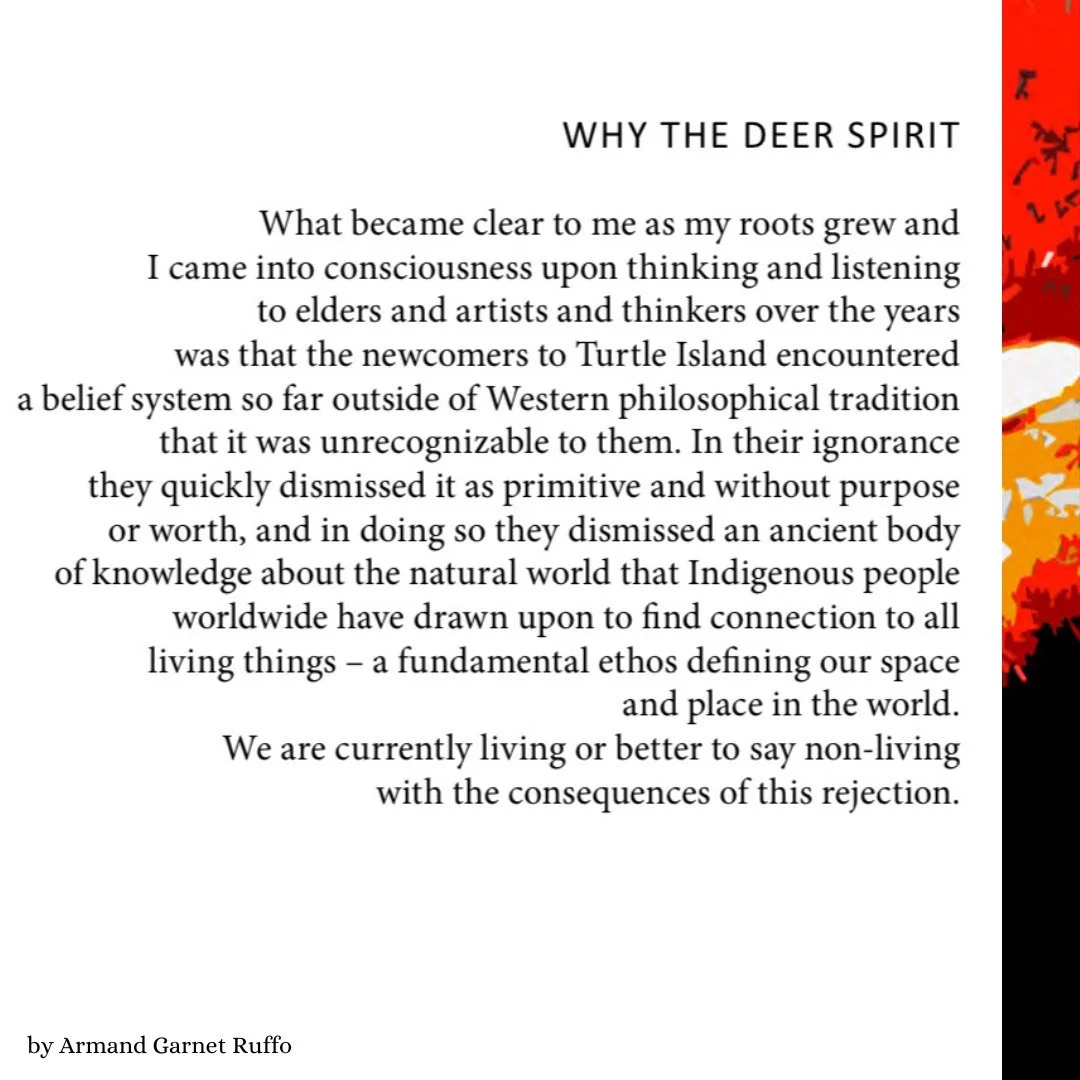
—“Why the Deer Spirit” from The Dialogues: The Song of Francis Pegahmagabow by Armand Garnet Ruffo. Published by Wolsak and Wynn © 2024 by Armand Garnet Ruffo.

More about The Dialogues: The Song of Francis Pegahmagabow:
In The Dialogues: The Song of Francis Pegahmagabow, award-winning author Armand Garnet Ruffo brings to life not only the story of the famed WWI Indigenous sniper, but also the complexities of telling Indigenous stories. From Wasauksing (Parry Island) to the trenches of WWI to the stage, Ruffo moves seamlessly through time in these poems, taking the reader on a captivating journey through Pegahmagabow’s story and onto the creation of Sounding Thunder, the opera based on his life. Throughout, Ruffo uses the Ojibwe concept of two-eyed seeing, which combines the strengths of western and Indigenous ways of knowing, and invites the reader to do the same, particularly through the inclusion of the Anishinaabemowin language within the collection. These are poems that challenge western conventions of thinking, that celebrate hope and that show us a new way to see the world.

Armand Garnet Ruffo. Photo credit: Bernard Clark.
More about Armand Garnet Ruffo:
Armand Garnet Ruffo was born in Chapleau, northern Ontario, and is a band member of the Chapleau (Fox Lake) Cree First Nation. A recipient of an Honorary Life Membership Award from the League of Canadian Poets, he is recognized as a major contributor to both contemporary Indigenous literature and Indigenous literary scholarship in Canada. His publications include Norval Morrisseau: Man Changing Into Thunderbird (2014) and Treaty # (2019), both finalists for Governor General’s Literary Awards. In 2020, he was awarded the Latner Writers’ Trust Poetry Prize in recognition of his work. Ruffo teaches at Queen’s University in Kingston, Ontario.

Excerpt from In a Tension of Leaves and Binding by Renée M. Sgroi
In a Tension of Leaves and Binding is an exploratory journey that examines our relationship to the natural world through the lens of a single garden. Enunciated from both a human perspective and from the imagined voices of the plants and animals that actually live in the garden itself, this collection also explores conceptual and visual articulations that function to disrupt our assumptions about poetry, meaning, and language.

—”irruptions” from In a Tension of Leaves and Binding by Renée M. Sgroi. Published by Guernica Editions. © 2024 by Renée M. Sgroi .

In a Tension of Leaves in Binding by Renée M. Sgroi.
About In a Tension of Leaves and Binding:
In a Tension of Leaves and Binding is an exploratory journey that examines our relationship to the natural world through the lens of a single garden. Enunciated from both a human perspective and from the imagined voices of the plants and animals that actually live in the garden itself, this collection also explores conceptual and visual articulations that function to disrupt our assumptions about poetry, meaning, and language. Woven through these dialectical conversations is a dominant elegiac thread that explores the territory of grief while simultaneously grappling with the possibilities for hope against the limits of language. The book concludes with a meditative essay or “Author’s Notes” that describe the processes and approaches employed and also work to pose questions that maintain the integrity of the entire manuscript’s fluidity, experimental form, and openness.

Poet Renée M. Sgroi.
About Renée M. Sgroi
Renée M. Sgroi holds a PhD in Education from the University of Toronto, an M.Sc. in Creativity and Change Leadership from SUNY Buffalo State, and works as a post-secondary educator. A runner up in the UK's 2020 erbacce poetry prize, her debut poetry collection, life print, in points, was published that year by erbacce-press. Renée's poetry has been published in numerous journals and anthologies including Pinhole Poetry, The /temz/ Review, The Windsor Review, The Beliveau Review, Lummox (U.S.), Prairie Fire, The Prairie Journal, Fresh Voices, and many others. Renée is a contributing editor to Arc Poetry Magazine. Her second poetry collection is forthcoming in 2024.

Excerpt from The Widow's Crayon Box by Molly Peacock
Have you received thoughts
And wondered why they’ve not
Occurred to you before?
They could be his


—”The Next World is One of Ideas” from The Widow’s Crayon Box by Molly Peacock. Published by W.W. Norton and Company. © 2024 by Molly Peacock.

The Widow’s Crayon Box by Molly Peacock.
About The Widow’s Crayon Box:
After her husband’s death, Molly Peacock realized she was not living the received idea of a widow’s mauve existence but instead was experiencing life with all 152 colours of the crayon box. The result is a collection of gorgeous poems, which are joyful, furious, mournful, bewildered, sexy, devastated, whimsical and above all, moving. They illuminate both the life as a caregiver and the crystalline emotions one can experience after the death of a cherished partner. With her characteristic virtuosity, her fearless willingness to confront even the most difficult emotions, and always with buoyancy and zest, Molly charts widowhood in the 21st century.

Molly and Mike. Photo credit: Alice Briesmaster.
About Molly Peacock:
Molly is the author of eight volumes of poetry, including The Widow’s Crayon Box, The Analyst: Poems and Cornucopia: New & Selected Poems, all from W.W. Norton, she recently wrote a book about a half-century friendship, A Friend Sails in on a Poem. As a poetry activist, Peacock was the co-founder of Poetry in Motion on New York’s subways and buses, the founder of The Best Canadian Poetry series, and the creator of The Secret Poetry Room at Binghamton University. https://www.mollypeacock.org/

Molly and Mike. Photo credit: Alice Briesmaster.

Power Q & A with Gloria Blizzard
Gloria Blizzard’s collection of essays, Black Cake, Turtle Soup, and Other Dilemmas (Dundurn Press, 2024) has been on our radar for a while. Earlier this year, it even made our Mother’s Day Book Gift List.
Lorri Neilsen Glenn, author of The Old Man in Her Arms, has praised Gloria for how she “effortlessly weaves elements of her life — its challenges and its gifts — into contemporary conversations about identity, feminism, the diaspora, art, and belonging.”
Gloria Blizzard’s collection of essays, Black Cake, Turtle Soup, and Other Dilemmas (Dundurn Press, 2024) has been on our radar for a while. (You may even recongise it from earlier this year when it was on our Mother’s Day Book Gift List.)
Lorri Neilsen Glenn, author of The Old Man in Her Arms, has praised Gloria for how she “effortlessly weaves elements of her life — its challenges and its gifts — into contemporary conversations about identity, feminism, the diaspora, art, and belonging.”
Ms. Magazine called the book, “as captivating and lovingly written as any of her songs or poems. From identity and belonging to feminism and food, these personal essays present complexities, challenges and reflections that will appeal to a wide range of readers.”
Ayelet Tsabari, author of The Art of Leaving, hailed it has “mesmerizing, lyrical, and cadenced.”
We’re honoured to have Gloria join us today for this Power Q & A. Welcome, Gloria!

Bring home Black Cake, Turtle Soup, and Other Dilemmas (Dundurn Press, 2024)
Q: Tell us about the rich and incredibly evocative title of your book! Where it it come from? How does it play out in themes throughout the book?
A: Welcome to my book! Black Cake, Turtle Soup, and Other Dilemmas is a meeting place. Often important stuff happens at the crossroads of many things. The intersections of art, science, race, culture and spirituality are a valuable, rich liminal space, if we care to pay attention. The subtitle for my book is ‘Essays on music, memory and motion’, as the essays are infused with music, dance and travel.
The title points to and includes all of these ideas. Black cake is a treat familiar to those of us of Caribbean origins, and it made up of ingredients from around the world, none of which are indigenous to the Caribbean. In the essay ‘Black Cake Buddhism’, I look at the intersections of spirituality, where my Catholic Trinidadian mother teaches me, a daughter inexplicably exploring Buddhism in Canada, how to make this traditional cake. Two forms of music compete for the position of the soundscape for this event. Cake can be emotionally and historically loaded!
‘Turtle Soup’ is another layered tale indicative of the collection, and a theme of interconnections between the personal, historical and universal. In this essay, I learn as a child, how death and food are connected, and later as an adult, about a macabre sport played on Ontario roads.
My book also dives into personal and social quandaries that I call dilemmas. ‘The Mathematic of Rage’ looks at negotiating the world in a female, Black body. ‘Trifecta’ explores the connections between academic institutions and the Atlantic slave trade. Woven into it are the healing aspects of Afro-Cuban dance and the making of art in general. Early readers from many worlds, are letting me now how deeply they relate to these intersections. Cultural crossroads can be places of insight and growth, and for many, they are also home.
—Gloria Blizzard

Gloria Blizzard.
About Black Cake, Turtle Soup:
A diasporic collection of essays on music, memory, and motion.
In this powerful and deeply personal collection, Gloria Blizzard uses traditional narrative essays, hybrid structures, and the tools of poetry to negotiate the complexities of culture, geography, and language in an international diasporic quest.
These essays of wayfinding accompany anyone exploring issues of belonging — to a family, a neighbourhood, a group, or a country. Here, the small is profound, the intimate universal; the questions are all relevant and the answers of our times require simultaneous multiple perspectives.
About Gloria Blizzard:
Gloria Blizzard is an award-winning writer and poet, and a Black Canadian woman of multiple heritages. Her work explores spaces where music, dance, spirit, and culture collide. It has won the Malahat Review’s Open Season Creative Nonfiction Prize, and been nominated for both the Queen Mary Wasafiri Life Writing Prize and the Pushcart prize. Gloria holds a Master of Fine Arts in creative nonfiction from the University of King’s College and lives in Toronto. Her book of essays Black Cake, Turtle Soup, and Other Dilemmas is published by Dundurn Press.

Excerpt from Dotted Lines by Stephanie Cesca
In November, my social studies teacher gave the class an end-of-term assignment. The instructions were both specific and vague. We were tasked with submitting a project on our upbringing. But we were left to decide how to tell this story, whether it was by creating a family yearbook, a short story or a comic strip. We all had to incorporate one aspect into our finished product: a family tree with pictures. Students were able to go as far back as they wished, depending on how much information they could get, or just focus on their immediate family unit.
In November, my social studies teacher gave the class an end-of-term assignment. The instructions were both specific and vague. We were tasked with submitting a project on our upbringing. But we were left to decide how to tell this story, whether it was by creating a family yearbook, a short story or a comic strip. We all had to incorporate one aspect into our finished product: a family tree with pictures. Students were able to go as far back as they wished, depending on how much information they could get, or just focus on their immediate family unit.
The project, for me, should have been a breeze. I had enough designer construction paper and other art supplies to decorate a city street. But the problem was that I didn’t have much of a story to tell. My family started with Mom and ended with Jesse. I also didn’t want to bring attention to my fractured tree. What if the teacher or someone else asked about something? I didn’t want people to know. Finally, there were the pictures—where would I get those? Mom wasn’t exactly the type to snap photos of special moments. I knew there was one box of pictures that existed somewhere, but I didn’t know where to find them.
I brought up the subject on a Saturday morning when Dave was sitting at the kitchen table, staring out the patio door while drinking his coffee.
“Morning,” I said.
“Morning.”
“I have to do a school assignment.”
“Okay, get to it,” he said, still staring outside.
“No. I mean I have a school assignment that I need help with. It’s something I can’t do without your help. It’s ... it’s sort of impossible for me to do on my own.”
Dave swung around to look at me. I stared down toward my feet, embarrassed that my voice had wavered.
“What’s up, kiddo?”
I blurted it all out in what felt like one breath. “I just, I have to do a project on my family history. It’s worth twenty-five per cent of my final mark this year and I need to write a story and include photos and a family tree. How big would my tree be—one branch? I don’t have any pictures of myself as a baby.” I gasped at the end as I held back my tears. “I don’t even know my real dad ... I don’t have a family.”
“Hey now, hey, it’s okay,” Dave said as he placed his coffee mug on the table. “You have a family, Mel Belle. You have me and your sister. And your mom—I know she’s not around, but she’s still your family. She’ll always be your mom.”
“You’re Jesse’s dad, not mine. How do I even include you in a family tree when we’re not related by blood?”
Dave paused for a second. “Why don’t you get a pencil and some paper and we’ll sketch this out together.”
I exhaled, dragging my feet as I went upstairs to my room. I gathered two freshly sharpened pencils, an eraser and a couple of pieces of plain white paper. I brought them back downstairs and sat down at the table with Dave. Beside him was Jesse, who had joined us to eat a bowl of cereal.
“So,” he said. “I’m no artist, but if we’re going to do a tree, then I say we pick a strong and sturdy one. Something that lasts during tough times. A survivor.”
“A palm tree,” Jesse said. Dave laughed. “A Christmas tree,” she said.
“Stop it, Jesse,” I said.
She made a face at me and took in a mouthful of Froot Loops.
“Let’s pick something that’s for all seasons, maybe,” Dave said.
“What about a maple tree,” I said.
“Great choice,” Dave said. He sketched the base of the trunk in light grey, outlining the branches and shading them in with the pencil. “This is our background, our base. At the top, let’s write your name.” He wrote in large, block letters: Melanie Forsythe’s Family. “Okay, we’ll need to pencil in some boxes where we can add names. Let’s start with the most important person in your life.”
I looked at him and shrugged.
“That would be you, kiddo. We’re starting with you.” Dave wrote my name carefully, making sure all of the letters fit neatly inside the box. “Okay, now, above you we have two boxes for your mom and your dad. Dave sketched the two boxes that were connected with a line between them. He then connected mine to theirs. In the left box, he added my mom’s name, Abigail Forsythe. He tapped his pencil on the desk and looked at me when he got to my dad’s. “So . . . what do you want to call him?” Dave asked.
“I don’t know his name.”
“Yes, so, should we call him what he is? First name Biological. Last name Father.”
“Are you serious?”
“Why not? It’s your family story—it’s your history. We aren’t making it up.”
I thought about it for a few seconds. “Okay, fine.”
“Great.” He filled in the box, carefully crossing the “t” and dotting each “i.”
“Okay, now, your grandparents.”
“But we don’t even know who my dad is.”
“Your maternal grandparents,” he said.
Dave drew two boxes above my mother’s name and filled in Bill Forsythe followed by Irene Forsythe. Dave connected the boxes, drawing a line between my grandparents and then one linking them to my mother.
“Fantastic. Now we get to the fun part—me and Jess.”
“Now it’s going to get weird.”
“You’re weird, kiddo,” Dave said, trying to get a laugh out of me. I didn’t laugh; I sat there waiting to see what he was going to do next.
“Well, Melanie,” Dave said, sketching a box beside Mom for him and one underneath them for Jess.
I studied the boxes, following the lines that connected them all.
“There’s no link between us,” I said.
“Huh?”
“You have a link with Jesse, who’s your actual daughter, and I’m linked to Jesse and Mom. But you and I aren’t connected in the tree even though you’re actually my most connected family member.”
Dave took a minute to think about it, grabbing his eraser. He sat for a second then put the eraser down, raising his eyebrows.
“Got it,” he said.
Starting with his name, Dave made a dotted line, diagonally linking himself to me.
“You see?” he asked. “It shows that, while we’re not biologically related, we’re still family. You’re still my little girl. And, here, I’m adding the same kind of line between me and your mom. We weren’t even married, but we’re still connected.”
I looked at the tree and smiled. The dotted lines connected all of us, together. “So we’re still family?”
“We are,” he said. “Of course we are.”
“It’s perfect.”
“Now, this is my rough draft. You need to do your own. But use this as a guide and do your thing with all your colours and your photos and I’m sure you’ll get your A plus.”
“And the pictures,” I said.
“Oh yes. Those are in the basement.”
“Are there any baby pictures?”
“You’ll have to take a look. Your mother left everything behind.”
I leaned over and gave him a hug, a real one meant for a real dad.
— from Dotted Lines by Stephanie Cesca. Published by Guernica Editions. © 2024 by Stephanie Cesca. Shared with permission of Guernica Editions.

Dotted Lines by Stephanie Cesca.
About Dotted Lines:
Dotted Lines (Guernica Editions, October 1, 2024) is a powerful and binary-breaking story that explores the complexities of families, bringing to brilliant light the vital but underrepresented perspective of a non-traditional family where the step-parent is the hero, and it’s the person who owes you nothing that gives you everything.
Abandoned as a child, Melanie Forsythe seeks stability and belonging after her mom’s boyfriend is left to raise her. Despite her raw deal, Melanie grows up to have a good head on her shoulders and a strong bond with her stepdad. But her dream of having a family of her own is shattered when she suffers tragedy and betrayal. Still, the relationship with her step-dad—the one that’s illustrated with a dotted line in her family tree—ultimately inspires her to create the life and family she wants.

Author Stephanie Cesca.
About Stephanie Cesca:
Stephanie Cesca was born and raised in Toronto, where she lives with her husband and three children. A former newspaper editor in both Canada and Europe, she holds an English degree from Western University, a journalism degree from Toronto Metropolitan University and a Certificate of Creative Writing from the University of Toronto School of Continuing Studies. Her work has been shortlisted for the Penguin Random House Canada Student Award for Fiction and The Marina Nemat Award for Creative Writing. Dotted Lines is her first novel.

Excerpt from Secrets in the Water by Alice Fitzpatrick
With the formalities of the funeral behind her, Kate felt herself begin to relax.
A giddy shriek of female laughter drew her attention to a crowd of older women surrounding artist David Sutherland, Meredith Island's most famous native son, and according to Alex, the A-list of contemporary British artists. Kate reckoned he must have been going on seventy but looked younger with a full head of faded blonde hair. Unlike so many older people whose faces fatten to blur their original features, his face had managed to retain its high cheekbones, deep-set eyes, and a jawline softly rounded yet remarkably unbroken by jowls or creases around his mouth. As a young man, he must have been stunningly attractive.
from CHAPTER ONE
(CONTEXT: When Kate Galway was just three years old, the body of her beloved aunt Emma was discovered—an apparent suicide. Now Kate has returned to her childhood home, an island off the Welsh coast, to bury her grandmother, where she is confronted with the islanders’ suspicions that her aunt was murdered all those years ago. )
With the formalities of the funeral behind her, Kate felt herself begin to relax.
A giddy shriek of female laughter drew her attention to a crowd of older women surrounding artist David Sutherland, Meredith Island's most famous native son, and according to Alex, the A-list of contemporary British artists. Kate reckoned he must have been going on seventy but looked younger with a full head of faded blonde hair. Unlike so many older people whose faces fatten to blur their original features, his face had managed to retain its high cheekbones, deep-set eyes, and a jawline softly rounded yet remarkably unbroken by jowls or creases around his mouth. As a young man, he must have been stunningly attractive.
David looked over at Kate. She lowered her gaze, embarrassed that she’d been caught staring, and quickly scanned the room for her daughter. Alex was being plied with large pieces of Madeira cake by three elderly men known to the islanders as Feebles, Gooley, and Smee, which had always struck Kate as an excellent name for a Dickensian law firm.
Alex excused herself and came to stand beside Kate.
“You’ll be struggling to get into those power suits if you eat any more cake,” Kate teased.
Alex licked the stray crumbs from her lips and laughed. “Uncle Gooley says I need some meat on my bones, so he’s taken it upon himself to fatten me up.”
“I can’t say I disagree, but did you tell him you spend thousands of pounds a year to sweat at some posh gym to keep your bony figure?”
“I think he’d be shocked and quite probably disgusted. I'm sure I’d be if I were him.” Alex stared at the people in the pub. “God, I love this place.”
As a child, Alex had divided her summer holidays between the Galways and James’s mother in her Cheshire cul-de-sac whose residents spent their days deadheading roses and taking an inordinate delight in keeping each other informed about any curious goings-on. But it was on Meredith Island Alex had been free to be herself.
Alex smiled and wiped a tear from her cheek. “I seem to be getting sentimental.”
“It’s a day for being sentimental.” Kate gave her daughter a quick hug. “Right, I think I could do with another drink.”
In Alex's absence, Kate’s attention was once again drawn to where David Sutherland continued to hold court. Judging from the expressions on the faces of his female admirers, Kate wasn’t the only one who found him easy on the eye. Fiona Caldicott, who looked two sizes smaller than her mauve print dress, stroked David’s arm like a woman whose inhibitions had vanished with her last gin and tonic.
Alex returned and handed Kate her whiskey. “Is Fiona flirting with David Sutherland?”
“Oh, it’s moved way beyond flirting.”
Alex raised her glass in salute. “Well, good for her. I hope I can summon up that much enthusiasm for it when I’m her age.” Alex stared intently for a moment. “David’s looking good. Do you think he’s had work done?”
"Alex!"
"C’mon, Mum. He definitely does something with his hair. As for the rest, well, he can certainly afford it. I mean, you can’t buy a David Sutherland painting for less than £80,000.”
“That much?”
David disentangled himself from his ladies and started to walk towards Alex and Kate.
“Oh God, he saw us,” Kate whispered. “That’s twice he’s caught me staring.”
“Well, he must be used to it. You can't deny it’s a nice view.”
“Kate, Alex, my sincere condolences.” David kissed them both lightly on the cheek and took Kate’s hand in his. He looked closely at her, as if searching for something familiar in her face. At last he said, “Lilian was a wonderful woman. We’ll all miss her.”
Kate teared up again. The realization that her family were all gone pressed hard on her heart.
“You were friends with Emma, weren’t you?” Alex asked him.
Once Alex got something into her head, it was hard to stop her. Kate wished her daughter would leave it alone. There had been enough talk about Emma today.
David looked down to where his hand still held Kate’s. He gently released it. “I was.”
People within earshot of their conversation had become quiet.
“We both were.” Fiona approached, her voice uncharacteristically loud from the drink.
“Please, Fiona,” David pleaded, as if anticipating what was coming.
“You want to know about the suicide, don’t you, my dear?” she said to Alex. “She didn’t kill herself. I know that for a fact. I know how much she had to live for. And you know that too, David.”
Fiona was so tiny with her sloping shoulders and flat chest, yet her blue eyes were sharp with a ferocity that surprised Kate.
“Miss Caldicott, let’s get you home.” Reverend Imogen took Fiona’s arm. “The day’s obviously been too much for you.”
“We trusted the police with their science and fancy ways of getting to the truth, but they let us down. We should have spoken up, all of us, insisted they do more.” Fiona voice was shaking. “But we failed her. We failed Emma.”
As she manoeuvred Fiona toward the door, Imogen offered Kate an apologetic, embarrassed look. “I’m so sorry.”
Kate looked toward David who was staring into his empty glass. He seemed to be avoiding her gaze. “Mr. Sutherland, you said you were Emma’s friend.”
David’s eyes were watery as if he was remembering something bitterly sad. “And I want to believe she’d have come to me before taking her own life. The suicide note rules out an accident, and if it wasn’t suicide...”
Kate couldn’t help but finish his thought. Then it was murder.
She stared at the familiar faces in the room, the people she considered her family.
And if it was, the killer could be standing in this very room.
— from Secrets in the Water by Alice Fitzpatrick. Published by Stonehouse Publishing. © 2024 by Alice Fitzpatrick.

Secrets in the Water by Alice Fitzpatrick.
About Secrets in the Water:
Emma Galway's suicide has haunted the Meredith Island for fifty years.
Back on the island to lay her grandmother to rest, Kate can't avoid reflecting on the death of her aunt. Learning that her late mother had believed Emma was murdered and had conducted her own investigation, she decides to track down her aunt's killer. With the help of her neighbour, impetuous and hedonistic sculptor Siobhan Fitzgerald, Kate picks up where her mother had left off. When the two women become the subject of threatening notes and violent incidents, it's clear that one of their fellow islanders is warning them off. As they begin to look into Emma's connection to the Sutherlands, a prominent Meredith Island family, another islander dies under suspicious circumstances, forcing Kate and Siobhan to confront the likelihood that Emma's killer is still on the island.

Author Alice Fitzpatrick.
About Alice Fitzpatrick:
Alice Fitzpatrick has contributed short stories to literary magazines and anthologies and has recently retired from teaching in order to devote herself to writing full-time. She is a fearless champion of singing, cats, all things Welsh, and the Oxford comma. Her summers spent with her Welsh family in Pembrokeshire inspired the creation of Meredith Island. The traditional mystery appeals to her keen interest in psychology as she is intrigued by what makes seemingly ordinary people commit murder. Alice lives in Toronto but dreams of a cottage on the Welsh coast. To learn more about Alice and her writing, please visit her website at www.alicefitzpatrick.com.

Excerpt from A Necessary Distance: Confessions of a Scriptwriter's Daughter by Julie Salverson
My father was my first competition. He got the words down fast. Stories would spin from dad’s brain, dusting our dinner table with whimsy and adventure. The children of writers talk about the sanctity of the study, the private magical terrain of the parent’s imagination. I guess I experienced some of that, but it also felt ordinary. Writing was Dad’s occupation and he went to work like I supposed other parents did, except he was around. He found the job lonely, so when he carried his brown leather briefcase into the car and drove the hour to Toronto for rehearsals or meetings, those were good days.
A RADIO GUY
My father was my first competition. He got the words down fast. Stories would spin from dad’s brain, dusting our dinner table with whimsy and adventure. The children of writers talk about the sanctity of the study, the private magical terrain of the parent’s imagination. I guess I experienced some of that, but it also felt ordinary. Writing was Dad’s occupation and he went to work like I supposed other parents did, except he was around. He found the job lonely, so when he carried his brown leather briefcase into the car and drove the hour to Toronto for rehearsals or meetings, those were good days.
I interviewed my father when he was eighty. The old cassette tape surfaces in a box in the basement as I’m writing this book. His voice, after almost twenty years. He is talking about his mother Laura Goodman Salverson. She was the first woman to win the Governor General’s Award, and won it twice:
“My mother soaked into my head an instinct of what to do with words. She held salons to talk about ideas and writing and would sit up all night reading three books. I was six years old learning about curtain lines. Live radio was exciting. Stimulating. You couldn’t make a mistake. They drilled it into me that every word had to go on the air. For much of my life a producer would say, 'give me an idea and I'll give you a contract'”.
Dad often had to come up with ideas in a day or two. Once he walked into a producer’s office in Toronto, “I’d like a few days to develop this idea some more.” The man looked at him for a moment. “Oh, come on George. You know you just write it.”
Radio dramas in Canada by the CBC (Canadian Broadcasting Corporation) had a one-week incubation period in the 1940's and 50's. Every Tuesday, Dad drove to the studio and pitched his idea to the producer. Wednesday through Friday he wrote the script. Saturday, he drove back for rehearsals, a read through in the morning and rehearsal with full orchestra in the afternoon, conducted by Lucio Agostini or Morris Surdin. Sunday, they broadcast live. Monday was his 'day off’ when he puttered around the house musing story ideas, and Tuesday it began all over again. He would have been astonished at our astonishment at this level of achievement. To him it was a job. He said he was a journeyman not an artist, but I don’t think semantics mattered to him. He was dismissive of notions like ‘writer’s block’ or ‘finding the muse’. He had bills to pay and storytelling did the job. My father was the proverbial bum on the seat, words on the page kind of guy. I wish I had learned his talent for routine.
Early television was also live. Dad was one of the first to write for the medium. It was a new art form; nobody in the world was ahead of them. My father told of an ACTRA meeting (Alliance of Canadian Cinema, Television and Radio Artists) where five members sat around a table and a writer from Halifax asked, "Shouldn’t we wait until everyone is here?" The ACTRA rep replied, "You are.”
My neighbor has lived in Canada most of her adult life and teaches renaissance drama at Queen’s University. I send her a photo of my mother with actor Lorne Greene of the American western Bonanza fame; it's a publicity shot for Othello at CBC sometime in the forties. Greene is in ‘dark’ make-up. It is shocking now but was normal then. My neighbor writes: “I don’t know a thing about Canadian culture before the 70’s except what my mother remembered. She used to talk about Christopher Plummer because he acted in Ottawa and Lorne Greene - one of them had a Queen’s connection, right?”
I text back, “It was Greene who went to Queen’s. He was born a Russian Jew in Canada, and called Chaim at home in Ottawa.” I tell her the books piled on my desk are full of people who were at our dining room table. Lots of Scotch. Late nights after shows. “Mom…and the CBC Stages…did Shakespeare, Ibsen and adaptations of classics. In the 40’s my mom played leads, usually opposite John Drainie. She had too much success too fast. That and other things undid her, but she was famous for a while. In that world and on the air.”
In the 1920’s Canadian radio was virtually indistinguishable from everything American, and the drama relied primarily on scripts from traditional theatre. Audiences listened to touring American and British companies. It took an ardent group of visionaries – in particular Graham Spry and Alan Plaunt - to rally for the establishment of the Canadian Radio Broadcasting Corporation (1932) which four years later became the CBC. Immediately the corp, as people continue to call it, was caught between a philosophy of educating and uplifting. Lord Reith in Britain thought of audiences in terms of a church congregation, but others prefered fast-paced commercial entertainment, meaning American. In the 1996 book A Dream Betrayed, former CBC President Tony Manera writes: "For commercial broadcasting, audiences represent consumers to be delivered to advertisers; for public broadcasting, audiences are made up of citizens whose interests must be served."
The drama department was established in 1938 and for three decades enjoyed an international reputation, winning rave reviews in the New York Times from critic Jack Gould and at home from the likes of Nathan Cohen and Herb Whittaker. With the depression and then the outbreak of war in Europe, live theatres were closed or turned into movie houses, and radio became the main professional outlet for Canadian dramatists and actors. At one point CBC Stage was second in popularity only to Hockey Night in Canada.
My neighbor grew up in America but Canadians don’t know about this history either. Where would we learn it?
One day, CBC director Esse Ljungh was told by his girlfriend, actor Beth Lockerbie, "Guess what they’ve got over at CKRC. A playwright!" Ljungh commissioned Dad to write a show for New Year's Eve. Fletcher Markle from Vancouver was on his way to Toronto and stopped by to watch the live recording. He said to my father, "You’re the first writer to have his first play performed in evening dress!”
Esse called my father into his office one morning. "You can stay here, but you won't get anywhere. Go to Toronto, buy yourself a thousand dollars worth of furniture and wait for the phone to ring." In 1948, he took the plunge to try his hand in the big leagues of national radio. His first show for producer Andrew Allan was an adaptation of Dracula. "I was fresh from commercial drama," Dad says in an interview I found at the National Archives of Canada. "You learn not to upset anybody. I wrote a draft and Andrew said, "It's okay. But. Isn't it supposed to be a horror story, George?" "Well, yes." "Then let's make it horrible!"
— from A Necessary Distance: Confessions of a Script Writer's Daughter by Julie Salverson. Published by Wolsak & Wynn. © 2024 by Julie Salverson. Used with permission of Wolsak & Wynn.

A Necessary Distance: Confessions of a Script Writer's Daughter by Julie Salverson.
About A Necessary Distance: Confessions of a Script Writer's Daughter :
George Salverson had written over a thousand radio plays for the CBC before he became the first television drama editor for the corporation. He wrote scripts for such beloved series as The Beachcombers and The Littlest Hobo, but he kept very little of his writing, being decidedly unsentimental about his work. So when his daughter Julie found a series of notebooks from a round-the-world trip he’d taken in 1963 to work on a documentary about world hunger, she knew she’d found something important. But the writer of these notebooks is not the father she thought she knew. From there Julie Salverson traces a fascinating web of personal and political history, of storytelling, of culture and it’s shaping and of a man caught in a time of great change.

Author Julie Salverson
About Julie Salverson:
Julie Salverson is a nonfiction writer, playwright, editor, scholar and theatre animator. She is a fourth-generation Icelandic Canadian writer: her father George wrote early CBC radio and television drama and her grandmother Laura won two Governor General Awards (1937,1939). Julie's theatre, opera, books and essays embrace the relationship of imagination and foolish witness to risky stories and trauma. She works on atomic culture, community-engaged theatre and the place of the foolish witness in social, political and inter-personal generative relationships. Salverson offers resiliency and peer-support workshops to communities dealing with trauma and has many years of experience teaching and running workshops. Recent publications include the book When Words Sing: Seven Canadian Libretti (Playwrights Canada Press, 2021) and Lines of Flight: An Atomic Memoir (Wolsak & Wynn, 2016).

Excerpt from The Dark King Swallows the World by Robert Penner
Nora sat in the train compartment by herself, an open book on her lap, watching the fields drift past. The engine was chugging away somewhere behind her, pulling her along. She was falling backward through the landscape, into a forgotten space that lay beyond it. As she fell, she thought about the argument she had heard the day before, through the closed door of her grandparents’ bedroom.
“Why should we send her to live with that horrible woman?” her grandmother had demanded. “She’s perfectly happy here.”
“Hush,” replied her grandfather. “She’s only twelve. That woman is her mother, and she loves her. And there’s the brother.”
Nora had wondered if her grandfather meant she loved her mother or that her mother loved her.
“Brother! Half of a brother. Partial.”
Chapter 1
Nora sat in the train compartment by herself, an open book on her lap, watching the fields drift past. The engine was chugging away somewhere behind her, pulling her along. She was falling backward through the landscape, into a forgotten space that lay beyond it. As she fell, she thought about the argument she had heard the day before, through the closed door of her grandparents’ bedroom.
“Why should we send her to live with that horrible woman?” her grandmother had demanded. “She’s perfectly happy here.”
“Hush,” replied her grandfather. “She’s only twelve. That woman is her mother, and she loves her. And there’s the brother.”
Nora had wondered if her grandfather meant she loved her mother or that her mother loved her.
“Brother! Half of a brother. Partial.”
“But still a brother. And still a mother.”
“Why is that woman still here? Why can’t she go back to where she belongs? Back to America? Why can’t she leave the girl in peace?”
“Peace! Where is there peace?” Her grandfather began angrily, but then his voice softened, and Nora was sure he was thinking not just about the big war raging all around them but also about his son who died years before, when he went off to Spain to fight the Fascists. Nora’s father. A man whom she could barely remember and whom her grandparents could never forget. “There’s no such thing anymore. Not here. Not anywhere.”
She returned to her book.
An hour later, the book was beside her on the seat and she was looking down at the Tamar from an iron bridge that stood hundreds of feet above the river. She knew the bridge had been built ages ago by Isambard Kingdom Brunel. It was, she told herself, “a marvel of Victorian engineering.” The view was spectacular to the point of being disorientating. The little pleasure boats and fishing vessels were so far below her as to seem mere points of colour on a grey canvas, their smallness emphasized further by the great steel warship standing guard over the estuary mouth, guns pointed out at the endless wastes of the Atlantic.
Nora looked back up to the horizon to see the carefully ordered Devon landscape slipping away, and she knew that rushing up behind her, unseen, was Cornwall, unknown, a great adventure. She thrilled at the idea she was crossing the river to a different place, a place that all the books she’d read described as somehow older than the rest of England, a remnant of a different, almost lost world. She was infected by this nostalgia and let herself dream about ruined castles, stone rings, and witchy moors.
She woke as the train descended wind-swept hills into a forest of tall evergreens. The view seemed very rugged and un-English to her. Maybe German. Or Swiss. But even more surprising than the alpine landscape was the small man sitting across from her playing solitaire on the fold-out table beneath the window. He had on an old-fashioned, well-worn, but very neat, dark suit. His head was suspended in a halo of grey hair, heavy caterpillar eyebrows bunched together in concentration. A moustache drooped over his straggly goatee. His hands hovered over the cards. The fine hairs on the back of his fingers and hands grew thicker and blacker as they crept up his wrists and vanished into the mellow white of his shirt. Nora watched through half-lidded eyes as the little hands started to dart about and the cards snapped and cracked in a blur of intricate movement.
She watched in a reverie for quite some time. The sun flashed in and out of the tall trees along the track. The creak and moan of the carriage sounded like an old sailing ship, like they were cutting across the waves on a breezy day. Occasionally, the old man looked up at her slyly from beneath his beetled brow as his fingers danced about. When their eyes finally met, Nora smiled at him, and he gave her a small smile in return.
“Good sleep, yes?” he asked, and she could hear the burr of an accent, maybe something Teutonic, something that matched the scenery.
“It was lovely,” said Nora and stretched. She dug around in her bag and found the can of peppermints her grandmother had packed for her. She popped one in her mouth.
“Would you like one?” she proffered the can to the old man.
“Thank you,” he said, plucked one out, and began sucking on it noisily as he returned to his cards.
“What funny cards!” Nora said. “I thought you were playing patience, but the cards don’t seem quite right.”
“It is a piquet deck,” the old man said. “It has fewer cards than a bridge deck.”
He looked up at her, and this time his smile was so big that, for a second, his bright eyes vanished entirely.
“It is better for telling the future,” he said. “Fewer mistakes.”
“Can you read the future?” Nora asked.
“No,” said the old man. “But sometimes I can read the cards, and the cards can read the future.”
Nora giggled. “Can you read my cards?”
“Well,” he said, “I have been winning. And that always makes one a little more hopeful about such chancy endeavours as divination.”
He shuffled the cards into a tidy stack and had Nora cut them and shuffle them herself. Then he shuffled them again and laid out four, face up, in a cross: the jack of hearts, the jack of spades, the queen of diamonds, and a nine of hearts. He made Nora cut the deck again and lay the top card out in the middle of the cross. It was the king of spades. He frowned.
“I think that card is for me,” he said. “It usually is. Let us try again.”
They repeated the process, and while different cards appeared in the cross, the middle was once again occupied by the king of spades. And it happened in the same way the next time. And the next. Then again. And again.
“It’s all a muddle today,” he muttered as they stared at the card. “It has been since this morning.”
“But it doesn’t seem a muddle,” said Nora. “It seems quite the opposite. What does it mean?”
“It means we should play a different game,” the old man said.
“Oh please,” Nora said. “What does it mean? Is that my mother’s new beau? Is he another black-hearted beast?”
“Almost certainly if such has been her habit, but you don’t need cards to learn something like that,” said the old man, and then he changed the subject. “I’ll teach you piquet. It’s a very old game. Very old indeed. Older than this silly cartomancy. Rabelais played it, you know? Piquet. Think of that! Rabelais!”
“Who’s Rabelais?” asked Nora.
“He was an ass,” said the old man. “He was a marvellous ass, a marvellous dreaming ass.”
He began to shuffle the cards.
Penzance was the end of the line, and the old man scurried away with his cards before Nora could say a proper goodbye. She felt nervous as she gathered her things and did so slowly. It had been such a long time since she’d seen her mother, months and months really, and she paused to take a deep breath before she stepped out of the carriage and onto the almost deserted platform. And then her mother was there, waiting for Nora, holding the hand of a small boy of three. Nora had forgotten how tall and beautiful her mother was. Not forgotten, really. Misremembered. She preferred to think of her mother as pretty in a commonplace sort of a way, as she looked in the photographs Nora had tucked away in her notebooks and half-read novels. But in person, it was impossible to imagine her mother as anything other than beautiful. So beautiful that she never quite looked like she belonged in the scenes in which Nora found her. The scenes in which Nora accompanied her.
Nora once heard her grandfather telling her grandmother that their daughter-in-law was an actress who’d wandered from the stage to the street without noticing the transition. This seemed right, as if her mother had never stopped playing the role she’d chosen for herself when she first left her parents’ mansion in Paterson, going to Wellesley to become “an independent person,” which was how she always described herself to Nora when discussing this part of her life. Which was what, Nora wondered. What was an independent person, exactly? What was her mother’s role, precisely? Who did she pretend she was? Not independent, thought Nora. Not really. Certainly not financially. They were perpetually waiting for money to be wired to their hotels and apartments. So maybe it was something else. Her mother had seen some success as a singer. And she’d been married to Nora’s father for some time, with about the same degree of success. She also liked to organize parties. And meet new people. And travel. And chatter. But who did she think she was? Leda? Callisto? Demeter? She was certainly willowy and elegant, fay, like the drawings of the nymphs and dryads in Bulfinch’s Mythology, the type of creature that in the old stories always attracted the attention of the most brutal and violent gods.
“Nora!” her mother cried out, releasing the little boy’s hand. He had dark hair and eyes, and Nora returned his gaze as she was enveloped in their mother’s embrace. When her mother eventually straightened up and looked down at her, eyes bright with tears, Nora felt pleased at the sight of them.
“Sweetheart,” she said. “I’ve missed you so much.”
But Nora was still staring past her at the boy.
“Oh! Introductions! Nora this is Sam.” Her mother laughed happily. “He’s your brother.”
“Half brother,” said Nora. “Partial.”
— from The Dark King Swallows the World by Robert Penner. Published by Radiant Press. © 2024 by Robert Penner. Used with permission of Radiant Press.

The Dark King Swallows the World by Rober G. Penner
About The Dark King Swallows the World:
While isolated and friendless in World War II Cornwall, Nora, a precocious American adolescent, loses her younger half-brother in a car crash. Overwhelmed by grief, Nora’s mother becomes involved with Olaf Winter, the self-professed necromancer Nora believes is responsible for the accident. Desperate to win back her mother’s love from the nefarious Mr. Winter, Nora embarks on an epic journey and is plunged into a world of faeries, giants, and homunculi. Eventually she reaches the land of the dead where she confronts the dark king who rules that realm, attempts to retrieve her half-brother, and heal her mother’s broken heart.

About Robert G. Penner:
Robert G. Penner lives and works in Winnipeg, Manitoba. He is the author of Strange Labour, one of Publishers Weekly‘s Best Science Fiction Books of 2020. He has published numerous short stories in a wide range of speculative and literary journals under both his name and various pseudonyms. He was also the founding editor of the online science fiction zine Big Echo.

Excerpt from The Suspension Bridge by Anna Dowdall
Harriet woke abruptly. She’d been dreaming she was hurrying across a frozen field under a darkening sky. She was being chased by something unseen and dangerous. A portentous dream voiceover told her she wouldn’t like what lay ahead any better.
Patricia, sitting kitty corner to her in the facing seat, where they had spread themselves large for the trip from the regional mother house, didn’t seem to have noticed anything. Anyway, her square impassive face gave nothing away.
Sister Harriet smoothed her habit, feeling unsettled. She blamed her summer bug, with its fitful fever. She’d have a few days, thank God, to get over it. But did she thank God? That was the problem, beside which her secret weakness in mathematics paled. Although not entirely since she would be teaching upper year science at Saint Reginald’s. She darted another furtive look at Sister Pat.
Arrival
Harriet woke abruptly. She’d been dreaming she was hurrying across a frozen field under a darkening sky. She was being chased by something unseen and dangerous. A portentous dream voiceover told her she wouldn’t like what lay ahead any better.
Patricia, sitting kitty corner to her in the facing seat, where they had spread themselves large for the trip from the regional mother house, didn’t seem to have noticed anything. Anyway, her square impassive face gave nothing away.
Sister Harriet smoothed her habit, feeling unsettled. She blamed her summer bug, with its fitful fever. She’d have a few days, thank God, to get over it. But did she thank God? That was the problem, beside which her secret weakness in mathematics paled. Although not entirely since she would be teaching upper year science at Saint Reginald’s. She darted another furtive look at Sister Pat.
The train, on this muggy day in the late summer of 1962, was approaching their destination, a midsize river city where Harriet had lived twice before. And here she sat, going to Bothonville for the third time, to embark on her teaching vocation at swanky Saint Reginald’s. How the city of her birth had changed, with all this prosperity you kept reading about, was one question she had. How she had changed was less a question than a fact.
“Bothonville,” she said, feeling the need to engage the other nun. “I’ve always wondered, Sister, how it got its name.” For a non-teaching sister in a drab brown habit, its unflattering short sleeves revealing arms you associated with convent chores, Patricia had a curiously subtle face.
Patricia wiped her forehead with a handkerchief, giving Harriet the time to feel guilty. Goodness knows, her own origins had been humble enough, and her post-secondary credentials hard won. However, someone always had to mash the potatoes.
“It was settled in the seventeenth century by the notorious Sieur de Bothon, after they kicked him out of New France. He made his way to this upriver wilderness with his retainers. Sounds to me like they didn’t want him back in the old country. Who knows, though, there used to be a big button factory around here. Bothonville, Buttonville.”
Harriet digested this unexpected reply. “A button factory? I don’t remember that.”
“Oh, before your time, Sister, it’s been shut for decades. It was big.” Patricia placed a strange emphasis on the word. She leaned forward, pointed. “Look, you can see the ruin on the horizon.”
The countryside had become wilder. The train was taking a curve along the flank of a hill and Harriet could see the locomotive and cars, with a vista of rugged valleys beyond. Far away and strange that you could see it at all, sprawling against the misty horizon and endless storeys high, loomed improbably the Ontario Button Manufacturing Company.
“There’s always this gap where it appears, although it’s got to be a good ten miles away.” Patricia’s non-explanation struck Harriet as smug.
Harriet looked again. Perhaps due to the tricky haze of declining summer, the ruin seemed to swell, and how she could see its hundreds of windows and age-stained brickwork at such a distance was bizarre. She blinked and refocused. But they were now around the curve and shaggy woodland hid the mill. Sister Pat looked as stolid as ever, but Harriet was left with a sense of hallucination.
— from The Suspension Bridge by Anna Dowdall. Published by Radiant Press. © 2024 by Anna Dowdall. Used with permission of Radiant Press.

The Suspension Bridge by Anna Dowdall.
About The Suspension Bridge:
A literary whodunit set in an unreliable 1962, The Suspension Bridge takes place in a Canadian river city dreaming of fame as it sets about building the world’s biggest bridge. The newly-arrived Sister Harriet navigates a chaotic first year at upscale Saint Reginald’s Academy, where the mysterious disappearance of boarding students complicates her ongoing identity crisis. The sinister bridge is meant to usher in a new era for Bothonville (pronounced Buttonville), but the inner lives of several characters, including Harriet’s, fall victim to its supernatural influence. Part comic allegory and part fairy tale, The Suspension Bridge takes the reader, with dark humour and occasional sympathy, into a midair world of bridges of many sorts, that don’t always hold up as well as they promise.

Author Anna Dowdall.
About Anna Dowdall:
Anna Dowdall was born in Montreal and, like her protagonist in The Suspension Bridge, moved back to the city of her birth twice. Again like the peripatetic Sister Harriet, she’s lived all over, currently making the Junction neighbourhood of Toronto her home. Occupationally just as restless, she’s been a reporter, a nurse’s aide, a graphic artist, a college lecturer, a planner, a union thug, a translator, a baker, a book conservator, a pilot and a horticultural advisor, as well as other things best forgotten. Raised on fairy tales, she began by writing two young adult fantasy novels. These manuscripts made the long lists for the American Katherine Paterson Prize and the Crime Writers of Canada’s unpublished novel award. After being told by an agent her words were too “big,” she shifted to adult fiction. Her three genre-bending literary mysteries, April on Paris Street (Guernica 2021), The Au Pair (2018) and After the Winter (2017), feature evocative settings and a preoccupation with the lives of women. A lover of prose, she once wrote a poem, which ended up on an electricity pole on Montreal’s rue de la Poésie

Excerpt of Trading Beauty Secrets with the Dead by Erina Harris
After Father died, I had all the wrong thoughts.
Step-Father, a Man of Science, prescribes Spiders:
For My Condition. Both Common, and Endangered,
crumpled onto teatime curds, or confined within
sentient globules of butter. One writhes in a nutshell,
when threaded at the neck. For Fever, or Ungovernable Emotion.
Letter E: The Education of Little Miss Muffet
After Father died, I had all the wrong thoughts.
Step-Father, a Man of Science, prescribes Spiders:
For My Condition. Both Common, and Endangered,
crumpled onto teatime curds, or confined within
sentient globules of butter. One writhes in a nutshell,
when threaded at the neck. For Fever, or Ungovernable Emotion.
On occasion, they forget their lines. Some erupt
from labelled bottles he keeps all over the house. Step-Father,
Perturbed by my bouts of shrieking - (How he creeps
in my chamber at night. Those hairy legs. Tufted!
I can’t stand the sight) - then it’s Off! to the Hysterium!
Little Miss, must rest. Were he takes away my journals,
(and then nothing happens but the silk wallpaper)
leaves me only his hornbook made of gingerbread
with Arachnids, discretely beaten into the batter.
It was the most concentrated moment of my life.
I listen with my ankles in case Father is watching.
In my abdomen I make thoughts trace diaphanous lines
silken striping diagonal all the way to the sill
of the high turret window. What patience!
when climbing one two seven ten eleven then, down
the sticky rungs of the lattice sometimes the room
tilts getting mixed in with the pudding (feminine foot-
steps in the hall could belong to anyone) I am spinning.
— from Trading Beauty Secrets with the Dead by Erina Harris. Published by Wolsak & Wynn. © 2024 by Erina Harris. Used with permission of Wolsak & Wynn.

Trading Beauty Secrets with the Dead by Erina Harris.
About Trading Beauty Secrets with the Dead:
In Trading Beauty Secrets with the Dead, Erina Harris works with fairy tales, children’s literature, mythology and feminist literary history to ask important questions of gender, of queerness, of misogyny and of the role of art in social change. These are brilliant, innovative poems, where Harris displays an exceptional mastery of both traditional and experimental forms to examine versions of our endangered future. Vibrant, disruptive and always questioning, Harris invites us all to upend tradition and engage deeply with the modern world.

Poet Erina Harris. Photo credit: Evan Will.
About Erina Harris:
Erina Harris is a Canadian writer, educator and mentor. Her first book, The Stag Head Spoke (Buckrider Books, 2014), was shortlisted for the Canadian Authors Association Award for Poetry. A graduate and Fellow of the Iowa Writers’ Workshop, her work has been published widely, translated and awarded multiple prizes including international residencies. She lives and teaches in Edmonton, Alberta.

Excerpt of Lies I Told My Sister by Louise Ells
Rose didn’t know that eleven weeks after Quentin left Big Rock Lake to return to New York, I’d spent the night in this hospital. The abortion clinic.
I wanted children. But one day, not now. Having children was not something Quentin and I had discussed, but I could imagine his reaction if I told him I was pregnant, and it would not be positive. I wasn’t willing to risk losing him, so by myself I made the choice between him and our baby.
A meeting with a counsellor to discuss my options was a prerequisite for the surgery. I talked about being young, and unmarried, and having plans for graduate school. That was easier than admitting my real fear that my boyfriend of not quite four months would leave me.
Chapter Two
Big Rock Lake, 1990
Rose didn’t know that eleven weeks after Quentin left Big Rock Lake to return to New York, I’d spent the night in this hospital. The abortion clinic.
I wanted children. But one day, not now. Having children was not something Quentin and I had discussed, but I could imagine his reaction if I told him I was pregnant, and it would not be positive. I wasn’t willing to risk losing him, so by myself I made the choice between him and our baby.
A meeting with a counsellor to discuss my options was a prerequisite for the surgery. I talked about being young, and unmarried, and having plans for graduate school. That was easier than admitting my real fear that my boyfriend of not quite four months would leave me.
‘Have you spoken to anyone else?’ The woman was middle-aged, kind, and a mother herself I guessed. ‘Your parents, a close friend, your partner?’
‘Bobby–my father is dead, and I–I haven’t told anyone else, no.’ That was an odd thing for me to have said. Suggesting that if Bobby had been alive I might have told him? Never.
‘And that’s fine. It’s entirely your decision. Your body, your choice.’ She gave me a booklet and some leaflets. She told me exactly what to expect. She organized everything, including a ride home with a volunteer driver.
I thought I handled the situation well. I was deeply grateful that I lived in a time and a place of legal terminations. I had no last moment regrets, and felt only relief, no guilt at all, after it was over. The volunteer driver was an older woman in a chunky knit sweater who pulled the car to the side of the road when I started crying and gathered me in her arms in a tight hug. She said nothing. I don’t remember her face, her car—only her sweater and that hug. I spent the following two days in bed crying, but that was simply a reaction to physical pain.
As soon as my body had healed enough, I dealt with contraception. No more risks. No more unplanned pregnancies. I was an adult woman, making adult choices. The single after-effect I acknowledged was an increased sense of insecurity, which manifested as recklessness. I had chosen Quentin over a child; I had to prove to myself that had been the right choice; I had to make sure I didn’t lose Quentin. When we were together, he got all my attention. When we were apart, I barely thought about anything else. My marks, unsurprisingly, plummeted. I was let go from my waitressing job for missing too many shifts. I ignored the few provisional offers I received to graduate programs, knowing I wouldn’t meet the conditions. My roommates teased me at first, then grew concerned. Finally, Larissa and Sally staged an intervention and said Quentin was no longer welcome to stay—that even if I didn’t care about final exams, they did.
—from Lies I Told My Sister by Louise Ells. Published by Latitude 46. © 2024 by Louise Ells. Used with permission of Latitude 46 Publishing.

Lies I Told My Sister by Louise Ells (Latitude 46, 2024).
About Lies I Told My Sister:
After a nine-month estrangement, sisters Lily and Rose, are reunited in a hospital emergency room when the younger sister’s husband has been badly injured in a car crash. While waiting for updates, they reminisce about their childhood memories in an effort to unearth the family tragedy - the death of their older sister Tansy. Lily and Rose begin to unravel the lies of omission that pulled them even farther apart.
Lies I Told My Sister is an exploration of how our community of loved ones can both buoy us up or tear us down. How innocently kept secrets can cause profound chasms.

Author Louise Ells.
About Louise Ells:
Louise Ells was born and raised in northeastern Ontario. After years of travel, she moved to Cambridge and earned her PhD in Creative Writing. She was a Hawthornden Fellow in 2017, and published her short story collection, Notes Towards Recovery (Latitude 46) in 2019. Louise teaches at universities and colleges in England and Canada and currently lives just north of Toronto, where she can often be found in her library surrounded by books and snuggled up with her cats.

Excerpt of Satellite Image by Michelle Berry
A few weeks after Ginny and Matt move into their new house they are having a dinner party for their new neighbours, a kind of meet-and-greet on a beautiful, warm, almost muggy evening. Might as well start off well, Ginny had said, even though there was still so much to do here, with their dining room, with the fact that they don’t have much furniture yet.
Matt is down the table from Ginny, sitting on a box instead of a chair. On Ginny’s left are Pierre and Ruby from next door, the house towards the park. Michael and Pat are on the right, from the house on the other side, closer to town, the one with the huge addition. And then there’s Rain, the hippy, young, single woman from directly across the street. She’s down by Matt.
A few weeks after Ginny and Matt move into their new house they are having a dinner party for their new neighbours, a kind of meet-and-greet on a beautiful, warm, almost muggy evening. Might as well start off well, Ginny had said, even though there was still so much to do here, with their dining room, with the fact that they don’t have much furniture yet.
Matt is down the table from Ginny, sitting on a box instead of a chair. On Ginny’s left are Pierre and Ruby from next door, the house towards the park. Michael and Pat are on the right, from the house on the other side, closer to town, the one with the huge addition. And then there’s Rain, the hippy, young, single woman from directly across the street. She’s down by Matt.
“And then I guess the satellite image on Google Maps suddenly changed pictures,” Ginny says. “Just at that exact moment. Matt and I were stuck there, literally. On the sofa, in shock. It was so hot.” Ginny smiles around the table. Her mouth feels large and she’s definitely sure her teeth and tongue are stained with red wine.
She is also definitely a little drunk. She’s nervous, plus she hasn’t had much to eat yet, as she’s been so busy serving everyone.
This has been a dinner party conversation Ginny has been waiting to have for two weeks now. After she talked herself out of the shock of seeing the satellite image and then talked herself into believing that she never saw the image, convinced herself that it was never there in the first place, Ginny decided to have a dinner party. She’s been so busy unpacking that she goes through periods of time not remembering the image. Here she is, though, telling all the new neighbours about it as they eat spaghetti in Ginny and Matt’s sparsely decorated dining room, surrounded by unpacked boxes. There are no pictures on the walls yet, Ginny hasn’t gotten around to hanging them and Matt has been working. School is in full session now. He has no time. There is so little furniture too that hanging pictures seems pointless. Where would she place them?
Last week Ginny swallowed her fear and went out and knocked on all their doors. She left a note if they weren’t there. She invited them all to the house. Ginny’s first dinner party here. She’s actually quite proud of herself. She was ready to make some changes when they moved here, ready to deal with her increasing anxiety from the attack, and to make new friends, and this dinner party is her first challenge. Ginny now has to wean herself off her anti-anxiety medication if she’s going to try to get pregnant and this is a start.
She can’t remember the last time she even wanted to make new friends. But here they are, sitting in the dining room of a house they own, with all new people. With strangers. Just like Dr. Margo told her to do. Ginny smiles sloppily at Matt and he smiles back.
He’s proud of her, she can feel it. Plus she didn’t burn the meatballs so the party is off to a good start.
Since the attack Ginny only wants to go back to normal. She wants Matt to stop tiptoeing around her, to see her the way he used to see her, full of energy and with an infectious personality. He’s been shuffling around her since last October, looking at her sideways, afraid to say anything, afraid to make a noise.
“But what did you see?” Rain asks, spooning her dry spaghetti up. Rain has long, knotty hair, almost like dreadlocks but less successful and not intentional. Rain didn’t mention she was vegan when Ginny asked about allergies in the invite and so Ginny’s meatball sauce and parmesan cheese are kept out of her bowl. She says she occasionally eats cheese if she has to, so she’s not full vegan, but she doesn’t like Parmesan. “It smells like barf,” she says and laughs. Ginny could see Matt agreeing, he’s never liked Parmesan either. She offers to cook something else for Rain but skinny, pale Rain says, “No, I don’t really eat dinner anyway.” Why did she coming then, Ginny wonders? To a dinner party? Rain twirls her noodles around with her spoon and fork and occasionally takes a nibble.
“There’s a group of us in town,” Rain says. “A lot of us. Clean living, I guess. Everyone calls us Crunchy but we’re not really. We’re just vegan.” Ginny smiles politely. Matt rolls his eyes.
The rest of the neighbours avoid each other’s eyes.
— from Satellite Image by Michelle Berry. Published by Wolsak & Wynn. © 2024 by Michelle Berry. Used with permission of Wolsak & Wynn.

Satellite Image by Michelle Berry, published by Wolsak & Wynn, 2024.
About Satellite Image:
The night before they move from the bustling, expensive rat race of the city to a sleepy, innocent, affordable small town two hours away, Ginny and Matt decide to look up their new home on a satellite image website. When they see what appears to be a body lying in their new backyard everything changes and an uneasy chain of events is set into motion. Little do they know they have bought a house with a baffling history and life in their new town is not all it’s meant to be. Odd neighbourhood dinner parties and a creepy ravine just out their back door have Ginny and Matt quickly questioning their move. Michelle Berry is the master of literary page-turners with unexpected endings, and Satellite Image is sure to be delight new readers and long-time fans alike.

Author Michelle Berry. Photo credit: Fred Thornhill.
About Michelle Berry:
Michelle Berry is the author of seven novels and three books of short stories. Her books have been shortlisted, longlisted and won awards. Her writing has been optioned for film several times and she has been published in the UK. Berry was a reviewer for the Globe and Mail for many years. She teaches at the University of Toronto in the Continuing Education department and has also taught at Toronto Metropolitan University, Humber College and Trent University. She has been on the board of PEN Canada and the Writers’ Union of Canada and on the Authors’ Advisory Group of the Writers’ Trust of Canada. For five years Berry owned and operated her own independent bookstore in Peterborough, Ontario, called Hunter Street Books.

Excerpt of The Donoghue Girl by Kim Fahner
Chapter 2
The night pressed in so that the lamps had been turned on in the apartment upstairs. The store was closed and there was a dance being held that evening in the community hall, so the girls were getting themselves in order—brushing and curling hair, adding ribbons, and choosing the right evening dresses and shoes. Lizzie thought that it was one of the loveliest things about growing up in a family of mostly girls, that you could look around this large room and imagine they were all part of a Life magazine photo, like starlets from Hollywood.
There was a sharp knock at the door and in came Mama. She was dressed in one of her prettiest evening frocks.
Chapter 2
The night pressed in so that the lamps had been turned on in the apartment upstairs. The store was closed and there was a dance being held that evening in the community hall, so the girls were getting themselves in order—brushing and curling hair, adding ribbons, and choosing the right evening dresses and shoes. Lizzie thought that it was one of the loveliest things about growing up in a family of mostly girls, that you could look around this large room and imagine they were all part of a Life magazine photo, like starlets from Hollywood.
There was a sharp knock at the door and in came Mama. She was dressed in one of her prettiest evening frocks. It was periwinkle and she wore a matching hat to further cement herself as a leader in the community. Lizzie watched her as her eyes moved from girl to girl, assessing their dress and demeanour. The giggling and general mayhem slowed when she entered the room, with the girls knowing that their mother was not one to mince words. She stepped further into the room on her sharp shoes. They were from Toronto, Lizzie knew. One of the newest and most expensive styles. Father had ordered her a pair, included in the last shipment of men’s black Oxfords from down south, as a gift for his wife.
Maisie rushed into the new silence first, filling it with words. “Mama, do you mind if I just stay here tonight? My throat is sore and I can’t stop coughing.” Lizzie watched her as she gestured with a book, open to where she was reading it.
“Yes, that’s fine. Jack won’t be going tonight, anyway, so you two can stay here together. You can rinse and clean the raspberries for the pie tomorrow night.” Mrs. Donoghue said. She turned her attention to the other girls.
“Now. Let’s see you girls. Ann, let’s have a look. What a lovely green on you, my girl. The cut suits you. And now, Lizzie.” She sighed. Lizzie looked down at what she was wearing and wondered what was wrong with it. “Oh, Lizzie. Surely you could try to find something a bit more flattering? It looks like an outfit you would wear to tend the shop downstairs. Really. You’ll be the death of me.” The words came in a rush, like a sudden summer rain storm, the kind where a person might find herself caught in a downpour if she wasn’t properly prepared with an umbrella. With Mama, Lizzie knew you had to be at your best or else her words would pierce.
Lizzie stood her ground. “I’m quite presentable. I’m not trying to impress anyone. I don’t see a problem, to be honest.” “To be honest? Lizzie, Lord knows you are nothing if you aren’t honest. Perhaps we ought to try and cultivate a bit more dishonesty in you, hmmm? To be honest, my girl, I think you need to learn some manners. Now, you need to behave in a certain way. Your father is a leader in the Knights of Columbus, for goodness sake.” Lizzie knew that this would be the response, even before she’d begun to speak up for herself. “I know, Mama. I know exactly what is expected of us. I just don’t like it.”
“You represent your father, and this family, whenever you walk through the streets of this town. I’ll have you remember that, Elizabeth.” Impatience resonated in her voice, warning Lizzie. “Now. Reach into that wardrobe and pull out the navy blue dress— the one with the draping across the waist. It will suit you just fine. You can add the pearls that your father gave you for Christmas.” She was curt and dismissive.
As she walked towards the door of the girls’ room, Mrs. Donoghue turned one last time. “I’ll see you downstairs in five minutes. Be sure your hair looks presentable, Ann. Tuck that stray curl in somewhere, will you? Maisie, you help her.”
—from The Donoghue Girl by Kim Fahner. Published by Latitude 46. © 2024 by Kim Fahner. Used with permission of Latitude 46 Publishing.

The Donoghue Girl by Kim Fahner, published by Latitude 46.
About The Donoghue Girl:
Longing for a life bigger than the one she inhabits, Lizzie Donoghue thinks she’s found a simple escape route in Michael Power, but soon discovers that she might have been mistaken…
The Donoghue Girl is the story of Lizzie Donoghue, the spirited daughter of Irish immigrants who desperately wants to not only escape Creighton—the Northern Ontario mining town where her family runs a general store—but also the oppressive confines of twentieth-century patriarchy. She believes her escape can be found in Michael Power, the handsome young mine manager recently arrived in Creighton from the Ottawa Valley.
Caught up in a complex familial love triangle, Michael first courts Lizzie’s older sister, Ann, but then finds himself more and more drawn to Lizzie. Their lives twist and turn as they are all forced to face the harsh reality of the broken expectations of marriage and family just before the onset of WWII in Europe.
This is Lizzie’s story, from beginning to end, and readers will fall in love with her bright spirit as she comes to realize her true strength.

Author Kim Fahner.
About Kim Fahner:
Kim Fahner lives and writes in Sudbury, Ontario, Canada. She has published two chapbooks, You Must Imagine the Cold Here (Scrivener, 1997) and Fault Lines and Shatter Cones (Emergency Flash Mob Press, 2023), as well as five full books of poetry, including: braille on water (Penumbra Press, 2001), The Narcoleptic Madonna (Penumbra Press, 2012), Some Other Sky (Black Moss Press, 2017), These Wings (Pedlar Press, 2019), and Emptying the Ocean (Frontenac House, 2022). Kim is the First Vice-Chair of The Writers' Union of Canada (2023-25), a full member of the League of Canadian Poets, and a supporting member of the Playwrights Guild of Canada. She was Poet Laureate for the City of Greater Sudbury from 2016-18.