

BLOG

Power Q & A with Caroline Topperman
Caroline Topperman’s memoir is not only highly anticipated but powerfully titled. Your Roots Cast a Shadow: One Family's Search Across History for Belonging (HCI, December 17, 2024), arises from Caroline’s 2013 move from Vancouver to her family’s homeland, Poland, and encourages readers to examine the ways in which family histories shape our understanding of ourselves and society.
Caroline Topperman’s memoir is not only highly anticipated but powerfully titled. Your Roots Cast a Shadow: One Family's Search Across History for Belonging (HCI, December 17, 2024), arises from Caroline’s 2013 move from Vancouver to her family’s homeland, Poland, and encourages readers to examine the ways in which family histories shape our understanding of ourselves and society.
We’re honoured to have Caroline join us today to speak to why she decided to share her family history with readers from around the world. Welcome, Caroline!

Your Roots Cast a Shadow: One Family's Search Across History for Belonging by Caroline Topperman (published by HCI).
Q: Sharing family stories can be fraught with tension and uncertainty. What made you decide to write this book—and share these stories—now?
A: In 2015 (when I started writing this book) Poland was very different than it is now, and frankly much of what I saw scared me. It was an eye-opening experience to participate in a Pride parade and have rows of police officers decked out in tactical gear on either side of our float. I was shocked each time I saw neo-Nazis and fascists and ultra-Nationalists marching through the streets. I participated in counter-marches; I signed petitions and it became more and more obvious that history is easily forgotten. I decided that I couldn’t stay silent.
More about Your Roots Cast a Shadow: One Family's Search Across History for Belonging:
Your Roots Cast a Shadow: One Family's Search Across History for Belonging is a gripping and powerful narrative of cultural translation, identity, and belonging. The thrill of a new place fades quickly for Caroline Topperman when she moves from Vancouver to Poland in 2013. As she delves into her family’s history, tracing their migration through pre-WWII Poland, Afghanistan, Soviet Russia and beyond, she discovers the layers of their complex experiences mirror some of what she felt as she adapted to life in a new country. How does one balance honouring both one’s origins and new surroundings?

Author Caroline Topperman.
More about Caroline Topperman:
Caroline Topperman is a European-Canadian writer, entrepreneur, and world traveller. Born in Sweden, raised in Canada with a recent stint of living in Poland, she holds a BFA in screenwriting. She is a co-founder of Mountain Ash Press and KW Writers Alliance, and currently runs Migrations Review, and Write, They Said. Her book, Tell Me What You See, serves as a toolkit for her writing workshops. She has written articles for Huffington Post Canada, Jane Friedman’s blog, was the Beauty Editor for British MODE Magazine, and served as managing editor for NonBinary Review. Her hybrid memoir, Your Roots Cast a Shadow, explores explosive intergenerational histories that link war zones and foreign shores with questions of identity and belonging. Her next book, The Road to Tang-e Gharu, integrates Afghan folktales and family memories with the story of one of the greatest roads ever built.

Power Q & A with Paola Ferrante
It’s easy to lose yourself in the dark and dreamy world of Paola Ferrante’s Her Body Among Animals (Book*hug Press). This collection of short fiction absorbs and unsettles. It explores the pressure of the patriarchy with playful and twisted stories that have dazzled readers since the book’s release in 2023. Paola’s book has been a finalist for the 2024 Governor General’s Literary Award for Fiction, a runner-up for the 2023 Danuta Gleed Literary Award, the Silver Winner of the 2023 Foreword INDIES Book of the Year Award for Short Stories, and a finalist for the 2023 Shirley Jackson Awards.
We are delighted to have Paola here with us today to talk about how her stories pitch darkness into light.
It’s easy to lose yourself in the dark and dreamy world of Paola Ferrante’s Her Body Among Animals (Book*hug Press). This collection of short fiction absorbs and unsettles. It explores the pressure of the patriarchy with playful and twisted stories that have dazzled readers since the book’s release in 2023. Paola’s book has been a finalist for the 2024 Governor General’s Literary Award for Fiction, a runner-up for the 2023 Danuta Gleed Literary Award, the Silver Winner of the 2023 Foreword INDIES Book of the Year Award for Short Stories, and a finalist for the 2023 Shirley Jackson Awards.
We are delighted to have Paola here with us today to talk about how her stories pitch darkness into light. Welcome, Paola!

Paola Ferrante’s Her Body Among Animals, published by Book*hug Press.
Q: You've fashioned darkness in your stories into a force of light and release for some of your characters. Was this something you consciously did, or an unconscious reaction to the stories you are telling?
A: I’m a horror fan, which is probably no a secret to anyone who’s read Her Body Among Animals, considering how many times I talk about Michael Myers or the Enfield poltergeist. And one of my favourite horror movies, The Babadook, is favourite precisely because it has a completely non-traditional ending for a horror film. Hopefully I’m not spoiling this for anyone, but there’s something so satisfying in seeing the monster chained up in the basement, and the victims, the mother and her son, now completely unafraid of him and able to go about their lives. That to me was always the type of ending I wished to achieve in my own fiction. So aiming for the light, while diving deep into the dark, was my aspiration from the beginning.
Because I knew, going into it, that the stories in Her Body Among Animals were going to deal with some pretty dark subject matter. These are stories about postpartum anxiety, climate grief, domestic abuse, untreated and stigmatized depression, and general misogyny. The reason I told these stories using the conventions of dark fantasy, science fiction and horror, letting sentient sex robots and ghosts and urban legends about lizard men do a lot of the heavy lifting for me, was because I wanted my reader to actually “enjoy” the experience of engaging with difficult material. And there’s a difference between writing horror and being bleak, one I learned from reading Timothy Findley’s memoirs (who, as an aside, is probably my favourite Canadian writer of that generation). I will always remember reading Findley’s memoir when I was a baby writer in a university creative writing program. During one section, he spoke about burning an entire manuscript because he felt, when it was done, that it had nothing redeeming for the reader. So I was very conscious that, in a book about women’s resilience, about looking at the mistakes of the past, and about trauma, there had to be a light at the end of tunnel. There had to be something for the reader to grab onto.
I believe, as a writer of this kind of fiction, it’s my responsibility to offer an idea how things could be different, whether it’s a young woman deciding not to put her self on hold to go to Mars with her boyfriend, a teen boy acknowledging his culpability in bullying another boy, thereby contributing to the kind of toxic masculinity in his friend group that enabled his brother to commit a sexual assault, a woman breaking out of the expectations of childbearing in her marriage by electing to stay a spider, or a sex robot enacting some fiery revenge. I always think the reader needs to see a way out. Because I think one of the greatest things fiction gives us is the ability to play with ideas, to imagine alternate futures of better possibilities.
More about Her Body Among Animals:
In this genre-bending debut collection merging horror, fairy tales, pop culture, and sci-fi, women challenge the boundaries placed on their bodies while living in a world “among animals,” where violence is intertwined with bizarre ecological disruptions.
A sentient sex robot goes against her programming; a grad student living with depression is weighed down by an ever-present albatross; an unhappy wife turns into a spider; a boy with a dark secret is haunted by dolls; a couple bound for a colony on Mars take a road trip through Texas; a girl fights to save her sister from growing a mermaid tail like their absent mother.
Magical yet human, haunted and haunting, these stories act as a surreal documentation of the mistakes in systems of the past that remain very much in the present. Ferrante investigates toxic masculinity and the devastation it enacts upon women and our planet, delving into the universal undercurrent of ecological anxiety in the face of such toxicity, and the personal experience of being a new mother concerned about the future her child will face.
Through these confrontations of the complexity of living in a woman’s body, Her Body Among Animals moves us from hopelessness to a future of resilience and possibility.

Paola Ferrante is a writer living with depression. Her debut fiction collection, Her Body Among
Animals (Book*hug Press, 2023), was nominated for the Governor General’s Award for Fiction and the Shirley Jackson Award, was a runner-up for the Danuta Gleed Award, a Silver Medal Winner in Foreword INDIES Book of the Year Awards, and was published in the UK by Influx Press in August 2024. Her fiction has been longlisted for the Journey Prize, and her debut poetry collection, What To Wear When Surviving a Lion Attack (Mansfield Press, 2019), was shortlisted for the Gerald Lampert Memorial Award. She was born, and still resides in, Toronto, with her partner Mat and their son.

Excerpt from Your Roots Cast a Shadow by Caroline Topperman
I am standing in the middle of the street, crying. “I hate this coffee. Why does everything taste so weird? Why is surówka served with everything?” To this day I don’t get what’s to love about a type of coleslaw. Why did we come here? What was I thinking? My poor husband stands helpless, watching my meltdown. He later tells me he was concerned by my extreme reaction, and worried that I was going to unravel. He felt bad, he said. He had no idea how to help me. We haven’t found our support system. For now it is just the two of us trying to navigate our daily existence.
ASSIMILATION (OR NOT) BY WAY OF FOOD
I am standing in the middle of the street, crying. “I hate this coffee. Why does everything taste so weird? Why is surówka served with everything?” To this day I don’t get what’s to love about a type of coleslaw. Why did we come here? What was I thinking? My poor husband stands helpless, watching my meltdown. He later tells me he was concerned by my extreme reaction, and worried that I was going to unravel. He felt bad, he said. He had no idea how to help me. We haven’t found our support system. For now it is just the two of us trying to navigate our daily existence.
The honeymoon period in a new place lasts about a month. That’s when everything feels new and shiny—before your new reality takes you by surprise. I have to wonder: is this how my parents felt when they first lived in Baghdad or Paris, in Sweden or Toronto? No wonder they didn’t hang on to the foods they knew. Or to the traditions. How could they? They learned it was easier to adapt than to blindly cling to old conventions. My father grew up in postwar Poland when food was heavily rationed. For years my parents had to be financially creative to put healthy meals on our table. Food was the bridge to our life in Canada and all the places my parents called home.
Adjusting to our new life in Poland is demanding. Having breakfast at Vincent’s, a Parisian café in the heart of the city, helps, and in a couple of days we fall into a routine that leads us daily to this tiny piece of Paris, complete with flags, those iconic wicker chairs, and the best baguettes outside of France. Each morning we leave our flat for a small park with sweeping views of Powiśle, an indie neighborhood bordering the Vistula River and the escarpment where we live. There are always lots of people, all walking dogs off leash, so we pick our way through dog poop and garbage left by partygoers, local drunks, and students. Pristine the park is not, but we have a prime view of the church grounds—one of the many, many churches in Warsaw—and a view of the river and the rooftops. Walking down a steep hill where kids toboggan in the winter, we come to the Chopin University of Music, where we’re serenaded by students practicing the piano or violin or occasionally a flute, creating that alluring cacophony heard at the start of a classical concert, then make our way up to Nowy Świat, a part of the Royal Route.
This daily walk to Vincent’s makes us happy. The general societal mood is electric, despite a certain heaviness that lingers. Warsaw is a city that displays its memories, especially those that contrast starkly with the modern world. Memorials and statues stand out on prominent streets. Buildings show off shell holes from World War II assaults. Every few steps there is a plaque commemorating a death or a war event, like the beautiful old library around the corner from our home that saw its books burned during the Nazi regime. Even with history at every turn, the pink, blue, and yellow buildings perk up the gray wintry feel of Warsaw.
Pixie, with her laid-back West Coast disposition, putters along at our side as we pass restaurants and cafés that will soon be bustling. Pixie loves Vincent’s as much as we do. Why wouldn’t she? The owner hand-feeds her fresh croissants, sometimes with jam. Those croissants are the best part of our mornings. Breaking apart the buttery flakes, each bite a melting morsel, and washing them down with rich cappuccinos is the only sane way to start the day. Actually, there are three Parisian cafés to choose from on this street, each with its own flavor. Petit Appetit has vintage French music, and each baguette is named after a different city. A few meters away is Croque Madame, with whitewashed walls and bunches of lavender strategically displayed. Vincent’s is my favorite because it reminds me the most of Paris, but each café is filled with the aroma of fresh bread. From flaky pastries to cream-filled macarons to warm, melt-in-your-mouth pain au chocolat to delicate madeleines, every day brings some new indulgence. In the weeks to come, when we finally rejoin society, we will drop by Vincent’s on Saturday mornings to pick up a freshly baked baguette that is still warm to the touch, to pair with runny cheeses, fragrant meats, juicy red tomatoes, and crisp pickles. This is the meal that grounds us, that makes us feel we are home.
For now, walking to faux Paris every morning is our escape from the obvious. At some point, we will have to find work. At some point, we will have to eat healthier food. That means I will have to cope with grocery shopping.
When I finally try, some items really stump me. The tomato sauce tastes sweet, and the only milk I find is boxed up, on a shelf. Eggs aren’t in the fridge either, which makes for a confusing run around the market. It takes days of dipping into different stores before finally working up the nerve to ask a clerk about this strange new-to-me milk. Actually, I have no idea what to ask, which is why the conversation goes as follows. “Przepraszam? Prosze pana, jakie to mleko, czy można je pić normalnie?” This roughly translates as, “Excuse me, sir? What kind of milk is this? Can I just drink it normally?” Or at least that’s what I want to say. Whether it comes out like that, I can’t be sure. “O co pani chodzi?” he scoffs. This term I will come to know intimately over the next four years. It translates roughly as, “What are you talking about?” said harshly. Dismissively. To be fair, I probably sounded odd asking about milk I can drink “normally.” I went to Poland thinking I spoke Polish. Which I do. I speak Polish fluently, but I was used to speaking Polish with my family over dinner and throwing in the occasional English word or modifying a Polish word when I didn’t know how to conjugate. Conversation went like this, “Jak dzisiaj było w szkole?” (How was your day at school?) “Okay. Miałam, science test i myślę że, that I passed.” Do I even need to translate? But in Poland, it will take a year before I figure out that I should smile my biggest smile and say, “I’m sorry I haven’t learned that word yet,” so people will laugh and possibly go out of their way to help me.
— from Your Roots Cast a Shadow: One Family’s Search Across Histoy for Belonging by Caroline Topperman. Published by HCI. © 2024 by Caroline Topperman.

Your Roots Cast a Shadow: One Family’s Search Across Histoy for Belonging by Caroline Topperman. Published by HCI.
About Your Roots Cast a Shadow: One Family’s Search Across Histoy for Belonging :
A narrative of cultural translation, identity, and belonging.
The thrill of a new place fades quickly for Caroline Topperman when she moves from Vancouver to Poland in 2013. As she delves into her family’s history, tracing their migration through pre-WWII Poland, Afghanistan, Soviet Russia and beyond, she discovers the layers of their complex experiences mirror some of what she felt as she adapted to life in a new country. How does one balance honoring both one’s origins and new surroundings?
Your Roots Cast a Shadow explores where personal history intersects with global events to shape a family’s identity. From the bustling markets of Baghdad to the quiet streets of Stockholm, Topperman navigates the murky waters of history as she toggles between present and past, investigating the relationship between migration, politics, identity, and home. Her family stories bring history into the present as her paternal grandmother becomes the first woman allowed to buy groceries at her local Afghan market while her husband is tasked with building the road from Kabul to Jalalabad. Topperman’s Jewish grandfather, a rising star in the Communist Party, flees Poland at the start of WWII one step ahead of the Nazis, returning later only to be rejected by the Party for his Jewish faith. Topperman herself struggles with new cultural expectations and reconciling with estranged relatives.
A study in social acceptance, Topperman contends with what one can learn about an adopted culture while trying to retain the familiar, the challenges of learning new languages and traditions even as she examines the responsibilities of migrants to their new culture, as well as that society’s responsibility to them.

Author Caroline Topperman.
More about Caroline Topperman:
Born in Sweden and raised in Canada, in 2013 Caroline Topperman returned to her ancestral roots in Poland to live, and to explore her love of traveling and experiencing different cultures. From sampling authentic Neapolitan Pizzas in Naples, to photographing a piano, frozen in a river in Užupis, an independent artist’s republic in Lithuania, to pitching Poutine as a great comfort food to a local French baker in Poland. She speaks fluent English, Polish, and French. Caroline holds a BFA in screenwriting from York University (Toronto). Her book credits include Tell Me What You See: visual writing prompts for the wandering writer (One Idea Press) and a complementary guide to her blog, FitWise: straight talk about being fit & healthy. Caroline has written a column for Huffington Post Canada and was the Beauty Editor for British MODE.

Power Q & A with Greg Rhyno
Greg Rhyno’s got a way with mystery. His novel, Who By Fire (Cormorant Books), is a gripping whodunnit that rings with sharp, witty observations that rival the hard-boiled pluck of Daschel Hammit. But without the sexism and with a delightful dose of Canadiana. In fact Who By Fire is set in Toronto. The novel tells the story of Dame—the daughter of a retired master sleuth—trying to pull her life together in the aftermath of a painful divorce. She is pulled into taking a PI job to try to make some extra cash. The job sounds easy: follow her landlord’s supposedly wayward wife around and confirm she’s been cheating. But what Dame uncovers is far more dangerous and dark than she imagined.
Greg Rhyno’s got a way with mystery. His novel, Who By Fire (Cormorant Books), is a gripping whodunnit that rings with sharp, witty observations that rival the hard-boiled pluck of Daschel Hammit. But without the sexism and with a delightful dose of Canadiana. In fact Who By Fire is set in Toronto. The novel tells the story of Dame—the daughter of a retired master sleuth—trying to pull her life together in the aftermath of a painful divorce. She is pulled into taking a PI job to try to make some extra cash. The job sounds easy: follow her landlord’s supposedly wayward wife around and confirm she’s been cheating. But what Dame uncovers is far more dangerous and dark than she imagined.
During Dame’s romps around the city, we are reminded of the abundance of culture and history in our country. When Greg could have set his novel anywhere on earth (or off earth, for that matter), we wanted to know why he chose Toronto?

Who by Fire by Greg Rhyno, published by Cormorant Books.
Q: Tell us about your decision to select Toronto as the setting for your exciting mystery?
I wrote Who By Fire as a thesis project for the University of Guelph MFA program. The MFA program is housed at Humber College, and part way through, all the college professors went on strike. This forced the U of G instructors to scramble for new locations, and every week, we would meet in different places across Toronto — libraries, community centres, art studios, etc. As a result, I got to spend time in parts of Toronto that were relatively unfamiliar to me. A number of my fiction classes took place in the basement of the Parkdale Public Library, and the neighbourhood seemed like a pretty perfect setting for a detective story.
More about Who By Fire :
Haunted by a childhood of picking locks and tailing suspects with her private-eye dad, Dame Polara desperately wants to leave the mysteries behind and lead an average life with average ambitions: to preserve heritage buildings through her job at City Hall, to care for her father’s mounting health complications, and to one day raise a family of her own.
But when her landlord serves her an eviction notice, and Dame agrees to investigate his wife’s infidelity in exchange for keeping the apartment. A simple domestic case, or so Dame believes, until her investigation uncovers a serial arsonist targeting the very buildings she’s fighting to preserve.
When this new mystery reopens old wounds, Dame must use every trick her father taught her to discover the truth and protect those she loves — lest the dangers of the job catch up to her and burn her whole life to the ground.

Author Greg Ryhno.
More about Greg Rhyno:
Greg Rhyno is the author of Who By Fire, the first novel in the Dame Polara mystery series from Cormorant Books. His debut novel, To Me You Seem Giant, was nominated for a ReLit Award and an Alberta Book Publishing Award. His writing has appeared in a number of journals including Hobart, Riddle Fence, The Quarantine Review, and PRISM International. He lives with his family in Guelph, Ontario.

Power Q & A with Molly Peacock
Molly Peacock’s experience of widowhood wasn’t what she expected. This is the catalyst for creating her collection of poems, The Widow’s Crayon Box(W.W. Norton and Company.) As an internationally beloved poet, biographer, and creativity activist, Molly is no stranger to the creative process or the act of releasing a book into the world. Still, to some extent, releasing a new book always carries some unexpected twists and turns.
In this Power Q & A, we asked Molly what she anticipates readers might find most surprising about her breathtaking new book.
Molly Peacock’s experience of widowhood wasn’t what she expected. This is the catalyst for creating her collection of poems, The Widow’s Crayon Box (W.W. Norton & Company.) As an internationally beloved poet, biographer, and creativity activist, Molly is no stranger to the creative process or the act of releasing a book into the world. Still, to some extent, releasing a new book always carries some unexpected twists and turns.
In this Power Q & A, we asked Molly what she anticipates readers might find most surprising about her breathtaking new book.

The Widow’s Crayon Box by Molly Peacock (W.W. Norton & Company, 2024).
Q: We know the scope of reader response to books can be difficult to predict but what do you anticipate readers finding most surprising about your collection?
A: I think they'll find The Widow's Crayon Box to be surprisingly alive and attuned to the full palette of emotions connected to caregiving and the loss of a beloved husband. There's orange fierceness and pink softness. There's purple murderousness (yes, you hate the person you're taking care of at times, however much you love them) and red sex (yes, there's cancer sex!). Loss can be a wonderworld of memory and emotion--plus 9ll, drug trials, a feeling that I'd never be calm again in my life. I contain all those things in sonnet sequences and release them in free verse, too. Loss attaches to objects, like an apple I couldn't throw out for a year. Loss attaches to gorgeous green and blue landscapes—lakes, ponds, and pools everywhere. After all, The Widow's Crayon Box is not just the basic 8 colors—it's the entire 152. For people who expect widowhood to be mauve, all this may come as a surprise. (It certainly surprised me.)
More about The Widow’s Crayon Box:
After her husband’s death, Molly Peacock realized she was not living the received idea of a widow’s mauve existence but instead was experiencing life with all 152 colours of the crayon box. The result is a collection of gorgeous poems, which are joyful, furious, mournful, bewildered, sexy, devastated, whimsical, and above all, moving. They illuminate both the life as a caregiver and the crystalline emotions one can experience after the death of a cherished partner. With her characteristic virtuosity, her fearless willingness to confront even the most difficult emotions, and always with buoyancy and zest, Molly charts widowhood in the 21st century.
Read an excerpt from The Widow’s Crayon Box here.

The miraculous Molly Peacock!
More about Molly Peacock:
Molly is the author of eight volumes of poetry, including The Widow’s Crayon Box, The Analyst: Poems and Cornucopia: New & Selected Poems, all from W.W. Norton, she recently wrote a book about a half-century friendship, A Friend Sails in on a Poem. As a poetry activist, Peacock was the co-founder of Poetry in Motion on New York’s subways and buses, the founder of The Best Canadian Poetry series, and the creator of The Secret Poetry Room at Binghamton University.

Looking Under the Hood: A Conversation on the Writing Life with Michelle Berry and Peter Darbyshire
Michelle Berry and Peter Dearbyshire are Canadian writers who are widely regarded as masters of their genres. Berry is known for her exhilarating and provocative literary thrillers. Her most recent novel, Satellite Image (Wolsak & Wynn, 2024), has been hailed as “a super-creepy, anxiety-filled tale that will dash any urbanite's fantasy of escaping to the tranquil countryside.” (Elyse Friedman, author of The Opportunist and The Answer to Everything.) Peter Darbyshire is renowned for wild and immersive speculative fiction that “mashes pop-culture genres together, exposing profound truths beneath classic tropes in ways at once hilarious, weird, and heart-breaking.” (Publishers Weekly.) Staring with The Mona Lisa Sacrifice, Darbyshire’s Cross Series, (which was originally published by the now defunct ChiZin)e, is enjoying a second reincarnation this year thanks to Hamilton, Ontario’s beloved publisher Wolsak & Wynn.
Michelle Berry and Peter Darbyshire are Canadian writers who are widely regarded as masters of their genres. Berry is known for her exhilarating and provocative literary thrillers. Her most recent novel, Satellite Image (Wolsak & Wynn, 2024), has been hailed as “a super-creepy, anxiety-filled tale that will dash any urbanite's fantasy of escaping to the tranquil countryside.” (Elyse Friedman, author of The Opportunist and The Answer to Everything.) Peter Darbyshire is renowned for wild and immersive speculative fiction that “mashes pop-culture genres together, exposing profound truths beneath classic tropes in ways at once hilarious, weird, and heart-breaking.” (Publishers Weekly.) Staring with The Mona Lisa Sacrifice, Darbyshire’s Cross Series, (which was originally published by the now defunct ChiZin)e, is enjoying a second reincarnation this year thanks to Hamilton, Ontario’s beloved publisher Wolsak & Wynn.
In this refreshingly real conversation, Berry and Darbyshire on their writing process and the writing life to reveal the mechanisms behind the so-called “magic.”
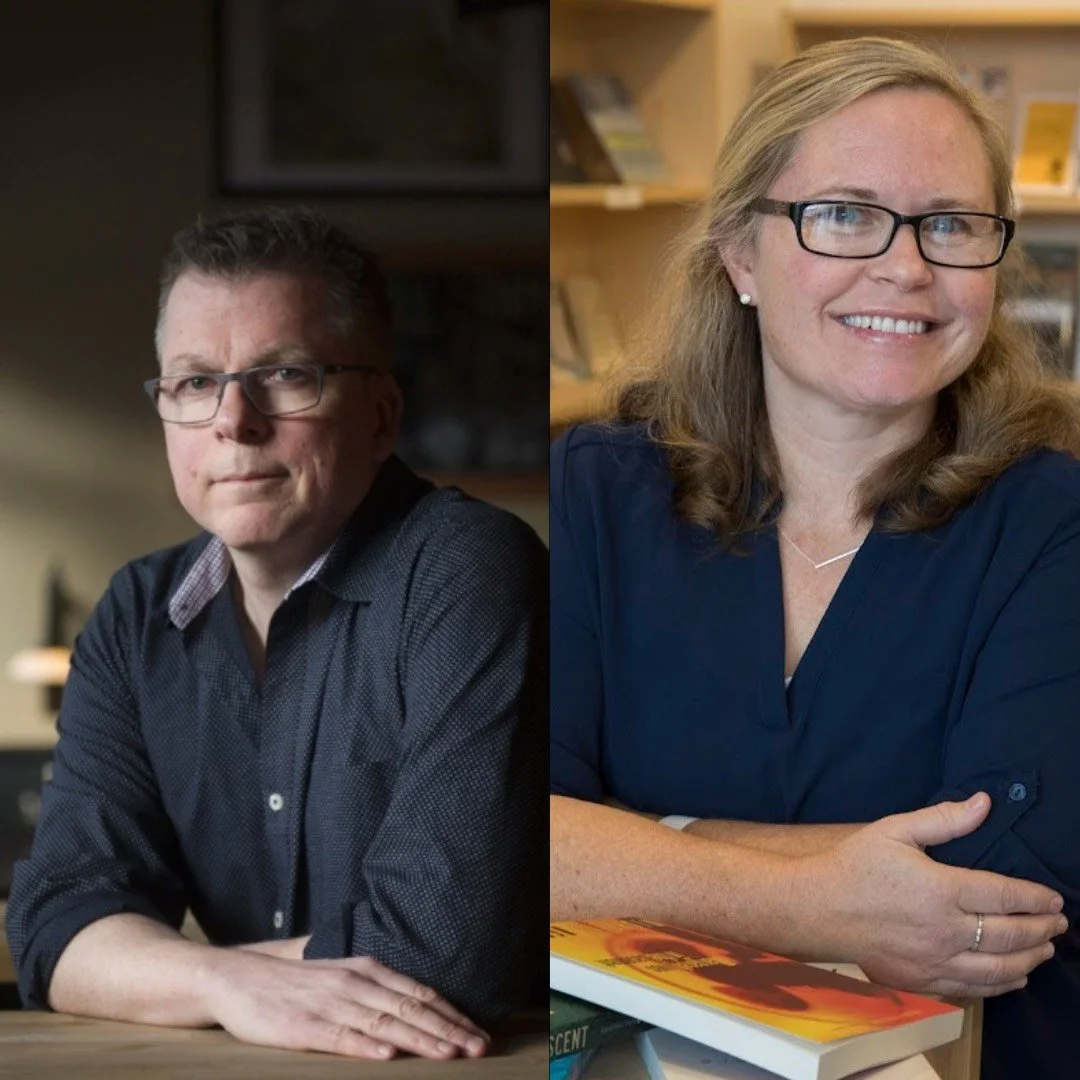
Peter Darbyshire: You published a dozen books before Satellite Image, a genuinely creepy novel that turns every urbanite’s dream of escaping to idyllic small town life into a nightmare. (Thanks for ruining that fantasy for me!) The steady pace at which you’ve been able to publish books tells me you’ve figured out some sort of writing system that’s working for you. What’s your secret?
Michelle Berry: Great question (and I'm sorry for ruining your dream of small town living). I look at my steady pace and look at what was happening in my life throughout and wonder the same thing. How did I continue to write while raising two children and three pets and a husband, while moving houses and cottages and cities, while teaching, while traveling and owning and working full time at my bookstore, during covid and suffering ongoing health issues? Maybe because writing can take me from the everyday and emotional and chronic conditions I live in to a world I can manipulate, a world that seems controllable. I've also been lucky to think that writing is my career and that there is nothing else. Even when I owned my bookstore I was thinking, I'm just doing this to procrastinate, soon I'll get back to my real work.
My system is that when I have a novel on the go I sit at my desk every day and try to work for a couple hours. No matter what is going on I've conditioned myself to check in with my characters every day. If I don't have something to work on I read and I read like a writer -- what is working in this book I'm reading? Why is it working? How does the author do this? I pick apart everything. Funny thing is that, because I read like this, I never remember what happened in a book about two weeks after I finished it. And I never remember the endings. I only have a sense of whether I liked it or not and some images of scenes float around my brain. But, really, my system is that my whole world revolves around books. If my fingers aren't on the keyboard moving then I'm lost. Weekends are long in my world because I don't have the routine of sitting at my desk, so I often feel lost.
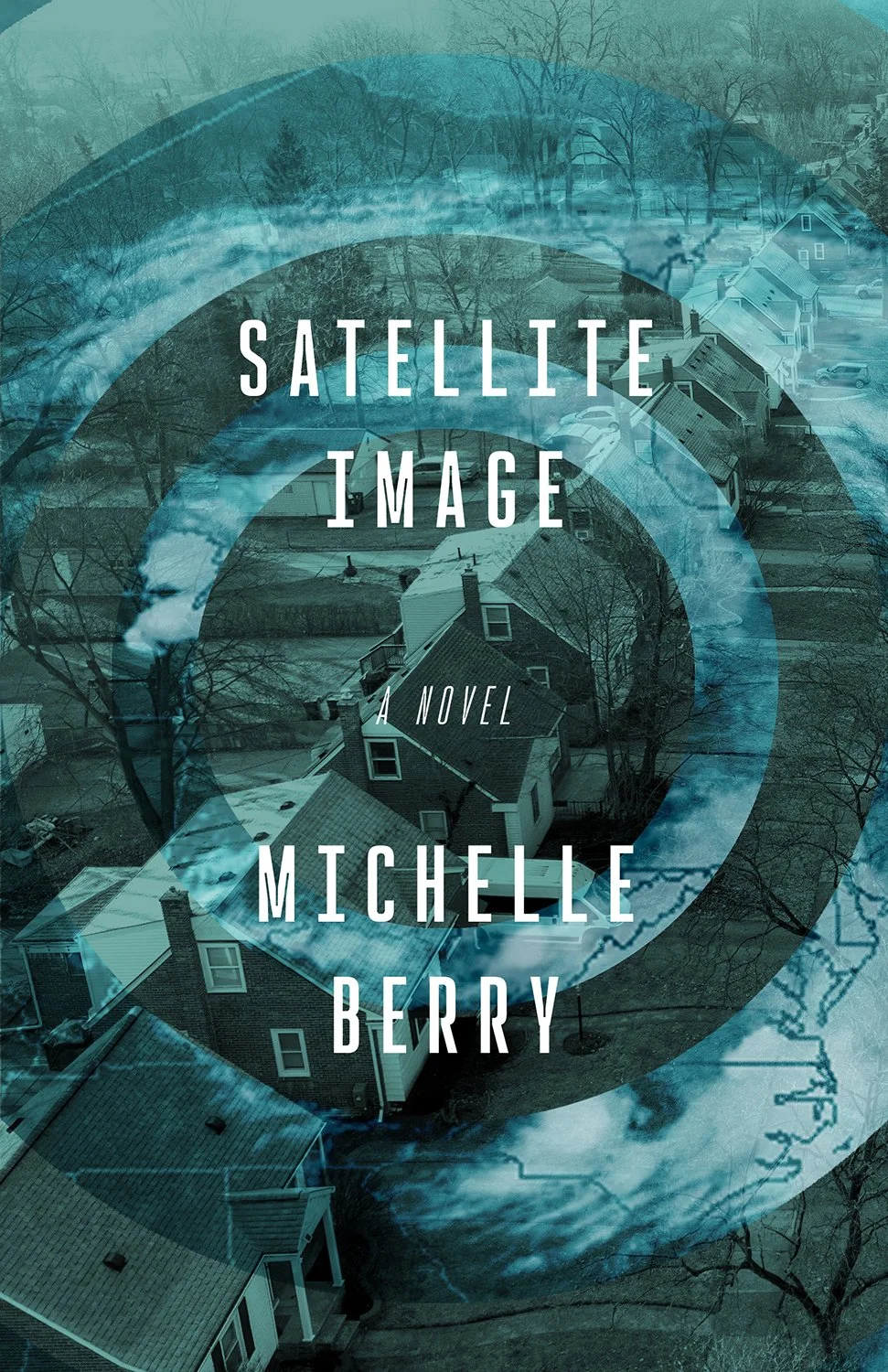
Satellite Image by Michelle Berry, published by Wolsak & Wynn.
PD: Oh, I love the idea that the act of writing can give you a sense of control in a world where we far too often have no control at all — of anything in our lives, really. I suppose the same could be said for reading. It’s a bit of escapism, but even more it helps us to make sense of a world that increasingly makes no sense.
So your writing secret is the old “butt in chair” approach? It does tend to be effective if you can turn off all the distractions on your computer and use that time in the chair to actually write. For those times when you’re not writing and you read instead, do you read at the same desk for the sake of consistency?
I find it interesting that you read to “pick apart” what other writers have done — reverse engineering! When I was younger I used to take short stories by other authors I really liked and copy them out by hand. I found that act of rewriting the stories word by word somehow gave me better insights into how they were structured and where everything was connected under the surface. It’s like taking an X-ray of the story.
What do you do when you are working on a project but your characters aren’t cooperating and the writing isn’t happening? I’ve struggled with that a few times, but I had a breakthrough with my second book, The Warhol Gang, where I realized I don’t actually have to write a book in a linear fashion. I can jump past the scene that is blocking me and work on the scenes that I know are going to happen later. I’ve found that writing the later scene often helps me figure out what is missing from the earlier scene. Sometimes writing feels more like assembling a jigsaw puzzle than building something from start to finish.
MB:You've given me so much to unpack here. I never get to talk about my writing in my daily life so this is wonderful. Don't you find that people who don't write tend to think of writing as magical, that it just happens? But writers work at what they do. Your first question here, about physicality, about sitting in the same spot to read—no, I don't do that. I read all over the house and porches and yard and I don't really associate my reading with my writing while I'm doing it, weirdly. Even though I'm picking apart someone else's work, with the book in my hand I'm not really fully aware that this will benefit my own writing. That comes later. I'm usually just in awe about someone else's talent. Your "butt in chair" meaning "butt in the exact same chair" might be something that could definitely help me (if not lead to slumped shoulders and more carpal tunnel). I think I'll try it and report back to you someday.
In fact, I do have to tell you my biggest trick to writing -- moving furniture. I tend to move my office around or into another room the days before I start writing something new. There's something about a new setting that leaks into my work, as if I've suddenly moved my brain slightly to focus on a new idea. I've put the old to rest and manipulated the new. Try it. Turn your desk around, move your bookshelf, see what happens. Your copying of a writer's work has the same effect, I think, and is a great idea. Instead of moving furniture to manipulate your world, you are jumping into someone else's brain and seeing how they manipulated a world. In the same way, I used to edit by retyping my own novels, it made it easier somehow to add and subtract to something already written, but I stopped somewhere along the way. You've reminded me that this process worked.
Your question about what I do when my characters aren't cooperating and about how you see your writing now as a jigsaw puzzle that you are building is fascinating. I think we are about the same age, Peter, and I've suddenly discovered that I don't like writing as much as I like editing -- and that is because creating is hard work but editing, to me, is like putting together a jigsaw puzzle (I've actually been using this analogy a lot lately). Moving characters, settings, plot around and fitting everything together smoothly is way more fun than creating these days. When I'm creating, and my characters aren't cooperating, I tend to go back through the whole piece I've written and play with the puzzle -- put that piece over here, discard the other piece, fit together pieces, until I see a pattern. Then I go back to that uncooperative character and suddenly she/he makes sense. I also read or go for a walk when I'm stuck.
Speaking of me trying to control everything (ahem), in your novel The Mona Lisa Sacrifice your character, Cross, goes with the flow, there is nothing he can control in his wild world so he (sort of) has to accept his crazy existence. In fact, he isn't in the real world, he moves from place to place and through history like he's on fire (which he is at some points, actually). Are you like Cross? Does your brain skip and race all over and throughout time? How do you keep up this frenetic pace in a novel? I felt like I was reading your book on adrenaline and had a hard time imagining you sitting peacefully at your desk. Tell me about how you keep Cross moving so rapidly and consistently over the years it must have taken you to write him? You must drink lots of coffee?
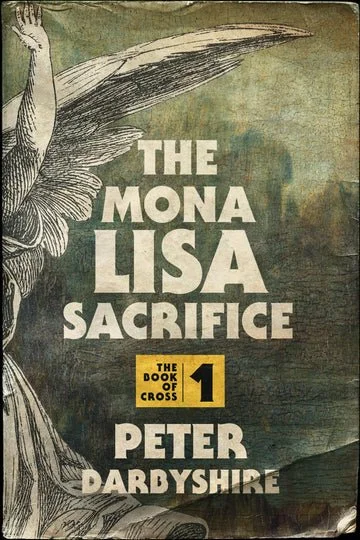
The Mona Lisa Sacrifice by Peter Darbyshire, published by Wolsak & Wynn, 2024.
PD: I think I did project a bit of myself onto Cross in The Mona Lisa Sacrifice, at least the times where I’m just exhausted with existence and this world. I figured that someone immortal like Cross would get pretty weary of the same stupid things that humans do over and over throughout the ages. But there’s also a strong element of stoicism to Cross, which helps him to accept that things are the way they are and he can only change the things he is actually capable of changing. (Which, granted, can be a lot when you have magic powers, hang out with faerie and gorgons, and get into fights with angels.) I was reading a lot about stoicism at the time I wrote the books to help me cope with anxiety issues and my tendency to catastrophize (all that coffee didn’t help!), so I think some of that definitely found its way into The Mona Lisa Sacrifice and perhaps more so its sequels, The Dead Hamlets and The Apocalypse Ark.
I don’t typically write myself into my own stories, although the episodes in Please, my first book, were largely inspired by things that had happened to me or my friends. But by the time I began writing The Warhol Gang I had moved on to being inspired by the unreality of the larger world — I was really trying to write tomorrow’s headlines with that novel. With the Cross books, I wanted to bring some magic into our world, maybe to counter all those bleak and absurd headlines. So I took the literary characters I had fallen in love with over the years, and the works of art that intrigued me, and I brought them to life in the books as Cross’s friends and enemies, or as plot elements and so on. The best way to fight absurdity is with creative absurdity!
The interesting thing about working with other creators’ characters as I did, such as Alice from the Wonderland tales or Captain Nemo from Jules Verne’s works, is that they tend to have a kind of literary resonance about them. They invoke other stories and even other worlds just by their presence — not only for the reader but also for me. I think it’s what leads to that frenetic pace you mention. I keep getting ideas for new twists or directions from those other characters, so Cross keeps bouncing from one story to another within a book, and somehow they come together to form the larger tale. Often it’s not the tale I set out to write, but writing should be a process of discovery not transcription.
I found the Cross books actually changed my writing style in some substantial ways. I now often hint at storylines that I have no intention of following up on. I want to plant the story seed in the mind of readers, but I want them to imagine those other storylines and what happens off the page for themselves. It’s a little more participatory for the reader, and it creates this sense of each book being a sort of endless library of tales, which fits the mood of the overall Cross series.
How do you feel your writing style has changed over the course of your career?
MB: Things that worked before don't often work the next time. I think my writing style has changed because I'm more forgiving when things aren't working than I used to be. I used to ceaselessly fret, now I just give myself a break and try to do something else for a bit if I can. Now I know that moving furniture helps my process. Now I don't retype my work in progress anymore (and in the process have saved my fingers). So I would say my style has changed in that I'm accepting and forgiving of myself now. All I want is to enjoy the process and have others enjoy the results. I look back at the writing of Satellite Image and remember all the old characters, all the other subplots I had and the other endings -- this wasn't the book I started with -- and I'm happy with the fact that I made all those changes without worrying about how different the book had become. And that's how my style has changed -- I'm more laid back about the whole process now. I've finally grown up.
I'm hoping and assuming that you are going to write more Cross books? Has your writing style changed over these last three novels more than it did, say, between Please and The Warhol Gang? I'm assuming that because you are following the same character, Cross, all through that you have to be incredibly consistent here. Micro-consistent. Does that bother you? Does a sequel take away from the excitement of creation? Or do you feel like you are jumping into a familiar skin and living the best (and strangest) life each time?
PD: That’s a really interesting question because I recently finished a new Cross novel, as well as a collection of short stories about Cross’s misadventures over the ages. At the same time, I’ve been editing the first three books for new editions due out in October 2024 with Wolsak and Wynn. Republishing the books has given me an opportunity to make some changes and rewrite parts of them. Most writers don’t have a chance to change a book once it’s been published, so it’s been a wonderful opportunity for me.
My writing style has changed somewhat over the past few years, in that I think about structure in different ways. This came out of being in a workshop group with some local writers — Sebastien de Castell, Wil Arndt, Kim Tough and Brad Dehnert — where we spent a lot of time talking and reading about structure, looking at the “rules” of structure in different mediums, that sort of thing. So when it came time to edit the new editions, I did some work on restructuring the series to make the books connect together better — more foreshadowing and echoes, etc. — and also to generate more inner conflict and mysteries for certain characters. I’m completely incapable of just leaving things alone in an edit — I also want to change things because I’m always thinking of new angles that interest me, and I find the act of writing a bit like solving a mystery. Once it’s done, I kind of lose interest in the project. So when I’m editing I have to introduce some new mysteries for me to solve to maintain my interest, even if they are simply technical mysteries.
I was really eager to step back into Cross’s world for the fourth book, but I did wonder if it would be a challenge given I hadn’t written anything in the series for a few years. So yes, I was worried about that consistency issue, to make sure it was like the other books. But I also wanted to take the series in a new direction because you should start seeing some changes four books in to a series, if you know what I mean. The nice thing about working in an established world is that you can slip back into it quite easily — jumping into the familiar skin, as you say. You already have the characters and their relationships and the world established, so the focus for you as a writer is really the plot. That’s quite different from a stand-alone book, where you have to figure out all those things. But you also have to watch out that you don’t slip into some unconscious pattern where you’re just repeating the same thing as previous books. So with the fourth book I spent a lot of time thinking about how to change Cross’s world and what those changes would mean for him. I was going through some significant personal changes while writing the book, so I tried to let some of the spirit of that enter the book, in the same way my reading about stoicism influenced the character of Cross.
One of the unexpected challenges of writing a series if you haven’t done so before is finding a system to keep track of all the characters, settings, plot threads, etc. There were times when I was writing the fourth book where I honestly couldn’t remember if I’d killed a character in one of the earlier books and so couldn’t use them again, that sort of thing. Plus I needed a better way of keeping notes than writing them down on scraps of paper I inevitably lose. I realized I needed a database system and wound up using Notion, which has really helped me keep track of things. I know other people use Scrivener or Evernote, so it’s whatever works for an individual writer. But at a certain point I think every writer needs a system to keep track of things.
I want to return to the idea of writing groups and peer support for a moment, because the idea of community has become very important for me when it comes to writing. I don’t think I would have ever become a published author without that community, and I doubt I would still be writing if not for my writer friends. That was actually one of the reasons I wanted to have this conversation with you, because you had sort of mentored me with Please when I was taking my first steps to being a writer. How important has mentorship and the writing community been to you as a writer?
MB: That’s so kind of you to say about me mentoring you for Please. I never feel as if I help anyone in any way and so hearing that memory is wonderful. I’m actually in a deep hole these days with my life. I ran my store for 5 years and was so focused on paying the rent, ordering books, hiring staff, etc. that I didn’t have time to concentrate on my writing. I was only able to edit during that time, really, and so I dredged up an old book of mine that I had filed away, Everything Turns Away, and spent months editing at the store and put that out instead of writing something new. I have also, for eight years, had major chronic health issues that are messing with my ability to see anyone (except doctors) so the only thing I do these days is get lost in my own work. I haven’t been able to reach out as much to other writers anymore in person and no one wants to chat on the computer because that seems like work to them now. I do mentor and teach online at U of T in the continuing education department, and I find that exciting and important and affirming. I know that discussing someone else’s work makes me look at my own work in a different way, plus it keeps me informed about the writing industry. Community is incredibly beneficial. But I feel I’ve lost a lot of that over the years.
I think about the past and how we were all together, fighting the good fight. Ha ha. We saw each other weekly at parties, readings, book events. We talked about writing on the run. But now we’re all spread out and have no time or energy (or health) anymore. But when I do get talking (like this!) with one of my colleagues I feel part of something again. Only another writer (or editor) can tell you what you need to hear to make a piece of work better. Maybe I just need to do more teaching and mentoring. I helped Trent University start a great continuing education certificate in creative writing many years ago (which has since been shut down) and I loved how involved I was with that. I do have some friends who used to be consistent readers for me. Charlie Foran was a big one over the years, as was Jonathan Bennett, a good friend to both of us. Another friend of ours, Paul Vermeersch, has been a constant supporter. My dad, a retired English professor, reads and comments on everything I write. My husband, of course, is saddled continuously with hearing about and reading my books in progress. My editors, my agents all help. I’m starting to realize, Peter, that, during this interview, you have been reminding me of all the things that used to work for me, all the things that I have to go back to doing.
My last question to you is: (because you’ve reminded me of my past so much in this interview)
If you could go back in time (like Cross) and tell your young writer-self what to do, how to make things better, how to avoid the bad things, take advantage of the good things, how to be the best writer you can be, what would you say and do? And conversely, if you think you’ve done everything you can at this point, what is your best writer-advice to the new up-and-coming writers? Be the crotchety old man in the rocking chair, Peter, the one who says, “when I was young,” and give those writers some hints and instructions and recommendations.
PD: I’m sorry to hear of your health issues and how that’s affected your sense of community. Maybe we need to start an online writing group to keep everyone in touch! You’re right that connecting with other writers or editors does make you feel part of something again. I always feel a renewed interest in writing after meeting with other writers. Sometimes we don’t even meet for writing — the group I mentioned earlier is also my D&D gang and we have wonderful times getting up to crazy misadventures together.
As for lessons to my younger self, that’s a tough one. It feels like so much of my writing career has been defined by luck, both good and bad (although I suspect we all feel that way). Obviously, I would say find that community and stay involved in it, as we’ve just been discussing. Or maybe communities — both physical and online. The other thing I would say is focus less on goals and find a system that really works for you. (Here I go about systems again….) It’s good to have a goal, such as getting your first book published or writing a book a year or whatever it is. But even if you achieve your goals — and that’s a big if when so much is out of your control — whatever satisfaction you get from that will be fleeting at best. Instead, if you work on developing a system that makes you happy or at least gives you satisfaction, you’ll likely be more inclined to sit down and write more often. And if you’re doing that, the goals tend to take care of themselves.
That system can be whatever you like — it could be writing in a certain environment or using a specific app or listening to soothing music or whatever. For me, it was trying to make my writing space more pleasant, which maybe gets back to your earlier point about moving desks and so on. I had a time when I just didn’t want to sit down at my desk and write because it felt like grinding work for not much return. So I set about trying to make my office more fun and a pleasant space where I wanted to spend time. I framed some D&D postcards and put them on my desk to keep my environment fun and creative, bought a Tintin rocket to sit beside my computer because I’d always wanted a Tintin rocket since I was a little boy, kept my stoicism coins from The Daily Stoic close at hand so I’d have something to fidget with that would help my peace of mind, changed my desktop pictures to photos of my kids, and so on. In short, I made it an environment I wanted to be in, not one that I felt obligated to visit to get some work done. As soon as I made those relatively simple changes, I began to write more. So figure out what makes you happy, then find a way to incorporate it into your writing routine.
Finally, I recommend that you write what you want to write. I think we all stress about writing to the market o the latest trends, what will sell and what won’t, and all that. That’s fine to a point — and perhaps unavoidable in today’s publishing market. But make sure that you are writing something that you actually want to write, that engages you and is your story and yours alone. Always remember that your creative vision and voice are valid and that there are readers out there who are waiting for exactly what you are writing. Maybe they number in the millions, maybe in the dozens, but they are out there and your writing will make a difference in their lives. Always remember the world needs you. So get writing.
Michelle Berry is the author of more than eleven books. Her latest novel, Satellite Image, was released by Wolsak and Wynn in October 2024.
Peter Darbyshire is the author of six books, including the Cross series of supernatural thrillers. The first three Cross books — The Mona Lisa Sacrifice, The Dead Hamlets and The Apocalypse Ark — was released by Wolsak & Wynn in October 2024.

Power Q & A with Sheila Stewart
Sheila Stewart’s stunning poetry collection, If I Write About My Father, (Ekstasis Editions, 2024) dismantles the patriarchal religious ideologies of Sheila’s upbringing by a protestant minister, while sustaining the emotional intimacy experienced in familial relationships.
Sheila explores the daughter-father relationship, uncovering the complexities of growing up as the minister’s only daughter in a family shaped by church and manse in small-town southern Ontario. She braids narrative and lyric, the textures of liturgy and memory. While critiquing patriarchal weight and constraint, the work explores how a particular religious upbringing shapes thinking, the rhythms of language, and the fabric of consciousness.
Sheila Stewart’s stunning poetry collection, If I Write About My Father, (Ekstasis Editions, 2024) dismantles the patriarchal religious ideologies of Sheila’s upbringing by a protestant minister, while sustaining the emotional intimacy experienced in familial relationships.
Sheila explores the daughter-father relationship, uncovering the complexities of growing up as the minister’s only daughter in a family shaped by church and manse in small-town southern Ontario. She braids narrative and lyric, the textures of liturgy and memory. While critiquing patriarchal weight and constraint, the work explores how a particular religious upbringing shapes thinking, the rhythms of language, and the fabric of consciousness.
Sheila joins us for this Power Q & A to talk about why she decided to tackle the church and her relationship with her father with these powerful poems.
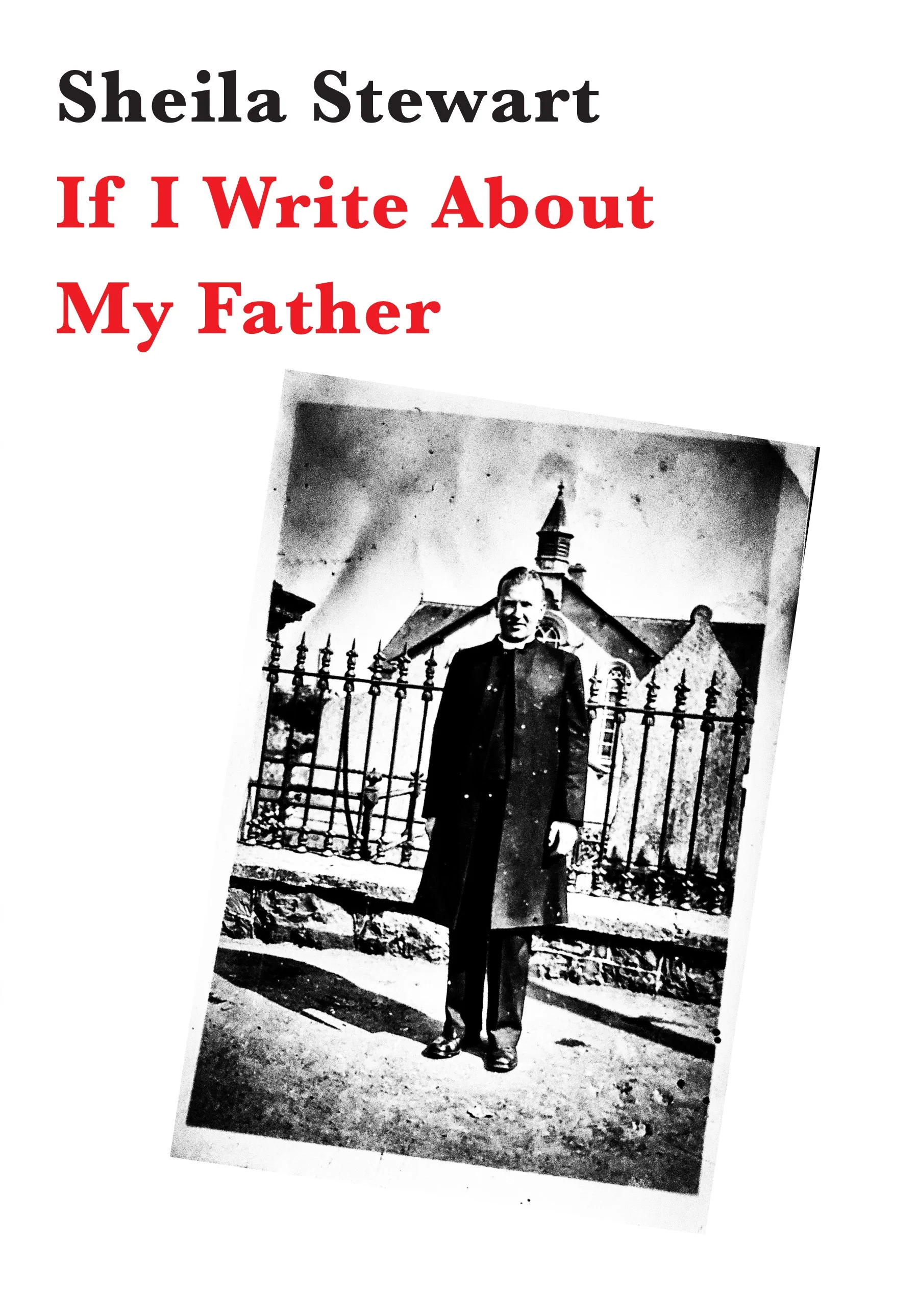
Q: Why did you focus this collection on your relationship with your father and the church?
A: It wasn’t so much a deliberate choice to write about my father and the church, as something I was compelled to do. I was writing a dissertation at the Ontario Institute for Studies of Education/University of Toronto (OISE/UT) and wrestling with my own authority as a writer. While I’ve always been drawn to ideas and learning, tackling a PhD at age 48, was intimidating. I was aware of the hierarchies and power structures of the University having worked at OISE/UT for years as a research coordinator on adult literacy issues.
Growing up in small town Southwestern Ontario as the minister’s only daughter, I was conscious of the power dynamics within our traditional Irish Canadian home and the congregations where my dad served. I’m very interested in the way religions provide stories and meaning for people to live their lives. I’m not Christian, but I was surrounded by the language and poetry of the Bible as a child. The book begins with a poem called “Altar”. I am exploring spirit and, in a sense, find it in the natural world, Lake Ontario, High Park. My earliest years were mainly indoors, in the manse and at church surrounded by parishioners, and then at school where I was known as the minister’s daughter. I needed to work through the restraint and strictures of my church upbringing to inhabit a more embodied sense of self.
My first collection, A Hat to Stop a Train (Wolsak and Wynn), is about my relationship with my mother and her life as a minister’s wife. I’m fascinated by how family members shape each other. If I Write About My Father (Ekstasis Editions) is kind of companion piece to my first book. While the book is about aspects of my relationship with my father, it is also about authority and power of different kinds: institutional and that found as a writer, often through a long wrestle with words.
More about If I Write About Father:
What effect do fathers and faith have on a child? In If I Write About My Father, Sheila Stewart explores the daughter-father relationship drawing on reflections about her father, a Northern Irish Presbyterian minister who immigrated to Canada and joined the United Church. Her poetry uncovers the complexities of growing up as the minister’s only daughter in a family shaped by church and manse in small-town southern Ontario. Stewart braids narrative and lyric, the textures of liturgy and memory. While critiquing patriarchal weight and constraint, the work explores how a particular religious upbringing shapes thinking, the rhythms of language, and the fabric of consciousness. In this quest, the poet draws from the sensory world by walking the woods and Lake Ontario shores.

Sheila Stewart
More about Sheila Stewart:
Sheila Stewart’s publications include two poetry collections, A Hat to Stop a Train and The Shape of a Throat, and a co-edited anthology of poetry and essays entitled The Art of Poetic Inquiry. Awards include the gritLIT Contest, the Scarborough Arts Council Windows on Words, and the Pottersfield Portfolio Short Poem Contest. Her poetry has been widely published in Canadian and international journals. She recently left teaching at the University of Toronto to devote herself to writing.

Power Q & A with Wayne Ng
Crime Writers of Canada Award-winning author Wayne Ng’s highly-anticipated Toronto-based novel, Johnny Delivers, is being released this November 1st by Guernica Editions, and it has already been included in CBC's and the 49th Shelf's Most-Anticipated Fall Fiction lists.
Set in 1977, Johnny Delivers tells the absorbing story of 18-year-old Johnny Wong—the son of Chinese immigrants to Canada—who calls on the spirit of Bruce Lee to help him navigate the still relevant challenges of racism and how it permeates our interiority, our institutions, our relationships, and our livelihood.
Crime Writers of Canada Award-winning author Wayne Ng’s highly-anticipated Toronto-based novel, Johnny Delivers, is being released this November 1st by Guernica Editions, and it has already been included in CBC's and the 49th Shelf's Most-Anticipated Fall Fiction lists.
Set in 1977, Johnny Delivers tells the absorbing story of 18-year-old Johnny Wong—the son of Chinese immigrants to Canada—who calls on the spirit of Bruce Lee to help him navigate the still relevant challenges of racism and how it permeates our interiority, our institutions, our relationships, and our livelihood.
This book is exciting and heart-wrenching and readers are loving it! A favourite element of the story is undoubtedly Johnny’s conversations with Bruce Lee, so we wanted to ask Wayne, “Why Bruce?:
We are happy to welcome Wayne to our Power Q & A series today to answer.
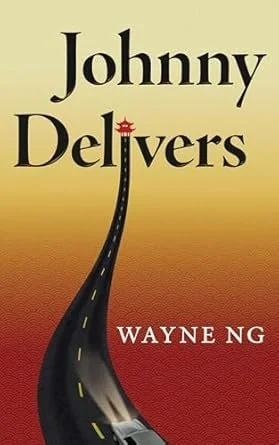
Q: Why did you choose Bruce Lee to serve as Johnny’s moral guide and confidant?
A: Most kids need a hero. In the standalone prequel, Letters From Johnny, 11-year-old Johnny worked through his problems by writing letters to hockey icon Dave Keon, just as I once did. Now, as an angst-filled teen on the cusp of manhood in Johnny Delivers, Johnny turns to Bruce Lee—a larger-than-life hero I also admired as an unstoppable fighter. What made Bruce especially significant was his defiance of the stereotypical portrayal of Asians in popular culture as humble, passive, and helpless.
With Johnny Delivers, I wanted to show that Bruce Lee was more than just a trailblazing martial arts film icon. He was also a philosopher, a writer, and family man. And, like any hero, he had his flaws—something Johnny struggles to accept. Since the novel is ultimately a coming-of-age and family story, Bruce is the glue that holds his relationship with his father. I wanted Johnny's evolving view of Bruce to reflect his journey—where their growth connects and separates them.
More about Johnny Delivers:
Eighteen-year-old Johnny Wong’s dead-end life consists of delivering Chinese food and holding his chaotic family together in Toronto. When his sweet but treacherous Auntie, the mahjong queen, calls in their family debt, he fears the family will lose the Red Pagoda restaurant and break apart.
Invoking the spirit of Bruce Lee and in cahoots with his stoner friend Barry, Johnny tries to save his family by taking up a life of crime delivering weed with a side of egg rolls. He chases his first love, but his hands are already full with his emotionally distant mother, his dream-crushing father, and his reckless, sardonic little sister.
As he fights to stay ahead of his Auntie, sordid family secrets unfold. With lives on the line, the only way out is an epic mahjong battle. While Johnny is on a mission to figure out who he is and what he wants, he must learn that help can come from within and that our heroes are closer than we think.
Dripping with 1970s nostalgia, Johnny Delivers is a gritty and humorous standalone sequel to the much-loved and award-winning Letters From Johnny.
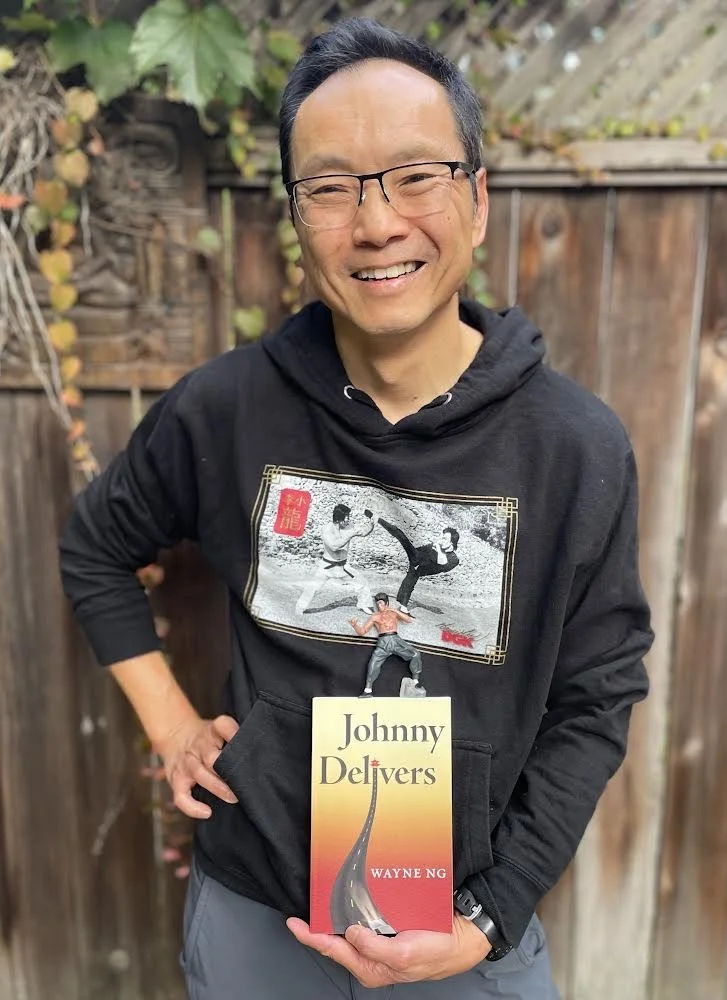
More about Wayne Ng:
Wayne Ng was born in downtown Toronto to Chinese immigrants who fed him a steady diet of bitter melon and kung fu movies. Ng is a social worker who lives to write, travel, eat, and play, preferably all at the same time. He is an award-winning author and traveler who continues to push his boundaries from the Arctic to the Antarctic. He lives in Ottawa with his wife and goldfish.
Ng is the author of The Family Code, shortlisted for the Guernica Prize; Letters From Johnny, winner of the Crime Writers of Canada Award for Best Crime Novella and a finalist for the Ottawa Book Award and Johnny Delivers.

Power Q & A with Michelle Berry
Michelle Berry is an acclaimed author of literary thrillers. Her newest novel, Satellite Image (Wolsak & Wynn, 2024) follows the story of Ginny and Matt, a young married couple from the city who decide to buy a house in a small town and move after Ginny is assaulted.
On the night before the move, however, Ginny and Matt, while looking at a satellite image of their new home, see what is undeniably a body in their backyard. Thus the stage is set for this eerie story.
Michelle Berry is an acclaimed author of literary thrillers. Her newest novel, Satellite Image (Wolsak & Wynn, 2024) follows the story of Ginny and Matt, a young married couple from the city who decide to buy a house in a small town and move after Ginny is assaulted.
On the night before the move, however, Ginny and Matt, while looking at a satellite image of their new home, see what is undeniably a body in their backyard. Thus the stage is set for this eerie story.
We noticed a different feel to Michelle’s novel compared to many other thrillers. While the story delivered on the chills and suspense, there was also a sophisticated rendering of character and events, where the reader was left to fill in what is not explicitly stated. There was also an upending of certain genre-based narrative conventions that offer a subtle commentary on real life and real people. We wondered: is this a signature of the literary thriller genre? What is a literary thriller, exactly? Or even just generally?
Welcome Michelle Berry to our series to help answer our questions.
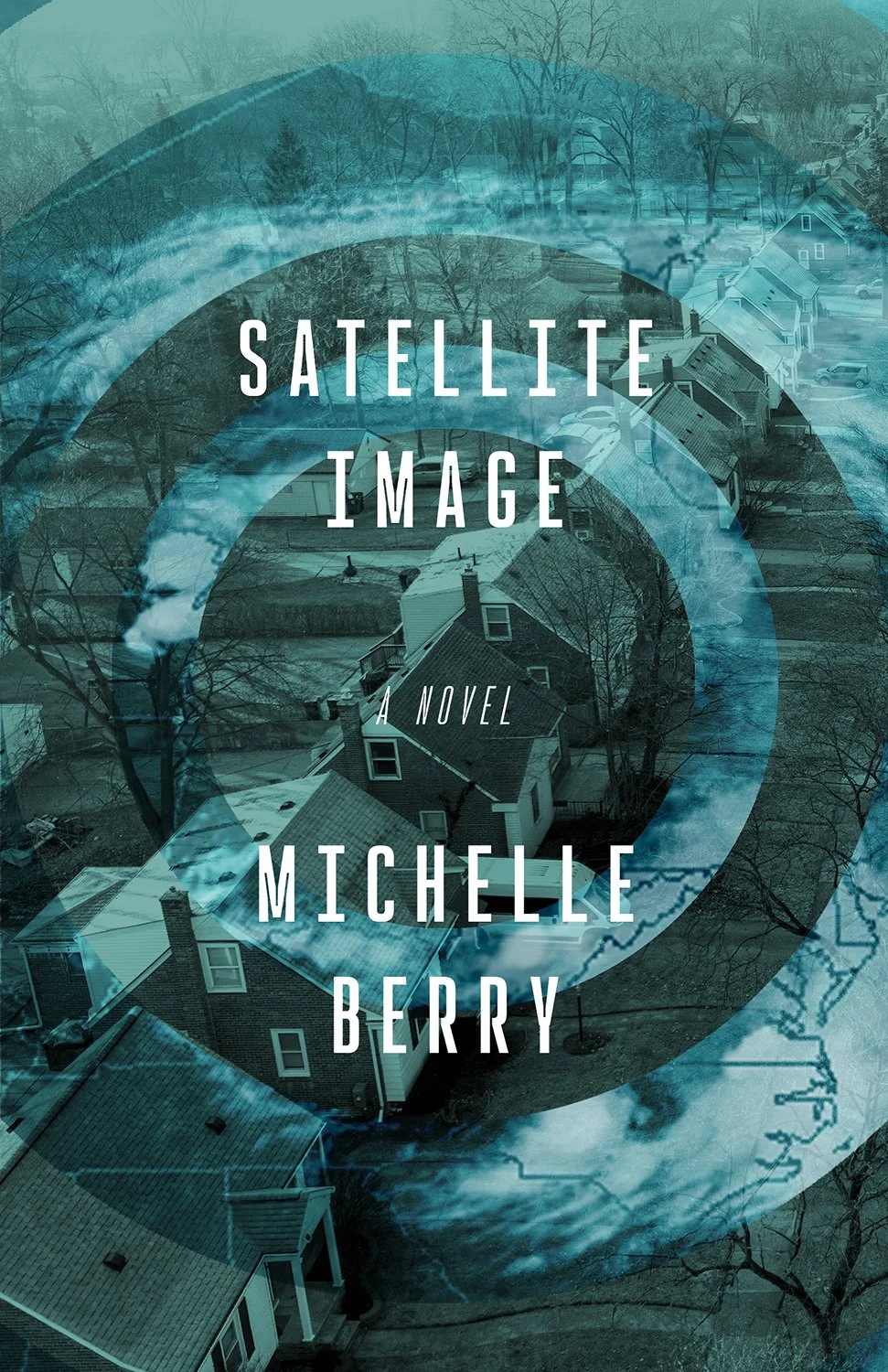
Bring home Satellite Image by Michelle Berry (Wolsak & Wynn, October 15, 2024).
Q: Would you use your book, Satellite Image, to highlight some differences between a literary thriller and a thriller?
A: I’m not sure if this is correct, but this is how I see the differences between a traditional thriller and a literary thriller. I imagine a tightrope. Let’s call it a Literary Thriller Tightrope. I’m walking along it. One foot falls off occasionally but I remain pretty steady to the end. Now I imagine another Tightrope. Let’s call this one a Thriller Tightrope. Again, I’m walking along and suddenly I really fall off. Both are tight ropes, but on one my foot just dips into the unknown, on the other I fall completely in.
I see a literary thriller, like Satellite Image, tipping back and forth between the frightening situation and the reality of the situation (in it I’m losing my balance, a foot falls off, but I don’t fall). This book focuses more on the psychological effects of the fear, on misperceptions and misunderstandings – what is real? What is not real? Ginny and Matt – are they really seeing/hearing/feeling something in their house or is their previous anxiety (seeing the satellite image of the body in their yard, Ginny’s attack in the city) playing havoc on their minds? On the other hand, a traditional thriller to me would look at things that are actually happening which are frightening and the reader would fall completely into those things. A threatening figure would be a threatening figure. But in Satellite Image the fear is more about perception—is the threatening figure real or is this just my imagination?
I also think that traditional thrillers generally give you more detail—things are explained and portrayed in ways that don’t demand you use too much of your own imagination and instead just fall into the writer’s thoughts. In a literary work the author may leave the reader with a lot to be figured out—do we know exactly what the characters are wearing or what they look like? Do we know what their house looks like? etc… I sometimes think thrillers are more entertaining in that they let you sink into what the author directs, whereas literary thrillers are maybe asking the reader to do a little more work in some way.
I’m probably completely wrong about the differences (and there are, of course, many books that are exceptions to the rule), but that’s kind of how I see Satellite Image. Ginny and Matt’s odd house, the things that make them nervous, their year of fear and what really happened is left up in the air – is anything real? Is anything easily explained? Or is it all psychological? Is it all a misunderstanding?
More about Satellite Image:
Reminiscent of the works of Barbara Gowdy and Joy Williams, Berry’s Satellite Image fully embraces the uncanny as it straddles the line between reality and unreality. When newly married couple, Ginny and Matt, move from the bustling, expensive rat race of the city to a sleepy, innocent, affordable small town two hours away, they assume life will be easier. Little do they know that they have bought a house with a baffling history. Life in this town is not all it’s meant to be. Odd neighbourhood dinner parties, and a creepy ravine just out their back door have Ginny and Matt quickly questioning their move.
Read an excerpt of Satellite Image here.
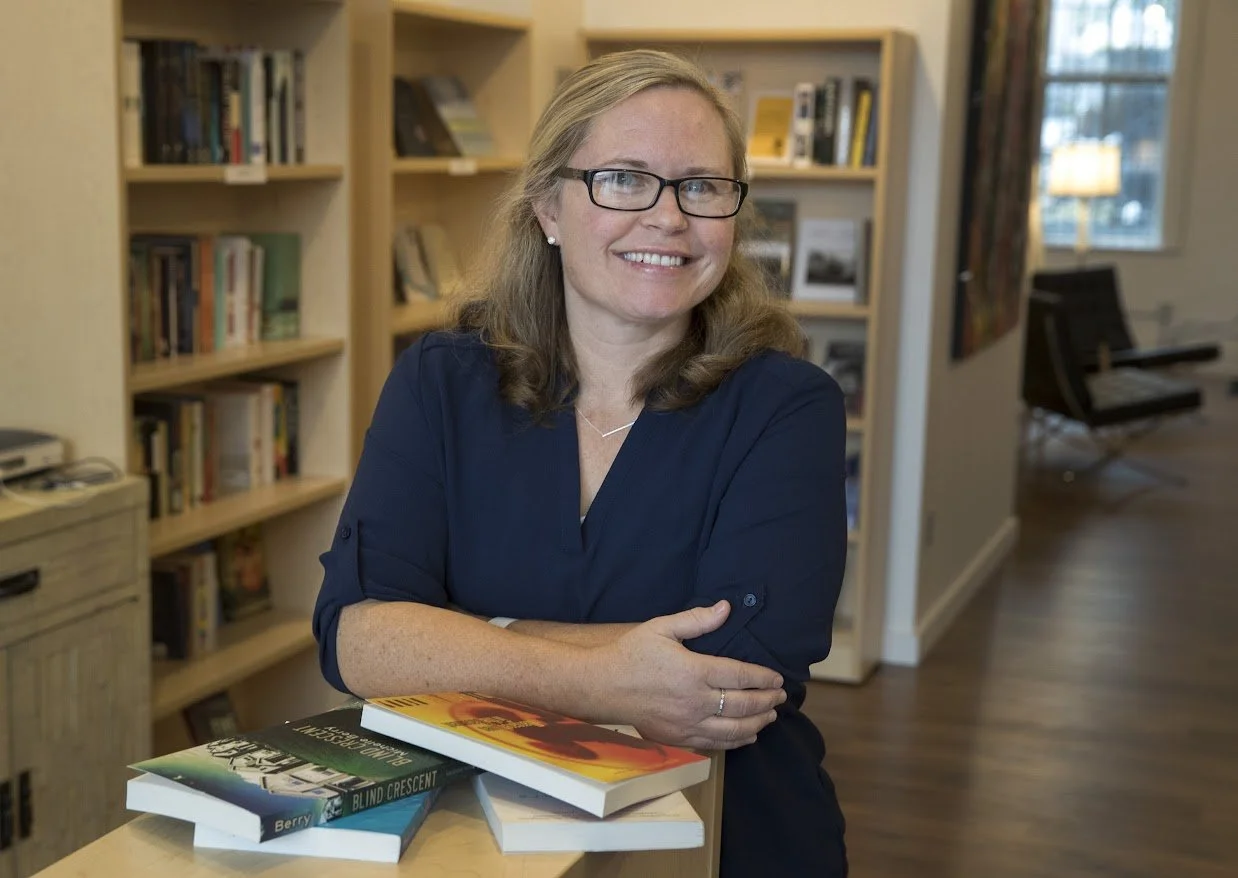
Michelle Berry. Photo credit: Fred Thornhill.
More about Michelle Berry:
Michelle Berry is the author of seven novels and three books of short stories. Her books have been shortlisted, long listed and have won multiple awards. Much of Berry’s writing has been optioned for film several times, with The Prisoner and the Chaplain currently in the works. Berry was a reviewer for the Globe and Mail for many years and currently teaches at the University of Toronto in the Continuing Education department. She has served on the board of PEN Canada, the Writer’s Union and on the Author’s committee of the Writer’s Trust. For five years, Berry owned and operated her own independent bookstore in Peterborough, Ontario, called Hunter Street Books.
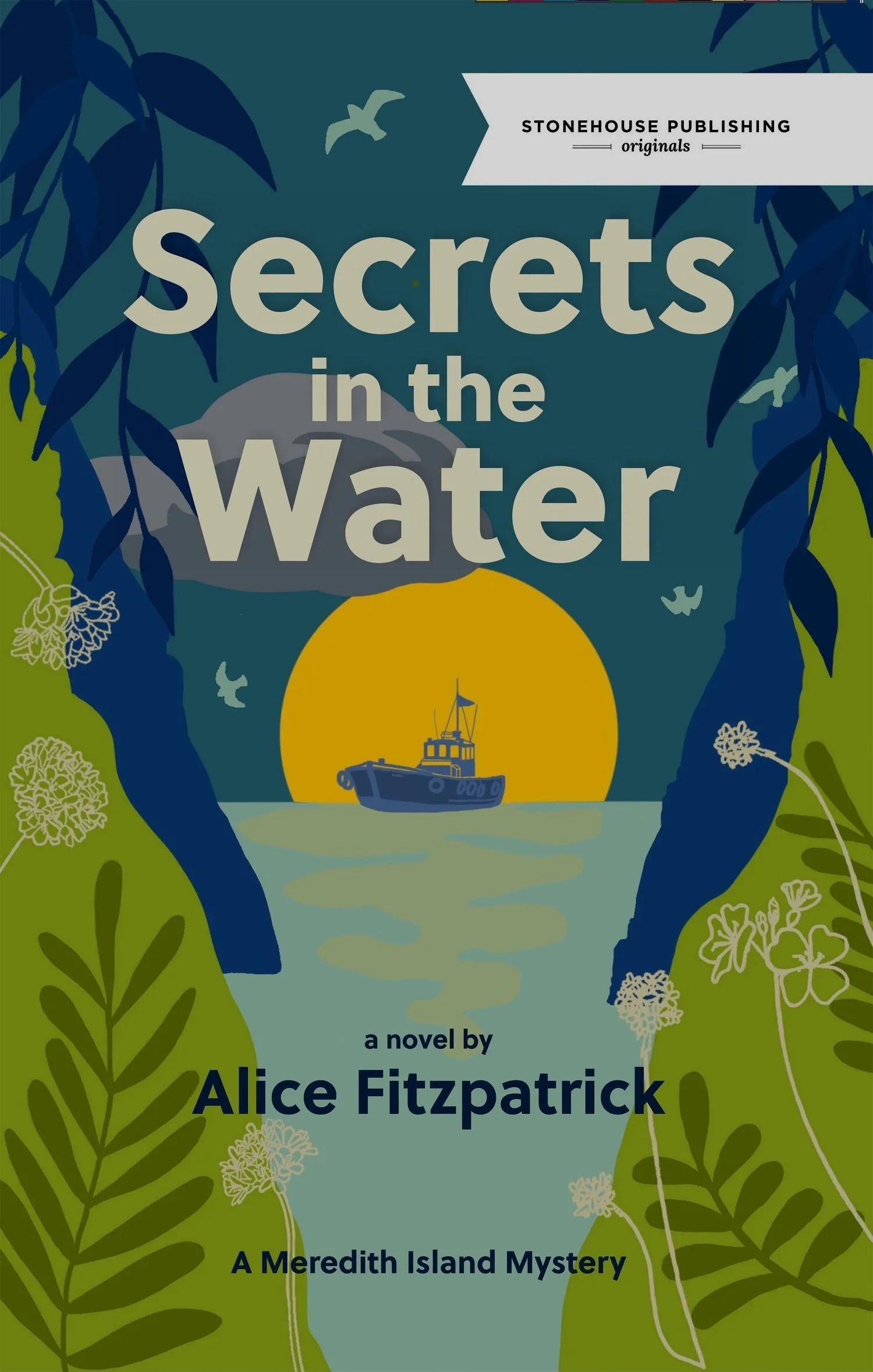
Power Q & A with Alice Fitzpatrick
Secrets in the Water by Alice Fitzpatrick is an absorbing mystery set in Wales that tells the story of Kate, a recently divorced woman who returns home to the fictional location of Meredith Island after her grandmother’s passing. There, she learns that her beloved aunt’s suicide may not have been a suicide. What follows is an exciting whodunnit in the tradition of great British mysteries.
Secrets in the Water by Alice Fitzpatrick is an absorbing mystery set in Wales that tells the story of Kate, a recently divorced woman who returns home to the fictional location of Meredith Island after her grandmother’s passing. There, she learns that her beloved aunt’s suicide may not have been a suicide. What follows is an exciting whodunnit in the tradition of great British mysteries.
The community of Meredith Island feels so real and rooted in place that we had to ask Alice about choosing the setting of her novel.
Welcome, Alice, to our Power Q & A series!

Secrets in the Water by Alice Fitzpatrick, published by Stonehouse Publishing.
Q: Can you tell us about your decision to set this compelling mystery in Wales?
A: When I was a child, my British family moved to Wales and each summer would welcome me to Tenby, a popular seaside resort on the south Pembrokeshire coast. It was during this time that I fell in love with the country and its people. When I decided to write a mystery series, I realized I’d be carrying the setting around in my head for the next twenty or thirty years, so I wanted it to be somewhere where I felt comfortable and welcome. Since I’ve always lived near large bodies of water, and I particularly love the sea, a Welsh island was perfect.
Like most places in the UK, Tenby has a long history. With evidence of settlement dating back to the Iron Age, the town was founded in 1093, and because of this Tenby has curious streets like Merlins Court, Upper and Lower Frog Street, Tudor Way, Crackwell Street, and Paragon. My fascination with these names led me to bestow upon my islanders similarly unconventional names such as Basil and Peregrine Tully, Old Alred, Drucilla Cragwell, and Feebles, Gooley, and Smee.
But it wasn’t just the town that inspired me. All along the Pembrokeshire coast, jagged cliffs rise high above the water, creating a menacing seascape where I imagine Kate’s aunt drowned over fifty years ago. The church next door to my cousin Jim’s house was the inspiration for the island church presided over by the Reverend Imogen Larkin, and its graveyard is the islanders’ final resting place.
Because I visited Tenby during my teenage years, many of my memories are tinged with wonder and innocence. It was where I had my first crush and my first heartbreak when a young man took my address, promising to keep in touch but never did. It was also the location of my aunt and uncle’s hotel where we often sat in the large kitchen and drank tea—sherry for my aunt—ate buttered scones, and shared jokes. So my island became a place of young love and friendship, warm kitchens full of sweet smells, and a pub where people gather for a natter and a gossip.
Unfortunately, it’s also a place where people are murdered. It’s this jarring juxtaposition that sets the tone of the book as protagonist Kate Galway digs deep into the islanders’ memories of their youth to unearth clues about the identity of her aunt’s killer.
More about Secrets in the Water:
Emma Galway’s suicide has haunted the Meredith Island for fifty years.
Back on the island to lay her grandmother to rest, Kate can’t avoid reflecting on the death of her aunt. Learning that her late mother had believed Emma was murdered and had conducted her own investigation, she decides to track down her aunt’s killer. With the help of her neighbour, impetuous and hedonistic sculptor Siobhan Fitzgerald, Kate picks up where her mother had left off. When the two women become the subject of threatening notes and violent incidents, it’s clear that one of their fellow islanders is warning them off. As they begin to look into Emma’s connection to the Sutherlands, a prominent Meredith Island family, another islander dies under suspicious circumstances, forcing Kate and Siobhan to confront the likelihood that Emma’s killer is still on the island.

Author Alice Fitzpatrick.
More about Alice Fitzpatrick:
Alice Fitzpatrick has contributed various short stories to literary magazines and anthologies and has recently retired from teaching in order to devote herself to writing full-time. She is a fearless champion of singing, cats, all things Welsh, and the Oxford comma. Her summers spent with her Welsh family in Pembrokeshire inspired the creation of Meredith Island. The traditional mystery appeals to her keen interest in psychology as she is intrigued by what makes seemingly ordinary people commit murder. Alice lives in Toronto but dreams of a cottage on the Welsh coast. To learn more about Alice and her writing, please visit her website at www.alicefitzpatrick.com.

Excerpt from In the Capital City of Autumn by Tim Bowling
Took the fat family bible and tossed it
off the Lions Gate Bridge
Goodbye Toronto pre-Depression infant death So long psalms of Edwardian fiscal failure
Hurled it the same as Cobden-Sanderson
into the Thames his blocks of type
so no one could come after
so no one could traffick in his lonely fight
Good riddance to fleshpress and letterpress
the antiquarian appetites of every cast
let the orca swallow the bile anvil
for a fibrillating sponge
and sound so deep
Yesteryears
Took the fat family bible and tossed it
off the Lions Gate Bridge
Goodbye Toronto pre-Depression infant death
So long psalms of Edwardian fiscal failure
Hurled it the same as Cobden-Sanderson
into the Thames his blocks of type
so no one could come after
so no one could traffick in his lonely fight
Good riddance to fleshpress and letterpress
the antiquarian appetites of every cast
let the orca swallow the bile anvil
for a fibrillating sponge
and sound so deep
I’ll never hear the undertaker’s step
up concrete walk to rented stoop
or smell the sighing midwife’s sweat
as she wraps another swaddling corpse
in garlic breath and sentiment.
Limit the edition
to a run of naught.
Dropped it like a gargoyle cracked
by revolution off a parapet.
Dead weight of words and font
a typewriter not typed with
since the cease-fire of the Second War
engine block of a Molotoved car
who my people and their moments were
a ledger book of no account
to marauding tide and tireless neon
all the totems not yet poles
along the shore
one black eye for the sun –
no more to visit those dates
that everyone loses or keeps –
the cage with a dead shark
clamped to a dead limb
most impossible evacuation
the bone lifted from under the skin
future’s twin.
—from The Capital City of Autumn by Tim Bowling. Published by Wolsak & Wynn. © 2024 by Tim Bowling.

In the Capital City of Autumn by Tim Bowling (Wolsak & Wynn, 2024)
About In the Capital City of Autumn:
Tim Bowling is in top form in his latest collection of poetry, In the Capital City of Autumn. Threading through autumnal themes such as the loss of his mother and the demolition of his childhood home, his children growing and the inevitable passage of time, Bowling writes with rich lyricism and imagery. Sweet William and loosely woven woollen mitts for his mother, the moon as “an egg in the pocket of a running thief” for time, salmon for eternity. In the Capital City of Autumn, the characters of The Great Gatsby come to life, and three a.m. brings wisdom. These are masterful poems, lightened with a touch of whimsy, poems to sink into on a quiet evening.

Poet Tim Bowling. Photo credit: J. Baker.
About Tim Bowling:
Tim Bowling is the author of twenty-four works of fiction, nonfiction and poetry. He is the recipient of numerous honours, including two Edmonton Artists’ Trust Fund Awards, five Alberta Book Awards, a Queen Elizabeth II Platinum Jubilee Medal, two Writers’ Trust of Canada nominations, two Governor General’s Award nominations and a Guggenheim Fellowship in recognition of his entire body of work.

Power Q & A with Ian Colford
Books have long lives, but if it’s possible to be late to the party celebrating an amazing book, we are definitely late to this one. Ian Colford’s 2023 Guernica Prize-winning novel, The Confessions of Joseph Blanchard, is a mesmerizing read that runs a dazzling gamut of human emotion: love, greed, grief, jealousy, rage. You name it: the characters in this novel—particularly our protagonist, Joseph—sing with range that would make Mariah Carey weak with envy.
Books have long lives, but if it’s possible to be late to the party celebrating an amazing book, we’re definitely late to this one. Ian Colford’s 2023 Guernica Prize-winning novel, The Confessions of Joseph Blanchard, is a mesmerizing read that runs a dazzling gamut of human emotion: love, greed, grief, jealousy, rage. You name it: the characters in this novel—particularly our protagonist, Joseph—sing with range that would make Mariah Carey weak with envy.
In Joseph—a man who falls in love with his 19-year-old cousin—we find a person to rally against and even (surprisingly and often against our better judgment) a person to rally for, despite his slippery moral footing. We are delighted to welcome Ian to our series today to ask him about creating the complex, haunting, and fascinating character of Joseph.

The Confessions of Joseph Blanchard by Ian Colford (Guernica Editions, 2023)
Q: One of the great feats of your book, to our mind, was the character of Joseph: a man who is repugnant in many ways but who we also couldn't help feel compassion toward—a surprising and disturbing realization. What is your advice to writers who want to create morally murky characters?
A: As I noted in a recent blog post about writing The Confessions of Joseph Blanchard, the character of Joseph came to me more or less fully formed. At the time I was writing the book, I wasn’t giving much thought to his status in the reader’s eyes, as someone they would like or dislike. My aim on days when I sat down to write was simply to keep the story moving forward. But as I got deeper into the story and saw what Joseph was doing, I grew more aware of the notion of sympathy. And after I finished it and started letting people read it, I had to wonder what they’d think of him.
Writing the book was a learning process and a lot of the time I was writing on instinct. But one thing I was sure of was that I didn’t want Joseph to be a nefarious schemer. I knew that if his intention from the get-go was to cause harm, the story would be boring, for me and for the reader. Instinct told me to dig deep into his history and find ways to give his character complexity and nuance. I wanted Joseph to be a puzzle for the reader to unravel. Because people behave in puzzling ways. They behave badly. Sometimes they even act against their own best interests. For the novel to work, the reader had to see Joseph as flawed and vulnerable. What makes our response to him so complicated is that we’re witnessing a fundamentally decent man struggling against base impulses. He knows he’s behaving badly. It eats at him, and yet he comes up with justifications that make it possible for him to carry on with behaviour that the reader will regard as unforgivable.
My advice for writers who want to create a morally murky character is to get to the root of why the character acts the way he does. If the reasons are simplistic (he’s doing it for revenge, or for kicks), then—probably but admittedly not always—the character you create will be one dimensional. If your character isn’t engaged in a struggle, not only will the reader quickly lose interest, but you, the writer, will tire of him. As a writer of fiction, your first responsibility is to write something the reader will find interesting, and a dependable compass to help you navigate your way through a novel manuscript is your own sense of what’s interesting. If you find your character boring, it’s likely the reader will too. But if you’ve endowed your character with the kind of depth that brings them convincingly to life and fires up your imagination every time you sit down to write, then there’s a reasonable chance your reader will be transfixed by what you’ve written.
More about The Confessions of Joseph Blanchard:
The Confessions of Joseph Blanchard is a contemporary tale of obsessive love, sexual transgression, and tragic loss. Bachelor and professional accountant Joseph Blanchard has led a socially active but emotionally cautious life until his late thirties. When he discovers that his beautiful cousin Sophie, a talented concert pianist, is in love with him, he finds he is powerless to resist her youthful charms, and against his better judgment embarks on a passionate affair. To avoid causing pain to her parents, the two lovers conspire to keep their relationship a secret. For a time, they are happy. But Sophie's career forces her to spend time in the company of other musicians, many of them young men. Consumed by jealousy, Joseph allows rage to take control, with tragic results. Grieving, he prepares to destroy all evidence of the affair. But when a family secret is exposed, it reveals the past in a new light. Eventually, his health in decline and with nothing but memories, he reveals his secret to a confidant.

Author Ian Colford.
More about Ian Colford:
Ian Colford was born, raised and educated in Halifax. His reviews and stories have appeared in many print and online publications. He is the author of two collections of short fiction and two novels and is the recipient of the Margaret and John Savage First Book Award for Evidence.

Power Q & A with Elizabeth Ruth
Award-winning writer Elizabeth Ruth’s first collection of poems, This Report is Strictly Confidential, (Caitlin Press, 2024) is stunning readers with its tender and biting look at Elizabeth’s aunt’s life in a notorious government-run residential hospital. These are poems that centre humanness in inhumane situations and undress taboo, pushing darkness into light and giving voice to the often voiceless.
Because the collection is so autobiographical in nature, we wanted to ask Elizabeth about the choices she made in deciding to share these parts of her aunt’s story with the world. Elizabeth was gracious enough to answer our question.
Award-winning writer Elizabeth Ruth’s first collection of poems, This Report is Strictly Confidential, (Caitlin Press, 2024) is stunning readers with its tender and biting look at Elizabeth’s aunt’s life in a notorious government-run residential hospital. These are poems that centre humanness in inhumane situations and undress taboo, pushing darkness into light and giving voice to the often voiceless.
Because the collection is so autobiographical in nature, we wanted to ask Elizabeth about the choices she made in deciding to share these parts of her aunt’s story with the world. Elizabeth was gracious enough to answer our question.
Welcome, Elizabeth!

This Report is Strictly Confidential by Elizabeth Ruth
Q: Your collection includes poems about your aunt, who lived for decades in a government-run residential hospital. What sorts of concerns (if any) did you have about bringing her story to light? And why did you select poetry as the form to explore her life?
A: I have spent years considering the ethics and implications of sharing pieces of my aunt’s life. Barbara, (or Babs as our family called her) was institutionalized in the 1960’s as a teenager. She was autistic, but her neurodivergence was misinterpreted, repeatedly misdiagnosed as psychosis, rudeness, treatment resistance, extreme shyness, belligerence, willfulness and more. She was examined, evaluated, assessed, poked and prodded, and medicated to the point of incoherence for thirty years. She was also born a type 1 diabetic with cognitive challenges. Barbara had very little, if any, agency in her day-to-day life. She was not allowed to make decisions about her body, where she lived or with whom, or how she spent time. This is the story of thousands of people, disabled children and adults locked away, women on the spectrum, women who behave in ways that contradict the norms and expectations of their time. People who are trying, in vain, to be nothing more than themselves in a world that doesn’t see or value them. I have no qualms about shining a light on my aunt’s story. No single life can be fully captured on the page, nor should it be left to fade into silence and obscurity.
In 2013, a multi-million-dollar class action lawsuit was settled against the Ontario government by former residents of my aunt’s institution, and their survivors. The government made a public apology. My aunt didn’t live to hear that apology. However, before she died, she gave written consent for me to receive copies of her official records which include medical, psychosocial and day logs. This paperwork chronicles her hour-by-hour experience within the institution from the perspective of those in power and paints a chilling picture.
Barbara lived a better life her final 18 years, in a Toronto group home with autistic friends, her own room and ensuite, where she used the kitchen, socialized, entertained visitors, made day trips, was able to think without the fog of medications she did not need. She had access to art therapies and a job that gave her a sense of purpose, and she could come home to us at her request.
The records she left with me, sat in a box under my desk for years. I couldn’t bring myself to shred them, to erase a life that had already been lived in the shadows. Finally, out of anger and out of love, and because she trusted me, I have tried to give my aunt the final word. These poems are not, of course, the final word. They are a keyhole glimpse into dynamics of power within a complicated, messy, often violent world. They are filtered through my lifelong relationship with Barbara.
In the beginning, I thought a great deal about which form would best tell her story and about the ethics of using her records for a project with my name on it. But I felt a duty to do something with the documents. I considered writing personal essays or a novelized version of events. In the end, the records themselves offered the clearest voice.
If I’ve hesitated in writing this collection, it’s because of my life, not my aunt’s. Exposing part of her experience necessitated that I expose parts of my own as well. Until now, I’ve rarely been public about myself in print. As a novelist, I’ve been tucked safely behind a wall of fiction. Thanks to my aunt, we are both a little freer today.
More about This Report Is Strictly Confidential:
Part exposé, part memoir, all heart—critically-acclaimed novelist Elizabeth Ruth’s poetry debut is an act of love and commemoration, inspired by real life events that have left a lasting imprint on generations of family. This collection offers readers rare glimpses into private worlds. With fresh, inventive use of language, biting irony and an unflinching gaze upon the human condition, these intimate poems give voice to the things that can’t be said.

Author Elizabeth Ruth.
More about Elizabeth Ruth:
Elizabeth Ruth is the author of the novels Ten Good Seconds of Silence, Smoke, Matadora, and Semi-Detached. Her work has been recognized by the Writers’ Trust of Canada Fiction Prize, the City of Toronto Book Award, the Amazon.ca First Novel Award, and One Book One Community. CBC named her “One of the Ten Canadian Women Writers You Must Read.” This Report Is Strictly Confidential is Elizabeth’s debut poetry collection. She is also the author of a plain language novella for adult literacy learners entitled Love You to Death and the editor of the anthology Bent on Writing: Contemporary Queer Tales. Before publishing, Elizabeth worked with homeless women and children, counselling in the areas of violence, trauma and recovery. She holds a BA in English Literature, an MA in Counselling Psychology, and an MFA in Creative Writing. Elizabeth Ruth teaches creative writing at the University of Toronto and lives in the city with her family. Insta: elizabethruthauthor. Website: elizabethruth.com

Power Q & A with Stephanie Cesca
Stephanie Cesca’s heartwarming debut novel, Dotted Lines (Guernica Editions, 2024), is a binary-breaking book existing in stunning defiance of the “evil stepparent” narrative. It shows readers how sometimes, it’s the person who owes you nothing who gives you everything. Bibliophiles across the country are already sharing how much they enjoyed this novel and Stephanie’s ability to challenge stereotypes with her clear, straightforward, and utterly absorbing storytelling.
Stephanie Cesca’s heartwarming debut novel, Dotted Lines (Guernica Editions, 2024), is a binary-breaking book existing in stunning defiance of the “evil stepparent” narrative. It shows readers how sometimes, it’s the person who owes you nothing who gives you everything. Bibliophiles across the country are already sharing how much they enjoyed this novel and Stephanie’s ability to challenge stereotypes with her clear, straightforward, and utterly absorbing storytelling.
We are excited to have Stephanie Cesca join us today to speak to highlight the often under-represented perspective of the single stepdad.
Welcome, Stephanie!
Dotted Lines by Stephanie Cesca
Q: Dotted Lines explores many challenges of parenthood, but it focuses on the more unusual role of being a single stepfather. What did you hope to achieve by highlighting this particular type of parent?
A: In Dotted Lines, the main character Melanie struggles with belonging and how to describe her family to the outside world. Given her situation, it’s easy to see why she’d feel this way. She doesn’t know her biological father, her mother abandoned her as a child, she doesn’t have a good relationship with her half-sister and she’s being raised by her mom’s former boyfriend, a man named Dave.
It’s a lot to deal with and to accept. But while Melanie doesn’t have a biological parent, she does have something else – and that’s someone who surrounds her with constant love and support. Dave is kind, responsible, patient, considerate and helpful. He’s all these things despite the fact he’s got a really tough job. Dave is not only a single dad, but a single stepdad. To girls! Including one that’s quite badly behaved. He has a lot on his plate, yet he soldiers through all of it to give Melanie the most wonderful gift: a life full of love and opportunity. This allows her concept of family to evolve throughout the story. Because of Dave, she learns that family is not just about who gives you life, but about who gives you love.
More about Dotted Lines:
Abandoned as a child, Melanie Forsythe seeks stability and belonging after her mom’s boyfriend is left to raise her. Despite her raw deal, Melanie grows up to have a good head on her shoulders and a strong bond with her stepdad. But her dream of having a family of her own is shattered when she suffers tragedy and betrayal. Finding herself at an unexpected crossroads, Melanie must rely on the lessons given to her by someone who owed her nothing but gave her everything.

Author Stephanie Cesca
More about Stephanie Cesca:
Stephanie Cesca was born and raised in Toronto, where she lives with her husband and three children. A former newspaper editor in both Canada and Europe, she holds an English degree from Western University, a journalism degree from Toronto Metropolitan University and a Certificate of Creative Writing from the University of Toronto School of Continuing Studies. Her work has been shortlisted for the Penguin Random House Canada Student Award for Fiction and The Marina Nemat Award for Creative Writing. Dotted Lines is her first novel.

Power Q & A with Karen Green
Karen Green’s debut novel Yellow Birds (Re:Books Publishing) is being hailed as a beautiful and textured exploration of love, community, and learning to accept ourselves and each other.
In the Toronto Star, Nancy Wigston writes that Yellow Birds, “carries readers into the heart of a vanished musical era, and does it with style and panache.” If you’re looking for a singular and stunning coming-of-age novel to lose yourself in this season, be sure to put this on your reading list.
Karen Green’s debut novel Yellow Birds (Re:Books Publishing) is being hailed as a beautiful and textured exploration of love, community, and learning to accept ourselves and each other.
In the Toronto Star, Nancy Wigston writes that Yellow Birds, “carries readers into the heart of a vanished musical era, and does it with style and panache.” If you’re looking for a singular and stunning coming-of-age novel to lose yourself in this season, be sure to put this on your reading list.
After reading Green’s book, we had to know about why Green set the novel when she did: just before the digital revolution, in the mid-1990s. So we invited her to our Power Q & A series and asked!
Welcome, Karen!

Yellow Birds by Karen Green.
Q: Would you tell us why you decided to set the novel in the time period you did?
A: The reason for this was intentional and two-fold: first -- because Yellow Birds is based on a lot of my own experiences when I was a young Deadhead, and that was in the mid-90s. I think fan culture is having a moment these days as well, but I would never have set Yellow Birds in a contemporary timeframe, because second -- cell phones and the internet solve too many problems. I couldn’t let my protagonists Google Map their road trip route or text each other when there was conflict. That’s just way too easy.
More about Yellow Birds:
Set in a time just before the digital revolution, Kait is a young woman searching for identity and community. A group of outcasts called the Yellow Birds take her town to town on what they refer to as the Open Road Tour. One night, when Kait is feeling kinship with this group of Birds, a man sits beside her who alters her fragile plans for the foreseeable future. Filled with sex, drugs, music, and cults, readers won't be able to get enough of the groupie lifestyle entangled within a bohemian love story.

Author Karen Green.
About Karen Green:
Karen Green is a writer and editor in southwestern Ontario. Her essays, poetry, and fiction pieces have appeared in The Globe and Mail, CBC, Today’s Parent, Room Magazine, Harlequin, Chicken Soup for the Soul, Bustle, and The Rumpus. She is also the author of two young readers books and is the lyricist for several children’s pop songs.

Excerpt from I Don't Do Disabilities and Other Lies I've Told Myself by Adelle Purdham
I cradled Elyse in my arms. Playtime and storytime had ended. The sun descended in one fell swoop into the earth. The slack weight of Elyse’s being pressed against my breast. With one deft finger, I broke her latch; one tear of milk ran from the corner of her wet mouth. I transported her limp body to the soft cotton mattress of her crib, laid a blanket over her torso. Her hands were cupped by her face like half moons, wispy hair curled around the backs of her ears. I smoothed two fingers along the creases of her forehead. The motion soothed her. Then I bent over the crib railing to kiss her plump cheek, careful not to wake her.
From “The Golden Hour”
The sun is a flower that blooms for just one hour.
— Ray Bradbury, “All Summer in a Day”
IN ELEMENTARY SCHOOL, I watch the film version of Ray Bradbury’s short story “All Summer in a Day.” We are several classes gathered into the library, huddled around one of the shared television and VCR sets. We sit with our legs crossed, hands neatly in our laps, necks craned up toward the artificial blue light. Our faces take on an eerie glow from the lit screen.
In one of the scenes, a young girl is locked in a room. Her knees are pulled into her chest and she’s sobbing. This is the saddest thing I have ever seen. The sun was taken from her.
I nursed Elyse as an infant and into toddlerhood, sitting in the rocking chair in her nursery. A patch of sunlight filtered through the blinds and landed on my arm. The beams of light held dancing motes of dust suspended mid-air. Cradled in my arms, nestled against my flesh, Elyse often submitted to sleep. A tower of children’s board books stood beside us on the dark IKEA nightstand, as well as a circus-themed music box that operated with a crank, a gift from Elyse’s grandparents. The music box played the tune “Für Elise,” composed by Beethoven, who himself was disabled. For Elyse. Elyse’s song.
Bradbury’s story is set on Venus in a dystopian future where the sun emerges once every seven years, and for only one golden hour. We follow a group of school children who are forever trapped indoors, who spend time daily under sun lamps. The skies are perpetually grey and rainy. Most of the children have never seen the sun and of those who have, none of them remember what it’s like, with the exception of one new student, Margot. Margot arrived from Earth only five years earlier and the other children are jealous of her. Only Margot remembers the sensation of the sun. Collectively, the children count down the weeks, days, hours until the sun’s appearance, but it is Margot who is most excited. Moments before the sun’s arrival, the teacher steps out. A bully tricks Margot into believing the sun isn’t coming, and in that created confusion, he and the other children push Margot into a utility closet and lock the door. A moment later, the sky lightens, the teacher returns to summon her students, who run outside in ecstasy, and they forget Margot completely. Margot’s muffled screams and bangs on the locked door go unheard. She is abandoned, left behind.
Day after day, Elyse in my lap, I played her tune. I guided her fingers to the crank and helped her turn the dial, but her fingers would alight, splay outward, as though the handle were hot to the touch. Grasping was beyond her skill set. I wanted badly for her to use the music box the way it was meant to be used. Her chubby hands pushed the toy up into her face, and she brought the crank to her mouth. The only sound was the clang of the music box dropping to the floor. I wanted desperately to hear her song, the way it should be played.
I cradled Elyse in my arms. Playtime and storytime had ended. The sun descended in one fell swoop into the earth. The slack weight of Elyse’s being pressed against my breast. With one deft finger, I broke her latch; one tear of milk ran from the corner of her wet mouth. I transported her limp body to the soft cotton mattress of her crib, laid a blanket over her torso. Her hands were cupped by her face like half moons, wispy hair curled around the backs of her ears. I smoothed two fingers along the creases of her forehead. The motion soothed her. Then I bent over the crib railing to kiss her plump cheek, careful not to wake her.
She remained a baby much longer than most babies, which I both appreciated and loathed. The contradictory feelings were like nostalgia for a past that never was, hope for a future that would not be.
In the original short story “All Summer in a Day,” as readers we are with the narrator and the school children outside, witnessing their jubilation at the sun’s return, the rapid growth of the flowers, the planet awakening. We don’t experience Margot’s perspective. But in the film version, we see Margot sitting on the floor, scrunching her knees into her chest, sobbing, holding herself. A crack in the door filters in a shaft of light that eventually fades away, and we know, as Margot does, that she has missed the sun. The sun was taken from her.
I will never forget viewing this scene as a child, the shaft of sunlight withdrawing and the sense of injustice burning in my chest. I felt that child’s agony as viscerally as if it were my own. That scene represented two of the saddest things I could imagine: to be excluded and to miss out on the sun.
Waiting for Elyse to reach a developmental milestone is like seven years of waiting for the sun to emerge. When the moment comes, the effect is a ray of sunshine in an otherwise grey world. The golden hour is pure celebration, light. The experience isn’t the same with my other children, inhabitants of Earth. They are expected to reach milestones. I celebrate them too, of course I do, but it isn’t the same. As neurotypical children, they bask in summer light all season long, as every child should, while, societally, Elyse shivers in winter’s eternal darkness. With her, I must live all of summer in a day.
—from I Don’t Do Disability And Other Lies I’ve Told Myself by Adelle Purdham. Published by Dundurn Press. © 2024 by Adelle Purdham.

I Don’t Do Disability And Other Lies I’ve Told Myself by Adelle Purdham. Published by Dundurn Press.
More about I Don’t Do Disability and Other Lies I’ve Told Myself:
A raw and intimate portrait of family, love, life, relationships, and disability parenting through the eyes of a mother to a daughter with Down syndrome.
With the arrival of her daughter with Down syndrome, Adelle Purdham began unpacking a lifetime of her own ableism.
In a society where people with disabilities remain largely invisible, what does it mean to parent such a child? And simultaneously, what does it mean as a mother, a writer, and a woman to truly be seen?
The candid essays in I Don’t Do Disability and Other Lies I’ve Told Myself glimmer with humanity and passion, and explore ideas of motherhood, disability, and worth. Purdham delves into grief, rage, injustice, privilege, female friendship, marriage, and desire in a voice that is loudly empathetic, unapologetic, and true. While examining the dichotomies inside of herself, she leads us to consider the flaws in society, showing us the beauty, resilience, chaos, and wild within us all.

Adelle and family.
More about Adelle Purdham:
Adelle Purdham is a writer, educator, and parent disability advocate. She holds an MFA in Creative Nonfiction from the University of King’s College and teaches creative writing at Trent University. Adelle lives with her family in her hometown of Nogojiwanong (Peterborough), Ontario.

Behind the Books with Noelle Allen
When I purchased the press and moved it to Hamilton, we continued going our own way, as the steel city was not seen at that time as a place for the arts. But we found a thriving literary and arts community here and we’ve grown much since then. I believe this ability to see potential where many companies might shy away is what sets us apart. Whether it’s a dedication to poets, seeing the beauty in a post-industrial city, encouraging our authors to blur literary genres and making space for new voices, we find books that change how people think about literature in Canada.
Behind the Books is a River Street interview series celebrating the hard-working visionaries creating the magic of small press CanLit. We are honoured to have Noelle Allen join us for our first installment!
Noelle is the publisher of Hamilton’s powerhouse small press, Wolsak & Wynn and the recent winner of the 2024 Arts Champion Award. She is the organizer for Sharp Words: Hamilton’s Winter Book Fair and works with Supercrawl to program the author talks. She is also the past chair of gritLIT and has long contributed to the literary community.
Welcome Noelle!

Wolsak & Wynn Publisher, Noelle Allen. Photo credit: Banko Creative.
1. Tell us about Wolsak & Wynn. What makes your press singular?
Wolsak and Wynn is a small literary press based in Hamilton that publishes a rich range of books. We’ve always gone a bit against the grain. When Marja Jacobs and Heather Cadsby started the press in 1982 it was dedicated to poetry and only published poetry for the first twenty years. As poets themselves Marja and Heather felt that authors they knew and admired were being overlooked by the current publishers. They decided that they would start a press and do something about that. When they had the press incorporated the lawyer also added stationary publishing to their papers, in case they decided they wanted to make money at some point. But they never wavered from poetry.
When I purchased the press and moved it to Hamilton, we continued going our own way, as the steel city was not seen at that time as a place for the arts. But we found a thriving literary and arts community here and we’ve grown much since then. I believe this ability to see potential where many companies might shy away is what sets us apart. Whether it’s a dedication to poets, seeing the beauty in a post-industrial city, encouraging our authors to blur literary genres and making space for new voices, we find books that change how people think about literature in Canada.

2. What’s one misconception people have about small press publishing?
That our books aren’t as good as something published by a multinational because they don’t sell as many copies. There are fabulous, innovative books being published by small presses across Canada, which I think are often better than much of what comes from those presses. What we lack is the heft of those enormous marketing departments. If I had as much money to spend on marketing as Penguin Random House does, our books would top every bestseller list.
3. Share a proud moment in your career as a small press publisher.
Why don’t I share two. The first was watching an author who has long been with the press, Richard Harrison, be awarded a Governor General’s Award for Poetry. I had attended a few of those ceremonies in other roles in the industry, and I had been struck by the power of seeing publishers I knew introduce their authors and then watching the authors be awarded those prizes. This was one of the earlier titles edited by our senior editor, Paul Vermeersch, after he had joined the press and it was lovely to be in Ottawa as this new version of Wolsak and Wynn, with a new publisher and new editor, was recognized in this way.
The second one is a bit more humorous. I was walking down my street in Hamilton one day, when one of my neighbours stopped me to tell me about this book she’d just read. She was sure I’d really enjoy it. She couldn’t quite remember the name, but it was by a local writer, something like Garden Work and it was put out by a publishing company in Westdale, just across the city. After a few questions I realized she was talking about Daniel Coleman’s Yardwork, which I had acquired and edited and which the press had released that spring. That’s when I knew our Hamilton books were really resonating with the community, even if the readers didn’t quite know where the books came from yet.

Yardwork: A Biography of an Urban Place by Daniel Coleman, published by Wolsak & Wynn, 2017.
More about Yardwork: A Biography of an Urban Place:
How can you truly belong to a place? What does being at home mean in a society that has always celebrated the search for greener pastures? And can a newcomer ever acquire the deep understanding of the land that comes from being part of a culture that has lived there for centuries?
When Daniel Coleman came to Hamilton to take a position at McMaster University, he began to ask himself these kinds of questions, and Yardwork: A Biography of an Urban Place is his answer. In this exploration of his garden – which Coleman deftly situates in the complicated history of Cootes Paradise, off of Hamilton Harbour – the author pays close attention to his small plot of land sheltered by the Niagara Escarpment. Coleman chronicles enchanting omnivorous deer, the secret life of water and the ongoing tension between human needs and the environment. These, along with his careful attention to the perspectives and history of the Six Nations, create a beguiling portrait of a beloved space.

Heart Close to Bone: Steven Mayoff reviews Widow Fantasies by Hollay Ghadery
Memoirist and poet, Hollay Ghadery has described her first book of fiction, Widow Fantasies (Gordon Hill Press, 2024) as “the result of my struggling to make sense of my fantasising about planning my husband’s funeral.” Not that she wants him dead, but rather because of her need for a more equitable partnership in her marriage, such are the circuitous paths of the psyche.
Widow Fantasies is a unique collection of micro-fictions where Ghadery condenses her narratives into semi-oblique snapshots
Memoirist and poet, Hollay Ghadery has described her first book of fiction, Widow Fantasies (Gordon Hill Press, 2024) as “the result of my struggling to make sense of my fantasising about planning my husband’s funeral.” Not that she wants him dead, but rather because of her need for a more equitable partnership in her marriage, such are the circuitous paths of the psyche.
Widow Fantasies is a unique collection of micro-fictions where Ghadery condenses her narratives into semi-oblique snapshots. I say “semi-oblique” because as a reader I often felt I was wandering one of those circuitous paths of the psyche and found it necessary to retrace my steps with a second reading of some stories to get a clearer picture of what was going on.
This is not meant as criticism. Rather the opposite, as I found Ghadery’s angular approach to story telling refreshing in how it kept me on my toes and demanded my full attention.
By my count, there are 33 stories covering about 90 pages. Ghadery manages to weave commonplace themes of aging, friendship, fidelity, parenthood, identity, sexuality and mortality by shining a light on the murkier corners of human experience and exploring the extraordinary in the mundane. These stories tend to lean into the dictum that it is only through the particular that we can discover what is universal. What’s especially impressive in stories as compressed as these is their complexity, which is achieved in part through the visceral nature of Ghadery’s descriptive language. A good example is the opening paragraph of Caviar, where a woman discovers her husband pleasuring himself in the shower.
“If I swallow hard, the synthetic punch of his body wash is still in the back of my throat. My skin still puckers into gooseflesh. The heat of the shower is behind the closed door, but I can feel how it ribboned out to meet me.”
When we discover that they have been trying to conceive and are going the expensive IVF route, the sense of betrayal becomes palpable in this following section.
“The wet smacking sound of his hand pumping against himself.
A sickening slosh in my stomach. We had salmon for dinner because he read somewhere that it was good for my ovaries.
His furrowed brown and slick fish-lipped focus in the shower: I didn’t have to see his face to picture it. My legs spread wide in stirrups, body bare under thin blue gown and the heavy demand for more of me: more tests, more transparency. My eggs growing gills and the small store of dark mouths I have left inside me.”

Widow Fantasies by Hollay Ghadery.
In Top Dog/Underdog two couples are in a van, returning home from a skiing holiday together. Marin is driving while her partner, Katie, is in the van’s middle row getting drunk on a wine cooler. In the front passenger seat is Amir, who is helping Marin navigate. In the van’s back row is Amir’s partner Dinah who sits with the sleeping pup Cyrus. Not much happens in this story, but when we find out that Dinah is a recovering alcoholic and that it was Marin and Katie who admitted her to the hospital with alcohol poisoning and that in the early stages of their courtship Amir stayed with her in the hospital, the bond between the four takes on a subtle poignancy beneath their post-holiday weariness.
We also discover that if not for Amir, Dinah’s son Isaac would have been taken away from her. The heart emojis that Amir and Dinah text each other only remind Dinah that being in recovery has taken its toll on her relationship with Amir.
“Love is need, and now that she’s sober, she doesn’t need him as much.”
The realization that love can become collateral damage in sobriety’s one-day-at-a-time seems to echo an earlier memory of Cyrus the pup killing a chipmunk during the holiday and laying the carcass at the skiers’ feet “like a waiter offering up a bottle of wine for a guest’s inspection.” This anecdote connects to the story’s ending when Dinah scratches under the dog’s chin and finds dried blood flaked onto her hand (presumably the chipmunk’s).
Such a stark open ending embodies the allure and the challenge of these stories. Their matter-of-fact style leaves enough space for mystery, allowing room for readers to crawl inside them, as uncomfortable as that is at times.
Anyone who has read Ghadery’s earlier books, the memoir Fuse (Guernica Editions’ Miroland Imprint, 2021) and the poetry collection Rebellion Box (Radiant Press, 2023), knows that beneath her sleeve, she wears her heart close to the bone. These lean and hungry tales in Widow Fantasies are further proof of a talent to keep our eyes on.

Author of Widow Fantasies, Hollay Ghadery.
More about Hollay Ghadery:
Hollay Ghadery is an Iranian-Canadian author living on Anishinaabe land in Ontario. Fuse, her memoir of mixed-race identity and mental health (Guernica Editions, 2021) won a Canadian Bookclub Award. Her poetry collection, Rebellion Box (Radiant Press), was released in 2023 and her short fiction collection, Widow Fantasies (Gordon Hill), is forthcoming in fall 2024. She is the Poet Laureate of Scugog Township. www.hollayghadery.com

Reviewer Steven Mayoff.
About Steven Mayoff:
Steven Mayoff (he/him) was born and raised in Montreal. His fiction and poetry have appeared in literary journals across Canada, the U.S. and abroad. He is the author of the story collection Fatted Calf Blues, winner of the 2010 PEI Book Award for Fiction; the novel Our Lady of Steerage; and two books of poetry Leonard’s Flat and Swinging Between Water and Stone. His acclaimed novel, The Island Gospel According to Samson Grief, was released by Radiant Press in 2023. Steven lives in Foxley River, PEI.

Excerpt from Johnny Delivers by Wayne Ng
In my bedroom, I did some shadowboxing while Bruce, in spandex shorts and boxing gloves, rope-a-doped and air punched rapidly.
I was doing a pretty good job, but Bruce refused to accept imperfection. “You are too rigid. Relax, bend, and shapeshift to respond to whatever comes at you mentally and physically.”
I told him to calm down.
“I do this by working hard,” he said.
In my bedroom, I did some shadowboxing while Bruce, in spandex shorts and boxing gloves, rope-a-doped and air punched rapidly.
I was doing a pretty good job, but Bruce refused to accept imperfection. “You are too rigid. Relax, bend, and shapeshift to respond to whatever comes at you mentally and physically.”
I told him to calm down.
“I do this by working hard,” he said.
Bruce trained and worked day and night. I wondered about his kids. I’ve seen the footage of his funeral in Hong Kong, where his kids looked so stunned. “Maybe you should have relaxed more. I’m sure Brandon would’ve loved more daddy time.”
“Don’t talk about my kids, okay?”
The happiest moments of my life were just hanging with Baba. “Trust me, every boy wants more of his father. That’s just a given. Even Shannon, I bet, wanted more daddy time.”
“I said, don’t talk about my kids.”
“Now look at who’s suddenly forgotten to bend and go with things,” I teased.
“Shut up.” Bruce pointed at me and scowled. “I’m warning you.”
“Okay, okay. It’s just that when my dad left, I was all busted up.” I knew Bruce’s father died when Bruce was just a bit older than me, and that his dad never got a chance to see Bruce at his pinnacle.
He stopped moving, and I froze, as the look on his face was so not him. I couldn’t tell if it was panic or desperation. You’d think Linda had just left him. You’ll never find Bruce sad or melancholy in the movies. Even when he didn’t win, he didn’t lose.
Whatever it was, we’re not supposed to go there.
My stomach kicked with hunger, and I hadn’t eaten since lunch, so I stepped into the restaurant through the back and into the kitchen. Once in a while, I want some Wonder Bread. No rice, ginger, soy, garlic, or green onions. Just plain white toast slathered with butter.
A couple of egg rolls were on the counter when I got downstairs. I hadn’t had one in a while, and though my mind was on toast, the rolls were still hot, almost like Mama knew I would be coming. I bit into one. It was hot! So hot I had to roll it around in my mouth. After a few bites, I peeled back the fried wrapper and looked inside. It really was good. It might even explain some of the extra sales.
I heard clanging and banging coming from the restaurant’s dining room. The warm glow of golden hour and a single overhead light shone on Mama who sat with her back to me. In front of her was a bowl of egg roll filling and wrappers. Beside that was the beat-up Tele-Tone portable record player Baba had dug out of someone’s garbage. She’d gotten it going, had cued the needle on the record player, and had put on one of her Chinese operas—all gongs, cymbals, and fiddle. It was pure torture—worse than the junior band tryouts.
Mama had tried to explain Chinese opera to me, but you might as well have made me eat cold, lumpy porridge. It wasn’t until she told me that Bruce’s father was a famous classically trained opera singer and that his training included weapons, acrobatics, and kung fu that I’d agreed to listen to her albums.
Mama told me when she was a girl, she fell in love with the Qingyi character and wanted to play her someday. But her mother laughed and said women were banned from performing. Looking closely at Qingyi at the next opera, Mama realized a man was playing her.
Mama has said the key to understanding who’s who is to recognize the patterns in the face masks. Each actor has unique techniques and interpretations, and each character has a set face type between which audiences can distinguish. They all just looked hideously over-made and exaggerated to me.
Her egg rolls had formed into a pile as she sang along.
“Gwo lai.” She called me over and said to bring the other hot egg roll.
She slid the plate of square wrappers and the filling bowl between us, then kicked a chair out for me.
The song soon ended and an awkward silence followed as I started filling and rolling.
“Too much filling,” she scolded.
“I know what I’m doing.” At least, I thought so—until I saw how she did three perfectly tight, chubby cigar rolls out of my two. Mine were perfect if you didn’t compare them with how even and aligned every fold of hers was. She lit a cigarette with her left hand and continued rolling with her right.
“When I was your age, I thought I knew what I was doing. I had a dream. I was going to be an opera star. Then I came to Canada, and things happened. It doesn’t matter. A long time ago.”
I just about fell out of my seat. That was as revealing as she ever got.
“These are magic egg rolls.” The corner of her mouth gripped her cigarette as she exhaled.
I nodded without looking up. “Ho sik wa.” They were delicious.
“Did you change the recipe?”
She listed the usual ingredients: the addition of tiny bits of homemade diced barbeque pork and oyster mushroom are flavour bombs no one else is doing.
She gave me a sharp look. “Same egg roll. Why is it so popular all of a sudden?”
She had this tone where I didn’t know whether it was a statement or an accusation, and I was left off-balance, unsure of what to say.
“And on days you work. Funny.”
I sped up, hoping to get through this batch. “I work most days, Mama.”
“And mustard. Funny. Very funny.” She switched to Toisanese, which I always struggled to keep up with. The needle on the record player skipped, repeating crackles and hisses. She ignored it. I overstuffed a roll and threw it upside down into the pile, hoping she wouldn’t notice.
“People phone and hang up all the time now. Sometimes, they come in for an egg roll, look around, and leave mad. They don’t even try the food. They are just mad. Not funny.”
I tore a wrapper accidentally and attempted to patch it up, but it looked awful. I know she noticed.
“Business is good, Johnny. But I worry—”
“Worry about what? Making money? Since when is that a problem?”
“I worry you are getting yourself into something. Am I wrong?”
My last two rolls were all uneven and sloppy. “I’m fine, the restaurant’s fine, school’s fine.”
The skipping on the record player was driving me crazy.
“This restaurant is not everything,” she said.
I stopped rolling. “It’s not? Because it’s not paying off your debt to Auntie?” That came out like a killer mahjong hand I’d revealed prematurely because I’d gotten impatient and foolish.
She stopped rolling. “That is none of your business. You do not understand. Do not—”
“What don’t I understand? What?”
“There are things we must do in a family.”
We finished wrapping the remaining egg rolls, sitting in our awkward silence. I slid my chair out and went to the kitchen to clean up. Before going upstairs, I glanced back at her. She was unwrapping some of my egg rolls, redoing my work. Making perfect the imperfections I’d created.
—from Johnny Delivers by Wayne Ng. Published by Guernica Editions. © 2024 by Wayne Ng.

Johnny Delivers by Wayne Ng.
More about Johnny Delivers:
Eighteen-year-old Johnny Wong’s dead-end life consists of delivering Chinese food and holding his chaotic family together in Toronto. When his sweet but treacherous Auntie, the mahjong queen, calls in their family debt, he fears the family will lose the Red Pagoda restaurant and break apart.
Invoking the spirit of Bruce Lee and in cahoots with his stoner friend Barry, Johnny tries to save his family by taking up a life of crime delivering weed with a side of egg rolls. He chases his first love, but his hands are already full with his emotionally distant mother, his dream-crushing father, and his reckless, sardonic little sister.
As he fights to stay ahead of his Auntie, sordid family secrets unfold. With lives on the line, the only way out is an epic mahjong battle. While Johnny is on a mission to figure out who he is and what he wants, he must learn that help can come from within and that our heroes are closer than we think.
Dripping with 1970s nostalgia, Johnny Delivers is a gritty and humorous standalone sequel to the much-loved and award-winning Letters From Johnny.

Wayne Ng.
More about Wayne Ng:
Wayne Ng was born in downtown Toronto to Chinese immigrants who fed him a steady diet of bitter melon and kung fu movies. Ng is a social worker who lives to write, travel, eat, and play, preferably all at the same time. He is an award-winning author and traveler who continues to push his boundaries from the Arctic to the Antarctic. He lives in Ottawa with his wife and goldfish.
Ng is the author of The Family Code, shortlisted for the Guernica Prize; Letters From Johnny, winner of the Crime Writers of Canada Award for Best Crime Novella and a finalist for the Ottawa Book Award; Johnny Delivers.

“It Always Starts with a Definition”: David J. MacKinnon on Why He Translates
It always starts with a definition. Whether you start by negative inference or Apollonian gazes over the landscape, it starts with a definition. Translation as it is practiced today should be slotted under another rubric – perhaps transliteration – the agronomical spewing out of words from one language or dialect to another. A semantic thresher. But, in the end, not up to the task. Garbage in, garbage out.
Translation is something that sups from a different chalice. It originates with an act of surpassing hubris. based on the belief that you are capable of mind-reading – of knowing the inner thoughts of the original author – be he or she writer, musician, or politician or even judge – and to even know these thoughts in their inchoate form, pre-articulation, while still hovering in the antechamber of the mind.
It always starts with a definition. Whether you start by negative inference or Apollonian gazes over the landscape, it starts with a definition. Translation as it is practiced today should be slotted under another rubric – perhaps transliteration – the agronomical spewing out of words from one language or dialect to another. A semantic thresher. But, in the end, not up to the task. Garbage in, garbage out.
Translation is something that sups from a different chalice. It originates with an act of surpassing hubris. based on the belief that you are capable of mind-reading – of knowing the inner thoughts of the original author – be he or she writer, musician, or politician or even judge – and to even know these thoughts in their inchoate form, pre-articulation, while still hovering in the antechamber of the mind.

David J. MacKinnon in Florence.
A translator would never admit to such a thing, but by the time his or her talent is brought to fruition, compromises and abdications will have become the rule in ways that will never be disclosed…unless of course events dictate otherwise. And with the initiation, an omerta, one that governs our tribe, the strength of which is ensured by the shame that accompanies the accession to knowledge. True knowledge.
To translate is to reveal the intent behind the cuneiform you are deciphering and to understand that an idea is written in the stars long before its formal expression.
In the mid-1980s, the blueprint for a new world order was being laid down, or should I say, several blueprints – the NAFTA, the EU Constitution and unknown to the world the Canadian Charter of Rights and Freedoms, which on its face was a deliberate attempt to hijack the history of a country. But that is another story.
I began as a lawyer, not a translator, but for reasons rooted in my clan atavism and a certain idea of Canada, I moved to Quebec to “save the nation” at a time when Quebec separation threatened. But my idealism imploded from the earliest days inside the cauldron of the Montreal corporate world where I learned that another transnational project was underway and that my firm, DMSD[1], was one of the engine rooms of a transnational project, and part of a nascent conspiracy to undermine our institutions and install a new world order. The following cases are intended to introduce the reader to this sectarian universe, where translators operate alone and at their own peril.
Case I – Manon
During the early days at DMSD, I met Manon, almost a prototype of the translators caught up in the killing fields of human translation during the 1980s. She was exquisitely refined, as fragile as an orchid, and her suffering made her almost ephemeral. A translator of securities prospectuses, work which is like being buried alive, and transformed into a sarcophagus, powdered corpse and all – and yet remaining perversely attached to her plight and by sculpting perfect works of art and conferring nobility upon each document destined for the Montreal Stock Exchange. At the same time – and this explains the hold she had on me – she was steadily but surely shrinking and becoming more evanescent. I was certain that she had been 5’9”, gangly, when I had first arrived. And in those last weeks, she had diminished to 5’5”. I was sure of this, or should I say, the condition to which I was succumbing was sure of it.
During the Autumn evenings in Quebec, la belle province is the loveliest region of the world – balsam, birch and maples rain kaleidoscopic colours across the province. But, like Manon, I was beginning to avoid direct sunlight. I was fettered to the arid corridors of DSMD as it was known, fiddling, playing sudoku, positing Manon’s height on a graph, and how to make comparatives with earlier weeks and months. I had stopped as an effective billable hour churner, but my time sheets had turned into music sheets, of what I imagined would appear in music if the madness I witnessed were transformed into music. From the ephemeral mist of that void, I decided that I had to measure Manon’s height prior to her disappearance, which I was sure would come.
Case II - Zigby
A second person convinced me I had to leave this sterile environment before I too succumbed. Zigby. Zigby was a silver-haired securities solicitor, always impeccable, chic, soft-spoken, a man in his seventh decade on the planet, who seemed to rule like an ancient tsar from the depths of his office. But for a period of several months, he began suddenly to gravitate towards the secretary pool in the middle of floor 57, cranking out prospectuses, in essence doing all the work you would expect reserved for articled students. I watched him one evening, midnight approaching, seemingly lost, well into the sunset of his life, and a terrible epiphany descended upon me, and I knew that I would not suffer a similar fate.
For several weeks, I fell into a disabused lull, blandly colouring in my timesheets without doing any real work and falling into an irreversible passivity. Then one day, I walked out, without so much as mentioning a word. And nobody even noticed for ten days. I spent my days shooting pool in the Bobar, the Café Central and the Inspecteur Epingle, mulling over things, until an unexpected opportunity arose out of nowhere.
***
Case III - Daouda
Daouda Djiang, QC, DG of the International Criminal Tribunal for Rwanda, headquartered in Arusha Tanzania, had heard about my unusual ability to translate tomes in record time. Daouda was a prince of a man, presiding over the macabre archives of that human, crypto-genetic catastrophe that occurred in April 1994 across the Rwandan nation – 800 000 Tutsis hacked to death and tossed casually into septic ditches over a period of four months. Daouda had found me through the association of lawyer translators in Montreal.
Daouda explained that nobody had been able to take on the job due to the pressures and the devastating subject matter of the charges.
“What does it involve?” I asked during our first telephone conversation.
“Defence briefs. Each of them over 300 pages. The lingua franca of the judges is English. But the ruling junta is francophone, so their lawyers are Parisian.”
“I can only do one at a time. Technically, I don’t foresee any major issues. How long is the turnaround time?"
“8 days.”
At this time – the late eighties - Montreal was divided into clearly demarcated ethnic zones – which also melted into a fused organic, amoebic mass, on a north/south spine of a street known as the Main.
I began each evening twenty blocks to the east of the Main, in a bar called l’Inspecteur Epingle, a bistro where the clientele was swivel-eyed, mad, shamelessly alcoholic and hell-bent to pursue that Jabberwockian experiment to its logical end. From there, I footed it back to the Main, the Café Central, and down to the Bobar to shoot pool beside the couples dancing bachata under the watchful eye of the Portuguese wrestler/owner, and then to the Bar Skala on Park, with the angry men shouting about politics as they guzzled quart bottles of Carling Black Label.
Looking back, I cannot fault myself for those nocturnal fugues into the night. It was a personal boot camp, The outdoors were freezing, but inside it was the heat of madness and sensuality, and the collective urge to yield to demi-urges and blend in with the night. And, of course, at my own peril, I took no account of the red zones I was moving into, and the perils that awaited me.
But it cured me of the genocide. And, after I had finished the first Defence Brief, and waded through the slaughter, the blood, the propaganda, in ten days, I had completed the first brief. Daouda called me from Arusha.
“It’s a miracle! You are a genius.”
But I had peeled away a layer of my soul, and could only mouth the following words:
“I’ll send you my invoice in the morning.”
***

David in Hotel du Quai Voltaire.
Case IV – Patient Zero
There is an inversely proportional ratio between the time spent in this confinement and the freedom it initially affords. If you are born with the gift – and it gives me no pleasure to say that I definitely fit the mould of that cursed designation – then a revolving door of successive Faustian bargains opens up. Mine occurred – my second epiphany as it were – when I translated a medical report into French for the largest law firm in Canada, which I will refer to as M&T. The case concerned a Haitian boy brought to emergency, tested and died almost immediately – as it turned out due to a rare blood disorder – and could in no way be attributed to any medical fault in the ordinary course of events. Novus actus interveniens. The physician – Dr K – was careful, meticulous to a fault – and sat firmly on the ethical fence or procedural correctness, a stance that virtually guaranteed immunity for this latest in a long string of defendants, the Quebec medical association, who were innocent of this, but collectively guilty for the AIDS blood transfusion catastrophe.
But, what no-one knew is that the translator of the case – me - had worked and watched barristers at DSMD defend guilty doctors while spreading an unfounded lie that a young and affable flight attendant named Gaetan Dugas was Patient Zero. I had come up against someone who was Dugas’ last lover, somebody who had every single STD extant – herpes, gonorrhoea, syphilis, he’d gone blind in one eye and then the other while driving in downtown traffic in Montreal. All of that was horrible enough, but it was worse to listen to the solicitors laughing in disgust as they read off the litany of diseases suffered by Dugas’ lover.
I knew that the Haitian case was weak and hung by a thread. But I decided to do something about it, and altered ever so slightly the part of the medical report that would bring in liability on the part of the hospital – through their procedures ironically – and yet save the doctor defendant. And it worked. I had altered the course of the case, and the presiding judge awarded damages. No-one had thought to question the translation, and yet the difference between the English and French versions was fundamental.
***
Case V – Deus Sex Machina
St Mary’s Hospital, I learned through a translator, was a code for a series of S&M clubs that knew no social boundaries and for a time dominated the late phases of the Montreal night until that fad fell out of popular taste in the 1990s, having achieved its purpose. It reflected perfectly the socio-economic and gender changing of the guard in the inner sanctum of the downtown area. There was a Catholic, liturgical, inquisitional side to the rituals that perfectly mirrored the social and corporate reality being played out in the downtown towers. In itself, it meant nothing more than amateur kitsch that was laughable. What I witnessed was commedia improvviso. But at St Mary’s hospital, a near absolute latitude was allowed to the capocomico, who also appeared in our performances. And, I am convinced that in the end, this art-erotic form would not have emerged in the subterranean climes had it not been for the corresponding decline of the Catholic church in the public agora.
To the outsider, and perhaps in the end, fundamentally, it meant nothing, unless you were into Venetian masked balls, and impostures, that require an embedded superficiality in the attendees. But this play, in every sense of the word required a deep commitment on the part of role players and once again I found that self-abnegation – the erasure of my essence as a person, was reasserting itself, as a rooted process that was existentially enveloping me.
There were simple phrases that resonated within me, leitmotifs that were like confetti on my unhappy life – that society was the reflection of the individual – and due to my estrangement with my father, I was governed by the thought that every indignity I suffered was altering the chemical and moral mosaic of my being. And, I had begun laying the basis for my charting of this in a series of books.
One particular day during this mezzanine phase, I was sitting across from Luciani, dancer, photographer, protégée of Merce Cunningham, brilliant literary translator and aficionado in the rituals of the Z club, one of the most radical S&M popular clubs in Mile-End in those times. We were discussing translation, this time of a novel I’d written.
“I found your book interesting. Particularly the bondage scene.”
“One of many.”
“Possibly.”
“Seriously, it’s backdrop. Nothing more to it.”
“You’re an adept. I can tell you. So am I. Or, I should say was. I’m out now.”
She looked at me, sizing me up.
“Let me put it this way. It’s the only thing I’ve ever found to replace Catholicism, eviscerated of its spiritual content.”
“I’m interested. What is Catholicism eviscerated of its spiritual intent?”
She laughed.
“Ritual, baby, ritual. Being and nothingness. Like falling into a pit.”
“Sounds self-defeating. Not my gig, thanks.”
“No it’s not. It’s a centrepiece to your story, don’t tell me any different. You’re an adept, a disciple.”
“What makes you such an expert?”
She threw a book on the table.
“Read this.”
The book was title Sex Vox Dominam, concerning a man who during a nocturnal derive in Paris, fell into a S&M cult.
“Never thought you’d be a reader of low-end pulp.”
“It’s not pulp. It’s a manual. A bible. If you agree, I’ll take you there tonight.”
I agreed to accompany Lucioni to a club just off the Main in the Mile-End district. On the third floor, there was a series of rooms. She took me into one of them with a drawing of the goddess Themis on the door. Inside, twelve well-dressed business-people sitting at the edge of a one-way, oval mirror on the floor, looking into a room, as if at a Ouija table. Visible through this aquarium like device was a silver-haired man strapped to the bed, and a woman dressed in a mask and in black leather, carrying a cat-of-nine tails. I recognized them. It was the Board of Directors of DSMD. The man on the bed was Zigby. And, the woman wielding the whip was Manon. What I witnessed was disturbing in the extreme. I resigned from DSMD the next day.
***
Baptismal David.
Case VI – A Matter of the Heart
Coincidentally, a contract was to prove a junction of sorts and brought me back from the edge where too many translators had gone over and perished, as usual in my case through pure serendipity and due to no merit of my own. MacDonald was a friend and one of the crême-de-la-crême Creative Directors in Toronto before that business was razed to the ground by the globalists. A CEO from a Japanese multinational electronics company, had decided that he wanted to remake his company in the image of a single thematic. Without naming it, he was looking for a concept that reflected his corporate entity – what it was, what the employers were , its history, its essence, its weltanschauung, its zeitgeist. He wanted it reflected in some kind of ideogram, a one letter expression of everything inside his empire building brain.
I hired three English to Japanese translators, one of whom was a specialist in haiku, and we set to work around the concepts of truth, the heart and lifestyle.
These were pure translators, so they were handing me nuanced ideograms, with contextual texture. It was craft elevated into art.
To answer the question raised in this article, you don’t choose to become a translator. It’s in the form of a Babellian curse. Caught in the core division of every human being, but lived out by translators, one and all.
De Nerval was the first to coin the phrase:“ je suis l’autre”.
Le traducteur, c’est lui l’autre.
About David J. MacKinnon
David J. MacKinnon is a Sorbonne graduate in history cum laude, a member of two law societies, and has translated for the international criminal tribunals of Rwanda, the Hague and Yugoslavia. He served on the Board of Directors of the Canadian Association of Legal Translators, and is co-founder and Director of the Long March to Rome, an indigenous-led mission seeking repeal of the Papal Bulls of Discovery. In earlier days, he worked as oil field roughneck, toilet factory worker, longshoreman and morgue attendant. He has walked the ancient Santiago de Compostela pilgrim’s trail and to Chartres several times. His previous books include Leper Tango, The Eel, A Voluntary Crucifixion, and a critically-acclaimed translation of radio interviews of the French vagabond poet Blaise Cendrars in Blaise Cendrars Speaks.

Most recently, MacKinnon is the translator of an absorbing new English translation of essays by French-Swiss essayist, novelist, and vagabond poet, Blaise Cendrars, A Dangerous Life – Sewermen, Bank Robbers & the Revelations of the Prince of Fire: True Tales from the Life and Times of Blaise Cendrars, The World’s Greatest Vagabond.
This essay series features seven Cendrars works—The Sewerman of London: a tale of a secret passage leading to the Bank of England, gleaned from a fellow legionnaire while trapped in the trenches of the Great War; River of Blood (J’ai saigné), the first-hand narrative of the killing fields of Champagne, and the day in 1916 he lost his writing hand to a German machine-gunner; Fébronio—Cendrars’ chilling and compelling interview with Brazil’s most infamous serial voodoo killer; The Diamond Circle: the tale of the discovery of a diamond with a curse; Hip-flask of blood (Bidon de sang): translation by Cendrars of an unpublished spaghetti-western novel by the bank robber lawyer Al Jennings; Le Saint Inconnu (The Anonymous Saint); Anecdotique: On Saint-Exupéry.
Translator David MacKinnon has brought Cendrars’ to brilliant life for English-speaking audiences, immersing readers in Cendrars’ attention to the forgotten of the world—of those who are not necessarily impoverished, but off the beaten track.

A Dangerous Life – Sewermen, Bank Robbers & the Revelations of the Prince of Fire: True Tales from the Life and Times of Blaise Cendrars, The World’s Greatest Vagabond by Blaise Cendrars, translated by David J. MacKinnon.