

BLOG

Power Q & A with Barbara Tran
Barbara Tran’s entrancing poetry collection, Precedented Parrotting (Palimpsest Press, 2024), was a finalist for the Governor General Literary Award for Poetry. This beautiful book stands as an expansive debut that plumbs personal archives and traverses the natural world.
We are honoured to have Barbara join us for our Power Q & A series to speak with us about the visual impact of her work, which uses the whole stage of the page.
Barbara Tran’s entrancing poetry collection, Precedented Parrotting (Palimpsest Press, 2024), was a finalist for the Governor General Literary Award for Poetry. This beautiful book stands as an expansive debut that plumbs personal archives and traverses the natural world.
We are honoured to have Barbara join us for our Power Q & A series to speak with us about the visual impact of her work, which uses the whole stage of the page.
Welcome, Barbara!

Precedented Parrotting by Barbara Tran (Palimpsest Press, 2024)
Q: Your poems are striking in so many ways, and we’d like to focus on the visual form of your work in this collection, that seems to flit and burst, mimicking bird flight. We wonder if you could speak to us about the form of these poems. Was the form intentional? Or a natural expression of the themes addressed in your collection? Maybe a bit of both?
A: Thank you so much for this question. I absolutely love talking about form. It’s at the crux of most of my writing. If I can’t figure out the form, I usually cannot move forward with the piece.
I read poetry — and write most everything — out loud, meaning I have to speak the words as I’m writing them down or reading them. It rules out working in a coffeeshop.
But, the upside of writing out loud is it tells me when a poem’s form is “off.” If I walk away from my writing and come back when I don’t really recall the words and their rhythm, and I can’t tell how to read the thing based on how it allows itself to take up space on the page, I know the form is not working to its full potential. The form should tell me where and how long the pauses are. And where the emphases. Is there a moment of contemplation?
I come from a background where there was not much stability, so, for me, a solid left margin often feels like a lie. It’s not where I come from.
On page 33 of my book, the text falls to the lower right half of the page. At the top could have been blank white space. But when we look at a page of mostly white space and a little bit of text, our eyes automatically go directly to the text. They tend not to linger on the white space for very long before being tempted off, and what I wanted for this time/space before the text at the bottom of the page was for the reader to contemplate, to spend a moment considering what was missing. What photos would they put here? What text? Who? What was here has been silenced. Why?
Myself, I’m so exhausted, thinking about what is missing, that I can no longer bring myself to rise to the top of the page. I’m leaving the text here at the bottom.
On the facing page, 32, the text refers to the speaker’s beginning. (The speaker in the poem is both me and not me.) The ground shifts before the text even gets to the speaker’s birth. Then, her existence is shrouded in secrecy. There is no solid ground here. The lines shift around on the page to convey that.
They move though, with intention. There is an Easter egg hidden here for my enjoyment. I don’t expect any readers to get it, but it puts a smile on my face every time I see it. This is an origin story, and it’s shaped like the country of Vietnam.
More about Precedented Parrotting:
Opening with an exit, the poems in Precedented Parroting accept no assumptions. With the determination and curiosity of a problem-solving crow, this expansive debut plumbs personal archives and traverses the natural world, endeavouring to shake the tight cage of stereotypes, Asian and avian. Praised as “lively and intelligent” and “lyrically delicious,” Barbara Tran’s poetry offers us both the keen eye and grace of a hawk, “red-tailed gliding / on time.”

Poet Barbara Tran.
About Barbara Tran:
Born in New York City, Barbara Tran is an immigrant. And a settler. She writes in multiple genres. Her debut poetry book, Precedented Parroting, was a Finalist for the 2024 Governor General’s Literary Award. Barbara’s short fiction and poetry have appeared in Conjunctions, The Malahat Review, The New Yorker, and The Paris Review. Her poetry chapbook, In the Mynah Bird’s Own Words, was selected by Robert Wrigley, as the winner of Tupelo Press’s inaugural chapbook award. Barbara's writing has been longlisted for the CBC Nonfiction Prize and nominated for two National Magazine Awards for short fiction. Barbara authored the titular character’s narration of Madame Pirate: Becoming a Legend, a short, virtual reality film, nominated for Best VR Story at the 2022 Cannes Film Festival. She is currently at work in collaboration with Jacqueline Hoàng Nguyễn on the screenplay for Nguyễn's debut feature film.
A contributing co-editor of Watermark: Vietnamese American Poetry and Prose, 25th Anniversary Edition, Barbara has been awarded a Pushcart Prize, MacDowell Freund Fellowship, and Bread Loaf Scholarship, as well as writing residencies at the Banff Centre for Arts and Creativity, Hedgebrook, Lannan Foundation, and Millay Arts, amongst others. Barbara is a member of the AfroMundo collective and has contributed to collaborative hybrid projects by She Who Has No Master(s). She shares her home in Dish with One Spoon Territory with her partner, the economist Bob Gazzale, and their two adopted canines, Sprocket and River.

Luca de la Lune Reviews Your Devotee in Rags, a sonic poetry collaboration by Anne Waldman and Andrew Whiteman
Your Devotee in Rags truly is a voracious visage of passionate construction. Exotic soundstages tumble unfettered around thunderous drum breaks and wholly convincing vocal performances. The narrative is female - is woman. Churning laments championed by steaming percussion drive us through moments, memories, patriarchy. The narrator is hungry. The voice is visceral, snarling.
Review: Your Devotee in Rags, a sonic poetry collaboration by Anne Waldman and Andrew Whiteman
Review by Luca de la Lune
Your Devotee in Rags truly is a voracious visage of passionate construction. Exotic soundstages tumble unfettered around thunderous drum breaks and wholly convincing vocal performances. The narrative is female - is woman. Churning laments championed by steaming percussion drive us through moments, memories, patriarchy. The narrator is hungry. The voice is visceral, snarling.

Your Devotee in Rags takes place in a brutalist landscape, bloody and hard-fought—yet through the eyes of our narrator, there is hope and a cathartic solace. My favourite track on the record occurs halfway through: 'to never have enough, be enough, get enough' rolls repeatedly from a cursive maw, comforting you in how casually it makes you feel seen. Hypnotically coherent it lands a dagger and twists it with persistence. As an album it is symbiotic. The sawtooth synthesizers bite in tandem with our protagonists chomping barbs. A familiar, telephone-like distortion frequently warms vocals and instruments alike. Drones and Sirens haunt from both ends of the frequency spectrum. It is a complete experience. A mature sense of structure skillfully coddles the raw chaos. I predict the journey it takes each listener on would be totally unique. immeasurably useful and changing; thus, I would recommend this album to anyone.

Your Devotee in Rags from Sonic Recordings, 2024.
Learn more about Luca de la Lune:
IMDB: https://www.imdb.com/name/nm15139363/
Instagram: https://www.instagram.com/itsautumnbb/
Website: https://lucadelalune.wixsite.com/
More about Your Devotee in Rags:
Your Devotee in Rags is a sonic poetry collaboration between Anne Waldman and Andrew Whiteman; an act of desire and metamorphosis expanding the performative vision of being at the horizon of new experience, stripped down, exploring the turf, through poetry and spiritual yearning.
More about Anne Waldman:
Anne Waldman is a living legend. Poet, performer, professor, editor, cultural activist, grandmother, and co-founder with Allen Ginsberg of the Jack Kerouac School of Disembodied Poetics. Former director of the Poetry Project. Tireless author of over 40 books, her trademark energy coils ever outward, always seeking to reveal the four-fold vision that we have largely lost.
More about Andrew Whiteman:
Andrew Whiteman is a musician and mythopoetics scholar from Montreal, Canada. He writes and performs in Broken Social Scene, Apostle of Hustle, AroarA, and Poets’ Workout Sound System. He is a co-founder of Siren Recordings.
Siren Recordings is a digital, multimodal platform that operates as boutique, studio, and archive. We seek to connect scholars, artists, and lovers of sonic poetry in an online community. Following Ed Sanders, we believe that perfection comes in the poetic triad: “the spoken text/the text as beauteously presented on the page/the text as performed.” We incorporate elements of sound and music into recordings of poetry performances to emphasize the affective, social experience of poetic work.
We value experimentation in form, both contemporary and modern. We renew older poetic works by treating the archive as a participant in the work we are making; archival play ensures that our releases blend contemporary technology with influential poetry. These values seek to serve one, ultimate goal: to contribute to the siren call that warns of the diminishing time we spend in the archaic situation of gathering to hear someone speak.

Power Q & A with Andrew Whiteman
Close your eyes and open your ears, friends, ‘cause cultural icons, Anne Waldman (The Iovis Trilogy: Colors in the Mechanism of Concealment) and Andrew Whiteman (Broken Social Scene) have collaborated to create Your Devotee in Rags—a metamorphic sonic poetry LP being released with Siren Recordings.
Your Devotee in Rags is a missive to this age of patriarchal power, its songs and poems are designed to specifically confront that power and hold it to account. Taking such activist inspiration from musicians like Lido Pimienta and Tanya Tagaaq, musically YDIR blends acoustic and electronic genres, waltzes, laments, and Pauls Boutique-era Beastie Boys mash-ups all with the intent of creating a new artistic headspace: sonic poetry. The cultural direction is forward, the earbuds open up the stereo field, listening to YDIR is, in a word, empowering.
Close your eyes and open your ears, friends, ‘cause cultural icons, Anne Waldman (The Iovis Trilogy: Colors in the Mechanism of Concealment) and Andrew Whiteman (Broken Social Scene) have collaborated to create Your Devotee in Rags—a metamorphic sonic poetry LP being released with Siren Recordings.
Your Devotee in Rags is a missive to this age of patriarchal power, its songs and poems are designed to specifically confront that power and hold it to account. Taking such activist inspiration from musicians like Lido Pimienta and Tanya Tagaaq, musically Your Devotee in Rags blends acoustic and electronic genres, waltzes, laments, and Pauls Boutique-era Beastie Boys mash-ups all with the intent of creating a new artistic headspace: sonic poetry. The cultural direction is forward, the earbuds open up the stereo field, listening to Your Devotee in Rags is, in a word, empowering.
We are excited to have Andrew join us today to talk to us about poetry as resistance. Welcome, Andrew!
Q: How is the performance of poetry an act of resistance, and what kind of resistance can listeners of Your Devotee in Rags expect to experience?
A: In the global west, the reading of poetry is already culturally resistant: its values are contrary to those promulgated by the culture-at-large. It seeks sustained and total attention, it slows the world around you down to a movement of breath, it rejects merely instrumental language and instead offers soul-making as the ‘pay-off’. Poetry doesn’t explain, it makes; but what it makes isn’t valued by society. To decide to spend one’s time here is to resist everything else the culture throws at you. Anne Waldman’s long career of poetry and performance teaches us that the human body is an integral part of this pact. The sounding of poetry keeps us grounded to the physical dimensions of our psychic being, even as it splits off like a kite into the blue or a truffle pig snout to the dirt. Isn’t that an antidote to virtuality, as it is now envisioned? Sonic Poetry treats the earbuds as the entry point for an experience of physicalized thought—in this case, Anne’s Your Devotee in Rags. Here, Waldman launches mind form after mind form at the patriarchy’s cynicism and embedded cruelty, buoyed and urged onward by an acoustic/electric collage by turns terrifying and tender. Like life.

Andrew Whiteman
More about Your Devotee in Rags:
Your Devotee in Rags is a sonic poetry collaboration between Anne Waldman and Andrew Whiteman; an act of desire and metamorphosis expanding the performative vision of being at the horizon of new experience, stripped down, exploring the turf, through poetry and spiritual yearning.
Anne says: “Wizard Hal Willner would be proud of us companions in the vibrational matrix. Comrades in a studio of subtle suspense, and where were we headed? A magnificent voyage! Tender, rugged, true. I met Andrew Whiteman, genius player, composer, scholar, in one of Hal’s unpredictable alchemical laboratories. We instantly bonded as mavens of poetry and its attendant orality, dedicated to the passion of epic life that is the source of this album, the 1000 plus pages of the feminist canto: Iovis Trilogy: Colors in the Mechanism of Concealment; passages plucked to be re-imagined in ambient explosive word-sound. On the Yantzse, in a strip club, a maelstrom of memory honoring precursor male poets, dressed in the rags of Celtic hags, so much more as mendicant, witty siren, compassionate lover, exploding empires of patriarchy and war. A kind of mythic hospitality.”
Andrew says: “It was filmmaker Ron Mann and producer Hal Wilner who showed me the way. Hal was my guiding presence—whip smart, funny, gentle, empathic. This album is dedicated to him.”
More about Anne Waldman:
Anne Waldman is a living legend. Poet, performer, professor, editor, cultural activist, grandmother, and co-founder with Allen Ginsberg of the Jack Kerouac School of Disembodied Poetics. Former director of the Poetry Project. Tireless author of over 40 books, her trademark energy coils ever outward, always seeking to reveal the four-fold vision that we have largely lost.
More about Andrew Whiteman:
Andrew Whiteman is a musician and mythopoetics scholar from Montreal, Canada. He writes and performs in Broken Social Scene, Apostle of Hustle, AroarA, and Poets’ Workout Sound System. He is a co-founder of Siren Recordings.
Siren Recordings is a digital, multimodal platform that operates as boutique, studio, and archive. We seek to connect scholars, artists, and lovers of sonic poetry in an online community. Following Ed Sanders, we believe that perfection comes in the poetic triad: “the spoken text/the text as beauteously presented on the page/the text as performed.” We incorporate elements of sound and music into recordings of poetry performances to emphasize the affective, social experience of poetic work.
We value experimentation in form, both contemporary and modern. We renew older poetic works by treating the archive as a participant in the work we are making; archival play ensures that our releases blend contemporary technology with influential poetry. These values seek to serve one, ultimate goal: to contribute to the siren call that warns of the diminishing time we spend in the archaic situation of gathering to hear someone speak.
Media inquiry about Your Devotee in Rags? Drop us a line!

Pock-Marked and Pun-Spinning: Steven Mayoff Reviews RuFF by Rod Carley
The major achievement of RuFF (Latitude 46 Publishing, 2024) is the artful way in which author Rod Carley weaves the slender threads of historical fact into a broader fictional tapestry to create a raucously pun-driven tale of Elizabethan politics, theatre, magic, and mayhem. The novel features a relatively familiar cast of characters from the theatrical scene in that era, including William Shakespeare, Thomas Middleton, Kit Marlowe, Richard Burbage, and Will Kempe. Women are given equal time in the form of Anne Hathaway, daughter Judith, and Magdalene Marbecke, known here as Maggie. Rounding out the motley crew are an assortment of allies, enemies, soldiers, peasants, peers, and political toadies – but most importantly, animals – specifically Shakespeare’s three-legged beagle, Biscuit; Judith’s cat, Gray-Malkin; and a crow named Cawdor.
The major achievement of RuFF (Latitude 46 Publishing, 2024) is the artful way in which author Rod Carley weaves the slender threads of historical fact into a broader fictional tapestry to create a raucously pun-driven tale of Elizabethan politics, theatre, magic, and mayhem. The novel features a relatively familiar cast of characters from the theatrical scene in that era, including William Shakespeare, Thomas Middleton, Kit Marlowe, Richard Burbage, and Will Kempe. Women are given equal time in the form of Anne Hathaway, daughter Judith, and Magdalene Marbecke, known here as Maggie. Rounding out the motley crew are an assortment of allies, enemies, soldiers, peasants, peers, and political toadies – but most importantly, animals – specifically Shakespeare’s three-legged beagle, Biscuit; Judith’s cat, Gray-Malkin; and a crow named Cawdor.

RuFF by Rod Carley (Latitude 46).
Carley spins a sprawling story set in Elizabethan England but evokes many modern-day echoes, such as the Plague with much of the public eschewing masks and other preventative measures that would keep them healthy. As well, there are the Puritan reformers, a minority who wield power by fusing religion and politics while reducing important issues, like women’s rights, into reigning culture wars. They are clearly recognizable as the Moral Majority from the last century or the growing Christian Nationalist movement of today.
The opening chapter acts as a prologue in which we see Marlowe as mentor to Shakespeare. When two child-catchers go after a young Tommy Middleton to “recruit” him into a theatre company, it is Kit and Will to the rescue with much help from an aggressive crow.
Jump ahead eighteen years and Will is a celebrated playwright, part of the establishment that is derided by a new breed of playwrights and pamphleteers known as punks, one of whom is Middleton, having forgotten his earlier history with the Bard of Avon. The punks want to usher in a new cultural order, such as having women playing themselves on stage rather than being portrayed by boys. This idealism, along with a strong sexual attraction, is what binds Middleton and theatre seamstress Maggie Marbecke, who has ambitions to be the first woman to act on stage.
After the death of the Queen and the ascension of King James of Scotland, Middleton and Maggie are both locked in the Tower at the mercy of head torturer, the Catholic-hating Trapdoor, who forces them to falsely ally themselves to Shakespeare in order to find evidence that would expose him as a secret Catholic so he can be arrested.
That’s about as much of the plot as I dare to get into. And while the plot and pacing are as intricate as they are absorbing, with Carley’s background as a theatre artist clearly bolstering his novelist’s chops, it is his obvious love of language that carries the reader literally from page to page. Here’s a passage, chosen at random, that will give you an idea of what I’m talking about:
Will opened the door. Burbage’s presence filled the room. He was a mortal god on earth with sharp wolfish features and mesmerizing blue eyes, big of both beard and appetite, his hair being his most prized possession. His barber stiffened, starched, powdered, perfumed, waxed, and dyed it a fashionable red which he wore shoulder-length and curled with hot irons. He produced a bottle of sack and plunked himself down on the bed. After tossing Biscuit a bone, the bigger-than-life actor found two dirty cups under a stack of papers, filled both to near overflowing, and handed one to Will. “Imported from Spain,” he said, raising his cup like a mighty stage king. “Here’s a toast to animal pleasures, to imagination, to rain on a roof and fine tobacco, to summer tours and full houses, to sack and good-hearted landlords, to music and warm bodies and rich conversation, to the actor’s life -- whatever it is and wherever it happens to be.” He took a long sip of the sweet, fortified wine. “May we be who our dogs think we are.”
A good example of Carley’s wit, although it’s not a toast I’d apply to cats. Nor to crows. And here is the way Carley introduces us to King James:
“These bog-biting biscuits are drier than a nun’s crack on Good Friday.”
He was not a kingly man.
The Protestant clergy of the Kirk bowed their heads in resigned embarrassment. To describe him as vulgar was a Scottish understatement. He had none of the beauty of his mother, nor the straight-backed grace of the English Queen. Yet, he was born to be a king. Jimmy was only eight-months old when his father was murdered. The suspected involvement of his mother in the murder forced her to abdicate to England; he never saw her again.
“You bastards!” Diaper-Rag Jimmy wailed at his political advisors. They were the first two words all Scottish babies learned. The mewling King was little more than a pawn in his advisors’ political machinations.
I could go on with more excerpts, but then I’d end up reproducing most of this thoroughly engaging novel and deprive you of the chance to discover it’s rat-infested, poetry-spouting, pock-marked, pun-spinning, beer-soaked, vomit-spewing, pie-gorging, witch-fearing, politics-bashing, Puritan-blaspheming, mud-caked and ghost-shimmering delights for yourself. From start to finish, you will be stepping into the days of yore only to keep finding yourself, for better or for worse, in the present moment.

Rod Carley. (Photo Credit: Virginia MacDonald.
About Rod Carley:
Rod is the award-winning author of three previous works of literary fiction: GRIN REAPING (long listed for the 2023 Leacock Medal for Humour, 2022 Bronze Winner for Humour from Foreword Review INDIES, a Finalist for the 2023 Next Generation Indie Book Award for Humor/Comedy, and long listed for the ReLit Group Awards for Best Short Fiction of 2023); KINMOUNT (long listed for the 2021 Leacock Medal for Humour and Winner of the 2021 Silver Medal for Best Regional Fiction from the Independent Publishers Book Awards); A Matter of Will (Finalist for the 2018 Northern Lit Award for Fiction).
His short stories and creative non-fiction have appeared in a variety of Canadian literary magazines including Broadview (winner of the 2022 Award of Excellence for Best Seasonal Article from the Associated Church Press), Cloud Lake Literary, Blank Spaces, Exile, HighGrader, and the anthology 150 Years Up North and More. He was a finalist for the 2021 Carter V. Cooper Short Fiction Prize.
Rod was the 2009 winner of TVO’s Big Ideas/Best Lecturer Competition for his lecture entitled “Adapting Shakespeare within a Modern Canadian Context. He is a proud alumnus of the Humber School for Writers and is represented by Carolyn Forde, Senior Literary Agent with The Transatlantic Agency. www.rodcarley.ca.

Steven Mayoff
About Steven Mayoff:
Steven Mayoff (he/him) was born and raised in Montreal. His fiction and poetry have appeared in literary journals across Canada, the U.S. and abroad. He is the author of the story collection Fatted Calf Blues, winner of the 2010 PEI Book Award for Fiction; the novel Our Lady of Steerage; and two books of poetry Leonard’s Flat and Swinging Between Water and Stone. His acclaimed novel, The Island Gospel According to Samson Grief, was released by Radiant Press in 2023. Steven lives in Foxley River, PEI.

Excerpt from The Unravelling: Incest and the Destruction of a Family by Donna Besel
Call me “Incested.”
I earned that name. I struggled long and hard to be able to say those words.
I cannot speak for husbands, children, sisters, brothers, cousins, wives, ancestors, friends,
or any of the hundreds involved; I speak only for myself. I tell this from my vantage point, my version of vision, my fractured reality.
PROLOGUE
Call me “Incested.”
I earned that name. I struggled long and hard to be able to say those words.
I cannot speak for husbands, children, sisters, brothers, cousins, wives, ancestors, friends, or any of the hundreds involved; I speak only for myself. I tell this from my vantage point, my version of vision, my fractured reality.
"She's lying. She's always been crazy and angry. What in hell is she trying to do?"
To that I say - this is my story. I earned it. I will call myself “Incested.”
CHAPTER ONE
August 15, 1992
This story begins, strangely enough, with a wedding.
As is often the case with incest, it had gone on for years, but the unraveling began when my family gathered for my younger sister's marriage. Even before the bride began to plan the nuptials, family members muttered, mumbled, and tried to think happier thoughts. We knew it needed to come out. I liked to call it the "constipated memory syndrome.”
Three months before the wedding, my brother David had decided to have his daughter christened. He suggested, since we might all be in the same city, we could gather to discuss incest. The time had come. Furtive and terrified, we freaked - we couldn't do this now- we had a wedding to plan, besides, what would the groom's mother think?
On the previous Christmas, the avalanche had already started. When my brother Robin dropped by for a visit, we had this strained conversation.
"Well, Shannon finally left home. He was still doing it to her. Did you know?"
"I'm not surprised. He did it to me for a long time."
"He did it to you? How come you never told me?"
"You never asked. I hoped he had stopped. We are so dumb."
"Who else?"
"Who knows?"
"What happens now? What can we do?"
"It's gonna be shitty, no matter what."
And then I felt a sinking feeling, like flunking a test, blowing an interview, only one hundred thousand times worse.
"Let's wait and see. Maybe it will work out. Maybe we won't have to do anything."
But we had come to a ledge, whether we wanted to or not.
And then ... we stepped off the cliff. Notice I say "We." I am mindful of pronouns, in writing and in speaking. Some of my siblings shared the same thoughts, fears, inklings of disaster. I wasn't on that precipice by myself.
First, some relevant numbers: my family of origin consisted of ten children, five sons and five daughters. I am sixth in birth order. We were raised in poverty, in a rural setting, in a small bush community called West Hawk Lake. My birth mother died of brain cancer at forty-eight, two years after her last child, Tom, was born. I was fourteen. My father remarried just as I turned eighteen, in my final year of high school. After a few years, my stepmother, Joan, adopted a daughter, Shannon, fours years old.
The arrivals of my brothers and sisters spanned about twenty-five years, in intervals of roughly every two years. Most managed to get educated, get married, and get children. Some managed all three, to greater or lesser success. At the time of the wedding, I was married, with two kids.
In the months prior to the wedding, my siblings silently transmitted the following message - the ceremony must be dealt with, before the incest bomb could be defused.
Not surprisingly, our family excelled at weddings. This would be our seventh. Wendy, the youngest daughter of our birth mother, deserved to have it done up right.
I gave the toast to the bride.
"Once upon a time, there was a girl with straight blonde hair, big blue eyes, and wrap-around grin. Her mother had so many children she didn't know what to do ...Whoops! Wrong story! Anyway, this girl seemed so old and so wise that everyone called her "Little Old Lady." When she was around six years old, her mother got sick and died, just before Christmas. The little girl became even older and wiser."
And so it went, on and on and on.
We raised our glasses, flung jackets on chairs, posed for photos, danced the polka - so boisterous and photogenic. For the moment, we could overlook the old man clutching and fondling the bridesmaids.
Wendy and her new husband Bill drove off into the darkness. Thankfully, they were far enough down the road and across the prairie, before the detonation. After the honeymoon ended, they returned to a changed family, smoldering, grieving, wounded; no semblance of the happy, bright wedding crowd remained.
CHAPTER TWO
While Wendy and Bill headed west, my second oldest sister, Belle, lingered in West Hawk Lake. She had arrived with lots of baggage, physical and other kinds. For four days, she asked questions, revealing glimpses of her own story. She pressed books about "survivors" into reluctant hands. Belle bothered people. She bothered our oldest sister, Jean, once too often.
Jean chose to enlighten Belle. But she did not talk about improprieties done to her, or any of our sisters. She told Belle about the sexual activity between Belle's adult daughter, Rena, and Belle's husband, Terry. He had been molesting her for years.
While Rena attended college, she worked as a seasonal employee for the local Parks Branch and lived in the big family home with our stepmother Joan and our father Jock. During those summers, she disclosed Terry’s sexual assaults to Joan and Jean. Both chose to keep quiet about these disclosures.
The day after the wedding, I returned home with my husband and children so I was not there when Jean told Belle about Terry abusing Rena. Belle called me later to tell me how she had lost control of every bodily function - screaming, puking, weeping, passing out, shaking, screaming some more.
Somehow, she managed to get to David's house in Winnipeg. David, one of the younger brothers, had hosted the christening in the spring. Belle spent three days with him and his wife, Sandra, vomiting and weeping, sedated at times.
In spite of her anguish, Belle phoned her husband.
— from The Unravelling: Incest and the Destruction of a Family by Donna Besel. Published by Univeristy of Regina Press. © 2021 by Donna Besel.

The Unravelling: Incest and the Destruction of a Family
By Donna Besel (Published by University of Regina Press)
About The Unravelling: Incest and the Destruction of a Family:
It’s the antithesis of why a wedding should be memorable. In 1992, at a sister’s nuptials, Donna Besel’s family members discovered that their father, Jock Tod, had molested their youngest sister. After this disclosure, the other five sisters admitted their father had assaulted them when they were younger and had been doing so for years. Despite there being enough evidence to charge their father, the lengthy prosecution rocked Besel's family and deeply divided their small rural community.
The Unravelling is a brave, riveting telling of the destruction caused by sexual assault, and the physical, psychological, emotional, financial, and legal tolls survivors often shoulder.
Donna Besel offers an honest portrayal of the years-long police process from disclosure to prosecution that offers readers greater insight into the challenges victims face and the remarkable strength and resilience required to obtain some measure of justice.

Author Donna Besel
About Donna Besel:
Donna Besel loves writing of all kinds, and does presentations for schools, libraries, universities, conferences, and retreats. Her work has gained recognition from CBC Literary Awards (three times), won national contests, and appeared in literary journals, magazines, and anthologies. Both of her books, a short story collection and a memoir, have been bestsellers.

Excerpt from Seeking Spirit: A Vietnamese (Non)Buddhist Memoir by Linda Trinh
After two thousand years, the historical truth of the two sisters, Trưng Trắc and Trưng Nhị, has evaporated into the winds of time, carried along by gusts of myth throughout the centuries. In the most traditional account of events, the one most widely reported by historians, the Trưng sisters were born into a noble family, their father part of the Lạc lords living in the Red River Delta valley, in Giao Chỉ province.
After two thousand years, the historical truth of the two sisters, Trưng Trắc and Trưng Nhị, has evaporated into the winds of time, carried along by gusts of myth throughout the centuries. In the most traditional account of events, the one most widely reported by historians, the Trưng sisters were born into a noble family, their father part of the Lạc lords living in the Red River Delta valley, in Giao Chỉ province. Presently, this is close to Hà Nội in northern Vietnam. The Lạc lords believed they were descendants of the Hùng kings as part of the origin story of the Vietnamese people. The mountain fairy Âu Cơ and the sea dragon Lạc Long Quân had one hundred children together. When they parted ways, fifty children went with their mother to the mountains where they became the highlanders. Fifty children went with their father to the seashore where they became the Hùng kings of the Lạc people.
Even after two hundred years of governance, the Lạc people had no love for their Chinese rulers of the Han Dynasty. In an act intended to secure obedience, the Chinese Administrator had Trưng Trắc’s husband, Thi Sách, executed for insurrection. This act had the opposite effect. Trưng Trắc set aside her mourning clothes and took up sword and shield in 40 C.E.
The sisters raised a rebellion army of women and men and drove out the Chinese through quick and decisive raids and battles. Trưng Trắc was crowned queen and she ruled for three years. Yet in 43 C.E., the Chinese came back, and defeated the Trưng sisters.
The historical accounts do not mention the sisters riding elephants into battle. There are different accounts of their deaths. The account closest to the hearts of the Vietnamese is that the sisters drowned themselves in the Hát River, preserving their honour for eternity. Yet others have written they were captured, executed, and their heads delivered back to the Han capital.
The Trưng sisters had fallen.
And the legend of Hai Bà Trưng, two sisters Trưng, was born.
The first time I saw the dance of Hai Bà Trưng performed, tears welled up in my eyes and goose pimples dotted along the back of my neck and down my bare arms. The Duckworth Centre at the University of Winnipeg where the Pavilion was held was well air-conditioned during muggy August. Yet I felt heat rise to my cheeks and out through the top of my head. I crossed my arms over my chest to hold myself together, my reaction was so immediate.
Mighty warrior women. Mighty Vietnamese women. I felt this story deep in my bones, resonating through my blood. This was my introduction to the two sisters, my first glimpse into my own history. The Trưng sisters were certainly not part of the curriculum at General Wolfe School in the West End.
Growing up in Canada, I knew about European explorers and I knew about ancient Egypt. Yet I knew very little about the history of the country of my birth. I was three when we emigrated, and I had visited Vietnam only once before entering junior high. The Vietnam War, phở noodle soup, and people on motorbikes came quickest to mind when I thought about where I was born.
I focussed on Jen standing stationary on her war elephant. What was going through her mind? She had just deployed her army to battle the greater force of the Chinese. Was she fearful? Was she determined to see this to the end? When did Trưng Trắc know she was going to be defeated? When did she decide to give up her mortal life? Trưng Trắc, channelled through my sister, reached out from the past. Trưng Trắc illuminated my path through the mists of the spirit realm, highlighting the Vietnamese pull to the otherworldly.
Ever since the summer of the Saigon Pavilion, Trưng Trắc has been nearby. She became my role model; I was a shy girl who loved to read and play games of imagination, but I did not see myself in my cherished Lucy Maud Montgomery books and blonde Barbie dolls. It was the first time I saw myself, a Vietnamese girl, represented anywhere.
Trưng Trắc was a whisper in the wind after I closed the front door. She was a flash of light after I turned off the lamp in my bedroom. She was a heroine from the land of my ancestors. Powerful and proud. A thread wove its way from Trưng Trắc through the generations to me. She was not far, she was close.
I followed the thread that linked me to Trưng Trắc. Through her, I discovered the threads that bound me to my family, that bound me to my dad, in the realm of the spirits.
Ba had passed on before I celebrated my eighth birthday. He went into the hospital and never came out. I only recall flashes—wavy black hair and brown sunglasses, a belly laugh that was contagious and hands tanned like leather, wrinkled yet warm. Everyone said I’d inherited my darker skin from Ba, while Jen took after Má. My memories of him as bone and flesh are faded and fragmented.
And yet, after his passing, I saw him everyday staring through his photo from his altar. We shared meals together of rice, bi soup, pan fried pork, after Má cúnged. I saw him when I cleaned his altar every month. When I envision Ba, I see him in black and white as a young man in his mid-twenties from his altar photo. Even though I never knew that man in real life, the man from the picture has been a presence in my life.
The veil between the living and the dead is thin. Family passes on and yet they remain. My family swirls around me, ghosts without form yet true to essence. A hand at my back, a caress on my cheek. Whispering to me, steadying my feet. They are never far from this world. Not peering down from heaven but walking alongside me. Slipping in between the veil of human breath and shadow existence.
A crack in the window, a doorway not quite shut, a lid slightly ajar.
Enough of an opening through which
light may pass,
air may flow,
water may seep,
and spirit may come.
— from Seeking Spirit: A Vietnamese (Non)Buddhist Memoir by Linda Trinh. Published by Guernica Editions. © 2025 by Linda Trinh

Seeking Spirit by Linda Trinh
About Seeking Spirit:
Linda Trinh says she had everything she thought an immigrant woman should want: motherhood, career, and security. Yet she felt empty. Growing up in Winnipeg, Linda helped her mom make offerings to their ancestors and cleaned her late dad's altar. These were her mother's beliefs, but was Buddhism Linda's belief? In her late-twenties, Linda sought answers in Egypt and China and prayed during corporate downsizing, seeking meaning in contemporary life. Via a collection of essays, she plays with form and structure to show the interconnection of life events, trauma, and spiritual practice, to move from being a passive believer to an active seeker.

Author Linda Trinh.
About Linda Trinh:
Linda Trinh is an award-winning Vietnamese Canadian author of fiction and nonfiction for children and adults. She is the author of The Nguyen Kids series. Her work has appeared in various anthologies and literary magazines, and has been nominated for numerous awards. The Secret of the Jade Bangle co-won the Manitoba Book Award for best first book. Linda immigrated to Canada with her family from Vietnam when she was three years old. She and her older sister were raised by a single mother, surrounded by extended family in the West End of Winnipeg, after her father passed away when she was seven. Growing up, she did not see herself represented in books and that absence influences her exploration of identity, cultural background, and spirituality. She lives with her husband and two kids in Winnipeg, on ancestral lands, Treaty 1 territory, traditional territory of the Anishinaabeg, Cree, Oji-Cree, Dakota, and Dene Peoples, and on the National Homeland of the Red River Métis.

Excerpt of The Fun Times Brigade by Lindsay Zier-Vogel
Spring is a blur this year—Amy sees purple crocuses from Alice’s bedroom window during those hazy first few days, but her nipples hurt too much to register what they are. The air smells different though when Max opens the window—it has lost its metallic-edge and is looser, greener.
Part One
Spring is a blur this year—Amy sees purple crocuses from Alice’s bedroom window during those hazy first few days, but her nipples hurt too much to register what they are. The air smells different though when Max opens the window—it has lost its metallic-edge and is looser, greener.
One morning after a particularly awful night, the tree outside their bedroom window has tiny green leaves that have never known wind or punishing rain. And she sees forsythia during a shuffle up the street, but then her organs feel like they’re going to fall out of her body so she turns around and shuffles home.
Until this year, Amy was always on tour in April and May, so she’s used to a patchwork of spring—cherry blossoms in Vancouver, snow flurries in Regina, tulips in Ottawa, blizzards in Fredericton. But this spring, she sees all the flowers bloom—the snowdrops, the crocuses, the daffodils that rise up with bright yellow trumpets, their wide-open faces almost too brave to bear. The allium grows as the tulip petals fall, their towering stalks higher than the fence, their onion-like buds ready to burst for days. When they do, they are like fireworks caught and held, and perfectly purple. Amy cuts them and brings them inside—spherical explosions on the dining room table that she can see from her breastfeeding corner on the couch. She needs to remember there is more to the world than Netflix-fueled cluster-feeding, and the strange half-awake, half-asleep state of her life.
Alice is four weeks old, her head rounder and less cone-shaped than it was when she was first born, her eyes that deep newborn blue that everyone says will change. She kicks away invisible ninjas and conducts orchestras with her tiny hands. She fights sleep and loves milk and hates baths. Her fingernails are daggers even after Amy bites them, swallowing those tiny half-moons instead of spitting them out.
Like lightning, Amy has become someone’s mom, and it’s still a shock that she and Alice are separate, though they are and they aren’t. When Alice falls asleep on Amy, their heartbeats pressed against each other’s, they are back to being a single entity, but Alice has her own lungs, her own voice, her own will that she asserts in the middle of the night.
It’s pitch black and Alice won’t stop screaming. It’s gas probably, or the whole mixing up day and night thing that’s been going on for way longer than Amy ever thought possible. Amy bounces up and down, holding Alice’s swaddled body against her chest, wondering if her stitches have fully dissolved. She’s so tired—cobbling together an hour, two hours of sleep in a row. She doesn’t know what time it is—she made Max hide the clocks in the bedroom. Her body knows it’s only been an hour since she was up last, and she doesn’t need bright red numbers taunting her at three a.m., four a.m., five a.m.
Amy bounces and sways. Maybe singing will lull Alice back into not-screaming, she thinks. She’s spent most of her adult life singing kids’ songs—touring, recording, performing on TV, but her mind is blank. She has no songs, nothing.
Eventually, she sings the only thing that comes to her—the Sleep Country Canada jingle. She sings it on loop, again and again while Alice screams. They bounce, Amy sings, and eventually the pitch of Alice’s crying isn’t quite as dire. She whimpers. Her eyes close. She’s almost asleep and Amy whisper-sings the jingle again. Alice is sleeping, her tiny red face scrunched up against Amy’s shoulder.
Amy lowers herself carefully into the glider—a beautiful, fancy glider that looked so much nicer than all the other old lady gliders in the store—but it is so uncomfortable. She regrets buying it, but she didn’t know about stitches then, about separated abs, about how awful it would be to not sleep for four weeks and counting—
Amy sits, too upright to sleep, Alice a tight muslin chrysalis on her chest, and the songs come flooding back. “Baby Beluga” and “Eensy Weensy Spider.” Out came the sun and dried up all the rain. She wills herself to remember them for when Alice wakes up.
“What did you do today?” Max asks Amy when he gets home from work. He reaches for Alice.
The answer is nothing. The day was a hamster wheel of nursing and diaper changes and swapping out damp breast pads and trying to get Alice to sleep. Hours bled into each other as Amy and Alice swayed and bounced and paced and Amy kept trying to get up the energy to leave the house.
Today was one of Max’s research days—he’s a math professor, and does the impenetrable kind of math, though he wouldn’t call it that. Pure math he’d call it—geometric topology. “Like, maps?” Amy asked on one of their early dates. But it wasn’t maps—he studied topological quantum field theory, invariants of manifolds, homotopical algebra, and moduli spaces, Amy learned, not that she knows what any of those words mean—and today, he got to sit in his silent office and follow a thought, any thought, to its end. No one needed to be fed, or burped, or convinced to nap. Amy envies him for his research days, but she’s envious of his teaching days too, when he gets to stand in front of a classroom of students, and go for lunch with colleagues, and drink coffee with his PhD candidates. A whole day of interacting with people who love what he loves, a whole day of being out of the house.
Amy can’t remember the last time she left the house. Tomorrow, she promises herself. Tomorrow, she will leave the house. She walks upstairs, while Max murmurs to Alice about his meeting with the Dean. It’s a relief to not be the only adult in the house, but her arms are hollow without Alice in them.
When she wakes up the next morning, Amy remembers her promise, and during Alice’s morning nap, she pulls out the wrap they got as a shower gift. It’s a long, grey piece of fabric and it seems impossible that it’ll hold a baby. But she wants to become one of the moms she’d see when she was pregnant, walking into the coffee shop and ordering cappuccinos with babies strapped to them. She opens up her laptop and finds a YouTube video and follows along, wrapping the fabric around her belly, and over her shoulders. She makes an X in the front, an X in the back, but it’s not right. She tries again and again, and she’s tangled in fabric when Alice wakes up, yowling and hungry. Amy pulls at the knots and yanks the grey fabric over her head, then sits back in her corner of the couch and nurses Alice, cursing the mom who made it look so easy in the YouTube video.
“We have to leave the house,” Amy tells Alice, but Alice screams when Amy tries to put her in her stroller, and Amy can’t handle trying the wrap again, so they stay inside, and Amy cries as quietly as she can while Alice falls back to sleep on her. Tomorrow, she tells herself, as she starts the second season of Schitt’s Creek. She’ll leave the house tomorrow.
After Max leaves for work the following morning, Amy wraps the fabric around and over, around and over, a crisscross at the front, a crisscross at the back. She doesn’t let herself hesitate. Alice starts crying when Amy shoves one leg, then the other, through the diagonal fabric, but she does it. Almost. It’s too loose. She puts Alice back down on the couch and starts again.
“One more time,” she says as Alice kicks and cries.
And this time, it works. Alice’s little legs are in, bum lower than her knees. Amy can rest her lips on the top of her head. She bounces to get Alice to stop crying. “See? Look at us!”
Amy takes a picture in front of the mirror and sends it to her best friend, Julie. I think we did it!
It’s almost nine and the sun is warm on her face. Squirrels dash across the sidewalk, and a FedEx guy carries boxes to a neighbour’s front door, and a toddler walks past her drunkenly pushing a wagon. The mom smiles at Amy and Amy smiles back. She presses her lips to Alice’s head and beams—she’s finally one of them, a capital-M mom.
She turns onto Bloor with Alice tight against her chest, but the traffic is loud and there are so many cars, and six dogs with a dog walker, and a man on a bike who shouldn’t be on the sidewalk, his basket clinking with empties. The coffee shop is still a block away, but it’s too much. Too loud and too busy and Alice hasn’t gotten her vaccines yet and Amy keeps imagining a car jumping the curb and slamming into them, pinning them against the window glass of the nail salon. She turns around and rushes back up the street, trying to breathe.
Amy opens the gate to the backyard. It’s quiet back here. Alice is safe. There are violets blooming on the lawn. Their neighbour’s lilac has just burst into bloom. Amy sits on the patio chair and tries not to feel like a failure.
She sends Julie a selfie with the lilacs in the background. Tried to make it to the coffee shop, but ended up here, she writes.
Gorg, you two! Julie writes back. Enjoy that sun!
The tulips and daffodils are long gone, but the peony bush Max planted from his grandmother’s backyard a few years ago is growing taller. Amy closes her eyes and reminds herself that the goal was to get outside and here she is, outside. She looks at the photo of her and Alice again. She did it. They did it. She can get coffee another day.
Amy opens the notes app on her phone and types: Potential spring song.
Leaf green
A line of sparrows (guest flute? Clarinet??)
Violets as polka dots
Ants and peonies
She tries humming something, then realizes it’s the tune of “Puddle Jumping”.
Sunhats and sunscreen (title?)
Strawberries and
Amy stares at the screen trying to think of another s-word.
A snail named Simon?
Alice wiggles in the wrap and starts whimpering, so Amy stands and starts to sway. She glances at the list on her phone and tries to will it into a song. She hasn’t written anything new since she got pregnant with Alice. She hasn’t touched her guitar, or even her ukulele, in months. For the first time in over a decade, she doesn’t have a Fun Times Brigade show coming up, or a recording session, or songs to write for a new album. Instead, it’s just Alice, every day.
— from The Fun Times Brigade by Lindsay Zier-Vogel. Published by Book*hug Press. © 2025 by Lindsay Zier Vogel.

The Fun Times Brigade by Lindsay Zier Vogel. Published by Book*hug Press.
From acclaimed author Lindsay Zier-Vogel comes an insightful and heart-rending exploration of motherhood, grief, and the search for identity.
Amy is a new mother, navigating the fog of those bewildering early days and struggling with a role she feels ill-prepared for. It’s the first time in a decade that she hasn’t been living the busy life of a successful children’s musician, and her sense of self is unravelling. To make matters worse, her former bandmates have seemingly abandoned her.
In flashbacks, we see Amy’s journey to artistic success—her stumblings as a solo singer-songwriter and her eventual evolution into acclaim as a children’s entertainer. But as the novel progresses—and Amy grapples with a devastating loss—we come to understand how precarious definitions of artistic success can be and how hard it is to truly find our place in the world.
The Fun Times Brigade examines the enduring challenges of reconciling being an artist with being a mother, and how we ultimately fail and find the need to forgive those we love. It is also a timely reflection on what it really means to have a good life in a world that demands we have—and be—it all, and asserts that amidst the chaos, we can find our way back to our genuine selves.

Author Lindsay Zier-Vogel. (Photo: Phillipa Croft)
About Lindsay Zier-Vogel:
LINDSAY ZIER-VOGEL is a Toronto-based author and the creator of the internationally beloved Love Lettering Project. After studying contemporary dance, Zier-Vogel received her MA in Creative Writing from the University of Toronto. She is the author of the acclaimed novel Letters to Amelia, and her first picture book, Dear Street was a Junior Library Guild pick, a Canadian Children’s Book Centre book of the year, and was nominated for a Forest of Reading Blue Spruce Award in 2024. The Fun Times Brigade is her second novel.

Excerpt from I Remember Lights by Ben Ladouceur
I headed to the bathhouse nearest to my home, hoping to find some good company. In case I couldn’t, I brought a book, though once I took my place in the empty sauna, it sat unopened in my lap. I leaned back and felt sweat develop on my forehead. It was late in the autumn, which in Montreal meant that the air outside was always cold, even on days of bright sun. The heat of the sauna was novel and welcome.
Part One
You Are Young
I headed to the bathhouse nearest to my home, hoping to find some good company. In case I couldn’t, I brought a book, though once I took my place in the empty sauna, it sat unopened in my lap. I leaned back and felt sweat develop on my forehead. It was late in the autumn, which in Montreal meant that the air outside was always cold, even on days of bright sun. The heat of the sauna was novel and welcome.
Another man came in a few minutes after I did. He carried a paper cup and took a seat on the lower row, beside my feet. From behind, I looked at his shoulders and the back of his neck, and the little drops of sweat instantly blooming from his skin. Though I couldn’t see his face, I knew he was very young, maybe twenty; his body had that easy beauty, unearned and unwitting. After a few seconds, he held the cup up and poured water over his head. In a frisky voice, he went, “Aah.” The water darkened and flattened his shaggy blond hair. “Feels great in a hot room,” he said without turning around.
I wanted to put my hand in his hair, and my mouth over the little divot between his collarbone and neck, before the water collecting there lost all of its cold. “I’ll try that sometime,” I said.
He leapt from his seat and out the door, returning moments later with a big grin and his cup once again full of water. “Close your eyes,” he said, dumping the water on my head. He asked if I liked the feeling. I said I did, and I offered my name. “I’m John,” he replied.
John remained standing as we talked about Scandinavia, where the people often ran out of their saunas, over and over, to roll in the snow. Neither of us had ever travelled as far as that, and he, in fact, had never left the country, not even to visit the States. He was on a work trip from Ottawa. His job, like mine, was too boring to bother explaining.
So much of him was on display—like me, he wore only a towel—but I still wanted more information, about the most remote details of his body. What his face and breathing were like when he was coming, what his cum exactly smelled like, what white thing from nature its colour most closely resembled. How close he was to falling asleep when he closed his eyes while lying still, on a soft surface, in a dark place. He knocked on the book that sat in my lap. Knock, knock. Then he read the title out loud.
“The Death of the Heart. The pages will warp in here, you know.”
“That’s all right. I’m not really enjoying it.”
He kept his hand in a fist and rested it against the book, putting his weight into it. The paper cup was in that fist, all crumpled up. “What’s the story?” he asked.
“An old friend wrote me about it. It was hard to find. He told me the title was Broken Hearts. He’d read it in French, but it’s an English book, and I guess when they translated it, that’s what they called it. Broken Hearts. Anyway, eventually I found it.”
“The story,” he said, laughing. “What happens in the book? That’s what I meant.”
“Oh. Hard to explain.”
Before I could say more, the lights turned off, then turned back on, over and over for a few seconds. John made a confused face.
“That’s on purpose,” I said. “They’re telling us that cops have come to a different bathhouse. Not this one. But it’s still a good idea to leave now.”
I could hear in my own voice a fleck of panic. This warning had happened weeks earlier, at this same bathhouse, and at that time I had felt a strong rush of gratitude that I was not at the wrong one, followed by an equally strong rush of terror, because I could have been. John did not look scared—only annoyed about having to leave. In the humid air between our faces, I could feel the breaking apart of our sexual charge.
“I live nearby,” I said hopefully. “Come over for a beer. I have a dog. She loves guests.”
I could hear, on the other side of the door, men scurrying out of the other rooms.
“Dachshund,” I added. “Short-haired. Very sweet. Name is Dorothy.”
“Let’s go dancing somewhere first,” said John.
In the locker room, I took much longer to dress than John, who slid into a burgundy jumpsuit without donning any underwear, cinched a thick yellow belt around his waist, and was done. “See you outside,” he said. He glided through the crowd of men who were quickly getting their clothes on. He was an odd duck in that room. No one else spoke, or made eye contact, or moved without urgency. I had worn to the bathhouse my usual daily outfit—a suit, this one light blue and windowpane-plaid, with a thin tie, also blue. Now I kept the tie off, and the top shirt button undone.
When I met him by the entrance, John said Truxx—his favourite dancing spot in Montreal—would be our destination. “With two X’s,” he said. “Not like the vehicle.”
I couldn’t remember if I had been there before. Years had passed since I had last kept track of which bars had what vibrations, which were for dancing and which were for chatting, which had a true mix of patrons and which had informal policies to keep out women and straights.
“I have to warn you, I’m not much for dancing,” I said.
“I have a cash stipend all weekend,” he said, smiling cheekily. “I’ll buy our beers and loosen you up. Tax dollars at work.”
“So long as you don’t pour any over my head.”
Once we were moving, the cause of his odd-duck behaviour occurred to me easily. All I had to do was watch him walk beside me, in his stylish tight clothes, with his long, gorgeous hair, in his confident strut. He wasn’t dumb, he wasn’t newly out, he wasn’t pretentious or especially arrogant. He was simply young—truly young—and aware that the world was his. His to possess, his to squander. His to make a strong impression on. He was going to share it with me that night—he was going to share all his possessions, the dark streets and the cool air, the promise of dancing and booze, as well as the promise of his own bright and slender body. Knowing that a single layer of fabric concealed it, I was preoccupied by this last promise—I who had moments before enjoyed a complete, prolonged view.
“Do raids happen a lot?” he asked.
“They started last year with the bathhouses. Sometimes the bars. It began just before the Olympics, but it didn’t stop when the games ended. One more thing to hate about the games. It was all such a shambles. They were just trying to recapture the glory, if you ask me.”
“The glory of Expo ’67, you mean.”
I nodded.
—from I Remember Lights by Ben Ladouceur. Published by Book*hug Press. © 2025 by Ben Ladouceur.

I Remember Lights by Ben Ladouceur. Published by Book*hug Press.
More about I Remember Lights :
The first novel from award-winning poet Ben Ladouceur, I Remember Lights depicts a time when the world promised everything to everyone, however irresponsibly.
In summer 1967, love is all you need… but some forms of love are criminal. As the spectacular Expo ’67 celebrations take shape, a young man new to Montreal learns about gay life from cruising partners, one-night stands, live-in lovers, and friends. Once Expo begins, he finds romance with a charismatic visitor, but their time is limited. When the fireworks wither into smoke, so do their options.
A decade later, during the notorious 1977 police raid on a gay bar called Truxx, he comes to understand even more about the bitter choice, so often made by men like him, between happiness and safety.
I Remember Lights is a vital reminder of forgotten history and a visceral exploration of the details of queer life: tribulation and joy, exile and solidarity, cruelty and fortitude.

Author Ben Ladouceur.
About Ben Ladouceur:
BEN LADOUCEUR is the author of Otter, winner of the Gerald Lampert Memorial Prize, finalist for a Lambda Literary Award, and a National Post best book of the year, and Mad Long Emotion, winner of the Archibald Lampman Award. He is a recipient of the Writers’ Trust of Canada’s Dayne Ogilvie Prize for LGBTQ Emerging Writers and the National Magazine Award for Poetry. His short fiction has been featured in the Journey Prize Stories anthology and awarded the Thomas Morton Prize. He lives in Ottawa.

Excerpt from Grandfather of the Treaties: Finding Our Future Through the Wampum Covenant by Daniel Louis Coleman
It matters which origin stories we tell and retell as we try to place ourselves in the land. I was taught the story of martyrs and savages in my high school class in Canadian history. I had never heard the stream of stories about linking arms until I moved to Hamilton, Ontario in my thirties. It takes an adjustment of mind to begin to hear stories that differ from the ones to which we are accustomed. As I’ll discuss later in this book when I introduce myself more directly, it took armed conflict in my neighbourhood and at the university where I work for me to begin to listen to the stories of how Indigenous people made peace in the northeast part of this continent.
Chapter One
Reintroducing the Linked Arms
It matters which origin stories we tell and retell as we try to place ourselves in the land. I was taught the story of martyrs and savages in my high school class in Canadian history. I had never heard the stream of stories about linking arms until I moved to Hamilton, Ontario in my thirties. It takes an adjustment of mind to begin to hear stories that differ from the ones to which we are accustomed. As I’ll discuss later in this book when I introduce myself more directly, it took armed conflict in my neighbourhood and at the university where I work for me to begin to listen to the stories of how Indigenous people made peace in the northeast part of this continent. I’d been hearing a little bit about wampum diplomacy ever since I arrived at McMaster University as a new professor in 1997, about ancient agreements known as the Covenant Chain of Friendship and the Two Row Wampum from the days of Europeans’ first arrival in this part of the world, but these stories seemed remote to me until conflict over Indigenous land rights in my neighbourhood made them immediate.
Kiotsaeton’s linking of arms with his enemies was taken straight from the Haudenosaunee vocabulary for family-and-alliance making.
“Gripping each arm of the adoptee, one sponsor on each side, recalls the [Haudenosaunee] adoption ceremony,” writes Kanyen’keháka author Amber Meadow Adams about this scene. “The lightning Kiotsaeton describes represents a force even stronger than that of a falling tree, which is the force that can’t break the rotiyaneshon’s [chiefs’] grip on one another’s arms.”
She is referring, in the first instance, to the Haudenosaunee ceremony for adopting an adult, when a representative of the adopting family walks the adoptee, arm in arm, up and down the longhouse, singing atónwa, their personal song of thanksgiving.
And she refers, in the second instance, to the image of the linked arms of the fifty Haudenosaunee rotiyaneshon that make up the Confederacy Council, the chiefs who form a circle of joined arms to protect and uphold the Tree of Peace at the centre of their way of life.
Every one of Kiotsaeton’s scenes, pictured in one of the belts of wampum hung up on the cord for all to see, represents a step in the Haudenosaunee ceremonial procedure for making peace and friendship.
And the French know it. For they, then, respond in kind with “presents,” “collars,” and oratory of their own. Marie L’Incarnation report that “Monsieur the Governor’s presents were bestowed by Couture, who [familiar with Haudenosaunee ways from having lived among them for the last two years, spoke] in the Iroquois tongue and with the gestures and manners of that nation, to correspond to those of the ambassador.”
His first “present” was “to thank the one that made heaven and earth for being everywhere, and for seeing into our hearts, and for now uniting the mind of all the peoples.” You could think of this as a French and Catholic approximation of the Words Before All Else. Couture’s fifth wampum, following Kiotsaeton’s order precisely, was “to make the river easy, the lake firm, and the way free so that the smoke of the fires of the French and the Algonkins may be seen.” Peace in the environment opens the way to peace between nations. The eighth wampum offered by the French signified “a mark of the happiness we receive from their [Haudenosaunee] alliance with us and the Algonkins and from the fact that we shall eat together in peace,” while the tenth, corresponding exactly to Kiotsaeton’s tenth linking-arms wampum, was given “To assure them that the French will have the Hurons come as soon as possible so that they will put their arms down like the Agnerognons [Mohawks] and to show that we wish to be the friends of Ognoté [Oneidas] and that they discuss later in this book when I introduce myself more directly, it took armed conflict in my neighbourhood and at the university where I work for me to begin to listen to the stories of how Indigenous people made peace in the northeast part of this continent. I’d been hearing a little bit about wampum diplomacy ever since I arrived at McMaster University as a new professor in 1997, about ancient agreements known as the Covenant Chain of Friendship and the Two Row Wampum from the days of Europeans’ first arrival in this part of the world, but these stories seemed remote to me until conflict over Indigenous land rights in my neighbourhood made them immediate.
Kiotsaeton’s linking of arms with his enemies was taken straight from the Haudenosaunee vocabulary for family-and-alliance making. “Gripping each arm of the adoptee, one sponsor on each side, recalls the [Haudenosaunee] adoption ceremony,” writes Kanyen’keháka author Amber Meadow Adams about this scene. “The lightning Kiotsaeton describes represents a force even stronger than that of a falling tree, which is the force that can’t break the rotiyaneshon’s [chiefs’] grip on one another’s arms.” She is referring, in the first instance, to the Haudenosaunee ceremony for adopting an adult, when a representative of the adopting family walks the adoptee, arm in arm, up and down the longhouse, singing atónwa, their personal song of thanksgiving. And she refers, in the second instance, to the image of the linked arms of the fifty Haudenosaunee rotiyaneshon that make up the Confederacy Council, the chiefs who form a circle of joined arms to protect and uphold the Tree of Peace at the centre of their way of life.
—from Grandfather of the Treaties: Finding Our Future Through the Wampum Covenant (Wolsak & Wynn) by Daniel Louis Coleman © 2025 by Daniel Louis Coleman.

Grandfather of the Treaties: Finding Our Future Through the Wampum Covenant (Wolsak & Wynn) by Daniel Louis Coleman
More about Grandfather of the Treaties: Finding Our Future Through the Wampum Covenant:
Grandfather of the Treaties shares Coleman’s extensive study of Haudenosaunee wampum agreements with European nations, which was done in close consultation with many Indigenous scholars, shows how we can chart a new future for everyone living in what we now call Canada—Indigenous, settler, more recent arrival—by tracing wampum’s long-employed, now-neglected past. The Covenant Chain-Two Row treaty tradition models how to develop good minds so that we can live peacefully together on the river of life that sustains us all. It is a philosophy, an ethical system, a way of learning to live as relatives with our human and more-than-human neighbours. This covenant has been called the “grandfather of the treaties,” and is also considered the grandmother of Canada’s Constitution.

Author Daniel Louis Coleman
More about Daniel Louis Coleman:
Daniel Coleman is an English professor who is grateful to live in the traditional territories of the Haudenosaunee and Anishinaabe in Hamilton, Ontario. He teaches in the Department of English and Cultural Studies at McMaster University. He studies and writes about Canadian Literature, whiteness, the literatures of Indigeneity and diaspora, the cultural politics of reading, and wampum, the form of literacy-ceremony-communication-law that was invented in by the people who inhabited the Great Lakes-St. Lawrence-Hudson River Watershed before Europeans arrived on Turtle Island.
Daniel has long been fascinated by the poetic power of narrative arts to generate a sense of place and community, critical social engagement and mindfulness, and especially wonder. Although he has committed considerable effort to learning in and from the natural world, he is still a bookish person who loves the learning that is essential to writing. He has published numerous academic and creative non-fiction books as an author and as an editor. His books include Masculine Migrations (1998), The Scent of Eucalyptus (2003), White Civility (2006; winner of the Raymond Klibansky prize), In Bed With the Word (2009), and Yardwork: A Biography of an Urban Place (2017, shortlisted for the RBC Taylor Prize).

A Quantum Entanglement of Genres: Steven Mayoff Reviews I Think We've Been Here Before by Suzy Krause
There is a school of thought that says we should live every day like it is our last. The impracticality of doing that should be obvious enough, although the spirit of that ideal carries a certain allure. Suzy Krause manages to capture something of both the impracticality and the allure, not to mention the sheer nightmarish absurdity of the world’s impending doom in her novel I Think We’ve Been Here Before (Radiant Press, 2024). Love, both romantic and familial, are put through the wringer in this story of human foibles juxtaposed against global doom. It is a kind of sci-fi tragi-rom-com, if you will.
There is a school of thought that says we should live every day like it is our last. The impracticality of doing that should be obvious enough, although the spirit of that ideal carries a certain allure. Suzy Krause manages to capture something of both the impracticality and the allure, not to mention the sheer nightmarish absurdity of the world’s impending doom in her novel I Think We’ve Been Here Before (Radiant Press, 2024). Love, both romantic and familial, are put through the wringer in this story of human foibles juxtaposed against global doom. It is a kind of sci-fi tragi-rom-com, if you will.
Nora is a young woman from rural Saskatchewan who has travelled to Berlin to get over her broken heart. Through a work-abroad program, she has arranged employment at the coffee shop Begonia. On her first day she meets Jacob and feels a strange déja-vu-like connection to him. She also has two roommates who rent a flat, Sonja, a flakey American, and Petra from Hamburg, whose domineering Teutonic personality flusters Nora.

I Think We’ve Been Here Before by Suzy Krause (Radiant Press, 2024). Read an excerpt from the novel here.
Back in Saskatchewan, Nora’s parents, Hilda and Marlen, are hosting a traditional Norwegian-Canadian Thanksgiving dinner for Hilda’s sister Irene, her husband Hank, their twelve-year old son Ole and Hilda’s and Irene’s father, Iver. It is in this holiday gathering where Hilda announces that Marlen has a malignant tumour signifying cancer.
The following day, NASA announces a rare double gamma ray burst outside of Earth’s solar system that will cause the world to end in roughly three months.
Reactions to this news vary in both of the novel’s locales. Shops and general services suffer slowdowns and closures. In Berlin, Nora and Sonja are scrambling to find flights back to their home countries. Petra, on the other hand, takes a much more ironic and detached (almost morbidly so) view of Earth’s imminent demise. She initiates outings for the three of them, such as getting a tattoo, going skydiving and an evening out at an exclusive night club. You know, millennial end-of-the-world stuff.
In Saskatchewan, Hilda’s anxiety increases because she cannot contact Nora, but strives to keep what time is left of hers and Marlen’s lives as normal as possible. She maintains her sanity by painting murals in all the rooms of their house. Hilda is influenced by an anonymous pamphlet that says the whole gamma ray thing is a hoax, which causes her and Hank to argue, which causes their son Ole to run away from home and live with his grandfather Iver, who believes that Ole is his dead son. In the meantime, Marlen has fulfilled his lifelong dream of writing a novel about the end of the world and gets it published.
It's probably best not to reveal any more but at some point, Jacob comes back into Nora’s life and explains the theory of quantum entanglement.
“Okay, so quantum entanglement is basically when a group of particles become linked in such a way that they can’t be described independently of each other, even when they’re separated by great distances. Scientists have found a way to do it, which is absolutely mind blowing, but it’s a thing that occurs naturally, too, without any help from people—which is maybe even more mind blowing? And once they’re linked, they’re linked forever, I think, and it doesn’t matter how far apart they are. Like, you could put one of the linked particles in a spaceship and send it to the moon, and whatever you did to the remaining particle on Earth would also happen to the one on the moon. They act like one particle, even though they’re far apart.”
As it happens, this theory also appears in Marlen’s novel and he explains it to Hilda.
In a way, I Think We’ve Been Here Before seems to be a kind of quantum entanglement of genres and styles, mixing the downhome qualities of Canadian prairie life with the European exoticism of urban Berlin. The writing style adopts an almost Hallmark romantic lightness, such as when Nora and Jacob take it upon themselves to embark on a guerilla operation of Christmas decorating of Berlin’s mostly abandoned buildings, while the gloomy deterioration of the world order is taking place. Krause’s meta-device of having Marlen write a novel about the end of the world becomes the pay off, when she quotes from it directly to end her own novel.
At its core, I Think We’ve Been Here Before is about a shared alienation, the culture of transformation and the illusion of permanence. It is a petri dish cultivating the birth pangs, growing pains and death rattles of our ongoing transience. As one character says:
“You think things like this are going to change you into someone else, but generally they make you more of who you already are. That’s true of lots of things. Tragedies. Weddings. Ends of civilization.”
Author Suzy Krause.
ABOUT SUZY KRAUSE:
Suzy Krause is the bestselling author of Sorry I Missed You and Valencia and Valentine. She grew up on a little farm in rural Saskatchewan and now lives in Regina, where she writes novels inspired by crappy jobs, creepy houses, personal metaphorical apocalypses, and favorite songs. Her work has been translated into Russian and Estonian.

Author Steven Mayoff
About Steven Mayoff:
Steven Mayoff (he/him) was born and raised in Montreal. His fiction and poetry have appeared in literary journals across Canada, the U.S. and abroad. He is the author of the story collection Fatted Calf Blues, winner of the 2010 PEI Book Award for Fiction; the novel Our Lady of Steerage; and two books of poetry Leonard’s Flat and Swinging Between Water and Stone. His acclaimed novel, The Island Gospel According to Samson Grief, was released by Radiant Press in 2023. Steven lives in Foxley River, PEI.

Power Q & A with Laine Halpern Zisman
Laine Halpern Zisman’s latest book Conceivable: A Guide to Making 2SLGBTQ+ Family (Fernwood, 2024) is the first book of its kind in Canada.
Laine Halpern Zisman is an adjunct professor at the School of Public Health and Social Policy at the University of Victoria. She is founder and project lead on Family Building Canada (familybuildingcanada.com) and a Certified Fertility Support Practitioner with Birth Mark in Toronto. Her research traverses the intersections of 2SLGBTQ+ equity, culture, and reproductive care.
Laine Halpern Zisman’s latest book Conceivable: A Guide to Making 2SLGBTQ+ Family (Fernwood, 2024) is the first book of its kind in Canada.
Laine Halpern Zisman is an adjunct professor at the School of Public Health and Social Policy at the University of Victoria. She is founder and project lead on Family Building Canada (familybuildingcanada.com) and a Certified Fertility Support Practitioner with Birth Mark in Toronto. Her research traverses the intersections of 2SLGBTQ+ equity, culture, and reproductive care.
We are honored to have Laine here with us today to talk about about her work.

Concievable by Laine Halpern Zisman (Fernwood, 2024)
Q: What is one thing you think people would be surprised to learn about the state of reproductive care in Canada?
A: Fertility care in Canada might not always be what you expect, which is why I always say to 'expect the unexpected.' There’s no national standardization of cost, wait times, and access, and that can lead to major gaps. Access, funding, and finding a clinic that fits your needs can vary drastically depending on your province or territory (and even your city). For example, some provinces have many clinics in city centres, while others have one clinic or none at all. Some provinces offer coverage for treatments like IVF, while others provide nothing at all, leaving patients to pay out of pocket (anywhere from $10,000-$100,000). On top of that, there’s no consistent system to help you navigate options, policies, or timelines. This lack of standardization is why advocacy is so critical—people need to know their rights, push for transparency, and demand equitable, accessible care no matter where they live.
About Conceivable:
Conceivable: A Guide to Making 2SLGBTQ+ Family moves beyond the birds and the bees to consider the politics, challenges, choices and opportunities for agency and joy involved in 2SLGBTQ+ fertility, conception and family building in Canada. With contributions from healthcare workers, mental health professionals and support people in the field of reproductive health and 2SLGBTQ+ sexual care, this book is an honest and thorough look at growing your family.
Conceivable is for birthing parents, non-gestational parents, families seeking a surrogate or donor, and those who do not yet know what they need. With illustrations, worksheets and activities to help you think about the intimate questions of communication, relationship building and community, this guide will prepare you with the knowledge you need to navigate advocacy, rights and regulations.

Laine Halpern Zisman
More about Laine Halpern Zisman:
In addition to Conceivable, Laine has published two collected volumes, Women and Popular Culture in Canada (2020) and the second edition of Queerly Canadian, co-edited with Professor Scott Rayter (2023), as well as multiple scholarly articles in academic journals and collected volumes.
Halpern Zisman received a SSHRC Partner Engage Grant (2023) and SSHRC Connection Grant (2022) to support activities related to HIV In My Day at the University of Victoria, as well as a Community One Foundation Grant (2023) to launch a new online platform for 2SLGBTQ+ Family Building (familybuildingcanada.com). She is the recipient of a CIHR Health Hub fellowship (2022); CATR O'Neill Book Prize (2022); a Graduate Mellon Fellowship (2017); and Course Instructor Teaching Excellence Award.

Power Q & A with Ayelet Tsabari
For this Power Q & A we are joined by internationally acclaimed author Ayelet Tsabari to talk about her gorgeous debut novel, Songs for the Broken Hearted (Harper Collins, September 10, 2024).
Many of you may know of Ayelet from her widely-acclaimed memoir in essays The Art of Leaving, winner of the Canadian Jewish Literary Awards, a finalist for the Hilary Weston Writers' Trust Prize for Nonfiction, and The Vine Awards for Canadian Jewish Literature, and an Apple Books and Kirkus Review Best Book of 2019.
For this Power Q & A we are joined by internationally acclaimed author Ayelet Tsabari to talk about her gorgeous debut novel, Songs for the Broken Hearted (Harper Collins, September 10, 2024).
Many of you may know of Ayelet from her widely-acclaimed memoir in essays The Art of Leaving, winner of the Canadian Jewish Literary Awards, a finalist for the Hilary Weston Writers' Trust Prize for Nonfiction, and The Vine Awards for Canadian Jewish Literature, and an Apple Books and Kirkus Review Best Book of 2019.
Songs for the Broken Hearted tells the story of a young Yemeni Israeli woman who learns of her mother’s secret romance in a dramatic journey through lost family stories, revealing the unbreakable bond between a mother and a daughter. This is a salient exploration of the cost of secrets and the power of women’s voices, which is a power we need to celebrate now more than ever.
Welcome to River Street, Ayelet!

Ayelet Tsabari gorgeous debut novel, Songs for the Broken Hearted (Harper Collins, September 10, 2024).
Q: The importance of women’s voices is powerfully explored in your book. Was this a topic you intended to address in the novel, or a natural response to the stories of your characters?
A: To me, that’s the heart of the novel. It’s a novel about voice and voicelessness and it’s a novel about women, about mothers, daughters and sisters. I knew I wanted to celebrate the women of my community and help amplify their stories in the world, and my two female characters, Zohara and her mother Saida, were there from a very early stage. When I discovered the tradition of the women’s songs, an oral storytelling tradition that had been passed on from mother to daughter for generations, it helped me reconcile something about the Yemeni Jewish women I knew, whom I had always regarded with awe: they were strong, loud, bold and passionate. They took no shit from anyone. But my research told me how oppressed they were, subject to the authority of men, how hard their lives had been. The songs were the women’s way to reclaim their narrative, to tell their stories, to have a voice. And there was something feminist and subversive about that. Once I began immersing myself in that tradition, it became a central thread in the novel.
More about Songs for the Broken Hearted:
1950. Thousands of Yemeni Jews have immigrated to the newly founded Israel in search of a better life. In an overcrowded immigrant camp in Rosh Ha'ayin, Yaqub, a shy young man, happens upon Saida, a beautiful girl singing by the river. In the midst of chaos and uncertainty, they fall in love. But they weren't supposed to; Saida is married and has a child, and a married woman has no place befriending another man.
1995. Thirty-something Zohara, Saida's daughter, has been living in New York City-a city that feels much less complicated than Israel, where she grew up wishing her skin were lighter, her illiterate mother's Yemeni music quieter, and that the father who always favoured her was alive. She hasn't looked back since leaving home, rarely in touch with her mother or sister, Lizzie, and missing out on her nephew Yoni's childhood. But when Lizzie calls to tell her their mother has died, she gets on a plane to Israel with no return ticket.
Soon Zohara finds herself on an unexpected path that leads to shocking truths about her family-including dangers that lurk for impressionable young men and secrets that force her to question everything she thought she knew about her parents, her heritage, and her own future. Songs for the Brokenhearted is a story about voice and voicelessness, traditions lost and found, and the unbreakable bonds between mothers and daughters.

The wonderful Ayelet Tsabari.
More about Ayelet Tsabari:
Ayelet Tsabari is the author of The Art of Leaving, finalist for the Writer’s Trust Hilary Weston Prize, winner of the Canadian Jewish Literary Award for memoir, and a Kirkus Reviews Best Book of 2019. Her first book, The Best Place on Earth, won the Sami Rohr Prize for Jewish Literature, was a New York Times Book Review Editors’ Choice and has been published internationally. She’s the co-editor of the anthology Tongues: On Longing and Belonging Through Language and has taught creative writing at Guelph MFA in Creative Writing and The University of King’s College MFA.

Violence and Identity: Steven Mayoff Reviews a Simple Carpenter by Dave Margoshes
After finishing A Simple Carpenter (Radiant Press, 2024) by Saskatchewan-based poet and novelist Dave Margoshes, the opening sentence from David Copperfield came to mind: “Whether I shall turn out to be the hero of my own life, or whether that station will be held by anybody else, these pages must show.”
This not-so-simple story of a ship’s carpenter, who has no memory of who he is or where he came from and goes by various names but finally settles on Yusef, chronicles his search for identity, his past and his place in the world in the modern-day Middle East.
After finishing A Simple Carpenter (Radiant Press, 2024) by Saskatchewan-based poet and novelist Dave Margoshes, the opening sentence from David Copperfield came to mind: “Whether I shall turn out to be the hero of my own life, or whether that station will be held by anybody else, these pages must show.”
This not-so-simple story of a ship’s carpenter, who has no memory of who he is or where he came from and goes by various names but finally settles on Yusef, chronicles his search for identity, his past, and his place in the world in the modern-day Middle East. I found the novel to be both timeless and timely. I often felt lulled into thinking the story was taking place at some unspecified point in the ancient past, possibly Biblical times, only to be woken up from this misperception by the occasional dropped hint that there are airplanes or through the description of modern clothing styles.
Even as these hints became more frequent and it was unquestionably apparent that we were in the latter part of the 20th century, I still sometimes found myself lapsing into the illusion that we were in a much earlier time in history. This false sense of timelessness gave me the impression of seeing the world through Yusef’s eyes, to experience his disoriented state of mind of having no memory.
Yusef goes through many adventures and takes on a number of roles, including sailor, carpenter, castaway, merchant, a translator for the U.N., a messenger for a mysterious Sheikh, and finally a clockmaker, a vocation which symbolically brings us back to the novel’s timeless/timely motif. But it is early on, when he is a castaway, stranded on what he dubs Shipwreck Island, that he experiences a disarming visitation by a strange beast that talks to him.
When I think of this beast that appears to Yusef throughout the book, even after he returns to civilization, I can’t help thinking of the Jungian shadow. My very limited understanding of this concept is that we must confront our dark side in order to bring balance to our lives. To wake ourselves up from the somnambulance of civilized life to understand those difficult and uncomfortable aspects of our personalities. It often felt that the beast was telling Yusef that he must give himself over to his fate and trust that it will all work out. This brings up the conundrum of Free Will. God gives us choices, but we are the ones to choose. Is the beast a manifestation of Free Will or Predestination? Or perhaps some kind of go-between or middleman? And secondly, does the beast appear to Yusef to tempt him or to warn him?

A Simple Carpenter by Dave Margoshes
A Simple Carpenter is an eminently readable novel, a veritable page-turner. I found that the declarative, spare prose brought to mind the similar style of Cormac McCarthy. Perhaps it is because A Simple Carpenter shares the universal themes of violence and identity in the human condition that can be found in many of McCarthy’s novels. Where Margoshes’ style – being a poet – differs from McCarthy’s, is the musical cadence of his sentences. One does not have to go farther than the very first paragraph for evidence of this:
‘The blood in my veins sang and boiled. The sheets of my bunk were awash with sweat and the other foul emanations from my body. I slept and slept, slipping in and out of consciousness. Through the haze of my own mind I heard voices babbling in a slew of languages, their words clear and distinct at the same time, their meanings incoherent. I heard the voices of men calling for their mother the way a child would, helpless and completely devoid of bravado. I heard curses aimed at various gods, at poor choices and bad luck. I heard the plaintive sound of men sobbing. Through that cacophony one voice eventually distinguished itself and became clear, the voice of the first mate, cutting like the serrated fisherman’s knife he wore on his belt: “Come on, Carpenter, hold on,” and while everything else was vague, in turmoil, suspect, I was certain of two things: I was Carpenter – Najjar – though whether that was my name or my occupation, I did not know – and I was holding on.’
Margoshes manages to sustain this level of turmoil throughout the novel. I don’t want to say too much more, lest I inadvertently provide any spoilers. But I will conclude by returning to the Dickens quote I cited at the start of this review. Yusef often comes across as a blank slate, a walking enigma who could be this or that, Arab or Jew, Israeli or Palestinian. But eventually, the mystery and myth of his existence take on a starkly human dimension. His journey and revelations will raise serious questions about the role each of us plays in the story of our lives and the interchangeable perspectives between who are the villains and who are the heroes.
Author Dave Margoshes.
More about Dave Margoshes:
Dave Margoshes is a poet and fiction writer. Most of his adult life has been spent in western Canada, for 35 years, in Saskatchewan. He began his writing life as a journalist, working as a reporter and editor on a number of daily newspapers in the U.S. and Canada, and has taught journalism and creative writing. He has published twenty books of fiction, nonfiction, and poetry. His work has appeared widely in literary magazines and anthologies, in Canada and beyond, including six times in the Best Canadian Stories volumes; he’s been nominated for the Journey Prize several times and was a finalist in 2009. His novel Bix’s Trumpet and Other Stories won two prizes at the 2007 Saskatchewan Book Awards, including Book of the Year. His collection of linked short stories A Book of Great Worth, was named one of Amazon.ca’s Top Hundred Books of 2012. Other prizes include the City of Regina Writing Award, twice; the Stephen Leacock Prize for Poetry in 1996 and the John V. Hicks Award for fiction in 2001. In 2022 he was the recipient of the Lieutenant Governor’s Lifetime Achievement Award. Dave lives on an acreage near Saskatoon.
Author Steven Mayoff.
About Steven Mayoff:
Steven Mayoff (he/him) was born and raised in Montreal. His fiction and poetry have appeared in literary journals across Canada, the U.S. and abroad. He is the author of the story collection Fatted Calf Blues, winner of the 2010 PEI Book Award for Fiction; the novel Our Lady of Steerage; and two books of poetry Leonard’s Flat and Swinging Between Water and Stone. His acclaimed novel, The Island Gospel According to Samson Grief, was released by Radiant Press in 2023. Steven lives in Foxley River, PEI.

Power Q & A with Kathleen Lippa
Arctic Predator: The Crimes of Edward Horne Against Children in Canada's North (Dundurn Press) by journalist Kathleen Lippa is a highly anticipated work of nonfiction. After years of research, Kathleen has written about the shocking crimes of Edward Horne, a trusted teacher who wrought lasting damage on Inuit communities in Canada’s Arctic when he sexually abused his male students.
Kathleen is not Indigenous and some people might question why Kathleen is the person to tell this story. We are honoured to have Kathleen on our Power Q & A series to talk about her position.
Arctic Predator: The Crimes of Edward Horne Against Children in Canada's North (Dundurn Press) by journalist Kathleen Lippa is a highly anticipated work of nonfiction. After years of research, Kathleen has written about the shocking crimes of Edward Horne, a trusted teacher who wrought lasting damage on Inuit communities in Canada’s Arctic when he sexually abused his male students.
Kathleen is not Indigenous and some people might question why Kathleen is the person to tell this story. We are honoured to have Kathleen on our Power Q & A series to talk about her position.
Welcome, Kathleen!
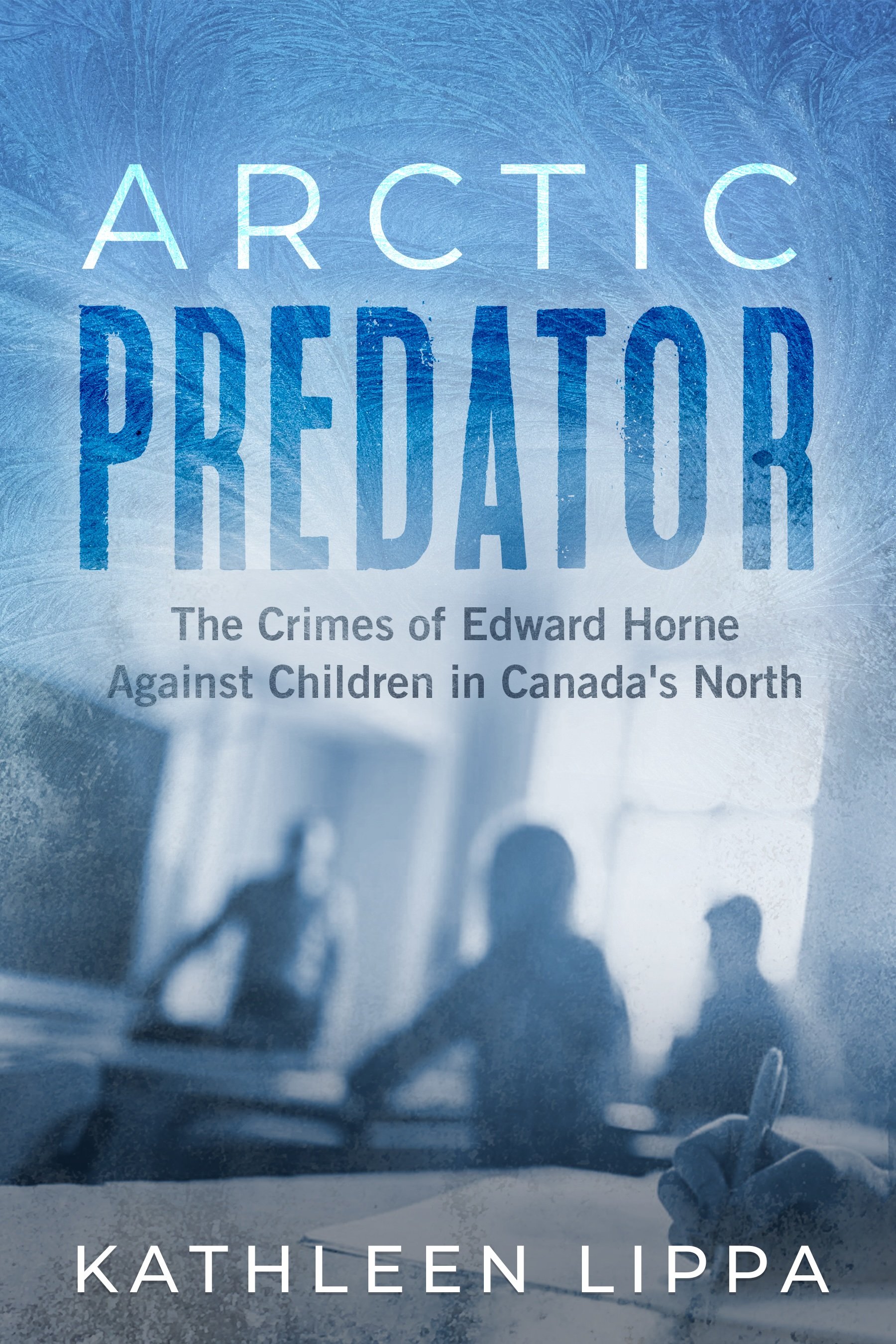
Arctic Predator by Kathleen Lippa (Dundurn Press, February 4, 2024)
Q: Did you ever question whether or not you are the right (or a right) person to tell this story?
A: We live in a time of truth and reconciliation in Canada, and non-Indigenous journalists who write stories that involve Indigenous people are sometimes questioned about their point of view or "right" to tell stories coming out of Indigenous communities.
I have never questioned my right or ability to compassionately write about Inuit in Nunavut. Maybe that's because I lived in Iqaluit for 9 years and worked for a local newspaper. Maybe it's because I felt accepted and appreciated in every Nunavut community I visited.
And when it came to writing Arctic Predator, the story about pedophile Ed Horne’s crimes against Inuit children, I faced a truly cross-cultural story involving Inuit and non-Inuit that local people wanted the world to know about. I know that my contacts, many of whom are survivors of Ed Horne’s predations, didn't care what colour I was. All that mattered to Inuit I spoke to was that I was a good person, and that I would tell the world what happened in Nunavut with all the grace I could.
More about Arctic Predator:
The shocking crimes of a trusted teacher wrought lasting damage on Inuit communities in Canada’s Arctic.
In the 1970s, a young schoolteacher from British Columbia was becoming the darling of the Northwest Territories education department with his dynamic teaching style. He was learning to speak the local language, Inuktitut, something few outsiders did. He also claimed to be Indigenous — a claim that would later prove to be false. In truth, Edward Horne was a pedophile who sexually abused his male students.
From 1971 to 1985 his predations on Inuit boys would disrupt life in the communities where he worked — towns of close-knit families that would suffer the intergenerational trauma created by his abuse.
Journalist Kathleen Lippa examines the devastating impact the crimes had on individuals, families, and entire communities. Her compelling work lifts the veil of silence surrounding the Horne story once and for all.

Author Kathleen Lippa.
About Kathleen Lippa:
Kathleen Lippa is a Canadian journalist, born in Toronto and raised in St. John’s, Newfoundland.
Kathleen trained as a professional dancer at The Quinte Ballet School and The School of the Toronto Dance Theatre before embarking on a journalism career.
At Memorial University, from which she graduated with a BA (English) in 1998, she worked on the student newspaper, the muse. Following graduation, she worked at a number of Canadian newspapers including The Express (St. John’s) where she won a Canadian Community Newspaper Association award for arts reporting, The Hanover Post (Ontario), a number of newspapers under the corporate umbrella of the Northern News Services, 24 Hours (Toronto), and the Calgary Sun.
For Northern News Services, after a short stint in Yellowknife, Kathleen served as Bureau Chief in Iqaluit, Nunavut.
Her experience includes writing, editing, page layout and design, and photography. Her Northern experience was in a cross-cultural setting primarily reporting news from Inuit communities.
After spending many years in Iqaluit, Kathleen now lives with her husband in Ottawa and St. John’s.

Power Q & A with Sawyer Cole
We met U.S. author Sawyer Cole a few years ago on Instagram and were immediately struck by their kindness, enthusiasm, and ability to talk about difficult issues movingly and with compassion. Sawyer is also a wonderful supporter of books and authors from around the world and today, we are delighted to welcome them to our Power Q & A to talk about reading with boundless curiosity.
We met U.S. author Sawyer Cole a few years ago on Instagram and were immediately struck by their kindness, enthusiasm, and ability to talk about difficult issues movingly and with compassion. Sawyer is also a wonderful supporter of books and authors from around the world and today, we are delighted to welcome them to our Power Q & A to talk about reading with boundless curiosity.
Welcome Sawyer Cole!

Coming Home by Sawyer Cole
Q: You have been a wonderful supporter of CanLit and books from around the world. Can you tell us about your reading priorities because they certainly (and refreshingly) aren’t defined by borders!
A: I think it’s important to me to read as diversely as possible because I have first hand experience of being a minority in some fashion. I was a nonbinary trans person with they/them pronouns living in Southern US. Sometimes I felt alone and secluded; ostracized from my neighbors for my identity and sexuality.
With that said, I also know I’m Caucasian so I’m still in the majority. Reading diversely lets me step beyond my world into someone else’s. It allows my empathy to run deeper and my compassion to grow further. If you aren’t reading diversely, you’re missing out on the world around you. They once said America is the Melting Pot when I was growing up, and I think that’s true. We each have our own stories, and I think that’s a beautiful thing to share and be connected with others.
About Coming Home:
Coming from a small, rural town in North Carolina, Sawyer grapples with what it means to grow up queer, where the population of queer people was, to the untrained eye, non-existent. Nuanced with the societal constructs of the gender binary, they deconstruct what it means to be queer in an evangelical Southern family. From growing up being a family proclaimed "tomboy," to joining the Army under Don't Ask, Don't Tell, Sawyer brings you a collection of essays detailing everything from coming out, to family life to church hurt and everything in between.
Candid, honest, insightful, and sometimes breathtakingly haunting, Coming Home is all about finding your queer voice in a heteronormative world. With an honest zeal for life, this set of essays will show you what it truly means to come home.

Author Sawyer Cole.
Follow Sawyer Cole on Instagram @colesbooknook.

Power Q & A with Louise Ells
Lies I Told My Sister is Louise Ells’ second novel and is a sensitive, poignant work of fiction. Taking place over just 17 hours and alternating between past and present, the novel takes us into the strained relationship of estranged sisters Rose and Lily, who are meeting at the hospital after Rose’s husband has been injured. Very quickly, issues of their childhood, the death of their older sister, and the inevitable truth of past lies and secrets surface. But while centering around a serious injury, the novel focuses on the cost of secrets, the depth of the bond between sisters, and just how far we will go to protect the ones we love—and ourselves.
Lies I Told My Sister is Louise Ells’ second novel and is a sensitive, poignant work of fiction. Taking place over just 17 hours and alternating between past and present, the novel takes us into the strained relationship of estranged sisters Rose and Lily, who are meeting at the hospital after Rose’s husband has been injured. Very quickly, issues of their childhood, the death of their older sister, and the inevitable truth of past lies and secrets surface. But while centering around a serious injury, the novel focuses on the cost of secrets, the depth of the bond between sisters, and just how far we will go to protect the ones we love—and ourselves.
Louise joins us for a Power Q & A to talk about her fascinating protagonist, Lily, and her unreliability as a narrator.

Lies I Told My Sister by Louise Ells (Latitude 46 Publishing)
Q: When recounting the traumatic incident from her childhood which changed the direction of her life, Lily is “. . . aware that it is the memory of a memory of a memory, and that over the years I have added details and embellished in some places, let other facts fall away.” Can any of Lily’s versions of her life be trusted, or is she an unreliable narrator?
A: That’s an interesting question! I didn’t deliberately set out to make Lily an unreliable narrator as a literary device, (such as Amy Dunne in Flynn’s Gone Girl), and she doesn’t lie to the reader about, or withhold, vital information. Lily is sometimes aware when she’s lying to herself, but she also believes stories she’s been telling herself for years, and many of those are less than accurate. She is convinced, for example, that had she not terminated her first pregnancy, she would have carried to term and delivered a healthy baby. In reality, she has no evidence to support that belief, and holding on to it is more harmful than beneficial for her. Although she places great importance on shared memories, Lily’s inability to face her painful memories results in her isolation.
“We do not see things as they are, we see things as we are.” (-attributed to Anaïs Nin)
I wonder if any of us is truly trustworthy a narrator of our life? My maternal family founded and ran a legal firm, and I’ve had many conversations with solicitors, barristers, and judges, all of whom suggest that eyewitnesses provide, at best, inaccurate evidence, because human memory is so fallible. Lily believes that her remembered lived experience must be true until she is presented with alternate versions, which she then has to decide between. I watched a production of the play Rashomon at the Shaw Festival in the mid-1990s, and thirty years later I still remember my amazement as I slowly came to the realisation that a single “true” version of events was never going to be revealed. I hope my readers question what really happened on that spring day in 1976, and what actually transpired the day that Peter fixed the broken kitchen door. I suspect readers will blame Lily far less than she blames herself.
Lily and her mum are both inadvertently responsible of having created family myths to share with Rose. Rose is an intelligent woman, and knows that Tansy can’t have been a perfect child and life on the Old Homestead can’t have been as romantic as Lily portrays it to have been. Because Rose loved and misses Bobby, however, she is more inclined to accept all the positive stories she’s told about him.
In many ways Lies I Told My Sister is a continuation of the conversation I started with my short story collection, Notes Towards Recovery, when I asked how the stories (and lies) we tell ourselves, and others, shape our lives. Like so many people, Lily creates her identity in part through the telling, and re-telling of her stories. She is fully aware that there is a clear line between exaggerating the truth and telling an outright falsehood, but when the truth is too distressing to face, she rewrites rather than reframing. Although she places great importance on shared memories, Lily’s inability to face her painful memories for years resulted in her isolation.
One of the wonderful things about fictional characters, of course, is that they can always learn and change. By the end of my novel, Lily has become much more aware of her mistakes and misinterpretations, and is determined to move forward with a greater understanding of, and focus on, honesty.

Author Louise Ells.
About Louise Ells:
Louise Ells was born and raised in Northeastern Ontario. After years of travel, she moved to Cambridge and earned her PhD in Creative Writing. She was a Hawthornden Fellow in 2017, and published her short story collection, Notes Towards Recovery (Latitude 46) in 2019. Louise teaches at universities and colleges in England and Canada and currently lives just north of Toronto, where she can often be found in her library surrounded by books and snuggled up with her cats.

Alchemizing the Mundane: Steven Mayoff Reviews Yellow Barks Spider by Harman Burns
The main narrative thrust of Yellow Barks Spider (Radiant Press, 2024), the debut coming-of-age novella by Saskatchewan-born trans-woman, filmmaker, sound artist and writer Harman Burns, is a rural boy’s journey toward transitioning to a woman. But to describe the experience of reading it in terms of coining a genre, I’d have to call it a Prairie Gothic Phantasia.
The main narrative thrust of Yellow Barks Spider (Radiant Press, 2024), the debut coming-of-age novella by Saskatchewan-born trans-woman, filmmaker, sound artist and writer Harman Burns, is a rural boy’s journey toward transitioning to a woman. But to describe the experience of reading it in terms of coining a genre, I’d have to call it a Prairie Gothic Phantasia.
The opening definition in Encyclopedia.com states: ‘The Greek word phantasia is usually translated "imagination." However, in Greek thought the word always retains a connection with the verb phainomai, "I appear." It can be used to refer both to the psychological capacity to receive, interpret, and even produce appearances and to those appearances themselves.’
The protagonist is known simply as “kid” who is raised by “mom”, “stepdad”, “grandma” and “grandpa.” Other characters are equally nameless, such as kid’s friend, “neighbour.” Later on, when kid strikes out on his own, he moves in with “roommate.” The lack of proper names suggests an anonymity prevalent in kid’s surroundings that mostly take a backseat to his inner world. The turbulence of that inner world is made manifest by Burns in a number of textual styles. Foremost, is a stream-of-consciousness prose-poetry that eschews upper-case letters (although kid becomes Kid later on, perhaps alluding to his adult self). Descriptions often tend toward the violent, where “a pile of boards” are “brutalized by nails” or when kid kicks at a dandelion it becomes “white fireworks exploding its brains a thousand directions.”
Although he is warned not to go into a certain shed, kid does and this serves almost as an origin story for him where he encounters the cowspider.
“the spider was startled and in a shot it was crawling up the stick towards kid’s frozen hand. something inside him told kid he couldn’t let go. something said, be still.”
But when fear gets the best of him, his imagination takes over.
“first it would numb him with venom, try to calm him. convince him to relax.
then it would strip him, it would peel him apart and expose him, pinned open with no escape except into the mind, the trapdoor in the basement, through the attic crawlspace into the treehouse, the secret passageway drops down into the hideout in the earth, through the narrowing tunnel, squeezing smaller and smaller shedding years of skin, climbing fleshless and wet with exposed nerves, baby teeth dropping out, small and pink as candies, and
through the tunnel comes the spider.”
Later in its definition, Encyclopedia.com continues: ‘Aristotle gives phantasia a specific place in his psychology, between perception and thought. In De anima 3.3 he offers an account of phantasia that includes mental images, dreams, and hallucinations. For Aristotle phantasia is based on sense-perception and plays a crucial role in animal movement and desire…’
And farther along: ‘In Hellenistic philosophy the term phantasia is most commonly used to refer not to the capacity to receive or interpret appearances but to those appearances themselves. Both the Epicureans and the Stoics use the word to refer to the impressions we receive through our senses.’
Burns achieves this effect by shifting from prose-poetry to a kind of concrete poetry. The use of negative space or the running-together of words gives the reader a visceral entryway into the changes that kid undergoes seemingly at a molecular level.
(((hairless body wet with piss)))
(((sweat saliva crying)))
(((guts boiling over)))
(((vomit escaping the)))
((((spidersareinsidespidersareinsidespidersareinsidespiders))))
((((spidersareinsidespidersareinsidespidersareinsidespiders))))
((((spidersareinsidespidersareinsidespidersareinsidespiders))))
((((spidersareinsidespidersareinsidespidersareinsidespiders))))

Yellow Barks Spider by Harman Burns (Radiant Press, 2024)
Kid’s experiences away from home include sharing roommate’s bed on his first night in the apartment (never to be repeated and after which their relationship alters), working a dead-end job in a restaurant kitchen, and falling prey to substance abuse. In epic form, Kid returns as her female self, back home to the shed where it all began.
“Not even the quietest parts of her, the ones that moved only in the membranes of sleep, could breach the silence that enclosed her now. It showed itself like a magic trick, like a hall of mirrors, repeating forever in some distant haze. There in the black, in the absence, a hole that swallows and swallows. That won’t be drowned, that won’t be shut.
Nothing that has ever happened to you, nothing that you have done, will ever go away.
It lives here. It all lives here.”
Anyone who has read Yellow Barks Spider knows the excerpts I have provided merely scratch the surface of what Harmon Burns achieves, torturing and twisting language to forge a lightning-flash of immediacy and, along the way, alchemizing mundane, everyday experience into a ritualistic cleansing. Anyone who has not read it yet, will, I hope, be enticed to take a literary leap of faith and open themselves to an experience they won’t soon forget.

Harman Burns.
About Harman Burns:
Harman Burns is a Saskatchewan-born trans woman, filmmaker, sound artist and writer. Her practice is informed by folklore, nature, the occult and bodily transfiguration. Her writing has been published in Untethered Magazine and Metatron Press, and was shortlisted for The Malahat Review’s Far Horizons Award for Short Fiction. Burns currently resides on the unceded ancestral territories of the Musqueam, Squamish, and Tsleil-Waututh peoples (Vancouver).

Steven Mayoff.
About Steven Mayoff:
Steven Mayoff (he/him) was born and raised in Montreal. His fiction and poetry have appeared in literary journals across Canada, the U.S. and abroad. He is the author of the story collection Fatted Calf Blues, winner of the 2010 PEI Book Award for Fiction; the novel Our Lady of Steerage; and two books of poetry Leonard’s Flat and Swinging Between Water and Stone. His acclaimed novel, The Island Gospel According to Samson Grief, was released by Radiant Press in 2023. Steven lives in Foxley River, PEI.

Power Q & A with crystal fletcher
all about canadian books (AACB) is one of our favourite author interview series. Host crystal fletcher doesn’t care if an author is a big name or the book a bestseller: she only cares that she likes the work. crystal has interviewed many of our favourite contemporary Canadian authors and brings with her to each conversation kindness, enthusiasm, and thoughtful and incisive questions—and her refreshingly raw and unfettered love of language. (Does anyone remember when she teared up during a National Poetry Month episode? As if we could adore her anymore!)
all about canadian books (AACB) is one of our favourite author interview series. Host crystal fletcher doesn’t care if an author is a big name or the book a bestseller: she only cares that she likes the work. crystal has interviewed many of our favourite contemporary Canadian authors and brings with her to each conversation kindness, enthusiasm, and thoughtful and incisive questions—and her refreshingly raw and unfettered love of language. (Does anyone remember when she teared up during a National Poetry Month episode? As if we could adore her anymore!)
We are happy to welcome crystal to our Power Q & A series to talk about her series, and why she started it.

all about canadian books host, crystal fletcher
Q: Why did you start AACB?
A: When COVID-19 hit, I wanted to do something to help, so I began to post readings from my novel Beauty Beneath the Banyan on YouTube. I thought I’d get through a few chapters before the world returned to ‘normal.’ Well…we know how that went; I ended up reading the entire book. By then I had a small audience who looked forward to the readings and didn’t want me to stop. So, I decided to pivot to author interviews.
I was nervous about this transition—I found the technology intimidating, I felt shy about approaching authors to be a guest on the program, I was fearful authors wouldn’t want to participate because who the heck was crystal fletcher? And, I was REALLY uncomfortable being on camera.
Well…I’m SO grateful I got over it! Besides writing, I’ve found another love. I adore interviewing new and established Canadian authors who are published by Canadian independent presses (with a few Canadian biggies thrown in).
My program is called AACB (all about canadian books). It was inspired by CBC’s Randy Bachman’s Vinyl Tap: Every Song Tells a Story. I was captivated by his stories about popular Guess Who and Bachman-Turner Overdrive songs. And as a reader, I find a book even more interesting when I know the author and what inspired them to write it. Hence my AACB quest, is to discover the author’s story and the story behind their book.
Fast forward to September 2024, Season 5 of AACB has kicked-off. I have had the pleasure of interviewing 75+ new and established Canadian authors. Donna Morrisey, Susan Swan, Brad Smith, Bianca Marais, Marissa Stapley, Lucy EM Black, Hollay Ghadery, Wayne Ng, Ernie Louttit, Dr. Anita Jack-Davies, Nancy Lam, Alie and Hejsa Christensen and SO many more. To find these interviews visit (AACB).
I am in deep awe of the talent we have in our Canadian literary community and the calibre of books our small independent presses send out into the world is phenomenal. I am so proud to be a part of the CanLit community and can’t wait to be inspired by more authors this season.
More about crystal fletcher:
CRYSTAL FLETCHER is the author of "Beauty Beneath the Banyan," which was published by Inanna Publications & Educations Inc. Her manuscript "Tears from the Sea," was longlisted for the 2021 Guernica Prize for Literary Fiction. As a passionate supporter of Canadian Literature, Crystal created a YouTube channel all about canadian books (AACB).

Power Q & A with Jean Marc Ah-sen
Kilworthy Tanner by Jean Marc Ah-sen (Vehicule Press, 2024) tells the story of Jonno—a ner’er-do-well and perpetually up-and-coming writer who becomes enthralled with the established, acclaimed, controversial, and already married but not monogamous author Kilworthy Tanner. What follows is a titillating metafiction that mirrors a literary world replete with “grasping, unprincipled” egos.
There’s much to love about this book, including Jonno’s narration, which teases and bites and soothes and is tender and playful. We are tickled to have Jean join us for this Power Q & A to talk about how he created his protagonist’s distinct voice.
Kilworthy Tanner by Jean Marc Ah-sen (Vehicule Press, 2024) tells the story of Jonno—a ner’er-do-well and perpetually up-and-coming writer who becomes enthralled with the established, acclaimed, controversial, and already married but not monogamous author Kilworthy Tanner. What follows is a titillating metafiction that mirrors a literary world replete with “grasping, unprincipled” egos.
There’s much to love about this book, including Jonno’s narration, which teases and bites and soothes and is tender and playful. We are tickled to have Jean join us for this Power Q & A to talk about how he created his protagonist’s distinct voice.

Kilworthy Tanner by Jean Marc Ah-sen.
Q: We have to know: what was the inspiration for Jonno’s language? It’s simultaneously highfaultin and grubby and, should anyone feel compelled to speak his words aloud, it’s also just plain delightful to wrap your tongue around.
A: I started to have the impression that my style was becoming too defined for my liking, and that it was starting to ossify. Something written with a more conversational patter, while still being intensely voice-driven, felt like a good way to break out of this pigeonhole.
Jonno's narrative voice was modelled after autobiographies and novels pulling back the curtain on cryptic scene-affiliations - what Dee Dee Ramones's Lobotomy did for the early days of punk, or what Jean-Patrick Manchette's Nada did for post-1968 revolutionary fervour, were inspirations on writing group dynamics. I'm not sure if I was successful on these fronts, but I think that it is better to fail spectacularly than to toe an unremarkable line, stylistically speaking.
More about Kilworthy Tanner:
A madcap, witty account of an aspiring author’s relationship with an infamous and provocative mentor.
Fresh-faced Jonno is looking to make a splash in the literary scene when he encounters celebrated novelist Kilworthy Tanner at a party. Having sold first editions of her works to Toronto’s book dealers, he’s immediately star-struck and more than a little surprised when she takes an interest in him. Could this be the break he’s after? It’s not long before the controlling and aloof Kilworthy is casually letting young Jonno move in with her, and they begin co-authoring sensational and unruly fictions together. But who’ll get the credit for these collaborations, and why does he constantly feel like he must fend off rival authors? Fuelled by outrageousness and hell-bent on literary self-annihilation, Kilworthy Tanner is Jonno’s tell-all ‘pseudobiography’ of their entanglement, and he doesn’t withhold any details of the sexual degeneracy, prodigious drug use, and vendettas of the era.
Jean Marc Ah-sen. (Photo credit Justin Legace.)
More about Jean Marc Ah-sen:
Jean Marc Ah-Sen is the author of Grand Menteur, In the Beggarly Style of Imitation, and Kilworthy Tanner. His work has appeared in Literary Hub, The Walrus, The Globe and Mail, and elsewhere. The National Post has hailed his writing as an “inventive escape from the conventional.”

Excerpt from On Beauty by rob mclennan
Upon the death of her widower father, there came the matter of dismantling his possessions. Emptying and cleaning the house for resale. It wasn’t as though either of the children were planning on returning to the homestead, both some twenty years removed, but it fell to them to pick apart the entirety of their parents’ lives from out of this multi-level wooden frame, a structure originally erected by their grandfather and great-grandfather immediately following the Great War.
On beauty
Upon the death of her widower father, there came the matter of dismantling his possessions. Emptying and cleaning the house for resale. It wasn’t as though either of the children were planning on returning to the homestead, both some twenty years removed, but it fell to them to pick apart the entirety of their parents’ lives from out of this multi-level wooden frame, a structure originally erected by their grandfather and great-grandfather immediately following the Great War. Theirs was the first house in the area, constructed on seventy-five acres of farmland, long since disappeared to development. Across the street, a smaller house of similar design and build, where the hired man and his family had lived. Where, originally, their widowed great-grandmother spent her final days, sixteen long years past the death of her husband.
The house was a local oddity, an obvious construction decades before the brown brick and stone-grey on either side, and contemporary infills. Where the neighbouring bungalow was once their back garden; another, where livestock spent fallow days. Where most likely a barn stood, then a shed, which now hold driveway and garage. Foundation maintenance that routinely uncovers the roots of an orchard. The difficulty of inground pools, and the puncture of linings.
Their father’s house: now that he was dead, it was though it had died as well. They had no choice but to bury it. Not a word. Silence. My wife and her sister, dismantling what would never exist again, and by dismantling, removing it from all but their memory. This, too, will fade.
—”On beauty” from On Beauty by rob mclennan. Published by University of Alberta Press. © 2024 by rob mclennan.

On Beauty (stories) by rob mclennan, published by University of Alberta Press.
About On Beauty:
The thirty-two stories in On Beauty exist as lyrically dense bursts of short prose that move across wide swaths of narrative in compact spaces, offering explorations of characters working through small or large moments. The stories include parenting, pregnancy, the death of a parent, complications between friends, spouses, etcetera. These stories, in their own ways, explore moments as potential sequence, and how each of those moments might impact each other. To ask where, when, how or who: the “why” is the story; all else are facts.

rob mclennan (Photo credit: Amanda Earl).
About rob mclennan:
Born in Ottawa (Canada’s glorious capital city) and raised on a farm near Maxville, Ontario, rob mclennan lives in Ottawa, where he is home full-time with the two wee girls he shares with Christine McNair. The author of more than thirty trade books of poetry, fiction and non-fiction, he won the John Newlove Poetry Award in 2010, the Council for the Arts in Ottawa Mid-Career Award in 2014, and was longlisted for the CBC Poetry Prize in 2012 and 2017. With recent titles including World’s End, (ARP Books, 2023), essays in the face of uncertainties (Mansfield Press, 2022) and the anthology groundworks: the best of the third decade of above/ground press 2013-2023 (Invisible Publishing, 2023), On Beauty: stories (University of Alberta Press, 2024) is his fourth work of fiction, after the novels white (The Mercury Press, 2007) and Missing Persons (The Mercury Press, 2009), and The Uncertainty Principle: stories, (Chaudiere Books, 2014). An editor and publisher, he runs above/ground press, periodicities: a journal of poetry and poetics and Touch the Donkey [a small poetry journal], and co-founded the ottawa small press book fair in fall 1994, which he’s run twice a year on his own since, The Artistic Director of VERSeFest: Ottawa’s International Poetry Festival, he spent the 2007-8 academic year in Edmonton as writer-in-residence at the University of Alberta, and regularly posts reviews, essays, interviews and other notices at robmclennan.blogspot.com