

BLOG

Power Q & A with Kathryn Kirkpatrick
These two words—insistence and wonder—speak to the paradox of making poems. There's got to be a willfulness involved in showing up to the blank page or the page with scattered lines and notes for a poem. I have to be insistent about that time and space. If I'm not, if I let the business of life's obligations take over, then there's an emotional and physical insistence that arises.

Q: We devoured your beautiful poetry collection, Creature (Jacar Press, 2025). Would you speak to how “insistence and wonder” I play a part in your poetic practice?
A: These two words—insistence and wonder—speak to the paradox of making poems. There's got to be a willfulness involved in showing up to the blank page or the page with scattered lines and notes for a poem. I have to be insistent about that time and space. If I'm not, if I let the business of life's obligations take over, then there's an emotional and physical insistence that arises. I feel heavy and a bit out of focus. Because I know that when I'm faithful to my practice, I have so much more access to a state of wonder, when what's offered by experience is so rich, I can't stay outside my practice for long. Or, if I do, I'm simply unhappy. The wonder for me is having access to other dimensions of life and reality--I start to recognize synchronistic events unfolding across the day, insights I wasn't making space and time for otherwise. Yet it takes courage to show up consistently, insistently (!) for that dynamic dimension of life. It both provides a grounding and a need for a grounding--wonder can sweep you away, take you outside time--and I still have to pay the bills. Perhaps that's why the monastic orders provide such ritualized structures to hold an intensely spiritual life and its wondrous dimensions. (I'm writing now as the new Pope is being chosen!)
About Creature: Poems:
What does it mean to be a person in relation to others, both human and animal? Rife with observations of the natural and manmade worlds, Creature by Kathryn Kirkpatrick is a garden of awareness and grief, insistence and wonder. In this full-length collection, Kirkpatrick blends a clarity of vision with a close attention to form, metaphor, and the nuances of language. These are poems rooted in landscape and memory, about mothers and daughters, love and mourning, and the harrowing context in which we now find ourselves living. Creature offers a poetry of paying attention and of being in the world, ultimately revealing that what is most human about us is what is most creaturely, and how we are all ultimately “tossed in the vastness.” Natalie Eleanor Patterson, Editor’s Choice Award.

About Kathryn Kirkpatrick:
Kathryn Kirkpatrick is Professor of English at Appalachian State University where she teaches environmental literature, animal studies, and Irish studies from an ecofeminist perspective and where she co-directs the animal studies minor, a multidisciplinary program she helped to found. Kirkpatrick has published essays on class trauma, eco-feminist poetics, and animal studies, focusing particularly on the work of Dublin poet Paula Meehan. Her monograph on Meehan’s work, Enraptured Space, is from West Virginia University Press (2025). She is co-editor of Animals in Irish Literature and Culture (2015), which includes her essay on the representation of foxes in Somerville and Ross’s Irish PM stories. As well as a scholar and editor, Kirkpatrick is the author of eight collections of poetry, including three recipients of the NC Poetry Society’s Brockman-Campbell award, The Body’s Horizon (1996), Our Held Animal Breath (2012), and Her Small Hands Were Not Beautiful (2014). The Fisher Queen: New & Selected Poems (Salmon, 2019) received the NC Literary and Historical Society’s Roanoke Chowan Poetry Prize. Creature was published by Jacar Press in 2025.

Power Q & A with Catherine Bush
Like many writers, I started out writing stories but very quickly discovered that a story I cared about deeply was trying to be a novel, so I plunged headlong into long-form fiction and never looked back. That unwieldy story became my first novel, Minus Time. I felt like the novel was my natural breath as a writer. A few years ago, I became intrigued by the wild and meaningful compression of flash fiction – the opposite of a novel. I started writing stories again more intently during the pandemic at a time when I felt exhausted and unable to start a new novel.

Q: How has writing this collection of short stories, Skin (Gooselane Editions, 2025) been different than writing a novel? And how has your publishing experience been different if it has?
A: Like many writers, I started out writing stories but very quickly discovered that a story I cared about deeply was trying to be a novel, so I plunged headlong into long-form fiction and never looked back. That unwieldy story became my first novel, Minus Time. I felt like the novel was my natural breath as a writer. A few years ago, I became intrigued by the wild and meaningful compression of flash fiction – the opposite of a novel. I started writing stories again more intently during the pandemic at a time when I felt exhausted and unable to start a new novel. Writing stories allowed me to enter other worlds on compressed timelines, to play, try out new things, seek pleasure at a time when pleasure was hard to find. I love the challenge of bringing a complex world to life in no more than a few pages. I love aiming for unpredictability in the story form, unusual intimacy, the swerve. The short arc rather than the long one. One of the perhaps unorthodox qualities of my collection is that it assembles stories of truly varied lengths, from flash to novella and those in between. A few of the stories, such as The International Headache Conference, about a woman who has an intense hook-up-type encounter with another migraine sufferer, or Voices Over Water, which draws on stories told to me by my father and grandfather, are older, re-edited for the collection. Benevolence, the long story that opens the collection, takes an idea that I began to explore years ago and totally re-imagines it. The title story, about a woman obsessed with foot washing, and Derecho, in which a man finds himself strangely attracted to extreme winds, are two of the newer stories. Because the stories were conceived over a long span of time I think of them as kind of a fictional autobiography (emphasis on fiction!).
My editor, André Alexis, was the person who said that he thought I should turn the stories into a collection and as I revised them, we both gave a lot of thought about how to order the stories to create a meaningful journey for the reader and, ultimately, a sense of a whole. Honestly, I think that the taxonomic distinction between novels and stories is a bit of a false one: novels come in all sorts of forms and lengths, as do stories. Whatever fiction you’re trying to create, it needs to find its necessary length – and breath!
More about Skin:
Now, for the first time, a blistering book of short fiction from one of Canada’s most loved novelists.
In Skin, Catherine Bush plunges into the vortex of all that shapes us. Summoning relationships between the human and more-than-human, she explores a world where touch and intimacy are both desirable and fraught.
Ranging from the realistic to the speculative, Bush’s stories tackle the condition of our restless, unruly world amidst the tumult of viruses, climate change, and ecological crises. Here, she brings to life unusual and perplexing intimacies: a man falls in love with the wind; a substitute teacher’s behaviour with a student brings unforeseen risks; a woman becomes fixated on offering foot washes to strangers.
Bold, vital, and unmistakably of the moment, Skin gives a charged and animating voice to the question of how we face the world and how, in the process, we discover tenderness and allow ourselves to be transformed.

About Catherine Bush:
Catherine Bush is the author of five novels. Her work has been critically acclaimed, published internationally, and shortlisted for numerous awards. Her most recent novel, Blaze Island, was a Globe and Mail and Writers’ Trust of Canada Best Book of the Year, and the Hamilton Reads 2021 Selection. Her other novels include the Canada Reads longlisted Accusation; the Trillium Award shortlisted Claire's Head; the national bestselling The Rules of Engagement, which was also named a New York Times Notable Book and a L.A. Times Best Book of the Year; and Minus Time, shortlisted for the City of Toronto Book Award. The recipient of numerous fellowships, Bush has been Writer-in-Residence/Landhaus Fellow at the Rachel Carson Centre for Environment and Society in Munich and a Fiction Meets Science Fellow at the HWK in Delmenhorst, Germany. An Associate Professor of Creative Writing at the University of Guelph, she lives in Toronto and in an old schoolhouse in Eastern Ontario.

Special Mother's Day excerpt from Widow Fantasies by Hollay Ghadery
River Street’s Founder Hollay Ghadery is an award-winning author as well as a mother of four humans and a multitude of furred and feathered bairn. As a special Mother’s Day gift to all, she’s agreed to share one of the most beloved stories from her short fiction collection, Widow Fantasies, which was released in 2024 with Gordon Hill Press.
As many critics have noted, in Hollay’s stories, there is a chorus of voices that sing to the multiple ways people can be women and mothers…or not. This inclusive and rangy mosiac has made Widow Fantasies a must-read for short fiction lovers, and we are proud to say, has introduced many members of our community to the wonderful world of flash fiction.
River Street’s Founder Hollay Ghadery is an award-winning author as well as a mother of four humans and a multitude of furred and feathered bairn. As a special Mother’s Day gift to all, she’s agreed to share one of the most beloved stories from her short fiction collection, Widow Fantasies, which was released in 2024 with Gordon Hill Press.
As many critics have noted, in Hollay’s stories, there is a chorus of voices that sing to the multiple ways people can be women and mothers…or not. This inclusive and rangy mosiac has made Widow Fantasies a must-read for short fiction lovers, and we are proud to say, has introduced many members of our community to the wonderful world of flash fiction.
Keep reading for Hollay’s story, “Jaws”.

Widow Fantasies by Hollay Ghadery, published by Gordon Hill Press.
jaws
What if the other fish don’t like her? That was my first thought, and it’s not as silly as it sounds. One never stops being a mother and Jaws was too sweet for her own good. Always had been. Originally, Jaws was one of two goldfish we brought home from the Nowruz bazaar seven years ago, and the other fish—a nasty, mottled thing of white and black—had pecked and picked on Jaws mercilessly. But we found the bully floating wide-eyed and belly up before the final new year celebration on Sizdah Bedar.
Thanks to God.
My second thought was that I would never speak to Reza again. Son of a dog, I told him I liked her in the house with me. But I leave for a day to get Keyvan settled in his dorm and he dumps Jaws in our pond.
What kind of life was that for a fish? Reza stabbed his finger toward the pond, spit flying from his mouth. Stuck in a tank in a house with you all day?
Goldfish aren’t as stupid as people.
Or as people think.
By our second year together, Jaws would eat her flakes right from my fingers. She’d respond to her dinner bell, bobbing excitedly when I rang it at mealtimes.
Whenever I walked by her tank, she’d swim out from behind the screen of her silk plants and follow me back and forth as I dusted and vacuumed and folded laundry. I tried to show Reza how incredible it was—she knew my face—but he only complained the tank was beginning to stink and didn’t I have anything better to do with my time? We should have had more children, he’d say.
1
Keyvan used to be amazed by her tricks until he wasn’t. She doesn’t know you, Mom. She probably can’t even see you. You’re just a blob or shadow or something.
When Reza’s mistress died last year, Jaws was the only one I let see me cry. She understood: it was my loss as much as his. The woman had been oxygen to our little bowl of stagnant water. She’d given me room to breathe.
Now light from shattered glass ricochets skyward from the driveway. A few minutes after I’d heaved the empty tank at Reza’s head, I heard the pop of gravel under his tires as he shot out onto the road. Good riddance to him. I was sorry about the tank though. I hadn’t been thinking.
I lower myself to the grass beside the pond. The cherry blossom tree is alive with bees and soft pink petals freckle the water’s surface. Jaws must be hidden somewhere in the weeds. I see a few of the black moors, the flash of a white and yellow fish, but no sign of Jaws’ telltale Tiger Lily scales. A fern green, three-legged frog sits like a mound of melting butter on a lily pad. He croaks a sonic, deep belch.
Do frogs eat goldfish?
There are at least half a dozen other fish in our decorative pond, but other than plugging in the de-icer every winter, I’ve never thought much about them. They were here when we bought the property and existed fine without my intervention. Even when a green heron began hunting around the water, baiting its surface with twigs and insects, I hadn’t worried. I stood at the living room window and watched, describing the scene to Jaws. She stared at me with her unblinking copper eyes and agreed: life was much better inside.
I put my hand in the pond water and splash a little. “Mahi koochik? Are you there?”
The three-legged frog belches again and leaps into the water. I splash some more, stirring up algae so the pond’s surface becomes opaque.
I think of all the time I spent by the pond with Keyvan when he was a child, watching larvae and tadpoles grow. How did I never think to check if the frogs were eating the goldfish?
I get up and run. Bursting into the house, I find the dinner bell where I left it: on the table where her tank used to be. I’m ringing the bell before I’m even back out the door. “Jaws, bia! Come!”
I continue to ring desperately until two unmistakable orange nares poke through the scum. I scoop her into overflowing palmfuls of water and we greet each other, gasping.
Excerpt from Widow Fantasies by Hollay Ghadery © 2024 by Hollay Ghadery. Published by Gordon Hill Press.
More about Widow Fantasies:
Fantasies are places we briefly visit; we can’t live there. The stories in Widow Fantasies deftly explore the subjugation of women through the often subversive act of fantasizing. From a variety of perspectives, through a symphony of voices, Widow Fantasies immerses the reader in the domestic rural gothic, offering up unforgettable stories from the shadowed lives of girls and women.
"Every story in this book feels like jumping into a lake, like the flare of heat in your throat after a shot, like missing a step on the way down the stairs at night. These are works all the more powerful for their brevity. Hollay Ghadery’s book, in short, has made me a convert to the flash fiction genre." Jade Wallace, for The Miramichi Reader

Hollay and her beautiful brood.
Hollay Ghadery is an award-winning Iranian-Canadian multi-genre writer living in rural Ontario on Anishinaabe land. Fuse, her acclaimed memoir of mixed-race identity and mental illness, was published by Guernica Editions’ MiroLand imprint in 2021 and won the 2023 Canadian Bookclub Award for Nonfiction/Memoir. Her debut collection of poetry, Rebellion Box, was released with Radiant Press in April 2023. Hollay's short-fiction collection, Widow Fantasies, came out with Gordon Hill Press in 2024. Hollay is a board member of the League of Canadian Poets, the co-chair of the League's BIPOC committee, as well as the Poet Laureate of the region in which she lives, and a Poetry, Canadian Studies, and Literature podcast host on The New Books Network. Hollay is also a host of HOWL—the literary arts show—on 89.5 CIUT FM, a member of The Writers Union of Canada, the Creative Nonfiction Collective, and the National Book Critics Circle.

Power Q & A with Anthony Bidulka
We are beyond thrilled to be welcoming many time award-winning author, Anthony Bidulka to our blog to talk to us about his compulsively readable and utterly absorbing new mystery thriller, Home Fires Burn (Stonehouse Publishing, June 1, 2025). Anthony is a Canadian legend of the mystery thriller genre who writes from places and perspectives that you don’t often see represented on the page.
We are beyond thrilled to be welcoming many time award-winning author, Anthony Bidulka to our blog to talk to us about his compulsively readable and utterly absorbing new mystery thriller, Home Fires Burn (Stonehouse Publishing, June 1, 2025). Anthony is a Canadian legend of the mystery thriller genre who writes from places and perspectives that you don’t often see represented on the page.
Welcome Anthony to our Power Q & A to tell us about his new book!

Home Fires Burn by Anthony Bidulka, published by Stonehouse Publishing.
Q: When so many mystery novels are set in global metropolis, tell us about the importance to you as an author of setting your book in a smaller city in Saskatchewan.
A: Even as a young boy growing up on a small family farm in rural Saskatchewan I knew I wanted to write. And I had a lot of ideas. What I didn't have was an answer to the question: Why do I write? In my case it took decades to come up with the concise answer I have today. My WHY is this: I write to tell stories about underrepresented people and underrepresented places in a way that is accessible and entertaining.
Part of the reason for this is that growing up and even as a young adult, I rarely saw myself or my place or my community reflected in mainstream fiction. But when I did, it was mind-blowing, and felt important. Representation is important. As I came to define what was important to me as a writer this was top of mind.
From a purely practical side of things, finding a way to distinguish yourself in a very competitive industry is not a bad thing. With my first series I was able to factually claim that my protagonist, Russell Quant, was the first and only wine-swilling, wise-cracking, world-travelling, ex-cop, ex-farm boy, gay, rookie Canadian prairie private eye. With my current trilogy, I can describe my heroine Merry Bell as the first and only kick-butt, Canadian prairie, transgender P.I. To be able to do so sets me apart as a writer, is pretty cool, and serves my WHY perfectly.
ABOUT HOME FIRES BURN:
From the author of Crime Writers of Canada Best Crime Novel, Going to Beautiful, comes the final, standalone book of the Merry Bell trilogy. A celebrated philanthropist is found slumped against his car, frozen to death. Trans private investigator Merry Bell is hired by his son, country music star Evan Whatley, to find out the truth behind what really happened on that desolate stretch of road. As Merry’s investigation uncovers old wounds that never healed, her own are revealed as she confronts her pre-transition past and questions the boundaries of family and friendship.

About Anthony Bidulka:
Anthony Bidulka’s books have been shortlisted for Crime Writers of Canada Awards of Excellence, Saskatchewan Book Awards, a ReLit award, and Lambda Literary Awards. Flight of Aquavit was awarded the Lambda Literary Award for Best Men’s Mystery, making Bidulka the first Canadian to win in that category. In 2023, in addition to being shortlisted for a Saskatchewan Book Award and Alberta Book Publishing Award, Going to Beautiful won an Independent Publisher Book Award being named Gold Medalist as the 2023 Canada West Best Overall Fiction novel and was awarded the Crime Writers of Canada Award of Excellence as Canada’s Best Crime Novel for 2023.

Excerpt from Home Fires Burn by Anthony Bidulka
John gazed down at his bloody, raw hands. Curlicues of peeling skin had frozen and snapped off, falling into a crimson mound of snow and wood shards, all that was left of the fence post. The car’s windows and doors, even its hood and trunk, scratched and dented but otherwise intact, had all been subjected to a brutal beating.
Prologue I
John gazed down at his bloody, raw hands. Curlicues of peeling skin had frozen and snapped off, falling into a crimson mound of snow and wood shards, all that was left of the fence post. The car’s windows and doors, even its hood and trunk, scratched and dented but otherwise intact, had all been subjected to a brutal beating.
Turning his back on the cruelly impenetrable vehicle, John allowed his body to flag, using the solidity of the car’s frame to hold himself up while he tried to catch his ragged breath. The intense, violent effort had caused him to sweat profusely. As he’d grown hotter, he’d torn the scarf from his neck and tossed it to the ground. He now considered retrieving it, but the effort seemed Herculean. He needed rest. But there was no time for rest.
John Whatley was not done for. There was still hope. He had to keep moving. Constant movement would stave off the conditions intent on killing him, at least until he found help or a place to shelter. The Saskatchewan countryside is littered with homesteads, grain storage units, even an abandoned farmyard would do. He just had to find one. Just one. Then he could get out of the cold, out of the wind. Out of death’s grasp. If he couldn’t find shelter, if no one came for him, then he would damn well keep moving until he reached the city of Livingsky, until he found his way home. He was in a challenging situation, he could admit that much, but he also knew without doubt, that the same persistence that had served him so well in building a successful business would serve him now too.
Gingerly, he crouched down and reached out to reclaim the scarf, tugging to free it from where the warmth of his sweat had caused the fabric to freeze to the ground. Refastening it for optimum protection, and more determined than ever, John buried his battered hands within the pockets of his jacket and stamped his boots to loosen the treads of snow.
As he collected himself, an unwelcome, stubborn truth emerged in his brain like a mind thistle. On average, fifteen people die from hyperthermia/exposure in Saskatchewan every year. It was a grim statistic that most people in the province were aware of, having heard it over and over again throughout their lives. In the past, John would scoff at the warnings, thinking to himself: what idiot living in Saskatchewan wouldn’t have the common sense to be prepared? Shivering in the remote darkness, he grumbled out loud: Idiot, meet John. John, meet Idiot.
Idiot not not, people needed him. He’d been a good man, helped a great many people. He’d lived a good life. He most certainly did not deserve to have it end this way. So it was with surprise when, after wiping away a build-up of delicate snowflakes from his face—when did it start snowing?—John looked up and saw the unexpected.
On the horizon. A diffused halo. It was…Livingsky. My god, it’s Livingsky!
He’d obviously made excellent progress. He would swear the twinkling skyline was not there even a few seconds ago. The city was closer than he’d dared to hope. His plan was working.
John noted that his limbs felt sluggish, but fortunately the cold had become less of an issue as time passed. Knowing his horrific dilemma would soon be over was probably helping his body withstand the elements. Hope was a powerful thing. Never forget that, he told himself, repeating it in his head like a mantra.
With more effort than he expected he’d need, John urged his torso to move. If he was going to assess his progress, he’d need to turn around and look behind him, find the car in the distance (if it was even still visible). But, strangely, his body resisted. Instead of moving forward, it rolled, slowly, cumbersomely, rotating until it wedged itself into a crook of something big and solid.
What the…?
John’s confusion turned to surprise, then shock, then back to surprise. In that horrible moment he realized he wasn’t on the road, halfway to Livingsky. He wasn’t even upright. He was on the ground, cheek and jowl flattened against icy snow, lying next to his car.
Excerpt from Home Fires Burn by Anthony Bidulka © 2025 by Anthony Bidulka. Reprinted by permission of Stonehouse Publishing.

Home Fires Burn by Anthony Bidulka, published by Stonehouse Publishing.
ABOUT HOME FIRES BURN:
From the author of Crime Writers of Canada Best Crime Novel, Going to Beautiful, comes the final, standalone book of the Merry Bell trilogy. A celebrated philanthropist is found slumped against his car, frozen to death. Trans private investigator Merry Bell is hired by his son, country music star Evan Whatley, to find out the truth behind what really happened on that desolate stretch of road. As Merry’s investigation uncovers old wounds that never healed, her own are revealed as she confronts her pre-transition past and questions the boundaries of family and friendship.

About Anthony Bidulka:
Anthony Bidulka’s books have been shortlisted for Crime Writers of Canada Awards of Excellence, Saskatchewan Book Awards, a ReLit award, and Lambda Literary Awards. Flight of Aquavit was awarded the Lambda Literary Award for Best Men’s Mystery, making Bidulka the first Canadian to win in that category. In 2023, in addition to being shortlisted for a Saskatchewan Book Award and Alberta Book Publishing Award, Going to Beautiful won an Independent Publisher Book Award being named Gold Medalist as the 2023 Canada West Best Overall Fiction novel and was awarded the Crime Writers of Canada Award of Excellence as Canada’s Best Crime Novel for 2023.

Power Q & A with Sharon Berg
May is National Short Story Month and we’re kicking it off with a brief and salient interview with award-winning multi-genre writer Sharon Berg, author of many books, including the short fiction collection, Naming the Shadows (Porcupine’s Quill 2019). Never one to shy away from tough conversations, we ask Sharon about writing difficult subjects as a necessary part of the responsibility we bear for one another.
May is National Short Story Month and we’re kicking it off with a brief and salient interview with award-winning multi-genre writer Sharon Berg, author of many books, including the short fiction collection, Naming the Shadows (Porcupine’s Quill 2019). Never one to shy away from tough conversations, we ask Sharon about writing difficult subjects as a necessary part of the responsibility we bear for one another.
Thank you to Sharon for joining us, and for your thoughtful response to our question. Keep reading.

Naming the Shadows by Sharon Berg (Porcupine’s Quill 2019).
Q: We are interested in your advice for writers who want to deal with difficult topics like violence against children, and how to do this with honesty while still being sensitive to readers. We are not readers who feel like we should be spared violence to save our own fragile sense of safety. We never think we should turn from the humanity of others.
A: Yes, I’m dealing with violence against children and young women in my stories and poetry all the time! If people hadn't turned away from the horrible things being done to me as a child or young woman, and if several agencies hadn’t failed me or my children, our lives would have turned out a whole lot differently. A big part of that is the laws protecting children need to be stronger, and the agencies claiming to safeguard them have to be more honest about what they will or cannot [read that as do not] do for them. Andrea Munro’s case against the husband of her mother points this out as she was failed by so many people and agencies in dealing with her trauma. Everyone is quick to point to Alice Munro’s failings but they don’t address the basic fact that neither her father or the several agencies involved truly addressed her pain.
There can be no denial that our laws need to change. When my daughter was sexually abused as a four-year-old by a neighbour in 1979, I was told by a policeman who said he 100% believed her, no child could testify against an adult. He suggested I try to catch him in the act next time. Absurd. I moved within two weeks. But I can tell you nothing is different in 2025 and that is beyond ridiculous. We have a duty as individuals living in a democracy such as Canada... to protect children and each other... or our house is built on a pile of lies.
I can’t be convinced people don’t have a responsibility to each other when we live in community. That’s the definition of community in my eyes. Refusing to review our legal response and neighbourly alert systems to the various trauma suffered by children says we deny our reality. I believe, as a writer, I have a duty. Fiction and poetry can and has addressed the unwilling observor and pulled them into action. Stories can speak to the heart, convincing us through artful writing, to address the trauma suffered by others. What I’m addressing in my stories is mainly the daily skirmishes being fought in our country and others around the world, the hidden casualties of an on-going war with paternalism and criminal mindset. That sort of war is just as important as any other. It gives criminals an arena to practice in. We need to stand on guard for all of those daily victims.
I truly believe I’m broadening people’s awareness through my writing or I wouldn’t bother. As Margaret Atwood has said, nothing I write about hasn’t happened, and I’d lay dollars to donuts the same is true for Alice Munro and Margaret Laurence. For my own female characters, I’d say nothing I write about hasn’t happened to me or a dearly loved one. Who can argue with the truth? I can’t speak for other authors, but I just add some literary devices and stir.
More about Naming the Shadows (Porcupine’s Quill 2019):
Sharon Berg’s quietly insightful collection focuses on relationships between generations, acknowledging the prevalence of the shadows that are everywhere—but also celebrating the light.
The stories in Naming the Shadows are touched with humour and outrage, mystery and shadow. Curious preteens receive an unexpected education at a mall-side carnival show. A lonely dairy farmer develops a special bond with his neighbours’ children, then suffers unexpected consequences. An ageing author manages to get one up on her adversarial interviewer, while another woman’s unsettling way of remembering past lovers confirms her emotional freedom.
In these stories of loss and learning, conflict and memory run through generations, innocence gives way to experience, and all must learn to redefine themselves and the way they see the world.

Author Sharon Berg. Photo credit: Cathi Carr.
More About Sharon Berg:
Sharon Berg’s work appears in Canada, USA, Mexico, England, Wales, Amsterdam, Germany, India, Singapore, and Australia. Her poetry includes To a Young Horse (Borealis 1979), The Body Labyrinth (Coach House 1984), three poetry chapbooks (2006, 2016, 2017), plus Stars in the Junkyard (Cyberwit 2020) was a 2022 International Book Award Finalist. Her short story collection is Naming the Shadows (Porcupine’s Quill 2019). The Name Unspoken: Wandering Spirit Survival School (BPR Press 2019) won a 2020 IPPY Award for Regional Nonfiction. She’s Resident Interviewer for The tEmz Review (London, ON, Canada) and operates Oceanview Writers Retreat out of Charlottetown, Newfoundland, Canada.

Ever think about publishing a chapbook? Montreal poet Carolyne Van Der Meer answers common chapbook questions
Ever think about publishing a chapbook?
Chapbooks are short collections of poetry that can range from just under 10 pages to just under 50 pages—and we love them! Chapbooks can be a perfect one-sitting poetry immersion.
We are delighted to have Montreal poet Carolyne Van Der Meer join us for an appropriately brief but powerful interview on chapbooks.

Carolyne Van Der Meer’s chapbook Birdology is an exploration of loss of memory, of autonomy—and ultimately of the loved ones themselves. Against a backdrop of urban and natural environments filled with everyday birds, she considers how our relationships with our parents evolve as they age, need us more—and eventually leave us. Through a quintet of flash essays and a handful of poems, Van Der Meer moves through what she calls the “spell of grief,” accompanied by flocks of gulls, house sparrows and rock pigeons.


Ever think about publishing a chapbook?
Chapbooks are short collections of poetry that can range from just under 10 pages to just under 50 pages—and we love them! Chapbooks can be a perfect one-sitting poetry immersion.
We are delighted to have Montreal poet Carolyne Van Der Meer join us for an appropriately brief but powerful interview on chapbooks.
Carolyne’s wonderful chapbook, Birdology, will be published in May by Montreal-based micro-press, Cactus Press.
Why publish a chapbook? Why not wait and publish a full book of poetry?
Publishing a chapbook is a great way to get your stuff out there, especially if you are an emerging poet. And for any poet, it’s a way to experiment with new work without committing to a full collection. The other thing is it’s fast! The lead time for publishing a chapbook can be quite short so you are not waiting a year or three to see your work in print. And finally, you can decide to self-publish a chapbook, which is an inexpensive way of doing all of the above: getting your new, experimental work out there quickly. Nothing says you can’t also be pushing towards publishing a full collection and you are doing this while you wait.
What is one piece of advice you have to poets thinking about publishing a chapbook?
Make sure you do your homework. Have a good look at all the chapbook publishing options in Canada so you can see where your collection fits best. And also, decide whether you actually want a publisher or whether you want to go it alone. There are plenty of reasons for doing one or the other. Just make sure you explore your own goals, desires and expectations before you decide.
What are some of your favourite chapbook presses in Canada?
Of course, I am rather biased about Cactus Press as they have taken me on. But that’s not all there is to it—Cactus has given a home to both emerging and experienced poets—this combined with their beautiful designs has given a real richness to the Montreal poetry scene.
But other Canadian chapbook publishers I like are Raven Chapbooks (imprint of Rainbow Publishers) on Salt Spring Island in BC; Agatha Press in Edmonton; Anstruther Press in Toronto; Gasperau Press in Kentville, NS; Turret House Press in Montreal; and Baseline Press in London. All these publishers produce original concepts on beautiful paper—and some are hand-sewn. Stunning to hold—and behold.

Birdology II: Excerpt from Birdology by Carolyne Van Der Meer
On our way to run errands, we passed a parked car and heard
splashing. A look down revealed a host of house sparrows
bathing themselves in a convenient puddle—an unexpected
beginning to a warm fall morning.
Birdology II
On our way to run errands, we passed a parked car and heard
splashing. A look down revealed a host of house sparrows
bathing themselves in a convenient puddle—an unexpected
beginning to a warm fall morning.
Sometimes we don’t know what awaits us. How suddenly, on a
random day of puddle splashing, there is also a feeling of
bereftness that cannot be contained. A highway pile-up of grief.
When I woke up one morning to find the family dog—my dog—
had been given to a farmer, no goodbyes. The young man who
got electrocuted in our backyard after his hedge cutters hit the
arc of a high-voltage line. My father’s skeletal face as he moved
towards death, unconscious in a palliative ward. How my mother
-in-law lost her speech after dementia took its final hold. And
now, how my father-in-law is a prisoner in his hospital bed,
awaiting diagnosis as death’s beacon is bright. And as my
mother gives in and says a care home is the only next step—a
place of antiseptic loneliness, its dotted line the one I sign on.
I am overcome by the anchor of loss, rooted somewhere in my
pelvis, my body wracked with a melancholy for what I cannot
change, for what is normal, for what is the cycle of life. I am not
unique, this is not unique. As my father-in-law said today, we all
begin and end in the same way: it is the middle that makes a life.
And the wisdom of a faraway Dutch cousin: live slow, for we will
all get there eventually.
There was nothing weighing down the sparrows in their puddle,
no sadness that I could discern. They flapped their wings,
flicking the water off their little bodies. And dove in again.
Excerpt from Birdology published by Cactus Press, copyright © 2025 by Carolyne Van Der Meer.

Birdology (Cactus Press, May 2025) by Carolyne Van Der Meer is a tender collection of poems and essays moves through what she calls the “spell of grief,” accompanied by flocks of gulls, house sparrows and rock pigeons. I’d love for you to consider this chapbook for review.
Birdology is an exploration of loss of memory, of autonomy—and ultimately of the loved ones themselves. Against a backdrop of urban and natural environments filled with everyday birds, she considers how our relationships with our parents evolve as they age, need us more—and eventually leave us. Through a quintet of flash essays and a handful of poems, Van Der Meer gently dissects the layers of emotion in grief with the delicacy of a feather.

About Carolyne Van Der Meer:
Carolyne Van Der Meer is a Montreal journalist, public relations professional and university lecturer. Her articles, essays, short stories and poems have been published internationally. Her five published books are: Motherlode: A Mosaic of Dutch Wartime Experience (WLUP, 2014); Journeywoman (Inanna, 2017); Heart of Goodness: The Life of Marguerite Bourgeoys in 30 Poems | Du Coeur à l’âme : La vie de Marguerite Bourgeoys en 30 poèmes (Guernica Editions, 2020); Sensorial (Inanna, 2022) and All This As I Stand By (Ekstasis Editions, 2024). Chapbook publications include One Week’s Worth but a Lifetime More (Local Gems Press, 2022) and Broken Pieces: Hospital Experiences (2023); Birdology is forthcoming from Cactus Press in May 2025.

Excerpt from Iris and the Dead by Miranda Schreiber (Book*Hug Press, 2025)
I wrote a story for you in a journal and it vanished. Yes, van- ished. The journal itself disappeared. Where do such missing things go?
In the story I laid down all the things I wanted you to understand. I wanted to write it because, in the years since we lay in the yellow grass, I have come to some knowledge. I cannot recall the contents of the story in full. Because of its loss, I sobbed and felt like the victim of a cruel and unusual fate.
I wrote a story for you in a journal and it vanished. Yes, van- ished. The journal itself disappeared. Where do such missing things go?
In the story I laid down all the things I wanted you to understand. I wanted to write it because, in the years since we lay in the yellow grass, I have come to some knowledge. I cannot recall the contents of the story in full. Because of its loss, I sobbed and felt like the victim of a cruel and unusual fate.
Do you think you can write it again, said my mother when I told her.
In some ways, I said. I mean, only in part.
But the heart of the story is gone and I no longer own it.
Still, my need to speak with you seems to have no end. As I wanted to tell you, in every possible universe, when presented with what you offered me, I take it.
May I begin again?
Part I: Sickness
On My Rights as the Author
What do you remember of me? Is it difficult to make out? I know your mind, which doesn’t take much interest in the past, has possibly let me rot for years. Lacking attention, per- haps the sounds we heard together have shrunk and become difficult to name. The colours you associated with me, mixed together now, present a peculiar new hue. Maybe a bronze, made up of grey lake water and the sun.
Some of my memories of you have been darkened by the things I’ve heard and seen in the time since we knew one another. Seeing pictures of you online almost removes you more from me; an image of you in red light by the water seems to have nothing to do with you. It is only occasionally that something comes up in front of me—in that hard way vir- tual things do, so that the rest of the world recedes—and I’m flooded with feeling. For you, I know these memories might have died. For me, they keep. For you, have they simply been discarded? And if they have, to where? What I want to know is, where are the things that have vanished?
For me, very few things end. I can revisit funny memories and put a different name on them. The uncanny ones I’ve wanted to speak with you about. I am sick to death of being dazzled, of lacking the words. We did not have a love affair.
As I said, I have a story to tell you: a better one than I ever could have come up with at the time I knew you. In many ways, I am teeming with knowledge about what was hap- pening during the time we spent together, and beyond. But I should admit I’m not just trying to pass on the knowledge
I’ve come to. I also have questions to ask you. Even as I write with vital information I’m bewildered. But the answers I need may be in that place where the vanished objects go, because I am unsure that even you have them.
On the Beginning
When I was twelve I lost my mind.
The phrase doesn’t bother me. I think it’s correct. I lost my mind as accidentally as I lost pencils and five-dollar bills. Maybe my mind flew down the sky to a land of the dead. I don’t believe this, of course. But it’s better to think it was somewhere.
On the Study of Strange Things
A gift is frightening. It comes with moorings. I am indebted to you, which makes this whole thing stranger. You overflow, my love. You exceed. For years your gift and its consequences seemed uncontrollable.
Part of you helped me because you wanted to free me. That was the gift you gave. But another part of you wanted to keep me in a contractual relation. Because a gift creates a debtor; gratitude flows forever as all of the gift’s effects play out. And in another way you left me so little. I have letters, a T-shirt. There is some documentation of our time together. My unsent emails are a study in bewilderment. When I was twenty I thought about writing to you: Of course this isn’t to overlook the wonderful things you did for me, but I’ve been thinking about the cost… Still, however, the uninformed archivist would never be able to sort our data from noise. A colossus of evi- dence claims we were meaningless to one another. I myself, evaluating it, could make a strong case for barely knowing you. I could argue the following: there is only one photo of these women together. Neither has ever wished the other merry Christmas. The one card they exchanged said, “Thanks for everything thus far.” Therefore, these two women knew each other briefly and then forgot one another. These two women spent a few months together and didn’t think much about
it after.
But really, the card was written in panic. It implored. “Thus far” actually meant I must have more. “Thus far” was intended to mean I’m old enough now, although I wrote it when I was very young.
Excerpt from Iris and the Dead by Miranda Schreiber copyright © 2025 by Miranda Schreiber. Reprinted by permission of Book*hug Press.

Miranda Schreiber’s Iris and the Dead (Book*hug Press, June 10, 2025).
About Iris and the Dead:
Iris and the Dead unfurls the hidden power dynamics of abuse, offering a beguiling inquiry into intergenerational trauma, moral ambiguity, and queer identity. This haunting exploration of love and desire, disability and madness, and trauma and recovery, is a diaristic marvel for fans of Annie Erneaux.
Weaving personal memory with magic realism and folklore, Iris and the Dead asks: What if you could look back and tell someone exactly how they changed the course of your life?
For our narrator, that someone is Iris, the counsellor with whom she developed an unusual, almost violent bond. There are things she needs to tell Iris: some that she hid during the brief time they knew each other, and some that she has learned since. She was missing her mind the autumn they spent together and has since regained it.

Miranda Schreiber. Photo credit: Sarah Bodri.
MIRANDA SCHREIBER is a Toronto-based writer and researcher. Her work has appeared in places like the Toronto Star, the Walrus, the Globe and Mail, BBC, and the National Post. She has been nominated for a digital publishing award by the National Media Foundation and was the recipient of the Solidarity and Pride Champion Award from the Ontario Federation of Labour. Iris and the Dead is her debut book.

Power Q & A with Callista Markotich
Callista Markotich’s beautiful debut collection of poetry enchants on many levels—even before you open the book. The cover of Wrap in a Big White Towel (Frontenac House Press, 2024) conjures feelings of cozy introspection and curiosity. We are pleased to have Callista join us today to talk about how the cover of her collections mirrors the themes explored within.
Callista Markotich’s beautiful debut collection of poetry enchants on many levels—even before you open the book. The cover of Wrap in a Big White Towel (Frontenac House Press, 2024) conjures feelings of cozy introspection and curiosity. We are pleased to have Callista join us today to talk about how the cover of her collections mirrors the themes explored within.
Welcome Callista!

Wrap in a Big White Towel by Callista Markotich (Frontenac House Press, 2024)
Q: Tell us about the cover of the book and how it reflects—in our opinion—so beautifully, themes and feelings explored within your collection.
A: I am so happy you asked about the cover—unsurprisingly, a painting of a woman wrapped in a big white towel! But it was painted by my granddaughter, fourteen at the time, and struggling with the shadow of social anxiety that Covid cast upon her. Still, she could paint. Neil Petrunia, publisher of Frontenac House, encouraged us to see what we could come up with. There were a few false starts. In early sketches the wrap looked turban-like or like a babushka, a shawl or a salon wrap. One of the prospective models, Harry the cat, emerged huffily from a tunnel of swathed towels, and stalked outside, affronted. In the end it was a photo of her mother, my daughter Steph, with a towel draped around her head and shoulders, to be painted on a serious black background. This wrapped woman has a slight esoteric look, as if Charlotte’s brush was soaked with the enigma of her personal struggle at the time. There were moments of doubt – the folds of the towel, the tucked border, the tendril of hair, sometimes the shaky paintbrush in Char’s hand, but here it is: a towel, around the face of a woman, an archetypal “everywoman”, whose thoughts are inscrutable, wrapped, and I am so proud of this cover.
The title came first. It is is a line from a poem in the manuscript about The Innocents by Michael Crummey, in which wrap is about protection and comfort, about hugging safety and well-being to oneself, wrap as in cover, conceal, prevaricate, deny – and it is about interrogating those illusory senses, unwrapping them. I assumed that there would be times when I would try to explain the title, but of the questions I’ve had, no one has asked me to elaborate on that. Had I been taken by surprise, I would have told the simplest truth: my husband and I sat with coffee in bed one Saturday morning and looked at lines from several poems that might have an application as a comprehensive title, and this was the line he liked best.
But I have had time to think about why it seems right for this book. In the title poem, it is I, wrapped, staring at my reflection, dimly understanding, through steam, in a mirror, in a white room, what is by definition un-understandable – the utterly cold, clear, dark reality of lives we do not live, in worlds and times not ours. In the poem, access to such a world is through bitter literature, yet it is not merely literature; this novel comes from historical records of an orphaned sister and brother, incredibly isolated in a remote Newfoundland bay, straining to survive. Those children haunted Michael Crummey. He had to write The Innocents. And for me, as his reader, bowled over in compassion and humility by the spectre of unimaginable hardship that make up daily existence for the young siblings – the small mercies that sustain them, their courage, their uneasy, stalwart survival; as a poet, desiring words for that self-conscious draping of a reality too stark to face.
And, in all these poems, really, there is wrapping, and there is unwrapping, uncovering, going deeper to mine for duende, the universal shade that underpins cognition and affect in us humans; duende found even in poetry about love or joy, because all is finite for us. Love is mutable in this life. Joy, by the semantic nuance it contains, will fade.
Sometimes it’s been a precious thing wrapped, like a memory, like a permanently bronzed baby shoe, to be unwrapped with love and awe through the diction of a poem, as in Daughter’s Softball Tourney. Sometimes the unwrapping yields a thing I did not know was there, as in Safe U-turn. When there’s nothing that can be said, as in Windmills Café, when there’s a truth so hard that I must hide from it, as in Windmills Café II, when a revelation is wrapped away for years until words finally find it, as in Nightmare Rite, there’s been the wrapping, the unwrapping. When something is so grievous it cannot possibly be borne, as in the poem Fugue, there is the fleeing, the hiding in a labyrinth of shocked thought, the wrapping in a winding cloth of words the truth too hard to bear.
This is what poetry is like for me. Language does the work, wrapping, unwrapping.

Callista Markotich
About Callista Markotich:
Callista Markotich has enjoyed a lifelong career as a teacher, principal, and Superintendent of Education in Eastern Ontario. Her poems appear in numerous Canadian reviews and quarterlies from The Antigonish Review through Vallum and in several American and British magazines and journals. Her poetry has received first and second-place awards and a placement in the League of Canadian Poets Poem in Your Pocket campaign. It has been short-listed and Honorably Mentioned in several Canadian contests and nominated for a Pushcart Prize and the National Magazine Awards. Her suite, Edward, was a finalist in the 2023 Gwendolyn MacEwen Poetry Award and the 2024 Toad Hall Chapbook Contest, with The Poets Corner. She is a contributing editor for Arc Poetry. Callista’s first collection, Wrap in a Big White Towel (2024) was published by Frontenac House. Callista lives gratefully on the banks of Lake Ontario, traditional territory of the Anishinaabe and Haudenosaunee nation, in Kingston Ontario, with her husband Don of fifty-nine years.

Power Q & A with Amanda Shankland
Speech Dries Here on the Tongue (edited by Hollay Ghadery, Rasiqra Revulva, and Amanda Shankland) is an anthology of poetry by Canadian authors, published by The Porcupine’s Quill, exploring the relationship between environmental collapse and mental health.
It’s been listed as a book to read by Quill & Quire and CBC Books, and we’re honoured to have one of the editors, Amanda Shankland, join us for this Power Q & A to talk about where this anthology started for her.
Speech Dries Here on the Tongue (edited by Hollay Ghadery, Rasiqra Revulva, and Amanda Shankland) is an anthology of poetry by Canadian authors, published by The Porcupine’s Quill, exploring the relationship between environmental collapse and mental health.
It’s been listed as a book to read by Quill & Quire and CBC Books, and we’re honoured to have one of the editors, Amanda Shankland, join us for this Power Q & A to talk about where this anthology started for her.

Speech Dries Here on the Tongue edited by Hollay Ghadery, Rasiqra Revulva, and Amanda Shankland, Porcupine’s Quill, 2025.
The idea for Speech Dries on the Tongue came to me during the long months of the pandemic. We all felt trapped in some way, in our homes, in our families, in our heads. Long walks were an escape from isolation, from uncertainty, and sometimes, from ourselves. Connecting with nature has always brought me peace. I thought about how others around the world might be connecting with nature at a time when we all stood face-to-face with an unclear future.
I started thinking a lot about how the pandemic wasn’t just a health crisis- it was also part of a larger story about disconnection, environmental loss, and how fragile our relationships with each other and the natural world can be.
In early 2021, I lost a dear friend to suicide. It was devastating and sad to know that despite the love of his family and friends, he did not get help in time. It reminded me of how important it is to find ways of connecting, especially in difficult times.
Poetry has always been a space for me to connect, share my inner struggles and remind myself that in spite of how difficult life can be, we are all experiencing similar emotions- grief, anger, love, frustration, and hope- are all part of the human experience.
That’s how this book started- as an idea to gather voices together. To create something honest about how we were living through this moment. About how we are part of the world around us and how who we are is fundamentally shaped by our environment.
Speech Dries on the Tongue is an anthology about isolation, connection, environmental grief, and the ways we care for each other in uncertain times.
More about Speech Dries on the Tongue :
Speech Dries Here on the Tongue is an anthology of poetry by Canadian authors exploring the relationship between environmental collapse and mental health. This threat of environmental collapse has brought with it a sense of impending annihilation and has contributed to the current mental health crisis, made crueller by a global pandemic that highlighted our fragile nature. These are poems by writers who have used their words to both articulate and navigate this crisis, unpacking the complex interplay between mental and environmental health in order to alert, inform, and inspire readers.
Edited by Hollay Ghadery, Rasiqra Revulva, and Amanda Shankland, the collection includes work by Brandon Wint, Jennifer Wenn, Canal Smiley, Amanda Shankland, Concetta Principe, Dominik Parisien, Khashayar Mohammadi, Kathryn Mockler, Tara McGowan-Ross, D.A. Lockhart, Grace Lau, Fiona Tinwei Lam, Aaron Kreuter, gregor Y kennedy, Maryam Gowralli, Elee Kraljii Gardiner, Sydney Hegele, Karen Houle, nina jane drystek, AJ Dolman, Conyer Clayton, Gary Barwin.

Amanda Shankland
About Amanda Shankland:
Amanda Shankland, Ph.D., is a writer, educator, and researcher whose work moves between creative storytelling and critical scholarship. She is the author of Cultivating Community: How Discourse Shapes the Philosophy, Practice and Policy of Water Management in the Murray–Darling Basin (Sydney University Press, 2024) and editor of the poetry collection Speech Dries on the Tongue (Porcupine’s Quill, 2025), which explores mental health, climate grief, and resistance. Her articles and reviews have appeared in Cuizine: The Journal of Canadian Food Cultures and Parvati Magazine, among others.
Shankland’s academic research focuses on water governance, agroecology, and food systems. She has recently published in the Journal of Agricultural and Environmental Ethics, Canadian Food Studies, and the Routledge Handbook of Sustainable Diets. She is also a contributing author to the Elgar Encyclopedia of Food and Society and an editor with Agroecology and Sustainable Food Systems. She holds a Ph.D. in Political Science from Carleton University and a Master’s in Public Policy from Toronto Metropolitan University. She teaches politics and food systems at Carleton University and the University of Ottawa and is currently a post-doctoral research fellow at the Global Center for Understanding Climate Change Impacts on Transboundary Waters.

Power Q & A with Saad Omar Khan
Saad Omar Khan’s gorgeous novel, Drinking the Ocean (Wolsak & Wynn, May 6, 2024) is a tender and absorbing story of love, family, and the complexities facing Muslims in the West. It has been named one of the 49th Shelf’s most anticipated fiction books of the year and is also one of the most anticipated books within our community.
Moving between Lahore, London, and Toronto, Drinking the Ocean is a story of connections lost and found and of the many kinds of love that shape a life, whether familial, romantic or spiritual.
Saad Omar Khan’s gorgeous novel, Drinking the Ocean (Wolsak & Wynn, May 6, 2025) is a tender and absorbing story of love, family, and the complexities facing Muslims in the West. It has been named one of the 49th Shelf’s most anticipated fiction books of the year and is also one of the most anticipated books within our community.
Moving between Lahore, London, and Toronto, Drinking the Ocean is a story of connections lost and found and of the many kinds of love that shape a life, whether familial, romantic or spiritual.
We are delighted to welcome Saad to our Power Q & A to answer a quick question about his book.
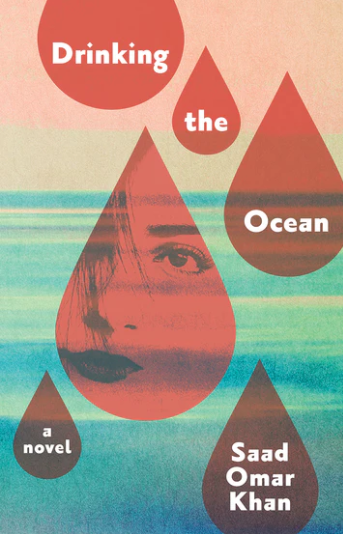
Drinking the Ocean by Saad Omar Khan
Q: Would you describe for readers how your book challenges Western perceptions of Muslim life?
A: One of the biggest challenges when representing the lives of Muslims living in the West is being forced to see Muslims only through the lens of geopolitics or the pathologies that non-Muslims assume is typical of Muslim communities.
Drinking the Ocean was, in a way, my rejoinder to this framework. In the course of writing this novel, it was often suggested to me that adding in a storyline on terrorism would make the book more marketable. This was well-intentioned advice, given in the context of a post 9/11 world where what is extreme and bloodthirsty had more appeal than a relatively quieter story where the inner lives of Muslim characters takes the centre stage.
Drinking the Ocean was never intended to be a specifically “political” book. It is an unfortunate reality, however, that Muslim identities have become inherently politicized. For years, we were a community seen as problematic, a source of chaos, a potential “fifth column” in the War on Terror, the antithesis of everything the secular, liberal, democratic, progressive West sees itself as.
Even in our current climate, where non-Muslims recognize the presence of Muslims in society more, and where Islamophobia as a form of bigotry is increasingly acknowledged, it still comes across to me that there is little room for representing the interaction of Muslims with their religious background in ways that are not simplistic, or where the Muslim character, in some fit of self-liberation, divorces themselves from the oppressiveness of Islam in favour of the warm, permissive embrace of a Western, non-religious value system.
I was, frankly, completely uninterested in this narrative template. Western literature has a long, rich tradition of characters from the Judeo-Christian tradition having to reconcile their sacred, spiritual identity and the realities of their profane, emotional existence. Their are many examples of this, but one that resonated strongly with me while I was writing Drinking the Ocean was Graham Greene’s The End of the Affair. In it, an atheist character has a passionate extramarital affair with a Catholic woman, who abandons the affair as part of a promise to God that she would leave her lover if it would spare his life during a V-2 rocket attack during the Second World War. At no point did Greene, a Catholic himself, condescend to the religious worldview of any of the characters. At the same time, Greene never hesitated to show his characters, believers or otherwise, as what they were: flawed, complex, nuanced, and all too human in the messiest sense of what being human means.
I use this example to illustrate one objective I had in writing this book. As I stated above, this book wasn’t intented to be specifically political, yet it has a political tone just underneath the surface that comes out subtly, and perhaps unintentionally, on my part. Writing about my characters and their emotional challenges--grief, mental illness, familial strife, and difficulties finding spiritual and worldly love--is a political act. It is my fight against the conventional framing of Muslims solely in terms of geopolitics or conflict. The challenge I hope to pose to the reader is to experience this inner world as the characters would. The only explosions to be witnessed are those that exist solely within the human heart. The ruptures my characters face are no less dramatic for it, and certainly no less compelling, as they speak to all of our desires, our need for connection, and our hope in experiencing life at its most transcendent.
More about Drinking the Ocean:
The day after his thirty-third birthday, Murad spots a familiar face at a crowded intersection in downtown Toronto. Shocked, he stands silently as Sofi, a woman he’d fallen in love with almost a decade ago, walks by holding the hand of a small child. Murad turns and descends the subway steps to return home to his wife as the past washes over him and he is taken back to the first time they met.
As Murad’s and Sofi’s lives touch and separate, we see them encounter challenges with relationships, family and God, and struggle with the complexities facing Muslims in the West. With compassion and elegance, Saad Omar Khan delicately illuminates the arcs of these two haunted lives, moved by fate and by love, as they absorb the impact of their personal spiritual journeys.

Saad Omar Khan
ABOUT THE SAAD OMAR KHAN:
Saad Omar Khan was born in the United Arab Emirates to Pakistani parents and lived in the Philippines, Hong Kong and South Korea before immigrating to Canada. He is a graduate of the University of Toronto and the London School of Economics and has completed a certificate in Creative Writing from the School of Continuing Studies (University of Toronto) where he was a finalist for the Random House Creative Writing Award (2010 and 2011) and for the Marina Nemat Award (2012). In 2019, he was longlisted for the Guernica Prize for Literary Fiction. His short fiction has appeared in Best Canadian Stories 2025 and other publications.

Excerpt from In Crisis, On Crisis: Essays in Troubled Times by James Cairns
The move itself was frigid. Men in boots tracking snow and salt through two houses. Half of our plants died in cold moving trucks. My big orange tabby shat in his cat carrier riding next to me in the car from Hamilton to Paris. An omen? Those first weeks in Paris, I saw omens everywhere. Worst was what I found in the attic. Kneeling and feeling for drafts by a small window, I saw bones lying on the floor next to me. They comprised a full skeleton. It was as though the skeleton had been picked clean and preserved for a science class. Not a bone missing or chipped. No rotting flesh or feathers attached. A bird? Squirrel? Baby raccoon? An offering to dark gods left by previous owners? I couldn’t tell.
Excerpt from “Crisis Moves”
[…]
The move itself was frigid. Men in boots tracking snow and salt through two houses. Half of our plants died in cold moving trucks. My big orange tabby shat in his cat carrier riding next to me in the car from Hamilton to Paris. An omen? Those first weeks in Paris [Ontario], I saw omens everywhere. Worst was what I found in the attic. Kneeling and feeling for drafts by a small window, I saw bones lying on the floor next to me. They comprised a full skeleton. It was as though the skeleton had been picked clean and preserved for a science class. Not a bone missing or chipped. No rotting flesh or feathers attached. A bird? Squirrel? Baby raccoon? An offering to dark gods left by previous owners? I couldn’t tell.
In Paul Auster’s Winter Journal he talks about finding a dead crow in the house he and Lydia Davis lived in in upstate New York during their short, doomed marriage. Auster doesn’t believe in ghosts, but feels that their house is haunted. In the crow, he saw “the classic omen of bad tidings”; and their marriage collapsed within a year of finding it. I didn’t have a bag or anything to put the bones in, and I didn’t want Jess or the kids to see them, so I left them lying where I’d found them for a few days. The skeleton lay on the floor of the attic, ten feet above our bed. Before falling asleep, I lay there thinking of it lying above me.
Our first months in Paris were isolating. It was the coldest, snowiest winter in memory. We couldn’t really go outside even if we’d wanted to because it was the peak of the omicron variant of COVID. Nearly everything about the move we’d been excited about – hikes, building community, exploring the town – felt unattainable. While the thing we dreaded most – feeling physically and socially isolated – was now our daily reality.
To make matters worse, there were all kinds of trouble with the house itself. Our first night in the home, the pipes connected to the bathtub leaked through the ceiling onto the basement stairs (talk about omens). The upstairs toilet moaned for fifteen seconds after every flush. We called it the “Paris-saurolophous” – because Gus loves dinosaurs, and the Parasaurolophus is the dino with the crest on its head that honks. You flush the toilet and wait. Then yell, “A Paris-saurolophus is running down the street!” while smiling at Gus and wondering what will break next.
The washing machine ran only hot water. Gus’ room was very cold, despite our covering the window in plastic. The door to the basement wouldn’t close. Neither would the bedroom door. Gus’ door didn’t have a handle. The gas fireplace stank. The whole main floor stank (of gas?). The bathroom sink faucet sprayed water on your clothes when running at normal pressure. Hammering a nail into the upstairs hall, I heard something large drop inside. Was this a normal level of move-in trouble, or had we bought a lemon? I imagined being interviewed for a TV show about people who unwittingly move into wrecks. Then the basement flooded.
Standing in the kitchen in morning darkness, bleary-eyed, waiting for coffee to brew, I heard unidentifiable splashing. With Gus in my arms, I ran down the basement stairs to see water gushing through the stone foundation. It had rained overnight for the first time since we moved. Snow melting in the yard poured into our utility room. In one spot, water was coming through the wall so rapidly, with such force, that it spurted into the room as if from a backyard garden feature. Weeping walls, a crumbling foundation – the contrived symbolism, the on-the-nose pathetic fallacy of an unimaginative poet. Was our house about to collapse? We were falling apart.
[…]
“Crisis Moves” is excerpted from In Crisis, On Crisis: Essays in Troubled Times by James Cairns copyright © 2025 by James Cairns. Reprinted by permission of Wolsak & Wynn.

In Crisis, On Crisis: Essays in Troubled Times by James Cairns
More about In Crisis, On Crisis: Essays in Troubled Times :
Drawing on social research, pop culture and literature, as well as on his experience as an activist, father and teacher, James Cairns explores the ecological crisis, Trump's return to power amid the so-called crisis of democracy, his own struggle with addiction and other moments of truth facing us today. In a series of insightful essays that move deftly between personal, theoretical and historical approaches he considers not only what makes something a crisis, but also how to navigate the effect of these destabilizing times on ourselves, on our families and on the world.

James Cairns
About James Cairns:
James Cairns lives with his family in Paris, Ontario, on territory that the Haldimand Treaty of 1784 recognizes as belonging to the Six Nations of the Grand River in perpetuity. He is a professor in the Department of Indigenous Studies, Law and Social Justice at Wilfrid Laurier University, where his courses and research focus on political theory and social movements. James is a staff writer at the Hamilton Review of Books, and the community relations director for the Paris-based Riverside Reading Series. James has published three books with the University of Toronto Press, most recently, The Myth of the Age of Entitlement: Millennials, Austerity, and Hope (2017), as well as numerous essays in periodicals such as Canadian Notes & Queries, the Montreal Review of Books, Briarpatch, TOPIA, Rethinking Marxism and the Journal of Canadian Studies. James’ essay “My Struggle and My Struggle,” originally published in CNQ, appeared in Biblioasis’s Best Canadian Essays, 2025 anthology.

Some thoughts on accuracy and research in historical fiction: A special feature by Tim Welsh
I recently read Robert Penner’s The Dark King Swallows the World, a novel set in Cornwall during World War II. I liked it a lot, and was surprised to learn that a few (of the otherwise uniformly positive) reviews had called it out for a lack of historical accuracy.
My initial response was: who cares? Complaining about historical accuracy in a work of fiction seems, to me, like bragging about being the best at doing homework. Missing the point, a little obnoxious.
I recently read Robert Penner’s The Dark King Swallows the World, a novel set in Cornwall during World War II. I liked it a lot, and was surprised to learn that a few (of the otherwise uniformly positive) reviews had called it out for a lack of historical accuracy.
My initial response was: who cares? Complaining about historical accuracy in a work of fiction seems, to me, like bragging about being the best at doing homework. Missing the point, a little obnoxious.

The Dark King Swallows the World by Robert Penner, published by Radiant Press.
Perhaps I’m being overly defensive here. My debut novel, Ley Lines, (Guernica Editions, 2025) takes place during the Klondike Gold Rush. It’s also full of errors and inaccuracies. And while I haven’t received a ton of feedback on book’s historical fidelity, or lack thereof, I’m sure that a significant portion of historical fiction readers would bristle at the liberties I’ve taken with time and place. (However, there’s only one way to find out: go buy it, please.)
Penner’s book is literary fantasy; Ley Lines I would describe as ‘psychedelic Canadiana,’ though magic realism works, too. Neither is historical fiction in the strictest sense of the word. So what do we, as writers of weird, playful fiction, who work in a historical milieu, owe to the historical record?
I can’t speak for Penner, but for me, the choice of the Klondike as a setting was deeply personal, and not the result of any scholarship on my part. I was inspired by Robert Service’s famous poems, “The Shooting of Dan McGrew” and “The Cremation of Sam McGee” — in particular, the illustrated 80s versions featuring Ted Harrison’s artwork.
Service was a bit of an interloper in the Klondike — he was a banker and a journalist, and he arrived in the Yukon years after the initial rush. Most of his poetry was based on twice-told tales and old prospectors’ lore. So already, we’re at a few degrees of removal from historical accuracy; Harrison, in the 1970s and 1980s, illustrating poems that were themselves based on second- or third-hand accounts of the 1890s gold rush. And me, in 2025, taking that as inspiration. Each step adding another layer of embellishment and idiosyncracy.
Of course you can’t build an entire novel off a few paintings. The weird, fantastic world I wanted to create — like Harrison’s paintings — had to have some basis in reality.

Ley Lines by Tim Welsh, published by Guernica Editons
When I did start doing actual research, I was very adamant that I look to sources offline. This, I felt, was an important strategic decision: as vast as the internet is, it seems to regurgitate the same anecdotes constantly. I would be embarrassed if someone called me out for, say, having a character use the wrong type of drill. But I’d be mortified if someone thought I drew inspiration from a viral post on Reddit.
So, Pierre Burton, to start. Burton’s Klondike: The Last Great Gold Rush, 1896-1899 is the definitive nonfiction account of the era. I knew I would have to make peace with it. I got about 1/3 of the way through, then read selectively when I felt like I needed to know more about a specific town, or topic, etc.
There were things I found myself weirdly hung up on: when did the rivers thaw in the spring of 1901? Could the Pinkertons have made it to the Klondike? Who really shot Soapy Smith?
There were also many things I chose to leave in, despite their anachronism or incongruity with the historical record. (I will leave it to the sleuths in A Writer of History’s readership to ferret these out — which, again, you can do ‘til your heart’s content, once you’ve bought the book.)
But all of these decisions — what to include, what to ignore — were secondary to the larger project of the book. Did it follow its own internal logic? Was the plot consistent with the themes I was interested in? Did the jokes land?
Ultimately, to praise a book for its level of research seems to me to be a bit of a backhanded compliment. Research, and the degree to which we use it or ignore it, is an artistic choice, alongside all the other things that make fiction great: style, plot, character, etc. No amount of research can make up for a book that lacks the other characteristics of great fiction.
That said, I get why people expect some degree of accuracy in historical fiction. One of the joys of a good book is that it takes us to new places — whether it’s Cornwall in WWII, the Yukon at the tail end of the Gold Rush, or somewhere not in the history books at all.
But those places will always exist in tension with reality. Whether or not a book successfully reconciles that tension shouldn’t be the only criteria by which we judge it.
—Tim Welsh
More about Ley Lines:
Set in the waning days of the Klondike Gold Rush, Ley Lines begins in the mythical boom town of Sawdust City, Yukon Territory. Luckless prospector Steve Ladle has accepted an unusual job offer: accompany a local con artist to the unconquered top of a nearby mountain. What he finds there briefly upends the town’s fading fortunes, attracting a crowd of gawkers and acolytes, while inadvertently setting in motion a series of events that brings about the town’s ruin.
In the aftermath, a ragtag group of characters is sent reeling across the Klondike, struggling to come to grips with a world that has been suddenly and unpredictably upturned. As they attempt to carve out a place for themselves, our protagonists reckon with the various personal, historical and supernatural forces that have brought them to this moment.
A wildly inventive, psychedelic odyssey, Ley Lines flips the frontier narrative on its ear, and heralds the arrival of an exciting new voice in Canadian fiction.

Tim Welsh
About Tim Welsh:
Tim Welsh was born in Ithaca, New York in 1980. He was raised in Ottawa, Ontario and attended Queen’s University and Carleton University, graduating with an MA in English Literature. Since then, he’s lived in New York City and Oaxaca, Mexico, played bass in a punk band, and managed a failing art gallery. Tim Welsh lives in Toronto with his wife and two children. Ley Lines is his first novel.

Power Q & A with Alex Gurtis
We became aware of American poet Alex Gurtis through his work as a literary critic and then further familiarized ourselves with his work in the literary community—specifically, his work uplifting Canadian authors. Then, we learned more about his poetry, and our interest was doubly piqued. We picked up his chapbook, When the Ocean Comes to Me (Bottlecap Press, 2024), and were blown away.
We became aware of American poet Alex Gurtis through his work as a literary critic and then further familiarized ourselves with his work in the literary community—specifically, his work uplifting Canadian authors. Then, we learned more about his poetry, and our interest was doubly piqued. We picked up his chapbook, When the Ocean Comes to Me (Bottlecap Press, 2024), and were blown away. His work is wild and rangy and polished and devotional. We had to talk to him, and are delighted he agreed.
Welcome, Alex, to our Power Q & A series.

When the Ocean Comes to Me (chapbook) by Alex Gurtis, Bottlecap Press, 2024.
Q: Your poetry seems to exist in the midst of perpetual motion: a ribboning out to times and places and people. Would you tell us about creating this energy in your writing which makes it feel alive and electric.
A: My creative process for this collection was grounded in answering how we project our emotions onto the landscapes around us and how those spaces come back to us. As someone living in an area that is a North American ground zero for climate change, I wanted to capture the interplay between, as you put it, “the ribboning out between time and place and people.” That last word, people, is the most important. My work is very anthropocentric, focused on real people living within changing spaces. There is an ecopoetic aspect too, but I wanted to focus on humanizing the climate crisis and parallel political crisis. In the same way a landscape painter pulls from their surroundings, my subject matter was the people around me. I like to think I applied an ekphrastic gaze in freezing the world around me like a still life in motion and then bringing it to life on the page.
In my opening poem, “Hurricane Party,” the anxiety of watching a storm barreling at you non-stop for 48 hours while you are being told the apocalypse is now, is mentally exhausting. It leaves you a little unhinged. It’s a space where you “walk backwards out of a store/with a bottle of wine” and “watch a man as cracked as the sidewalk/ juggling a baseball, football, and basketball” as entire communities are devastated. None of those experiences are made up. A lot of these poems started as collages of images around certain thematic events like Hurricane Ian. The other half of the collection is political by way of economics and really pulled from my time working in grocery, as a barista, running a bookstore, and working as an adjunct. So many people in my life have been close to or spent time houseless. Rent is high and pay is low in Orlando, Florida and the storms keep coming. My poem “Absence of a Diet Coke” began as a riff off a comment made by a peer in MFA who couldn’t buy a coke. Her credit card bounced because our TA pay got delayed a month.
Ultimately, the real currency we are lacking isn’t dollars but time. We are reacting too slow to stop the climate crisis. Florida is under Neo-Fascist control (as is America as a whole) and the life plan we were all sold, the “American Dream” is a bunch of bollocks. “Post Capitalist Americana” could be retitled “Life in Late-Stage Capitalist America” but wouldn’t have the same snap. Still, it raises a question about identity and how it relates to place. What is America after capitalism? Is there one? Similarly, what is the Floridian identity after “the sea began to rise”? Worst case is probably an archipelago thanks to the Lake Wales Ridge but that's a lot of displaced people when we are just struggling to survive. This isn’t a uniquely Florida problem either. So many people around the country are dealing with disasters like fires that are forcing us to rethink where we live.
Anxiety is a perpetual motion, a sort of flight response, I’m trying to capture though, to borrow a phrase from Carolyn Forché, “the poetry of witness” which I try to apply to communities and spaces that are being erased by extreme weather events incited by the political refusal to accept carbon’s role in changing our planet. Similarly, I want to create a space to help readers find anxious affirmations and grieve while also maintaining a space for readers to hold hope for the future, even if it looks vastly different than we imagined or want it to be. There is something powerful in recording the stories of the people now so people can look back and see that the world was scary, we were scared, but also, we lived.
More about When the Ocean Comes to Me:
When the Ocean Comes to Me is a collection dripping with the anxiety of the Anthropocene. Salt water rises along Florida’s coast as inhabitants watch a clock’s “hands chase each other/ along their predestined path.”
These poems meditate on how “education is a type of trauma” and ask how we can cope with the knowledge that our planet is changing before our eyes. Imagist studies of built environments come unraveled as late-stage capitalism erodes cities and natural landscapes alike.

Writer Alex Gurtis
More about Alex Gurtis:
Alex Gurtis is the author of the chapbook When the Ocean Comes to Me (Bottlecap Press, 2024). He is an assistant editor for Burrow Press and runs an occasional interview series at Barrelhouse.
A ruth weiss Foundation Maverick Poet Award Finalist and a winner of Saw Palm’s 2022 Florida Fauna and Flora contest, Alex received his MFA from the University of Central Florida. His work as a poet and critic has appeared in or is forthcoming in anthologies and publications such as Aquifer: The Florida Review Online, Barrelhouse, Bear Review, HAD, Heavy Feather Review Identity, Identity Theory, Rain Taxi, The Shore and West Trade Review, among others.
An avid believer in community and leaving the world a little better than he found it, Alex serves on the board of the Kerouac Project of Orlando and is often found at the intersection of writing and place making. You can follow him on Instagram @apbg_alex, Bluesky @alexgurtis.bsky.social and Substack,

Power Q & A with Andrew French
On this Power Q & A, we are tickled to be joined by poet and podcast host, Andrew French. Andrew is the host of the popular Page Fright poetry show, where they interview established and emerging authors about breaking through as writers and finding their literary style.
In this interview, we ask Andrew to share with us about why they started the podcast.
On this Power Q & A, we are tickled to be joined by poet and podcast host, Andrew French. Andrew is the host of the popular Page Fright poetry show, where they interview established and emerging authors about breaking through as writers and finding their literary style.
In this interview, we ask Andrew to share with us about why they started the podcast.
Welcome, Andrew!

Listen in to Page Fright.
Q: Would you tell us about your podcast and why you started it?
A: Page Fright is a poetry podcast with a simple concept: I talk to my favourite poets from across Canada about their latest collections and poetics more generally. Guests share poems from their recent publications, answer a question from my previous episode’s guest, and discuss the process of creating their collections and writing as a practice beyond their latest projects. The show has been running for nearly six years and has a catalogue of over a hundred episodes you can listen to wherever you get your podcasts.
I started the show out of a selfish desire to make some friends in the literary community. I moved back to Vancouver in 2018 after graduating from Huron University College in London, Ontario and didn’t have any writer pals (or community at all, really) out here. I attended a few readings alone and sheepishly chatted with authors afterwards as they signed my copy of their book, realizing they were surprisingly willing to answer my questions about their work. What started with a rented booth at the Vancouver Public Library, a brief chat with one of my many inspirations and fantastic poet Shazia Hafiz Ramji (thank you again and always, Shazia!) and some free audio software, has led to me gabbing my way across Canada video call by video call.
What keeps me returning to these conversations is the community that’s grown and continues to grow around the show. Podcasts are weird because you can’t see the audience, so it often feels as if you’re talking into a void. But the moments of interaction online or at the readings I’ve organized for the show make all those chats into the online abyss well worth the awkwardness. I was so scattered and nervous at the live reading/taping I held for the show’s 100th episode last fall because there it was: a room full of people who had heard everything I thought I was only admitting to the other voice in the Zoom room.
That community is such a powerful motivator as a poet, though; we’re not writing for money or even for readership at times! I write poems to try and create moments of connection between myself and the world around me, and anytime somebody else engages with that connection is truly the most beautiful bonus. I think people come on my show for that reason – I’m engaging with the connections they’ve created and relating to their perspective on some level.
On my end, Page Fright is the best project I’ve created, far beyond my own publications and writing. It’s certainly the most rewarding. It inspires me to keep working on my own poems, reading new collections, and engaging with the Canadian literary community. This isn’t the world’s biggest podcast, and I’m never going to be flooded with sponsorship deals for boxed mattresses and online therapy companies, but I am beyond grateful for the community that’s grown and continues to grow around it. It’s the reason I begin episodes with “Welcome back to Page Fright” instead of “Welcome” – whether it’s your first episode, your last, or somewhere in between, this space is and always has been yours to connect in as much as it is mine.

More about Andrew French:
Andrew French is a queer poet from North Vancouver, BC. Their third poetry chapbook, Buoyhood, is forthcoming from Alfred Gustav Press in July of 2025. Andrew’s writing has previously appeared in Event, PRISM International, long con, and a number of other literary journals across North America and the UK. In addition to their own writing, Andrew has chatted to their favourite poets as host of Page Fright: A Poetry Podcast since 2019.
More about Buoyhood:
In Buoyhood, Andrew French surfaces a queer identity that has been suppressed by a speaker swimming in masculinity. A brief selection of poetry spanning a range of forms, the collection explores what it means to be a man, to be family and, more simply, to be.

Power Q & A with Tim Welsh
We are delighted to have Tim Welsh join us today to speak about history in his extraordinary debut novel, Ley Lines (May 1, 2025, Guernica Editions).
Set in the waning days of the Klondike Gold Rush, Ley Lines begins in the mythical boom town of Sawdust City, Yukon Territory. Luckless prospector Steve Ladle has accepted an unusual job offer: accompany a local con artist to the unconquered top of a nearby mountain. There, the duo finds a seven-foot human ear, floating in a halo of light. This mysterious discovery briefly upends Sawdust City's fading fortunes, attracting a crowd of gawkers and acolytes, while inadvertently setting in motion a series of events that brings about the town's ruin.
We are delighted to have Tim Welsh join us today to speak about history in his extraordinary debut novel, Ley Lines (May 1, 2025, Guernica Editions).
Set in the waning days of the Klondike Gold Rush, Ley Lines begins in the mythical boom town of Sawdust City, Yukon Territory. Luckless prospector Steve Ladle has accepted an unusual job offer: accompany a local con artist to the unconquered top of a nearby mountain. There, the duo finds a seven-foot human ear, floating in a halo of light. This mysterious discovery briefly upends Sawdust City's fading fortunes, attracting a crowd of gawkers and acolytes, while inadvertently setting in motion a series of events that brings about the town's ruin.
Welcome, Tim!

Q: Would you tell us about writing this trippy story in a historical setting?
A: A benefit of writing fiction with a historical setting is that it gives you a larger palette of words to play with. One of the joys of writing Ley Lines was melding the language of 19th-century prospectors with my own style. The goal isn’t necessarily to be historically accurate (if it were, the book would be a failure on multiple levels, lol) but to create a distinctive experience for the reader.
To me, style is the thing that makes literary fiction unique as a form; it’s the difference between writing a novel and, say, relating the plot of an imaginary movie (which is how I would characterize a lot of bad fiction). To the extent that the book works, a large part of that is because the language itself—slightly absurd, slightly psychedelic—mirrors and complements the narrative as a whole. I wouldn’t write this way if I was writing, say, a tender, realistic, coming-of-age drama; conversely, Ley Lines wouldn’t be Ley Lines with any other style of writing. You’re either in for the ride or you’re not.

More about Tim Welsh:
Tim Welsh was born in Ithaca, New York in 1980. He was raised in Ottawa, Ontario, and attended Queen’s University and Carleton University, graduating with an MA in English Literature. Since then, he’s lived in New York City and Oaxaca, Mexico, played bass in a punk band, and managed a failing art gallery. Tim Welsh lives in Toronto with his wife and two children. Ley Lines is his first novel.

A Workshop Junkie Comes Clean
The last time I attended a writing workshop was in 2014. It was the Tone + Text opera workshop in Vadstena, Sweden at the Vadstena Akademien, a school for opera artists. I was there as a librettist. This was part two of the workshop, which lasted four days, culminating in a showcase of scenes written by librettists who had been paired with composers at part one, also a 4-day affair that took place the previous year.
By: Steven Mayoff
The last time I attended a writing workshop was in 2014. It was the Tone + Text opera workshop in Vadstena, Sweden at the Vadstena Akademien, a school for opera artists. I was there as a librettist. This was part two of the workshop, which lasted four days, culminating in a showcase of scenes written by librettists who had been paired with composers at part one, also a 4-day affair that took place the previous year.
Prior to Tone + Text, I had been attending writing workshops on a fairly regular basis since 2003, at least one, and more often two, a year. With only a couple of exceptions, the majority of these were not merely one-day sessions, but rather fairly intensive week-long workshops. I would describe these as sleepaway camps for writers.
Since those last workshop in Sweden, I have often wondered about this decade of attending writing workshops. I suppose I could have taken a creative writing course at some university, but I doubt it would have been the same. I was in the fortunate position of being able to devote much of my time to writing. The workshops were brief respites from the solitude of my efforts. I was also able to take a variety of workshops that addressed my interest in different forms of writing.
But somewhere along the way, the brief respites became necessary stopgaps.
In 2000, I was still living in Toronto. A playwright friend had suggested that we adapt one of my short stories into a radio play and use it to apply to a radio drama workshop at the CBC. We were accepted into the workshop and developed our rough script into a 10-minute radio play, which aired on CBC the following year, after I had moved to Prince Edward Island. We then wrote a second 10-minute radio play, which aired in 2002. We also attended a second radio drama workshop, this one involving collaborations with composers in Banff, Alberta in 2003. This produced a third 10-minute play, airing that same year.
But the workshop that got me hooked and really started me on my decade-long jag was the Maritime Writing Workshop in 2004 at the University of New Brunswick campus in Fredericton. I didn’t know what to expect and I was nervous. Of the different categories of workshops – poetry, art criticism and fiction – I chose the latter. Along with my application, I had to submit a story that I wanted to work on. I brought a story that I had been sending out to various magazines without much luck. Although in my late 40s, I was still something of an emerging writer with a slowly growing number of literary journal publications under my belt. Perhaps this workshop would illuminate the hidden flaws in this particular story and possibly suggest some helpful tips for getting it into print.
On the first day, after we had registered and been shown to our rooms in the on-campus residence, the writers met with their respective instructors and fellow group members in a brief orientation session that would be followed by an informal meet-and-greet. There were ten of us in total. We sat in a circle, regarding each other warily, as our instructor, the short story writer Richard Cumyn, gamely tried to get us to talk about ourselves. And while everybody seemed nice enough, no shyer or bolder than myself, I started to have doubts about how beneficial this week would be for me.
My fears were quickly dispelled after we broke out of our groups to wander and mingle with each other. I found myself in casual conversation with Richard. He immediately wanted to talk about my story. To my surprise he had a couple of suggestions to improve it. What struck me was the passion he had for writing. It didn’t surprise me to find out he had been a high school teacher. He reminded me of the few good ones I’d had back in the day, the kind that made learning an adventure. Late 40s or not, I suddenly felt the fire in my belly that can shed years off anyone’s psyche. That night in my room I found myself mulling over his advice and happily concocted possible new scenes to write. Things were happening faster than I had expected and I felt pleased.
Even more pleasing was how quickly our group gelled, evident from the first proper session together. A genuine camaraderie seemed to be emerging, not to mention mutual respect for each other’s work. The spirit of constructive criticism was apparent in our assessment of each other’s stories. Unfettered by the fear of hurting a fellow writer’s feelings we always spoke plainly, pointing out flaws, making suggestions, but always with the intention of supporting whoever was in the hot seat.
The suggestions that Richard had made about my story on that first day resulted in me writing two new scenes. I finished first drafts in time for the morning when it was my turn to be in the hot seat. After the group had assessed my story, I read the new scenes to them. I didn’t have that much experience reading to an audience, yet there I was reading these scenes aloud to the group, giving them nuance and point of view, eliciting laughter from my audience. From that moment something in me changed. To say I fell hard for the workshop experience would be a vast understatement when you consider that I went to another week-long workshop only a month later.
That one was with Tapestry New Opera Works in Toronto. The Composer/Librettist Laboratory, or the Lib/Lab for short, was a yearly event. My playwright friend, with whom I’d written the radio plays, had done it, so I thought I’d give it a shot and applied. Although I consider myself primarily a fiction writer, I also write poetry and song lyrics. I had collaborated on a sung-through modernized adaptation of The Picture of Dorian Gray, with a long-time composing partner, so I did have some experience as a librettist, although that was not a requirement to get in the workshop.
The Lib/Lab had four librettists, four composers, two accompanists on piano and six opera-trained singers (three male, three female). There were two instructors, one for the composers and one for the librettists. Librettists and composers were paired together, given a theme, and had to write short scenes, which would then be performed by the singers. It was essentially a series of tag-team matches as, throughout the week, each librettist got to write with each composer and the scenes were performed at the end of each day. There was a certain amount of overlapping, which was nerve-wracking, especially for the composers, but also great fun.
In an attempt to gain some insight as to what drew me to writing workshops, I will look at the years I attended all of the Great Blue Heron Writing Workshops, which took place for one week every summer from 2005 to 2010 at the St Francis Xavier University campus in Antigonish, Nova Scotia. It was there, maybe not so coincidentally, that I first heard the term “workshop junkie” although not pertaining to me specifically. Nevertheless, the term lodged itself in my consciousness and I often wondered if that was what I had become. I still took my interest in going to workshops as a positive sign of my commitment to being a writer and an integral part of my development. I considered my attendance to be part of my ongoing education. There were many things I liked about writing workshops in general and the Great Blue Heron Writing Workshops in particular.
I liked the camaraderie, being with people who were there because of their interest in writing. Some participants, like myself, had published and worked at their writing with serious intent, while others had never written anything before but wanted to improve their ability in expressing themselves on paper or word processor screen. There were many people from other professions, mostly doctors, although once there was a young minister with whom I had some interesting conversations. I remember a psychiatrist who read us an amazing poem about her conflicted feelings when having to commit a patient to an institution.
No matter what brought any of my fellow participants there or their degree of writing experience, I truly felt we were all on a level playing field in wanting to become better writers. While those of us who may have been more accomplished could offer advice to others, I also felt that the so-called neophytes had something to offer as well: an almost innocent sense of wonder that served to remind everyone, or me at any rate, that passion and curiosity, rather than ambition, were at the heart of writing well.
I also liked the instructors and I had some pretty good ones, with whom I felt privileged to study under. Anne Simpson for poetry was one of the GBHWW’s organizers and had won the Griffin Poetry Prize for her collection Loop. Sheldon Currie for screenwriting, even though he was mainly a fiction writer, was best known for his novel The Glace Bay Miner’s Museum, which had been adapted into the film Margaret’s Museum starring Helena Bonham Carter. I also took poetry with Anne Compton, winner of the Governor General’s Award for her collection, Procession. There was Alistair MacLeod, the well-respected writer of short fiction, whose novel No Great Mischief won the Dublin Literary Award. I took fiction workshops with him in 2007 and 2009. In Great Blue Heron’s final year of 2010, I took playwriting with actor, director and playwright Daniel MacIvor, who had won the Siminovitch Prize among many other theatre awards.
It was in that final year that, with teasing affection, I was presented with the Great Blue Heron Writing Workshop’s Extreme Participant Award for returning year after year. The award was a slim folder with brochures from every year of the workshop’s existence. I was touched, even proud, and yet, somewhere in the back of my mind, I questioned what it really said about me. Still, even if there was a silent rebuke in the honour, I accepted it with good humour and what I considered to be a healthy dose of humility.
Looking back, one thing that kept me returning to Great Blue Heron was the noticeable (by me at least) change in my personality. In general, I am a textbook example of an introvert. In groups of two or more I tend to listen rather than speak, unless I have something very specific to contribute. But at the Great Blue Heron, I found myself becoming more outgoing and social. It was a change of personality that I welcomed in myself. Possibly because of the novelty of it. Or possibly, I felt I had found my tribe.
But the main lure was the opportunity to bring with me a work-in-progress and, by the end of the week, be able to return home, knowing what I had to do to take the story, poem or play to the next level. Whatever other pros or cons there were in attending all those workshops, that was what mattered most to me. Being able to push ahead and improve whatever I was working on. It was all part of the process of developing myself as a writer, no matter what anyone else thought.
And I soon became aware of what some thought and the perceived drawbacks of going to workshops for so many years. My first clue came during a week-long workshop in Prince Edward Island.
During some free time away from the group, my instructor and I were chatting about the workshop and the dynamics of our group. My instructor then said she was surprised to have me in the group, that I seemed more like a colleague than a student. I wasn’t sure how to take this. At first it felt like a compliment. I sometimes found that certain instructors treated me seriously as a writer. This was yet another reason I often returned to the workshop environment. While I had some writer friends, it was in workshops that I often felt genuinely recognized as a writer.
I suppose I used workshops as a substitute for not having the kind of recognition I craved after I started getting published.
But when I thought more about my instructor’s comment, how she felt more inclined to treat me like a peer, it seemed that maybe I had outgrown writing workshops but didn’t know how to let go. It was strange to think of my instructor’s comment and feel so empowered yet kind of humiliated at the same time, although I’m sure it was not her intention to make me feel that way.
The second clue was from a much more straightforward comment, this time from an ex-instructor with whom I had stayed in touch for a number of years after our workshop experience together. My second book, a novel, had just come out. My ex-instructor also had a new book coming out and one of us had suggested a straight swap. I’m not sure how workshops came up. Possibly I had mentioned doing the opera workshop in Sweden.
My ex-instructor’s comment left no room for interpretation. He advised me flat out to stop going to workshops because, with two books out now, workshops had become a liability for me. If others in the writing and publishing communities saw that I was still going to workshops it would undermine my credibility. No one would take me seriously as a writer, even though I was getting my work published.
I don’t mind admitting that such a blunt piece of advice was a small blow to my self-confidence, but only because I knew beyond any doubt that what he was saying was true. I was disappointed in myself for not seeing it on my own. Or more to the point, for seeing it and choosing to ignore it.
This gave rise to a different backlash within myself: a need to defend my choices. All I wanted was to facilitate my development as a writer. So what if I did it by going to workshops? Why did I have to knuckle under to the public perception others might have had of me? What’s wrong with experienced writers going to workshops to get a fresh perspective on their ingrained notions of the craft? Why couldn’t I continue going to workshops just as long as it was still working for me?
But then I had to ask myself if workshops were indeed still working for me.
If I was being honest with myself, I had to recognize that, at times, I felt as if I was covering old territory in workshop sessions. I knew I was at a point where this phase of my writing life, the workshop phase, was over. I suppose I was merely embarrassed that I had to be given gentle and maybe not-so-gentle reminders by my ex-mentors.
Yet, I have no regrets.
One of the best things I learned in workshops that served me well later on, was how to critique another writer’s work in group sessions. It was not easy to do at first, because you want to say something intelligent and not come off sounding like an idiot in front of everyone. But on the other hand, it did become easier because it’s always easier to look objectively at someone else’s work rather than your own. And when I started to consider the advice I gave other writers about their work, and then asked myself whether I was taking my own advice, I found the key to what is the most important technique a writer needs to learn: self-editing. Going back to reread one’s own work as if it was somebody else’s. A bit of playacting to fool oneself into a semblance of objectivity.
I met many interesting people during my workshopping years. I even made a few friends who I still stay in touch with to this day. And I won’t lie, I sometimes miss the excitement of arriving on the first day and the relief of going home on the last day. Workshops started off as a nice break from my day-to-day struggles with procrastination and triumphs of productivity. Then they became something else, a substitute for something I lacked: that sense of coming to terms with my journey. Not just the slowness of it, but the big fat question mark that always seemed to loom at the end of the road. Workshops started off as stepping stones toward the writing career that I thought was my due. Then they became bubbles of pretence, a kind of rehearsal for some expected arrival.
While I still justify my years of writing workshops as an ongoing education, it’s been all these years away from them that have become the true learning experience. A change of attitude: the slow transition from coveting a writing career that might or might not be in the cards for me to recognizing, accepting and valuing the writing life that I have been carving out for myself all this time. It still includes struggles and self-doubt and periods when packing it all in feels all too tempting. I guess the only reason I haven’t given it up yet is the same as when I relax with a good book or beaver away at a story. I just want to know what happens next.

Author Steven Mayoff.
About Steven Mayoff:
Steven Mayoff (he/him) was born and raised in Montreal. His fiction and poetry have appeared in literary journals across Canada, the U.S. and abroad. He is the author of the story collection Fatted Calf Blues, winner of the 2010 PEI Book Award for Fiction; the novel Our Lady of Steerage; and two books of poetry Leonard’s Flat and Swinging Between Water and Stone. His acclaimed novel, The Island Gospel According to Samson Grief, was released by Radiant Press in 2023. Steven lives in Foxley River, PEI.

Excerpt from Drinking the Ocean by Saad Omar Khan
He went to the library after class and thought about her sudden disappearance. Undergrads preparing for mid-term exams and equally ambitious postgraduates doing early research for their theses littered every section of the circular, three-story library. Murad found a lone table and made an effort to do some research for his class on internal migration. When he finished working in the early evening, he felt focused and lucid, his mind free of the clouded haze that often weighed it down. He went outside and sat on the same concrete slab where he had first met Sofi. The sky’s leaden greyness was darkening, and Murad found himself surrounded by small, atomized groups of students huddled together. He thought about the email she’d sent him. He had no reason to call her. He had nothing that he needed to say, no wound that needed to be tended. There was only an absence felt, a persistent emptiness without her presence.
He went to the library after class and thought about her sudden disappearance. Undergrads preparing for mid-term exams and equally ambitious postgraduates doing early research for their theses littered every section of the circular, three-story library. Murad found a lone table and made an effort to do some research for his class on internal migration. When he finished working in the early evening, he felt focused and lucid, his mind free of the clouded haze that often weighed it down. He went outside and sat on the same concrete slab where he had first met Sofi. The sky’s leaden greyness was darkening, and Murad found himself surrounded by small, atomized groups of students huddled together. He thought about the email she’d sent him. He had no reason to call her. He had nothing that he needed to say, no wound that needed to be tended. There was only an absence felt, a persistent emptiness without her presence.
He dialed her number. She picked up. For a brief moment, Murad hesitated to say anything.
“Sofi, it’s Murad,” he said, finally.
“Hi,” she said, almost too casually.
“I got your message.” There was silence. He fumbled for words. “I got your message, and I thought I should call.”
“Is everything all right?” she asked, her voice sounding more concerned.
“No, no, everything’s fine. I saw you in class and you left so quickly that I didn’t get a chance to ask you about dinner. I made you a promise, and I’d feel like I’d be losing all my manners if I didn’t follow through with it.”
“I don’t doubt you’re the type who’d fail to keep a promise, Murad,” said Sofi. There was amusement in her voice, the tone light, soft and comforting.
“The answer’s yes then?”
She laughed. “Is it a date?”
“Two people sharing a meal. Let’s leave it at that.”
There was a pause on the other line. “Where and when?” she asked.
Murad looked around at the slate, anemic buildings surrounding him. “Any place that’s not school.”
#
At her suggestion, they were to meet in Covent Garden, near the station, for lunch on Saturday. Covent Garden on any given weekend was exactly what Murad had hoped the city would be when he’d first arrived in London. It truly seemed like the centre of the world, visitors and residents alike blending together with seamless fluidity. He hurried to the restaurant off Long Acre that Sofi recommended. It was a bistro, half-spilling into the street, with metal chairs and tables covered under a broad canopy. He saw Sofi to his right as he entered, sitting at a small, rounded table in front of the window. Her coat was draped over the back of her chair and she wore a thick, white, high-necked sweater. She peered outside and turned to him as he walked toward the table, without any trace of anticipation, as if waiting for someone else.
“You’re late,” she said, before Murad could greet her. She rubbed her hands together, her elbows on the table.
He apologized, removed his jacket and took the seat across from her. “How are you?” she asked.
“I’m fine.”
“That’s good,” she said absently, staring back through the window. A waiter came by the table. They both ordered the soup of the day.
“I had a realization last night,” said Murad.
She turned and gave him a quizzical look. “What?”
“We’ve been talking about me all this time and I haven’t asked anything about you.”
Sofi took one of the breadsticks from the container on the table and delicately broke it in two. “I said I wanted to get to know you. This has nothing to do with me.”
“This shouldn’t be a one-sided relationship, you know? We are getting to know each other.”
Sofi nodded her head. “Maybe. I guess you’re right.”
“Okay,” he said, leaning forward. “We started at the beginning with me. Let’s start at the beginning with you. Where were you born?”
“Here, in London.” She explained how her father had been a petroleum engineer, doing work with BP in Britain when she was born. He also had an accounting degree (“a genius with numbers,” said Sofi). The family left for Dubai around her first birthday. She spent a few years in private British schools in the Gulf before work dried up for expatriates. They decided to immigrate to Toronto rather than go back to Pakistan or England.
Murad listened attentively, comparing her experiences to his, checking off all their commonalities: the same country of origin, the same globetrotting family history, an underlying sense of dislocation. As she spoke, the sense of familiarity he felt with her grew.
“Do you feel at home here?” he asked as a waiter came with water. “In London, I mean.”
“I’m good at making myself feel at home anywhere.”
“I think I’m the exact opposite of you.” The waiter brought their soup, quicker than Murad had anticipated. “I try to find home in far-off places but never succeed.”
“Have you tried in any place other than London?”
“I suppose not,” said Murad.
Neither one of them spoke for a few moments. Murad needed to restrain the urge to ask about every aspect of her life. Outside the window, he watched men and women in dark pea coats stepping carefully across the cobblestone pavement, as if ice covered the surface. They bore a solitary elegance, sharp-featured faces peering into their phones or walking with a determined pace to destinations unknown without companions, weaving through each other like lone atoms repelling each other.
— from Drinking the Ocean by Saad Omar Khan, forthcoming Spring 2025 with Wolsak & Wynn. © 2025 by Saad Omar Khan.

Drinking the Ocean by Saad Omar Khan (Wolsak & Wynn, 2025)
About Drinking the Ocean:
The day after his thirty-third birthday, Murad spots a familiar face at a crowded intersection in downtown Toronto. Shocked, he stands silently as Sofi, a woman he’d fallen in love with almost a decade ago, walks by holding the hand of a small child. Murad turns and descends the subway steps to return home to his wife as the past washes over him and he is taken back to the first time they met.
As Murad’s and Sofi’s lives touch and separate, we see them encounter challenges with relationships, family and God, and struggle with the complexities facing Muslims in the West. With compassion and elegance, Saad Omar Khan delicately illuminates the arcs of these two haunted lives, moved by fate and by love, as they absorb the impact of their personal spiritual journeys.

Saad Omar Khan
ABOUT SAAD OMAR KHAN
Saad Omar Khan was born in the United Arab Emirates to Pakistani parents and lived in the Philippines, Hong Kong and South Korea before immigrating to Canada. He is a graduate of the University of Toronto and the London School of Economics and has completed a certificate in Creative Writing from the School of Continuing Studies (University of Toronto) where he was a finalist for the Random House Creative Writing Award (2010 and 2011) and for the Marina Nemat Award (2012). In 2019, he was longlisted for the Guernica Prize for Literary Fiction. His short fiction has appeared in Best Canadian Stories 2025 and other publications.

Tea Gerbeza Reviews I Think We’ve Been Here Before by Suzy Krause
Suzy Krause’s I Think We’ve Been Here Before (Radiant Press, 2024) is unlike any apocalypse novel I’ve ever read; it’s a refreshing perspective on humanity at the end of the world. The people in this novel do not become the worst versions of themselves; instead, Krause’s vibrant characters remain generous and kind and community oriented. No one takes more than they need at the grocery store, pilots—after systems have gone down—fly planes so that others can get back to their families, and others decorate whole cities with paper chains and snowflakes just to bring small joys in an unfathomable time. In fact, small joys and creativity are at the forefront of what’s meaningful to the book and its characters. These joys offer hope, even if we know the end.
Review of Suzy Krause’s I Think We’ve Been Here Before
By Tea Gerbeza
Content note: this review contains spoilers. Read at your own discretion.
Suzy Krause’s I Think We’ve Been Here Before (Radiant Press, 2024) is unlike any apocalypse novel I’ve ever read; it’s a refreshing perspective on humanity at the end of the world. The people in this novel do not become the worst versions of themselves; instead, Krause’s vibrant characters remain generous and kind and community oriented. No one takes more than they need at the grocery store, pilots—after systems have gone down—fly planes so that others can get back to their families, and others decorate whole cities with paper chains and snowflakes just to bring small joys in an unfathomable time. In fact, small joys and creativity are at the forefront of what’s meaningful to the book and its characters. These joys offer hope, even if we know the end.

Suzy Krause’s I Think We’ve Been Here Before (Radiant Press, 2024)
Throughout the novel, the reader, unknowingly, lives within a nesting doll of memory. Cues of this involves Nora’s cat—simultaneously with Nora, with her parents, and at a neighbour’s—and the uncanny déjà vu the characters experience. Krause cleverly hones her book’s concept through the several perspectives she weaves throughout the book, noting any small change to the overarching memory of the end as intense déjà vu for each respective character. As Marlen’s book says, “It’s the beginning of the same as last time, but better” (294). This time, the time we’re reading, Alfie is not alone when she dies, Jacob is with Nora for the end, and Ole is found—“like last time, but better.” Krause is masterful in revealing what’s at play in the book through her endearing characters, leaving us hanging onto every chapter’s end with a desire to keep going to find what happens next. If they all do, in fact, die. “You die, but also, you’re immortal. You never die” (289), Hilda quotes from Marlen’s book (a mirror reality to theirs), and it is this comfort that Krause leaves us with: like her characters, we, too, will live beyond the page. I Think We’ve Been Here Before is a tender and devastating novel that will call you back to it well after you close its pages.

Reviewer Tea Gerbeza. Photo credit: Ali Lauren.
About Tea Gerbeza:
Tea Gerbeza (she/her) is the author of How I Bend Into More (Palimpsest Press, 2025). She is a queer, disabled poet, writer, editor, and multimedia artist creating in oskana kâ-asastêki in Treaty 4 territory (Regina, SK) and on the Homeland of the Métis. She primarily works with paper in her visual art, but also creates digital works on her scanner (scanography). Her writing and artwork focus on themes of reclaiming disabled identity, disability justice, the Bosnian diaspora, queer platonic friendships, and the complexities of pain. Her artwork has been exhibited at The Art Gallery of Regina. Tea is one of four Pain Poets.
Most recently, her poem “Body of the Day” was a People’s Choice Award finalist in Contemporary Verse 2’s 2024 2-Day Poem Contest. In 2022, Tea won the Ex-Puritan’s Austin Clarke Prize in Literary Excellence for poetry. She also made the longlist for Room magazine’s 2022 Short Forms contest. In 2019, Tea’s poetry won an Honourable Mention in the 2019 Short Grain Contest. Her scanograph, “My Father Catches Me Confronting Memory,” won an Honourable Mention in Room magazine’s 2020 Cover Art Contest, and she was a finalist for Palette Poetry’s 2021 Emerging Poet Prize. In 2023, Tea was recognized by SK Arts as one of 75 strong emerging artists that makes the future of Saskatchewan arts exciting.
Tea holds a BA (Hons.) in English (2017) and an MA in Creative Writing and English from the University of Regina (2019). Tea’s thesis work for her MA was SSHRC funded. She also holds an MFA in Writing from the University of Saskatchewan (2021).
When not doing any of these things, Tea goes on bike rides with her spouse, does puzzles, or reads poetry to her three dogs and cat, Tonks, Ghost, Fenway, and Fig.