

BLOG

Excerpt from The Character Actor Convention by Guy Elston
My sister says How could you
bring a child into this world.
I get it—not like galvanised iron
is the ideal nest lining.
Traditional Nest Material
Crows and magpies using anti-bird spikes
to build nests, researchers find
My sister says How could you
bring a child into this world.
I get it—not like galvanised iron
is the ideal nest lining.
Who’d choose polycarbonate
spikes in the morning,
needle pricks at night? But why
let the world win. Am I right?
I don’t know about bring, but
I’d toss a kid into the mix.
Breed ‘em tough. Malicious compliance
I’d teach, if the tarmac stinks
shit wherever, if the phone rings constantly
faux-ring constantly back.
I wouldn’t rather not exist.
City blocks function as NICU incubator,
smog clouds my biological clockface
but I swear the apocalypse
is always incoming, for all epochs. Like
the half-portion of peanut butter
slicked in the jar—won’t you scrape,
twirl your knife like a feather?
As a father, I’d come to terms.
I’d spread further. Even here, even now.
“Traditional Nest Material”, excerpted from The Character Actor Convention © 2025 by Guy Elston. Reprinted by permission of The Porcupine’s Quill.

The Character Actor Convention by Guy Elston, published by The Porcupine’s Quill, 2025.
About The Character Actor Convention:
A pumpkin writes a letter to his father. A sheep recalls a revolution, and love. Hydrogen pens a tell all exposé of Oxygen. The Stick Insect Orders His Tomb. Napoleon counts waves and cheats at cards. A sunflower seeks answers – why sun? A crow considers children in this cruel, spiky world. And all the while, character actors gather for the endless convention...
Guy Elston’s debut is a curious smorgasbord of personas, voices and (un)natural perspectives. Through impossible encounters and strange viewpoints an insistent, ever-shifting ‘I’ questions its relation to itself. Wist, wit, and obsession rise like tides, are forgotten, and start fresh. Authenticity is always just round the corner.
The Character Actor Convention is not urgent, timely or topical. It’s something else.

Guy Elston
About Guy Elston:
Guy Elston was born and raised in Oxford, UK. After various jobs, journeys and other lifetimes he surfaced in Toronto in 2020. He has an MA in History from the University of Amsterdam. Since moving to Canada his poetry has been published by The Malahat Review, Canadian Literature, Event, The Literary Review of Canada, Vallum, The Antigonish Review and other journals. His chapbook Automatic Sleep Mode was published by Anstruther Press in 2023. His debut full-length collection, The Character Actor Convention, is forthcoming from The Porcupine's Quill in 2025. Guy lives in Toronto and can be found at poetry events. He’s a member of the Meet the Presses collective and is a first reader for Untethered magazine.

Power Q & A with Guy Elston
To put it simply, because I’m not that interested in myself. Which isn’t true, of course – what poet isn’t obsessed with themselves – but perhaps I'm not that interested in the front-facing, autobiographical concept of ‘Guy Elston’. Memory, identity, the cause and effect of life and its happenings – it’s all a sheer mountain face, senseless. I need an angle, a longer way round.
Q: Your debut collection The Character Actor Convention (The Porcupine’s Quill, 2025) is full of persona poems, monologues and dialogues. The speaker is variously an animal, an object, a chemical element, a season, even someone on a date with King Arthur. Why?
A: To put it simply, because I’m not that interested in myself. Which isn’t true, of course – what poet isn’t obsessed with themselves – but perhaps I'm not that interested in the front-facing, autobiographical concept of ‘Guy Elston’. Memory, identity, the cause and effect of life and its happenings – it’s all a sheer mountain face, senseless. I need an angle, a longer way round.
Poetry can be so many wonderful things, and there’s clearly no one superior model. It can be urgent, timely and important, absolutely. Or, the complete opposite. I like to see my poetry simply as a form of storytelling. I’m most interested in forgotten, impossible, niche encounters and viewpoints, the kind which can thrive best in the literary-popcorn realm of poems. A snatched glimpse through a window into a courtyard you never knew was there. Some kind of masked ritual is happening in the courtyard. Think Invisible Cities, but snack-sized.
This is not to say that my psyche doesn’t fill the book. If anything, the book is even more full of me than if I wrote straight confessional poetry. When I write from the POV of Jonah’s whale, for example, I’m not starting from scratch – I'm necessarily depositing a bunch of my own hang-ups and melodramas into the voice of the whale.
I guess the short answer is, persona poems and odd dialogues are my way of incorporating Emily Dickinson’s famous “Tell all the truth, but tell it slant” into my practice. I approach myself at a slant through these guises. If I see a flash of something I could be, or once was, or that might seem knowable to someone, somewhere, that’s my thrill. As for why – it’s simple. All I ever want is to make you both laugh and cry.

The Character Actor Convention by Guy Elston (The Porcupine’s Quill, 2025)
About The Character Actor Convention:
A pumpkin writes a letter to his father. A sheep recalls a revolution, and love. Hydrogen pens a tell all exposé of Oxygen. The Stick Insect Orders His Tomb. Napoleon counts waves and cheats at cards. A sunflower seeks answers – why sun? A crow considers children in this cruel, spiky world. And all the while, character actors gather for the endless convention...
Guy Elston’s debut is a curious smorgasbord of personas, voices and (un)natural perspectives. Through impossible encounters and strange viewpoints an insistent, ever-shifting ‘I’ questions its relation to itself. Wist, wit, and obsession rise like tides, are forgotten, and start fresh. Authenticity is always just round the corner.
The Character Actor Convention is not urgent, timely or topical. It’s something else.

Guy Elston
About Guy Elston:
Guy Elston was born and raised in Oxford, UK. After various jobs, journeys and other lifetimes he surfaced in Toronto in 2020. He has an MA in History from the University of Amsterdam. Since moving to Canada his poetry has been published by The Malahat Review, Canadian Literature, Event, The Literary Review of Canada, Vallum, The Antigonish Review and other journals. His chapbook Automatic Sleep Mode was published by Anstruther Press in 2023. His debut full-length collection, The Character Actor Convention, is forthcoming from The Porcupine's Quill in 2025. Guy lives in Toronto and can be found at poetry events. He’s a member of the Meet the Presses collective and is a first reader for Untethered magazine.

Power Q & A with Christy Climenhage
I hope that readers will take away the idea that just because we are capable of doing a thing, doesn’t mean we should do the thing. We need to use our own critical thinking and ethical judgement to determine our way forward and make decisions in a complex world. We live in an era of marvels where so much is possible. But just because something is possible doesn’t mean that it serves any kind of public good. We shouldn’t do it just because we can. This applies to genAI, it applies to resurrecting dire wolves (which were not resurrected at all, not really), and it applies to deep-sea mining. And of course, it applies to the central premise of my novel – adapting humans to live in the ocean depths.
Q: Christy, your near-future debut novel THE MIDNIGHT PROJECT (Wolsak & Wynn, 2025) deals with some serious issues ranging from the ethics of genetic engineering, the commodification of science to the perils of late-stage capitalism. What do you hope readers will take away from your novel?
A: I hope that readers will take away the idea that just because we are capable of doing a thing, doesn’t mean we should do the thing. We need to use our own critical thinking and ethical judgement to determine our way forward and make decisions in a complex world. We live in an era of marvels where so much is possible. But just because something is possible doesn’t mean that it serves any kind of public good. We shouldn’t do it just because we can. This applies to genAI, it applies to resurrecting dire wolves (which were not resurrected at all, not really), and it applies to deep-sea mining. And of course, it applies to the central premise of my novel – adapting humans to live in the ocean depths.
Science fiction is supposed to provide a cautionary tale to encourage people to use their own cognitive faculties to think ahead to the consequences of their actions. Dystopian tales are not meant to be inevitable roadmaps to the future, they are there to encourage sober second thought. In addition to entertaining readers, I hope my novel will spark some reflection on the role of big billionaires and venture capital in scientific endeavours, and the ethics of bespoke genetic engineering.
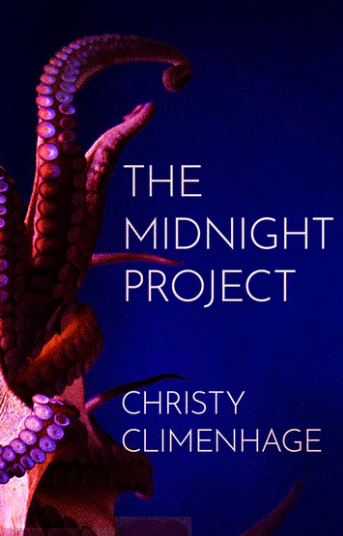
The Midnight Project by Christy Climenhage (Wolsak & Wynn, 2025)
About The Midnight Project :
When enigmatic billionaire Burton Sykes walks into Re-Gene-eration, a bespoke reproduction assistance clinic run by Raina and Cedric, two disgraced genetic engineers struggling to get by, they know they have a very unusual client. When Sykes asks them to genetically engineer a way for humanity to survive the coming ecological apocalypse, Raina is tempted. Bees are dying, crops are failing, and she knows her research is partly to blame. Could she help in some way? Though troubled, Cedric agrees to take part when it becomes clear their benefactor will do this with or without them. How else can he be sure their work won’t fall into the wrong hands? But can they really trust Mr. Sykes?
In this near-future science fiction thriller, Christy Climenhage has created a frighteningly real world on the verge of collapse. As disaster strikes, the two friends need to decide whether to cling to their old life or to let go and embrace a new path for humanity.
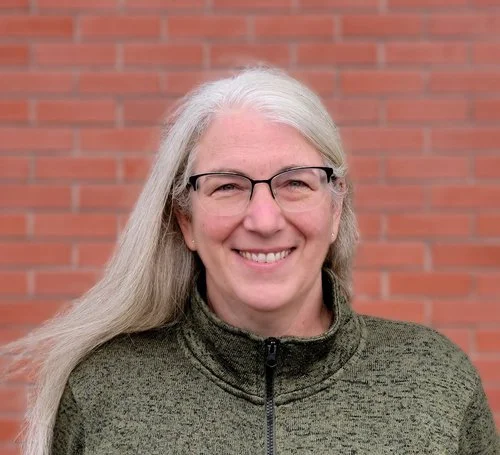
Christy Climenhage
Photo credit: Roger Czerneda
About Christy Climenhage:
Christy Climenhage was born in southern Ontario, Canada, and currently lives in a forest north of Ottawa. In between, she has lived on four continents. She holds a PhD from Cambridge University in Political and Social Sciences, and Masters’ degrees from the Norman Paterson School of International Affairs at Carleton University (International Political Economy) and the College of Europe (European Politics and Administration). She loves writing science fiction that pushes the boundaries of our current society, politics and technology. When she is not writing, you can find her walking her dogs, hiking or cross-country skiing.

Power Q & A with Aamir Hussain
The core inspiration of the story does come from my lived experience of coming from a family of Muslim women who are incredibly accomplished in many different fields and my attempt to reconcile this with the image of my faith in the West of being incredibly misogynistic and oppressive towards women. An image that has been a part of Western culture for hundreds of years but came into prominence as a part of the incessant drumbeats successfully justifying wars against Muslim Majority countries for the past few decades.
Q: In your novel, Under the Full and Crescent Moon (Dundurn Press, September 23, 2025) you have a very high concept of a Muslim Matriarchy. How important is that to the story?
A: The core inspiration of the story does come from my lived experience of coming from a family of Muslim women who are incredibly accomplished in many different fields and my attempt to reconcile this with the image of my faith in the West of being incredibly misogynistic and oppressive towards women. An image that has been a part of Western culture for hundreds of years but came into prominence as a part of the incessant drumbeats successfully justifying wars against Muslim Majority countries for the past few decades.
Much of the reading and research into Islam and the mechanics of Islamic Law (Sharia) I did was to delve into what it is about Islam that can allow both of these very different realities to exist simultaneously, especially since I did grow up in Saudi Arabia in the 1980's and early 90's which did hew very close to Western misogynistic stereotypes of Islamic society. I've always been very comfortable with the idea that there exist very different interpretations of Islam and as my conviction grew that the faith itself is able to accommodate even something as unintuitive as a matriarchy, the seeds of the story were firmly planted
But having done the research and having used it to create the setting and the core conflicts that drive the story, it is the characters that I have grown to view as the most important. Their triumphs, their failures, their strengths and flaws are what I have been most honoured to have attempted to capture. More than even the accuracy of the theology and history that I built the world on, I am worried about how believable the women are that I strived to portray in the pages of the novel. I want the growth of Khadija, the main character, from a fearful introvert to a fierce defender of her society to be relatable. I want her mentors, her rivals, her friends all to feel real.
I have been blessed to have had early readers, first among my circle of family and friends and, later, in a wider community of accomplished and talented editors and authors, and every bit of praise from the women among them has been an unimaginable source of relief.

Under the Full and Crescent Moon by Aamir Hussain (Dundurn Press, 2025)
About Under the Full and Crescent Moon:
In a battle of words and beliefs, a young woman must defend her city against zealotry during the Islamic Golden Age.
After his long-time scribe retires, Khadija’s father, the city’s leading jurist, offers his introverted daughter the opportunity to take on the role of his assistant. In accepting, Khadija is thrust into her community, the medieval hilltop city of Medina’tul-Agham, where she, as a motherless young woman, has spent little time. Led by Imam Fatima and guided by the Circle of Mothers, it is a matriarchy — the only one in the empire. Though forced to set aside her quiet life among the books and parchments of her family home, Khadija thrives, finding her power and place in the world with the support of her new friends and strong female mentors.
Yet Khadija’s idyllic new life is shattered when fanatical forces weaponize Sharia law to threaten the very fabric of the society. Using only the power of her parchment and quill, Khadija must win the support of the people and write fatwas to fight against injustice, or the peace and prosperity of her city will be nothing more than a footnote in the annals of history.

Aamir Hussain
About Aamir Hussain:
Aamir Hussain was born into a family of strong women in Pakistan, grew up in Saudi Arabia, and moved to Canada when he was fifteen years old. He works in the tech sector in Toronto. Under the Full and Crescent Moon is his debut novel. He lives in Milton, Ontario.

Power Q & A with Kevin Andrew Heslop
The work of a good book or a good art or an et cetera is to make it harder to live, to invite the reader to stretch beyond the settled narratives and reduplicative forms to which they’ve become habituated, an injunction ever the more keen in a world so stricken with capitalist call and response, itch and scratch, that the moral obligation to look longer, allow greater complexity to be revealed, and not categorically to encapsulate one’s satisfaction by acquiring the product of an echo is the greater.
Q: You have a book coming out this fall, The Writing on the Wind’s Wall: Dialogues about Medical Assistance in Dying (The Porcupine’s Quill, 2025)—a collection of moving, thought-provoking dialogues about Medical Assistance in Dying (MAiD) with a wide range of voices—doctors, doulas, faith leaders, survivors, and prospective recipients—set in the healthcare hub of London, Ontario. What question’s answer will make somebody buy a thing? In this case, your book?
A: In the context of this book, the trouble with the question-answer format are several. But don’t worry: dopamine comes later.
First, a question that can be answered is a bore, is a solved proof, partakes of an understanding of exchange whereby a need inherent in the opening is satisfied resolutely in the reply; worse than a linear A-B, it is A-Z, a beginning and an ending. This is not the work of the humanities; this is the work of marketing, the simple satisfaction of a need.
The work of a good book or a good art or an et cetera is to make it harder to live, to invite the reader to stretch beyond the settled narratives and reduplicative forms to which they’ve become habituated, an injunction ever the more keen in a world so stricken with capitalist call and response, itch and scratch, that the moral obligation to look longer, allow greater complexity to be revealed, and not categorically to encapsulate one’s satisfaction by acquiring the product of an echo is the greater.
Second and carrying on from there, an answer, being contained, is a product, is a complete thing, is separable from its environment, an individual ego bereft of an understanding of its context, unconnected to more than the dyad of commercial exchange in which it partakes.
Fourth, it is the product of what Paolo Freire calls the “banking model of education:” an answer replicates an old order, limned with Grecian dust, in which the questioner (the student), knowing nothing, appeals to the teacher (knowing everything), but this fundamentally neglects to recognize the subjectivity of the student (whom Freire calls the student-teacher in complement to the teacher-student, both of whom are enjoined to the process of conscientisization, of mutual liberation through continuous subjective exchange) while also anticipating that every student is equally blank of history—you hear overtones of Skinnerian and Pavlovian programmatic call-response/stimulus-reaction here—rather than full of unique experience, rich and complex and individuated. The same could be said for the interview format, which after over a decade in practice I’ve foregone in favour of dialogue.
Zebrath, if the sequencing of paragraphs “second” followed immediately by “fourth” troubled you, allow me to invite the poor proverbial cat out of the bag by offering a paragraph begun as this one is to remind you that the expected sequence in response to a simple provocation is not living reality but habit, rather what we might expect of the algorithm. When you are open to it, meaningful dialogue, like reality—trigger warning—is full of unexpected surprises by the provoked torsion and friction of whose incoming difference demands you differ yourself in response to the novel (which, #TLDR, this “answer” is becoming).
What I love about dialogue is exampled by the practice of a wonderful artist Pascal Hachem I spoke with a few days ago.
Pascal and I met following the installation of his first solo show in São Paulo which he created during a residency in Brasilia—to which he arrived, as he always arrives to residencies, with nothing more than a notebook. No paints, no glue, no objects or ideas preconceived and therefore unresponsive to the environment: he simply showed up with “trust” enough that what “dots” would need to be “connected” would present themselves simultaneous to his apprehension of how to connect them. The result was Whispering Skies, a relational cat’s cradle between Brasilia and Lebanon, analogizing the kite-fights of Brazil to the military drones forever whispering from Lebanese skies coupled with notice of locations that will be bombed, with or without warning, an element of Pascal’s representation of which was a tongue-in-cheek invocation of the smart phone locals will hold up from the street next to an anticipated bombing to watch; red string, evocative of the glass-covered string of battling kites, evocatively strewn along pieces of corrugated roof, themselves indicative of favelas, of stubborn life persisting despite, and connective personally to Pascal because of how he was taught in Lebanon to seek shelter under as many layers of roof as he could to survive—usually, because a storage space is often to be found in the ceiling of a bathroom in Lebanon, meaning these layered ceiling structures provide more protection from incoming explosives, in a bathroom—an edict made obsolete by the development and deployment of modern drone technology that will level a building with a single modern bomb; roofs which “I’m not used to this, but in Brasilia, the roof was like this: it depicts everything: one tiny lizard walking on the roof; it depicts one bird walking; it depicts the leaves and the wind, et cetera. So for me it was interesting to understand this project until one day, one mango fell on the roof. And this [incomprehensible]. And by forming this, it made the sound of, like, BOOM. Suddenly I was like—It’s interesting, because suddenly my perception of what’s the roof is completely different from what I’m surrounded. So, I said, I should place it and exchange it as a story because it’s very crucial and I’m amazed by nature how it’s very close to me—and I’m not against that, but—it was like a ping-pong of things between my experience of life and where I am now.” (Here is a link to Pascal’s show.)
Falafelth, many of the above words would have been characterized as run-on sentences and dismissed by institutions of learning that obstructed the education meaningful long-form dialogue would provide me through my twenties—along with extracurricular study and production of theatre and publication of poetry and art, music, and film criticism—a consequence of which dialogic practice is this book, The Writing on the Wind’s Wall: Dialogues about Medical Assistance in Dying, to which I’ll address myself more directly now.
The book is not written in the digressive, performative, syntactically complicated, and lexically stunting style of the foregoing. Rather the book is written for as wide an audience as possible because it aspires to an accessible act of service in line with the lives and careers of the two people whom by their fatal encounters with the Canadian healthcare industry prompted the book—my late father, a professional public servant of thirty-eight years in London, Ontario, a dedicated past president of the Optimist Club of Oakridge Acres, the local chapter of a charity designed to raise money for children’s sport, including what has become the world’s largest sledge-hockey tournament (The London Blizzard Invitational, which my dad helped found in the early aughts), retired professionally for nearly five years before a furious cancer spread throughout splitting his bones, a man entitled to MAiD but who for a fugue of reasons died without the good quick death he requested in Victoria Hospital on July 10th, 2020; and his mother, a nurse and teacher of forty years and a dedicated community servant for longer, a woman who was knitting sleeping bags for the unhoused until despite requesting MAiD died days after her 91st birthday by conscious phlegmatic asphyxiation at that same hospital on February 8th, 2025.
By the book I sought to catch and enlotus their tortures into polyphony defiant of public discourse as binary and it’s on the image of the lotus that I’ll close: as I aspired in microcosm here to do in response to an iterative invitation to partake of a banking model of education, the itch a scratch solves—capitalism as psoriasis—the lotus sits upon and among the swamp, transmuting the stink of the muck into many-petalled balance, fragrant presence, and radiant light; and so do I daily and so might we all aspire to that invitational act of transmutation in—I trust you’ll agree—fertile times.
P.S. Allow me to address you directly with an invitation. This book on Medical Assistance in Dying has led me to another, First Do No Harm: Ten Years as a Death Doctor, as well as that second book’s limited-series adaptation to the screen, Death Doctor, which I bring to your attention because I’m looking for visionary collaborators in the publishing and film-and-television industries to contribute to making these happen.
I’m also developing a feature film, The Phoenix, about the life and work of revolutionary theatre director Zé Celso, with Teatro Oficina of São Paulo, Brazil; a dystopian news-parodying sketch-comedy limited series; a dozen titles of world-class IP from leading Canadian publishers for adaptation to the screen; multiple books of dialogue with avant-garde artists from around the world; multiple books of formally unique poetry; and multiple collaborative art installations.
In addition to my work in the arts, as one of the first venture capital investors in Revolve Surgical, which recently made its first sale for pioneering a minimally invasive surgical robotic device capable of mending the splitting spine of a foetus in utero, I’m also actively seeking to engage additional companies in the field of medical robotics provided their ambit is to minimize suffering; and as an Ambassador for Green Field Paper Company, on whose recycled seed-paper two of my recent books have been published, and as Vice-Chair of the Board of Directors of Changing Ways, a non-profit in my hometown dedicated to ending violence against women, I’m always open to connections and collaborations in the non-profit, ecological, and social-justice sectors too.
If you wish to support my or my international community’s work in any way, or if you want to connect or collaborate on any imaginable project in any of the arts, you can always reach out to me at kevin@astoriapictures.ca.

The Writing on the Wind’s Wall: Dialogues about Medical Assistance in Dying (The Porcupine’s Quill, 2025) by Kevin Heslop.
About The Writing on the Wind’s Wall:
The Writing on the Wind’s Wall listens at length to the voices of those affected by 'Medical Assistance in Dying' in the city of London, Ontario, a national healthcare hub: a death doula, a sound-healer, a psychiatrist, a scholar, a doctor, a medium, an ethicist, a prospective recipient, a politician, a reverend, and several recipients' survivors. Facilitated by Kevin Andrew Heslop, these dialogues are informed by the work of a wide variety of cultural leaders, including Paolo Freire, John Cage, Li-Young Lee, Thích Nhất Hạnh, and Robert Hass. The collection documents how euthanasia, while in the spirit of individual liberty, increases proportional to the world’s socioeconomic, ideological, and (therefore) ecological unsustainability. The Writing on the Wind’s Wall is a testament to what a community felt and believed in the 2020s about living, and dying, together.

Kevin Andrew Heslop
About Kevin Andrew Heslop:
Kevin Andrew Heslop (b. 1992, Canada) is the author, most recently, of The Writing on the Wind’s Wall: Dialogues about Medical Assistance in Dying (The Porcupine’s Quill, 2025).
Currently serving his hometown as Vice-Chair of the Board of Changing Ways, a non-profit dedicated to ending violence against women, Kevin is also one of the first venture-capital investors in Revolve Surgical, which recently made its first sale for pioneering a minimally invasive surgical robotic device capable of mending the splitting spine of a foetus in utero, and an ambassador to Green Field Paper Company, on whose recycled seed-paper two of his recent books have been published.
Supported by the London, Ontario, and Canada Councils for the Arts, Kevin’s directorial work with Nicole Coenen—notably White, Things She Wants, and Ripley’s Aquarium—has won prizes from the Toronto Short Film Festival, the Vancouver Independent Film Festival, the Independent Shorts Awards, the Berlin Shorts Awards, and the Los Angeles International Film Festival, screening at dozens of festivals around the world. In 2022 he founded Astoria Pictures to develop, finance, and distribute projects in film and television for which to will serve as writer, director, and/or producer.
Kevin’s poetry has been published by The Blasted Tree Art Collective, Frog Hollow Press, Anstruther Press, Gordon Hill Press, Baseline Press, Rose Garden Press, and, mostly recently, The Fiddlehead; collaborative art installed with McIntosh Gallery, Westland Gallery, and Centre [3] for artistic and social practice; and dialogues amplified via Parrot Talks, The Miramichi Reader, and The Seaboard Review, a selection of which are forthcoming from Guernica Editions as Craft, Consciousness: Dialogues about the Arts (2027, vol. i & 2028, vol. ii).

Excerpt from What Shade of Brown by John Brady McDonald
Someone said today
That I belong to the
“Cree Race”
Well, madam,
Allow me to educate
As well as disseminate
That which I wish to illuminate
What one they tried to eradicate
Permit me to
Elucidate….
Someone Said Today
Someone said today
That I belong to the
“Cree Race”
Well, madam,
Allow me to educate
As well as disseminate
That which I wish to illuminate
What one they tried to eradicate
Permit me to
Elucidate….
There is no “race.”
It is the common shared experience
The unbroken line of
Fifteen thousand years
of my relations
my family
my ancestors
living, thriving, surviving
in the land between
those Great Lakes
and those Rocky Mountains
you see, madam,
it is
Generation after Generation
Surviving these winters
While hunting in those forests
Fishing in those waters
Hunkered down against
Anything the prairie
Or the woodlands
Could throw at us
If there is such a thing as a
“Cree Race”, madam,
It would be the race to eliminate
The historical, allegorical and colonial way of thinking
That placed those words into your mind
Upon your tongue
And past your teeth.
“Someone Said Today”, excerpted from What Shade of Brown. © 2025 by John Brady McDonald. Reprinted by permission of Radiant Press.

What Shade of Brown. © 2025 by John Brady McDonald. Published by Radiant Press.
More about What Shade of Brown:
Passionate poetry and prose exploring the experience of an Indigenous person who feels like a stranger in a strange land, not quite accepted because of his light skin but also undermined by a settler-colonial society. Lyrical and heartfelt, bewildered and shaken, the poet struggles to find a connection to his family and lost culture.
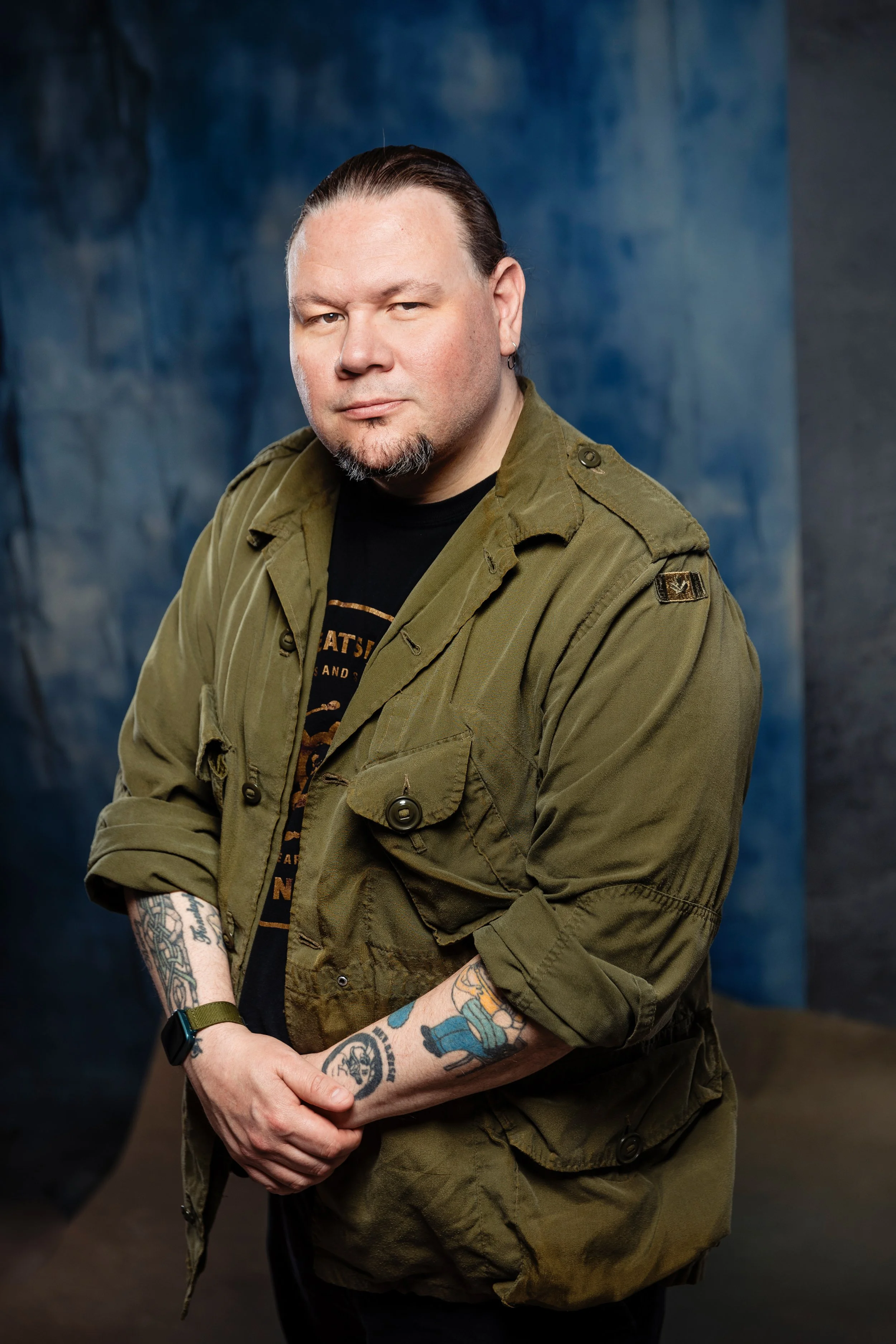
John Brady McDonald
More about John Brady McDonald:
John Brady McDonald is a Nêhiyawak-Métis writer, artist, historian, musician, playwright, actor and activist born and raised in Prince Albert, Saskatchewan. He is from the Muskeg Lake Cree Nation and the Mistawasis Nêhiyawak. He is the author of several books, and his written works have been published and presented around the globe. Kitotam, a poetry collection, was published by Radiant Press in 2021, and Carrying It Forward, a book of essays, was published in 2022 and won the Saskatchewan Book Award for Non-fiction and the Indigenous Peoples’ Writing Award. He is also an acclaimed public speaker, who has presented in venues across the globe, such as the Ânskohk Aboriginal Literature Festival, the Black Hills Seminars on Reclaiming Youth, the Appalachian Mountain Seminars, the Edmonton and Fort McMurray Literary Festival, the Eden Mills Writers’ Festival and the Ottawa International Writers Festival. A noted polymath, John lives in Northern Saskatchewan.

Power Q & A with Lucy E.M. Black
This novel began in an antique store when I fell in love with a reproduction poster from May 1874. The splendid horse, young Netherby, was available as a proven foal-getter at $4 a single leap. I was charmed by the poster but also intrigued by the idea of a farmer advertising his horse’s services in this way. I began to wonder about the farmer and gradually Larkin’s story revealed itself and the novel unspooled.
Q: What do you most hope that readers will take from your novel, A Quilting of Scars (NoN Publishing, October 15, 2025)?
A: This novel began in an antique store when I fell in love with a reproduction poster from May 1874. The splendid horse, young Netherby, was available as a proven foal-getter at $4 a single leap. I was charmed by the poster but also intrigued by the idea of a farmer advertising his horse’s services in this way. I began to wonder about the farmer and gradually Larkin’s story revealed itself and the novel unspooled.

I was an educator for nearly thirty years and during that time, I interacted with many young people who were frightened of revealing their sexual identities to parents and family members. Many of them were certain that they would be shunned or sent for counselling to reprogram their inclinations. Sadly, many students I knew were asked to leave their family home as a result of such disclosures and spent weeks, if not months, couch-surfing while attempting to find a more sustainable living arrangement. It broke my heart to see young people turned away by the very individuals who should have embraced them and celebrated their life choices. As I reflected on this, I realized that the church had a role to play in perpetuating the kind of judgement that so damaged these beautiful young people.
And so, as the novel took shape and I came to know Larkin and his best friend Paul, it became important to me to tell their story – which is a love story of sorts and a celebration of male friendship. The setting is placed at the end of the 19th century when small-town Ontario was still very much under the influence of Victorian ideology. This is a period of tremendous growth and potential with huge advances in science and technology and yet the social mores, if you will, were much slower to change.
Placing Larkin’s story in rural Ontario allowed me to celebrate all that was worthwhile, even noble, about that period of farming history while also showing the treatment of such things as breast cancer, prostitution, child abuse and murder in the same period.
Finally, what I hope readers take away from A Quilting of Scars is more than a simple condemnation of those who judge the Larkins of this world, in the form of a deep realization of the vulnerability of young men like Paul and Larkin, both then and now. The murders and fire in the novel are a direct result of unchallenged cruelty and lack of compassion. The secrets that are kept throughout the story changed Larkin’s life and left him isolated and lonely. So much of our society has changed in the last hundred-years but what is so clear to me is how desperately we still need acceptance and unconditional love without judgement. If this novel brings those thoughts to the forefront for readers to consider, I will be grateful.

A Quilting of Scars by Lucy E.M Black, published by NoN Publishing
About A Quilting of Scars:
Filled with the pleasure of recognizable yet distinctively original characters and a deftly drawn sense of time and place, A Quilting of Scars brings to life a story of forbidden love, abuse and murder. Pulsing with repressed sexuality and guilt, Larkin Beattie reveals the many secrets he has kept hidden throughout his lonely life. The character-driven narrative is a meditation on aging and remorse, offering a rich account of the strictures and rhythms of farming in the not-so-distant past, highlighting the confines of a community where strict moral codes are imposed upon its members and fear of exposure terrifies queer youth. As Larkin reflects upon key events, his recollections include his anger at the hypocrisy of the church, and the deep grief and loneliness that have marked his path. There is a timelessness to this story which transcends the period and resonates with heart-breaking relevance.

Author Lucy E.M. Black
Lucy E.M. Black (she/her/hers) is the author of The Marzipan Fruit Basket, Eleanor Courtown, Stella’s Carpet, The Brickworks, Class Lessons: Stories of Vulnerable Youth and A Quilting of Scars. Her award-winning short stories have been published in Britain, Ireland, USA and Canada in literary journals and magazines including Cyphers Magazine, the Hawai’i Review, The Antigonish Review, the Queen’s Quarterly and others. She co-ordinates Heart of the Story, an author reading series in Port Perry, writes book reviews for The Miramichi Reader, serves as literary chair for Scugog Arts, is a dynamic workshop presenter, experienced interviewer and freelance writer. She lives with her partner in the small lakeside town of Port Perry, Ontario, the traditional territory of the Mississaugas of Scugog Island, First Nations.

Excerpt from Grandfather of the Treaties by Daniel Coleman
If we are to survive long term, we need to give the land back, first, to Yethi’nihstenha Mother Earth herself, to her rules and practical laws, and, second, to Indigenous governance and ways of proceeding, which were fashioned within the framework of her rules. To do this, we need to align our laws, as Indigenous people have been telling us all along, with earth’s laws, with what Onondaga naturopathic doctor Johanne McCarthy calls Mother Earth’s house rules, her “ground rules.” Western legal systems cannot give the land back to its own ground rules because they are grounded in a foreign and inappropriate set of basic philosophical assumptions about what land is and what its laws are.
Ground Rules
If we are to survive long term, we need to give the land back, first, to Yethi’nihstenha Mother Earth herself, to her rules and practical laws, and, second, to Indigenous governance and ways of proceeding, which were fashioned within the framework of her rules. To do this, we need to align our laws, as Indigenous people have been telling us all along, with earth’s laws, with what Onondaga naturopathic doctor Johanne McCarthy calls Mother Earth’s house rules, her “ground rules.” Western legal systems cannot give the land back to its own ground rules because they are grounded in a foreign and inappropriate set of basic philosophical assumptions about what land is and what its laws are. As Onondaga leader Oren Lyons wrote back in the 1980s: “it is important to understand that when a government develops laws to rule the people, it must develop those laws in accordance with the natural law; otherwise, the laws will fail” (12). The PCBs collecting in the rivers and mothers’ milk at Akwesasne, the sewage in Hamilton’s Chedoke Creek, constitute their own judgment, regardless of what courts or city councils decide. These pollutants are handing out sentences to fish and algae, lake grass and white pines—and to humans. Already people have been forced to move their habitations, businesses, farms, and fisheries to other places, out of immediate range of toxified watersheds. There are no loopholes, no exceptions, no pardons, bail, nor parole. The true sovereignty of land itself remains non-negotiable.
And it is Indigenous understandings of land as animate, sovereign, reasoning and reasonable that can challenge and reorient the damage caused by the assumptions carried within the Western sailing ship. We need to reassess the culture, beliefs, and laws that have steered us so far off course, causing us to smear the living skies, lakes, and rivers with deadly chemical sludge. Perhaps, as the extent of our predicament grows upon our awareness, we will reach for our end of the Covenant Chain, asking our disregarded allies of the Indigenous canoe for their help to address the self-made threat to our own—as well as their—way of life. Perhaps, we will begin to ask: what are the laws of this land whose sovereignty we ignored? What, in fact, is land, in the first place?—and what is it “for”?
Listening to Indigenous ways of thinking might open us to the sentience of earth, to what Anishinaabe-Haudenosaunee philosopher Dr. Vanessa Watts calls “place-thought.” “Place-Thought,” she explains, “is based upon the premise that land is alive and thinking and that humans and non-humans derive agency through the extensions of these thoughts.” Hearkening to the teachings contained in her ancestors’ creation stories, of the Sky Woman who fell to earth where sentient waterbirds and animals conferred about how best to sustain her, Watts illustrates by contrast the Western tendency to split off thinking and brain life (epistemology) from being and body life (ontology). How the delusion of human exceptionalism which grew from the idea that humans are the only ones who think has lifted us off of the ground on which we live, leaving us both groundless and ungrounded. In her ancestors’ teachings, by contrast, Watts shows how the land’s many beings are understood to express intelligence, place-thought:
Where waters flow and pool, where mountains rise and turn into valleys, all of these become demarcations of who will reside where, how they will live, and how their behaviours toward one another are determined. Scientists refer to this as ecosystems or habitats. However, if we accept the idea that all living things contain spirit, then this extends beyond complex structures within an ecosystem. It means that non-human beings choose how they reside, interact and develop relationships with other non-humans. So, all elements of nature possess agency, and this agency is not limited to innate action or causal relationships.
Understanding place and land as animated with spirit and agency informs civic, political, and legal relationships, as Watts goes on to explain: “Thus, habitats and ecosystems are better understood as societies from an Indigenous point of view; meaning that they have ethical structures, inter-species treaties and agreements, and further their ability to interpret, understand and implement. Non-human beings are active members of society. Not only are they active, they also directly influence how humans organize themselves into that society. The very existence of clan systems evidences these many historical agreements between humans and non-humans.”
Watts quotes Cree attorney, Sharon Venne, on the implications for Indigenous understandings of sovereignty. Whereas Western concepts of sovereignty conceive of absolute power vested in human institutions (think of Hobbes’s monarchial Sovereign), Venne explains, “For us absolute power is in the Creator and the natural order of all living things; not only in human beings… Our sovereignty is related to our connections to the earth and is inherent. The idea of a nation did not simply apply to human beings. We call the buffalo or the wolves, the fish, the trees, and all are nations. Each is sovereign, an equal part of the creation, interdependent, interwoven, and all related.”
Understanding the earth’s own sovereignty demands that we who have usurped the idea of authority and power need to return the land back to itself, to its set of laws, its own requirements and orders. Its ground rules.
Because, in the end, ground rules.
To reorient the sailing ship’s culture, beliefs, and laws requires polishing the chain, reanimating the peace, good-mindedness, and respect laid out in the Two Row agreement, to reground our norms by learning from our allies in the canoe. In this sense, it is in all of our best interest—Indigenous and non-Indigenous peoples alike—to support the resurgence of Indigenous people’s knowledge, culture, science, art, and languages, and the lifeways that emerge from them. Colonialism tried to destroy so many of these things, and it succeeded in separating many Indigenous people from the knowledges and values their ancestors had held. Now we need these teachings—all of us do. The renewed ground rules will require us all to foster the conditions in which current generations of Indigenous youth can re-encounter their Elders, learn their languages, participate in their ceremonies, spend time in their traditional lands, so that they can re-ignite the hearths where their traditions have been maintained.
While this reorientation undoubtedly constitutes a major and profound shift in our own Canadian culture, beliefs, and laws, it is not impossible to do. As Watts puts it, it simply requires us to listen to and follow the advice of those whose “ears … remain open and low to the ground.”
“Ground Rules” is excerpted from Grandfather of the Treaties: Finding our Future Through the Wampum Covenant by Daniel Coleman, copyright © 2025. Reprinted by permission of Wolsak & Wynn, 2025.

Grandfather of the Treaties: Finding our Future Through the Wampum Covenant by Daniel Coleman (Wolsak & Wynn, 2025)
About Grandfather of the Treaties: Finding our Future Through the Wampum Covenant:
Grandfather of the Treaties shares Coleman’s extensive study of Haudenosaunee wampum agreements with European nations. It was written in close consultation with many Indigenous scholars and shows how we can chart a new future for everyone living in what we now call Canada—Indigenous, settler, more recent arrival—by tracing wampum’s long-employed, now-neglected past. The Covenant Chain-Two Row treaty tradition models how to develop good minds so that we can live peacefully together on the river of life that sustains us all. It is a philosophy, an ethical system, a way of learning to live as relatives with our human and more-than-human neighbours. This covenant has been called the “grandfather of the treaties,” and is also considered the grandmother of Canada’s Constitution.

More about Daniel Coleman:
Daniel Coleman is a recently retired English professor who is grateful to live in the traditional territories of the Haudenosaunee and Anishinaabe in Hamilton, Ontario. He taught in the Department of English and Cultural Studies at McMaster University. He studies and writes about Canadian Literature, whiteness, the literatures of Indigeneity and diaspora, the cultural politics of reading, and wampum, the form of literacy-ceremony-communication-law that was invented in by the people who inhabited the Great Lakes-St. Lawrence-Hudson River Watershed before Europeans arrived on Turtle Island.
Daniel has long been fascinated by the poetic power of narrative arts to generate a sense of place and community, critical social engagement and mindfulness, and especially wonder. Although he has committed considerable effort to learning in and from the natural world, he is still a bookish person who loves the learning that is essential to writing. He has published numerous academic and creative non-fiction books as an author and as an editor. His books include Masculine Migrations (1998), The Scent of Eucalyptus (2003), White Civility (2006; winner of the Raymond Klibansky prize), In Bed With the Word (2009), and Yardwork: A Biography of an Urban Place (2017, shortlisted for the RBC Taylor Prize).

Power Q & A with Daniel Coleman
The 16th and 17th century encounters between Indigenous people in Turtle Island and merchant sailors coming from Europe constitutes the meeting of two very different ways of seeing and living in the world, two very different approaches to trade. The French, Dutch, and English who arrived at the mouths of rivers flowing into the Atlantic were the envoys of a new way of making wealth. These were not aristocrats who stood to inherit their fathers’ land and properties, they were sailors from Europe’s emerging merchant class who were looking for trade goods and resources—spices from Asia, minerals from “El Dorado,” manufactured items from China or India. They had recently developed the capacity to navigate across huge oceans, and they were learning that they could become independently wealthy by exploring the world’s coastlands and islands and bringing back objects they could sell at home.
Q: Your book, Grandfather of the Treaties: Finding our Future Through the Wampum Covenant (Wolsak & Wynn, 2025) is being hailed as an essential read for Canadians looking to understand our nation’s complicated history. What do the founding wampum agreements have to offer us today?
A: They can teach us a better understanding of trade at a time when trade wars are giving us lots of grief. The 16th and 17th century encounters between Indigenous people in Turtle Island and merchant sailors coming from Europe constitutes the meeting of two very different ways of seeing and living in the world, two very different approaches to trade. The French, Dutch, and English who arrived at the mouths of rivers flowing into the Atlantic were the envoys of a new way of making wealth. These were not aristocrats who stood to inherit their fathers’ land and properties, they were sailors from Europe’s emerging merchant class who were looking for trade goods and resources—spices from Asia, minerals from “El Dorado,” manufactured items from China or India. They had recently developed the capacity to navigate across huge oceans, and they were learning that they could become independently wealthy by exploring the world’s coastlands and islands and bringing back objects they could sell at home.
These new bourgeoisie met Haudenosaunee people on the Hudson River, who were also traders. But traders of a very different mindset. These inhabitants of Turtle Island understood “trade” as conducted between all the beings of the living world, not just between humans. So they were interested in the goods that the Dutch brought in their ships—copper kettles or iron knife blades—but they knew that the plants and animals and water systems all around them were influenced by trade, not just the people. Trade, to them, meant that whoever was involved, including non-humans, were part of the equation of exchange. Good trade meant exchanging what was necessary to the flourishing of the entire environment.
This is what makes the early wampum agreements that the Haudenosaunee made with the Dutch and then with the English so unique and so relevant for us today. When the Haudenosaunee diplomats explained that the Two Row Wampum (circa 1613) represented the Dutch trading ship and their own canoes as two vessels traveling down the river of life, they were emphasizing that the agreement made between the two vessels’ “culture, beliefs, and laws” must benefit not just the people in the vessels but also the river itself, which, after all is what kept everyone afloat (let alone hydrated). The Two Row Wampum which was renewed as the “Silver Covenant of Friendship” wampum agreement with the British (1674) is as much ecological philosophy as it is political philosophy. To make peaceful, healthy agreements between humans was not a separate undertaking from making agreements to secure the peace of the land, the earth, the watershed. “No one can claim Mother Earth,” the Haudenosaunee said when they were working out the Two Row agreement with the Dutch, “except the faces rising in the earth to be born.” Those “faces” were like seeds, the embryos of future plants, animals, or humans. The point is that the wampum agreements that shaped Dutch and then British relations with Indigenous North Americans understood that the eco (Gk: “home”) of “economy” is the same as the eco of “ecology.”
The Covenant Chain-Two Row Wampum agreements have been called the “Grandfather of the Treaties,” because the British learned these ground rules for treaty-and-trade-making from them, and they went on to make wampum covenants with First Nations all across northeastern Turtle Island. They then expanded from these to the written and numbered treaties, so these principles lie latent in our country’s constitutional DNA. We need to renew these understandings today. Our ancestors’ first agreements for how to live in this continent, how to share the river of life, were framed within these ground rules—because, in the end, ground rules.
So many of our legal arrangements have been twisted away from these early agreements. The extractive and exploitative understanding of trade, which disregards non-humans as participants in, let alone beneficiaries of, trade, has polluted and abused the river of life. The current battles over trade tariffs show how twisted our understanding has become. An obsessive focus on asserting sovereignty over dead objects (“resources”), distracts us from trade agreements aimed at benefitting the faces waiting in the ground to be born.

Grandfather of the Treaties: Finding our Future Through the Wampum Covenant by Daniel Coleman (Wolsak & Wynn, 2025)
More about Grandfather of the Treaties: Finding our Future Through the Wampum Covenant:
Grandfather of the Treaties shares Coleman’s extensive study of Haudenosaunee wampum agreements with European nations. It was written in close consultation with many Indigenous scholars and shows how we can chart a new future for everyone living in what we now call Canada—Indigenous, settler, more recent arrival—by tracing wampum’s long-employed, now-neglected past. The Covenant Chain-Two Row treaty tradition models how to develop good minds so that we can live peacefully together on the river of life that sustains us all. It is a philosophy, an ethical system, a way of learning to live as relatives with our human and more-than-human neighbours. This covenant has been called the “grandfather of the treaties,” and is also considered the grandmother of Canada’s Constitution.

Daniel Coleman
More about Daniel Coleman:
Daniel Coleman is a recently retired English professor who is grateful to live in the traditional territories of the Haudenosaunee and Anishinaabe in Hamilton, Ontario. He taught in the Department of English and Cultural Studies at McMaster University. He studies and writes about Canadian Literature, whiteness, the literatures of Indigeneity and diaspora, the cultural politics of reading, and wampum, the form of literacy-ceremony-communication-law that was invented in by the people who inhabited the Great Lakes-St. Lawrence-Hudson River Watershed before Europeans arrived on Turtle Island.
Daniel has long been fascinated by the poetic power of narrative arts to generate a sense of place and community, critical social engagement and mindfulness, and especially wonder. Although he has committed considerable effort to learning in and from the natural world, he is still a bookish person who loves the learning that is essential to writing. He has published numerous academic and creative non-fiction books as an author and as an editor. His books include Masculine Migrations (1998), The Scent of Eucalyptus (2003), White Civility (2006; winner of the Raymond Klibansky prize), In Bed With the Word (2009), and Yardwork: A Biography of an Urban Place (2017, shortlisted for the RBC Taylor Prize).

Excerpt from A Town With No Noise by Karen Smythe
I insisted on having time off this Christmas, which I’ve covered at the café for three years running, to spend the holidays with my mother in Copper Cliff. I’ve had my old room back during visits home ever since my grandmother died five years ago. My mother had moved Sigrid into the apartment for the last two years of her life. She never told me why she made that decision, even when I questioned whether it was the right thing to do, to keep Besta out of a hospital, especially when I knew they had never gotten along.
DECEMBER
I insisted on having time off this Christmas, which I’ve covered at the café for three years running, to spend the holidays with my mother in Copper Cliff. I’ve had my old room back during visits home ever since my grandmother died five years ago. My mother had moved Sigrid into the apartment for the last two years of her life. She never told me why she made that decision, even when I questioned whether it was the right thing to do, to keep Besta out of a hospital, especially when I knew they had never gotten along.
During the drive I think about the last time I had driven up, when my car’s alternator died en route and I’d had to call the CAA to tow me to a garage in Parry Sound. My mother gave me money for Christmas that year, which helped me to pay off most of what I’d had to charge to my credit card to get the car going again.
I haven’t been home in years, but everything looks the same: the wide streets with no sidewalks, old maples on front lawns of modest, wooden bungalows, with a pizza place and a Tim Hortons the only restaurants in town. The Stack—which made the town famous in its day, before the CN Tower was built, for being the tallest structure in the world—still stands, though it isn’t functional anymore; it had been built to solve Copper Cliff’s pollution problem, by pushing the smelter’s poisons up so high in the air that the wind would blow it all someplace else, to become an issue for other people.
My mother must have been looking out her kitchen window as I parked in the lot behind the low-rise building, because she is waiting on the landing for me.
“Hey, Ma! How are you?”
“I’m so happy to see you! You’re still driving that old car?”
“Well, it refuses to die. It has over two hundred thousand klicks on it, but Volkswagens can go over three.”
“I hope it has a good heater, since you have a tarp for a roof. Come on, I’ll make some tea to warm you up.”
Mom looks heavier to me; she seems to have forgotten her golden rule, “If you can pinch an inch, lose it.” Nonetheless, we nibble on the deep-fried fattigmann and the pepperspisser cookies she’d made a few days before my arrival as we catch up. I told her about how the freelance assignment I’d taken from Nick didn’t turn out as planned.
“I got sidetracked from the story when I found out what went on at the vineyards that I was supposed to be promoting. I met one of the foreign workers at a winery and he told me about the horrendous circumstances he and his friends were in. When I got home, I did some research about the situation and got involved with some people who’d organized, to push the government to take action.” I open my laptop and show my mother my blog posts, which had been cited by the group and helped them to get the attention of local politicians.
“I’m so proud of you, honey.”
“Thanks Ma. I want to do more writing like that, about issues under the surface. About things people don’t know about, or don’t want to know about.”
She was smiling at me. “I always thought you should be a writer. You have more going for you than most people who pour coffee for a living.”
“You can’t live on words alone, Ma. Plus, I think you have to hit a certain age before you have anything to say. It took me this long to stumble onto a story—one I wasn’t even supposed to be writing about.”
“I have an idea for a project you could write about,” she says, with a sheepish look on her face. “You could write about immigrants who came here after the war. You could tell your grandmother’s story.”
“Maybe,” I say, stalling and trying to be polite. “She was hardly a typical immigrant, though.” I pause and think of Besta. “She was a tough old broad.”
“I can’t blame her, really. She had a pretty hard life.”
I stop licking sweetened whipped cream from the electric beaters left lying on the kitchen counter. “That’s the first time I’ve heard you say anything like that about Besta. You used to tell me how cruel she could be to you. Like the time she hid in a neighbour’s apartment when you were six, and you got home from school and were calling and calling for her, crying, but she wouldn’t answer.”
“That’s true. She finally walked in and said, ‘Surprise!’ and laughed at the tear stains on my face. She was trying to toughen me up, she said.”
“She was strict when she looked after me. Remember that time when I went for a bike ride to get away from her after she’d scolded me for something, and I took a bad fall? You stopped sending me to spend summers with her, after that.”
“Yes, I did. But I’ve been feeling more sympathetic toward her lately. Maybe it’s because I’m getting close to the age she was when her cancer was diagnosed.”
“Ma, you’re not feeling well?”
“I’m fine, Sam. I get checked every couple of years, don’t worry. You should, too, when you get to be forty or so, by the way.”
“Yeah, yeah. My doctor knows the family history. We’ll be onto it.”
“You know,” she says, softly, “it wasn’t until after my mother died that I was able to forgive her.” Her voice trembled as if she were about to cry, which is not her nature. “I don’t want that to happen between us, Sam.”
“What are you talking about?” I put my hand on hers. “Why so sad? I have no grudges against you.”
“Not now, maybe.”
“I can’t think of anything you could do that I wouldn’t forgive, Ma.”
“We’ll see.”
Excerpt from A Town with No Noise. © 2025 by Karen Smythe. Reprinted by permission of Palimpsest Press.

A Town with No Noise by Karen Smythe (Palimpsest Press, 2025)
About A Town with No Noise:
Samara and J., a struggling young couple, are off to J.’s birthplace, Upton Bay, a small town turned upscale theatre and winery destination. Sam has been hired by an editor friend to write a promotional piece about the place while she and J. stay with his grandfather Otto, a prominent businessman in his day.
But their visit does not go as planned. Sam’s explorations of Upton’s tourist attractions lead her to ugly truths behind the quaint little town’s façade—discoveries that are counterpointed with vignettes of the town’s wealthy, elderly ruling class, painting a different picture than the one Sam’s friend expects her to provide. Tensions between Sam and J. worsen as J.’s true nature emerges and Sam begins to question both his values and his family’s past—especially after Otto tells them stories about his time as a German soldier during WW2.
Back in the city, Sam’s opinions and judgments about what is right and wrong are tested when a shocking truth surfaces about her grandmother’s flight from Norway after the war, profoundly changing Sam’s understanding of who she is and who she wants to become.
In A Town with No Noise, fact and fiction combine to ask difficult questions about the communities we build, questions that are as relevant today as ever: Who stays? Who is chased away? And who decides?

ABOUT KAREN SMYTHE:
Karen Smythe is the author of the novel This Side of Sad (Goose Lane Editions, 2017), the story collection Stubborn Bones (Polestar/Raincoast, 2001), and the ground-breaking critical study Figuring Grief: Gallant, Munro, and the Poetics of Elegy (McGill-Queen’s U.P., 1992). In the 90s, she was the guest fiction editor for The Wascana Review and fiction editor for the Pottersfield Portfolio, and she also guest edited the Michael Ondaatje issue of Essays on Canadian Writing. Several of Karen’s short stories have appeared in Canadian literary journals including The Fiddlehead, Grain, and The Antigonish Review. A Town with No Noise is her second novel. She currently lives in Guelph, Ontario

Power Q & A with Karen Smythe
y novel began as a book about the hidden lives of wealthy retired people living in a fictional small town in Ontario that had transitioned from agricultural to a winery- and tourist-based economy. When one character with a past in wartime Germany emerged, threads opened up that I turned into storylines about the responsibility to remember and be accountable for atrocities in World War 2.
Q: Why did you decide to write a story about the Holocaust in Norway in your novel, A Town with No Noise (Palimpsest Press, 2025)?
A: My novel began as a book about the hidden lives of wealthy retired people living in a fictional small town in Ontario that had transitioned from agricultural to a winery- and tourist-based economy. When one character with a past in wartime Germany emerged, threads opened up that I turned into storylines about the responsibility to remember and be accountable for atrocities in World War 2.
My narrator is a young woman, Sam, whose ancestry is Norwegian, and after her working visit to the small town ends (she is there to write an article on tourism in the area), her focus shifts to another small town, this one in Occupied Norway. Sam learns about her extended family’s experience there under Nazi occupation—of which she knew nothing until now—and decides to write about it and post what she finds on her blog. Not many people know about what happened in Norway during and after World War 2: that there was a Jewish population there that was all but decimated; that children of German soldiers and Norwegian mothers were treated horribly; and that there was a level of complicity with which the country is still coming to terms. Sam’s character evolves as her knowledge of this history and her family’s role in it grows.
There are two Parts to the book, linked by the first-person narrator Sam; the related themes about privilege, power, history, and remembering and writing about the past also tie the two Parts together. In Part 1, I also introduced both a third-person narrator—who provides vignettes about the residents of the small town that Sam visits—as well as an omniscient narrative voice that speaks via footnotes. These techniques not only provide the reader with windows on the town and on the people that Sam doesn’t have access to, but also emphasize her unreliability as a narrator and the fact that individual perspectives (and what we think we know is true) are limited. In Part 2, Sam herself—an aspiring researcher and historian—uses footnotes in her writings to expand upon the historical research she is conducting about her family and about the Holocaust and the Norwegian Jewish population.
One of the key themes of the novel is that there is no single truth about the historical past, that it takes listening to many voices to piece together a version of truth that is, unavoidably, a mere representation of the past. So using footnotes and also interviews and other narrative forms within the novel allowed me to enact the theme, formally. This is the power of fiction, I believe—to provide multiple perspectives and stories that merge the personal and social threads with the historical, thereby using the imagination to garner empathy and a broader understanding of the human experience.

A Town with No Noise by Karen Smythe (Palimpsest Press, 2025)
About A Town with No Noise:
Samara and J., a struggling young couple, are off to J.’s birthplace, Upton Bay, a small town turned upscale theatre and winery destination. Sam has been hired by an editor friend to write a promotional piece about the place while she and J. stay with his grandfather Otto, a prominent businessman in his day.
But their visit does not go as planned. Sam’s explorations of Upton’s tourist attractions lead her to ugly truths behind the quaint little town’s façade—discoveries that are counterpointed with vignettes of the town’s wealthy, elderly ruling class, painting a different picture than the one Sam’s friend expects her to provide. Tensions between Sam and J. worsen as J.’s true nature emerges and Sam begins to question both his values and his family’s past—especially after Otto tells them stories about his time as a German soldier during WW2.
Back in the city, Sam’s opinions and judgments about what is right and wrong are tested when a shocking truth surfaces about her grandmother’s flight from Norway after the war, profoundly changing Sam’s understanding of who she is and who she wants to become.
In A Town with No Noise, fact and fiction combine to ask difficult questions about the communities we build, questions that are as relevant today as ever: Who stays? Who is chased away? And who decides?

ABOUT KAREN SMYTHE:
Karen Smythe is the author of the novel This Side of Sad (Goose Lane Editions, 2017), the story collection Stubborn Bones (Polestar/Raincoast, 2001), and the ground-breaking critical study Figuring Grief: Gallant, Munro, and the Poetics of Elegy (McGill-Queen’s U.P., 1992). In the 90s, she was the guest fiction editor for The Wascana Review and fiction editor for the Pottersfield Portfolio, and she also guest edited the Michael Ondaatje issue of Essays on Canadian Writing. Several of Karen’s short stories have appeared in Canadian literary journals including The Fiddlehead, Grain, and The Antigonish Review. A Town with No Noise is her second novel. She currently lives in Guelph, Ontario

Power Q & A with Shane Neilson
A question I’ve asked myself since my son Kaz suffered the neurological catastrophe that rendered him intellectually disabled: Who will look out for him after I am gone?
I touch my left popliteal fossa. Left wrist. Left index. I ask the question again. Who will look out for him after I am gone? My right hand repeats the cycle.
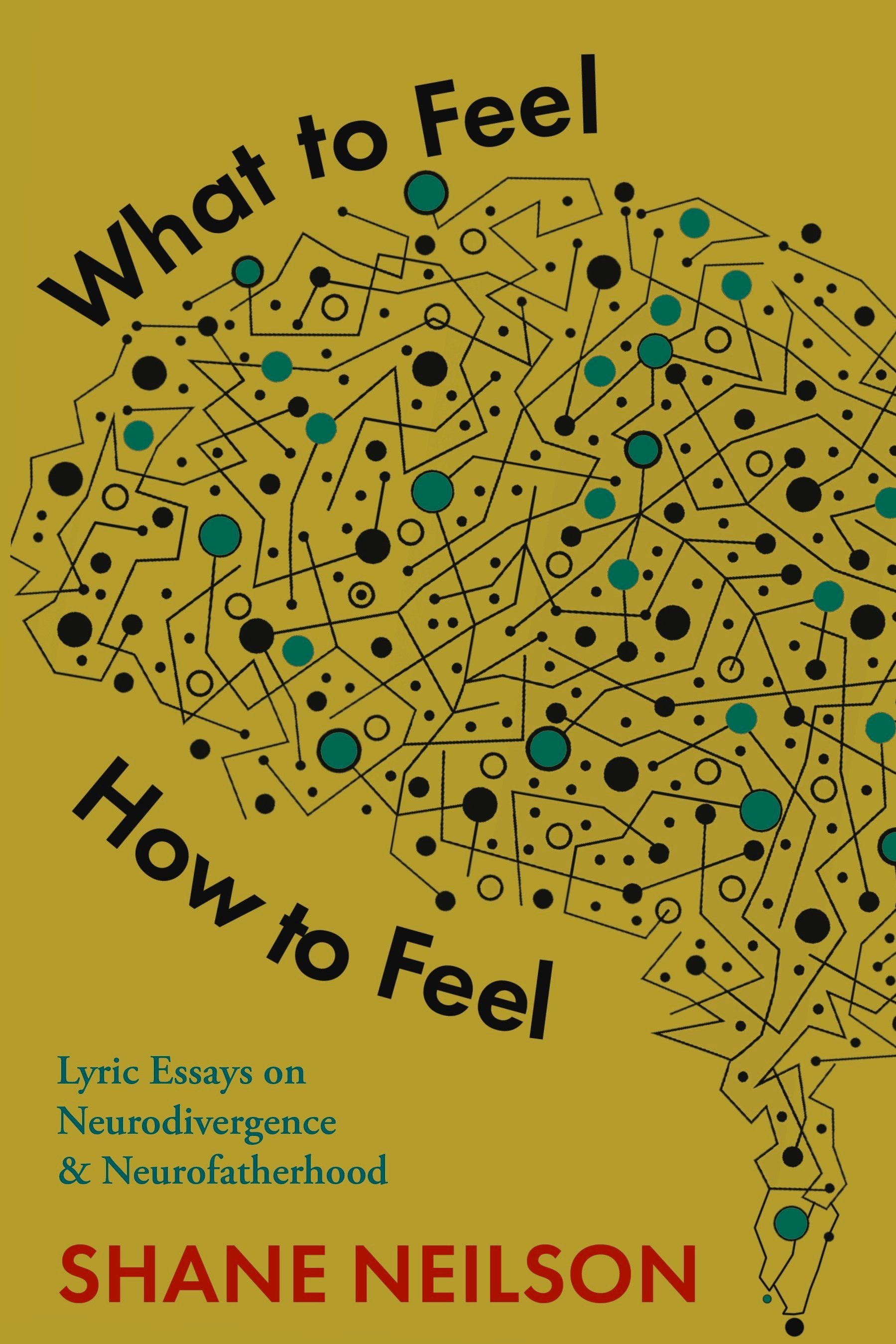
Q: Your book, What to feel, how to feel: Lyric essays on neurodivergence and neurofatherhood (Palimpsest Press, 2025) is replete with questions. Lots of questions. And fittingly, no tidy answers. What’s a question you grapple with still?
A: A question I’ve asked myself since my son Kaz suffered the neurological catastrophe that rendered him intellectually disabled: Who will look out for him after I am gone?
I touch my left popliteal fossa. Left wrist. Left index. I ask the question again. Who will look out for him after I am gone? My right hand repeats the cycle.
In the basement, at age ten, I’m throwing a dance party. For one person – my son. Laser lights and loud music from a kiddie karaoke machine. At any moment, a dance party can happen. At any moment, I might think: I don’t think he’ll be able to live independently. Will he be able to have a job? Who will look out for him after I am gone? My right hand repeats the cycle.
In “The Weeping Tense,” a poem I wrote when he was eleven years old, I ask the question in a different way: “Who will stand on guard uselessly for him when I am gone?” For my watching and guardianship are so often futile. How can I hope to stop the world as it lands on both of us, right now?
Clothes on hangers. Stock on shelves. Peanut butter on sandwiches. Vocational training at his school. Chores around the house. I’ll ask the question as I watch, the fucking question. The question tyrannizes me now, I know it’s pointless, destructive. I know too what matters now is that he’s here now, that I’m here now, that it’s foolish for the norm to impose itself as competency in mudane domesticity, that he is not auditioning for self-sufficiency at every moment, that independence is not the normie agency dream it’s cracked up to be. For a few seconds I forget the question by looking out the window. An older man with an everted foot slowly makes his way down Grand Street South. He’s making his way back from a long day collecting change at an intersection near the Wal-Mart on Pinebush Road, his face bronzed from sun. Three steps, then he has to stop. Start again. Who will look out for him after I am gone?
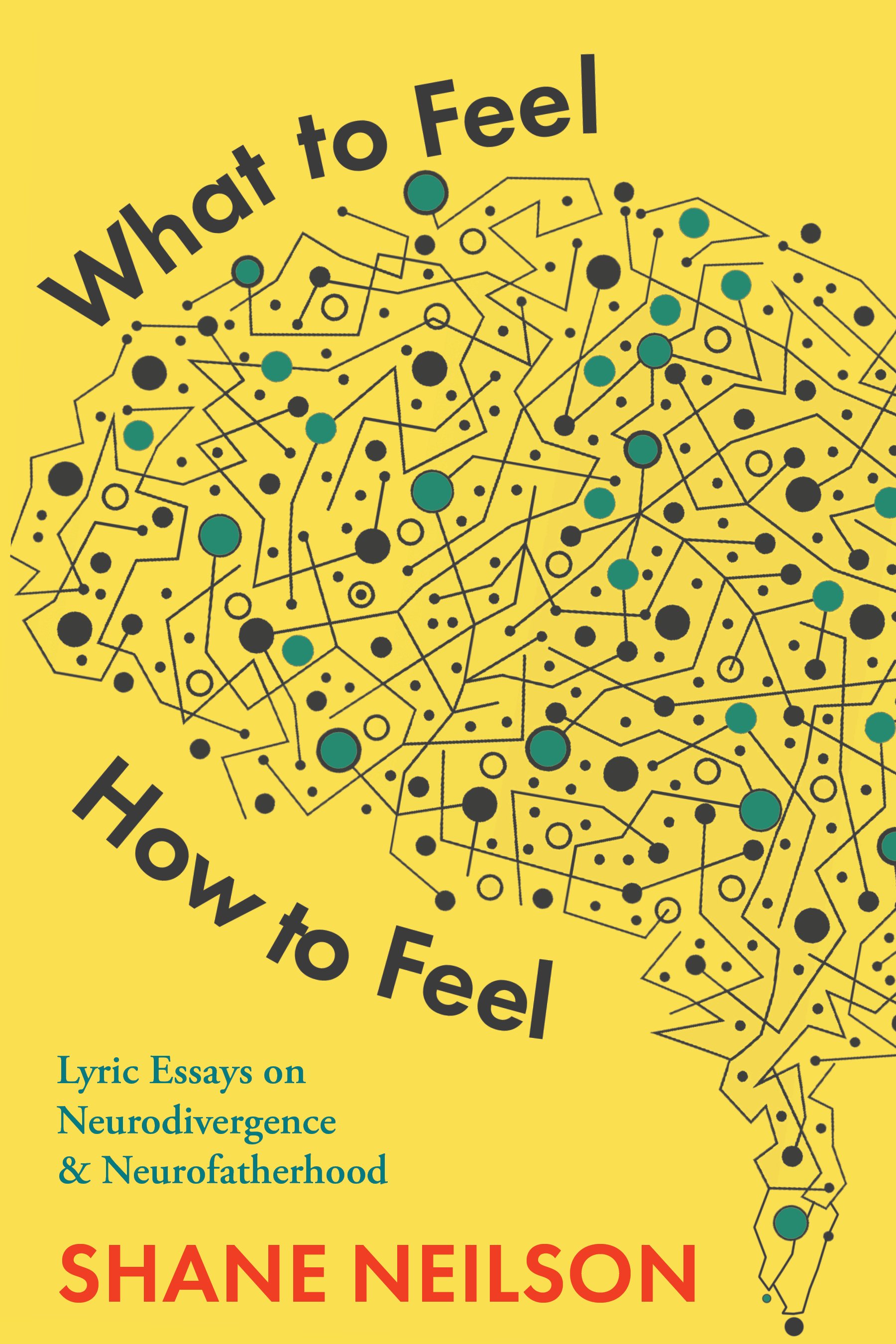
What to feel, how to feel: Lyric essays on neurodivergence and neurofatherhood (Palimpsest Press, 2025)
About What to feel, how to feel:
In What to feel, how to feel, Shane Neilson dazzles in the lyric essay form. Focusing on non-neurotypicality, Neilson investigates his supposed difference of self while also holding to account society’s construction of that difference, moving from his early childhood to adulthood and then back again in terms of a neurodivergent fathering of his own son. Covering subjects that have yet to receive attention in Canadian literature, including how the medical profession discriminates against its own, Neilson’s poetic accounts of stigma and self-discovery interleavened with literary history mark a first in our letters.

Shane Neilson. Photo credit: Zdenka Neilson
About Shane Neilson:
Shane Neilson is a mad and autistic poet-physician who practices in Guelph, Ontario and who teaches health humanities at the Waterloo Regional Campus of McMaster University. His prose has appeared in the Walrus, Maisonneuve, Image, the Globe and Mail, and many other places.
Excerpt from What to feel, how to feel by Shane Neilson
We call it Frink, and Frink it has been since he was able to demand “drink.” Frink it remains, though Frink is specific in a way only his family can know: a carbonated drink from McDonalds as dispensed by an accessible self-serve fountain (a pox on behind-the-counter tyrannical control!). Though cup sizes have escalated over the years, Frink’s always come as an earned reward. Frink as the meaning of life; Frink as the purest joy; Frink as the promise at the end of a long day pining for Frink; Frink if, and only if, one is Good. Frink because he is Good. Consider Frink to be your sex, your drug, your rash internet purchase, but also your wholesome chaste handhold with a first date at a carnival, your sleep stuffy, your comfortable around-the-house lived-in sweater. Frink for a blissful, refill-laden hour. Then the return to normal frinkless life.
Excerpt from “McDonaldsing into the Future-Death”
We call it Frink, and Frink it has been since he was able to demand “drink.” Frink it remains, though Frink is specific in a way only his family can know: a carbonated drink from McDonalds as dispensed by an accessible self-serve fountain (a pox on behind-the-counter tyrannical control!). Though cup sizes have escalated over the years, Frink’s always come as an earned reward. Frink as the meaning of life; Frink as the purest joy; Frink as the promise at the end of a long day pining for Frink; Frink if, and only if, one is Good. Frink because he is Good. Consider Frink to be your sex, your drug, your rash internet purchase, but also your wholesome chaste handhold with a first date at a carnival, your sleep stuffy, your comfortable around-the-house lived-in sweater. Frink for a blissful, refill-laden hour. Then the return to normal frinkless life.
*
At the Toronto Zoo, a spooked middle-aged woman walks alongside a much younger, frowning woman, their age difference thirty years, at least. Woman the Younger seems in a hurry; Older moves in a way I know: slow, subtly uncoordinated, arms slightly flexed. Her clothes (pastel polyester pants, an unflattering white blouse) fit poorly. Her thick, slightly sticky hair is shaped like a hard hat. Ungroomed, not unsightly or unkempt. In contrast, Younger dresses stylishly, in an actual dress – Van Goghian, blue with yellow erupting sunflowers. After a few more seconds of observation, I realize that these two probably unrelated people – they are different races, there is no affection – have been brought together in a care relationship. Older, who’s intellectually disabled in some way, is being led by hand-pull, not hand-hold. Ah. Like my son, she can’t move any faster, it seems. She’s not resisting, she just lacks a faster gear. Younger the Frustrated wants to get somewhere. Always, an abled somewhere to hurry to on the way to another Important Place. Older could be fearful about anything, I suppose. To be fair, Younger could want to get elsewhere for any reason, perhaps a reasonable one. In my gut, though, I interpret this scene as a disabled person taken out on an excursion by a personal support worker, easy gig for them. The relationship is both paid and overtly uncaring. It’s happened before – I sense Older accepts the lack of concern as the cost of coming to the zoo. I ask you: when you were a child, unable to arrange a trip to McDonalds, the movie theatre, or the zoo on your own, wasn’t it enough to just go? When I turn my head to see if anyone else notices the pair, I witness everyone else involved in their own lives, couples and families, my own son and daughter fighting over who saw the first polar bear. Kaz says “Me!” Aria says, “No, me!” I wouldn’t come here if I didn’t love them. I wouldn’t take them if I didn’t love them. I am privileged to love them. They are privileged to be loved. Is that right? That shouldn’t be right.
*
Kaz is late for the special van that couriers him and a few other disabled children to Galt Collegiate. By this point in our lives together, my self-appointed job title is “Leaving Specialist.” From the time he entered kindergarten until now, a strong organizational structure conveyors, coerces, and coaxes Kaz to leave the house in the morning. First, music from downstairs. Then, I climb the stairwell and call to him from his doorway. (Lately, he picks his own clothes.) Then, breakfast after he removes his Invisalign. Breakfast’s intricate movements: for the past few days, he’s attempted to choose an item or two from the fridge. Item choice influences pacing because peanut butter takes minutes to spread on crackers, an apple thirty seconds to slice. Breakfast is carefully arranged – he gets a halfway warning, a 5-minute warning, and then an absolute final warning to leave the table and dress for outside. Ding, louder ding, loudest ding. Waiting by the door, of course, are his bookbag (packed with a lunch made by his mother that he won’t eat, but which we must pack else the school will call us to bring one he also won’t eat), coat, and boots. I have streamlined everything, economized all. Milk in the fridge stands ready to pour, his go-to foods always accounted for and facing frontward, otherwise the routine will be disturbed, Kaz will angrify, and his chances of catching the bus reduce. If we fall behind, there is but one absolute truth and certainty: he will not, cannot accelerate. The factory installed a single low gear. If we fall behind, no admonishment can quicken him. This deep understanding of intellectually disabled (ID) physics enables me to discern the nature of care relationships in the wild. When I encounter ID people in public, I watch their carers. Are the carers in a hurry, at odds with their charges, or in synch? My son may never know this until the day I am gone, but the fact that much has been cleared away for him, that preparation and expertise smooth his progress, is a mark of love through action. Love is also that I understand he cannot be made to go faster, that slowness is his nature. If I were to shout and scare him as I was myself so often scared as a child, then he would startle, yet not move faster and quicker. And when I see him startle, I see myself, and I never want to see myself that way again, too scared to even move. Too heavy to move.
*
At the Toronto Zoo, I order an iced lemonade for Kaz and a croissant for my daughter Aria. Kaz savours the liquid, nursing it for over an hour; my daughter gobbles the croissant. Next to the entrance to Africa Savanna, Kaz sets his lemonade down on a concrete railing and tries to locate the biggest lion, but they hide from the sun, undetectable. When he turns back to his lemonade, yellowjackets swarm the rim. He looks up to me, asks me to get them away. Though I’m not scared of being stung, I know that stinging will happen with so many wasps crawling on the top, several already past the straw aperture soon to reach the sugar water. Plus, he shouldn’t drink the thing now that the wasps are in there. Plus, I want to teach him to respect danger. So I say “Let’s leave the juice for them. They’re yellow. It’s yellow. Yellow things go together.” But he does not accept my silly reasoning and begins to rage, screaming about his Frink, how it’s his, how he should still have it, noowwwwwwwww. The meltdown continues for another thirty minutes. The lions refuse movement, too.
*
Two women sit across a coffee shop table from a middle-aged man. He smiles oddly, askance from them both. Only one woman speaks to him, often in a sing-song voice about his “treat.” Every few minutes, she asks, “Do you want your treat?” Each time, he nods in return, says, “frozey lemonade” while continuing to smile. The one that doesn’t speak to him continues to not speak to him. In a minute, the one that talks to him leaves the table, soon returning with a yellow semisolid liquid in a large plastic cup that she places in front of him. The one who doesn’t speak to the man mentions her previous night spent with a boyfriend and how much of an asshole he is. Apparently, he’s handsy and cheap. The one who singsongs to the man responds with a generic sympathy no more authentic than her singsong interactions with the man. Now it’s her turn to talk, and she describes an aggressive client, pausing only to coo to the man who smiles oddly, who is not aggressive, no no, he is good, good. She talks to him like a dog. Then she complains about another client who soils himself and needs constant watching, otherwise he’ll run away. The one who doesn’t talk to the man mentions how much she hates her ex-boyfriend, who always walked around the house naked. Though she didn’t exactly hate how good he was in bed. The singsong woman watches the liquid level in the smiling man’s cup, as I do: the meniscus vibrates slightly as trucks rumble by the drive-through window. How often does the group home send someone to take him here? How often does he get his treat? Is treating the only activity he does outside the home? Is there anyone to love him?
*
From the time he could walk, Kaz helped me take out the garbage. Once a week, we used to drag the blue, grey, and green containers streetside. Early on, he play-helped, but even when he contributed nothing except trouble, running underfoot, chucking Frink containers out of the bins, overturning the bins, and shoving bins onto the street, I considered this activity his ‘job’ and he would be rewarded with apple juice after we finished. As he became older, repetitively shown what to do week after week, year after year, and given so much juice, he eventually became able to perform the task himself. Once he completes a cycle (garbage out in the morning, bins back in the evening) correctly, without cueing, then the reward comes: a trip to the McDonalds on Main. Frink, from the fountain, classic mix: two-thirds Nestea, one-third red Fruitopia. The visit has its own ritual: we try to sit in the same place in the restaurant, across from the fish tank. We locate the sucker fish who hides in the hollow tree. We look for anyone else disabled. I don’t say what I often wonder: who will take him to McDonalds after I am dead? I know the answer already. Either no one, or people who don’t care about him. After a refill, we leave.
*
Another restaurant, this time Mandarin on King Street in Kitchener. Mando is Kaz’s favourite – he can see all the buffet items and pick exactly what he wants. Fries, onion rings, gravy, and California roll sushi, an undeviating selection. Everyone else at the table – Janet, Aria, me – drink water, Aria with double ice because I spoon out mine and make the exchange. Kaz gets iced tea. Across from us, a disabled pair of young men sit at a small rectangular table. One of the men is dressed as life-size Super Mario, red cap, suspenders, the whole deal. The other man has pronounced retrognathia and strabismus. I hear a speech impediment, a heavy lisp but also dysphonia to boot. As I eat my undeviating meal, chicken fried rice and chicken balls, I map the dynamic between them. Super Mario makes several trips to the buffet, his heaping plates scarfed down and replaced with more. He’s genial, always answering “Yes” to the other’s pleas to hang out after dinner, to hang out at other times. “Let’s hang out later” says the pulled-back jaw man after perhaps the two-dozenth “Yes” to the same question. It’s unclear if the man has been stood up or ghosted by Super Mario before, or whether his anxiety reflects being ignored by others. He pulls out his phone and shows Super Mario something. Retrognathia giggles, Super Mario guffaws. “Isn’t this fun?” Retrognathia asks for the tenth time, adding a new variant, “This is so fun, isn’t it?” As per the ritual, “Yes” comes as response. In time, the waiter comes by, asks “How are you going to pay?” in what I deem a not un-nice way, a not-mean way. A regular way. The normal way. Super Mario points wordlessly to Retrognathia, who volunteers that he will pay. I can tell that this was the deal. Retrognathia’s credit card doesn’t work on tap, so the waiter inserts it into the machine for him, but Retrognathia doesn’t know his passcode. Retrognathia calls someone on the phone, places it on speaker. Someone I assume is his mother patiently recites his code over and over again, a code for a card that is quite possibly hers. The code doesn’t work even when the waiter puts in the numbers. The waiter looks to Super Mario. “Can you pay?” he asks, but Super Mario smiles and says that he cannot. “Can your parents come and fix this?” he asks both of them. Have they been here before? Does he know they have parents? Realizing this interaction is attracting a lot of staring, the waiter commands the two men to stand up and move to the front of the restaurant where the manager will “work things out.” When I finish eating ten minutes later, I walk past the two men sitting at the front. Super Mario stares ahead happily. Retrognathia talks down into his phone, an image of an old woman looking back at him.
*
Excerpt from Shane Neilson’s Imaginary Last Will and Testament, as Written on a Brown McDonalds Napkin Using Red (Provided) Crayon
For my son:
1. Frinks, once weekly
2. Spotify account
3. Gorilla stuffy, medium size
4. Computer with Garageband
5. Someone to love
Excerpt from What to feel, how to feel: Lyric essays on neurodivergence and neurofatherhood © 2025 by Shane Neilson. Reprinted by permission of Palimpsest Press.
In What to feel, how to feel, Shane Neilson dazzles in the lyric essay form. Focusing on non-neurotypicality, Neilson investigates his supposed difference of self while also holding to account society’s construction of that difference, moving from his early childhood to adulthood and then back again in terms of a neurodivergent fathering of his own son. Covering subjects that have yet to receive attention in Canadian literature, including how the medical profession discriminates against its own, Neilson’s poetic accounts of stigma and self-discovery interleavened with literary history mark a first in our letters.

Shane Neilson. Photo credit: Zdenka Neilson
About Shane Neilson:
Shane Neilson is a mad and autistic poet-physician who practices in Guelph, Ontario and who teaches health humanities at the Waterloo Regional Campus of McMaster University. His prose has appeared in the Walrus, Maisonneuve, Image, the Globe and Mail, and many other places.

Power Q & A with Connor Lafortune & Lindsay Mayhew
What surprised me the most about editing an anthology was the length of the process itself. When I was first approached to co-edit with Lindsay [Mayhew], I was surprised by the timeline. I could not imagine it taking over two years from initial conversations to publications.
Q: What was something that surprised you about co-editing the anthology, A Thousand Tiny Awakenings (Latitude 46, 2025)?
Connor Lafortune: What surprised me the most about editing an anthology was the length of the process itself. When I was first approached to co-edit with Lindsay [Mayhew], I was surprised by the timeline. I could not imagine it taking over two years from initial conversations to publications. However, I quickly realized that many of the pieces needed a lot of time in between. I learned to take my time and be patient throughout the process.
Something else that surprised me was the cohesion between all of the submissions. There was an incredible throughline among the poems and short stories. As an editor, I was surprised we could tell a larger story among its smaller pieces.
Miigwetch!
Lindsay Mayhew: This collection brought about many discoveries. I was especially surprised by the weight of responsibility I felt as an editor. The contributors trusted us not only with their art, but also their personal stories. We rarely discuss the importance of ethical practice as editors, but it’s a conversation I look forward to starting often!
It was an honour and delight to work on these pieces with the contributors. This experience has inspired me to continue editing, and I am excited for the never-ending learning involved.
A Thousand Tiny Awakenings (Latitude 46), editied by Connor Lafortune and Lindsay Mayhew.
About A Thousand Tiny Awakenings (Latitude 46):
A Thousand Tiny Awakenings is a collection of genuine and heartfelt expressions from young and marginalized creators who challenge the oppressive structures that shape our world. These narratives, poems, and artworks echo across Turtle Island, transcending borders to offer a stirring testament to resilience and hope. Discover 15 young writers, and 23 unique and powerful pieces that embody the spirit of resistance and resurgence; uplifting the upcoming generation in their pursuit to dismantle boundaries that define their bodies, lives, and futures. Through art and storytelling, these voices call for action and inspire revolution, reminding us that our words have the power to transform the world.
A Thousand Tiny Awakenings features contributions by:
Carson Bohdi Michelle Delorme Brennan Gregoire
Waed Hasan Tyler Hein Jesse June-Jack
Kay Kassirer Nicole Robitaille Blaine Thornton
Lisa Shen Lindsay Mayhew Sydney Read
Connor Lafortune Ra'anaa Yaminah Ekundayo
Chimdi Kingsley-Emereuwa
About Connor Lafortune & LINDSAY MAYHEW:
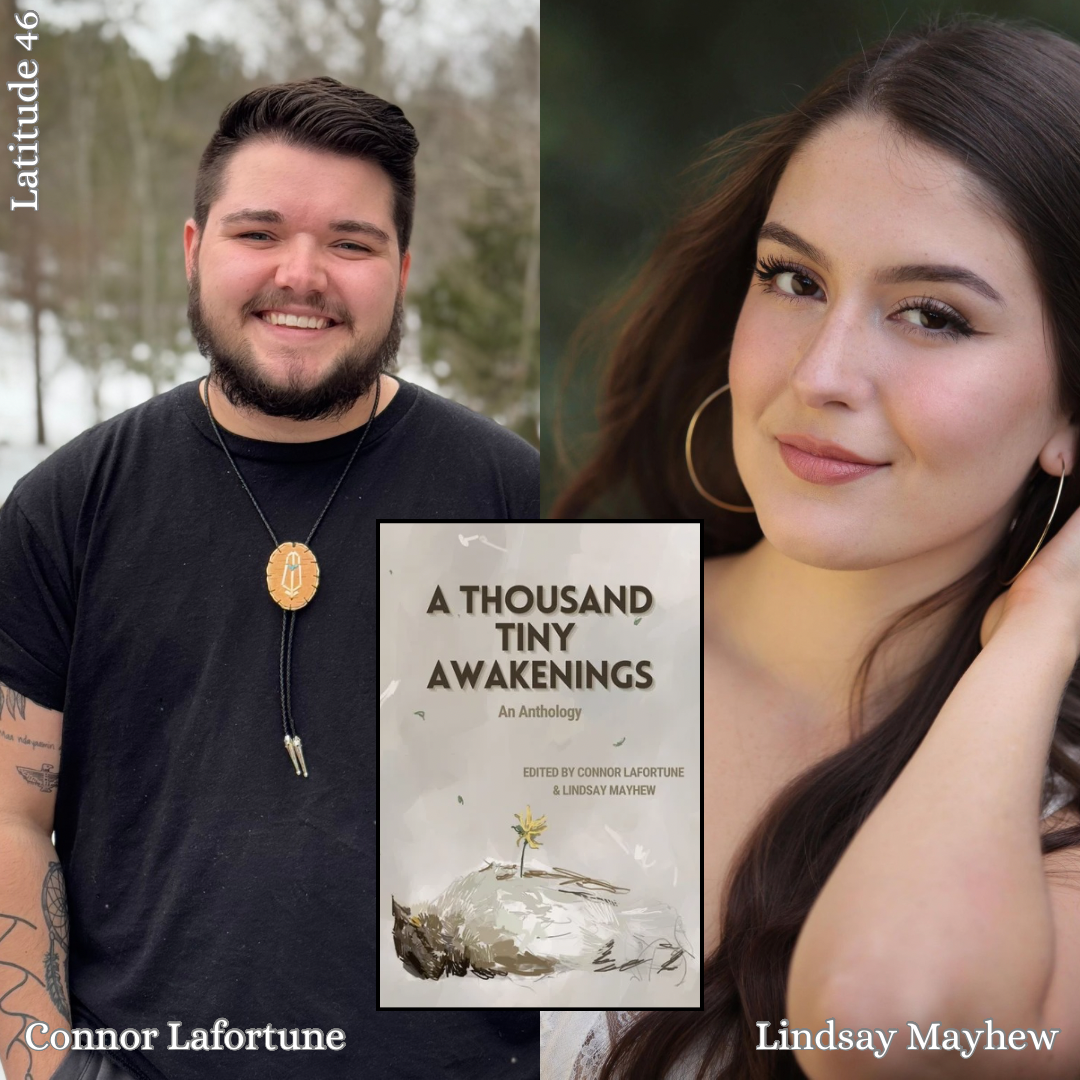
Connor Lafortune is from Dokis First Nation on Robinson Huron Treaty territory of 1850 in Northeastern Ontario. He works primarily in Life Promotion, harm-reduction, mental health, and Indigenous education. He completed his Bachelor’s Degree at Nipissing University with a Double Honors Major in Indigenous Studies and Gender Equality and Social Justice. He is currently in the Masters in Indigenous Relations at Laurentian University. Connor is Anishinaabek, Queer, and Francophone; he uses his understanding of the world to shape his creations as a writer, spoken word poet, and musician. Connor often combines the written word with traditional Indigenous beadwork and sewing to recreate the stories of colonization, showcase resilience, and imagine a new future. He recently released a single in collaboration with Juno Award winner G.R. Gritt titled “Qui crie au loup? ft. Connor Lafortune.” Above all else, Connor is an activist, a shkaabewis (helper), and a compassionate human being.
Lindsay Mayhew (she/her) is a spoken word artist, poet, and writer from Sudbury, Ontario. She recently graduated with a Master’s in English Literature from the University of Guelph. Lindsay is the multi-year champion of Wordstock Sudbury’s poetry slam, and she has featured in events across Ontario, including JAYU Canada, Hamilton’s 10th Fashion Week, and Nuit Blanche. She represented Canada in the 2024 Womxn of the World poetry slam. Lindsay’s written work is featured in multiple editions of Sulphur. Her spoken word and written work seeks to combine art and theory to voice feminist futures.

Excerpt from Palpitations by Thomas Leduc: "My Northern Lake"
My Northern Lake
Thomas Leduc
Come with me, I’ll show you beauty, show you life,
show you where the loon swallows the sun
and the moon sits in the eye of a snowy owl.
Painted trees shimmer across the landscape,
setting the lakes on fire. Here every
stroke of our paddle slices the water’s skin,
pushes away our wounds.
My Northern Lake
Thomas Leduc
Come with me, I’ll show you beauty, show you life,
show you where the loon swallows the sun
and the moon sits in the eye of a snowy owl.
Painted trees shimmer across the landscape,
setting the lakes on fire. Here every
stroke of our paddle slices the water’s skin,
pushes away our wounds.
Come with me to undo
the knots of our everyday lives,
to set our stresses free to float
in fresh water, bundle up at the mouth
of a river like a well-woven nest
cradling our anxieties
in its broken-fingered hand.
Come with me, we’ll trickle through the dam
like eyelashes blinking in the sun.
We’ll meet the day together,
leave our pasts behind,
be baptized by the boreal.
I’ll stir your soul and you can stir mine,
until our muscles hurt, until the sun sets,
until our breath turns to frost and the water to ice.
Come with me, to my northern lake,
where time drifts away on a youthful dream
and sets us free, for a while.
“My Northern Lake” is excerpted from Palpitations by Thomas Leduc copyright © 2025. Reprinted by permission of Latitude46. For more information, please visit latitude46publishing.com.
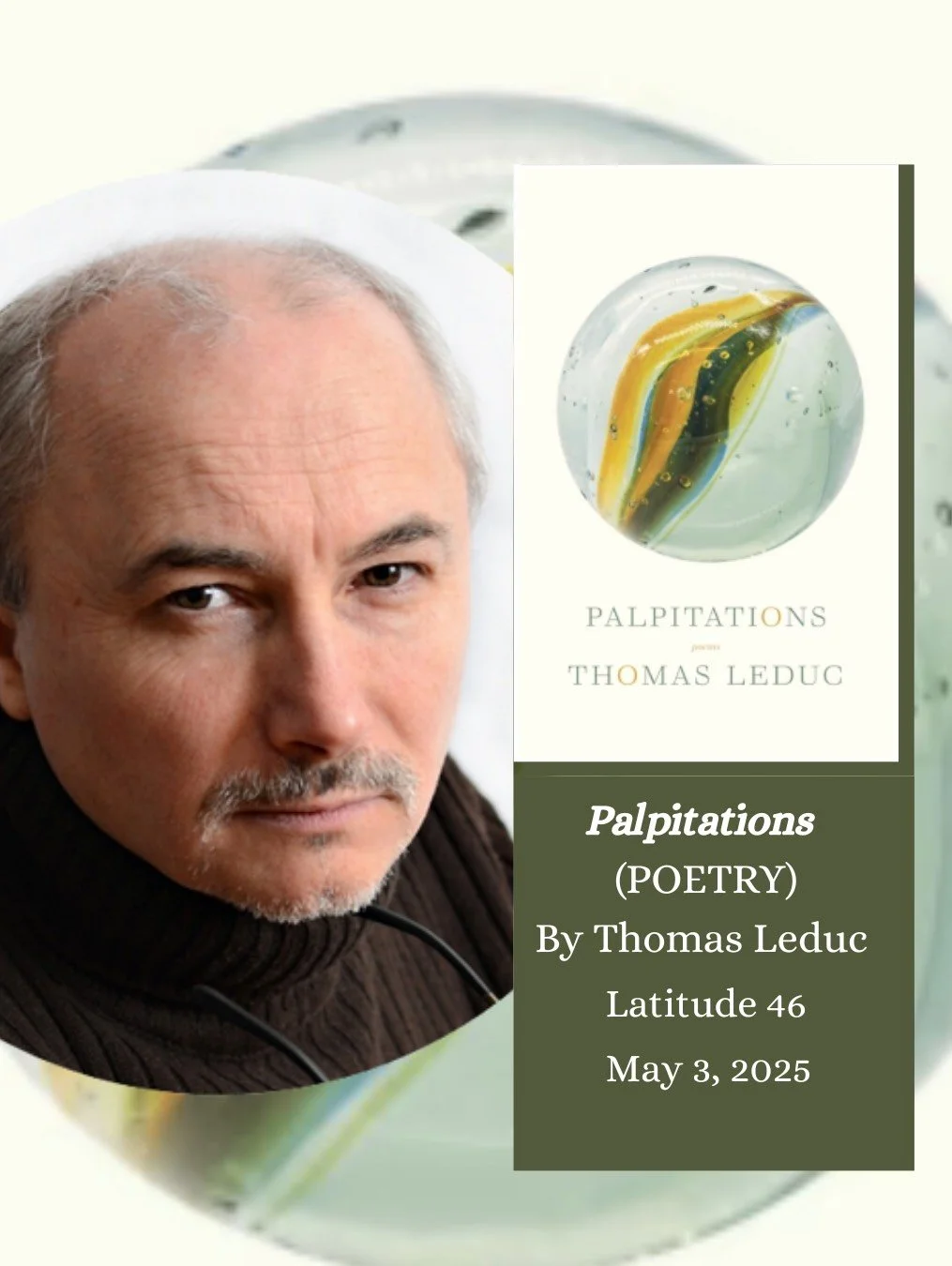
About Palpitations:
There are moments that change the course of a day, a year, or even a life.
Palpitations explores the journey through the twists and turns of the human experience. From childhood memories of struggling with dyslexia and what to be when one grows up, reflections on love, to the global disruption caused by the COVID-19 pandemic. Thomas Leduc delves into the shared experiences that have altered the world’s perception of itself. Full of vivid imagery and deep, thoughtful reflections, Palpitations is a tribute to that which makes us human – moments that palpitate with life, longing and change.
About Thomas Leduc:
Thomas Leduc was Poet Laureate of Sudbury, Ontario from 2014-2016 and the President of the Sudbury Writers’ Guild from 2017-2021. His poems and short stories have been published in various magazines and anthologies. In 2019 he released his first collection of poetry, Slagflower Poems Unearthed From A Mining Town (Latitude 46). He lives in Sudbury, Ontario.

Power Q & A with Allister Thompson
Like a lot of people, when I moved here, I was amazed at the sheer scope of a sparsely populated landscape, as well as its natural beauty, and it really captivated me. It still does. I wanted to share that feeling. Second, given that fact, I felt that while there is a great body of literature about northern Ontario, there can always be room for more!
Q: Why was it important to you to set your YA novel, Birch & Jay (Latitude 46 Publishing) in northern Ontario?
A: There were a few reasons for the setting being important. First, I live here. I know intimately the beauty of the northern wilderness and what it has to offer the imagination and the soul. Like a lot of people, when I moved here, I was amazed at the sheer scope of a sparsely populated landscape, as well as its natural beauty, and it really captivated me. It still does. I wanted to share that feeling. Second, given that fact, I felt that while there is a great body of literature about northern Ontario, there can always be room for more! And in this particular genre (speculative fiction/post-apocalyptic), I felt I could do something unique in this setting that no one has done before. Lastly, it was important to my process because my knowledge of this area, all the way down to Toronto, really enabled me to accurately describe and bring to life the settings in vivid ways.
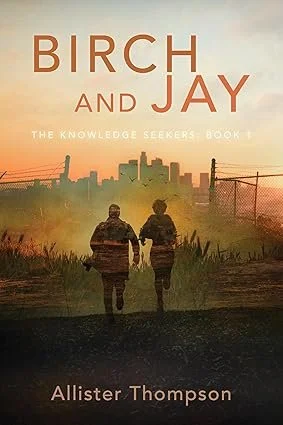
Birch & Jay by Allister Thompson, published by Latitude 46, spring 2025.
More about Birch & Jay:
Decades after the world was levelled by the effects of human-made climate change, the scattered remnants of humanity have begun to pull themselves together. Birch and Jay are a young couple living in a small, idyllic community away from the ruins of one of Canada’s great cities.
As a newly graduated Knowledge Seeker, Jay must leave Birch and their community to collect remnants of old wisdom from the dead world. Along the way, he comes across a mysterious elderly woman who offers to travel with him. He will receive more than a travel companion — she offers revelations about their town’s founding as well as knowledge of how to survive in a lawless world.
Birch, seeking adventure, pursues Jay but finds more danger than she ever imagined. Will they find each other in the chaos and brutality of the city and get safely back home to tell the tale?
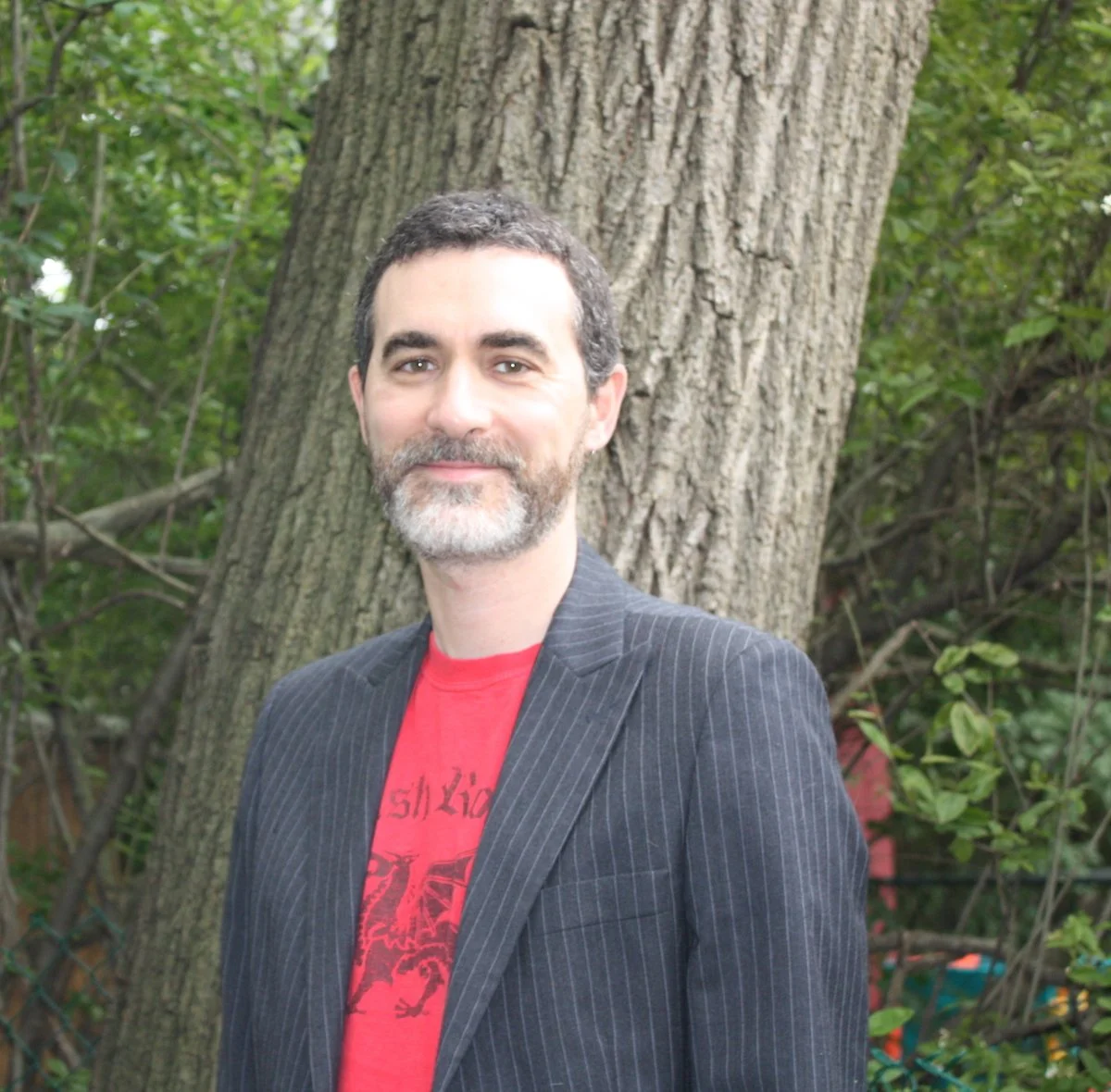
Author Allister Thompson
About Allister Thompson:
Allister Thompson was born in the UK and spent his childhood in Mississauga, Ontario, where he got his first part-time job in a small bookstore at the mall at age sixteen. He has spent the rest of his life working in the publishing and bookselling industries. He worked for small and mid-sized publishers in Toronto for fifteen years before striking out on his own as a freelance editor. This freedom eventually led him to North Bay, Ontario, where he has lived and worked with dozens of authors for the past ten years.

Steven Mayoff reviews Oliver Bell and the Infinite Multiverse by Jake Swan
As a follow-up to Grantrepreneurs, his wickedly witty 2023 debut novel, Jake Swan raises the stakes and widens his scope with Oliver Bell and the Infinite Multiverse (Galleon Books, 2025). This detailed and often dense melding of science fiction and demonology is liberally sprinkled with Swan’s trademark caustic social commentary. Comparisons to Douglas Adams may be inevitable, but add a dash of Tolkien and a pinch of Pynchon to this cosmological smorgasbord of a novel and you’ve got yourself one engagingly volatile page-turner.
As a follow-up to Grantrepreneurs, his wickedly witty 2023 debut novel, Jake Swan raises the stakes and widens his scope with Oliver Bell and the Infinite Multiverse (Galleon Books, 2025). This detailed and often dense melding of science fiction and demonology is liberally sprinkled with Swan’s trademark caustic social commentary. Comparisons to Douglas Adams may be inevitable, but add a dash of Tolkien and a pinch of Pynchon to this cosmological smorgasbord of a novel and you’ve got yourself one engagingly volatile page-turner.
Our titular hero is a university mathematician in Nova Scotia who is working on his thesis, a computer program that could “mathematically predict exactly how to turn any set of instructions into accurate code in any computer language, past, present or future.” When brainstorming at the library, all hell breaks loose in the form of a riot that seems to be a protest by vegans to remove books written by meat eaters. Things quickly turn violent and Oliver manages to barely escape alive.

Oliver Bell and the Infinite Multiverse (Galleon Books, 2025) by Jake Swan.
Heading back to his apartment, Oliver soon finds that his block has been cordoned off by the same vegan protesters. He confronts someone who seems to be guarding the area, a shaggy man “doing a pretty good impression of a naked, extra-scrawny Clint Eastwood.” The guard explains that Oliver’s home is now inside the “Vagisil Autonomous Zone.” When Oliver asks about the name, the guard explains:
“They’re our corporate sponsor. You can’t pull off a major protest that includes the establishment of a self-governed and policed autonomous zone without a corporate sponsor. So, we let them put their name on our movement. They get good corporate cred for supporting a progressive cause and we get plywood and Kalashnikovs.”
“Vagisil bought you AK-47s?”
“If they didn’t we’d call them out for being fascist and anti-progressive, and they’d lose business. Failure to support progressive causes like ours is absolute marketing poison. Especially for their target demographic. And think of all the advertising they’re getting. By midnight tonight, hashtag Vagisil Autonomous Zone will be trending on Twit, I mean X. Then everyone will have Vagisil on the brain. Sales will skyrocket.”
The plot takes an intricate turn early on and the reader is sucked in like a star into a black hole.
Oliver is soon confronted by Teddy, a muscle-bound, baseball bat wielding demon hunter who bears a striking physical resemblance to Dwayne “The Rock” Johnson, and Emma, his attractive but equally formidable common-law soul mate. Believing that Oliver has been possessed by a demon, they drug him and drive him to Florida to see an elderly Jewish couple: Bert, a cardiologist who moonlights as Death, and his wife Carmella. Bert is able to ascertain that Oliver is not possessed by a demon, but rather is a host to a supernatural being, Mayhem, whose physical form is that of an adorable puppy. As it is explained in The Comprehensive Guide to Hosting a Celestial Entity:
While the term “Host,” in reference to human beings, suggests a parasitic relationship between spiritual being and physical being, this is something of a misnomer as the relationship is usually symbiotic.
Are you starting to get the picture? If not, don’t worry. The ever-unfolding twists and turns of Swan’s hyper-inventive imagination have only begun to hit their stride and trying to keep up is half the fun. Teddy and Emma have been hunting the demon Amon, who is believed to be after Oliver’s thesis since the code at the centre of it, which Oliver only envisioned being useful for computer gaming, in fact holds the key to global destruction. Oliver forms a bond with Teddy, Emma, Bert and Carmella that seems to have begun as a form of Stockholm Syndrome, but eventually develops into a genuine extended family.
Together, this ragtag quintet embark on a journey that takes them to various strata of the multiverse, which apparently is a real thing. Along the way they encounter numerous allies, such as a philandering pot-vaping novelist, and a few other-worldly and underworldly denizens, some of whom bring to mind H. R. Pufnstuf as much as they do H. P. Lovecraft. As much fun as Swan is having pulling these mind-blowing mutations out of his seemingly bottomless hat, he grounds Oliver’s transmigratory adventures with an unexpected reunion that is this novel’s emotional core and adds a layer of human gravitas to the rollicking rollercoaster of events.
Oliver Bell and the Infinite Multiverse is both a good-natured and sharp-tongued view of a world gone mad and a universe that doesn’t fare much better. In his author disclaimer, Jake Swan cautions the reader: “This is a satire, written by an idiot. Try not to take it too seriously.” It brings to mind a quote by Dostoevsky: “An ugly stupid man can be a fool, but a beautiful intelligent one must be an idiot.”

Author Jake Swan
Jake Swan is a writer, musician and physician. He lives in New Brunswick with his wife Chrissy, son Jack and Stella, their rescue dog from South America. His website is https://jakeswan.ca

Steven Mayoff
Steven Mayoff is a novelist, poet and lyricist. He lives on Prince Edward Island. His latest book is the revised edition of his poetry collection Swinging Between Water and Stone (Galleon Books, 2025). His website is http://www.stevenmayoff.ca

Power Q & A with Bruce Hunter
Frontenac House Press has published a gorgeous reissue of Bruce Hunter’s award-winning novel of love, disability, and wildness, In the Bear’s House(May 23, 2025.)
Set in 1960s Calgary and Alberta ‘s backcountry, this reissue of In the Bear’s House tells the story of a creative young mother, Clare Dunlop, raising her deaf son against the insurmountable odds of poverty, mental illness and hardship. In the Bear’s House is ultimately about listening to the wild and the wilderness, and what we lose when it’s gone.
We are honoured to have Bruce join us to answer a question about the rebirth of his much-loved story.
Frontenac House Press has published a gorgeous reissue of Bruce Hunter’s award-winning novel of love, disability, and wildness, In the Bear’s House (May 23, 2025.)
Set in 1960s Calgary and Alberta ‘s backcountry, this reissue of In the Bear’s House tells the story of a creative young mother, Clare Dunlop, raising her deaf son against the insurmountable odds of poverty, mental illness and hardship. In the Bear’s House is ultimately about listening to the wild and the wilderness, and what we lose when it’s gone.
We are honoured to have Bruce join us to answer a question about the rebirth of his much-loved story.
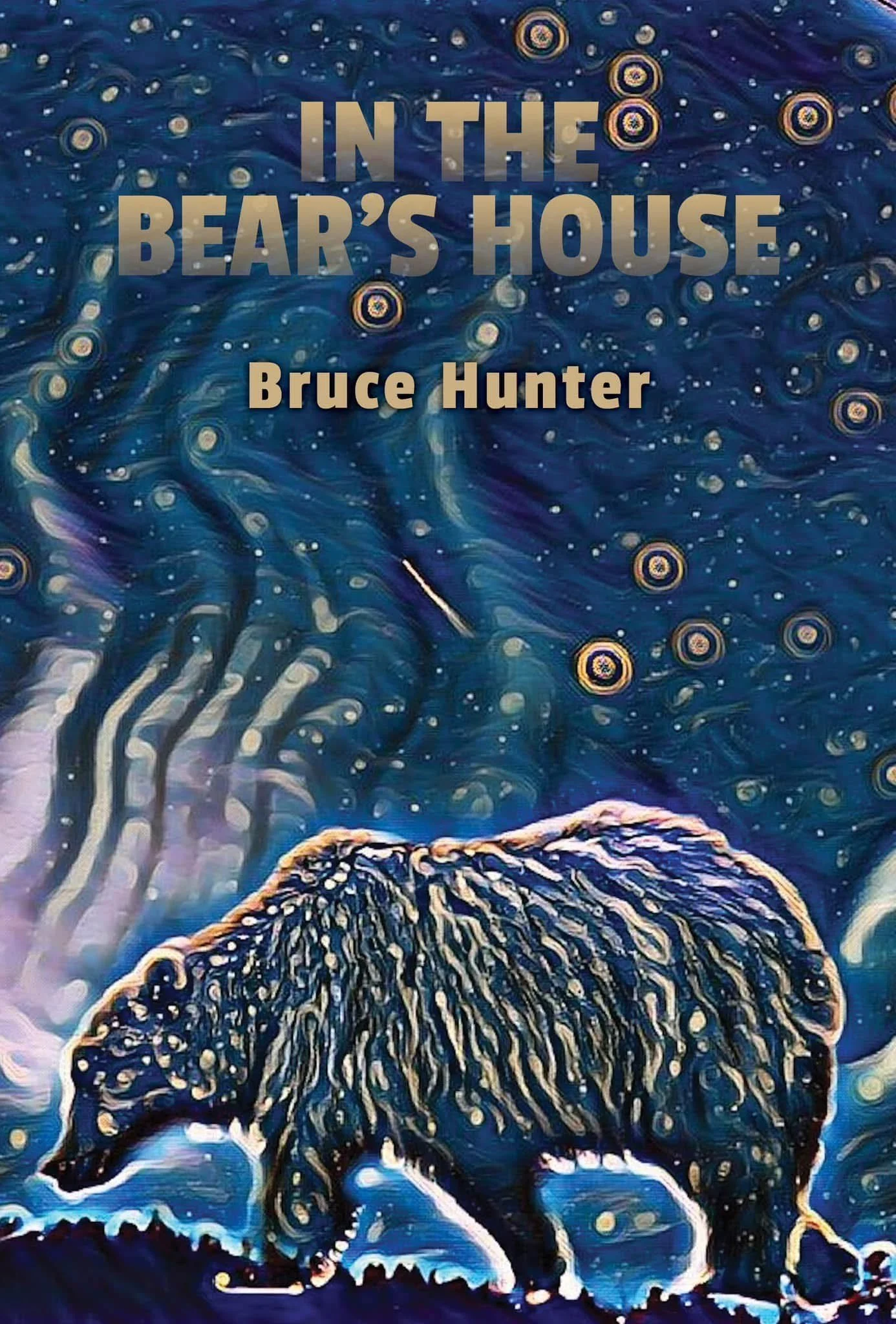
In the Bear’s House by Bruce Hunter
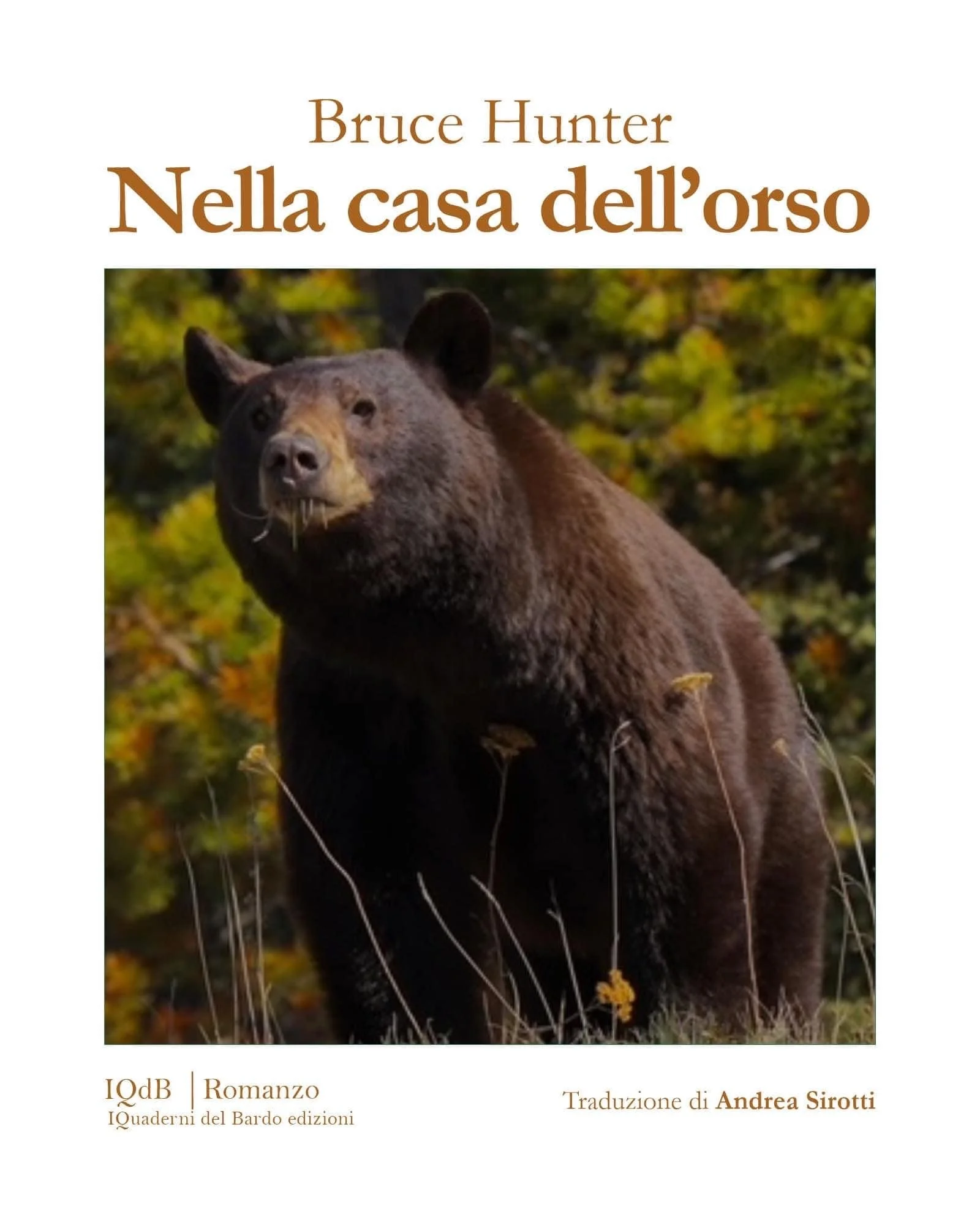
Nella casa dell’orso by Bruce Hunter, translated by Andrea Sirotti, published by iQdB eidizioni.
Q: What has it been like to reissue In the Bear’s House and have it translated?
A: As a mature writer on the eve of his 73rd birthday on May 21, I’m gobsmacked to have in my hands an Italian translation by iQdB eidizioni, and a sparkling new edition by Calgary’s Frontenac House. What a validation of my life’s work. Which I hope is an inspiration to all writers, young and old. To borrow a baseball metaphor, it’s all about staying in the game, whether you strike out or not, and keep getting up to bat.
Both publishers lavished such love on their books, inside and out. Both books radiate that level of professionalism and care.
I first published In the Bear’s House in 2009. It sold well and won an award at the Banff Mountain Film and Book Festival where it was deemed a mountain classic. But the publisher disappeared as did my edited galleys. I gave up all hope of ever seeing it in print again. Then my neighbor, the gifted poet and editor, Elana Wolff read It. It speaks to our times, she said. You must get it out there.
A cousin in IT scanned the hard copy and created a new submissible file. I showed it to the brilliant editor Micheline Maylor-Kovitz at Frontenac House in Calgary who took it to her bosses. There, Micheline, Terry Davies, and Neil Pretunia helped me take In the Bear’s House to a whole new level.
In the meantime, my Italian publisher brought out a translation as Nella casa dell’orso (literally, ln the House of the Bear). In April, I did a four-city tour to Lecce, Copertino, Florence, and Trieste, where the audiences’ enthusiastic response showed the story of a creative young mother and her deafened son in 1960s Alberta transcends time, language, and culture.
I look forward to the Calgary launch on May 23. What a birthday gift. From the bottom of my mended heart, gratitude to every one of you who got me here.
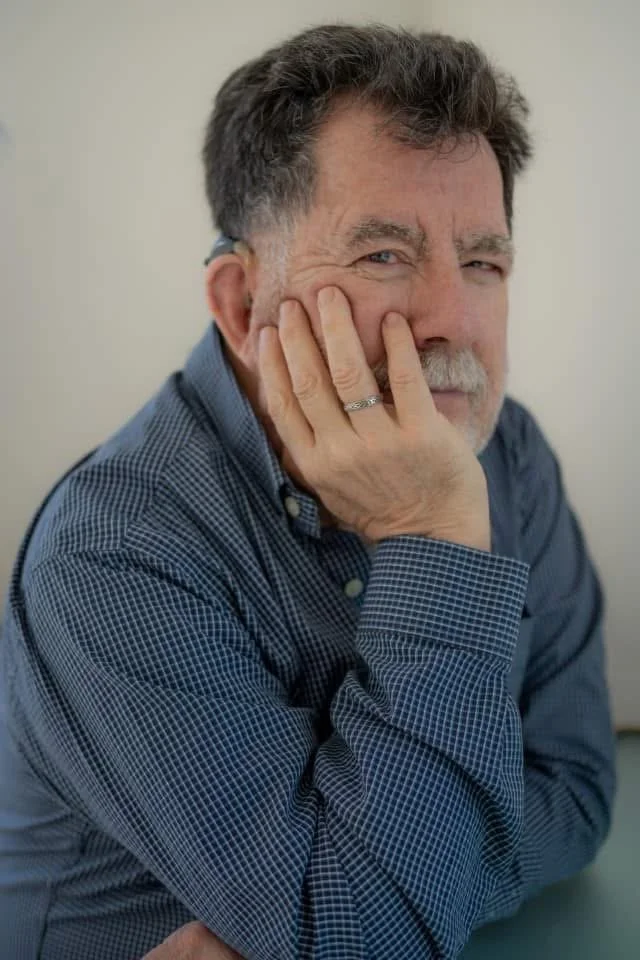
Bruce Hunter
About Bruce Hunter:
Bruce Hunter is a writer, editor, speaker, and mentor. In 2024, his novel, Nella casa dell’orso, was published in Italy by iQdB edizioni. In 2023, his poetry collection, Galestro, was published in Italy, following the release there in 2022 of A Life in Poetry, Poesie scelteda Two O’clock Creek, also by iQdB edizioni. 1n 2021, his memoir essay, “This is the Place I Come to in My Dreams” was shortlisted for the Alberta Magazine Publishers’ Awards. In 2024, his long poem “Dark Water” from Galestro won Gold for poetry for the Alberta Magazine Publishers’ Awards. And he is a proud new grandfather of Alice, Julian and Lucas.
Born in Calgary, Alberta, Bruce was deafened as an infant and afflicted with low vision much of his adult life. He grew up in the working-class neighbourhood of Ogden in the shadow of Esso’s Imperial Oil Refinery and now decommissioned Canadian Pacific Railway’s Ogden Shops. Calgary is located on Treaty Seven lands, in the traditional territories of the Blackfoot Confederacy (Siksika, Kainai, Piikani), the Tsuut’ina, the îethka Nakoda Nations (Chiniki, Bearspaw, Goodstoney), the Otipemisiwak Métis Government (Districts 5 and 6).
In his early teens Bruce discovered writing, for there he could hear everything – and be heard. After high school, he worked for ten years as a labourer, equipment operator, Zamboni driver, and completed his technical education and apprenticeship as a gardener and arborist. In his late twenties, his published poetry won him a scholarship to the Banff School of Fine Arts to study with novelist W.O. Mitchell and poet Irving Layton. From there he went onto York University to study film and literature and taught in the creative writing department before landing a position at Seneca College.
His poetry, fiction, reviews, interviews, and creative nonfiction have appeared in over 90 blogs, journals and anthologies internationally in Italy, Canada, China, India, Romania, the U.K. and the U.S.
Bruce has authored seven poetry books, as well as the best-selling CBC Radio-produced 1996 short story collection, Country Music Country (the third edition, the Reboot appeared in 2018).
In 2009, In the Bear’s House, won the Canadian Rockies Prize at the Banff Mountain Book and Film Festival. In 2010, his book Two O’clock Creek – poems new and selected, won the Acorn-Plantos Peoples’ Poetry Award for Canada.
Bruce was the 2017 Author in Residence for Calgary Public Library. His past residencies include the Banff Centre, Deaf and Hear Alberta, Richmond Hill Public Library, University of Toronto, Mount Royal University, and many others across Canada.
Bruce is an associate member of the Association of Italian Canadian Writers, a full member of the Canadian Authors Association, a life member of the Canadian Hard of Hearing Association (C.H.H.A.), and the Canadian National Institute for the Blind (C.N.I.B.), as well as long-time member of the League of Canadian Poets, the Writers’ Union of Canada, and the Writers’ Guild of Alberta. For more than three decades, Bruce has championed accessibility for those with vision and hearing loss.

Power Q & A with Caitlin Galway
The longer form definitely comes naturally to me, though it’s not something I set out to do, so much as a reflection of how I think. I’ve learned to see my own intuitive approaches more clearly, and how to amplify or deconstruct them, challenge or upend them. Something particular that I’ve realized is that as I write, everything is somewhat of a spiderweb; ideas emerge connected to several other ideas, which connect to one layer, then another, and so on. It’s part of what feeds me electricity as a writer: this instantaneous, sparking interaction between narrative, symbolism, philosophy, psychological and emotional interiority, history, and commentary, and I find that it means the story will probably need more breathing room.

Q: Your short fiction collection, A Song for Wildcats (Dundurn Press, 2025), is remarkable in many regards: it has lilting, poetic language, haunting and gorgeous imagery, and—what we want to ask you about today—an unusual structure. Your book is made up of five longer stories, as opposed to many shorter ones. Would you tell us about writing longer form short fiction?
A: The longer form definitely comes naturally to me, though it’s not something I set out to do, so much as a reflection of how I think. I’ve learned to see my own intuitive approaches more clearly, and how to amplify or deconstruct them, challenge or upend them. Something particular that I’ve realized is that as I write, everything is somewhat of a spiderweb; ideas emerge connected to several other ideas, which connect to one layer, then another, and so on. It’s part of what feeds me electricity as a writer: this instantaneous, sparking interaction between narrative, symbolism, philosophy, psychological and emotional interiority, history, and commentary, and I find that it means the story will probably need more breathing room.
“The Lyrebird’s Bell”, for example, on a narrative level is a story about two young girls and the absorbing, even disturbing bond they form in response to isolation and familial abuse. There’s a prominent layer exploring the complexities of human relationships, and another navigating grief, trauma, and the impulse to retain some shred of love. However, it’s also a story about essentialism, and how metaphysical reflection might manifest in the mind of a child desperate to make sense of the inexplicable. It’s also about imagination, both as joy and necessity, and why it’s so often steeped in myth.
Those layers need to engage with one another thoughtfully and meaningfully, and as a result, I usually feel a certain elasticity to a story. It keeps lengthening because it demands more space to explore itself, and for me, it’s a matter of being receptive and listening.
More about A Song for Wildcats:
Infatuation and violence grow between two girls in the enchanting wilderness of postwar Australia as they spin disturbing fantasies to escape their families. Two young men in the midst of the 1968 French student revolts navigate — and at times resist — the philosophical and emotional nature of love. An orphaned boy and his estranged aunt are thrown together on a quiet peninsula at the height of the Troubles in Ireland, where their deeply rooted fear attracts the attention of shape-shifting phantoms of war.
The five long-form stories in A Song for Wildcats are uncanny portraits of grief and resilience and are imbued with unique beauty, insight, and resonance from one of the country's most exciting authors.

About Caitlin Galway:
Caitlin Galway is the author of the novel Bonavere Howl and the forthcoming short story collection A Song for Wildcats. Her work has appeared in Best Canadian Stories 2025, EVENT, Gloria Vanderbilt's Carter V. Cooper Anthology, House of Anansi's The Broken Social Scene Story Project (selected by Feist), The Ex-Puritan as the 2020 Morton Prize winner (selected by Pasha Malla), Riddle Fence as the 2011 Short Fiction Contest winner, and on CBC Books as the Stranger than Fiction Prize winner (selected by Heather O'Neill).

Power Q & A (Part II) with Kathryn Kirkpatrick
Talk about wonder! Paula Meehan's work came to me in the mail as a request for a book review! Poet and editor R.T. Smith certainly kept channels open for synchronicities, and I'll always be grateful for that request. I think currently we're suffering from the Cartesian dualisms inherent in our capitalist version of modernity, and we've got some horrendous fixes floating around. Paula's beautiful work combines a compassionate, progressive politics (for lack of a better word) through a thoroughgoing critique of the class exploitations underwriting modernity as we know it.

Q: Your book, Enraptured Space: Gender, Class, and Ecology in the Work of Paula Meehan
(West Virginia University Press, 2025) opened our world to a poet we, admittedly, had never heard of before. Would you tell us why the work of Paula Meehan is particularly salient today and how you came to her writing?
A: Talk about wonder! Paula Meehan's work came to me in the mail as a request for a book review! Poet and editor R.T. Smith certainly kept channels open for synchronicities, and I'll always be grateful for that request. I think currently we're suffering from the Cartesian dualisms inherent in our capitalist version of modernity, and we've got some horrendous fixes floating around. Paula's beautiful work combines a compassionate, progressive politics (for lack of a better word) through a thoroughgoing critique of the class exploitations underwriting modernity as we know it. I think her work invites us to find a third way through the dualisms of culture/nature, man/woman, head/heart, reason/feeling. What does that world look like? How might we feel and think our way into it? Can we keep what we've learned through this human passage through capitalist modernity and come through it with the insight and lessons, while being open to what might come next? I think she's always on the border of this kind of seeing, and I want to be there with her, and to be there also in my own life and writing.
More about Enraptured Space: Gender, Class, and Ecology in the Work of Paula Meehan:
Drawing on her own lived experiences as a practicing poet, Kirkpatrick explores how scholarship is grounded in an imaginative exchange between words on the page and the material conditions of the scholar who works to inhabit them. With chapters of literary analysis swimming in a conversation between poets, this book breaches the boundaries between criticism and memoir, suggesting the ways that every scholar is transformed by the subjects they study.
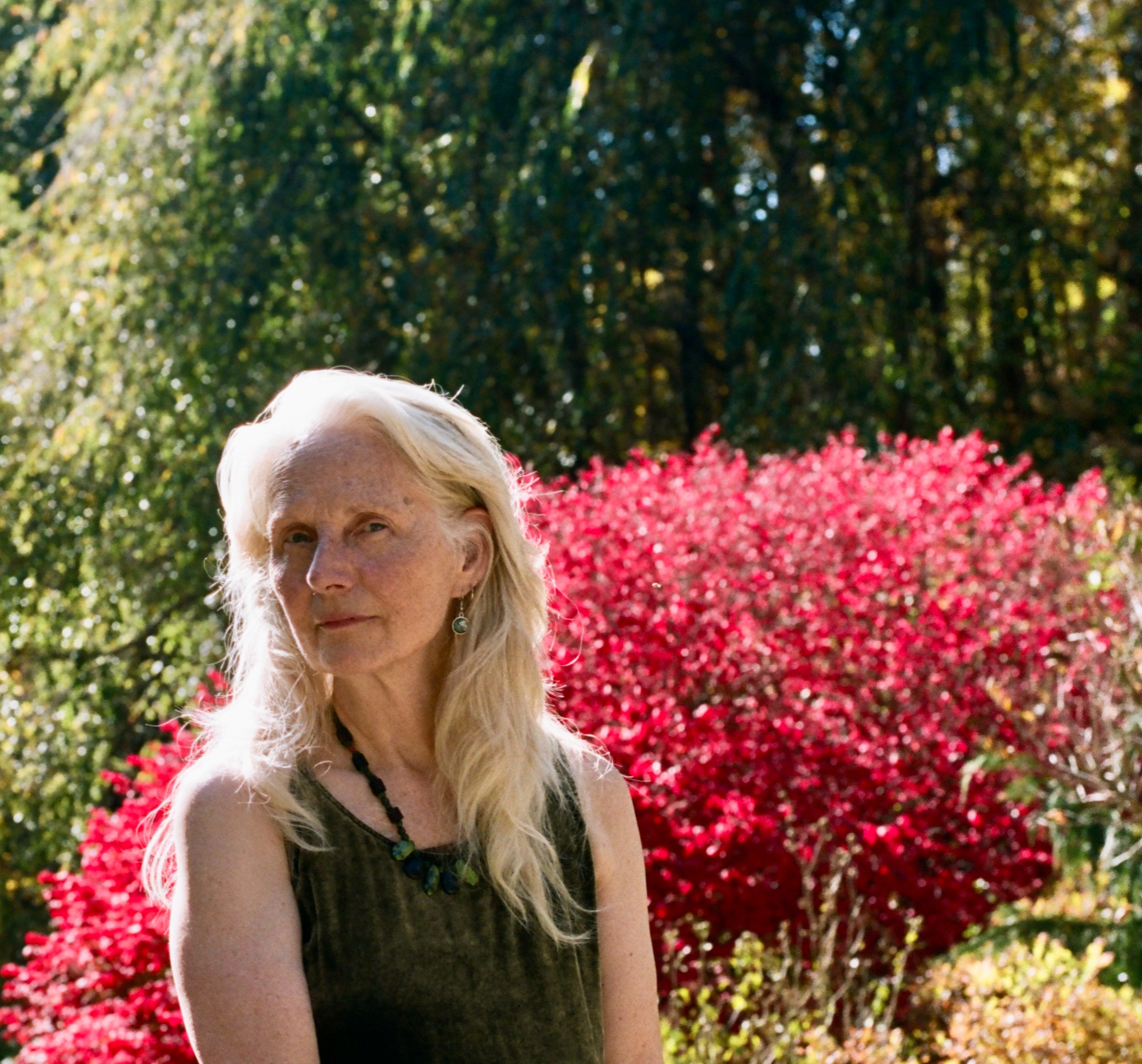
About Kathryn Kirkpatrick:
Kathryn Kirkpatrick is the author of seven collections of poetry, including three recipients of the NC Poetry Society’s Brockman-Campbell award. The Fisher Queen: New & Selected Poems (Salmon, 2019) received the NC Literary and Historical Society’s Roanoke-Chowan Poetry Prize. Although she grew up in the nomadic subculture of the U.S. Air Force and spent my childhood in the Philippines, Texas, and Germany, she has lived in the Blue Ridge Mountains for many years, where she teaches environmental literature, animal studies, Irish studies, and creative writing as Professor of English at Appalachian State University.