
Review of Guy Elston’s The Character Actor Convention by Callista Markotich
Let imagination Uber you there.
Say you’re this Convention’s keynote. You’ll be in the Grand Ballroom looking out at the attendees. You’d better be at the top of your game, addressing the wild, earnest characters there assembled. There’s room for insecurity – there’s this, from the actors:
We applaud, but it could be an act.
Here in the title poem, the characters are slippery, we and they blend, and there’s that guy, yes, him and one startling you, and the imitable, inimitable I, at first, casual and in charge:
at the fin, I pocket my lanyard, picture you,
front centre on a billboard, sigh performatively
while fading to black
and then, poof! self-extracted from the speaker’s function, bringing no closure to this meet.
I had a final line — I forget.
The convention closes, as ever, on a question:
Are we nearly them yet?
Let us accept the crowd-fostered confusion of person. Let us precariously enjoy the close-call near-cliché which hugs us with homely familiarity: are we nearly there yet? Let us reconsider the title: The Character Actor Convention. Convention – is this the only Convention we may find? Or not?
For Guy Elston employs conventions. For example, well-chosen direction and flow of some poems come through the canal of an epigraph; an epigraph chosen to introduce, inspire, illuminate and add authority. Guy Elston does not turn his back on this convention, But, a poet of invention, humour and courage, he upheaves the convention early and airily and as readily as is fair.
For example, here is the epigraph, from Wikipedia, that introduces The Great Sheep Panic of 1888
…when tens of thousands of sheep fled from various fields across some 200 square miles of Oxfordshire.
Immediately, in the first line, the author creates a segue:
It’s that word panic
I take offense to.
And he’s off! In this poem he creates a nostalgic monologue by a survivor (sheep) who waxes poetic on the panic, which is really much grander thing: a revolt, its opening complete with a small selection of vernacular expressions which (irritatingly) trivialize such heroic purpose:
Are you feeling Ok?
Do you need a snack?
Here are figureheads,
…big horns suited our purpose,
but Benny wasn’t the real brains, or brawn;
martyred leaders,
Ruby, with her wolf -sharp hooves,
with her rabbit pellet eyes … leading the herd;
and true believers.
…and footrot Leon,
he believed more than anyone.
Here are the tragic remainders, reminders, regrets,
Thing is, it’s not just the fence,
the dogs, the whistles, the shearing,
and a sadness, a sense of futility.
I know she had a final epiphany.
She just never told us what it was.
His epigraph ably steers us, unsuspecting, from panic to mock epic, with sympathy for the sheep.
At times Poet Guy Elson skydives into allusion, a convention, surely — sometimes into deeply respectable and cherished pieces of literature. Twice the dramatic titles of Robert Browning are launchpads for gypsy titles which roam the poems into simpler? terrain. From the beseeching oration in which The Bishop Orders His Tomb, we hear in the hyperbolic asks of the Bishop of Saint Praxed only the faintest echo as The Stick Insect Orders His Tomb. We hear the Bishop pleading with nephews—sons mine; my boys, he calls them, while the straight-speaking stick insect addresses “kids” and is not the least prescriptive in his wants. And, though the Bishop seeks motifs and materials of epic grandeur, deeply desiring to better and best a rival bishop, a cool inversion awaits us, if we reduce his wants to this:
Put me where I may look at him! Here is the Bishop, active and vengeful.
For Elston’s Stick Insect ultimately asks this:
Bury me somewhere,
anywhere, I might be sensed. Here is the Stick Insect, passively existential.
But, finally, Stick Insect, too, lays one kind of unkind common denominator in which he too seeks a certain satisfaction:
One vanity.
Let me stick in one giant’s maw.
Too, Guy’s title His Last Cigarette has an auntie in a high place, on a cold-hearted Duke’s wall. The title My Last Duchess by Robert Browning is evoked in a swish; “the curtains I have drawn for you” open in this poem too, as Cigarette confesses his yearns, hopes and dreams. The “he” of this poem has evidently decreed it: My last cigarette. Pity the Duchess. Pity the cigarette, their shared mortal question:
Why stamp me out, so cinematic?
With poetic aplomb and hocus-pocus, the author is capable of igniting that conventional sentinel of poetic response, affect. In Produce, the speaker of the poem, a pumpkin, addresses his fame-seeking father, directly:
Dear Father.
Poor Father.
The poem is sad. It is full of entreaty. In spite of greedy futility of parental desire for fame, a selfishly motivated kind of love, akin to the phenomena of Svengalian control, it sorrows for a flawed and failed relationship. The setting, a necrotic autumn fair, is by itself is a symbol of fleeting glory and dying beauty. There is pathos:
Poor father.
Couldn’t you ever see,
just once, the future?
Can we agree that thes emotions are not unique to the pumpkin? Can we not think of cases where this very pain is not pumpkin pain? Rolling past the pumpkin personification, we can imagine a human sorrow, a child’s distress, and the pumpkin speaker helps us do so, when we consider that, heartrendingly, his pain is not merely for himself, but for the misguide sacrifices of his father:
(you)…wrapped me at night.
Fed your life into mine.
Poor father.
That’s Guy Elson’s offering.
The same thing happens in The Whale. We’re at the portal of the affective domain with the first line:
I never really knew my dad.
And then, the diction of the poem passes us from the ready-at-hand anthromorphism into a sense of all-too-human dejection and helplessness. There is the steady flow of futility in the poem, as the whale mourns his opaque genesis. Who wouldn’t ?
God provided a huge fish.
God’s casual creative wave. How dismissive.
Worse than silent seas, passing ships, no echo-song.
Then, it’s bound to pluck the heartstrings of a poet, that a poem saved Jonah in the belly of the whale!. Don’t we hope that’s true? A light shines! We think about this. We think about how scripture is poetic, and the whale and all, are scriptural. And besides, there a life-line for us to grab here:
No-one’s big enough to swallow poetry.
We can feel emotional about that.
Joan of Arc’s appearance in The Stake, which initiates the collection, does it too, for me, at least. My heart has always been warmed by Joan. She is a hero, a feminine character breaking the mould, already sung, not only in hagiographic literature, but by other poets, and Guy Eston gives her a laugh at the end of the first poem. I find that moving.
Oh, I’ll burn, Joan laughs.
I do every time.
And I feel edified that she is in charge:
Your move.
I really like that.
When Joan appears again, in For a Good Time (this may be idiosyncratic), I respond. I enjoy reading her name again in this collection, and that a reverse Joan of Arc can be envisioned:
Stop getting burnt.
The treatment of my favourite martyr in The Character Actor Convention touches me, in that ineffable way that poetry can, and must.
There are other examples. In No More Worlds, Guy Elston uses a homely geography to create an ownership. Personally, I “see” that cement square on Queen and Bathhurst in my mind’s eye. I almost see Golden Alex, or someone akin. Does the poet know how affirming that is? Surely.
You will leave this convention with plenty of swag!
There are sonic mementos: sink-eyed, days-crazed; cicada backtracked sticky,
and cameo images that turn mnemonic; wolf in a tree, prick eared, wet-eyed.
There are catchy, keeper turns of phrase: If why is not the question, neither’s how
and
adjectives are the canned laughter of language
and unique juxtapositions: wolf-sharp hooves/rabbit pellet eyes …
Unpack that bag and array the curios along the worktable and try them as titles to see if they wouldn’t jettison us into marvel and fantasmagoria. In contrast, Guy Elson’s style is to title his poems straight; poems exactly about what the titles suggests. But if his title does not promise an extraordinary content: (Sunday Drive, Automatic Feeder,) the legerdemain begins. The Work is suddenly about mushrooms. Their work. Other poems which have more exotic titles, such as Halloween Training for Horses and Dead Pheasant at Casa de Montejo tidily stay precisely within the realm of what the title provocatively suggests.
Examine Sunday Drive. The title smacks of Americana. In the first lines we are treated to Pepsi and confronted with the consumer image of the strip mall. See the ad in your mind’s eye? A two -tone Chevrolet practically swings into being; there’s a fun-loving frivolity to the exclamation marks employed in the poem, Sunday Drive! But here the drivers are lab rats, albeit, the scientists learned joy from training them. That’s how Guy Elston takes us in!
Blow a kiss. The poem ends, nevertheless, with a rare explicit tug on our human conscience:
….Race the raised expressway
Separating us from our indifference.
In Automatic Feeder, the title again unveils the subject. It is truly just an automatic feeder. But in the opening line it is the speaker of the poem who addresses the soulless machine:
I’d spend every moment of my life
below you mouth open , hoping, gaping
After savouring the musicality of open, hoping, note the stance of ambiguous reliance on the purveyor of nutrition. There is mourning for active food-procurement, the adventure and possibility of surprise and reward:
so this is how it ends, my prowl, my sleuth.
and the poem closes with a juxtaposition of bravado and capitulation:
….I am the ship’s cat
the captain is going down with, singing hymns
or purring at plastic.
Suppose we’re not alone in the room, reading this book. This happens: an eyebrow rise /a smile /a chuckle /a belly laugh. Husband, wife, roomie, “other” says: What? And we can’t express it simply – we say: You have to read this poem!
The poem H20, for instance, initiates hilariety by becoming, immediately, an address to O by H. and beginning with the query:
O, were you really worth
two of me?
Humour is sustained by the poet’s loyalty to the scientific concepts of H and O, and their elemental marriage in H2O, in which the H recalls the partners at times together:
drip drip
plonk
but, jibing, remembering O’s insults and H’s own retorts:
A fork in a world of soup
you called me. A dick
in a world of dicks
….
air headed
puffed up
grandiose
H recalls the cosmic:
For a spell the planet turned
to our yearly release
but H sees O finally in a dubious role on earth:
Last I heard
you were dosing up wildfires
Yet, H anchors his address with a nostalgic touch of sentiment:
But O,
when we were fresh,
when we flowed…
I Swear is a another very funny poem which ….. allow me: You have to read this poem!
Three Star Resort determinedly offers bathetically humorous images, painting a slightly-off vacation venue, tongue in cheek, its diction suggesting the not-quite-OK stay (note brackets):
(a friend of a friend checks themselves out).
It is a resort of last resort, exercising the ambiguity and reality that attend the choice:
How lucky we are to know how lucky we are.
Would we stay again?
We’d have no choice.
Funny, not funny, funny.
Finally, from the ultimate poem To Whoever is Writing Me, this luscious line:
You are confused.
Guy Elston, you may mean me. Yes, I have been confused, often, deliciously, provocatively so. I feel my right brain poised to make meaning and settle appreciatively in its director’s chair, while my left brain plays jacks in the sand with the kids. I could quote The Whale.
That’s my problem.
Recently, somewhere very accessible – maybe on Facebook – I read this statement: “The things I enjoy reading most are the ones that make me think, sometimes a bit uncomfortably”. Whether or not I’m a full yea on that, I can relax. No need for discomfort; in his poem The Whale, generous Guy Elston gives us cover:
No-one’s big enough to swallow poetry.
If that’s not reassuring enough, there’s an assertion in Dead Pheasant at Casa de Montejo that secures us comfortably within the norm:
…the only universal human word
is huh?
Note should be taken though, it is the dead hare who gives this assurance.
—reviewed by Callista Markotich
Callista Markotich has enjoyed a life-long career as a teacher, principal and Superintendent of Education in Eastern Ontario. Her poems appear in numerous Canadian reviews and quarterlies from The Antigonish Review through Vallum and in several American and British magazines and journals. Her poetry has received first and second place awards and a placement in the League of Canadian Poets Poem in Your Pocket campaign. It has been short-listed and Honorably Mentioned in several Canadian contests and nominated for a Pushcart Prize and the National Magazine Awards. Her suite, Edward, was a finalist in the 2023 Gwendolyn MacEwen Poetry Award and the 2024 Toad Hall Chapbook Contest, with The Poets Corner. She is a contributing editor for Arc Poetry. Callista’s first collection, Wrap in a Big White Towel (2024) was published by Frontenac House. Callista lives gratefully on the banks of Lake Ontario, traditional territory of the Anishinaabe and Haudenosaunee nation, in Kingston Ontario, with her husband Don of fifty-nine years.
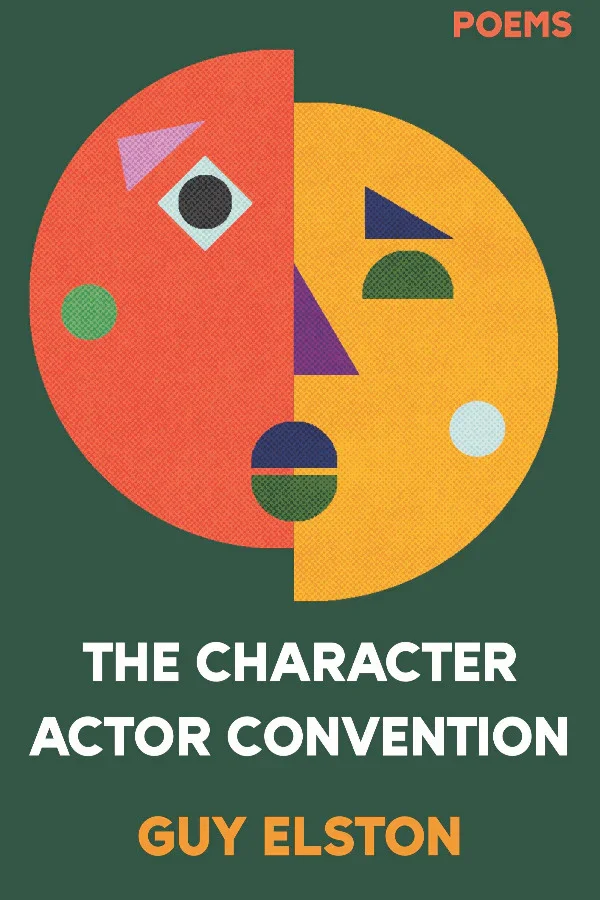
The Character Actor Convention by Guy Elston, Gordon Hill Press/The Porqupine’s Quill, 2025.