

BLOG
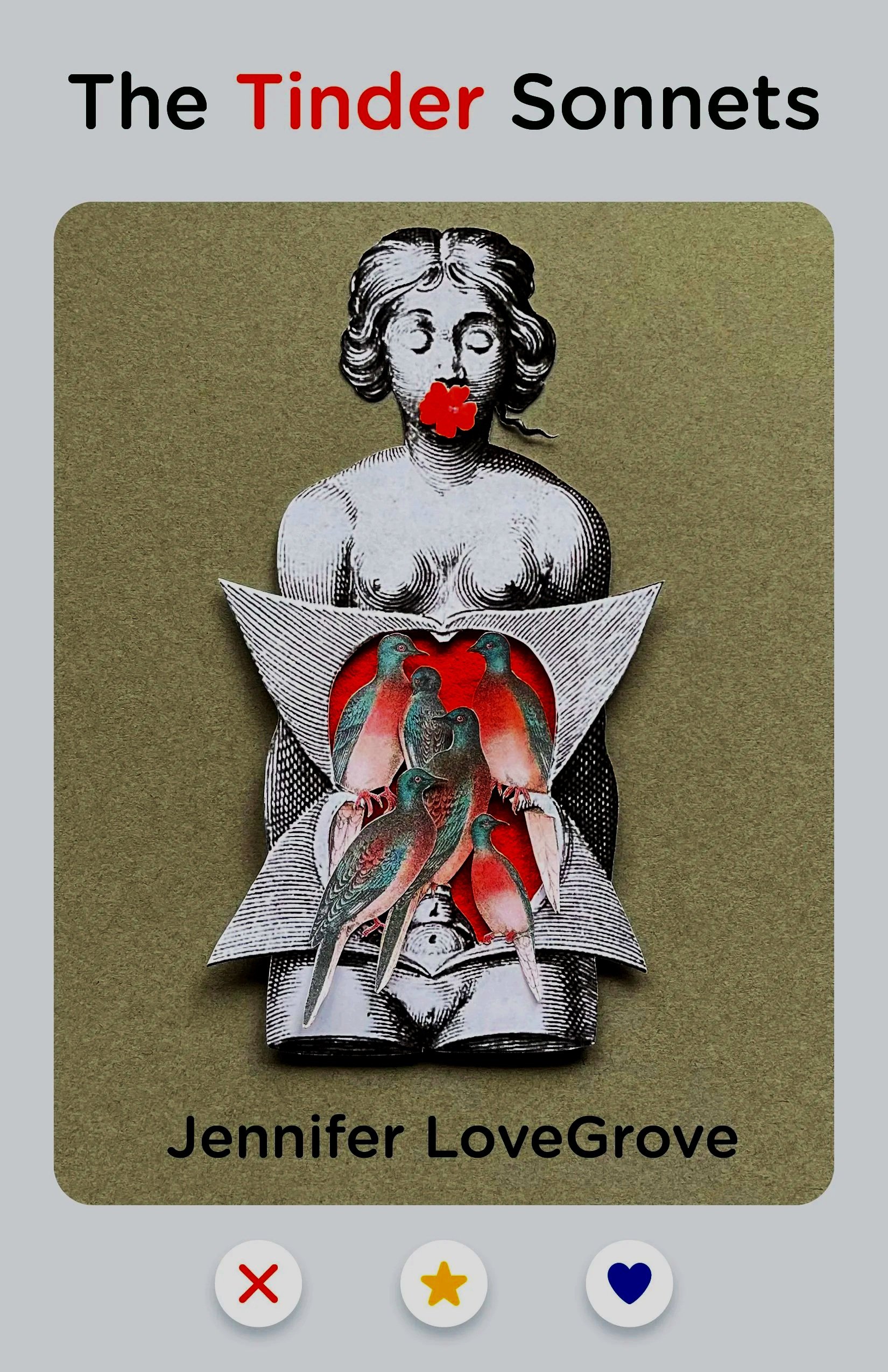
Excerpt from The Tinder Sonnets by Jennifer LoveGrove
Fresh loroco, importing banned. Oblong
little smugglers, edible blossoms, green-
sheathed, pale inside. Insipid. Pandemic
first date in rain. Sipping cheap white wine from
a pink plastic cup, SLUT scrawled across the
bus shelter. I text a friend a selfie.
Fernaldia pandurata and Diabrotica adelpha get symbiotic in Christie Pits
Fresh loroco, importing banned. Oblong
little smugglers, edible blossoms, green-
sheathed, pale inside. Insipid. Pandemic
first date in rain. Sipping cheap white wine from
a pink plastic cup, SLUT scrawled across the
bus shelter. I text a friend a selfie.
At least you don’t have herpes, she says, plus
a broken toe. Tastes green, like broccoli,
artichoke, or chard. Overtones of nuts.
High in niacin. Most vigorous vine,
finely pubescent, minutely hairy.
Upper leaves blunt at the base, the lower,
cordate. Heart-shaped. Bright pulse on tongue. The buds
an aphrodisiac, the root — poison.
Hands soft despite knife nicks, scorch scars. Nimble
tease, wet lips to collarbone as I come.
Between lockdowns, opens a restaurant
on his birthday. Then robbed, twice. Menus and
trauma monologues: curled fetal in the
back of his car after a bong hit, sure
of being hunted. The bridgetop panic
attack in New York for a death metal
show. How he sold his car and never drove
again. I offer doomsday cults, psych wards,
stitches, suicides. I may have been a
refugee, but you’re from Dunnville! Festive,
invasive, an orange-necked crop killer —
hard flea, tough to slaughter, dirty daughter.
Second date, asks if he can slap me. Where?
Third date, so worried he’s having a stroke.
Arteries tangled like reasons he thinks
his father left. We agree on nothing.
I win every debate. He admits that
it’s a turn-on. He pulls my hair when I
suck his cock, but never when I ask him
to. The midnight phone calls reading aloud
our worst reviews: This book’s so depressing!
or Why all the chopped cabbage?! I’m always
hungriest on the nights I most need sleep,
when every small delicacy unfurls
a threat. Don’t let go of me, he whimpers,
then recoils when I whisper, You can stay.
"Fernaldia pandurata and Diabrotica adelpha get symbiotic in Christie Pits" from Tinder Sonnets © 2026 by Jennifer LoveGrove. Used with permission of Book*hug Press.
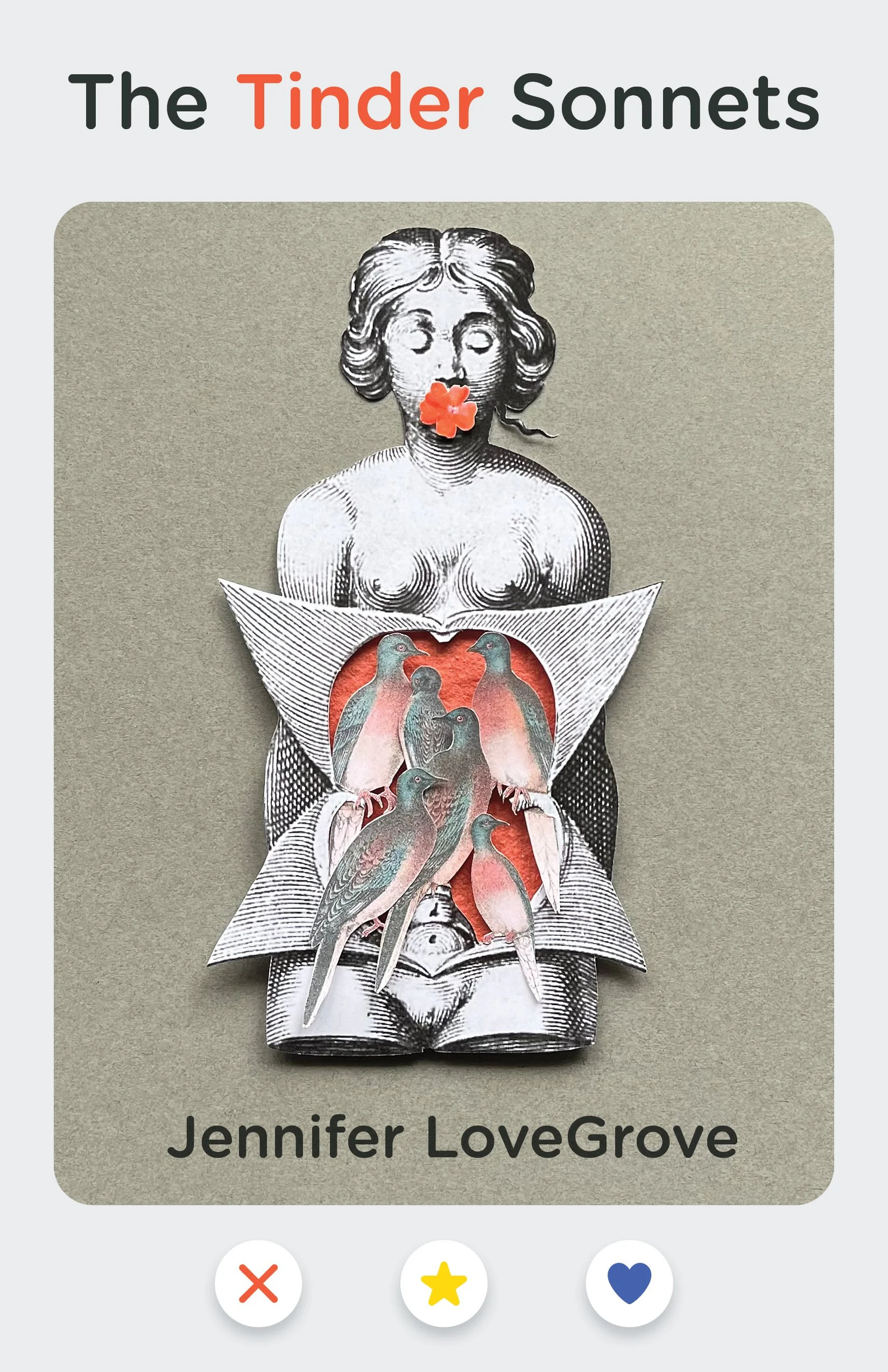
From acclaimed writer Jennifer LoveGrove comes an electric poetry collection exploring female sexual desire, contemporary dating, misogyny, and middle age that reflects and embodies our social media-saturated times.
Unabashedly confessional and radically vulnerable, The Tinder Sonnets rallies against the long-standing demand that “women of a certain age” politely accept being rendered non-sexual. Each poem is based on a date, relationship, or contemporary dating insight, and highlights how misogyny impacts the way we connect in the modern world–or don’t.
Juxtaposing folklore and the natural world against the digital sphere of texting and dating apps, this is poetry that defies invisibility and instead confronts and subverts it through a discerning feminist lens. While experimenting with the traditional form of the sonnet, these sonically textured poems are playful and wry, erotic and joyful, all while refusing to shy away from palpable anger, frustration, and disappointment.
Centering strength and resilience in the face of a resurgence of misogynistic chauvinism, The Tinder Sonnets is a staunch refusal to recede from view, to cede sexual space, or to be quiet and polite.
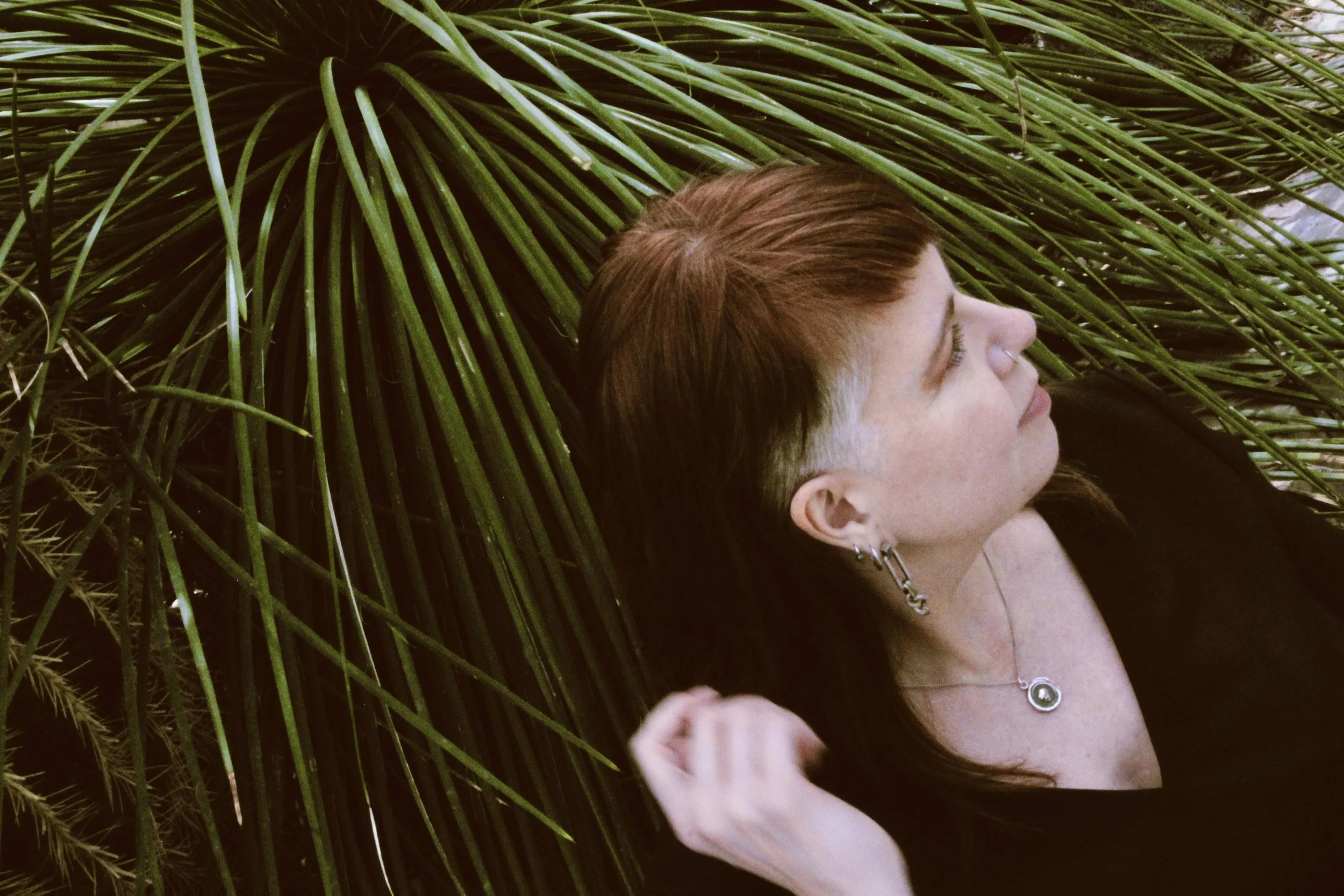
Photo credit: Sharon Harris
JENNIFER LOVEGROVE is the author of the Giller Prize–longlisted novel Watch How We Walk, as well as three poetry collections: Beautiful Children with Pet Foxes (longlisted for the Raymond Souster Award), I Should Never Have Fired the Sentinel and The Dagger Between Her Teeth. She is currently working on a new novel, and creative nonfiction. She divides her time between downtown Toronto and Squirrel Creek Retreat in rural Ontario.
Excerpt from How I Bend Into More by Tea Gerbeza
Based on Tea Gerbeza’s experience with scoliosis, How I Bend Into More (Palimpsest Press, 2024) re-articulates selfhood in the face of ableism and trauma. Meditating on pain, consent, and disability, this long poem builds a body both visually and linguistically, creating a multimodal space that forges Gerbeza’s grammar of embodiment as an act of reclamation.
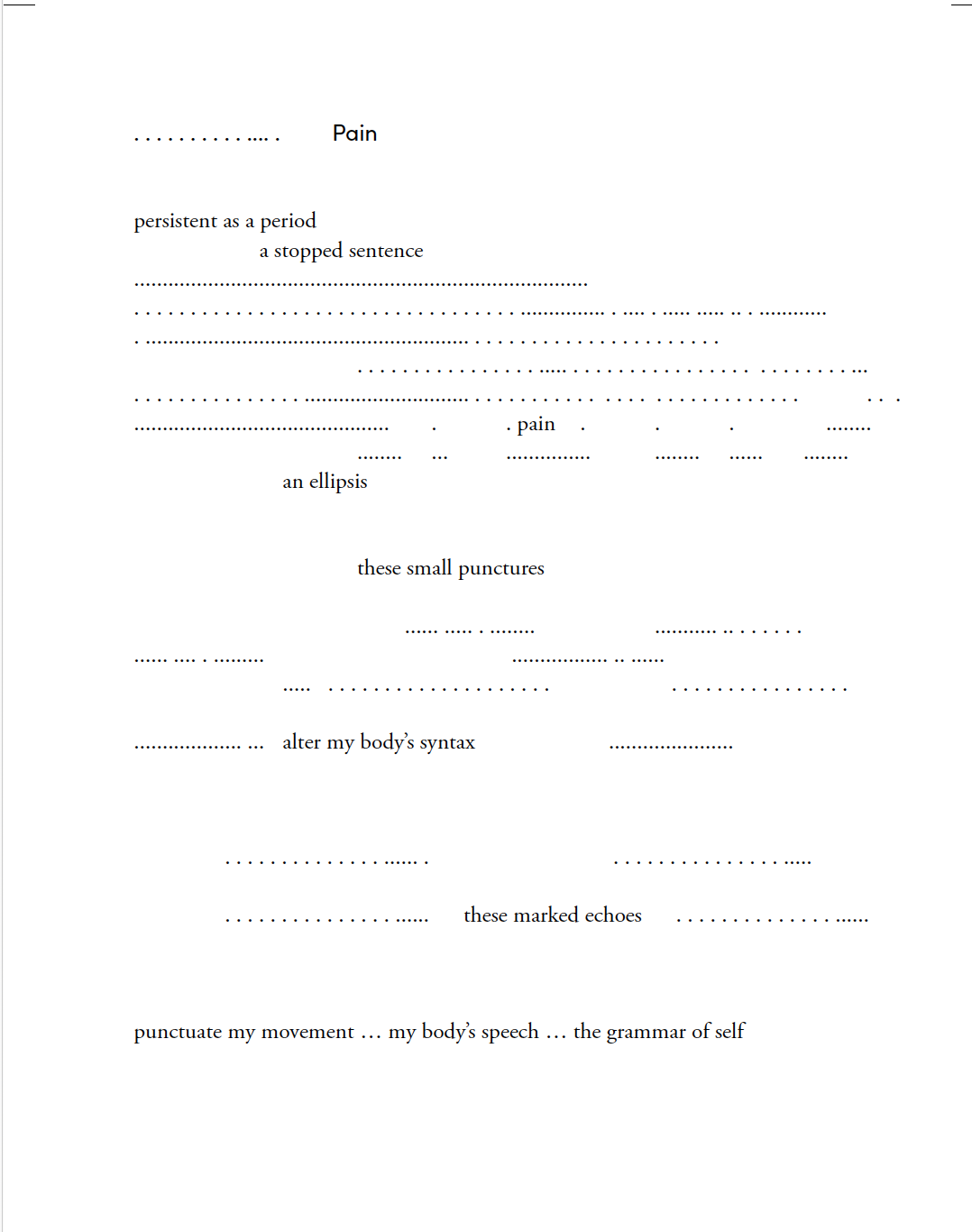
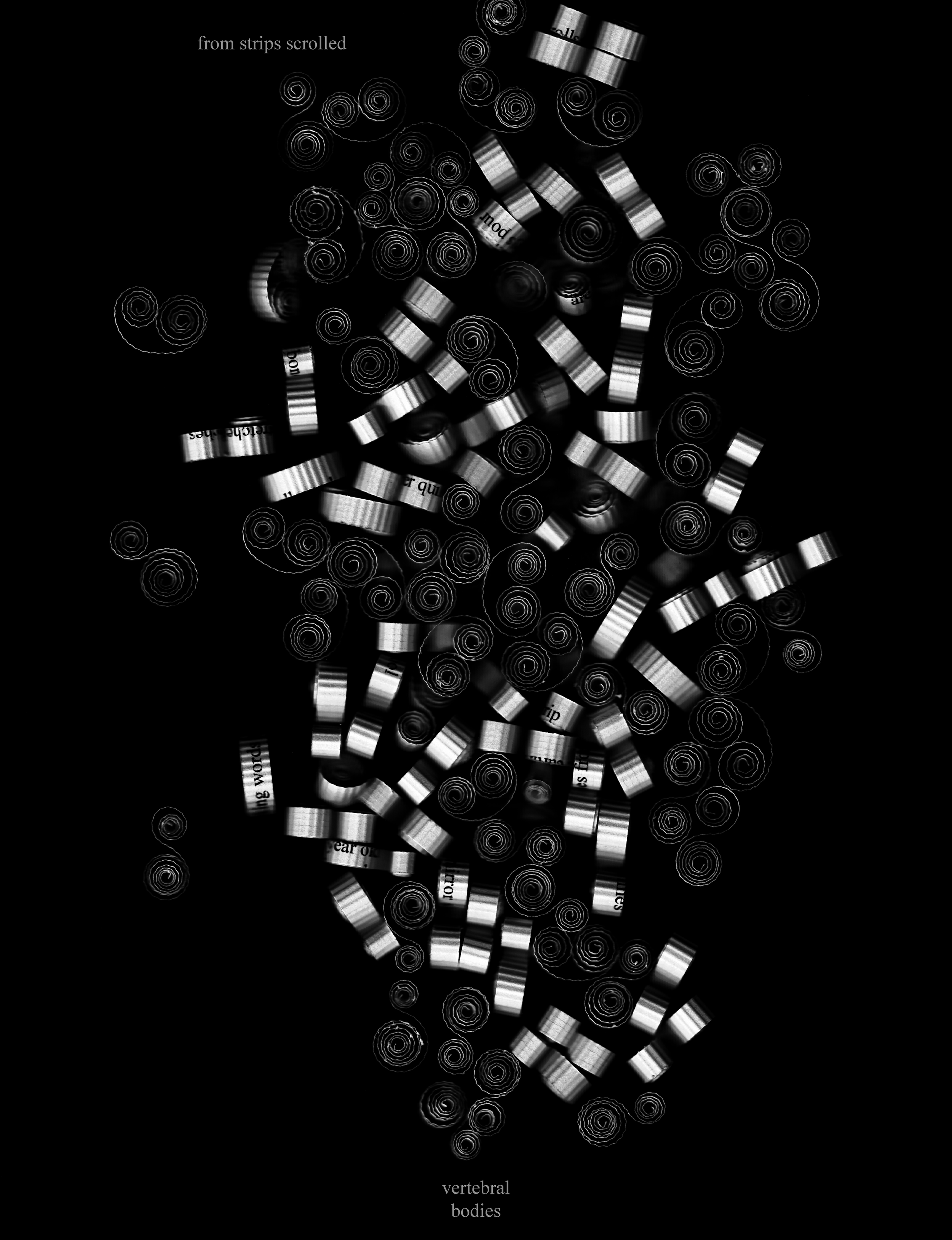
Excerpt from How I Bend Into More by Tea Gerbeza. Published by Palimpsest Press. Copyright Tea Gerbeza, 2024. Reprinted with permission.
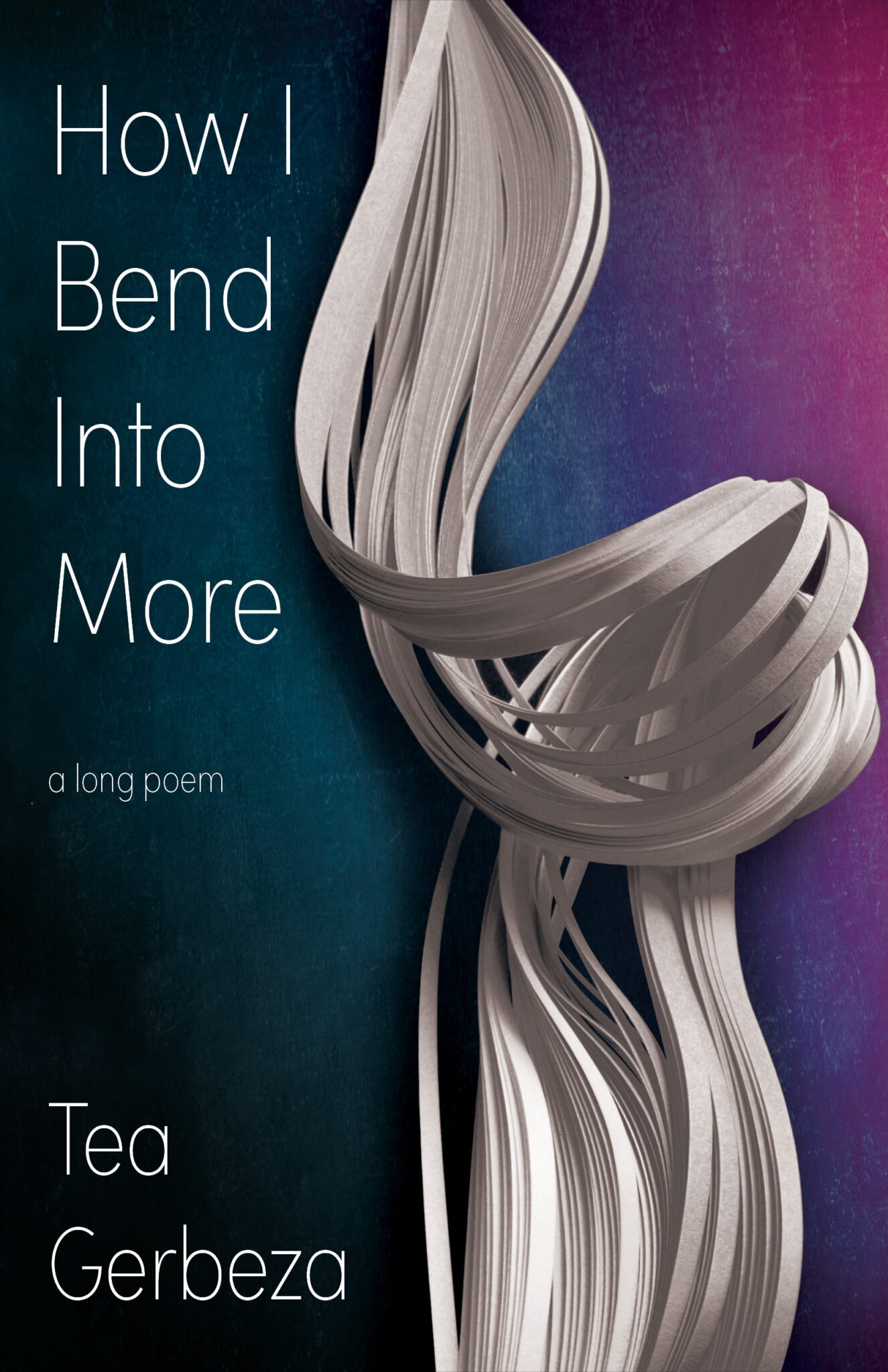
Based on Tea Gerbeza’s experience with scoliosis, How I Bend Into More (Palimpsest Press, 2024) re-articulates selfhood in the face of ableism and trauma. Meditating on pain, consent, and disability, this long poem builds a body both visually and linguistically, creating a multimodal space that forges Gerbeza’s grammar of embodiment as an act of reclamation. Paper-quilled shapes represent the poet’s body on the page; these shapes weave between lines of verse and with them the reclaimed disabled body is made. How I Bend Into More is a distinctive poetic debut that challenges ableist perceptions of normalcy, and centers “the double architecture / of ( metamorphosis (.”
Tea Gerbeza is the author of How I Bend Into More (Palimpsest Press, 2025), which was a finalist for the Writers’ Trust 2025 Dayne Ogilvie Prize for 2SLGBTQ+ emerging writers. She is a neuroqueer, disabled poet, writer, editor, and multimedia artist creating in oskana kâ-asastêki in Treaty 4 territory (Regina, SK) and on the Homeland of the Métis. She primarily works with paper in her visual art, but also creates digital works on her scanner (scanography). Her writing and artwork focus on themes of reclaiming disabled identity, disability justice, the Bosnian-Croatian diaspora, queer platonic friendships, and the complexities of pain. Her artwork has been exhibited at The Art Gallery of Regina. Tea has a very loud laugh, and is one of four Pain Poets.
Most recently, Tea was a finalist for YWCA Regina’s 2026 Women of Distinction awards in the Igniting Equity category. In 2023, She was recognized by SK Arts as one of 75 strong emerging artists that makes the future of Saskatchewan arts exciting. Tea’s poem “Body of the Day” was a People’s Choice Award finalist in Contemporary Verse 2’s 2024 2-Day Poem Contest. In 2022, Tea won the Ex-Puritan’s Austin Clarke Prize in Literary Excellence for poetry. She also made the longlist for Room magazine’s 2022 Short Forms contest. Her scanograph, “My Father Catches Me Confronting Memory,” won an Honourable Mention in Room magazine’s 2020 Cover Art Contest, and she was a finalist for Palette Poetry’s 2021 Emerging Poet Prize.
Tea holds a BA (Hons.) in English (2017) and an MA in Creative Writing and English from the University of Regina (2019). Tea’s thesis work for her MA was SSHRC funded. She also holds an MFA in Writing from the University of Saskatchewan (2021).
Photo of Tea by Ali Lauren.
Review of Guy Elston’s The Character Actor Convention by Callista Markotich
Let us accept the crowd-fostered confusion of person. Let us precariously enjoy the close-call near-cliché which hugs us with homely familiarity: are we nearly there yet? Let us reconsider the title: The Character Actor Convention. Convention – is this the only Convention we may find? Or not?
Let imagination Uber you there.
Say you’re this Convention’s keynote. You’ll be in the Grand Ballroom looking out at the attendees. You’d better be at the top of your game, addressing the wild, earnest characters there assembled. There’s room for insecurity – there’s this, from the actors:
We applaud, but it could be an act.
Here in the title poem, the characters are slippery, we and they blend, and there’s that guy, yes, him and one startling you, and the imitable, inimitable I, at first, casual and in charge:
at the fin, I pocket my lanyard, picture you,
front centre on a billboard, sigh performatively
while fading to black
and then, poof! self-extracted from the speaker’s function, bringing no closure to this meet.
I had a final line — I forget.
The convention closes, as ever, on a question:
Are we nearly them yet?
Let us accept the crowd-fostered confusion of person. Let us precariously enjoy the close-call near-cliché which hugs us with homely familiarity: are we nearly there yet? Let us reconsider the title: The Character Actor Convention. Convention – is this the only Convention we may find? Or not?
For Guy Elston employs conventions. For example, well-chosen direction and flow of some poems come through the canal of an epigraph; an epigraph chosen to introduce, inspire, illuminate and add authority. Guy Elston does not turn his back on this convention, But, a poet of invention, humour and courage, he upheaves the convention early and airily and as readily as is fair.
For example, here is the epigraph, from Wikipedia, that introduces The Great Sheep Panic of 1888
…when tens of thousands of sheep fled from various fields across some 200 square miles of Oxfordshire.
Immediately, in the first line, the author creates a segue:
It’s that word panic
I take offense to.
And he’s off! In this poem he creates a nostalgic monologue by a survivor (sheep) who waxes poetic on the panic, which is really much grander thing: a revolt, its opening complete with a small selection of vernacular expressions which (irritatingly) trivialize such heroic purpose:
Are you feeling Ok?
Do you need a snack?
Here are figureheads,
…big horns suited our purpose,
but Benny wasn’t the real brains, or brawn;
martyred leaders,
Ruby, with her wolf -sharp hooves,
with her rabbit pellet eyes … leading the herd;
and true believers.
…and footrot Leon,
he believed more than anyone.
Here are the tragic remainders, reminders, regrets,
Thing is, it’s not just the fence,
the dogs, the whistles, the shearing,
and a sadness, a sense of futility.
I know she had a final epiphany.
She just never told us what it was.
His epigraph ably steers us, unsuspecting, from panic to mock epic, with sympathy for the sheep.
At times Poet Guy Elson skydives into allusion, a convention, surely — sometimes into deeply respectable and cherished pieces of literature. Twice the dramatic titles of Robert Browning are launchpads for gypsy titles which roam the poems into simpler? terrain. From the beseeching oration in which The Bishop Orders His Tomb, we hear in the hyperbolic asks of the Bishop of Saint Praxed only the faintest echo as The Stick Insect Orders His Tomb. We hear the Bishop pleading with nephews—sons mine; my boys, he calls them, while the straight-speaking stick insect addresses “kids” and is not the least prescriptive in his wants. And, though the Bishop seeks motifs and materials of epic grandeur, deeply desiring to better and best a rival bishop, a cool inversion awaits us, if we reduce his wants to this:
Put me where I may look at him! Here is the Bishop, active and vengeful.
For Elston’s Stick Insect ultimately asks this:
Bury me somewhere,
anywhere, I might be sensed. Here is the Stick Insect, passively existential.
But, finally, Stick Insect, too, lays one kind of unkind common denominator in which he too seeks a certain satisfaction:
One vanity.
Let me stick in one giant’s maw.
Too, Guy’s title His Last Cigarette has an auntie in a high place, on a cold-hearted Duke’s wall. The title My Last Duchess by Robert Browning is evoked in a swish; “the curtains I have drawn for you” open in this poem too, as Cigarette confesses his yearns, hopes and dreams. The “he” of this poem has evidently decreed it: My last cigarette. Pity the Duchess. Pity the cigarette, their shared mortal question:
Why stamp me out, so cinematic?
With poetic aplomb and hocus-pocus, the author is capable of igniting that conventional sentinel of poetic response, affect. In Produce, the speaker of the poem, a pumpkin, addresses his fame-seeking father, directly:
Dear Father.
Poor Father.
The poem is sad. It is full of entreaty. In spite of greedy futility of parental desire for fame, a selfishly motivated kind of love, akin to the phenomena of Svengalian control, it sorrows for a flawed and failed relationship. The setting, a necrotic autumn fair, is by itself is a symbol of fleeting glory and dying beauty. There is pathos:
Poor father.
Couldn’t you ever see,
just once, the future?
Can we agree that thes emotions are not unique to the pumpkin? Can we not think of cases where this very pain is not pumpkin pain? Rolling past the pumpkin personification, we can imagine a human sorrow, a child’s distress, and the pumpkin speaker helps us do so, when we consider that, heartrendingly, his pain is not merely for himself, but for the misguide sacrifices of his father:
(you)…wrapped me at night.
Fed your life into mine.
Poor father.
That’s Guy Elson’s offering.
The same thing happens in The Whale. We’re at the portal of the affective domain with the first line:
I never really knew my dad.
And then, the diction of the poem passes us from the ready-at-hand anthromorphism into a sense of all-too-human dejection and helplessness. There is the steady flow of futility in the poem, as the whale mourns his opaque genesis. Who wouldn’t ?
God provided a huge fish.
God’s casual creative wave. How dismissive.
Worse than silent seas, passing ships, no echo-song.
Then, it’s bound to pluck the heartstrings of a poet, that a poem saved Jonah in the belly of the whale!. Don’t we hope that’s true? A light shines! We think about this. We think about how scripture is poetic, and the whale and all, are scriptural. And besides, there a life-line for us to grab here:
No-one’s big enough to swallow poetry.
We can feel emotional about that.
Joan of Arc’s appearance in The Stake, which initiates the collection, does it too, for me, at least. My heart has always been warmed by Joan. She is a hero, a feminine character breaking the mould, already sung, not only in hagiographic literature, but by other poets, and Guy Eston gives her a laugh at the end of the first poem. I find that moving.
Oh, I’ll burn, Joan laughs.
I do every time.
And I feel edified that she is in charge:
Your move.
I really like that.
When Joan appears again, in For a Good Time (this may be idiosyncratic), I respond. I enjoy reading her name again in this collection, and that a reverse Joan of Arc can be envisioned:
Stop getting burnt.
The treatment of my favourite martyr in The Character Actor Convention touches me, in that ineffable way that poetry can, and must.
There are other examples. In No More Worlds, Guy Elston uses a homely geography to create an ownership. Personally, I “see” that cement square on Queen and Bathhurst in my mind’s eye. I almost see Golden Alex, or someone akin. Does the poet know how affirming that is? Surely.
You will leave this convention with plenty of swag!
There are sonic mementos: sink-eyed, days-crazed; cicada backtracked sticky,
and cameo images that turn mnemonic; wolf in a tree, prick eared, wet-eyed.
There are catchy, keeper turns of phrase: If why is not the question, neither’s how
and
adjectives are the canned laughter of language
and unique juxtapositions: wolf-sharp hooves/rabbit pellet eyes …
Unpack that bag and array the curios along the worktable and try them as titles to see if they wouldn’t jettison us into marvel and fantasmagoria. In contrast, Guy Elson’s style is to title his poems straight; poems exactly about what the titles suggests. But if his title does not promise an extraordinary content: (Sunday Drive, Automatic Feeder,) the legerdemain begins. The Work is suddenly about mushrooms. Their work. Other poems which have more exotic titles, such as Halloween Training for Horses and Dead Pheasant at Casa de Montejo tidily stay precisely within the realm of what the title provocatively suggests.
Examine Sunday Drive. The title smacks of Americana. In the first lines we are treated to Pepsi and confronted with the consumer image of the strip mall. See the ad in your mind’s eye? A two -tone Chevrolet practically swings into being; there’s a fun-loving frivolity to the exclamation marks employed in the poem, Sunday Drive! But here the drivers are lab rats, albeit, the scientists learned joy from training them. That’s how Guy Elston takes us in!
Blow a kiss. The poem ends, nevertheless, with a rare explicit tug on our human conscience:
….Race the raised expressway
Separating us from our indifference.
In Automatic Feeder, the title again unveils the subject. It is truly just an automatic feeder. But in the opening line it is the speaker of the poem who addresses the soulless machine:
I’d spend every moment of my life
below you mouth open , hoping, gaping
After savouring the musicality of open, hoping, note the stance of ambiguous reliance on the purveyor of nutrition. There is mourning for active food-procurement, the adventure and possibility of surprise and reward:
so this is how it ends, my prowl, my sleuth.
and the poem closes with a juxtaposition of bravado and capitulation:
….I am the ship’s cat
the captain is going down with, singing hymns
or purring at plastic.
Suppose we’re not alone in the room, reading this book. This happens: an eyebrow rise /a smile /a chuckle /a belly laugh. Husband, wife, roomie, “other” says: What? And we can’t express it simply – we say: You have to read this poem!
The poem H20, for instance, initiates hilariety by becoming, immediately, an address to O by H. and beginning with the query:
O, were you really worth
two of me?
Humour is sustained by the poet’s loyalty to the scientific concepts of H and O, and their elemental marriage in H2O, in which the H recalls the partners at times together:
drip drip
plonk
but, jibing, remembering O’s insults and H’s own retorts:
A fork in a world of soup
you called me. A dick
in a world of dicks
….
air headed
puffed up
grandiose
H recalls the cosmic:
For a spell the planet turned
to our yearly release
but H sees O finally in a dubious role on earth:
Last I heard
you were dosing up wildfires
Yet, H anchors his address with a nostalgic touch of sentiment:
But O,
when we were fresh,
when we flowed…
I Swear is a another very funny poem which ….. allow me: You have to read this poem!
Three Star Resort determinedly offers bathetically humorous images, painting a slightly-off vacation venue, tongue in cheek, its diction suggesting the not-quite-OK stay (note brackets):
(a friend of a friend checks themselves out).
It is a resort of last resort, exercising the ambiguity and reality that attend the choice:
How lucky we are to know how lucky we are.
Would we stay again?
We’d have no choice.
Funny, not funny, funny.
Finally, from the ultimate poem To Whoever is Writing Me, this luscious line:
You are confused.
Guy Elston, you may mean me. Yes, I have been confused, often, deliciously, provocatively so. I feel my right brain poised to make meaning and settle appreciatively in its director’s chair, while my left brain plays jacks in the sand with the kids. I could quote The Whale.
That’s my problem.
Recently, somewhere very accessible – maybe on Facebook – I read this statement: “The things I enjoy reading most are the ones that make me think, sometimes a bit uncomfortably”. Whether or not I’m a full yea on that, I can relax. No need for discomfort; in his poem The Whale, generous Guy Elston gives us cover:
No-one’s big enough to swallow poetry.
If that’s not reassuring enough, there’s an assertion in Dead Pheasant at Casa de Montejo that secures us comfortably within the norm:
…the only universal human word
is huh?
Note should be taken though, it is the dead hare who gives this assurance.
—reviewed by Callista Markotich
Callista Markotich has enjoyed a life-long career as a teacher, principal and Superintendent of Education in Eastern Ontario. Her poems appear in numerous Canadian reviews and quarterlies from The Antigonish Review through Vallum and in several American and British magazines and journals. Her poetry has received first and second place awards and a placement in the League of Canadian Poets Poem in Your Pocket campaign. It has been short-listed and Honorably Mentioned in several Canadian contests and nominated for a Pushcart Prize and the National Magazine Awards. Her suite, Edward, was a finalist in the 2023 Gwendolyn MacEwen Poetry Award and the 2024 Toad Hall Chapbook Contest, with The Poets Corner. She is a contributing editor for Arc Poetry. Callista’s first collection, Wrap in a Big White Towel (2024) was published by Frontenac House. Callista lives gratefully on the banks of Lake Ontario, traditional territory of the Anishinaabe and Haudenosaunee nation, in Kingston Ontario, with her husband Don of fifty-nine years.
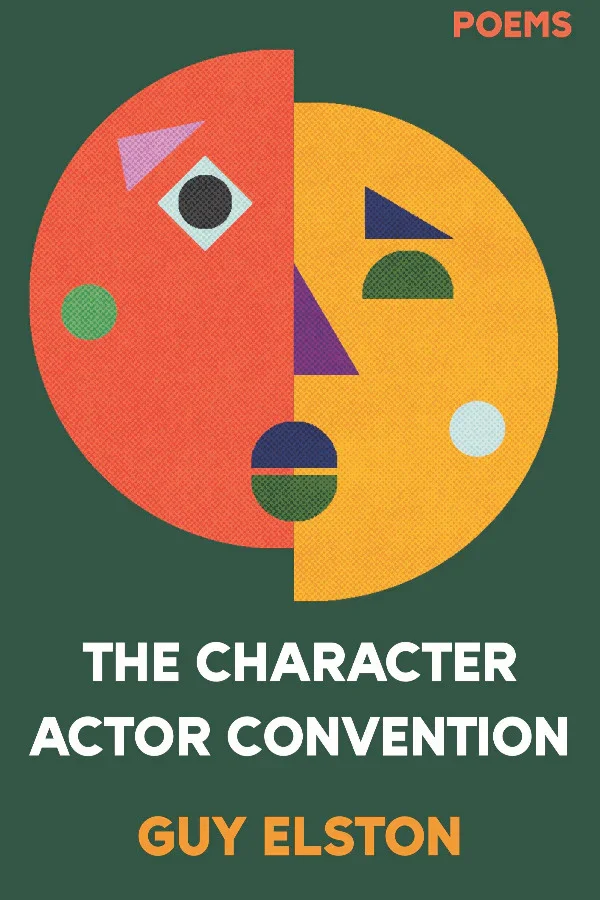
The Character Actor Convention by Guy Elston, Gordon Hill Press/The Porqupine’s Quill, 2025.

Power Q & A with Mallory Tater
I discovered my love of swimming in 2019. One of my best friends had just died, and I was searching for escapism—away from screens, away from work, and, in some ways, away from my own body. The weightlessness of being submerged in the public pool eased my angst and softened the tension and grief in my neck and shoulders. The quiet beneath the water cleared my mind. The rhythm I could build toward, channel, and disrupt brought me a sense of control and steadiness. Stripping down my body and taking a warm shower before and after felt reverent. Small talk with strangers—those quiet good mornings in the lobby and the lanes—became part of the day’s calm order. The pool, like the poem, became a place of repetition, refining, and resistance.
Q: How do the practices of swimming and poetics intersect?
A: I discovered my love of swimming in 2019. One of my best friends had just died, and I was searching for escapism—away from screens, away from work, and, in some ways, away from my own body. The weightlessness of being submerged in the public pool eased my angst and softened the tension and grief in my neck and shoulders. The quiet beneath the water cleared my mind. The rhythm I could build toward, channel, and disrupt brought me a sense of control and steadiness. Stripping down my body and taking a warm shower before and after felt reverent. Small talk with strangers—those quiet good mornings in the lobby and the lanes—became part of the day’s calm order. The pool, like the poem, became a place of repetition, refining, and resistance.
The poetic line is like a length—it’s a unit of offering, brief and intentional. Like a chosen stroke, a line engages with a complete thought, opening it into being through movement and language. Like poetry, swimming is the complete interaction of the body. Like swimming, poetry is a practice that commits to being adrift. It is active, afloat. As there are different strokes in swimming, there are different poetic forms expressing both constraint and release.
In my creative practice, I consistently write poems in response to inquiries I wish to address—and these inquiries often surface at the pool while I swim lengths. While writing Lockers, I always surfaced back to the world of competitive athletics: the cultural impact sports have on youth, their mental and physical health, and the ways they haunt the adult body. Other recurring themes include grief, girlhood, and memory. In the book’s titular long poem, the speaker contemplates death, the body, gender roles, and language while watching a swim team of skilled athletes warm up before practice. It’s an act of vicarious envy for their talent and fear for their vulnerability.
Poetry lives in community, but also in the solitary urge to create—like a public pool where we are alone together. Our bodies pass in a shared liminality, each holding strength in individuality, like the poetic voice itself. Swimmers thrive among swimmers; poets thrive among poets. To read water is to swim in a poem: immersion, fluidity, and sensory awareness merge in a call that welcomes all of our bodies into this shared language.

Lockers are for Bearcats Only by Mallory Tater offers poetry that traces the complexities of grief, the importance of destigmatizing dialogue around suicide, and the beauty and complicated core of girlhood friendships while improving our collective understanding of mental health awareness and suicide prevention in an approachable, concrete, and empathetic way.
The poems spill out from the confluence of grief and water. After losing one of her closest friends, the poet began swimming laps—part meditation, part therapy, part escapism—immersed in the depths of the public pool. There, she found herself haunted by the strange tension between fitness / surrender and memory / motion where ghosts of girlhood, catholicism, and addiction rose to the surface.
These themes haunt Lockers Are for Bearcats Only – a tender, unguarded exploration of loss, embodiment, and the currents that carry us through life with and without those who shaped us.
About Mallory Tater:
Mallory Tater is the author of This Will Be Good: Poems (Book*Hug Press, 2018), The Birth Yard: A Novel (HarperCollins, 2020), and Soft Tissue: A Novel (forthcoming, ECW Press, 2027). She was the publisher of Rahila’s Ghost Press, a now-retired chapbook press. Mallory currently lives in Vancouver, where she teaches at the University of British Columbia’s School of Creative Writing. Lockers are for Bearcats Only is her second poetry collection.

Excerpt from Lockers are for Bearcats Only by Mallory Tater
With an unnaturally faint heart, I clasp
rooted qualms that match my own:
fears hidden in worn rock,
fears that rest in vertebral gaps.
SUN GONE
With an unnaturally faint heart, I clasp
rooted qualms that match my own:
fears hidden in worn rock,
fears that rest in vertebral gaps.
Cora—she is the tallest.
She climbs in dark, and I write
our names in clay with a thin,
child-legged branch. All the way
up now; the sand and Cora’s legs meld,
grit rains down from her feet
into my open mouth. I wish Cora
would fall, only in dream,
so she won’t feel the rocks,
the enormity of the rocks below
where I stand and speak of things
too faint. If I could see Cora now
I’d see the winding sky has shrunk her,
but we would watch the damp
vectors of mountains.
She would pause in binding worship,
she would pause,
every reef of her bones
would pause.
EARTHQUAKE KIT
I gorge on chickpeas, undrained and stinking,
under the bed, saved for our earthquake kit—
that day, we all anticipate
Vancouver to be ensorcelled by one stoned
and shoulder-chipped God.
Boundary Bay will draw a high fever.
Mount Baker will headache with fear.
We will hide under ourselves,
whisper we should have moved
to Pembroke or Antigonish when we got grants.
Tonight, it’s not that I planned
to eat our cluster of rations—Nature Valley bars,
canned pickerel, homemade fruit leather—
it’s that grief clutched me and would not let
me walk. I could not walk the serpentine
trail down Cambie Street to No Frills
for orange juice and frozen pizza.
I could not walk to Kia Foods
for kale and brown bread.
I can eat grief now. I trim wrappers with scissors,
brine my lips with small, tinned fish,
all those bones, my mouth gnathic in missing you.
I took one of her velour sweaters
from your closet. I wear it often. I did not steal
her Ariana Grande CLOUD perfume
but I sprayed it on my wrists and neck.
I did snap a photo of a photo—her beautiful childhood
self on a toboggan—
gap-toothed, forever-girl, winter
splashed on her cheeks. When we were girls
we’d weave our hair together until we were conjoined,
we’d wear g-strings and tell lies to our moms,
we’d tell lies about ourselves to each other
under the glow of lava and ice fiber lamps,
all because we were bored and breathing.
My survival has become silent—
it’s not legumes, an emergency radio, AA batteries.
I am not afraid of The Big One.
I am not afraid of some drunk God.
I am afraid of what I can do without her.
And how she can’t see me doing it.

Mallory Tater and her poetry collection, Lockers are for Bearcats Only (Palimpest Press, February 15, 2025)
Lockers are for Bearcats Only by Mallory Tater offers poetry that traces the complexities of grief, the importance of destigmatizing dialogue around suicide, and the beauty and complicated core of girlhood friendships while improving our collective understanding of mental health awareness and suicide prevention in an approachable, concrete, and empathetic way.
The poems spill out from the confluence of grief and water. After losing one of her closest friends, the poet began swimming laps—part meditation, part therapy, part escapism—immersed in the depths of the public pool. There, she found herself haunted by the strange tension between fitness / surrender and memory / motion where ghosts of girlhood, catholicism, and addiction rose to the surface.
These themes haunt Lockers Are for Bearcats Only – a tender, unguarded exploration of loss, embodiment, and the currents that carry us through life with and without those who shaped us.
About Mallory Tater:
Mallory Tater is the author of This Will Be Good: Poems (Book*Hug Press, 2018), The Birth Yard: A Novel (HarperCollins, 2020), and Soft Tissue: A Novel (forthcoming, ECW Press, 2027). She was the publisher of Rahila’s Ghost Press, a now-retired chapbook press. Mallory currently lives in Vancouver, where she teaches at the University of British Columbia’s School of Creative Writing. Lockers are for Bearcats Only is her second poetry collection.

Excerpt from NMLCT by Paul Vermeersch
Poetry that explores our “post-truth” society, NMLCT holds up a mirror not only to nature, but also to its unnatural distortions and facsimiles. Imagine The Matrix retold by the reanimated cyborg bodies of the Brothers Grimm.
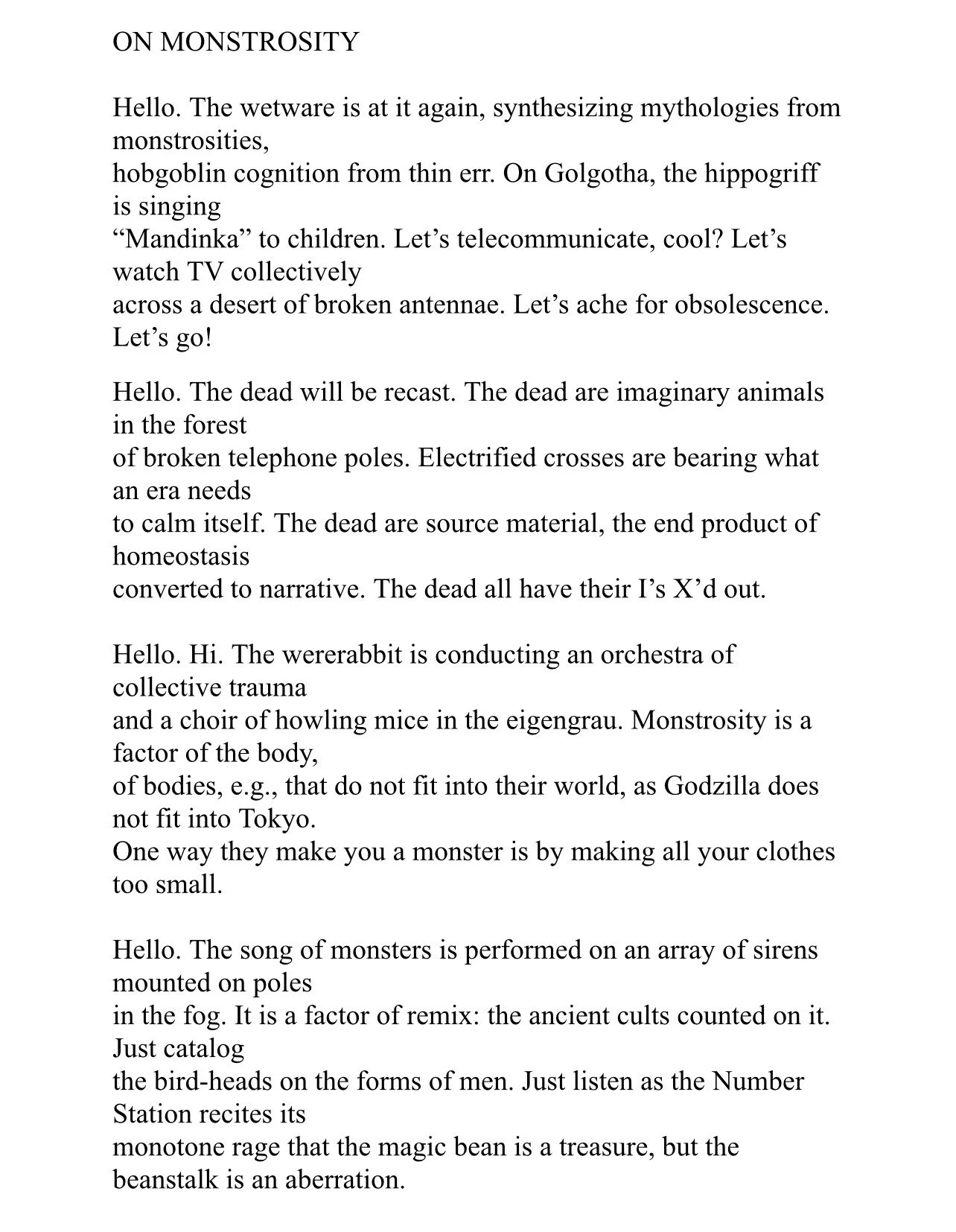
Excerpt from NMLCT by Paul Vermeersch. Published by ECW Press. Copyright Paul Vermeersch. Reprinted with permission.
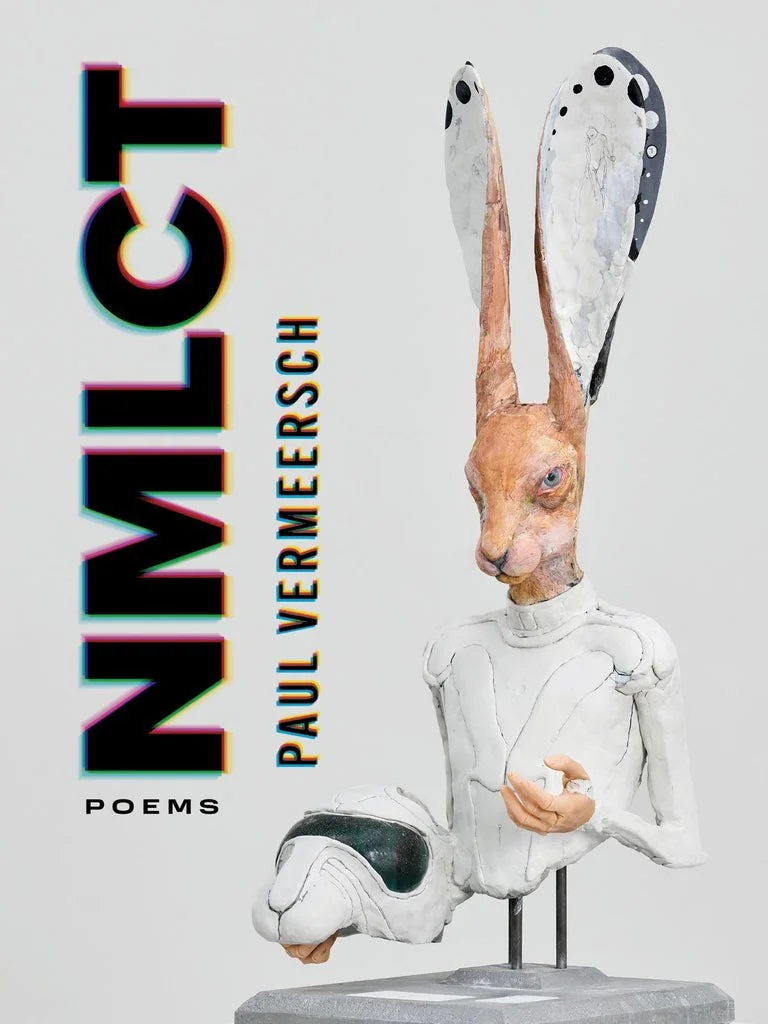
About NMLCT:
Poetry that explores our “post-truth” society, NMLCT holds up a mirror not only to nature, but also to its unnatural distortions and facsimiles. Imagine The Matrix retold by the reanimated cyborg bodies of the Brothers Grimm.
“Paul Vermeersch has become more daring and emphatic with every poetry collection, and this book is a blistering mourner’s lament: audacious, brutal, compassionate, and darkly ecstatic. ‘What on earth,’ he asks, ‘has happened here, and when? Who is the astronaut and who is the ape?’” — Stuart Ross, author of The Book of Grief and Hamburgers and The Sky Is a Sky in the Sky
Fables and fairy tales collide with virtual reality, artificial intelligence, and monstrous myths in a world where no one knows what to believe. In his eighth book of poems, Paul Vermeersch responds to the increasing difficulty of knowing what is real and what isn’t, what is our genuine experience and what is constructed for us by The Algorithm. In a “post-truth” society rife with simulations, misinformation, and computer-generated hallucinations, these poems explore the relationship between the synthetic and the authentic as they raise hope for the possibility of escape from MCHNCT (Machine City) to NMLCT (Animal City), where the promise of “real life” still exists.
All precisely 16 lines long — identically formed as though mass-produced — these poems are themselves artificial creations, products of the imagination, sometimes disorienting but always vivid. In NMLCT, Vermeersch gives us his answer to an existence in thrall to the artificial. But it also foretells a different future, one where the air and the grass and the trees, and all the life they engender, might always be genuine and sensed and safe.
Photo of Paul Vermeersch by Bianca Spence
Paul Vermeersch is a poet, multimedia artist, and literary editor. His last book of poetry was Shared Universe: New and Selected Poems 1995–2020. A professor of creative writing and publishing at Sheridan College, he also edits his own imprint, Buckrider Books, for Wolsak & Wynn Publishers. He lives in Toronto, ON.

Power Q & A with Stephanie Bolster
The timing of the book’s release was coincidental, though it’s a fortunate coincidence in that Katrina and the subsequent levee breaches that wreaked such devastation in New Orleans are back in the public consciousness and may make readers more interested in the perspective the book offers. Sadly, the inequalities the disaster highlighted are even more acute now than they were then, and the climate change that contributed to the storm has only worsened.
Q: Hurricane Katrina made landfall on August 29, 2005. Given that the storm and its aftermath are a primary subject of Long Exposure, did you time the book’s publication to coincide with the 20th anniversary?
A: The timing of the book’s release was coincidental, though it’s a fortunate coincidence in that Katrina and the subsequent levee breaches that wreaked such devastation in New Orleans are back in the public consciousness and may make readers more interested in the perspective the book offers. Sadly, the inequalities the disaster highlighted are even more acute now than they were then, and the climate change that contributed to the storm has only worsened.
I had visited New Orleans twice before Katrina, so I paid particular attention to the news stories during the storm. The extent of the chaos and devastation, and the human suffering caused not only by the storm itself but by systemic failures and inequalities, shocked me.
In 2009, I visited a retrospective of Robert Polidori’s work at the Musée d’art contemporain in Montréal. I had been drawn to his photographs of New Orleans and Chernobyl since first seeing them several years earlier, but had avoided writing about them because I worried the subject matter was too predictable, given that I have often written about photographs and that I tend to be drawn to bleak subjects. I was also uncomfortable with the voyeurism of the photographs, which depict human-centered spaces (often private homes) in the absence of the humans who lived and worked there. And I was even more uncomfortable with my own interest in this material.
In the museum that day, I realized that the only way to write about these photographs would be to interrogate my own fascination. I had done something similar in exploring my ambivalence about zoos, but this felt like a riskier, more difficult kind of questioning. I knew I wanted the work that would become Long Exposure to be a book-length poem. I wanted it to centre perspective and work associatively. I had no idea how to write it.
The structural, aesthetic, and ethical challenges this project posed are part of the reason I worked on it for so long. I was also raising two children and teaching creative writing full-time. After a decade, I thought the project was finished, but as I read through the manuscript in the first few months of the COVID pandemic, I couldn’t help seeing connections between events and experiences of that time and many passages in the book. So the project kept expanding, and could have continued to expand had I not decided that I needed to move on.
When Palimpsest accepted the book and I learned that it would appear in 2025, I wasn’t thinking about the Katrina anniversary. I wish we could mark this anniversary by focusing on positive societal and systemic changes that have happened since, as indeed there have been some. But many of those are in the process of being lost, certainly in the U.S. Much of the Lower Ninth Ward, the area most devastated by the levee breaches, has yet to be rebuilt. I stopped working on this book, but the urgency I felt in writing it is not over.

About Long Exposures:
After Hurricane Katrina, the photographer Robert Polidori flew to New Orleans to document the devastation. In the wreckage he witnessed, and in her questions about what she saw in what he saw, Stephanie Bolster found the beginnings of a long poem. Those questions led to unexpected places; meanwhile, life kept pouring in. The ensuing book, Long Exposure, is Bolster’s fifth, a roaming, associative exploration of disasters and their ongoing aftermaths, sufferings large and small, and the vulnerability and value of our own lives. Incremental, unsettling, Long Exposure rushes to and through us.

About Stephanie Bolster:
Stephanie Bolster’s latest book of poetry, Long Exposure, began as an exploration of Robert Polidori’s photographs of New Orleans and Chernobyl, and extended inward and outward from there. Her first book, White Stone: The Alice Poems, won the Governor General’s Award and the Gerald Lampert Award and was translated into French (Pierre Blanche). Her poems have also been translated into Spanish, German, and Serbo-Croatian. Editor of The Best Canadian Poetry in English 2008 and The Ishtar Gate: Last and Selected Poems by the late Ottawa poet Diana Brebner, and co-editor of Penned: Zoo Poems, she was born in Vancouver and grew up in Burnaby, BC. She has been a professor of creative writing at Concordia University since 2000 and lives in Pointe-Claire, on the Mohawk (Kanien’kehá:ka) territory of Skaniatara:ti.
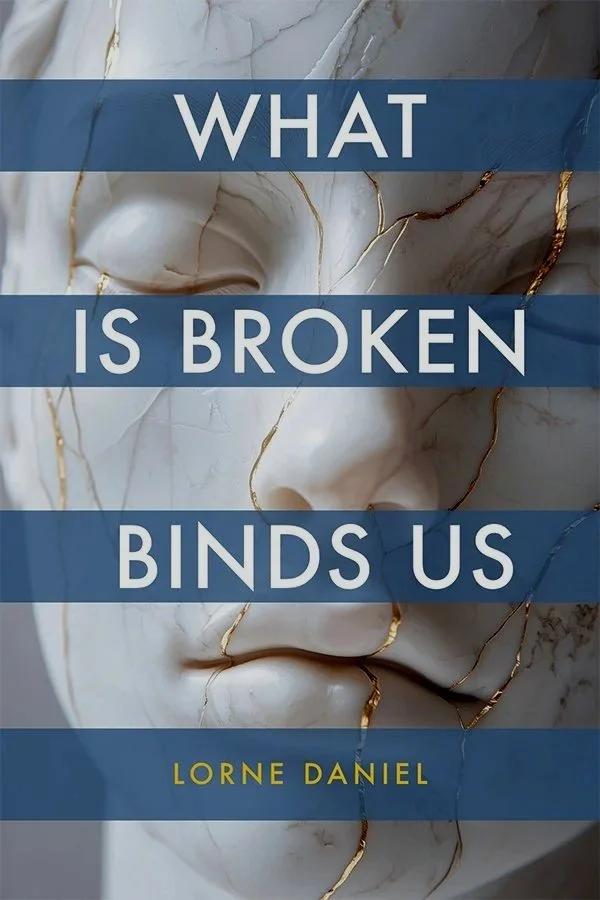
Addiction, Family, and the Story Behind Lorne Daniel's What is Broken Binds Us
“I initially wrote the story of our family’s journey purely to record what was happening as it happened,” says poet and retired communications consultant Lorne Daniel about his poetry collection What is Broken Binds Us. “The addictive behaviours, the anger, the borderline housing challenges disrupted and changed week by week, month by month, over years and stretched into decades,” he says of one son’s journey. “While we tried to support him, it was often a real challenge to track what was happening, even to track where he was.”
Addiction, Family, and the Story Behind Lorne Daniel's What is Broken Binds Us
“I initially wrote the story of our family’s journey purely to record what was happening as it happened,” says poet and retired communications consultant Lorne Daniel about his poetry collection What is Broken Binds Us. “The addictive behaviours, the anger, the borderline housing challenges disrupted and changed week by week, month by month, over years and stretched into decades,” he says of one son’s journey. “While we tried to support him, it was often a real challenge to track what was happening, even to track where he was.”
As a writer, Daniel began to form his rough notes into something others could understand. “I found that short poems that just shared incidents from the journey were the best form because readers can pick up on the chaos, the jumble of a path that is not simple and not straight.” Even so, he grappled for a long time over whether to share the poems beyond family and friends.
“What convinced me to publish the very personal poems in this book with a broader readership was the experience of running into so many people who have been on similar journeys, but feel disconnected,” Daniel says. “In our society, the narratives often don’t fit the real lived experiences of families. ‘Troubled teens’ don’t always find a way through those troubles, parents become exhausted looking for answers, and there may not always be answers.”
“On multiple occasions,” Daniel says, “we went for years without hearing from our son. Sadly, those were more peaceful times than the full-on crises times.”
“Every family that experiences addictions and mental health challenges is unique, but there are emotional characteristics that we have in common. What is Broken Binds Us is my small gesture of connection.”

What is Broken Binds Us by Lorne Daniel, published by University of Calgary Press.
What is Broken Binds Us is a collection of poems of the disruptions and emotional tremors that shape us: enslaved families broken and dispersed, histories hidden, addiction and estrangement, and the shocks of bodily trauma.
What is Broken Binds Us shares stories of loss, absence, acceptance, and hope. Returning to the page after a long absence, poet Lorne Daniel provides a unique perspective on crisis that balances raw emotion with vulnerability, thoughtfulness, and care.
In seven sections, Daniel braids the stories of empire, personal traumas, addiction and family estrangement, shifting emergencies, and the wisdom of elders and the natural world. Lessons in Emergency Preparedness traces accident, injury and recovery, facing the trauma of a sudden loss of physical competence through the metaphorical and literal breaks of a shattered body and the slow movement towards mending. When the Tributaries Ran Rich unravels empire and a five-century narrative of hard-working immigrants with the discovery of enslavement in family records, forcing a deep reconsideration of the truth of the past. Episodic Tremor & Slip speaks of the tectonic shifts in family life that occur when facing substance abuse, addiction, and mental health struggles, of the pain of estrangement and the love that continues. In the Family Name is a reflection on time, on people, and on the natural world that revisits and turns over all that came before, exploring it from new angles.
Lorne Daniel writes with calm, conversational assurance. These poems are accessible and evocative, speaking from their specificity to the many people who have faced injury, estrangement, struggle, and pain, and must carry it—and carry on.

Lorne Daniel is a Canadian poet and non-fiction writer. He has been deeply engaged in the literary community, including the emergence of a Canadian prairie poetry scene in the 1970s. He has publsihed four books of poetry, edited anthologies and literary journals, and written freelance journalism. His work has been published in dozens of anthologies, journals, newspapers and magazines in Canada, the U.S. and the U.K. Lorne lives on the traditional territories of the Lək̓ʷəŋən people in Victoria, BC.

Excerpt from Long Exposure
After Hurricane Katrina, the photographer Robert Polidori flew to New Orleans to document the devastation. In the wreckage he witnessed, and in her questions about what she saw in what he saw, Stephanie Bolster found the beginnings of a long poem. Those questions led to unexpected places; meanwhile, life kept pouring in. The ensuing book, Long Exposure, is Bolster’s fifth, a roaming, associative exploration of disasters and their ongoing aftermaths, sufferings large and small, and the vulnerability and value of our own lives. Incremental, unsettling, Long Exposure rushes to and through us.
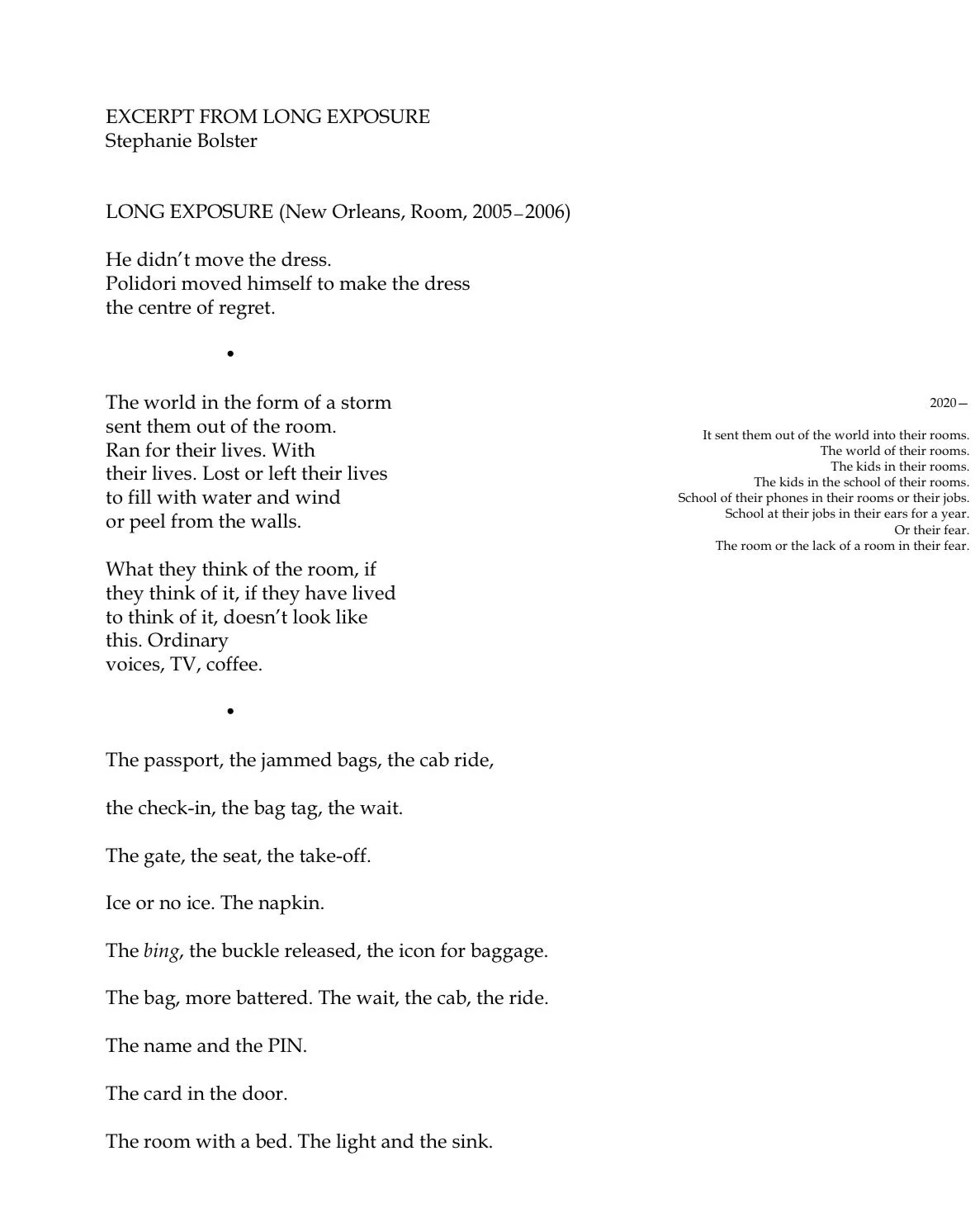
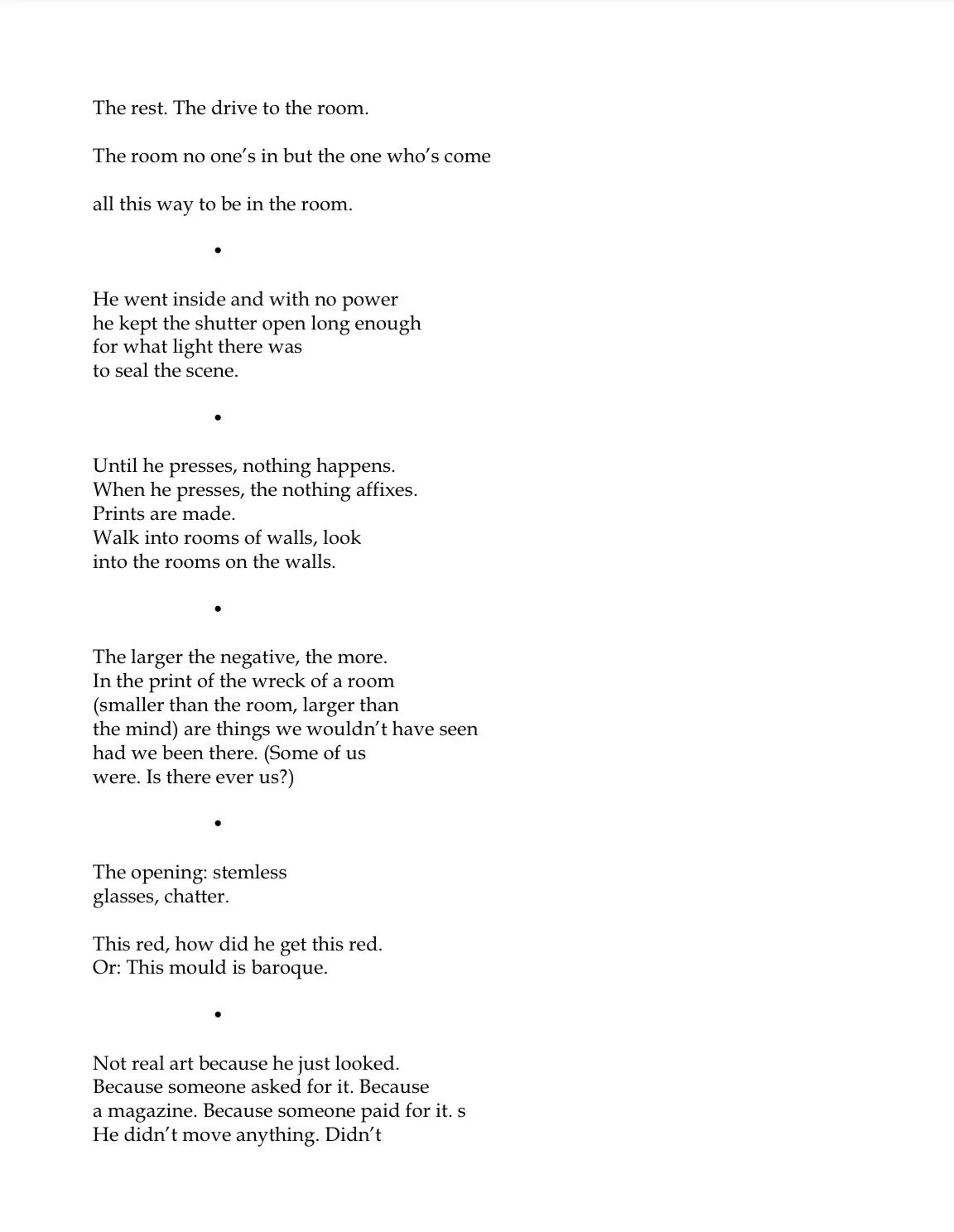
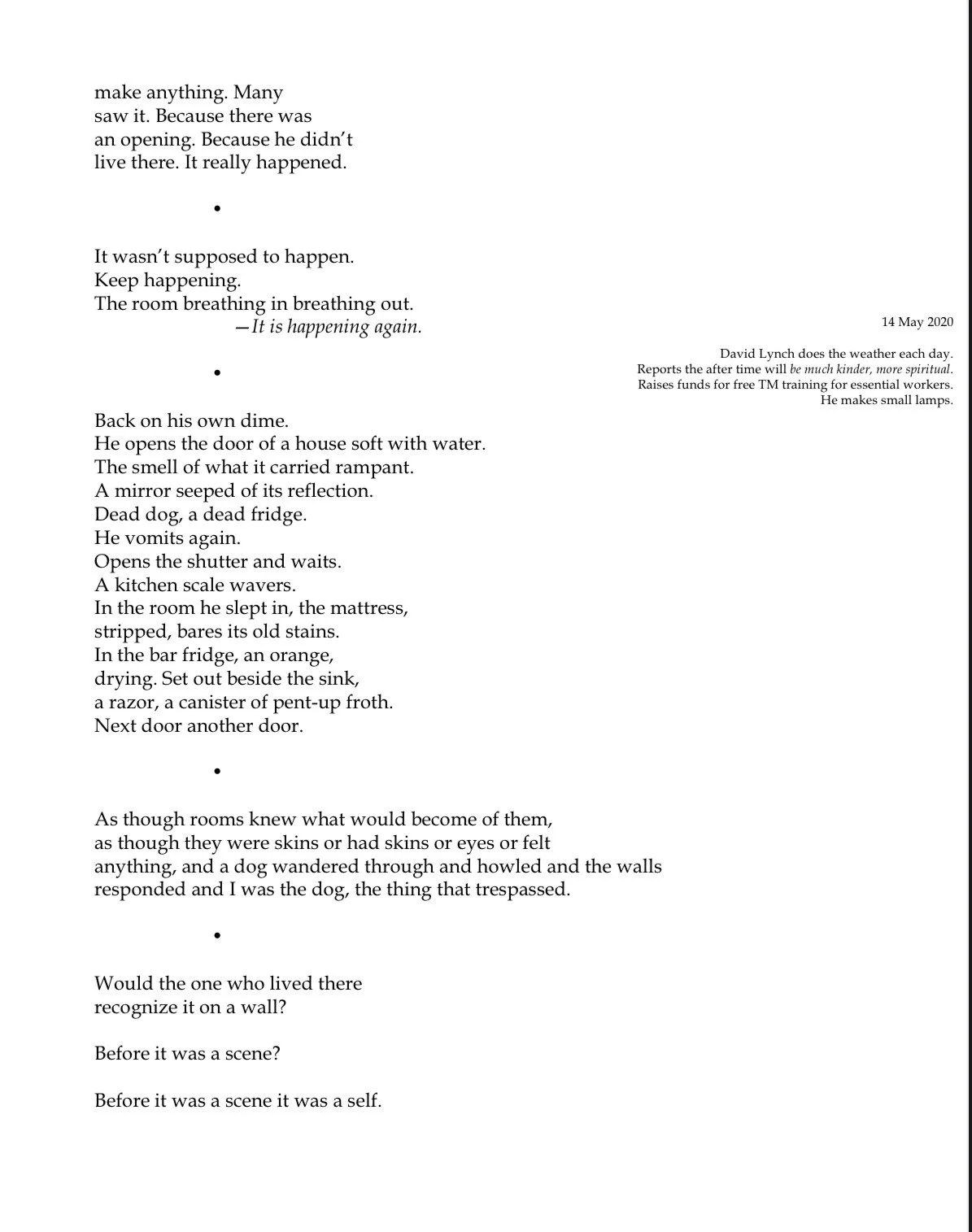
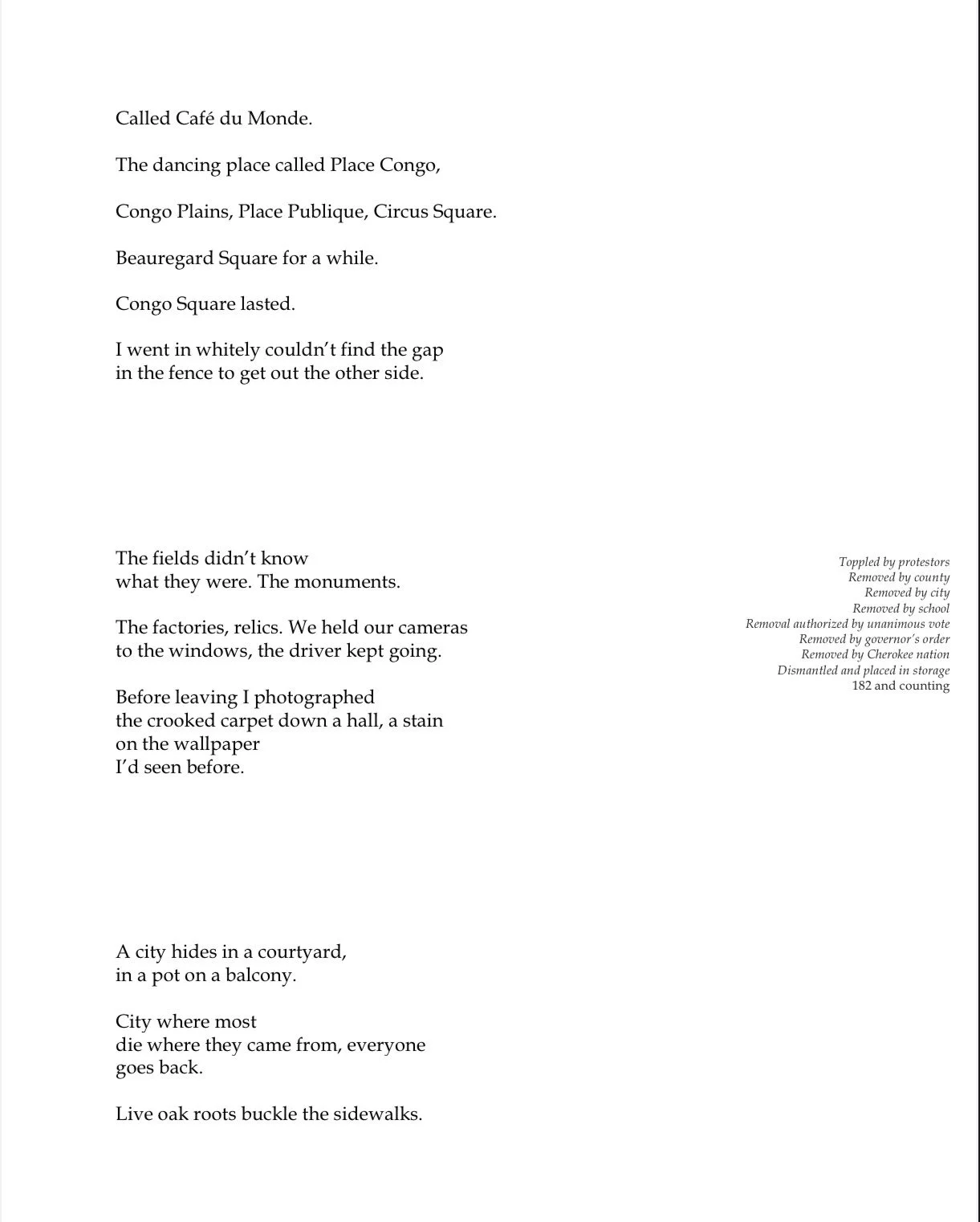
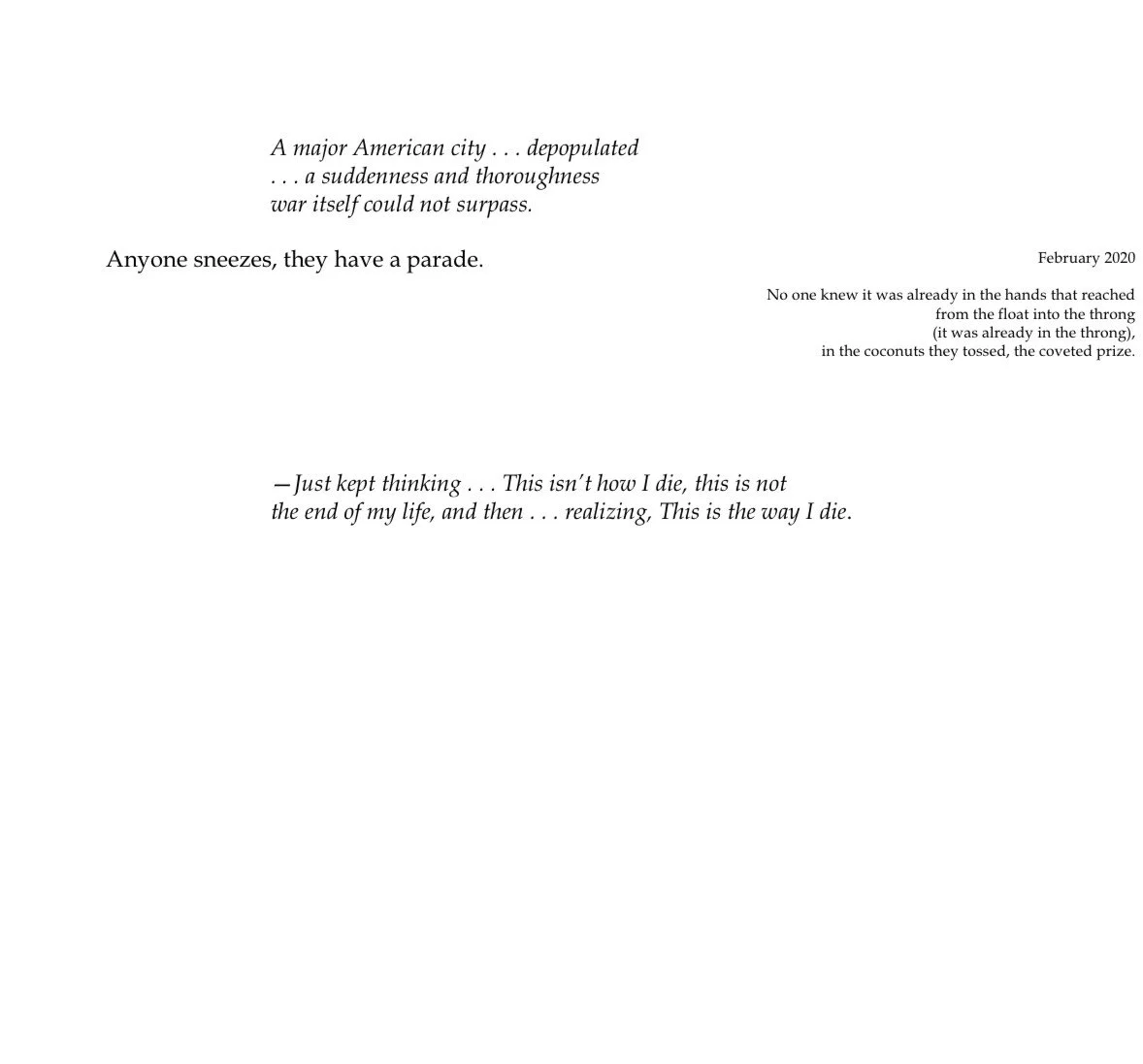
Excerpt from Long Exposure by Stephanie Bolster. Reprinted by permission of Palimpsest Press.
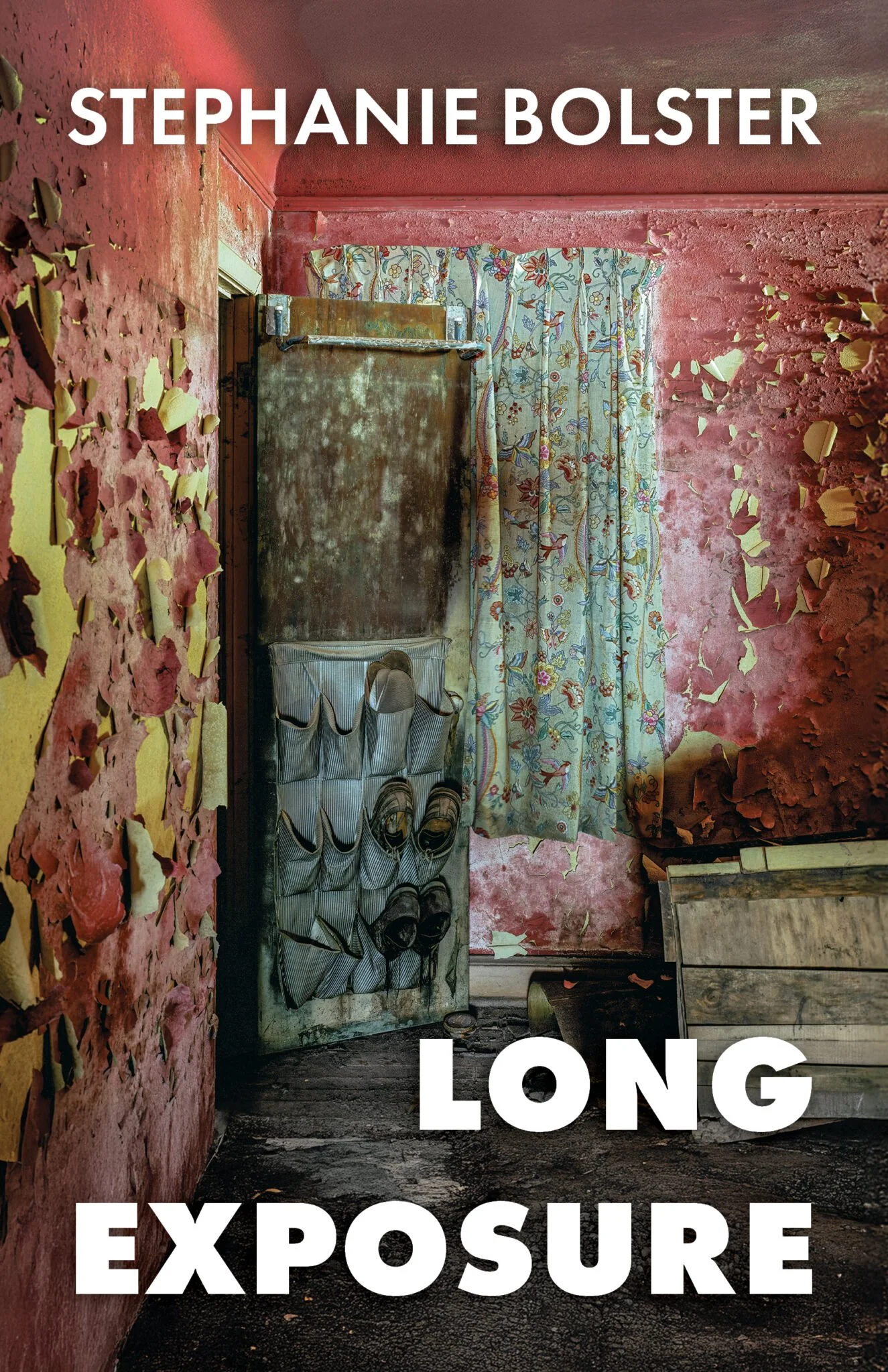
Long Exposure by Stephanie Bolster
After Hurricane Katrina, the photographer Robert Polidori flew to New Orleans to document the devastation. In the wreckage he witnessed, and in her questions about what she saw in what he saw, Stephanie Bolster found the beginnings of a long poem. Those questions led to unexpected places; meanwhile, life kept pouring in. The ensuing book, Long Exposure, is Bolster’s fifth, a roaming, associative exploration of disasters and their ongoing aftermaths, sufferings large and small, and the vulnerability and value of our own lives. Incremental, unsettling, Long Exposure rushes to and through us.

Stephanie Bolster has published four books of poetry, the most recent of which, A Page from the Wonders of Life on Earth, appeared with Brick Books in 2011 and was a finalist for the Pat Lowther Award. Her first book, White Stone: The Alice Poems (Véhicule Press, 1998) won the Governor General’s and the Gerald Lampert Awards, and her second, Two Bowls of Milk (McClelland & Stewart, 1999), won the Archibald Lampman Award and was a finalist for the Trillium Award. Her work has been translated into French (Pierre Blanche: poèmes d’Alice, Les Éditions du Noroît, 2007), Spanish, German, and Serbo-Croatian. She edited The Best Canadian Poetry in English 2008 (Tightrope), the inaugural volume in that ongoing series; and co-edited Penned: Zoo Poems (Signal/Véhicule, 2009). Born in Vancouver, she grew up in Burnaby, BC, now lives in Pointe-Claire, Québec on the Mohawk (Kanien’kehá:ka) territory of Skaniatará:ti, and has taught creative writing at Concordia University in Montréal since 2000.

Excerpt from Ajar by Margo LaPierre
Do you like my braids? Pinterest taught me.
Curls come tumbling.
I have a room just for this. Night terrors and vanity.
Pigeons, rroux rroux.
Rroux, rroux. It sounds like American poets.
Sounds like opaque familiarity.
Manic Wire
Do you like my braids? Pinterest taught me.
Curls come tumbling.
I have a room just for this. Night terrors and vanity.
Pigeons, rroux rroux.
Rroux, rroux. It sounds like American poets.
Sounds like opaque familiarity.
Words can be barriers to define self, concisely.
Call me modal (a helping verb): domestic, gullible.
Or fierce. Woo me. Count me among the wombed
wombing. Periodically cocooning.
Time flattens.
Medication insulates the raw copper wire.
Do something about heavy doorways.
Push or something.
Curtains could be plusher, tender.
Fear the slender monster where the waves
part ways.
Light.
Keep out light
-hearted nurses with their blue
triage forms.
Scratchy upholstering.
Too many beeps to calm down.
What is it to have this body?
High, a ceiling light,
or a spent weapon, holstered.
Exoskeleton
A grasshopper thuds in flight: my scapula.
My shoulder aches thanks to pavement’s pull.
My tibia: a mongoose hiding in all this flesh,
hoarding eggs. My throat: a highway, surging.
So why can’t I speak? The warm bath
of time floats around me, cooling.
I am always leaving: the being beyond the word.
My kneecaps are heartbeats, hibernating bears.
Phalanges: fish spines laid out along a sandy lake.
Blood clots run through me monthly
like so many blackberries. Firefly children
test the word mother before I wake.
Smother fire before it burns the curtains. An abyss
beyond that word’s promise: mother. Parent?
What about platelet? Or blood not mixed, or bones
not formed? What shaky instrument do I have
with which to prolong life: hips? That’s it?
Hysterosonogram
I have seen three perinatal psychiatrists
this month; each one’s advice
goes against the others’
and everything I’ve been warned about
for a decade.
Their questions of my history make me
red with light inside. It aches.
I wear a sheet while the doctor
inserts a catheter, balloon.
On the monitor my uterus: a planet
where hurt is the mother tongue.
Light skidding over valleys and ridges: a site
resistant to damage.
Light blipping over ova and striated flesh:
pomegranate gems.
Afterward, a neighbourhood walk.
The five p.m. sun will slick
eavestroughs golden, starburst windows.
I will bring my face into the flares
above the hard snow,
my body booming
with old griefs.
I was told there would be pain.
It’s not the pain I remember.
The pain I remember hooks like light
through an open stitch.
Ahead, in the sky, a percussion of pigeons.
Ahead, in the street, a leashed dog.
Excerpt from Ajar © 2025 by Margo LaPierre. Reprinted by permission of Guernica Editions.

Ajar by Margo LaPierre, published by Guernica Editions (October 31, 2025)
More about Ajar:
The poems in Ajar navigate the physical and psychological dangers of womanhood through the flattening lens of mood disorder. Psychosis isn’t the opposite of reality—it’s another perceptual system. If neurotypical thought measures the world in centimetres, this collection measures it in inches, gallons, amperes. Ajar celebrates radical recovery from gendered violence and psychotic paradigm shifts, approaching madness through prismatic inquiry. As time converges within us, we find new ways to heal and grow. From the emergency room to the pharmacy to the fertility clinic to the dis/comfort of home and memory, this collection humanizes bipolar psychosis.

Margo LaPierre (Photo credit: Curtis Perry)
More about Margo LaPierre:
Margo LaPierre is a writer and freelance literary editor. With multi-genre work published in The Ex-Puritan, CV2, Room, PRISM, and Arc, among others, she has won national awards for her poetry, fiction, and editing. She holds an MFA in Creative Writing from UBC. Ajar is her second poetry collection.

Power Q & A with Lorne Daniel
Some of the poems about family estrangement in this book started simply with me wanting to record what was going on – to create a record. But then, I have an urge to do more with it, to explore the nuances of the experiences and to create relationships.
Q: Your poetry collections, What is Broken Binds Us (University of Calgary Press), explores some significant disruptions: addiction and mental health challenges, family estrangement and an unexpected ancestral connection to slavery. How does poetry arise from these difficult realities?
A: As a writer, I’m interested in making meaning, but also in making life meaningful. Life events deliver experiences, and we are guaranteed big helpings of grief and upset and joy. I explore these, initially, so that I can see life more clearly myself. Some of the poems about family estrangement in this book started simply with me wanting to record what was going on – to create a record. But then, I have an urge to do more with it, to explore the nuances of the experiences and to create relationships. What are the connections between this event and that sense of concern or well-being? What does this remind me of? What images are dancing around in my subconscious as I jot down the ‘facts’ of an incident? Why? I don’t set out to answer every question, because life never answers every question. But the poetry becomes one way of processing life. When things begin to fall into place in a poem, to create some clarity for me, the creative work also starts to become something that other people can relate to. There are inevitably points of resonance in the human experience, when is its artfully reflected in a poem or painting or sculpture. The difficult life experiences can become something of deeper value.
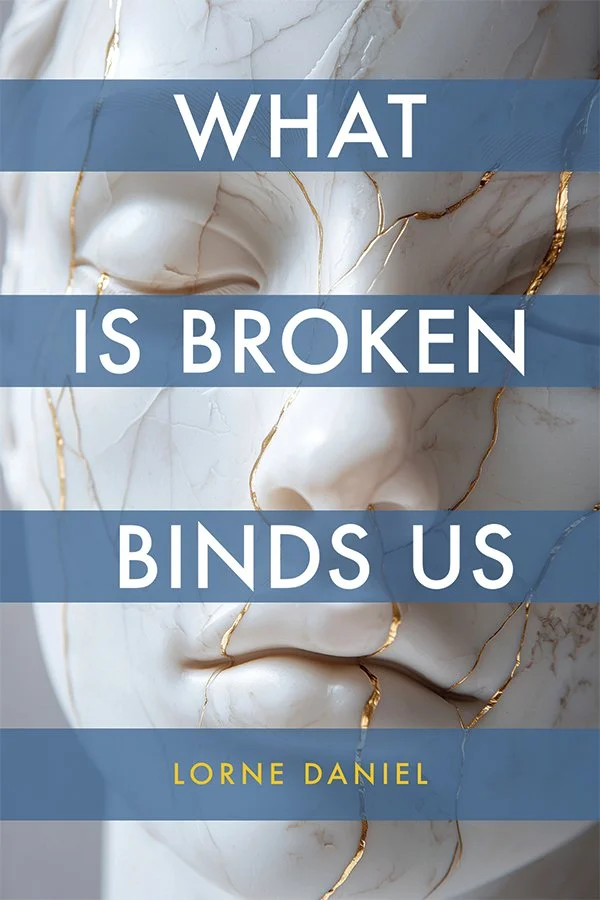
What is Broken Binds Us by Lorne Daniel (University of Calgary Press)
What is Broken Binds Us is a collection of poems of the disruptions and emotional tremors that shape us: enslaved families broken and dispersed, histories hidden, addiction and estrangement, and the shocks of bodily trauma.
What is Broken Binds Us shares stories of loss, absence, acceptance, and hope. Returning to the page after a long absence, poet Lorne Daniel provides a unique perspective on crisis that balances raw emotion with vulnerability, thoughtfulness, and care.
In seven sections, Daniel braids the stories of empire, personal traumas, addiction and family estrangement, shifting emergencies, and the wisdom of elders and the natural world. Lessons in Emergency Preparedness traces accident, injury and recovery, facing the trauma of a sudden loss of physical competence through the metaphorical and literal breaks of a shattered body and the slow movement towards mending. When the Tributaries Ran Rich unravels empire and a five-century narrative of hard-working immigrants with the discovery of enslavement in family records, forcing a deep reconsideration of the truth of the past. Episodic Tremor & Slip speaks of the tectonic shifts in family life that occur when facing substance abuse, addiction, and mental health struggles, of the pain of estrangement and the love that continues. In the Family Name is a reflection on time, on people, and on the natural world that revisits and turns over all that came before, exploring it from new angles.
Lorne Daniel writes with calm, conversational assurance. These poems are accessible and evocative, speaking from their specificity to the many people who have faced injury, estrangement, struggle, and pain, and must carry it—and carry on.

Lorne Daniel
About Lorne Daniel:
Lorne Daniel is a Canadian poet and non-fiction writer. He has been deeply engaged in the literary community, including the emergence of a Canadian prairie poetry scene in the 1970s. He has publsihed four books of poetry, edited anthologies and literary journals, and written freelance journalism. His work has been published in dozens of anthologies, journals, newspapers and magazines in Canada, the U.S. and the U.K. Lorne lives on the traditional territories of the Lək̓ʷəŋən people in Victoria, BC.

Excerpt from The Character Actor Convention by Guy Elston
My sister says How could you
bring a child into this world.
I get it—not like galvanised iron
is the ideal nest lining.
Traditional Nest Material
Crows and magpies using anti-bird spikes
to build nests, researchers find
My sister says How could you
bring a child into this world.
I get it—not like galvanised iron
is the ideal nest lining.
Who’d choose polycarbonate
spikes in the morning,
needle pricks at night? But why
let the world win. Am I right?
I don’t know about bring, but
I’d toss a kid into the mix.
Breed ‘em tough. Malicious compliance
I’d teach, if the tarmac stinks
shit wherever, if the phone rings constantly
faux-ring constantly back.
I wouldn’t rather not exist.
City blocks function as NICU incubator,
smog clouds my biological clockface
but I swear the apocalypse
is always incoming, for all epochs. Like
the half-portion of peanut butter
slicked in the jar—won’t you scrape,
twirl your knife like a feather?
As a father, I’d come to terms.
I’d spread further. Even here, even now.
“Traditional Nest Material”, excerpted from The Character Actor Convention © 2025 by Guy Elston. Reprinted by permission of The Porcupine’s Quill.

The Character Actor Convention by Guy Elston, published by The Porcupine’s Quill, 2025.
About The Character Actor Convention:
A pumpkin writes a letter to his father. A sheep recalls a revolution, and love. Hydrogen pens a tell all exposé of Oxygen. The Stick Insect Orders His Tomb. Napoleon counts waves and cheats at cards. A sunflower seeks answers – why sun? A crow considers children in this cruel, spiky world. And all the while, character actors gather for the endless convention...
Guy Elston’s debut is a curious smorgasbord of personas, voices and (un)natural perspectives. Through impossible encounters and strange viewpoints an insistent, ever-shifting ‘I’ questions its relation to itself. Wist, wit, and obsession rise like tides, are forgotten, and start fresh. Authenticity is always just round the corner.
The Character Actor Convention is not urgent, timely or topical. It’s something else.

Guy Elston
About Guy Elston:
Guy Elston was born and raised in Oxford, UK. After various jobs, journeys and other lifetimes he surfaced in Toronto in 2020. He has an MA in History from the University of Amsterdam. Since moving to Canada his poetry has been published by The Malahat Review, Canadian Literature, Event, The Literary Review of Canada, Vallum, The Antigonish Review and other journals. His chapbook Automatic Sleep Mode was published by Anstruther Press in 2023. His debut full-length collection, The Character Actor Convention, is forthcoming from The Porcupine's Quill in 2025. Guy lives in Toronto and can be found at poetry events. He’s a member of the Meet the Presses collective and is a first reader for Untethered magazine.

Power Q & A with Guy Elston
To put it simply, because I’m not that interested in myself. Which isn’t true, of course – what poet isn’t obsessed with themselves – but perhaps I'm not that interested in the front-facing, autobiographical concept of ‘Guy Elston’. Memory, identity, the cause and effect of life and its happenings – it’s all a sheer mountain face, senseless. I need an angle, a longer way round.
Q: Your debut collection The Character Actor Convention (The Porcupine’s Quill, 2025) is full of persona poems, monologues and dialogues. The speaker is variously an animal, an object, a chemical element, a season, even someone on a date with King Arthur. Why?
A: To put it simply, because I’m not that interested in myself. Which isn’t true, of course – what poet isn’t obsessed with themselves – but perhaps I'm not that interested in the front-facing, autobiographical concept of ‘Guy Elston’. Memory, identity, the cause and effect of life and its happenings – it’s all a sheer mountain face, senseless. I need an angle, a longer way round.
Poetry can be so many wonderful things, and there’s clearly no one superior model. It can be urgent, timely and important, absolutely. Or, the complete opposite. I like to see my poetry simply as a form of storytelling. I’m most interested in forgotten, impossible, niche encounters and viewpoints, the kind which can thrive best in the literary-popcorn realm of poems. A snatched glimpse through a window into a courtyard you never knew was there. Some kind of masked ritual is happening in the courtyard. Think Invisible Cities, but snack-sized.
This is not to say that my psyche doesn’t fill the book. If anything, the book is even more full of me than if I wrote straight confessional poetry. When I write from the POV of Jonah’s whale, for example, I’m not starting from scratch – I'm necessarily depositing a bunch of my own hang-ups and melodramas into the voice of the whale.
I guess the short answer is, persona poems and odd dialogues are my way of incorporating Emily Dickinson’s famous “Tell all the truth, but tell it slant” into my practice. I approach myself at a slant through these guises. If I see a flash of something I could be, or once was, or that might seem knowable to someone, somewhere, that’s my thrill. As for why – it’s simple. All I ever want is to make you both laugh and cry.

The Character Actor Convention by Guy Elston (The Porcupine’s Quill, 2025)
About The Character Actor Convention:
A pumpkin writes a letter to his father. A sheep recalls a revolution, and love. Hydrogen pens a tell all exposé of Oxygen. The Stick Insect Orders His Tomb. Napoleon counts waves and cheats at cards. A sunflower seeks answers – why sun? A crow considers children in this cruel, spiky world. And all the while, character actors gather for the endless convention...
Guy Elston’s debut is a curious smorgasbord of personas, voices and (un)natural perspectives. Through impossible encounters and strange viewpoints an insistent, ever-shifting ‘I’ questions its relation to itself. Wist, wit, and obsession rise like tides, are forgotten, and start fresh. Authenticity is always just round the corner.
The Character Actor Convention is not urgent, timely or topical. It’s something else.

Guy Elston
About Guy Elston:
Guy Elston was born and raised in Oxford, UK. After various jobs, journeys and other lifetimes he surfaced in Toronto in 2020. He has an MA in History from the University of Amsterdam. Since moving to Canada his poetry has been published by The Malahat Review, Canadian Literature, Event, The Literary Review of Canada, Vallum, The Antigonish Review and other journals. His chapbook Automatic Sleep Mode was published by Anstruther Press in 2023. His debut full-length collection, The Character Actor Convention, is forthcoming from The Porcupine's Quill in 2025. Guy lives in Toronto and can be found at poetry events. He’s a member of the Meet the Presses collective and is a first reader for Untethered magazine.

Power Q & A with Connor Lafortune & Lindsay Mayhew
What surprised me the most about editing an anthology was the length of the process itself. When I was first approached to co-edit with Lindsay [Mayhew], I was surprised by the timeline. I could not imagine it taking over two years from initial conversations to publications.
Q: What was something that surprised you about co-editing the anthology, A Thousand Tiny Awakenings (Latitude 46, 2025)?
Connor Lafortune: What surprised me the most about editing an anthology was the length of the process itself. When I was first approached to co-edit with Lindsay [Mayhew], I was surprised by the timeline. I could not imagine it taking over two years from initial conversations to publications. However, I quickly realized that many of the pieces needed a lot of time in between. I learned to take my time and be patient throughout the process.
Something else that surprised me was the cohesion between all of the submissions. There was an incredible throughline among the poems and short stories. As an editor, I was surprised we could tell a larger story among its smaller pieces.
Miigwetch!
Lindsay Mayhew: This collection brought about many discoveries. I was especially surprised by the weight of responsibility I felt as an editor. The contributors trusted us not only with their art, but also their personal stories. We rarely discuss the importance of ethical practice as editors, but it’s a conversation I look forward to starting often!
It was an honour and delight to work on these pieces with the contributors. This experience has inspired me to continue editing, and I am excited for the never-ending learning involved.
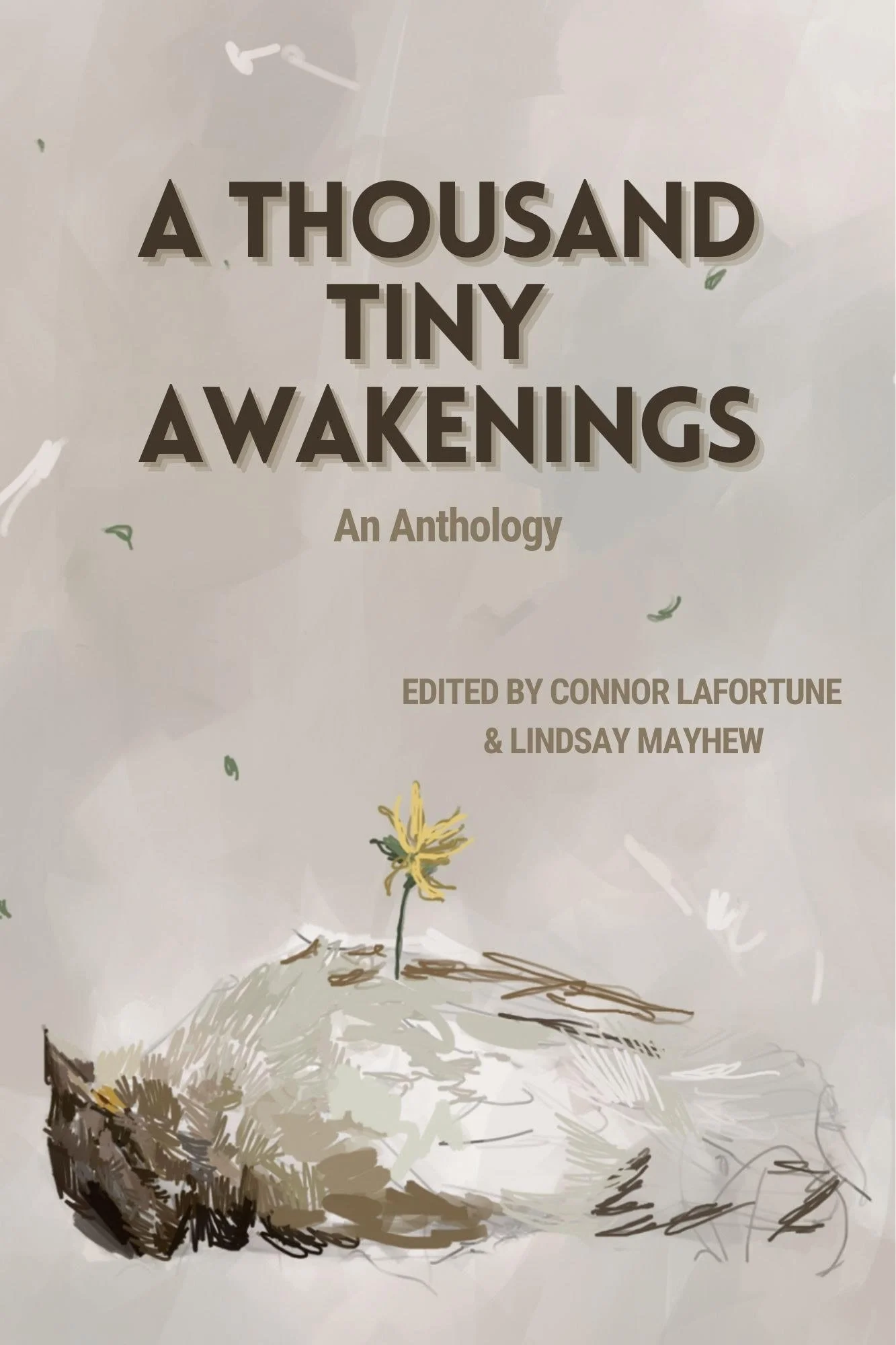
A Thousand Tiny Awakenings (Latitude 46), editied by Connor Lafortune and Lindsay Mayhew.
About A Thousand Tiny Awakenings (Latitude 46):
A Thousand Tiny Awakenings is a collection of genuine and heartfelt expressions from young and marginalized creators who challenge the oppressive structures that shape our world. These narratives, poems, and artworks echo across Turtle Island, transcending borders to offer a stirring testament to resilience and hope. Discover 15 young writers, and 23 unique and powerful pieces that embody the spirit of resistance and resurgence; uplifting the upcoming generation in their pursuit to dismantle boundaries that define their bodies, lives, and futures. Through art and storytelling, these voices call for action and inspire revolution, reminding us that our words have the power to transform the world.
A Thousand Tiny Awakenings features contributions by:
Carson Bohdi Michelle Delorme Brennan Gregoire
Waed Hasan Tyler Hein Jesse June-Jack
Kay Kassirer Nicole Robitaille Blaine Thornton
Lisa Shen Lindsay Mayhew Sydney Read
Connor Lafortune Ra'anaa Yaminah Ekundayo
Chimdi Kingsley-Emereuwa
About Connor Lafortune & LINDSAY MAYHEW:
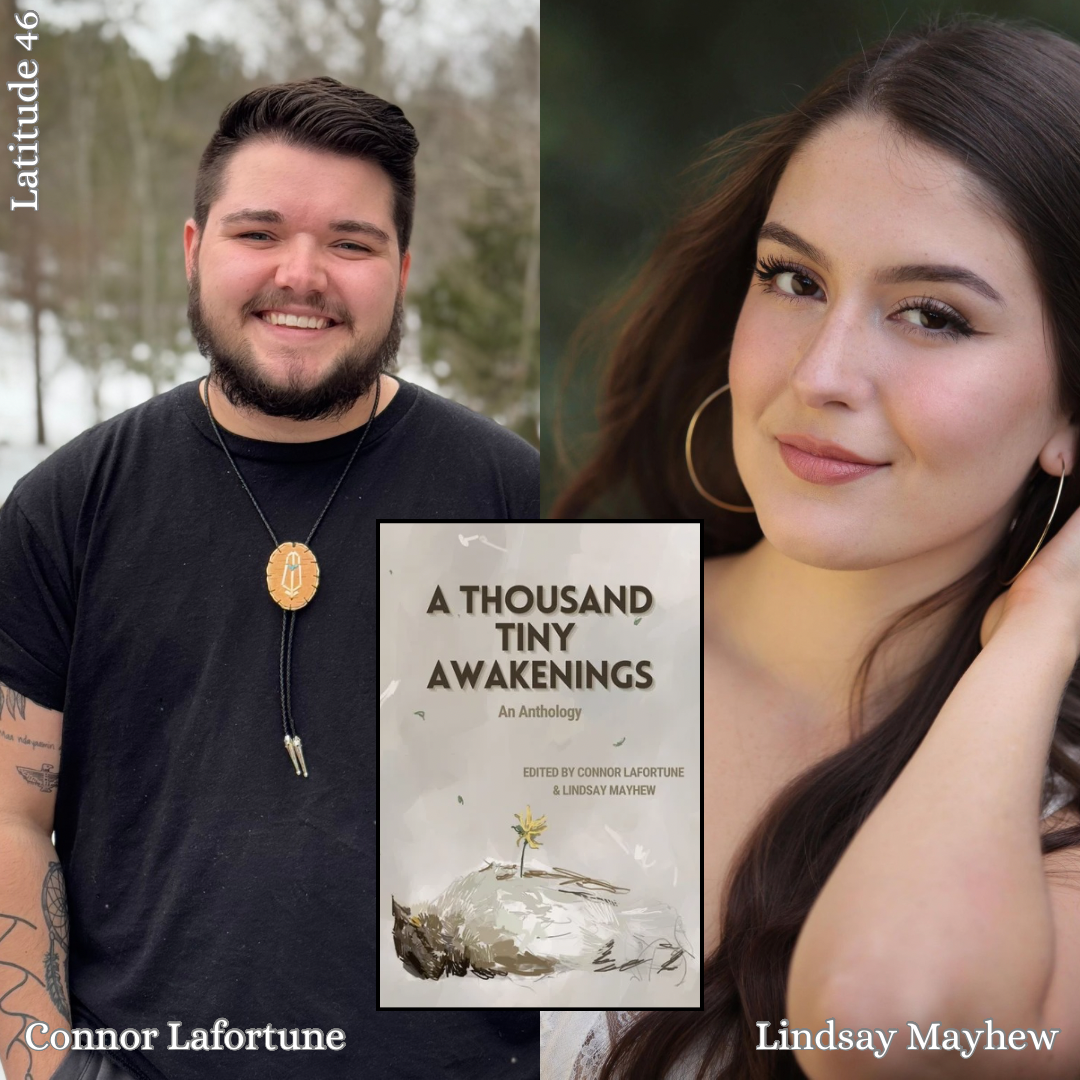
Connor Lafortune is from Dokis First Nation on Robinson Huron Treaty territory of 1850 in Northeastern Ontario. He works primarily in Life Promotion, harm-reduction, mental health, and Indigenous education. He completed his Bachelor’s Degree at Nipissing University with a Double Honors Major in Indigenous Studies and Gender Equality and Social Justice. He is currently in the Masters in Indigenous Relations at Laurentian University. Connor is Anishinaabek, Queer, and Francophone; he uses his understanding of the world to shape his creations as a writer, spoken word poet, and musician. Connor often combines the written word with traditional Indigenous beadwork and sewing to recreate the stories of colonization, showcase resilience, and imagine a new future. He recently released a single in collaboration with Juno Award winner G.R. Gritt titled “Qui crie au loup? ft. Connor Lafortune.” Above all else, Connor is an activist, a shkaabewis (helper), and a compassionate human being.
Lindsay Mayhew (she/her) is a spoken word artist, poet, and writer from Sudbury, Ontario. She recently graduated with a Master’s in English Literature from the University of Guelph. Lindsay is the multi-year champion of Wordstock Sudbury’s poetry slam, and she has featured in events across Ontario, including JAYU Canada, Hamilton’s 10th Fashion Week, and Nuit Blanche. She represented Canada in the 2024 Womxn of the World poetry slam. Lindsay’s written work is featured in multiple editions of Sulphur. Her spoken word and written work seeks to combine art and theory to voice feminist futures.

Power Q & A (Part II) with Kathryn Kirkpatrick
Talk about wonder! Paula Meehan's work came to me in the mail as a request for a book review! Poet and editor R.T. Smith certainly kept channels open for synchronicities, and I'll always be grateful for that request. I think currently we're suffering from the Cartesian dualisms inherent in our capitalist version of modernity, and we've got some horrendous fixes floating around. Paula's beautiful work combines a compassionate, progressive politics (for lack of a better word) through a thoroughgoing critique of the class exploitations underwriting modernity as we know it.

Q: Your book, Enraptured Space: Gender, Class, and Ecology in the Work of Paula Meehan
(West Virginia University Press, 2025) opened our world to a poet we, admittedly, had never heard of before. Would you tell us why the work of Paula Meehan is particularly salient today and how you came to her writing?
A: Talk about wonder! Paula Meehan's work came to me in the mail as a request for a book review! Poet and editor R.T. Smith certainly kept channels open for synchronicities, and I'll always be grateful for that request. I think currently we're suffering from the Cartesian dualisms inherent in our capitalist version of modernity, and we've got some horrendous fixes floating around. Paula's beautiful work combines a compassionate, progressive politics (for lack of a better word) through a thoroughgoing critique of the class exploitations underwriting modernity as we know it. I think her work invites us to find a third way through the dualisms of culture/nature, man/woman, head/heart, reason/feeling. What does that world look like? How might we feel and think our way into it? Can we keep what we've learned through this human passage through capitalist modernity and come through it with the insight and lessons, while being open to what might come next? I think she's always on the border of this kind of seeing, and I want to be there with her, and to be there also in my own life and writing.
More about Enraptured Space: Gender, Class, and Ecology in the Work of Paula Meehan:
Drawing on her own lived experiences as a practicing poet, Kirkpatrick explores how scholarship is grounded in an imaginative exchange between words on the page and the material conditions of the scholar who works to inhabit them. With chapters of literary analysis swimming in a conversation between poets, this book breaches the boundaries between criticism and memoir, suggesting the ways that every scholar is transformed by the subjects they study.
About Kathryn Kirkpatrick:
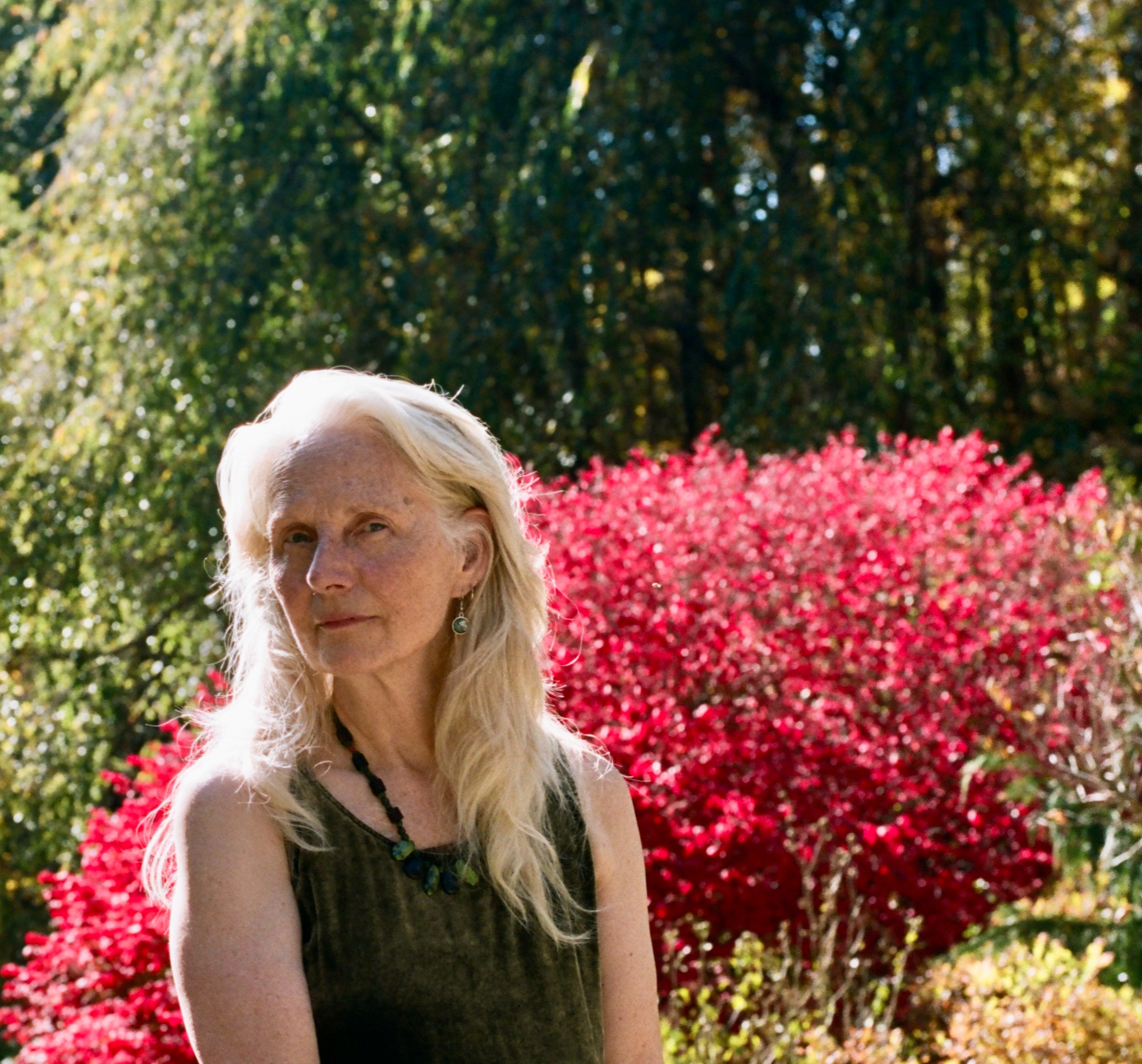
Kathryn Kirkpatrick is the author of seven collections of poetry, including three recipients of the NC Poetry Society’s Brockman-Campbell award. The Fisher Queen: New & Selected Poems (Salmon, 2019) received the NC Literary and Historical Society’s Roanoke-Chowan Poetry Prize. Although she grew up in the nomadic subculture of the U.S. Air Force and spent my childhood in the Philippines, Texas, and Germany, she has lived in the Blue Ridge Mountains for many years, where she teaches environmental literature, animal studies, Irish studies, and creative writing as Professor of English at Appalachian State University.

Power Q & A with Kathryn Kirkpatrick
These two words—insistence and wonder—speak to the paradox of making poems. There's got to be a willfulness involved in showing up to the blank page or the page with scattered lines and notes for a poem. I have to be insistent about that time and space. If I'm not, if I let the business of life's obligations take over, then there's an emotional and physical insistence that arises.

Q: We devoured your beautiful poetry collection, Creature (Jacar Press, 2025). Would you speak to how “insistence and wonder” I play a part in your poetic practice?
A: These two words—insistence and wonder—speak to the paradox of making poems. There's got to be a willfulness involved in showing up to the blank page or the page with scattered lines and notes for a poem. I have to be insistent about that time and space. If I'm not, if I let the business of life's obligations take over, then there's an emotional and physical insistence that arises. I feel heavy and a bit out of focus. Because I know that when I'm faithful to my practice, I have so much more access to a state of wonder, when what's offered by experience is so rich, I can't stay outside my practice for long. Or, if I do, I'm simply unhappy. The wonder for me is having access to other dimensions of life and reality--I start to recognize synchronistic events unfolding across the day, insights I wasn't making space and time for otherwise. Yet it takes courage to show up consistently, insistently (!) for that dynamic dimension of life. It both provides a grounding and a need for a grounding--wonder can sweep you away, take you outside time--and I still have to pay the bills. Perhaps that's why the monastic orders provide such ritualized structures to hold an intensely spiritual life and its wondrous dimensions. (I'm writing now as the new Pope is being chosen!)
About Creature: Poems:
What does it mean to be a person in relation to others, both human and animal? Rife with observations of the natural and manmade worlds, Creature by Kathryn Kirkpatrick is a garden of awareness and grief, insistence and wonder. In this full-length collection, Kirkpatrick blends a clarity of vision with a close attention to form, metaphor, and the nuances of language. These are poems rooted in landscape and memory, about mothers and daughters, love and mourning, and the harrowing context in which we now find ourselves living. Creature offers a poetry of paying attention and of being in the world, ultimately revealing that what is most human about us is what is most creaturely, and how we are all ultimately “tossed in the vastness.” Natalie Eleanor Patterson, Editor’s Choice Award.

About Kathryn Kirkpatrick:
Kathryn Kirkpatrick is Professor of English at Appalachian State University where she teaches environmental literature, animal studies, and Irish studies from an ecofeminist perspective and where she co-directs the animal studies minor, a multidisciplinary program she helped to found. Kirkpatrick has published essays on class trauma, eco-feminist poetics, and animal studies, focusing particularly on the work of Dublin poet Paula Meehan. Her monograph on Meehan’s work, Enraptured Space, is from West Virginia University Press (2025). She is co-editor of Animals in Irish Literature and Culture (2015), which includes her essay on the representation of foxes in Somerville and Ross’s Irish PM stories. As well as a scholar and editor, Kirkpatrick is the author of eight collections of poetry, including three recipients of the NC Poetry Society’s Brockman-Campbell award, The Body’s Horizon (1996), Our Held Animal Breath (2012), and Her Small Hands Were Not Beautiful (2014). The Fisher Queen: New & Selected Poems (Salmon, 2019) received the NC Literary and Historical Society’s Roanoke Chowan Poetry Prize. Creature was published by Jacar Press in 2025.

Ever think about publishing a chapbook? Montreal poet Carolyne Van Der Meer answers common chapbook questions
Ever think about publishing a chapbook?
Chapbooks are short collections of poetry that can range from just under 10 pages to just under 50 pages—and we love them! Chapbooks can be a perfect one-sitting poetry immersion.
We are delighted to have Montreal poet Carolyne Van Der Meer join us for an appropriately brief but powerful interview on chapbooks.

Carolyne Van Der Meer’s chapbook Birdology is an exploration of loss of memory, of autonomy—and ultimately of the loved ones themselves. Against a backdrop of urban and natural environments filled with everyday birds, she considers how our relationships with our parents evolve as they age, need us more—and eventually leave us. Through a quintet of flash essays and a handful of poems, Van Der Meer moves through what she calls the “spell of grief,” accompanied by flocks of gulls, house sparrows and rock pigeons.


Ever think about publishing a chapbook?
Chapbooks are short collections of poetry that can range from just under 10 pages to just under 50 pages—and we love them! Chapbooks can be a perfect one-sitting poetry immersion.
We are delighted to have Montreal poet Carolyne Van Der Meer join us for an appropriately brief but powerful interview on chapbooks.
Carolyne’s wonderful chapbook, Birdology, will be published in May by Montreal-based micro-press, Cactus Press.
Why publish a chapbook? Why not wait and publish a full book of poetry?
Publishing a chapbook is a great way to get your stuff out there, especially if you are an emerging poet. And for any poet, it’s a way to experiment with new work without committing to a full collection. The other thing is it’s fast! The lead time for publishing a chapbook can be quite short so you are not waiting a year or three to see your work in print. And finally, you can decide to self-publish a chapbook, which is an inexpensive way of doing all of the above: getting your new, experimental work out there quickly. Nothing says you can’t also be pushing towards publishing a full collection and you are doing this while you wait.
What is one piece of advice you have to poets thinking about publishing a chapbook?
Make sure you do your homework. Have a good look at all the chapbook publishing options in Canada so you can see where your collection fits best. And also, decide whether you actually want a publisher or whether you want to go it alone. There are plenty of reasons for doing one or the other. Just make sure you explore your own goals, desires and expectations before you decide.
What are some of your favourite chapbook presses in Canada?
Of course, I am rather biased about Cactus Press as they have taken me on. But that’s not all there is to it—Cactus has given a home to both emerging and experienced poets—this combined with their beautiful designs has given a real richness to the Montreal poetry scene.
But other Canadian chapbook publishers I like are Raven Chapbooks (imprint of Rainbow Publishers) on Salt Spring Island in BC; Agatha Press in Edmonton; Anstruther Press in Toronto; Gasperau Press in Kentville, NS; Turret House Press in Montreal; and Baseline Press in London. All these publishers produce original concepts on beautiful paper—and some are hand-sewn. Stunning to hold—and behold.

Birdology II: Excerpt from Birdology by Carolyne Van Der Meer
On our way to run errands, we passed a parked car and heard
splashing. A look down revealed a host of house sparrows
bathing themselves in a convenient puddle—an unexpected
beginning to a warm fall morning.
Birdology II
On our way to run errands, we passed a parked car and heard
splashing. A look down revealed a host of house sparrows
bathing themselves in a convenient puddle—an unexpected
beginning to a warm fall morning.
Sometimes we don’t know what awaits us. How suddenly, on a
random day of puddle splashing, there is also a feeling of
bereftness that cannot be contained. A highway pile-up of grief.
When I woke up one morning to find the family dog—my dog—
had been given to a farmer, no goodbyes. The young man who
got electrocuted in our backyard after his hedge cutters hit the
arc of a high-voltage line. My father’s skeletal face as he moved
towards death, unconscious in a palliative ward. How my mother
-in-law lost her speech after dementia took its final hold. And
now, how my father-in-law is a prisoner in his hospital bed,
awaiting diagnosis as death’s beacon is bright. And as my
mother gives in and says a care home is the only next step—a
place of antiseptic loneliness, its dotted line the one I sign on.
I am overcome by the anchor of loss, rooted somewhere in my
pelvis, my body wracked with a melancholy for what I cannot
change, for what is normal, for what is the cycle of life. I am not
unique, this is not unique. As my father-in-law said today, we all
begin and end in the same way: it is the middle that makes a life.
And the wisdom of a faraway Dutch cousin: live slow, for we will
all get there eventually.
There was nothing weighing down the sparrows in their puddle,
no sadness that I could discern. They flapped their wings,
flicking the water off their little bodies. And dove in again.
Excerpt from Birdology published by Cactus Press, copyright © 2025 by Carolyne Van Der Meer.

Birdology (Cactus Press, May 2025) by Carolyne Van Der Meer is a tender collection of poems and essays moves through what she calls the “spell of grief,” accompanied by flocks of gulls, house sparrows and rock pigeons. I’d love for you to consider this chapbook for review.
Birdology is an exploration of loss of memory, of autonomy—and ultimately of the loved ones themselves. Against a backdrop of urban and natural environments filled with everyday birds, she considers how our relationships with our parents evolve as they age, need us more—and eventually leave us. Through a quintet of flash essays and a handful of poems, Van Der Meer gently dissects the layers of emotion in grief with the delicacy of a feather.

About Carolyne Van Der Meer:
Carolyne Van Der Meer is a Montreal journalist, public relations professional and university lecturer. Her articles, essays, short stories and poems have been published internationally. Her five published books are: Motherlode: A Mosaic of Dutch Wartime Experience (WLUP, 2014); Journeywoman (Inanna, 2017); Heart of Goodness: The Life of Marguerite Bourgeoys in 30 Poems | Du Coeur à l’âme : La vie de Marguerite Bourgeoys en 30 poèmes (Guernica Editions, 2020); Sensorial (Inanna, 2022) and All This As I Stand By (Ekstasis Editions, 2024). Chapbook publications include One Week’s Worth but a Lifetime More (Local Gems Press, 2022) and Broken Pieces: Hospital Experiences (2023); Birdology is forthcoming from Cactus Press in May 2025.

Power Q & A with Amanda Shankland
Speech Dries Here on the Tongue (edited by Hollay Ghadery, Rasiqra Revulva, and Amanda Shankland) is an anthology of poetry by Canadian authors, published by The Porcupine’s Quill, exploring the relationship between environmental collapse and mental health.
It’s been listed as a book to read by Quill & Quire and CBC Books, and we’re honoured to have one of the editors, Amanda Shankland, join us for this Power Q & A to talk about where this anthology started for her.
Speech Dries Here on the Tongue (edited by Hollay Ghadery, Rasiqra Revulva, and Amanda Shankland) is an anthology of poetry by Canadian authors, published by The Porcupine’s Quill, exploring the relationship between environmental collapse and mental health.
It’s been listed as a book to read by Quill & Quire and CBC Books, and we’re honoured to have one of the editors, Amanda Shankland, join us for this Power Q & A to talk about where this anthology started for her.

Speech Dries Here on the Tongue edited by Hollay Ghadery, Rasiqra Revulva, and Amanda Shankland, Porcupine’s Quill, 2025.
The idea for Speech Dries on the Tongue came to me during the long months of the pandemic. We all felt trapped in some way, in our homes, in our families, in our heads. Long walks were an escape from isolation, from uncertainty, and sometimes, from ourselves. Connecting with nature has always brought me peace. I thought about how others around the world might be connecting with nature at a time when we all stood face-to-face with an unclear future.
I started thinking a lot about how the pandemic wasn’t just a health crisis- it was also part of a larger story about disconnection, environmental loss, and how fragile our relationships with each other and the natural world can be.
In early 2021, I lost a dear friend to suicide. It was devastating and sad to know that despite the love of his family and friends, he did not get help in time. It reminded me of how important it is to find ways of connecting, especially in difficult times.
Poetry has always been a space for me to connect, share my inner struggles and remind myself that in spite of how difficult life can be, we are all experiencing similar emotions- grief, anger, love, frustration, and hope- are all part of the human experience.
That’s how this book started- as an idea to gather voices together. To create something honest about how we were living through this moment. About how we are part of the world around us and how who we are is fundamentally shaped by our environment.
Speech Dries on the Tongue is an anthology about isolation, connection, environmental grief, and the ways we care for each other in uncertain times.
More about Speech Dries on the Tongue :
Speech Dries Here on the Tongue is an anthology of poetry by Canadian authors exploring the relationship between environmental collapse and mental health. This threat of environmental collapse has brought with it a sense of impending annihilation and has contributed to the current mental health crisis, made crueller by a global pandemic that highlighted our fragile nature. These are poems by writers who have used their words to both articulate and navigate this crisis, unpacking the complex interplay between mental and environmental health in order to alert, inform, and inspire readers.
Edited by Hollay Ghadery, Rasiqra Revulva, and Amanda Shankland, the collection includes work by Brandon Wint, Jennifer Wenn, Canal Smiley, Amanda Shankland, Concetta Principe, Dominik Parisien, Khashayar Mohammadi, Kathryn Mockler, Tara McGowan-Ross, D.A. Lockhart, Grace Lau, Fiona Tinwei Lam, Aaron Kreuter, gregor Y kennedy, Maryam Gowralli, Elee Kraljii Gardiner, Sydney Hegele, Karen Houle, nina jane drystek, AJ Dolman, Conyer Clayton, Gary Barwin.

Amanda Shankland
About Amanda Shankland:
Amanda Shankland, Ph.D., is a writer, educator, and researcher whose work moves between creative storytelling and critical scholarship. She is the author of Cultivating Community: How Discourse Shapes the Philosophy, Practice and Policy of Water Management in the Murray–Darling Basin (Sydney University Press, 2024) and editor of the poetry collection Speech Dries on the Tongue (Porcupine’s Quill, 2025), which explores mental health, climate grief, and resistance. Her articles and reviews have appeared in Cuizine: The Journal of Canadian Food Cultures and Parvati Magazine, among others.
Shankland’s academic research focuses on water governance, agroecology, and food systems. She has recently published in the Journal of Agricultural and Environmental Ethics, Canadian Food Studies, and the Routledge Handbook of Sustainable Diets. She is also a contributing author to the Elgar Encyclopedia of Food and Society and an editor with Agroecology and Sustainable Food Systems. She holds a Ph.D. in Political Science from Carleton University and a Master’s in Public Policy from Toronto Metropolitan University. She teaches politics and food systems at Carleton University and the University of Ottawa and is currently a post-doctoral research fellow at the Global Center for Understanding Climate Change Impacts on Transboundary Waters.

Power Q & A with Alex Gurtis
We became aware of American poet Alex Gurtis through his work as a literary critic and then further familiarized ourselves with his work in the literary community—specifically, his work uplifting Canadian authors. Then, we learned more about his poetry, and our interest was doubly piqued. We picked up his chapbook, When the Ocean Comes to Me (Bottlecap Press, 2024), and were blown away.
We became aware of American poet Alex Gurtis through his work as a literary critic and then further familiarized ourselves with his work in the literary community—specifically, his work uplifting Canadian authors. Then, we learned more about his poetry, and our interest was doubly piqued. We picked up his chapbook, When the Ocean Comes to Me (Bottlecap Press, 2024), and were blown away. His work is wild and rangy and polished and devotional. We had to talk to him, and are delighted he agreed.
Welcome, Alex, to our Power Q & A series.

When the Ocean Comes to Me (chapbook) by Alex Gurtis, Bottlecap Press, 2024.
Q: Your poetry seems to exist in the midst of perpetual motion: a ribboning out to times and places and people. Would you tell us about creating this energy in your writing which makes it feel alive and electric.
A: My creative process for this collection was grounded in answering how we project our emotions onto the landscapes around us and how those spaces come back to us. As someone living in an area that is a North American ground zero for climate change, I wanted to capture the interplay between, as you put it, “the ribboning out between time and place and people.” That last word, people, is the most important. My work is very anthropocentric, focused on real people living within changing spaces. There is an ecopoetic aspect too, but I wanted to focus on humanizing the climate crisis and parallel political crisis. In the same way a landscape painter pulls from their surroundings, my subject matter was the people around me. I like to think I applied an ekphrastic gaze in freezing the world around me like a still life in motion and then bringing it to life on the page.
In my opening poem, “Hurricane Party,” the anxiety of watching a storm barreling at you non-stop for 48 hours while you are being told the apocalypse is now, is mentally exhausting. It leaves you a little unhinged. It’s a space where you “walk backwards out of a store/with a bottle of wine” and “watch a man as cracked as the sidewalk/ juggling a baseball, football, and basketball” as entire communities are devastated. None of those experiences are made up. A lot of these poems started as collages of images around certain thematic events like Hurricane Ian. The other half of the collection is political by way of economics and really pulled from my time working in grocery, as a barista, running a bookstore, and working as an adjunct. So many people in my life have been close to or spent time houseless. Rent is high and pay is low in Orlando, Florida and the storms keep coming. My poem “Absence of a Diet Coke” began as a riff off a comment made by a peer in MFA who couldn’t buy a coke. Her credit card bounced because our TA pay got delayed a month.
Ultimately, the real currency we are lacking isn’t dollars but time. We are reacting too slow to stop the climate crisis. Florida is under Neo-Fascist control (as is America as a whole) and the life plan we were all sold, the “American Dream” is a bunch of bollocks. “Post Capitalist Americana” could be retitled “Life in Late-Stage Capitalist America” but wouldn’t have the same snap. Still, it raises a question about identity and how it relates to place. What is America after capitalism? Is there one? Similarly, what is the Floridian identity after “the sea began to rise”? Worst case is probably an archipelago thanks to the Lake Wales Ridge but that's a lot of displaced people when we are just struggling to survive. This isn’t a uniquely Florida problem either. So many people around the country are dealing with disasters like fires that are forcing us to rethink where we live.
Anxiety is a perpetual motion, a sort of flight response, I’m trying to capture though, to borrow a phrase from Carolyn Forché, “the poetry of witness” which I try to apply to communities and spaces that are being erased by extreme weather events incited by the political refusal to accept carbon’s role in changing our planet. Similarly, I want to create a space to help readers find anxious affirmations and grieve while also maintaining a space for readers to hold hope for the future, even if it looks vastly different than we imagined or want it to be. There is something powerful in recording the stories of the people now so people can look back and see that the world was scary, we were scared, but also, we lived.
More about When the Ocean Comes to Me:
When the Ocean Comes to Me is a collection dripping with the anxiety of the Anthropocene. Salt water rises along Florida’s coast as inhabitants watch a clock’s “hands chase each other/ along their predestined path.”
These poems meditate on how “education is a type of trauma” and ask how we can cope with the knowledge that our planet is changing before our eyes. Imagist studies of built environments come unraveled as late-stage capitalism erodes cities and natural landscapes alike.

Writer Alex Gurtis
More about Alex Gurtis:
Alex Gurtis is the author of the chapbook When the Ocean Comes to Me (Bottlecap Press, 2024). He is an assistant editor for Burrow Press and runs an occasional interview series at Barrelhouse.
A ruth weiss Foundation Maverick Poet Award Finalist and a winner of Saw Palm’s 2022 Florida Fauna and Flora contest, Alex received his MFA from the University of Central Florida. His work as a poet and critic has appeared in or is forthcoming in anthologies and publications such as Aquifer: The Florida Review Online, Barrelhouse, Bear Review, HAD, Heavy Feather Review Identity, Identity Theory, Rain Taxi, The Shore and West Trade Review, among others.
An avid believer in community and leaving the world a little better than he found it, Alex serves on the board of the Kerouac Project of Orlando and is often found at the intersection of writing and place making. You can follow him on Instagram @apbg_alex, Bluesky @alexgurtis.bsky.social and Substack,